J
OURNAL OFN
ANO-
ANDE
LECTRONICP
HYSICS Р А А-
А РVol.
5
No 4, 04038(2pp) (2013)
Том
5
№
4, 04038(2cc) (2013)
The article was reported at the International Conference «Physics and Technology of Nanomaterials and Structures», Kursk, 21-22 November, 2013
2077-6772/2013/5(4)04038(2)
04038-1
2013
Sumy State University
Short Communication
Properties and Characterizations of Powders Produced from Waste Carbides
E.V. Ageeva, E.V. Ageev, A.S. Osminina
Southwest State University, 94, 50 Let Oktyabrya Str., 305040 Kursk, Russia
(Received 13 October 2013; published online 10 December 2013)
The prospects of using the method for dispersing the EDM carbide nanopowders. It is noted that the evaluation of the effectiveness of their use requires a comprehensive theoretical and experimental studies.
Keywords: Waste carbide, Dispersion of spark erosion, Carbide nanopowder.
PACS numbers: 42.65.Dr, 75.60.Ch
The first studies on the application of electrical
ero-sion of metal powders to produce belong to the 40th
years of the last century. In 1943, BR Lazarenko and
NI Lazarenko suggested the use effect for electrical
erosion of fine powders [1-12]. Despite the fairly
high-performance Kuyu powdering, dispersion of the
pow-der, the possibility of regulation of grain size and the
degree of cooling, as well as relatively low-cal energy
costs and environmental friendliness of the process, as
opposed to of other ways to get the powder from the
waste of hard alloys, contribute -own produce metallic
powder by electroerosive tion dispersion (EED) is not
widely used in the industry. This is due to insufficient
knowledge of the structure and properties of powders,
as well as the laws of processes for powdering
electro-discharge dispersion of waste carbide.
One possible application of the method is EDE
re-processing waste trudnopererabatyvaemyh
nanopow-ders in metallic materials, such as tool materials,
tita-nium alloys, etc. In particular, the authors of this
method has been used for waste-chennyh special
tung-sten carbide.
Sintered carbides are in modern technology is very
important. The basis of most used carbide is tungsten
carbide. Analysis of a research work in the field of
tungsten carbide shows that most of them are related
to the question of economy of tungsten.
EDM process dispersion (Fig. 1) represents the
de-struction of the conductive material in the result of the
local impact of short-term electrical discharges between
electrodes which are in the working fluid.
Fig. 1 –EED process: a) the installation diagram,
b) diagram of the process
Impulse voltage generator 1 is applied to the
elec-trodes 2 and 3 and on the plates of solid alloy 6. The
electrodes are also a carbide plate . With the
achieve-ment of the defined voltage value is electric-sky sample
fluid 5, located in the area between the electrodes, with
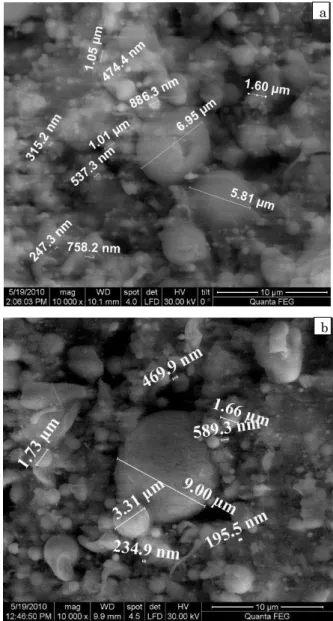
Fig. 2– The powder obtained EED alloy: a) VK8 b) T15K6
a
b
a
E.V. A
GEEVA,
E.V. A
GEEV,
A.S. O
SMININAJ.
N
ANO-
E
LECTRON.
P
HYS.
5
, 04038 (2013)
04038-2
the formation of the discharge channel 7. Due to the
high concentration of heat, the material at the point of
discharge plans becomes 8 and evaporates the liquid to
evaporate and surrounds the discharge channel gaseous
decomposition products 9. As a result, developing in the
discharge channel and the decomposition products of
significant fluid dynamic forces droplets of molten
mate-rial 4 ejected outside the discharge zone to the working
fluid, ambient electrodes and solidify therein, forming a
drop-like carbide particles (Fig. 2).
The widespread use of the method for processing
EDE ramsoderzhaschih tungsten carbide powders in
order to re-use is constrained by the lack of a scientific
and technical literature, full of information on the
ef-fect of the initial composition , temperature regimes
and obtain the properties of the powders, and the
prac-tical application of the technology . Therefore, to
devel-op recycling technologies powders produced from waste
tungsten carbide, and evaluate the effectiveness of
their use requires a comprehensive theoretical and
ex-perimental research.
In experimental studies found:
1. Investigated the structure and properties of
pow-ders produced from waste carbide VK8, T15K6 into
oxygen and carbonaceous-containing fluids. Found that
increased viscosity and boiling fluid powder particle
size decreases. The quantity of high-temperature phase
-WC powder increases. It is shown that the dispersion
of an oxygen-containing fluid leading to loss of carbon
but in the powder until obtaining phase W
2C and W,
and dispersing of liquid in the carbonaceous reducing
carbon loss and contributes to the formation of phases
-WC, TiC.
2. Found that the powders obtained from waste
ramsoderzhaschih tungsten carbide have a particle size
of 3 nm to 50 microns. It is noted that in the particle
size distribution of the resulting powder EDE , the
most significant influence regimes we dispersion
(volt-age, capacitance and frequency of the pulse ) and the
properties of the working fluid.
3. Chemical and X-ray microanalysis It was found
that the chemical composition of powders depends on
the working fluid and is independent of the electrical
parameters of the process of EED . It was determined
that the obtained powders have distorted ITATION
crystal lattice and consist of the following phases:
–
For liquid oxygen: VK8 - W, W
2C; T15K6 - W,
W
2C, TiC. It should be noted that in the case of
pow-ders, a small amount of the phase α
-WC;
–
For carbon-containing liquid: VK8 -
-WC,
-WC;
T15K6 -
-WC,
-WC, TiC.
The work done on the subject of the grant of the
President
of
the
Russian
Federation
No MK
-1765.2013.8.
REFERENCES
1. B.R. Lazarenko, N.I. Lazarenko, (Moscow: Publishing House of the USSR Academy of Sciences, 1) (1957). 2. B.R. Lazarenko, N.I. Lazarenko, (Gosenergoizdat) (1944). 3. B.R. Lazarenko, N.I. Lazarenko, A. p. 70000 USSR, 22f,
09/00 Method for Producing Powders and Device for its Implementation – No 1371/321510; appl. 01.04.1943, publ. 23.09.1964, Bull. Number 22.-2.
4. V.F. Boiko, S.V. Nikolenko, M.I. Dvornik, Powder Metall.
Met. C+ 45 No11-12, 620 (2006).
5. V.F. Boiko, S.V. Nikolenko, Powder Metall. Met. C+ 46 No5-6, 261 (2007).
6. V.L. Butukhanov, T.B. Ershova, E.V. Khromtsova, Theor.
Found. Chem. En+ 42 No5, 699 (2008).
7. H.E. Davis, Powder Met. 3 (1990).
8. M.I. Dvornik, Int. J. Refract. Met. H. 28 No4, 523 (2010). 9. M.I. Dvornik, A.D. Verkhoturov, Powder Metall. Met. C+
47 No7-8, 486 (2008).