ACPD
13, 12743–12770, 2013Particle partitioning
potential of organic
compounds
A. G. Carlton and B. J. Turpin
Title Page
Abstract Introduction
Conclusions References
Tables Figures
◭ ◮
◭ ◮
Back Close
Full Screen / Esc
Printer-friendly Version
Interactive Discussion
Discussion
P
a
per
|
Dis
cussion
P
a
per
|
Discussion
P
a
per
|
Discussio
n
P
a
per
|
Atmos. Chem. Phys. Discuss., 13, 12743–12770, 2013 www.atmos-chem-phys-discuss.net/13/12743/2013/ doi:10.5194/acpd-13-12743-2013
© Author(s) 2013. CC Attribution 3.0 License.
Atmospheric
Chemistry
and Physics
Open Access
Discussions
Geoscientiic Geoscientiic
Geoscientiic
Geoscientiic
This discussion paper is/has been under review for the journal Atmospheric Chemistry and Physics (ACP). Please refer to the corresponding final paper in ACP if available.
Particle partitioning potential of organic
compounds is highest in the Eastern US
and driven by anthropogenic water
A. G. Carlton and B. J. Turpin
Dept. of Environmental Sciences, Rutgers University, New Brunswick, NJ 08901, USA
Received: 19 April 2013 – Accepted: 1 May 2013 – Published: 14 May 2013
Correspondence to: A. G. Carlton ([email protected])
ACPD
13, 12743–12770, 2013Particle partitioning
potential of organic
compounds
A. G. Carlton and B. J. Turpin
Title Page
Abstract Introduction
Conclusions References
Tables Figures
◭ ◮
◭ ◮
Back Close
Full Screen / Esc
Printer-friendly Version
Interactive Discussion
Discussion
P
a
per
|
Dis
cussion
P
a
per
|
Discussion
P
a
per
|
Discussio
n
P
a
per
|
Abstract
Gas phase water-soluble organic matter (WSOM
g) is ubiquitous in the troposphere.
In the summertime, the potential for these gases to partition to particle phase liquid
water (H
2O
ptcl) where they can form secondary organic aerosol (SOA
AQ) is high in the
Eastern US and low elsewhere, with the exception of an area near Los Angeles, CA.
5
This spatial pattern is driven by mass concentrations of H
2O
ptcl, not WSOM
g. H
2O
ptclmass concentrations are predicted to be high in the Eastern US, largely due to sulfate.
The ability of sulfate to increase H
2O
ptclis well-established and routinely included in
atmospheric models, however WSOM
gpartitioning to this water and subsequent SOA
formation is not. The high mass concentrations of H
2O
ptclin the southeast (SE) US but
10
not the Amazon, may help explain why biogenic SOA mass concentrations are high in
the SE US, but low in the Amazon. Furthermore, during the summertime in the
East-ern US, the potential for organic gases to partition into liquid water is greater than their
potential to partition into organic matter (OM) because concentrations of WSOM
gand
H
2O
ptclare higher than semi-volatile gases and OM. Thus, unless condensed phase
15yields are substantially di
ff
erent (
>
∼
order of magnitude), we expect that SOA formed
through aqueous phase pathways (SOA
AQ) will dominate in the Eastern US. These
findings also suggest that H
2O
ptclis largely anthropogenic and provide a previously
un-recognized mechanism by which anthropogenic pollutants impact the amount of SOA
mass formed from biogenic organic emissions. The previously reported estimate of the
20
controllable fraction of biogenic SOA in the Eastern US (50 %) is likely too low.
1
Introduction
Liquid water is the most abundant particle phase species in the atmosphere, 2–3 times
total aerosol dry mass globally (Liao and Seinfeld, 2005). Yet, chemical mechanisms
employed in atmospheric photochemical models largely under-represent the impact of
25
ACPD
13, 12743–12770, 2013Particle partitioning
potential of organic
compounds
A. G. Carlton and B. J. Turpin
Title Page
Abstract Introduction
Conclusions References
Tables Figures
◭ ◮
◭ ◮
Back Close
Full Screen / Esc
Printer-friendly Version
Interactive Discussion
Discussion
P
a
per
|
Dis
cussion
P
a
per
|
Discussion
P
a
per
|
Discussio
n
P
a
per
|
This hinders development of e
ff
ective strategies for air quality management and climate
mitigation because important processes, feedbacks and anthropogenic influences are
missing from model predictions.
Formation of SOA through partitioning of semivolatile products of gas-phase
pho-tochemical reactions into preexisting particulate OM (SOA
gas) is well established. For
5more than twenty years empirical relationships developed from relatively dry SOA smog
chamber studies conducted with little particle phase liquid water (e.g., relative humidity
(RH)
<
20 %, Gri
ffi
n et al., 1999; Ng et al., 2007), have provided critical data for
atmo-spheric modeling of organic aerosol (Pankow, 1994; Odum et al., 1996; Seinfeld and
Pankow, 2003). However, extending these relationships beyond the chamber studies
10
from which they are developed remains problematic (Chang et al., 2010), possibly in
part because derived empirical formulations do not include the potential for polar
or-ganic gases to partition to polar solvents such as water and react in that medium. Parikh
et al., find that when an Odum 2-product or volatility basis set (VBS) SOA model is
ap-plied to independent smog chamber studies where relative humidity (RH) and particle
15
phase liquid water concentrations (H
2O
ptcl) are more typical of general atmospheric
conditions, SOA parameterizations cannot reproduce observed amounts or trends in
SOA mass (Parikh et al., 2011, 2012). In a series of experiments conducted in an
out-door chamber, accounting for gas phase formation of water-soluble gases followed by
partitioning into aerosol water was necessary to accurately describe observed SOA
20
mass (Parikh et al., 2011, 2012). It is important to note available H
2O
ptclis not only
a function of RH, but also of particle concentration and hygroscopicity (Zhou et al.,
2011). Measurement of RH alone is not su
ffi
cient to determine H
2O
ptcl.
Gas phase photochemistry oxidizes and fragments biogenic and anthropogenic
VOCs resulting in the ubiquitous and abundant presence of small, water-soluble
25
organic compounds (e.g., formic and acetic acids, glyoxal, methylglyoxal, acetone)
(Spaulding et al., 2003). These compounds are too small to form SOA through
tradi-tional semi-volatile partitioning theory in atmospheric models (e.g., SOA
gas). However,
ACPD
13, 12743–12770, 2013Particle partitioning
potential of organic
compounds
A. G. Carlton and B. J. Turpin
Title Page
Abstract Introduction
Conclusions References
Tables Figures
◭ ◮
◭ ◮
Back Close
Full Screen / Esc
Printer-friendly Version
Interactive Discussion
Discussion
P
a
per
|
Dis
cussion
P
a
per
|
Discussion
P
a
per
|
Discussio
n
P
a
per
|
fogs and wet aerosols) to form SOA (Blando and Turpin, 2000; Ervens et al., 2011;
Liu et al., 2012). Evidence for SOA formation from gas followed by aqueous chemistry
(SOA
AQ) is provided by laboratory experiments conducted at concentrations typical of
atmospheric waters (e.g., with OH radicals and other reactants) that demonstrate
for-mation of compounds found predominantly in the particle phase in the atmosphere:
5
organic acids/salts (e.g., oxalate), high molecular weight compounds (HMWC)
includ-ing oligomers, and sulfur- and nitrogen-containinclud-ing organics (Carlton et al., 2006, 2007;
Altieri et al., 2006, 2008; Guzman et al., 2006; Noziere and Cordova, 2008; Volkamer
et al., 2009; Galloway et al., 2009; Shapiro et al., 2009; De Haan et al., 2009a,b; El
Haddad et al., 2009; Perri et al., 2009, 2010; Liu et al., 2009, 2012b,c; Noziere et al.,
10
2009, 2010; Yasmeen et al., 2010; Tan et al., 2010, 2012; Sun et al., 2010; Sareen
et al., 2010; Grgic et al., 2010; Poulain et al., 2010; Zhang et al., 2010; Huang et al.,
2011; Lee et al., 2011; Ortiz-Montalvo et al., 2012; Zarzana et al., 2012; Nguyen et al.,
2012).
The analysis herein suggests that, as is the case for SOA
gas(Lane et al., 2008;
15Carlton et al., 2010b), anthropogenic pollution enhances the formation of biogenic
SOA
AQ. We propose that this anthropogenic enhancement of biogenic SOA
AQoccurs
because sulfur pollution increases the amount of H
2O
ptclat a given relative humidity
(RH) (Malm et al., 1994). In many locations including the Eastern US, SOA is
predomi-nantly formed from biogenic hydrocarbons (Lewis et al., 2004; Kleindienst et al., 2007;
20
Ding et al., 2008). However, correlations between biogenic SOA mass and tracers of
anthropogenic pollution are strong suggesting that anthropogenic pollution plays an
important role in biogenic SOA formation (De Gouw and Jimenez, 2009). In fact
an-thropogenic aerosol water could potentially drive biogenic SOA formation in high RH
locations by providing the partitioning medium (H
2O
ptcl) for SOA
AQformation. There is
25ACPD
13, 12743–12770, 2013Particle partitioning
potential of organic
compounds
A. G. Carlton and B. J. Turpin
Title Page
Abstract Introduction
Conclusions References
Tables Figures
◭ ◮
◭ ◮
Back Close
Full Screen / Esc
Printer-friendly Version
Interactive Discussion
Discussion
P
a
per
|
Dis
cussion
P
a
per
|
Discussion
P
a
per
|
Discussio
n
P
a
per
|
Eastern US (Carlton et al., 2010b). While anthropogenic H
2O
ptclwas estimated in those
simulations, WSOM
gpartitioning and subsequent SOA
AQformation in wet aerosol was
not included, thus the 50 % estimate is likely too low.
To explore potential drivers of spatial di
ff
erences in observed SOA mass, we use
a 3-D photochemical transport model to predict mixing ratios of gas phase organic
5
compounds and mass concentrations of particulate species. We use these predictions
to evaluate spatial trends in the overall solubility of organic gas-phase inventories,
par-ticle phase concentrations of liquid water (H
2O
ptcl), and particulate OM. We use these
predictions to estimate the chemical potential of organic gases to partition into liquid
water. We also compare this potential (qualitatively) to the partitioning of semi-volatile
10
organic gases into OM.
2
Methods
Version 4.7 of the Community Multiscale Air Quality (CMAQ) (www.cmascenter.org)
model is applied to predict the photochemistry and transport of atmospheric trace
species over the continental US for July 2003. Observational estimates during this time
15
period indicate that secondary organic carbon is a substantial fraction of total particle
carbon mass (Kleindienst et al., 2007).
2.1
CMAQ model simulations
CMAQ simulation details and inputs are described in detail elsewhere (Carlton et al.,
2010b). Briefly, CMAQv4.7, with SOA formation (Carlton et al., 2010a) and aqueous
20
phase chemistry of sulfur, glyoxal and methylglyoxal in clouds (Carlton et al., 2008)
is applied. The MM5 meteorology model, EPA’s 2002 National Emissions Inventory
(NEIv2) and the Biogenic Emission Inventory System (BEIS) (Pierce et al., 1998) are
used to drive transport and develop anthropogenic and biogenic emissions, projected
hourly for input to CMAQ with SMOKE (Houyoux et al., 2000). The SAPRC99 gas
ACPD
13, 12743–12770, 2013Particle partitioning
potential of organic
compounds
A. G. Carlton and B. J. Turpin
Title Page
Abstract Introduction
Conclusions References
Tables Figures
◭ ◮
◭ ◮
Back Close
Full Screen / Esc
Printer-friendly Version
Interactive Discussion
Discussion
P
a
per
|
Dis
cussion
P
a
per
|
Discussion
P
a
per
|
Discussio
n
P
a
per
|
phase chemical mechanism was used to simulate gas phase photochemistry. The
model domain is resolved horizontally with 36 km
×
36 km grid cells and vertically up
to 100 mb with 14 vertical layers, with most resolution near the surface. Presented
re-sults are averages for July 2003. Aerosol free acidity is calculated in nmol m
−3from
CMAQ predictions of Aiken and accumulation mode aerosol as:
5
H
+=
1000
"
2
SO
42−
96
+
NO
3−62
+
Cl
−35
−
Na
+23
−
NH
+418
#
(1)
The
ion
mass
concentrations
are
calculated
from
the
following
CMAQ
species: SO
4=
ASO4I
+
ASO4J; NO
3=
ANO3I
+
ANO3J; Cl
=
ACLJ; Na
=
ANAJ;
NH
4=
ANH4I
+
ANH4J.
2.2
Water soluble and semi-volatile gases
10
Organic gases listed in Table 1 are simulated in the CMAQ model when SAPRC is
employed. Mixing ratios of each species are converted from ppb
Vto ppb
vC and mass
concentrations are calculated in µg m
−3using the ideal gas law and MM5 predicted
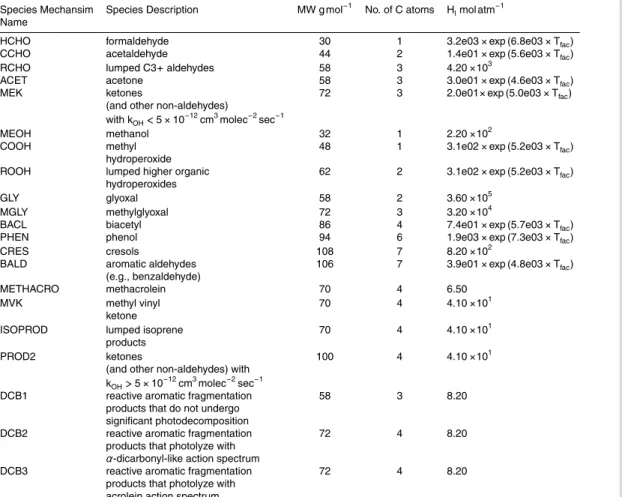
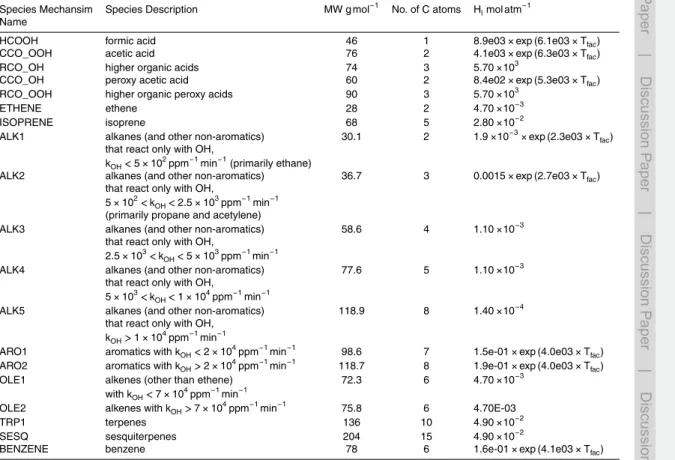
air density. For the purposes of this work, WSOM
gis calculated as the sum of water
soluble gases simulated by CMAQ and shown in laboratory experiments to make SOA
15
through aqueous phase processes at concentrations typical of wet aerosol: glyoxal
(Carlton et al., 2007), methylglyoxal (Tan et al., 2010), acetaldehyde (Li et al., 2011),
methacrolein (El Haddad et al., 2009), phenols (Sun et al., 2010), acetone (Poulain
et al., 2010), acetic acid (Tan et al., 2012) and glycolaldehyde (Perri et al., 2010).
Gly-colaldehyde is not an explicit species in SAPRC99 and is counted as half of model
20
species “RCHO”. It should be recognized that this summation is a lower bound
esti-mate of WSOM
gwith the potential to form SOA
AQ. Formaldehyde, an abundant water
soluble gas, forms particle phase hydroxymethansulfonate in the presence of sulfur
through aqueous phase processes (Munger et al., 1984), but is not counted here. Only
half of model species “RCHO” (C3 aldehydes and higher) was counted in the sum,
ACPD
13, 12743–12770, 2013Particle partitioning
potential of organic
compounds
A. G. Carlton and B. J. Turpin
Title Page
Abstract Introduction
Conclusions References
Tables Figures
◭ ◮
◭ ◮
Back Close
Full Screen / Esc
Printer-friendly Version
Interactive Discussion
Discussion
P
a
per
|
Dis
cussion
P
a
per
|
Discussion
P
a
per
|
Discussio
n
P
a
per
|
but the uncounted RCHO mass will also likely form SOA
AQto some degree similar
to aldehydes that are considered (glyoxal, methylglyoxal, glyocolaldehyde). The
semi-volatile gas phase species are the 1st and 2nd products from isoprene, monoterpenes,
sesquiterpenes, benzene, long chain alkanes, toluenes and xylenes that form SOA in
CMAQ (Carlton et al., 2010a) through semi-volatile partitioning (Odum et al., 1996)
5
(SOA
gas).
2.3
Methylglyoxal equivalent solubility
In order to account for the combined e
ff
ects of compound specific water solubility and
concentration, a solubility index for describing organic gas concentrations was adopted.
Methylglyoxal is used as a reference compound because, as an oxidation product of
10
both biogenic and anthropogenic hydrocarbons (Paulson and Seinfeld, 1992; Smith
et al., 1999; Atkinson and Arey, 2003; Ham et al., 2006), it is found widely in urban
and rural environments (Spaulding et al., 1999, 2003; Moortgat et al., 2002; Wang
et al., 2002; Li and Yu, 2005; Ho et al., 2006). In this method, analogous to the
propy-lene equivalent concentration used in reactivity calculations (Chameides et al., 1992),
15
a methylglyoxal equivalent concentration is calculated for each organic species J in the
SAPRC99 mechanism using values in Table 1.
MGLY
equiv(J)
=
[C
J]
H
L,JH
L,MGLY(2)
Where C
Jis the concentration of organic species J, H
L,Jis the Henry’s Law constant
for species J and H
L,MGLYis the Henry’s Law Constant for methylglyoxal. Henry’s Law
20constants are adjusted to hour specific model-predicted temperature when appropriate
(Table 1). MGLY
equivis the concentration of species J on a scale normalized to the
solubility of methylglyoxal. MGLY
equivis the gas phase mass concentration of
methyl-glyoxal needed to generate an equal amount of partitionable (gas-to-aqueous) organic
mass of species J. The concentration is calculated in µg m
−3to investigate trends and
ACPD
13, 12743–12770, 2013Particle partitioning
potential of organic
compounds
A. G. Carlton and B. J. Turpin
Title Page
Abstract Introduction
Conclusions References
Tables Figures
◭ ◮
◭ ◮
Back Close
Full Screen / Esc
Printer-friendly Version
Interactive Discussion
Discussion
P
a
per
|
Dis
cussion
P
a
per
|
Discussion
P
a
per
|
Discussio
n
P
a
per
|
patterns in gas phase water-soluble organic matter (WSOM
g). In this context, if gas
phase organic species J has an atmospheric abundance of 10 µg m
−3and is twice as
soluble as methylglyoal, it would have a MGLY
equivconcentration of 20 µg m
−3; if the
species was half as soluble as methylglyoxal, it would have a MGLY
equivconcentration
of 5 µg m
−3. Because this solubility-based method accounts for a species’ solubility as
5
well as its atmospheric concentration, it provides an estimate of the relative
contribu-tion each organic species can make to the flux of gas phase organic matter to aerosol
water. It also provides a framework to compare spatial di
ff
erences in the overall gas
phase organic solubility for a particular inventory.
2.4
Instantaneous aqueous partitioning potential
10
The overall potential for organic gas-to-liquid water partitioning is dependent not only
on the concentration and water solubility of organic gases, but also the spatial and
tem-poral colocation (or not) of liquid water. In this work we consider only particle phase
liquid water (H
2O
ptcl). The mass concentration of H
2O
ptclis predicted in CMAQ with
ISORROPIA from water vapor mixing ratios and concentrations of inorganic species.
15
In ISORROPIA, partitioning of inorganic species and atmospheric water between the
gas- and aerosol-phase is calculated using relative humidity and molality of an aqueous
binary solution of species containing sulfate, nitrate, chlorine, sodium and ammonium
(Nenes et al., 1999). The partitioning potential of WSOM
gto liquid water is
calcu-lated with a thermodynamic equilibrium assumption as is done for gas-phase organic
20
species that partition to OM (Pankow, 1994). The potential is calculated here:
P
WSOMP
(J)
=
[C
J][C
H2O]
H
JH
MGLYΦ
J=
MGLY
equiv[C
H2O]
Φ
J(3)
where C
Jis the concentration of organic species J (µg m
− 3), C
H2Ois the liquid
wa-ter concentration (H
2O
ptcl) (µg m
− 3).
Φ
Jis referred to as the SOA
AQ-forming
poten-tial, analogous to incremental reactivity in ozone studies (Chameides et al., 1992).
Φ
JACPD
13, 12743–12770, 2013Particle partitioning
potential of organic
compounds
A. G. Carlton and B. J. Turpin
Title Page
Abstract Introduction
Conclusions References
Tables Figures
◭ ◮
◭ ◮
Back Close
Full Screen / Esc
Printer-friendly Version
Interactive Discussion
Discussion
P
a
per
|
Dis
cussion
P
a
per
|
Discussion
P
a
per
|
Discussio
n
P
a
per
|
represents the likelihood organic mass will remain in the condensed phase after
parti-tioning, for example by being transformed into low volatility products.
Φ
Jdepends on
a variety of factors including the presence of other species/reactants (e.g., OH radicals,
NH
3) and local meteorology (e.g., temperature and RH). Values of
Φ
Jare not currently
known and are likely not constant. Here a value of 1 is assigned to all species. This
5
assumption is not correct and represents a non-trivial limitation of the framework, but
regardless, the partitioning potential is useful as an index that identifies areas where
SOA
AQis likely to be important. In assessing this partitioning potential, the relative
importance of one organic species to another will depend not only upon the relative
concentrations of the compound in the MGLY
equivindex, but also the liquid water
con-10
tent of the air mass. For this reason, a highly soluble species with a large concentration
will not necessarily be an important precursor if not colocated with H
2O
ptclin space and
time.
2.5
Limitiations
There are uncertainties when calculating partitioning potentials and comparing
path-15
ways. First, the degree to which CMAQ accurately represents particle phase liquid
water mass is not well understood. CMAQ might underpredict H
2O
ptclbecause
ISOR-ROPIA, the thermodynamic partitioning model implemented in CMAQ and employed to
predict particle phase liquid water, includes only inorganic species. In laboratory
stud-ies, organic compounds ubiquitous in the troposphere (methylglyoxal and
acetalde-20
hyde) increase particle hygroscopicity (Sareen et al., 2013) and particle phase organic
material is reported to contribute to H
2O
ptclin several locations (Dick et al., 2000;
Canepari et al., 2013). Second, it is well established that CMAQv4.7 underpredicts
secondary organic aerosol mass (Carlton et al., 2010a; Carlton and Baker, 2011). The
uncertainties in H
2O
ptcl, OM, WSOM
gand semi-volatile gas phase species constitute
25the major limitations of this assessment.
ACPD
13, 12743–12770, 2013Particle partitioning
potential of organic
compounds
A. G. Carlton and B. J. Turpin
Title Page
Abstract Introduction
Conclusions References
Tables Figures
◭ ◮
◭ ◮
Back Close
Full Screen / Esc
Printer-friendly Version
Interactive Discussion
Discussion
P
a
per
|
Dis
cussion
P
a
per
|
Discussion
P
a
per
|
Discussio
n
P
a
per
|
Henry‘s Law constants are predictors of organic gas-to-aqueous partitioning and
there-fore useful in a “partitioning potential” calculation. The assumption
Φ
J=
1 for all organic
species is not correct. Appropriate values for
Φ
are not well understood. The results
herein provide a framework to identify species, locations and times where SOA
AQfor-mation is likely to be important and further investigation is warranted.
5
3
Results
3.1
Ubiquity of water-soluble organic gases
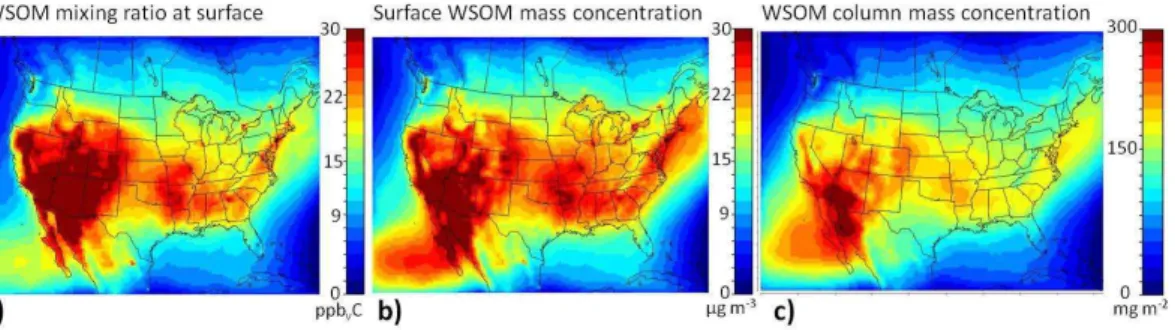
In the summertime, throughout the troposphere over the continental US water-soluble
organic gases, demonstrated to form SOA in laboratory experiments through
aque-ous phase chemistry, are ubiquitaque-ous (Fig. 1). This finding is consistent with a
vari-10
ety of ambient measurements that indicate WSOM
gis abundant (Chebbi and Carlier,
1996; Nolte et al., 1999; Hennigan et al., 2009). At the surface, mass concentrations
of WSOM
gin MGLY
equivare high throughout the US, typically
>
20 µg m
−3
(Fig. 2).
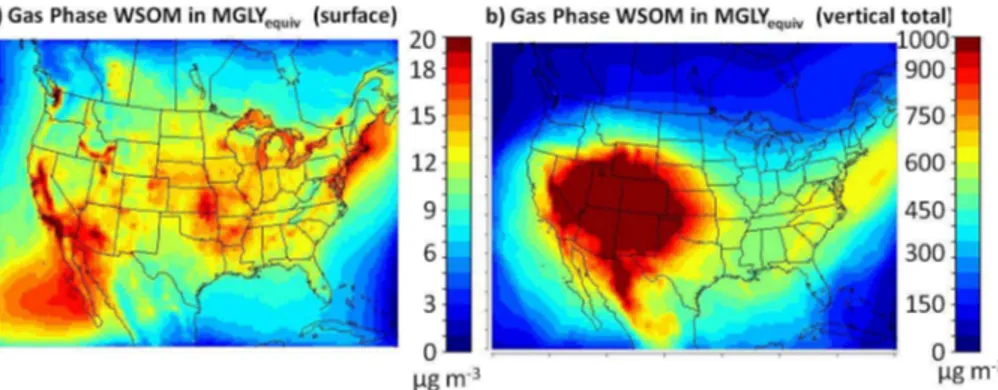
MGLY
equivconcentrations suggest organic gas phase inventories are soluble
through-out the US (Fig. 2a). When the entire model column is considered (up to 100 mb), mass
15
concentrations of WSOM in MGLY
equivare ubiquitously large (typically
>
500 µg m
− 2)
and greatest in the Western US (
>
1 mg m
−2) (Fig. 2b). Tropospheric gas phase
or-ganic inventories over the continental US are highly water soluble, whether evaluated
in mixing ratios, mass concentrations or MGLY
equiv.
3.2
WSOM aqueous partitioning potential is high in the Eastern US
20
ACPD
13, 12743–12770, 2013Particle partitioning
potential of organic
compounds
A. G. Carlton and B. J. Turpin
Title Page
Abstract Introduction
Conclusions References
Tables Figures
◭ ◮
◭ ◮
Back Close
Full Screen / Esc
Printer-friendly Version
Interactive Discussion
Discussion
P
a
per
|
Dis
cussion
P
a
per
|
Discussion
P
a
per
|
Discussio
n
P
a
per
|
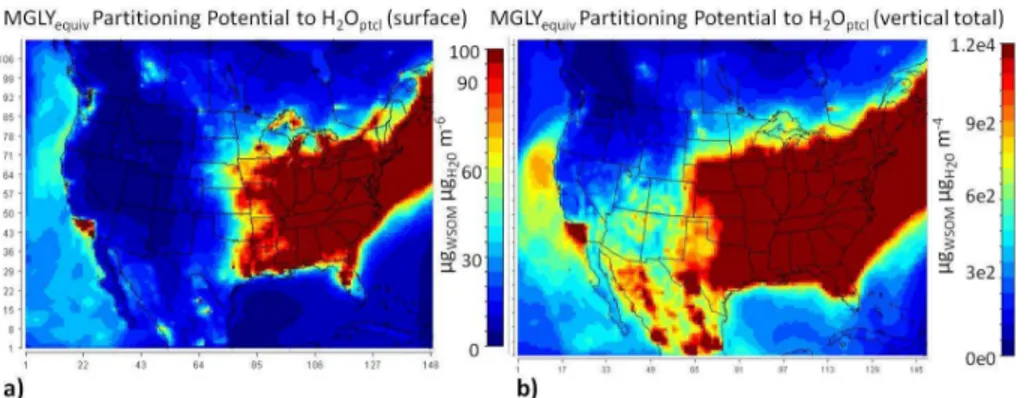
gas concentrations (WSOM
g, MGLY
equiv), this “liquid water partitioning potential” is not
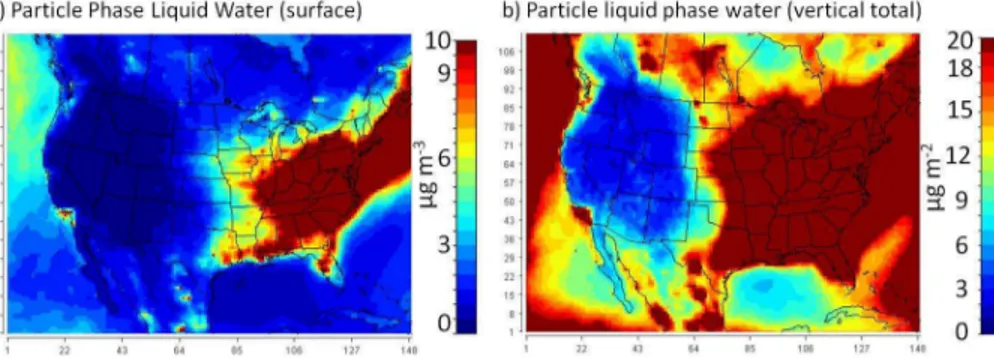
spatially ubiquitous. This phenomenon is explained by spatial patterns in H
2O
ptclmass
concentrations (Fig. 4). The abundance of H
2O
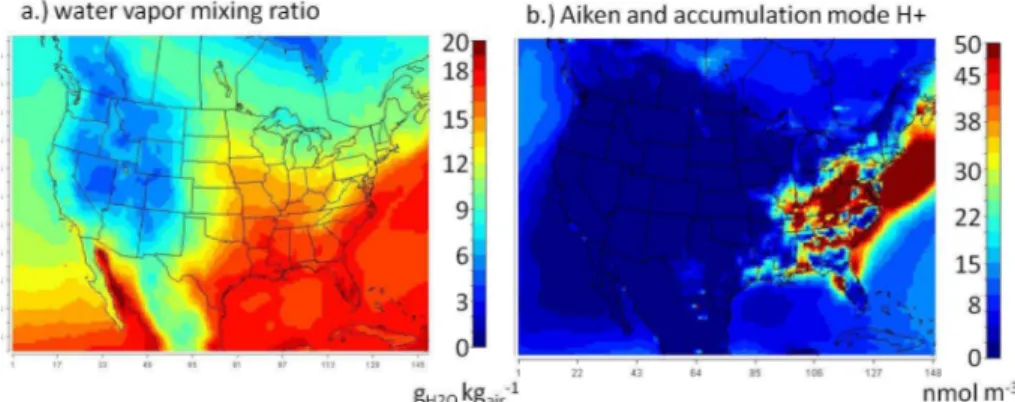
ptclis a function of the mixing ratio of
water vapor in the atmosphere and the concentration and hygroscopicity of the aerosol.
Water vapor mixing ratios are highest in the Eastern US, as are aerosol free acidity
5
concentrations (Fig. 5). The abundance of aerosol free acidity in the Eastern US is
influenced to a large degree by anthropogenic SO
2emissions and the subsequent
sulfate aerosol mass concentrations (see Supplement). In these simulations, particle
phase acidity and the resulting H
2O uptake are anthropogenic in surface air over the
continental US.
10
The simulated increase in partitioning potential when liquid water is available is
con-sistent with ambient observations. Hennigan et al. and Sorooshian et al., find that when
liquid water is available, there is increased partitioning of gas phase water-soluble
organic compounds with increasing sub-saturated relative humidity (Hennigan et al.,
2008, 2009; Sorooshian et al., 2010). Gas phase WSOM partitioning also increases
15
with increasing aerosol hygroscopicity (Sorooshian et al., 2010). This work suggests
that because gas phase WSOM is ubiquitous and H
2O
ptclis not, the availability of
par-ticle phase liquid water caused by anthropogenic influences, is the limiting factor in
SOA
AQformation over the continental US.
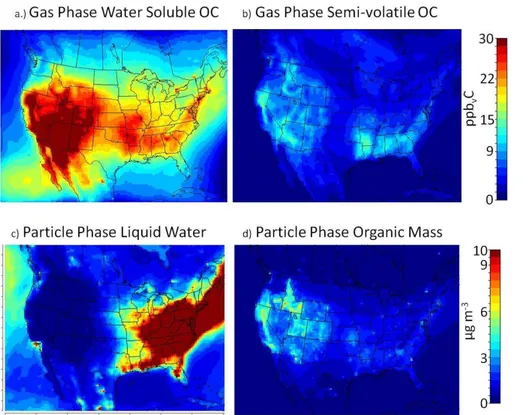
CMAQ-estimated polar, water-soluble gases are more abundant than semi-volatile
20
organic gases and particle phase liquid water is more abundant than dry organic
aerosol mass in the summertime over the US. In many locations, in particular the
East-ern US, the chemical potential for aqueous partitioning (water soluble gases to particle
liquid water) appears to be greater than the potential for semi-volatile gases to
parti-tion to dry OM (Fig. 6). And it seems that the overall geographic distribuparti-tion of SOA
gas 25ACPD
13, 12743–12770, 2013Particle partitioning
potential of organic
compounds
A. G. Carlton and B. J. Turpin
Title Page
Abstract Introduction
Conclusions References
Tables Figures
◭ ◮
◭ ◮
Back Close
Full Screen / Esc
Printer-friendly Version
Interactive Discussion
Discussion
P
a
per
|
Dis
cussion
P
a
per
|
Discussion
P
a
per
|
Discussio
n
P
a
per
|
3.3
Biogenic SOA is controllable
Insights gained from this work lead us to hypothesize that biogenic SOA is abundant in
the Southeastern US (Kleindienst et al., 2007, 2010; Lewandowski et al., 2007;
Henni-gan et al., 2008, 2009) but low in the Amazon (Pöschl et al., 2010) because H
2O
ptclcon-centrations are high (and anthropogenic) in the SE US but low in the Amazon. Global
5
predictions of H
2O
ptclby Liao and Seinfeld (2005) support this idea. This work
sug-gests SO
2pollution contributes to biogenic SOA mass concentrations in the Eastern
US through mechanisms not currently accounted for in atmospheric models. Carlton
et al. (2010b) previously estimated that anthropogenic pollution accounts for
approxi-mately half of biogenic SOA (SOA formed from biogenic hydrocarbons) in the Eastern
10
US. The framework herein identifies another mechanism by which anthropogenic
pol-lution can facilitate “biogenic” SOA production, and suggests that previous estimates
of the controllable fraction of biogenic SOA are too low.
Supplementary material related to this article is available online at:
http://www.atmos-chem-phys-discuss.net/13/12743/2013/
15
acpd-13-12743-2013-supplement.pdf.
Acknowledgements. This work was funded, in part by the US EPA STAR program (grant
num-ber 83504101) and the US NSF (grant AGS-1052611).
References
Altieri, K. E., Carlton, A. G., Turpin, B. J., and Seitzinger, S.: Formation of Oligomers in cloud-20
processing: reactions of isoprene oxidation products, Environ. Sci. Technol., 40, 4956–4960, 2006.
ACPD
13, 12743–12770, 2013Particle partitioning
potential of organic
compounds
A. G. Carlton and B. J. Turpin
Title Page
Abstract Introduction
Conclusions References
Tables Figures
◭ ◮
◭ ◮
Back Close
Full Screen / Esc
Printer-friendly Version
Interactive Discussion
Discussion
P
a
per
|
Dis
cussion
P
a
per
|
Discussion
P
a
per
|
Discussio
n
P
a
per
|
composition, properties, and mechanisms investigated by ultra-high resolution FT-ICR mass spectrometry, Atmos. Environ., 42, 1476–1490, 2008.
Atkinson, R. and Arey, J.: Atmospheric degradation of volatile organic compounds, Chem. Rev., 103, 4605–4638, 2003.
Blando, J. D. and Turpin, B. J.: Secondary organic aerosol formation in cloud and fog droplets: 5
a literature evaluation of plausibility, Atmos. Environ., 34, 1623–1632, 2000.
Canepari, S., Farao, C., Marconi, E., Giovannelli, C., and Perrino, C.: Qualitative and quanti-tative determination of water in airborne particulate matter, Atmos. Chem. Phys., 13, 1193– 1202, doi:10.5194/acp-13-1193-2013, 2013.
Carlton, A. G. and Baker, K.: Photochemical modeling of the Ozark isoprene volcano: MEGAN, 10
BEIS and their impacts on air quality predictions, Environ. Sci. Technol., 45, 4438–4445, 2011.
Carlton, A. G., Lim, H.-J., Altieri, K., Seitinger, S., and Turpin, B. J.: Link between Isoprene and SOA: fate of pyruvic acid in dilute aqueous solution, Geophys. Res. Lett., 33, L06822, doi:10.1029/2005GL025374, 2006.
15
Carlton, A. G., Turpin, B. J., Altieri, K. E., Reff, A., Seitzinger, S., Lim, H. J., and Ervens, B.: Atmospheric oxalic acid and SOA production from glyoxal: results of aqueous photooxidation experiments, Atmos. Environ., 41, 7588–7602, 2007.
Carlton, A. G., Turpin, B. J., Altieri, K. E., Seitzinger, S. P., Mathur, R., Roselle, S. J., and We-ber, R. J.: CMAQ model performance enhanced when in-cloud SOA is included: comparisons 20
of OC predictions with measurements, Environ. Sci. Technol., 42, 8798–8802, 2008.
Carlton, A. G., Bhave, P. V., Napelenok, S. L., Edney, E. O., Sarwar, G., Pinder, R. W., Pouliot, G. A., and Houyoux, M.: Treatment of secondary organic aerosol in CMAQv4.7, Environ. Sci. Technol., 44, 8553–8560, 2010a.
Carlton, A. G., Pinder, R. W., Bhave, P. V., and Pouliot, G. A.: To what extent can biogenic SOA 25
be controlled?, Environ. Sci. Technol., 44, 3376–3380, 2010b.
Chameides, W. L., Fehsenfeld, F., Rodgers, M. O., Cardelino, C., Martinez, J., Parrish, D., Lon-neman, W., Lawson, D. R., Rasmussen, R. A., Zimmerman, P., Greenberg, J., Middleton, P., and Wang, T.: Ozone precursor relationships in the ambient atmosphere, J. Geophys. Res.-Atmos., 97, 6037–6055, 1992.
30
ACPD
13, 12743–12770, 2013Particle partitioning
potential of organic
compounds
A. G. Carlton and B. J. Turpin
Title Page
Abstract Introduction
Conclusions References
Tables Figures
◭ ◮
◭ ◮
Back Close
Full Screen / Esc
Printer-friendly Version
Interactive Discussion
Discussion
P
a
per
|
Dis
cussion
P
a
per
|
Discussion
P
a
per
|
Discussio
n
P
a
per
|
and quantification of isoprene-derived epoxydiols in ambient aerosol in the Southeastern United States, Environ. Sci. Technol., 44, 4590–4596, 2010.
Chang, W. L., Griffin, R. J., and Dabdub, D.: Partitioning phase preference for secondary or-ganic aerosol in an urban atmosphere, P. Natl. Acad. Sci. USA, 107, 6705–6710, 2010. Chebbi, A. and Carlier, P.: Carboxylic acids in the troposphere, occurrence, sources, and sinks: 5
a review, Atmos. Environ., 30, 4233–4249, 1996.
De Gouw, J. and Jimenez, J. L.: Organic aerosols in the Earth’s atmosphere, Environ. Sci. Technol., 43, 7614–7618, 2009.
De Haan, D. O., Corrigan, A. L., Smith, K. W., Stroik, D. R., Turley, J. J., Lee, F. E., Tolbert, M. A., Jimenez, J. L., Cordova, K. E., and Ferrell, G. R.: Secondary organic aerosol-forming reac-10
tions of glyoxal with amino acids, Environ. Sci. Technol., 43, 2818–2824, 2009a.
De Haan, D. O., Tolbert, M. A., and Jimenez, J. L.: Atmospheric condensed-phase reactions of glyoxal with methylamine, Geophys. Res. Lett., 36, L11819, doi:10.1029/2009gl037441, 2009b.
Dick, W. D., Saxena, P., and McMurry, P. H.: Estimation of water uptake by organic compounds 15
in submicron aerosols measured during the Southeastern Aerosol and Visibility Study, J. Geophys. Res.-Atmos., 105, 1471–1479, 2000.
Ding, X., Zheng, M., Yu, L. P., Zhang, X. L., Weber, R. J., Yan, B., Russell, A. G., Edgerton, E. S., and Wang, X. M.: Spatial and seasonal trends in biogenic secondary organic aerosol tracers and water-soluble organic carbon in the Southeastern United States, Environ. Sci. Technol., 20
42, 5171–5176, 2008.
El Haddad, I., Liu, Y., Nieto-Gligorovski, L., Michaud, V., Temime-Roussel, B., Quivet, E., Marc-hand, N., Sellegri, K., and Monod, A.: In-cloud processes of methacrolein under simulated conditions – Part 2: Formation of secondary organic aerosol, Atmos. Chem. Phys., 9, 5107– 5117, doi:10.5194/acp-9-5107-2009, 2009.
25
Ervens, B., Turpin, B. J., and Weber, R. J.: Secondary organic aerosol formation in cloud droplets and aqueous particles (aqSOA): a review of laboratory, field and model studies, Atmos. Chem. Phys., 11, 11069–11102, doi:10.5194/acp-11-11069-2011, 2011.
Galloway, M. M., Chhabra, P. S., Chan, A. W. H., Surratt, J. D., Flagan, R. C., Seinfeld, J. H., and Keutsch, F. N.: Glyoxal uptake on ammonium sulphate seed aerosol: reaction products and 30
ACPD
13, 12743–12770, 2013Particle partitioning
potential of organic
compounds
A. G. Carlton and B. J. Turpin
Title Page
Abstract Introduction
Conclusions References
Tables Figures
◭ ◮
◭ ◮
Back Close
Full Screen / Esc
Printer-friendly Version
Interactive Discussion
Discussion
P
a
per
|
Dis
cussion
P
a
per
|
Discussion
P
a
per
|
Discussio
n
P
a
per
|
Grgic, I., Nieto-Gligorovski, L. I., Net, S., Temime-Roussel, B., Gligorovski, S., and Wortham, H.: Light induced multiphase chemistry of gas-phase ozone on aqueous pyruvic and oxalic acids, Phys. Chem. Chem. Phys., 12, 698–707, 2010.
Griffin, R. J., Cocker, D. R., Flagan, R. C., and Seinfeld, J. H.: Organic aerosol formation from the oxidation of biogenic hydrocarbons, J. Geophys. Res.-Atmos., 104, 3555–3567, 1999. 5
Guzman, M. I., Colussi, A. I., and Hoffmann, M. R.: Photoinduced oligomerization of aqueous pyruvic acid, J. Phys. Chem. A, 110, 3619–3626, 2006.
Ham, J. E., Proper, S. P., and Wells, J. R.: Gas-phase chemistry of citronellol with ozone and OH radical: rate constants and products, Atmos. Environ., 40, 726–735, 2006.
Hatch, L. E., Creamean, J. M., Ault, A. P., Surratt, J. D., Chan, M. N., Seinfeld, J. H., Edger-10
ton, E. S., Su, Y., and Prather, K. A.: Measurements of isoprene-derived organosulfates in ambient aerosols by aerosol Time-of-Flight Mass Spectrometry – Part 2: Temporal variability and formation mechanisms, Environ. Sci. Technol., 45, 8648–8655, 2011.
Hennigan, C. J., Bergin, M. H., Dibb, J. E., and Weber, R. J.: Enhanced secondary organic aerosol formation due to water uptake by fine particles, Geophys. Res. Lett., 35, L18801, 15
doi:10.1029/2008gl035046, 2008.
Hennigan, C. J., Bergin, M. H., Russell, A. G., Nenes, A., and Weber, R. J.: Gas/particle par-titioning of water-soluble organic aerosol in Atlanta, Atmos. Chem. Phys., 9, 3613–3628, doi:10.5194/acp-9-3613-2009, 2009.
Ho, K. F., Lee, S. C., Cao, J. J., Kawamura, K., Watanabe, T., Cheng, Y., and Chow, J. C.: 20
Dicarboxylic acids, ketocarboxylic acids and dicarbonyls in the urban roadside area of Hong Kong, Atmos. Environ., 40, 3030–3040, 2006.
Houyoux, M. R., Vukovich, J. M., Coats, C. J., Wheeler, N. J. M., and Kasibhatla, P. S.: Emis-sion inventory development and processing for the Seasonal Model for Regional Air Quality (SMRAQ) project, J. Geophys. Res.-Atmos., 105, 9079–9090, 2000.
25
Huang, D., Zhang, X., Chen, Z. M., Zhao, Y., and Shen, X. L.: The kinetics and mechanism of an aqueous phase isoprene reaction with hydroxyl radical, Atmos. Chem. Phys., 11, 7399– 7415, doi:10.5194/acp-11-7399-2011, 2011.
Kleindienst, T. E., Jaoui, M., Lewandowski, M., Offenberg, J. H., Lewis, C. W., Bhave, P. V., and Edney, E. O.: Estimates of the contributions of biogenic and anthropogenic hydrocarbons to 30
ACPD
13, 12743–12770, 2013Particle partitioning
potential of organic
compounds
A. G. Carlton and B. J. Turpin
Title Page
Abstract Introduction
Conclusions References
Tables Figures
◭ ◮
◭ ◮
Back Close
Full Screen / Esc
Printer-friendly Version
Interactive Discussion
Discussion
P
a
per
|
Dis
cussion
P
a
per
|
Discussion
P
a
per
|
Discussio
n
P
a
per
|
Kleindienst, T. E., Lewandowski, M., Offenberg, J. H., Edney, E. O., Jaoui, M., Zheng, M., Ding, X. A., and Edgerton, E. S.: Contribution of primary and secondary sources to organic aerosol and PM2.5at SEARCH Network Sites, J. Air Waste Manage., 60, 1388–1399, 2010. Kroll, J. H., Ng, N. L., Murphy, S. M., Varutbangkul, V., Flagan, R. C., and Seinfeld, J. H.:
Chamber studies of secondary organic aerosol growth by reactive uptake of simple carbonyl 5
compounds, J. Geophys. Res., 110, D23207, doi:10.1029/2005jd006004, 2005.
Lane, T. E., Donahue, N. M., and Pandis, S. N.: Effect of NOx on secondary organic aerosol concentrations, Environ. Sci. Technol., 42, 6022–6027, 2008.
Lee, A. K. Y., Herckes, P., Leaitch, W. R., Macdonald, A. M., and Abbatt, J. P. D.: Aqueous OH oxidation of ambient organic aerosol and cloud water organics: formation of highly oxidized 10
products, Geophys. Res. Lett., 38, L11805, doi:10.1029/2011gl047439, 2011.
Lewandowski, M., Jaoui, M., Kleindienst, T. E., Offenberg, J. H., and Edney, E. O.: Composition
of PM2.5 during the summer of 2003 in Research Triangle Park, North Carolina, Atmos. Environ., 41, 4073–4083, 2007.
Lewis, C. W., Klouda, G. A., and Ellenson, W. D.: Radiocarbon measurement of the biogenic 15
contribution to summertime PM2.5 ambient aerosol in Nashville, TN, Atmos. Environ., 38, 6053–6061, 2004.
Li, Y. C. and Yu, J. Z.: Simultaneous determination of mono- and dicarboxylic acids, omega-oxo-carboxylic acids, midchain ketocarboxylic acids, and aldehydes in atmospheric aerosol samples, Environ. Sci. Technol., 39, 7616–7624, 2005.
20
Li, Z., Schwier, A. N., Sareen, N., and McNeill, V. F.: Reactive processing of formaldehyde and acetaldehyde in aqueous aerosol mimics: surface tension depression and secondary organic products, Atmos. Chem. Phys., 11, 11617–11629, doi:10.5194/acp-11-11617-2011, 2011. Liao, H. and Seinfeld, J. H.: Global impacts of gas-phase chemistry-aerosol interactions on
di-rect radiative forcing by anthropogenic aerosols and ozone, J. Geophys. Res., 110, D18208, 25
doi:10.1029/2005jd005907, 2005.
Liu, J. F., Horowitz, L. W., Fan, S. M., Carlton, A. G., and Levy, H.: Global in-cloud pro-duction of secondary organic aerosols: Implementation of a detailed chemical mecha-nism in the GFDL atmospheric model AM3, J. Geophys. Res.-Atmos., 117, D15303, doi:10.1029/2012jd017838, 2012.
30
ACPD
13, 12743–12770, 2013Particle partitioning
potential of organic
compounds
A. G. Carlton and B. J. Turpin
Title Page
Abstract Introduction
Conclusions References
Tables Figures
◭ ◮
◭ ◮
Back Close
Full Screen / Esc
Printer-friendly Version
Interactive Discussion
Discussion
P
a
per
|
Dis
cussion
P
a
per
|
Discussion
P
a
per
|
Discussio
n
P
a
per
|
simulated conditions – Part 1: Aqueous phase photooxidation, Atmos. Chem. Phys., 9, 5093– 5105, doi:10.5194/acp-9-5093-2009, 2009.
Liu, Y., Monod, A., Tritscher, T., Praplan, A. P., DeCarlo, P. F., Temime-Roussel, B., Quivet, E., Marchand, N., Dommen, J., and Baltensperger, U.: Aqueous phase processing of secondary organic aerosol from isoprene photooxidation, Atmos. Chem. Phys., 12, 5879–5895, doi:10. 5
5194/acp-12-5879-2012, 2012a.
Liu, Y., Siekmann, F., Renard, P., El Zein, A., Salque, G., El Haddad, I., Temime-Roussel, B., Voisin, D., Thissen, R., and Monod, A.: Oligomer and SOA formation through aqueous phase photooxidation of methacrolein and methyl vinyl ketone, Atmos. Environ., 49, 123– 129, 2012b.
10
Malm, W. C., Sisler, J. F., Huffman, D., Eldred, R. A., and Cahill, T. A.: Spatial and seasonal
trends in particle concentration and optical extinction in the United States, J. Geophys. Res., 99, 1347–1370, 1994.
Moortgat, G. K., Grossmann, D., Boddenberg, A., Dallmann, G., Ligon, A. P., Turner, W. V., Gab, S., Slemr, F., Wieprecht, W., Acker, K., Kibler, M., Schlomski, S., and Bachmann, K.: 15
Hydrogen peroxide, organic peroxides and higher carbonyl compounds determined during the BERLIOZ campaign, J. Atmos. Chem., 42, 443–463, 2002.
Munger, J. W., Jacob, D. J., and Hoffmann, M. R.: The occurrence of bisulfite-aldehyde addition products in fog- and cloud-water, J. Atmos. Chem., 1, 335–350, 1984.
Nenes, A., Pandis, S. N., and Pilinis, C.: Continued development and testing of a new ther-20
modynamic aerosol module for urban and regional air quality models, Atmos. Environ., 33, 1553–1560, 1999.
Ng, N. L., Kroll, J. H., Chan, A. W. H., Chhabra, P. S., Flagan, R. C., and Seinfeld, J. H.: Secondary organic aerosol formation from m-xylene, toluene, and benzene, Atmos. Chem. Phys., 7, 3909–3922, doi:10.5194/acp-7-3909-2007, 2007.
25
Nguyen, T. B., Lee, P. B., Updyke, K. M., Bones, D. L., Laskin, J., Laskin, A., and Nizko-rodov, S. A.: Formation of nitrogen- and sulfur-containing light-absorbing compounds ac-celerated by evaporation of water from secondary organic aerosols, J. Geophys. Res., 117, D01207, doi:10.1029/2011jd016944, 2012.
Nolte, C. G., Fraser, M. P., and Cass, G. R.: Gas phase C2−C10 organic acids concentrations 30
ACPD
13, 12743–12770, 2013Particle partitioning
potential of organic
compounds
A. G. Carlton and B. J. Turpin
Title Page
Abstract Introduction
Conclusions References
Tables Figures
◭ ◮
◭ ◮
Back Close
Full Screen / Esc
Printer-friendly Version
Interactive Discussion
Discussion
P
a
per
|
Dis
cussion
P
a
per
|
Discussion
P
a
per
|
Discussio
n
P
a
per
|
Noziere, B. and Cordova, A.: A kinetic and mechanistic study of the amino acid catalyzed aldol condensation of acetaldehyde in aqueous and salt solutions, J. Phys. Chem. A, 112, 2827– 2837, 2008.
Noziere, B., Dziedzic, P., and Cordova, A.: Products and kinetics of the liquid-phase reaction of glyoxal catalyzed by ammonium ions (NH+4), J. Phys. Chem. A, 113, 231–237, 2009.
5
Noziere, B., Ekstrom, S., Alsberg, T., and Holmstrom, S.: Radical-initiated formation of organosulfates and surfactants in atmospheric aerosols, Geophys. Res. Lett., 37, L05806, doi:10.1029/2009gl041683, 2010.
Odum, J. R., Hoffmann, T., Bowman, F., Collins, D., Flagan, R. C., and Seinfeld, J. H.: Gas/particle partitioning and secondary organic aerosol yields, Environ. Sci. Technol., 30, 10
2580–2585, 1996.
Ortiz-Montalvo, D. L., Lim, Y. B., Perri, M. J., Seitzinger, S. P., and Turpin, B. J.: Volatility and yield of glycolaldehyde SOA formed through aqueous photochemistry and droplet evapora-tion, Aerosol Sci. Tech., 46, 1002–1014, 2012.
Pankow, J. F.: An absorption model of the gas/aerosol partitioning involved in the formation of 15
secondary organic aerosol, Atmos. Environ., 28, 189–193, 1994.
Parikh, H. M., Carlton, A. G., Vizuete, W., and Kamens, R. M.: Modeling secondary organic aerosol using a dynamic partitioning approach incorporating particle aqueous-phase chem-istry, Atmos. Environ., 45, 1126–1137, 2011.
Parikh, H. M., Carlton, A. G., Zhou, Y., Zhang, H., Kamens, R. M., and Vizueter, W.: Modeling 20
secondary organic aerosol formation from xylene and aromatic mixtures using a dynamic partitioning approach incorporating particle aqueous-phase chemistry (II), Atmos. Environ., 56, 250–260, 2012.
Paulson, S. E. and Seinfeld, J. H.: Development and evaluation of a photooxidation mechanism for isoprene, J. Geophys. Res., 97, 20703–720715, 1992.
25
Perri, M. J., Seitzinger, S., and Turpin, B. J.: Secondary organic aerosol production from aque-ous photooxidation of glycolaldehyde: laboratory experiments, Atmos. Environ., 43, 1487– 1497, 2009.
Perri, M. J., Lim, Y. B., Seitzinger, S. P., and Turpin, B. J.: Organosulfates from glycolaldehyde in aqueous aerosols and clouds: laboratory studies, Atmos. Environ., 44, 2658–2664, 2010. 30
ACPD
13, 12743–12770, 2013Particle partitioning
potential of organic
compounds
A. G. Carlton and B. J. Turpin
Title Page
Abstract Introduction
Conclusions References
Tables Figures
◭ ◮
◭ ◮
Back Close
Full Screen / Esc
Printer-friendly Version
Interactive Discussion
Discussion
P
a
per
|
Dis
cussion
P
a
per
|
Discussion
P
a
per
|
Discussio
n
P
a
per
|
Pöschl, U., Martin, S. T., Sinha, B., Chen, Q., Gunthe, S. S., Huffman, J. A., Borrmann, S., Farmer, D. K., Garland, R. M., Helas, G., Jimenez, J. L., King, S. M., Manzi, A., Mikhailov, E., Pauliquevis, T., Petters, M. D., Prenni, A. J., Roldin, P., Rose, D., Schneider, J., Su, H., Zorn, S. R., Artaxo, P., and Andreae, M. O.: Rainforest aerosols as biogenic nuclei of clouds and precipitation in the Amazon, Science, 329, 1513–1516, doi:10.1126/science.1191056, 5
2010.
Poulain, L., Katrib, Y., Isikli, E., Liu, Y., Wortham, H., Mirabel, P., Le Calve, S., and Monod, A.: In-cloud multiphase behaviour of acetone in the troposphere: gas uptake, Henry‘s law equi-librium and aqueous phase photooxidation, Chemosphere, 81, 312–320, 2010.
Sareen, N., Schwier, A. N., Shapiro, E. L., Mitroo, D., and McNeill, V. F.: Secondary organic 10
material formed by methylglyoxal in aqueous aerosol mimics, Atmos. Chem. Phys., 10, 997– 1016, doi:10.5194/acp-10-997-2010, 2010.
Sareen, N., Schwier, A. N., Lathem, T. L., Nenes, A., and McNeill, V. F.: Surfactants from the gas phase may promote cloud droplet formation, P. Natl. Acad. Sci. USA, 110, 2723–2728, 2013.
15
Seinfeld, J. H. and Pankow, J. F.: Organic atmospheric particulate material, Annu. Rev. Phys. Chem., 54, 121–140, 2003.
Shapiro, E. L., Szprengiel, J., Sareen, N., Jen, C. N., Giordano, M. R., and McNeill, V. F.: Light-absorbing secondary organic material formed by glyoxal in aqueous aerosol mimics, Atmos. Chem. Phys., 9, 2289–2300, doi:10.5194/acp-9-2289-2009, 2009.
20
Smith, D. F., Kleindienst, T. E., and McIver, C. D.: Primary product distributions from the reaction of OH with m-, p-xylene, 1,2,4- and 1,3,5-trimethylbenzene, J. Atmos. Chem., 34, 339–364, 1999.
Sorooshian, A., Murphy, S. M., Hersey, S., Bahreini, R., Jonsson, H., Flagan, R. C., and Se-infeld, J. H.: Constraining the contribution of organic acids and AMSm/z44 to the organic 25
aerosol budget: on the importance of meteorology, aerosol hygroscopicity, and region, Geo-phys. Res. Lett., 37, L21807, doi:10.1029/2010gl044951, 2010.
Spaulding, R. S., Frazey, P., Rao, X., and Charles, M. J.: Measurement of hydroxy carbonyls and other carbonyls in ambient air using pentafluorobenzyl alcohol as a chemical ionization reagent, Anal. Chem., 71, 3420–3427, 1999.
30
ACPD
13, 12743–12770, 2013Particle partitioning
potential of organic
compounds
A. G. Carlton and B. J. Turpin
Title Page
Abstract Introduction
Conclusions References
Tables Figures
◭ ◮
◭ ◮
Back Close
Full Screen / Esc
Printer-friendly Version
Interactive Discussion
Discussion
P
a
per
|
Dis
cussion
P
a
per
|
Discussion
P
a
per
|
Discussio
n
P
a
per
|
Sun, Y. L., Zhang, Q., Anastasio, C., and Sun, J.: Insights into secondary organic aerosol formed via aqueous-phase reactions of phenolic compounds based on high resolution mass spectrometry, Atmos. Chem. Phys., 10, 4809–4822, doi:10.5194/acp-10-4809-2010, 2010. Tan, Y., Carlton, A. G., Seitzinger, S. P., and Turpin, B. J.: SOA from methylglyoxal in clouds and
wet aerosols: measurement and prediction of key products, Atmos. Environ., 44, 5218–5226, 5
2010.
Tan, Y., Lim, Y. B., Altieri, K. E., Seitzinger, S. P., and Turpin, B. J.: Mechanisms leading to oligomers and SOA through aqueous photooxidation: insights from OH radical oxidation of acetic acid and methylglyoxal, Atmos. Chem. Phys., 12, 801–813, doi:10.5194/acp-12-801-2012, 2012.
10
Volkamer, R., Ziemann, P. J., and Molina, M. J.: Secondary Organic Aerosol Formation from Acetylene (C2H2): seed effect on SOA yields due to organic photochemistry in the aerosol
aqueous phase, Atmos. Chem. Phys., 9, 1907–1928, doi:10.5194/acp-9-1907-2009, 2009. Wang, G. H., Niu, S. L., Liu, C., and Wang, L. S.: Identification of dicarboxylic acids and
alde-hyde of PM10and PM2.5aerosols in Nanjing, China, Atmos. Environ., 36, 1941–1950, 2002. 15
Yasmeen, F., Sauret, N., Gal, J. F., Maria, P. C., Massi, L., Maenhaut, W., and Claeys, M.: Char-acterization of oligomers from methylglyoxal under dark conditions: a pathway to produce secondary organic aerosol through cloud processing during nighttime, Atmos. Chem. Phys., 10, 3803–3812, doi:10.5194/acp-10-3803-2010, 2010.
Zarzana, K. J., De Haan, D. O., Freedman, M. A., Hasenkopf, C. A., and Tolbert, M. A.: Op-20
tical properties of the products of alpha-dicarbonyl and amine reactions in simulated cloud droplets, Environ. Sci. Technol., 46, 4845–4851, 2012.
Zhang, X., Chen, Z. M., and Zhao, Y.: Laboratory simulation for the aqueous OH-oxidation of methyl vinyl ketone and methacrolein: significance to the in-cloud SOA production, Atmos. Chem. Phys., 10, 9551–9561, doi:10.5194/acp-10-9551-2010, 2010.
25
ACPD
13, 12743–12770, 2013Particle partitioning
potential of organic
compounds
A. G. Carlton and B. J. Turpin
Title Page
Abstract Introduction
Conclusions References
Tables Figures
◭ ◮
◭ ◮
Back Close
Full Screen / Esc
Printer-friendly Version
Interactive Discussion
Discussion
P
a
per
|
Dis
cussion
P
a
per
|
Discussion
P
a
per
|
Discussio
n
P
a
per
|
Table 1.Values used in MGLYequivcalculations for gas phase organic species in the SAPRC99 gas phase chemical mechanism as applied in CMAQv4.7.
Species Mechansim Species Description MW g mol−1
No. of C atoms Hlmol atm− 1
Name
HCHO formaldehyde 30 1 3.2e03×exp (6.8e03×Tfac) CCHO acetaldehyde 44 2 1.4e01×exp (5.6e03×Tfac) RCHO lumped C3+aldehydes 58 3 4.20×10³
ACET acetone 58 3 3.0e01×exp (4.6e03×Tfac) MEK ketones 72 3 2.0e01×exp (5.0e03×Tfac)
(and other non-aldehydes)
with kOH<5×10⁻¹²cm3molec−2sec−1
MEOH methanol 32 1 2.20×10²
COOH methyl 48 1 3.1e02×exp (5.2e03×Tfac) hydroperoxide
ROOH lumped higher organic 62 2 3.1e02×exp (5.2e03×Tfac) hydroperoxides
GLY glyoxal 58 2 3.60×10⁵
MGLY methylglyoxal 72 3 3.20×10⁴
BACL biacetyl 86 4 7.4e01×exp (5.7e03×Tfac) PHEN phenol 94 6 1.9e03×exp (7.3e03×Tfac)
CRES cresols 108 7 8.20×10²
BALD aromatic aldehydes 106 7 3.9e01×exp (4.8e03×Tfac) (e.g., benzaldehyde)
METHACRO methacrolein 70 4 6.50
MVK methyl vinyl 70 4 4.10×101
ketone
ISOPROD lumped isoprene 70 4 4.10×101
products
PROD2 ketones 100 4 4.10×101
(and other non-aldehydes) with kOH>5×10−
12
cm3molec−2 sec−1
DCB1 reactive aromatic fragmentation 58 3 8.20 products that do not undergo
significant photodecomposition
DCB2 reactive aromatic fragmentation 72 4 8.20 products that photolyze with
α-dicarbonyl-like action spectrum
DCB3 reactive aromatic fragmentation 72 4 8.20 products that photolyze with
ACPD
13, 12743–12770, 2013Particle partitioning
potential of organic
compounds
A. G. Carlton and B. J. Turpin
Title Page
Abstract Introduction
Conclusions References
Tables Figures
◭ ◮
◭ ◮
Back Close
Full Screen / Esc
Printer-friendly Version
Interactive Discussion
Discussion
P
a
per
|
Dis
cussion
P
a
per
|
Discussion
P
a
per
|
Discussio
n
P
a
per
|
Table 1.Continued.
Species Mechansim Species Description MW g mol−1
No. of C atoms Hlmol atm− 1
Name
HCOOH formic acid 46 1 8.9e03×exp (6.1e03×Tfac) CCO_OOH acetic acid 76 2 4.1e03×exp (6.3e03×Tfac) RCO_OH higher organic acids 74 3 5.70×10³
CCO_OH peroxy acetic acid 60 2 8.4e02×exp (5.3e03×Tfac) RCO_OOH higher organic peroxy acids 90 3 5.70×10³
ETHENE ethene 28 2 4.70×10⁻³
ISOPRENE isoprene 68 5 2.80×10⁻²
ALK1 alkanes (and other non-aromatics) 30.1 2 1.9×10⁻³×exp (2.3e03×Tfac) that react only with OH,
kOH<5×10²ppm−1min−1(primarily ethane)
ALK2 alkanes (and other non-aromatics) 36.7 3 0.0015×exp (2.7e03×Tfac) that react only with OH,
5×10²<kOH<2.5×10³ppm−1min−1
(primarily propane and acetylene)
ALK3 alkanes (and other non-aromatics) 58.6 4 1.10×10⁻³
that react only with OH, 2.5×10³<kOH<5×10 3
ppm−1 min−1
ALK4 alkanes (and other non-aromatics) 77.6 5 1.10×10⁻³
that react only with OH,
5×10³<kOH<1×10⁴ppm−1min−1
ALK5 alkanes (and other non-aromatics) 118.9 8 1.40×10⁻⁴ that react only with OH,
kOH>1×10⁴ppm−1min−1
ARO1 aromatics with kOH<2×10⁴ppm−1 min−1
98.6 7 1.5e-01×exp (4.0e03×Tfac) ARO2 aromatics with kOH>2×10
4 ppm−1
min−1
118.7 8 1.9e-01×exp (4.0e03×Tfac) OLE1 alkenes (other than ethene) 72.3 6 4.70×10⁻³
with kOH<7×10⁴ppm−1min−1
OLE2 alkenes with kOH>7×10⁴ppm−1min−1 75.8 6 4.70E-03
TRP1 terpenes 136 10 4.90×10⁻²
SESQ sesquiterpenes 204 15 4.90×10⁻²
BENZENE benzene 78 6 1.6e-01×exp (4.1e03×Tfac)
ACPD
13, 12743–12770, 2013Particle partitioning
potential of organic
compounds
A. G. Carlton and B. J. Turpin
Title Page
Abstract Introduction
Conclusions References
Tables Figures
◭ ◮
◭ ◮
Back Close
Full Screen / Esc
Printer-friendly Version
Interactive Discussion
Discussion
P
a
per
|
Dis
cussion
P
a
per
|
Discussion
P
a
per
|
Discussio
n
P
a
per
|
ACPD
13, 12743–12770, 2013Particle partitioning
potential of organic
compounds
A. G. Carlton and B. J. Turpin
Title Page
Abstract Introduction
Conclusions References
Tables Figures
◭ ◮
◭ ◮
Back Close
Full Screen / Esc
Printer-friendly Version
Interactive Discussion
Discussion
P
a
per
|
Dis
cussion
P
a
per
|
Discussion
P
a
per
|
Discussio
n
P
a
per
|
ACPD
13, 12743–12770, 2013Particle partitioning
potential of organic
compounds
A. G. Carlton and B. J. Turpin
Title Page
Abstract Introduction
Conclusions References
Tables Figures
◭ ◮
◭ ◮
Back Close
Full Screen / Esc
Printer-friendly Version
Interactive Discussion
Discussion
P
a
per
|
Dis
cussion
P
a
per
|
Discussion
P
a
per
|
Discussio
n
P
a
per
|
ACPD
13, 12743–12770, 2013Particle partitioning
potential of organic
compounds
A. G. Carlton and B. J. Turpin
Title Page
Abstract Introduction
Conclusions References
Tables Figures
◭ ◮
◭ ◮
Back Close
Full Screen / Esc
Printer-friendly Version
Interactive Discussion
Discussion
P
a
per
|
Dis
cussion
P
a
per
|
Discussion
P
a
per
|
Discussio
n
P
a
per
|
ACPD
13, 12743–12770, 2013Particle partitioning
potential of organic
compounds
A. G. Carlton and B. J. Turpin
Title Page
Abstract Introduction
Conclusions References
Tables Figures
◭ ◮
◭ ◮
Back Close
Full Screen / Esc
Printer-friendly Version
Interactive Discussion
Discussion
P
a
per
|
Dis
cussion
P
a
per
|
Discussion
P
a
per
|
Discussio
n
P
a
per
|
ACPD
13, 12743–12770, 2013Particle partitioning
potential of organic
compounds
A. G. Carlton and B. J. Turpin
Title Page
Abstract Introduction
Conclusions References
Tables Figures
◭ ◮
◭ ◮
Back Close
Full Screen / Esc
Printer-friendly Version
Interactive Discussion
Discussion
P
a
per
|
Dis
cussion
P
a
per
|
Discussion
P
a
per
|
Discussio
n
P
a
per
|