A geometallurgical comparison between lump ore and pellets of
manganese ore
G.L. Faria
a,⁎, J.A.S. Tenório
b, N. Jannotti Jr.
c, F.G. da S. Araújo
daDepartamento de Engenharia Metalúrgica e de Materiais DEMET/UFOP, Campus Universitário Morro do Cruzeiro, Bauxita, Ouro Preto, MG, Brazil bUniversidade de São Paulo/USP, Brazil
cVALE Manganês, Brazil
dRede Temática em Engenharia de Materiais/REDEMAT/UFOP, Brazil
a b s t r a c t
a r t i c l e
i n f o
Article history: Received 6 January 2014
Received in revised form 1 December 2014 Accepted 4 March 2015
Available online 7 March 2015
Keywords: Manganese lump ore Characterization Recycling Pellets Reduction
Manganese lump ores are still the main raw material used in the manufacture of manganese ferroalloys, but the processing of the ore to the beneficiation point generatesfines. So an alternative to be studied is making pellets. This work compares the main geometallurgical characteristics of the lump ore from the Azul Mine and the pellets made fromfines generated during beneficiation of this lump ore on a small scale. The characteristics assessed were: the chemical composition, mineralogical constitution, hot and cold particle disintegration, thermal decom-position and solid state reduction. It can be observed that the pellets contain a greater proportion of manganese oxides than the lump ore and they are also richer in Mn. In the pellets the hot and cold particle disintegration phe-nomena are minimal when compared with those found in lump ore. Lump ore can be efficiently reduced in the solid state, while most of the manganese minerals in the pellets have already been reduced to MnO. The conclu-sion is that manufacturing pellets in order to take advantage of the manganese orefines is a path that must be studied further, since the pellets can be used as a viable source of manganese and act as agents that contribute to the increase in permeability of the charge. But possible reductions in the temperature of the granular zone dur-ing solid state reduction need to be considered.
© 2015 Elsevier B.V. All rights reserved.
1. Introduction
Manganese ferroalloys are mainly produced in electric reduction furnaces and are widely used as elements in steel alloys (Faria, 2011; Olsen et al., 2007; Tangstad et al., 2004).
Manganese lump ores are widely used as raw material for producing manganese ferroalloys. The mixtures of these ores, which come from various mines or even from different mining fronts in the same mine, are usually defined in ferroalloy plants exclusively according to their chemical and granulometric characteristics (Faria, 2011; Olsen et al., 2007; Tangstad et al., 2004; Faria et al., 2013a).
A frequently encountered problem in the mineral processing of limp ore from mines is the significant generation offines that are rich in man-ganese, but whose granulometry is unsuitable for the reduction process in an electric furnace. In this context, this work presents a comparative study of the quality parameters (that are still little studied aspects) of the lump ore from the Azul Mine, which are solid state reduction, cold particle disintegration, granular crepitation and hot particle disintegra-tion, and of manganese ore pellets made on a small scale fromfines
resulting from the processing of lump ore from Azul (Faria, 2011; Yoshikoshi et al., 1983).
The Azul manganese mine is the largest producer of manganese ore in Latin America, with annual production of 2.5 million tons. The ore produced is used mainly for producing ferroalloys and, to a lesser ex-tent, in the chemical and battery industries. This mine is located in the mineral province of Carajás, in the Carajás National Forest, in the State of Pará. The ore extracted from this mine mainly comprises oxides like cryptomelane, in the biggest proportion, and others like magnetite and pyrolusite. Hydroxides, like n-sutite and gibbsite also occur (Faria, 2011; Faria et al., 2013a).
The focus of this research is on the metallurgical properties of the lump ore from Azul and the pellets produced from itsfines in the solid state reduction zone of the electric reduction furnace. This is an impor-tant region in the alloy-making process. By comparing the chemical, mineral and metallurgical characteristics it is intended to evaluate the possibility of making manganese ore pellets as a possible way of taking advantage of thefines generated in the beneficiation process of lump ore.
In the solid state reduction zone of the electric furnace the solid raw materials undergo an increase in temperature as theyflow down. The temperature of the charge in this zone varies between 500 °C and 1100 °C, on average. In this region the water, present in the form of hu-midity, evaporates and the manganese oxides are reduced by the rising
–
⁎ Corresponding author.
E-mail addresses:[email protected](G.L. Faria),[email protected]
(J.A.S. Tenório),[email protected](N. Jannotti),[email protected]
(F.G.S. Araújo).
http://dx.doi.org/10.1016/j.minpro.2015.03.003
0301-7516/© 2015 Elsevier B.V. All rights reserved.
Contents lists available atScienceDirect
International Journal of Mineral Processing
flow of CO. In order for the process involved in this zone to be effective it is important that the permeability of the gasflow is high and homoge-nous throughout the charge (Faria, 2011; Berg and Olsen, 2000; Faria et al., 2012, 2013b).
According toBerg and Olsen (2000)andWang and Sundman (1992)
in addition to the physical integrity of the charge it is important that the reduction of the higher oxides is effective. According to the authors, the main reduction reactions in manganese oxides can be described in the following sequence: in the temperature band between 600 °C and 700 °C there is a significant reduction from MnO2to Mn2O3, with a
loss of mass of the order of 9.2%. Between 900 °C and 1000 °C there is a significant reduction from Mn2O3to Mn3O4, with a loss of mass of
the order of 3.3%. When it reaches temperatures in excess of 1200 °C, which vary depending on the raw material and the type of alloy to be produced, the charge, with the exception of carbon, softens and melts (Faria, 2011; Faria et al., 2010, 2013b; Wang and Sundman, 1992; Zaki et al., 1997).
In this context, this work proposes a physical simulation methodol-ogy of the solid state reduction process under similar conditions to those found in an electric reduction furnace, in order to assess the phys-ical integrity of the lump ore and pellets, as well as their reduction characteristics.
2. Materials and methods
A ton of lump ore from Azul was homogenized, quartered and repre-sentative samples weighing 100 kg were taken from both the overall sample and from the granulometric band containing particle sizes be-tween 9.5 mm and 15.9 mm. Both the overall sample and the sample from the granulometric band chosen were submitted to chemical, phys-ical and mineralogphys-ical characterization procedures. A part of the sample, whose average particle size was between 9.5 mm and 15.9 mm, was set aside for metallurgical tests.
A 100 kg batch of manganese ore pellets (74% in weight, with an av-erage diameter of between 11 mm and 13 mm) made on a small scale fromfines generated in processing the lump ore from Azul was also ho-mogenized and quartered. Representative samples were sent for chem-ical, physchem-ical, mineralogical and metallurgical testing.
The Mn, Fe,CaO, MgO, SiO2, Al2O3, TiO2and P concentrations were
determined. The concentrations of Mn and SiO2were determined by
ti-tration and the other components by ICP-OES (inductively coupled plas-ma optical emission spectrometry).
The main mineral constituents in the sample studied were quantita-tively determined. The results were obtained by a combination of tech-niques involving optical microscopy, X-ray diffractometry, the total powder method, an electronic microprobe coupled to a scanning
electron microscope, thermogravimetry and mass scales. The physical properties assessed were density (apparent and structural) and the po-rosity parameters.
Once the samples had been characterized, methodologies were pro-posed for the metallurgical characterization of the materials that are the focus of this work. Over and above the chemical, physical and mineral-ogical characteristics, the experimental methods allowed for a compar-ison of the thermal decomposition behaviors to air, solid state reduction and particle disintegration.
Thefirst experimental methodology allowed for a comparison of the thermal decomposition and solid state reduction of the materials. The studies of thermal decomposition and the solid state reduction effi cien-cy were undertaken by submitting samples to heating, from room tem-perature to as much as 1000 °C, at a constant rate of 25 °C/min. The time it stayed at this temperature was 1 h. The assays were carried out in a vertical resistance furnace, with a thermobalance. For the thermal de-composition tests the atmosphere used was fresh air. For the solid state reduction efficiency tests, however, an atmosphere comprising 5 NL/min of 100% N2was used during heating, while different outputs
of 99.5% CO and 0.5% N2(2 Nl/min, 5 Nl/min and 15 Nl/min) were
used during the isotherm test.
By the chemical analysis and X-ray diffractometry of the assay prod-ucts, as well as the mass losses observed during heating, the tempera-tures at the beginning of decomposition of the less stable phases were determined, as were the fractions in thefinal sample structure of each product resulting from the decomposition and reduction. Each assay was carried out twice.
A quantitative index was proposed for assessing the mechanical be-havior of the materials when cold; their resistance to impact and abra-sion. This index was defined as the Cold Disintegration Index (CDI) (Faria, 2011). The ore sample from the granulometric band between 9.5 mm and 15.9 mm was dried and then tumbled (for 30 min, in three 10-minute spells) in an ISO9246-1 and ISO9246-2 certified rotat-ing tumbler. The percentages in mass of material produced below the 9.5 mm, 6.3 mm, 3.3 mm, 5 mm, 1.18 mm, 0.6 mm and 0.150 mm meshes provided the CDIs. The pellets were submitted to the same methodology, but the average size band of the pellets used was between 11 mm and 13 mm.
The aim was to try and assess the mechanical behavior of the mate-rial as itflows down the metallurgical reactor, against a rising jet of gas that is rich in CO, while undergoing heating. A parameter was proposed and defined as the Heating Disintegration Index (HDI) (Faria, 2011). The granulometric band chosen for measuring this index was also located between 9.5 mm and 15.9 mm for the lump ore from Azul and between 11 mm and 13 mm for the pellets. The granulometric bands used for the lump ore and pellets were selected because they were considered opti-mal bands for the operation of the electric furnace.
To determine the HDIs, two amounts of 500 g of material were indi-vidually placed in a retort that was 75 mm in diameter and heated in a
Table 2
Mineralogical constitution of the lump ore from Azul (MG60).
Sample Constituents (% in weight)
KMn8O16 (Cryptomelane)
(Na, Ca, K)2Mn6O12.3a4,5(H2O) (Todorokite) Mn(O,OH)2 (N-Sutite) Al(OH)3 (Gibbsite) MnO2 (Pyrolusite)
Fe3O4 (Magnetite)
Others
MG60 (overall) 33–23 33–23 16–10 13–10 4–2 7–5 8–7
MG60 (−15.9 mm +9.5 mm) 35–25 31–21 16–10 10–7 5–3 6–4 8–7
Table 3
Microstructural constitution of pellets made from lump orefines from Azul.
Sample Constituents (% in weight)
MnO (Manganosite) Mn3O4 (Hausmannite) Fe3O4 (Magnetite) Others
Pellets 64–60 5–3 12–9 25–20
Table 1
A comparison of the chemical composition of lump ore from Azul and pellets.
Sample Mn Fe SiO2 P Al2O3 CaO MgO TiO2
% % % % % % % %
MG60 (overall) 47.68 3.59 3.16 0.097 5.22 0.120 0.180 0.240 MG60 (−15.9 mm +
9.5 mm)
49.10 3.37 2.46 0.100 4.86 0.154 0.100 0.259
Pellets (−13 mm + 11 mm)
50.94 7.53 8.00 0.092 7.80 0.27 0.32 0.43
vertical resistance furnace (ISO-certified for Reduction Disintegration Index (RDI) and reducibility assays of iron ore), from room temperature to 1000 °C, at a constant rate of 25 °C/min, in an atmosphere comprising 100% N2in an ascendingflow (5 Nl/min). When it reached the residence
time temperature theflow of N2was interrupted and the reducing
at-mosphere in an ascendingflow was established (2 Nl/min, 5 Nl/min and 15 Nl/min of 99.5% CO and 0.5% N2). The residence time in this
tem-perature was 1 h. At the end of the residence time theflow of reducing gas was interrupted and the sample was cooled inside the furnace under an ascendingflow of N2(5 Nl/min).
After cooling, the samples underwent granulometric classification in the 9.5 mm, 6.3 mm, 3.35 mm, 1.18 mm, 0.6 mm and 0.150 mm meshes to obtain the particle disintegration indices during heating in a reducing atmosphere without tumbling. Once these indices had been obtained the samples were recomposed and tumbled in a rotary tumbler with a rotation frequency of 30 ± 1 rpm. Tumbling was interrupted after 10 min, 20 min and 30 min of assaying to determine the disintegration indices.
The products of the hot crepitation and particle disintegration tests were characterized by reflected light optical microscopy and water pycnometry.
3. Results and discussion
Table 1shows the chemical analyses overall and by particle band be-tween 9.5 mm and 15.9 mm of the lump ore from Azul. The same table also compares the chemical composition of the pellets made on a small scale from the lump ore from Azul.
The lump ore from Azul (47.7% in the overall sample) and the pellets (50.9%) have a manganese content considered good for the process. The difference in manganese content reaches 3.2%. The lump ore from Azul has a Mn/Fe ratio of 13.3, while that of the pellets is 6.8. The low Mn/Fe ratio found in the pellets is the consequence of a significant concentra-tion of Fe, which is not desirable when making some types of alloy.
The chemical characteristics of the lump ore allow for greater free-dom in the selection and addition of ferriferous charges in the electric furnace. Because of its SiO2(3.2%) and CaO (0.12%) concentrations, its
reduction without additives is likely to generate an acidic slag, with slightly limitedfluidity and reactivity. The chemical characteristics of the pellets may be responsible for an intermediate metal/slag ratio, with the possible formation of an acidic slag that may be formed at lower points in the electric reduction furnace and have limitedfluidity and reactivity.
Table 2shows the mineralogical constitution of the lump ore from Azul and of the pellets. The main carriers of Mn in the mineralogical con-stitution of this lump ore are the oxides of cryptomelane [KMn8O16] and
pyrolusite [MnO2], and the hydroxides of todorokite [(Na, Ca,
K)2Mn6O12·3a4,5(H2O)] and n-sutite [Mn(O,OH)2]. The level of Al is
justified by the presence of gibbsite [Al (OH)3], and the Fe by the
pres-ence of magnetite [Fe3O4]. Because of this constitution the lump ore
from Azul may be typologically classified as microporous, hydrated and oxidized.
The micro-structural constitution of the pellets is shown inTable 3. It can be seen that the main bearer structure of Mn is the oxide, MnO, which has a crystalline structure corresponding to that of the mineral, manganosite (MnO). There is also a small amount of Mn3O4as a bearer
of Mn, which has a crystalline structure corresponding to the mineral,
Table 4
Bulk and structural densities and porosities of the lump ore from Azul (MG60) and of pellets.
Samples MG60
(overall)
MG60 (−15.9 mm + 9.5 mm)
Pellets
Bulk density(g/cm3) 3.55 3.20 3.82
Structural density (g/cm3) 3.98 3.71 4.17
Total porosity (%) 10.9 13.8 8.2
Total porosity (cm3/kg) 30.6 43.1 21.5
Fig. 1.Variation in mass during heating in air, up to 1000 °C.
Fig. 2.Mass loss over time during isothermal treatment at 1000 °C in air.
Fig. 3.Mass losses from samples of lump ore from Azul during solid state reduction at 1000 °C.
hausmannite (Mn3O4). The level of Fe is justified by the presence of
magnetite in the pellet's structure. The chemical difference between the samples is a reflection of the fractions of each constituent in the characterized samples. This high concentration of MnO is due to the fact that the pellets had been sintered at temperatures in excess of 1100 °C with reactive carbon in their constitution, which partially re-duces the higher oxides to MnO. Because of this constitution, the pellets can be classified as macroporous, oxidized, and solid state reduced.
Table 4gives a comparison between the bulk and structural densities and porosities of the samples studied. The pellets have the greatest structural and bulk densities, which are directly related to the fraction of the constituent, MnO, which is associated with the sintering process to which they were submitted. The lump ore from Azul, because it has a high proportion of hydrated and porous mineral phases is more porous.
The methodology described for characterizing the behavior of the thermal decomposition of the materials being studied enabled the var-iation in mass of the samples–caused by temperature, during heating in air from room temperature to 1000 °C–to be determined.Fig. 1shows a comparison between the mass loss profiles during heating andFig. 2
shows them during 1 h of isothermal treatment at 1000 °C.
It can be seen that the variation in mass profiles during heating are completely different. When the lump ore from Azul is being heated to
1000 °C, there is an average mass loss of 11.9%. This loss in mass is asso-ciated with the decomposition of the todorokite, n-sutite, and gibbsite, which are the hydrated minerals that are present, and the oxides of manganese, cryptomelane and pyrolusite.
When the pellets are being heated there was no appreciable varia-tion in mass, but just a small reducvaria-tion that occurs before 200 °C. This can undoubtedly be attributed to the elimination of water from the hu-midity present in the sample holder. This behavior can be justified by the fact that the pellets had already been submitted to a sintering pro-cess at temperatures over 1100 °C when they were being made.
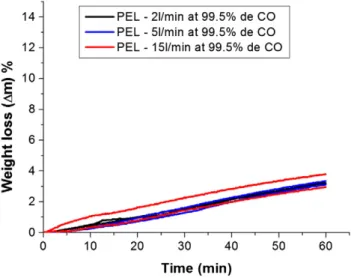
In seeking to assess the solid state reduction behavior of the samples studied they were heated up to 1000 °C and then submitted to different amounts of reducing gas for an hour (99.5% CO and 0.5% N2).Figs. 3 and
4show the mass loss profiles as a function of the isothermal treatment time for the differentflows studied for the lump ore from Azul and for the pellets, respectively.
It can be seen that theflow of reducing gas has a direct influence on the solid state reduction behavior of the lump ore from Azul. The greater theflow of gas, the greater the solid state reduction speed. It is also
Fig. 4.Mass losses from pellet samples during solid state reduction at 1000 °C.
Fig. 5.Cold Particle Disintegration Indices (CDI) of the lump ore from Azul.
Fig. 6.Cold Particle Disintegration Indices (CDI) of the pellets.
Fig. 7.Comparison between the CDIs and HDIs measured in a 6.3 mm mesh sieve for lump ore from Azul.
noted that for the threeflows tested, the total mass losses were very similar, providing evidence that all the reactions were processed, but with different kinetics.
It can also be observed that theflow of reducing gas does not have a significant influence on the solid state reduction of the pellets studied, because they are already in an advanced state of pre-reduction. The small differences between the loss of mass profiles during solid state re-duction may be associated with the different proportions of each phase in each sample.
As for characterization of the particle disintegration of the materials analyzed, thefirst assay was proposed with the objective of assessing cold particle disintegration by way of the CDI, as suggested byFaria (2011).Figs. 5 and 6give thefines generation profiles at room temper-ature of the lump ore from Azul and the pellets, respectively.
For the tumbling conditions studied it can be seen that both the lump ore from Azul and the pellets generate very fewfines, although the pellets behave better in this respect. After 30 minutes of tumbling 2.2% of the lump ore material from Azul passed through the 6.3 mm mesh, while with pellets it was only 0.3%.
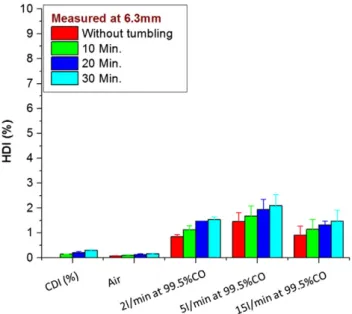
Figs. 7 and 8show a comparison between the CD and Hot Particle Disintegration (HDI) indices, also proposed byFaria (2011), for the lump ore from Azul and for the pellets, respectively. It can be seen that the pellets are more resistant to particle disintegration than the lump ore from Azul under all assay conditions.
It is supposed that the removal of oxygen resulting from the solid state reduction of the samples significantly increases the porosity of the same, thus justifying the increase in the generation offines. In pel-lets this structural damage is presumably less severe, because they are already in an advanced state of pre-reduction after being made.
4. Conclusions
Lump ore from Azul has a 47.7% level of Mn and an Mn/Fe ratio of 13.3. Pellets have a higher concentration of Mn (50,9%), but a lower Mn/Fe ratio (6.8).
Lump ore from Azul is rich in hydrated manganese minerals (todorokite and n-sutite). There is a significant occurrence of manganese
oxides (cryptomelane and pyrolusite) and iron (magnetite). Among others minerals, this ore has a significant amount of gibbsite. Lump ore from Azul may be typologically classified as hydrated, oxidized and mi-croporous. The pellets studied constituted mainly of oxides. The main oxides are MnO and Fe3O4. They may be classified as oxidized,
pre-reduced and macroporous.
Structural water is eliminated from the lump ore from Azul at be-tween 350 °C and 500 °C. The oxides with a higher valence start disintegrating when the temperature reaches 600 °C. There is no signif-icant loss of mass in pellets, indicating that all the phases present are thermodynamically stable under study conditions.
During solid state reduction, the loss of mass of the lump ore from Azul is greater than for pellets. The lump ore proves to be very sensitive to any variation in theflow of reducing gas, while the pellets are not. As the pre-reduction reactions of the manganese oxides are exothermic they will not contribute towards maintaining the thermal profile of the metallurgical reactor if they are used as the only source of Mn in the process.
The pellets and the ore studied resist cold particle disintegration well and generate 0.3% and 2.2% of fines that pass through a 6.3 mm mesh sieve after 30 min of tumbling, respectively.
Pellets undergo less particle disintegration during pre-reduction than lump ore from Azul. While on average the particle product gener-ates between 20% and 25% offines that pass through a 6.3 mm mesh, the pellets generate just 2%.
Manufacturing pellets to take advantage of manganese orefines is a process that should be studied, because pellets can be used as a feasible source of manganese and act as agents that contribute to the increase in permeability of the charge. Possible reductions in the temperature of the particle zone during pre-reduction should be considered.
Acknowledgments
The authors thank CAPES (Coordenação de Aperfeiçoamento de Pessoal de Nível Superior) for itsfinancial support and VALE Manganês for kindly providing the samples.
References
Berg, K.L., Olsen, S.E., 2000.Kinetics of manganese ore reduction by carbon monoxide. Metall. Mater. Trans. B 31B, 477–490.
Faria, G.L., 2011. Estudo Geometalúrgico de Granulados e Pelota de Minério de Manganês. (Tese de Doutorado), Universidade Federal de Ouro Preto—REDEMAT, Ouro Preto, Brasil (302 pp.,www.redemat.ufop.br).
Faria, G.L., Vianna, N.C.S., Jannoti, N., Vieira, C.B., Araujo, F.G.S., 2010.Decrepitation of Brazilian manganese lump ores. The Twelfth International Ferroalloys Congress—
INFACON XII (Helsink).
Faria, G.L., Jannotti, N., Araújo, F.G. da S., 2012.Decrepitation behavior of manganese lump ores. Int. J. Miner. Process. 150–155.
Faria, G.L., Tenório, J.A.S., Jannotti, N., Araújo, F.G.S., 2013a.Disintegration on heating of a Brazilian manganese lump ore. Int. J. Miner. Process. 8 (Print, p. MINPRO-02539-137).
Faria, G.L., Reis, E.L., Jannoti Jr., N., Araujo, F.G.S., 2013b.Chemical, physical and typological characterization of main Brazilian manganese lump ores. Lat. Am. Appl. Res. 43, 17–22.
Olsen, S.E., Tangstad, M., Lindstad, T., 2007.Production of Ferromanganese Alloys in the Submerged Arc Furnace (Trondheim, Norway, 247 pp.).
Tangstad, M., Calvert, P., Brun, H., Lindseth, A.G., 2004.Use of Comilog ore in ferromanga-nese production. INFACON 10, Cape Town, South Africa, pp. 213–222.
Wang, M., Sundman, B., 1992.Thermodynamic assessment of the Mn–O system. Metall. Trans. B 23B, 821–831.
Yoshikoshi, H., Takeuchi, O., Miyashita, T., Kuwana, T., Kishikawa, K., 1983.Development of composite cold pellet for silico-manganese production. 105th ISIJ Meeting (Tokyo).
Zaki, M.I., Hasan, M.A., Pasupulety, L. e, Kumari, K., 1997.Thermochemistry of manganese oxides in reactive gas atmospheres: probing redox composition in the decomposition Course MnO2→MnO. Thermochim. Acta 303, 171–181.
Fig. 8.Comparison between CDI's and HDIs measured in a 6.3 mm mesh sieve for pellets.