85
CASE REPORTSociedade Brasileira para o Estudo da Dor
c
Rev Dor. São Paulo, 2012 jan-mar;13(1):85-8
SUMMARY
BACKGROUND AND OBJECTIVES: Post-herpetic neuralgia (PHN) is the pain remaining after the resolu-tion of acute herpes zoster episode. This study aimed at reporting a case of PHN pain treatment in lung trans-planted patient.
CASE REPORT: Male patient, 73 years old, submit-ted to lung transplantation three years ago and under immunosuppressants. He developed herpes zoster one year ago with vesicles in the eighth intercostal space of the right hemithorax (RHT). Treatment was effect-ive with ganciclovir, however the patient evolved with severe, constant burning pain worsened one month ago with intensity 9 according to the numeric visual scale (NVS), even with 600 mg/day gabapentin. At physical evaluation he presented a hyperesthesic reddish lesion in the RHT. Patient was treated with gabapentin (900 mg), amitriptyline (25 mg), dipirone (8 g) and oxy-codone (20 mg) per day. Low intensity laser (LIL) was applied daily for one week, followed by treatment with 4% topic amitriptyline. Pain intensity decreased to 5.
Alternative treatment for post-herpetic neuralgia after lung
transplan-tation. Case report*
Tratamento alternativo para neuralgia pós-herpética após transplante pulmonar. Relato
de caso
Paulo de Oliveira Vasconcelos Filho, TSA
1, Fernando Henrique Machado de Carvalho Zylbersztejn
1,
Magda Aparecida Santos da Silva
2, Mara Helena Corso Pereira
3* Received from the Heart Institute (InCor), Clinicas Hospital, School of Medicine, University of São Paulo (HCFMUSP). São Paulo, SP.
1. Anesthesiologist of the Pain Group, Heart Institute (InCor), Clinicas Hospital, School of Medicine, University of São Paulo (HCFMUSP). São Paulo, SP, Brazil.
2. Nurse of the Pain Group, Heart Institute (InCor), Clinicas Hospital, School of Medicine, University of São Paulo (HCF-MUSP). São Paulo, SP, Brazil.
3. Supervisor of the Pain Group, Heart Institute (InCor), Cli-nicas Hospital, School of Medicine, University of São Paulo (HCFMUSP). São Paulo, SP, Brazil.
Correspondence to:
Paulo de O. Vasconcelos Filho, M.D.
Rua Estado de Israel, 435/21 Bloco B – Vila Clementino 04022-001 São Paulo, SP.
E-mail: [email protected]
LIL frequency was decreased to once every two days with signiicant NVS improvement to 1 and 2. He was discharged with 25 mg/day oral amitriptyline and 4% topic amitriptyline.
CONCLUSION: LIL and topic amitriptyline were ef-fective for pain remission.
Keywords: Amitriptyline, Herpes zoster, Laser beams, Lung transplantation.
RESUMO
JUSTIFICATIVA E OBJETIVOS: A neuralgia pós-herpética (NPH) é a dor que permanece após o des-aparecimento do episódio agudo de herpes zoster. O objetivo deste estudo foi relatar o tratamento da dor da NPH em paciente transplantado pulmonar.
-Filho, Zylbersztejn, Silva et al.
Rev Dor. São Paulo, 2012 jan-mar;13(1):85-8
86
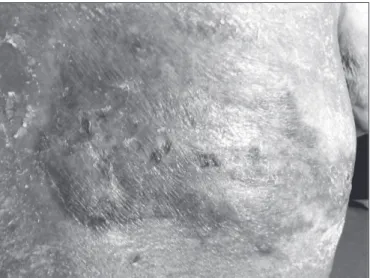
Figure 1 – Chronic herpes zoster lesion
talar, com 25 mg/dia de amitriptilina oral e amitrip-tilina tópica a 4%.
CONCLUSÃO: O uso do LBI e da amitriptilina tópica foi eicaz para remissão do quadro doloroso.
Descritores: Amitriptilina, Herpes zoster, Raios laser, Transplante de pulmão.
INTRODUCTION
The International Association for the Study of Pain (IASP) deines post-herpetic neuralgia (PHN) as pain which remains after the disappearance of vesicles of the acute herpes zoster episode (HZ), after a minimum per-iod of 8 to 12 weeks. There are PHN reports for more than 150 years. During this period, especially in the last 60 years, an extraordinary variety of treatments have ap-peared to decrease pain during acute HZ phase, to pre-vent progression to PHN and to decrease pain when the disease is established1,2.
HZ is caused by the same virus responsible for varicella, which is the varicella zoster virus (VZV) or human herpes virus type 3 (HHV3). Latent virus reactivation causes the disease. The reactivation cause is unknown and may be related to age group, stress or immunodif-iciencies such as tumors, acquired immunodeiciency syndrome (AIDS), autoimmune diseases and the use of immunosuppressive drugs3,4.
After the advent of cyclosporin, lung transplantation started to be consolidated as a real therapy for patients with disab-ling respiratory failure5. Cyclosporin leads to
immunosup-pression and patients are more subject to infections6.
This study aimed at reporting the case of a patient who evolved with PHN in the late postoperative period of lung transplantation and had substantial improvement with topical amitriptyline and low intensity laser.
CASE REPORT
Male patient, 73 years old, diabetic, with clinical, func-tional, tomographic and pathological diagnosis of idio-pathic lung ibrosis (ILF) for six years. Patient progres -sively evolved with dyspnea at minimum efforts and se-vere mucoid cough dificult to control. Three years ago he was submitted to left unilateral lung transplantation. He was discharged with immunosuppressive scheme, prednisolone and tacrolimus.
One year ago he developed HZ with the appearance of vesicles in the eight intercostal space of the right hemith-orax (RHT). Antiviral treatment with ganciclovir was ef-fective, however patient evolved with PHN.
During the irst pain therapy team evaluation patient was clinically well, but with constant burning pain worsened in the last month, with intensity 9 by the visual numerical scale (VNS). Patient was under 600 mg/day gabapentin. He reported sleep changes and high anxiety with regard to the disease. At physical evaluation he presented trans-plantation scar in left hemithorax and right RHT lesion due to HZ (Figure 1). During lesion evaluation patient complained of hyperesthesia, but not of alodinia.
Pain treatment was started with oral gabapentin (900 mg/day), amitriptyline (25 mg/day) and dipirone (8 g/day). Since there was no signiicant improvement, oxycodone (20 mg/day) was also associated. Patient evolved with postural hypotension, diarrhea and vomit-ing. Oxycodone was withdrawn and low intensity laser (LIL) application was started with the Twin-Laser®
(MM-Optics) device, 780 nm/ 40 mW/ 40 Jcm2/ 40s
per point, in a total of 72 J for 30 minutes, with 10% decrease in pain intensity.
The indication of alcohol injection in the affected nerve was discarded due to technical dificulty and possibility of evolving to deafferentation of the affected nerve7.
LIL was applied daily during the irst week, in the same intensity. Six days later, 4% topic amitriptyline was started with 30% decrease in pain intensity, with VNS = 5. LIL was then applied every other day with lower potencies varying from 9 to 36 J for 10 to 15 minutes. Oral 600 mg gabapentin, 25 mg amitriptyline and 6 g dipirone per day were maintained.
dipi-Alternative treatment for post-herpetic neuralgia after lung transplantation. Case report
Rev Dor. São Paulo, 2012 jan-mar;13(1):85-8
87
rone doses were progressively decreased. At hospitaldischarge patient had NVS = 1, and was under oral 25 mg/day amitriptyline and 4% topic amitriptyline.
DISCUSSION
PHN, major HZ complication, has incidence of 10% to 20% and is deined as pain remaining after the dis -appearance of vesicles of the acute episode, after a min-imum period of up to six weeks8. In this case, HZ was a
consequence of immunosuppression due to lung trans-plantation due to DLD.
DLF is a chronic disease with progressive evolution to disabling respiratory failure in spite of pharmacological treatment. In this stage, lung transplantation is one treat-ment option. In the last 15 years, the difference between the number of potential beneiciaries and the number of donors has considerably increased8.
After the advent of cyclosporin in the 1980s, lung transplantation started to be consolidated as ther-apy9. Cyclosporin A (CsA) was an
immunosuppres-sive revolutionizing organ transplantations, however, problems associated to dosage came to light. The drug had little and imprecise absorption, narrow therapeut-ic window and adverse effects. With the availability of other drugs, such as tacrolimus (FK506) and siroli-mus, there was a therapeutic control enhancement with serum dosage of immunossupressives. CsA and FK506, calcineurin inhibitors, are the basis of clinical immunosuppression. They have toxic effects such as dose-related nefrotoxicity10.
Studies showing the eficacy of existing treatments for PHN have classiied analgesics as irst line drugs, together with tricyclic antidepressants, anticonvulsants and lidocaine patch with proven eficacy; and as second line drugs, where opioids were included. Neural blocks may also be considered a potential treatment11,12.
In our case, systemic oral or venous administration of analgesics and adjuvants did not change PHN pain pro-ile and was a complicating factor since patient took a large amount of drugs. LIL and topical amitriptyline were decisive for pain remission.
LIL has been used for decades in Europe to treat chronic pains, especially in body regions with soft tissues. Its action mechanism is not totally clear but it seems to be related to microcirculation and inlammatory response improvement and to adenosine triphosphate (ATP) pro-duction. In addition, it is believed that laser therapy in-creases serotonin production. Laboratory essays have shown higher urinary excretion of serotonin byproducts
after treatment. A study has shown that after 4 weeks of LIL, as compared to placebo, there has been signiicant pain improvement at rest and during activities, as well as pain threshold increase. LIL has the advantage of not being invasive and of being well tolerated by elderly and high-risk patients13.
Amitriptyline, a tricyclic antidepressant (TAD), is used as analgesic adjuvant to treat chronic and neuropathic pain in humans. It is orally administered and induces analgesia by acting in spinal cord and supraspinal struc-tures. Recent pre-clinical trials have shown that topical TAD induces analgesia. In formalin models of neuro-pathic pain and skin relex in rats, local amitriptyline has induced analgesia. Studies have shown that topical doxepin, as compared to placebo, has induced effective analgesia. Although these drugs may be promising as topical analgesics, peripheral TAD action mechanism is still not well understood14,15.
This case presents an alternative treatment for chronic neuropathic pain patients. During the 10 days from ad-mission until pain control, patient was in great distress, which was relatively easily controlled with LIL and top-ical amitriptyline.
CONCLUSION
LIL and topical amitriptyline were effective for pain remission.
REFERENCES
1. Gnann JW Jr, Whitley RJ. Clinical practice. Herpes zoster. N Engl J Med 2002;347(5):340-6.
2. Gilden DH, Kleinschmidt-DeMasters BK, LaGuar-dia JJ, et al. Neurologic complications of the re-activation of varicella-zoster virus. N Engl J Med 2000;342(9):635-45.
3. Dworkin RH, Portenoy RK. Pain and its persistence in herpes zoster. Pain 1996;67(2-3):241-51.
4. Truini A, Galeotti F, Haanpaa M, et al. Pathophysi-ology of pain in postherpetic neuralgia: a clinical and neurophysiological study. Pain 2008;140(3):405-10. 5. Jatene FB, Pêgo-Fernandes PM. Challenges in lung transplantation. J Bras Pneumol 2008;34(5):249-50. 6. Espinosa M, Rodil R, Goikoetxea MJ, et al. Transplante pulmonar. An Sist Sanit Navar 2006;29(2):105-12.
Filho, Zylbersztejn, Silva et al.
Rev Dor. São Paulo, 2012 jan-mar;13(1):85-8
88
8. Schmader K. Herpes zoster and postherpetic neuralgia in older adults. Clin Geriatr Med 2007;23(3):615-32. 9. Ruino R, Madi K, Mourad O, et al. Accelerated form of interstitial pulmonary ibrosis in the native lung after single lung transplantation. J Bras Pneumol 2007;33(6):733-7. 10. Garcia SC, Lopes LS, Schott KL, et al. Ciclospor-ina A e tacrolimus: uma revisão. J Bras Patol Med Lab 2004;40(6):393-401.
11. Tyring SK. Management of herpes zoster and posther-petic neuralgia. J Am Acad Dermatol 2007;57(6):S136-42. 12. Dworkin RH, Backonja M, Rowbotham MC, et al. Advances in neurophatic pain. diagnosis, mechan-isms, and treatment recommendations. Arch Neurol 2003;60(11):1524-34.
13. Bjordal JM, Johnson MI, Iversen V, et al.
Photo-radiation in acute pain: a systematic review of possible mechanisms of action and clinical effects in random-ized placebo-controlled trials. Photomed Laser Surg 2006;24(2):158-68.
14. Lynch ME, Clark AJ, Sawynok J, et al. Topical 2% amitriptyline and 1% ketamine in neuropathic pain syn-dromes: a randomized, double-blind, placebo-controlled trial. Anesthesiology 2005;103(1):140-6.
15. Oatway M, Reid A, Sawynok J. Peripheral anti-hyperalgesic and analgesic actions of ketamine and ami-triptyline in a model of mild thermal injury in the rat. Anesth Analg 2003;97(1):168-73.
Submitted in December 24, 2010.