The 9 -O -ace tyl GD 3 ganglio side s are
e xpre sse d by m igrating chains o f
subve ntricular zo ne ne uro ns
in vitro
Instituto de Biofísica Carlos Chagas Filho, Universidade Federal do Rio de Janeiro, Rio de Janeiro, RJ, Brasil
L.M. Miyakoshi, R. Mendez-O tero and C. Hedin-Pereira
Abstract
Neurons from the anterior subventricular zone (SVZ) of the cerebral cortex migrate tangentially to become interneurons in the olfactory bulb during development and in adult rodents. This migration was defined as neuronophilic, independent of a radial glial substrate. The cortical SVZ and the rostral migratory stream to the olfactory bulb were shown to be rich in 9-O-acetyl GD3 gangliosides (9-O-acGD3), which have been previously shown to be implicated in gliophilic migration in the rodent cerebral cortex and cerebellum. In the present study, we performed SVZ explant cultures using rats during their first postnatal week to analyze the expression of these gangliosides in chain migration of neuronal precursors. We characterized migrating chains of these neuroblasts through morphological analysis and immunocy-tochemistry for the neural cell adhesion molecule. By using the Jones monoclonal antibody which binds specifically to 9-O-acGD3 we showed that migrating chains from the SVZ explants express O-acGD3 which is distributed in a punctate manner in individual cells. 9-O-acGD3 is also present in migrating chains that form in the absence of radial glia, typical of the neuronophilic chain migration of the SVZ. Our data indicate that 9-O-acetylated gangliosides may participate in neuronophilic as well as gliophilic migration.
Co rre spo nde nce
C. Hedin-Pereira Instituto de Biofísica Carlos Chagas Filho, UFRJ CCS, Bl. G, Cidade Universitária 21941-590 Rio de Janeiro, RJ Brasil
E-mail: hedin@ biof.ufrj.br Presented at
SIMEC 2000 - International Symposium on Extracellular Matrix, Angra dos Reis, RJ, Brazil, September 24-27, 2000. Research supported by FINEP/ PRO NEX (No. 052/97), the Third World Academy of Science (TWAS) and FAPERJ to R. Mendez-O tero.
Received January 9, 2001 Accepted January 30, 2001
Ke y wo rds
·Subventricular zone
·Migration
·9-O -Acetylated gangliosides
·Rostral migratory stream
During development of the cerebral cor-tex most neuronal precursors migrate radi-ally from the ventricular zone to their final destination in the cortical plate (for a review, see 1). Radial glia-mediated migration, termed gliophilic, appears to be the prevalent form of migration in the cerebral cortex. However, long tangential migratory path-ways have been described, both deriving from cortical proliferative zones to extracor-tical sites (for a review, see 2), as well as
independent of radial glial guides, the so-called neuronophilic migration. They also showed that these chains of migrating neuro-blasts are ensheathed by glial cells that form tube-like structures.
Recently, it has been possible to charac-terize chain migration in vitro using anterior
SVZ explant cultures (5). In this model, neuronal precursors that migrate in chains out of SVZ explants express polysialic acid (PSA)-neural cell adhesion molecule (NCAM) (6,7) and TuJ1 (8) as was shown in vivo. These chains were also shown not to
have glial fibrillary acidic protein (GFAP)-labeled processes growing into them, further characterizing this migration as neurono-philic. Little is known of the molecular mechanisms that underlie chain migration. There is evidence that enzymatic removal of polysialic acid chains from NCAM (9) or the genetic deletion of PSA-NCAM disrupts neu-ronal precursor migration in vivo (10-12).
The in vitro analysis of SVZ migration in
adults showed that chain migration still oc-curs in transgenic mice in which all isoforms of NCAM are deleted (13).
The cortical SVZ and the rostral migra-tory stream were shown to have a strong expression of 9-O-acetylated gangliosides during development and in adult rats (14). This sialic acid-containing glycolipid was previously associated with gliophilic migra-tion in the cerebral cortex (15) and cerebel-lum (16). In the present study we analyzed the expression of 9-O-acetylated ganglio-sides in anterior SVZ explant cultures to determine whether these gangliosides could be involved in neuronophilic migration. To this end we studied migrating chains of neu-ronal precursors in which glial cells were absent.
We prepared anterior SVZ explants from postnatal day P0-P7 rat brains. Animals were decapitated, their brains were removed and placed in cool Geys solution and cut
para-From these slices we dissected out the most anterior portion of the SVZ to obtain our explants. Explants were plated onto glass coverslips previously incubated with poly-L-lysine. Our cultures were fed with culture medium (10% fetal calf serum and DMEM-F12-Gibco, Gaithersburg, MD, USA) and kept in an incubator (5%/95% CO2/air) for 4-7 days.
Explant cultures were fixed with 4% para-formaldehyde and submitted to immunocy-tochemistry. The explant cultures were incu-bated overnight with Jones monoclonal IgM (1:200, Sigma Chemical Co., St. Louis, MO, USA), anti-GFAP polyclonal IgG (1:400, Dako, Carpinteria, CA, USA) and anti-NCAM monoclonal IgG (1:10, Sigma) solu-tions prepared with 5% normal goat serum, 0.05% Triton X-100 (except for Jones mAb) in PBS. After this period, cultures were washed and incubated for 2 h with second-ary antibodies linked to Cy3 (IgM specific and whole molecule, 1:1000), FITC (1:100; Accurate, Westbury, NY, USA) and FITC (IgG specific, 1:50; Cappel, Aurora, OH, USA) prepared in the same solutions as above. Cultures were analyzed for the pres-ence of migrating chains of neurons using a Zeiss inverted fluorescence microscope equipped with rhodamine, FITC and UV filters in addition to differential interferen-tial contrast (DIC) and phase contrast mi-croscopy. Images were captured with a Kodak digital camera (MDS 120) or with a Zeiss confocal microscope with 480 and 543 nm lasers.
these cells as SVZ neuronal precursors, ex-plants were immunoreacted for NCAM. All migratory chains that were identified as SVZ chains in DIC were also immunolabeled for NCAM. It should be noted, however, that this antibody is not entirely specific for the embryonic isoform of NCAM that carries the PSA sequence. In our culture system thick migrating chains grew out of the ex-plants - several cell bodies wide and also 3 to 5 cell bodies high as can be demonstrated by depth analysis (Zeiss LSM version 3.98, copyright 1997) of 3D-reconstructed confo-cal images of NCAM-positive neurons. (Fig-ure 1C). Furthermore, previous work has shown that different postnatal brain regions close to the SVZ trajectory such as the over-lying cortex, striatum, medial septum, hip-pocampus, hypothalamus and habenula do not form chains in explant cultures (5).
Typical migrating chains out of SVZ ex-plants expressed the ganglioside 9-O-acetyl GD3 in most cells and generally displayed a punctate distribution within cell membranes (Figure 2). This ganglioside exhibits a simi-lar punctate pattern of distribution in growth cones of dorsal root ganglion neurons in culture (17). This distribution may be related to adhesion sites necessary for cell and growth cone translocation. To study if the migration of ganglioside-positive neuronal precursors occurred independent of glial cells we
ana-Figure 1. Immunolabeling for NCAM in subventricular zone explants. A, DIC microscopy im-age of a subventricular zone ex-plant present ing m igrat ory chains of neuroblasts. These chains can be view ed at high pow er in B. C, Confocal micros-copy image of a migratory chain im m unolabeled f or NCAM view ed in a depth code image show ing that these chains are organized as thick bundles of neuroblasts. M agnification bars in A: 200 µm, B: 100 µm, and C: 50 µm.
Figure 2. Confocal microscopy of Jones-positive neurons in mi-grating chains of neuroblasts. Note the punctate pattern of the membrane labeling. M agnifica-tion bar: 50 µm.
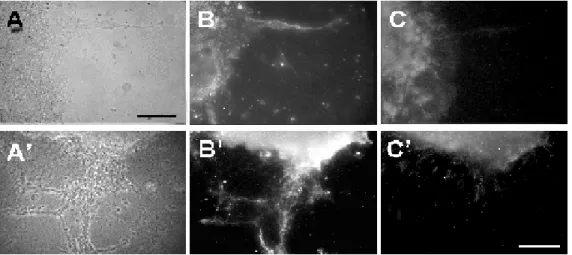
lyzed the expression of GFAP in these cul-tures. Typically, GFAP-positive fibers ex-tended out of the SVZ explants (Figure 3). Differentiated astrocytes can be identified underlying some of the growing chains. How-ever, migrating chains present in the periph-ery of the explant outgrowth appeared to be completely devoid of GFAP-positive pro-cesses (Figure 3). When double-labeling cul-tures with anti-GFAP and Jones we found that neuronal precursor chains in which glial processes were absent expressed the Jones antibody (Figure 3). These results suggest that the 9-O-acetyl GD3 ganglioside may participate in chain migration, which has been shown to be independent of glial guid-ance. Previous work has strongly associated these sialogangliosides with gliophilic mi-gration (for a review, see 18). They are ex-pressed in most proliferative zones and along radial glial fibers in a spatiotemporal pattern
consistent with its role in promoting migra-tion (19). In mixed cultures of cerebellar neurons and glia, elongated glial forms ap-pear which are able to support migration. It has been shown in this system that these glial cells only express the ganglioside when serv-ing as substrate for neuronal migration (20). In migration assays using cerebellar explants, immunoblockade of the 9-O-acetyl GD3 gan-glioside disrupts neuronal precursor migra-tion along radial glial fibers (16). Our results substantiate the hypothesis that 9-O-acety-lated gangliosides participate in neurono-philic migration. The mechanism underlying this action remains to be determined.
Ackno wle dgm e nts
We are grateful to José Tibúrcio for ani-mal care and to Felipe de Melo Marins for technical assistance.
Re fe re nce s
1. Rakic P (1990). Principles of neural migra-tion. Experientia, 46: 882-891.
2. Goldman SA & Luskin M B (1998). Strate-gies utilized by migrating neurons of the postnatal vertebrate forebrain. Trends in Neurosciences, 21: 107-114.
3. Anderson SA, Eisenstat DD, Shi L & Rubenstein JLR (1997). Interneuron mi-gration from basal forebrain to neocortex: dependence on Dlx genes. Science, 278: 474-476.
4. Lois C, Garcia-Verdugo JM & Alvarez-Buylla A (1996). Chain migration of neu-ronal precursors. Science, 271: 978-981. 5. Wichterle H, García-Verdugo JM &
Alvarez-Buylla A (1997). Direct evidence for ho-motypic, glia-independent neuronal migra-tion. Neuron, 18: 779-791.
6. Rousselot P, Louis C & Alvarez-Buylla A (1995). Embryonic (PSA) N-CAM reveals chains of migrating neuroblasts betw een the lateral ventricle and the olfactory bulb of adult mice. Journal of Comparative Neurology, 351: 51-61.
7. Jankovski A & Sotelo C (1996). Subven-tricular zone-olfactory bulb migratory
path-heterochronic and heterotopic transplan-tation. Journal of Comparative Neurology, 371: 376-396.
8. M enezes JRL & Luskin M B (1994). Ex-pression of neuron-specific tubulin de-fines a novel population in the prolifera-tive layers of the developing telencepha-lon. Journal of Neuroscience, 14: 5399-5416.
9. Ono K, Tomasiew icz H, M agnuson T & Rutishauser U (1994). N-CAM mutation inhibits tangential neuronal migration and is phenocopied by enzymatic removal of polysialic acid. Neuron, 13: 595-609. 10. Tomasiew icz H, Ono K, Yee D, Thompson
C, Goridis C, Rutishauser U & M agnuson T (1993). Genetic deletion of a neural cell adhesion molecule variant (NCAM 180) produces distinct defects in the central nervous system. Neuron, 11: 1163-1174. 11. Cremer H, Lange R, Christoph A, Plomann M , Vopper G, Roes J, Brow n R, Baldw in S, Kraem er P, Scheff S, Barthels D, Rajew sky K & Wille W (1994). Inactivation of the N-CAM gene in mice results in size reduction of the olfactory bulb and
defi-12. Hu HY, Tomasiew icz H, M agnuson T & Rutishauser U (1996). The role of poly-sialic acid in migration of olfactory bulb interneuron precursors in the subventricu-lar zone. Neuron, 16: 735-743.
13. Chazal G, Durbec P, Jankovski A, Rougon G & Cremer H (2000). Consequences of neural cell adhesion molecule deficiency on cell migration in the rostral migratory stream of the mouse. Journal of Neuro-science, 20: 1446-1457.
14. M endez-Otero R & Cavalcante LA (1996). Expression of 9-O acetylated gangliosides is correlated w ith tangential cell migration in the rat brain. Neuroscience Letters, 204: 97-100.
15. Hedin-Pereira C, de M oraes ECP, Lent R & M endez-Otero R (1998). 9-O Acetylated gangliosides are required for radial cell migration in embryonic cerebral cortex. Axon Guidance and Neural Plast icit y M eeting. September 16-20, Cold Spring Harbor, NY, 75.
Neurosciences (in press).
17. Araújo H, M enezes M & M endez-Otero R (1997). Blockage of 9-O-acetylated gan-gliosides induces microtubule polymeriza-tion in grow th cones and neurites. Euro-pean Journal of Cell Biology, 72: 202-213. 18. M endez-Ot ero R, Schlosshauer B & Constantine-Paton M (1992). Role of
acetylated gangliosides on neuronal mi-gration and axonal outgrow th. In: Lent R (Editor), The Visual System from Genesis to M aturity. Birkhauser, Boston. 19. M endez-Otero R, Schlosshauer B,
Barn-stable CJ & Constantine-Paton M (1988). A developmentally regulated antigen as-sociated w ith neural cell and process
mi-gration. Journal of Neuroscience, 8: 564-579.