J of Evidence Based Med & Hlthcare, pISSN- 2349-2562, eISSN- 2349-2570/ Vol. 2/Issue 40/Oct. 05, 2015 Page 6662
ANALGESIC ACTIVITY OF AQUEOUS EXTRACT OF CURCUMA AMADA
(MANGO-GINGER) IN MALE ALBINO WISTAR RATS
Kumari Bai C1, Shanmukananda P2
HOW TO CITE THIS ARTICLE:
Kumari Bai C, Shanmukananda P. “Analgesic Activity of Aqueous Extract of Curcuma Amada (Mango-Ginger) in Male Albino Wistar Rats”. Journal of Evidence based Medicine and Healthcare; Volume 2, Issue 40, October 05, 2015; Page: 6662-6669, DOI: 10.18410/jebmh/2015/910
ABSTRACT: BACKGROUND: Mango ginger (Curcuma amada Roxb.) has morphological resemblance with ginger, but imparts mango flavour. According to Ayurveda and Unani medicinal systems, the biological activities include antioxidant, antibacterial, antifungal, anti-inflammatory, antiallergic, CNS depressant and analgesic activity. Hence curcuma amada aqueous extract for analgesic activity was evaluated in pain animal models. Pain is a most common complaint of many medical conditions, and pain control is one of the most important therapeutic priorities. Curcuma Amada suppresses the inflammatory mediators associated with pain. However there is no scientific data suggestive of its analgesic activity. Hence this study was carried out to evaluate its role in central and peripheral models of pain. OBJECTIVE: To Evaluate rhizomes of Curcuma Amada for analgesic activity in male albino wistar rats. MATERIALS AND METHODS: Albino rats, the proven models for analgesic studies. They were obtained from the animal house of DR.B. R. Ambedkar Medical College. Animals were maintained as per CPCSEA guidelines. The aqueous extract of curcuma amada was used.4x2 groups of 6 Rats were used to ensure that results obtained were statistically significant using ANOVA test. Analgesic activity was assessed with the help of following screening methods. Acetic Acid Writhing Method using Acetic Acid. Tail Flick Methodusing the Analgesiometer. Tail Immersion Method using Hot Water (550C). Hot Plate
method using Hot Plate. RESULTS: Aqueous extract of curcuma amada significantly suppressed the 1% acetic acid induced writhing response in rats when compared to control group (Gum acacia). In Tail flick test and Hot plate test Curcuma Amada increases the latency period of pain (reaction time). In Tail immersion test the test drug significantly (P < 0.001) reduces pain at 30 min when compared to control group at 60 min of oral administration. CONCLUSION: The present findings indicate that Curcuma Amada showed significant analgesic activity may be via peripheral as well as central mechanisms.
KEYWORDS: Acetic acid writhing; Tail immersion; Tail flick; Hot plate; Curcuma Amada; Analgesic activity.
INTRODUCTION: Medicinal herbs have been used as a form of therapy for the relief of pain throughout history.1 Mango ginger (Curcuma amada Roxb.) is a unique spice having
morphological resemblance with ginger, but imparts a raw mango flavour. The geographical distribution of this genus ranges from India to Thailand, and northern Australia. C. Amada is found the wild in parts of West Bengal, and is cultivated in Gujarat, Uttar Pradesh, Kerala, Karnataka, Tamil Nadu and the north-eastern states.2 Curcuma Amada belongs to Zingiberaceae
J of Evidence Based Med & Hlthcare, pISSN- 2349-2562, eISSN- 2349-2570/ Vol. 2/Issue 40/Oct. 05, 2015 Page 6663
aphrodisiac, diuretic, emollient, expectorant and laxative and to cure biliousness, itching, skin diseases, bronchitis, asthma, hiccough and inflammation due to injuries. The biological activities of mango ginger include antioxidant activity, antibacterial activity, antifungal activity, anti-inflammatory activity, platelet aggregation inhibitory activity, antiallergic activity, hypotriglyceridemic activity, enterokinase inhibitory activity, CNS depressant and analgesic activity. The major chemical components include starch, phenolic acids, volatile oils, curcuminoids and terpenoids like difurocumenonol, amadannulen and amadaldehyde. This brings to light the major active components present in C. amada along with their biological activities that may be important from the pharmacological point of view.3 The analgesic activity of the aqueous extract
of Curcuma Amada was investigated using various pain models in rats in order to validate its use to relieve pain, in ailments accompanied with pain.
MATERIALS AND METHODS: MATERIALS:
1. Chemicals: Gum Acacia, Curcuma-Amada aqueous extract, 1% acetic acid. 2. Animals: Male Albino wistar rats weighing 100-150 gms.
3. Equipments: Tuberculin Syringe (1ml), Analgesiometer, Thermometer, Temperature controlled organ bath, Hot Plate.
Gum Acacia: Gum-Acacia is the dried gummy exudation from the stems and branches of acacia senegal or other African specis of Acacia. It is an inert substance used as a suspending agent for the oral administration of the test compound and the standard compound, the concentration being 2%.
Acetic Acid: In our study, intraperitoneal injection of 1% acetic acid has been used to induce pain.
SOURCE OF ANIMALS: Albino rats are proven models for analgesic studies. In this study, male albino wistar rats weighing 100-150gms were used. Animals were obtained from the animal house, Dept. of Pharmacology, DR.B. R. Ambedkar Medical College, K. G. Halli, Bangalore-560045. Animals were maintained as per Committee for the purpose of control and supervision on Experiments on Animals [CPCSEA] guidelines with food and water.
Number of rats used was 48, in order to provide statistically significant results using ANOVA test.
J of Evidence Based Med & Hlthcare, pISSN- 2349-2562, eISSN- 2349-2570/ Vol. 2/Issue 40/Oct. 05, 2015 Page 6664
acacia suspension orally. The untreated group received 2% plain gum acacia suspension (without drug) orally. The animals used were 4x2 groups of 6 Male Albino Wistar Rats to ensure that the results obtained were statistically significant using ANOVA test.
METHODOLOGY:
Inclusion Criteria: Male albino wistar rats, 100 days old weighing 100-150grams.
Exclusion Criteria:
Pregnant or female rats.
Rats weighing more than 150grams. Diseased rats.
Study has been approved by Institutional Animal Ethics Committee (IAEC), and CPCSEA Delhi.
METHODS: The Methods employed here in to study the analgesic activity are; Acetic acid writhing method using acetic acid.3
Tail flick method using the Analgesiometer.4
Tail immersion method using hot water (550C).5
Hot plate method using hot plate.6
Acetic acid writhing method using acetic acid:
Principle: Acetic acid induces a painful reaction on intra peritoneal injection (I.P.).
Requirements: 6x2=12 male albino wistar rats (100-150gm), test drugs (CA, Gum acacia), 2ml syringe, acetic acid 1% (0.1 ml/10g body weight).
Procedure:
Rats are pretreated (with control and test drugs 1 hour before) 1 ml of 1% Acetic acid I.P.
Response: No of writhes occurring for next 30 min were observed.
WRITHE: A stereotyped behaviour in rats characterized by constriction of the abdomen, twining of the trunk and extension of hind limbs is called as writhe.
Interpretation: Analgesics decrease the total number of writhes when compared to control groups.
J of Evidence Based Med & Hlthcare, pISSN- 2349-2562, eISSN- 2349-2570/ Vol. 2/Issue 40/Oct. 05, 2015 Page 6665 Tail flick method using the analgesiometer:
Principle: The application of thermal radiation to the tail of an animal provokes the withdrawal of the tail by a brief vigorous movement. It is the reaction time of this movement that was recorded.
Requirements: 12 male albino wistar rats (100-150gms), Test drugs (C.Amada, Gum acacia), equipment- Analgesiometer.
Procedure:
N=6 rats were weighed and numbered.
Animal was held in a restrainer in such a way that the tail lies over the nichrome wire of the Analgesiometer.
Strength of current used is 4 ampere.
Basal reaction time to radiant heat was taken by placing the tip of tail (last 1-2 cm) on the radiant heat source.
Tail- withdrawal from heat (flicking response) was taken as the end point. A rat withdraws its tail within 3-5 sec.
Reaction time 10 sec is considered as maximal analgesia and tail is removed from the source of heat to avoid tissue damage.
Index of analgesia was calculated by percentage increase in reaction time at each time interval.
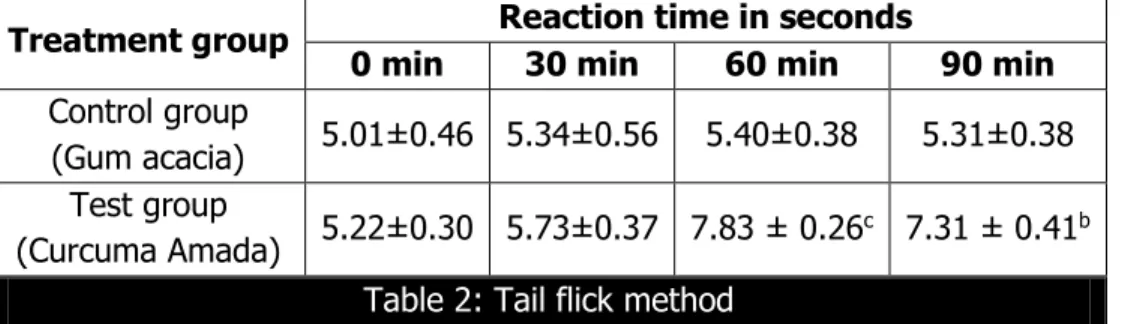
Reaction time was taken at 0, 30, 60, 90 minutes. The results obtained are indicated in Table 2.
Tail immersion method using hot water (550 C):
Principle: Analgesics prolong reaction time of tail-withdrawal reflex in rats induced by immersing the end of the tail in warm water of 55⁰C.
Requirements: 12 male albino wistar rats (100-150gms), test drugs (C.Amada, Gum acacia), Organ bath with temperature controlled at 550 C.
Procedure:
N=6 rats were weighed and numbered. Lower 5 cm portion of the tail is marked.
Marked part of the tail was immersed into the organ bath with water maintained at 55⁰C. Within few seconds the rat reacts by withdrawing the tail.
The reaction time was recorded in 0.01s units by a stopwatch. After each determination the tail was carefully dried.
The reaction time was determined before and periodically after oral administration of the test and standard substance.
The cut off time was 15 sec.
J of Evidence Based Med & Hlthcare, pISSN- 2349-2562, eISSN- 2349-2570/ Vol. 2/Issue 40/Oct. 05, 2015 Page 6666 Hot Plate Method using hot plate:
Principle: Heat is used as a source of pain (Thermal stimulus) as the paws of rats are sensitive to heat at temperatures of 55-56⁰C.
Requirements: 12 male albino wistar rats (100-150gms), Test drugs (C.Amada, Gum acacia), Eddy’s hot plate.
Procedure:
Response: Hind paw licking and jump response. The basal reaction time was 6-8 seconds.
Cut-off period was 15 sec. to avoid damage to rats.
Reaction time taken for licking for paws or jumping was recorded. Percentage increase in reaction time was calculated.
Observations were recorded at time interval of 0, 30, 60, 90, 120 min. The results obtained are indicated in Table 4.
STATISTICAL ANALYSIS: Results were expressed as mean ± SEM. Differences among data were determined by one way ANOVA. P value < 0.001 was considered statistically significant.
RESULTS:
Acetic Acid Writhing test: Curcuma Amada at a dose of 100mg/kg significantly suppressed the 1% acetic acid induced writhing response when compared to control group.
Acetic acid induced writhing: Number of writhing in 30 min.
Treatment group Dose (mg/Kg) No. of writhes in 30 min (mean ±SEM)
Inhibition (%) Control group
(Gum acacia) 100mg/kg 63.7±1.054 -
Test group (CA) 100mg/kg 21.2±0.307 66.76%
Table 1: Acetic acid writhing method
Each value is the mean ± S. E.M. p<0.001 significant, data were analyzed by using ANOVA.
J of Evidence Based Med & Hlthcare, pISSN- 2349-2562, eISSN- 2349-2570/ Vol. 2/Issue 40/Oct. 05, 2015 Page 6667 Treatment group Reaction time in seconds
0 min 30 min 60 min 90 min Control group
(Gum acacia) 5.01±0.46 5.34±0.56 5.40±0.38 5.31±0.38 Test group
(Curcuma Amada) 5.22±0.30 5.73±0.37 7.83 ± 0.26
c 7.31 ± 0.41b
Table 2: Tail flick method
Each value are the mean ± S.E.M.a P <0.05,b P < 0.01,c P <0.001. Data were analyzed by
using ANOVA.
Tail immersion method: In tail immersion method the test drug significantly (P<0.001) reduced the pain as compare to the control group.
Treatment group Reaction time in seconds
0 min 30 min 60 min 90 min 120 min Control group (Gum acacia) 0.78±0.07 1.24±0.09 1.15±0.12 1.08±0.05 0.96±0.04 Curcuma Amada (Test group) 0.77±0.03 1.76±0.07c 1.99±0.03c 2.44±0.14c 2.49±0.16c
Table 3: Tail immersion method
Each value are mean±S. E. M.a P <0.05,b P <0.01,c P <0.001. Data were analyzed using
ANOVA.
Hot plate method: CA at a dose of 100 mg/kg produced an increase in the latency period of pain induced by heating of the plate. The significant (P < 0.001) analgesic activity was noticed at 90 and 120 min for test drug.
Treatment group Reaction time in seconds
0 min 30 min 60 min 90 min 120 min Control group (Gum acacia) 4.08±0.38 3.85±1.00 3.89±1.76 3.98±0.85 4.46±0.58 Curcuma Amada (Test group) 4.24±0.51 5.19±0.48 6.41±0.34 7.66±0.51c 7.66±0.51c
Table 4: Hot plate method
Each value are mean±S. E. M.a P < 0.05,b P < 0.01,c P <0.001. Data were analyzed using
ANOVA.
J of Evidence Based Med & Hlthcare, pISSN- 2349-2562, eISSN- 2349-2570/ Vol. 2/Issue 40/Oct. 05, 2015 Page 6668
chemicals injected intraperitoneally is due to sensitization of nociceptors by prostaglandins. The aqueous extract of Curcuma Amada caused a significant and dose-dependent inhibition of writhes in rats. Recent findings suggest that aqueous and alcoholic (ethanol) extracts of Curcuma Amada contains active phytoconstituents which showed analgesic activity by inhibiting either synthesis, release of inflammatory mediators. These observations provide a possible basis for the peripheral analgesic action of CA.8 The extract showed significant effects in the hot plate and tail flick tests.
Centrally acting analgesic drugs elleviate pain threshold of animals to heat and pressure. The results obtained indicate a significant, dose and time related analgesic activity of the extract in both the hot plate and tail flick tests. The effect of the extract on these pain models indicate that it might be centrally acting. The observed analgesic activity was found to be significant with P <0.001 when compared with the control group. Studies done by Mujumdar et al.9 Policegoudra
RS et al.8 also suggest that CA has analgesic activity thus supporting our study.
CONCLUSION: We can conclude that, Curcuma Amada possess analgesic activity which can be explained by animal models of pain. Probably, it acts by peripheral and central mechanisms. But this needs to be further confirmed by encouraging more studies on this plant Rhizome and more number of animal species models to evaluate and confirm the findings. This provides evidence for its use in human medicine in the treatment of pain.
ACKNOWLEDGEMENT: Dr. Padma L, Former Professor & HOD, Department of Pharmacology, Dr. B. R. Ambedkar Medical College, Bangalore.
REFERENCES:
1. Almeida, R.N., D. S. Navarro and J. M. Barbosa- Filho. Plants with central analgesic activity. Phytomedicine 2001 (8); 310-322.
2. Sasikumar B. Genetic resources of Curcuma: diversity, characterization and utilization. Plant Gen. Res. 2005; 3: 230–251.
3. Galani V, Patel B. Analgesic and Anti-Inflammatory activity of Argyreia Speciosa and Sphearanthus indicus in Experimental animals. Global Journal of Pharmacology. 2011; 5(1):54-59.
4. Mishra D., Ghosh G., Kumar P.S., Panda P.K. An experimental study of analgesic activity of selective cox-2 inhibitor with conventional NSAIDs. Asian Journal of Pharmaceutical and Clinical Research. 2011; 4(11):78-81.
5. Ching P, Omogbai EKI, Ozolua RI, Okpo SO. Analgesic activity of aqueous extract of Stereospermum kunthianum (cham, sandrine petit) stem bark fidelis. Acta Poloniae Pharmaceutica ñ Drug Research. 2009; 66(1): 83-88.
6. Gene RM, Segura L, Adzet T. Heterothecainuloides: anti-inflammatory and analgesics effects.J. Ethanopharmacol. 1989; 60:157.
7. Amico-Roxas M., Caruso A., Trombadore S., Scifo R., Scapagnimi U. Arch Int. Pharmacodyn. Ther.1984; 10: 272.
J of Evidence Based Med & Hlthcare, pISSN- 2349-2562, eISSN- 2349-2570/ Vol. 2/Issue 40/Oct. 05, 2015 Page 6669
9. Mujumdar AM, Naik DG, Misar AV, Puntambekar HM and Dandge CN. CNS depressant and analgesic activity of a fraction isolated from ethanol extract of Curcuma amada rhizomes. Pharma. Biol.2004; 42: 542–546.
NAME ADDRESS EMAIL ID OF THE CORRESPONDING AUTHOR:
Dr. Kumari Bai C, Post Graduate Tutor,
Department of Pharmacology, Dr. B. R. Ambedkar Medical College, Bangalore.
E-mail: [email protected]
Date of Submission: 12/09/2015. Date of Peer Review: 14/09/2015. Date of Acceptance: 22/09/2015. Date of Publishing: 30/09/2015.
AUTHORS:
1. Kumari Bai C. 2. Shanmukananda P.
PARTICULARS OF CONTRIBUTORS:
1. Post Graduate Tutor, Department of Pharmacology, Dr. B. R. Ambedkar Medical College, Bangalore. 2. Professor & HOD, Department of