ARTIGO ORIGINAL DOI: 10.5007/1980-0037.2011v13n2p100
Abstract – Bioelectrical impedance (BI) is commonly used to estimate body composition in different populations. The aim of this study was to determine the accuracy of bipolar BI (Omron BF 300) in estimating relative body fat (%F) by comparing it with dual-energy X-ray absorptiometry (DEXA). %F was measured in 66 men (18 to 33 years) with a mean body weight of 73.7 ± 8.4 kg, height of 175.1 ± 6.5 cm, body mass index of 23.9 ± 2.2 kg/ m2, %F
BI 15.1 ± 4.4%, and %FDEXA 17.7 ± 5.1%. A paired t-test, correlation test, standard error of the estimate (SEE), and residue analysis were used to evaluate the accuracy of the method. BI signiicantly (p < 0.05) underestimated %F and, the correlation between the two methods was moderate (r = 0.769). Residue analysis showed the lack of agreement between the two methods, with an average error of -2.6 percentage points (95%CI: -9.1; 3.9). The SEE was above the recommended level (>3.5%F) in 42% of the sample. In subjects with higher fat accumulation (%F >20%), the Omron BF BI model produced greater bias in the %F measurement. Therefore, in the case of adult men, the Omron BF 300 BI model does not agree with the DEXA measurement for the estimation of %F in adult men. In addition, the higher the level of fat accumulation, the higher the error in estimated %F.
Key words: Bioelectrical impedance; DEXA; Body composition; Adiposity; Test validity.
Resumo – O objetivo deste estudo foi veriicar a acuracidade da IB Bipolar (Omron BF 300) para a estimativa da gordura corporal relativa (G%), comparada com a absortometria de raio X de dupla energia (DXA). A G% foi mensurada em 66 homens (18-33 anos), com massa corporal média de 73,7 ± 8,4 kg; estatura 175,1 ± 6,5 cm; índice de massa corporal 23,9 ± 2,2kg/m2;
G% IB 15,1 ± 4,4% e G% DXA 17,7 ± 5,1%. A acuracidade foi veriicada por teste t pareado, correlação, erro padrão de estimativa (EPE) e análise de resíduos. A IB subestimou signiicati-vamente (p <0,05) os valores de G% e a correlação entre os métodos foi moderada (r= 0,769). A análise dos resíduos demonstrou que não houve concordância, sendo o erro médio de -2,6% (IC95%: -9,1;3,9). Observou-se que 42% da amostra apresentaram EPE acima do recomendado (>3,5 G%). Nos indivíduos com maior acúmulo de gordura (G% >20) a IB modelo Omron BF produziu maiores vieses na estimativa da G%. este modelo de IB não apresentou concordância com a medida da DXA para estimar a G% em homens adultos, sendo o erro maior em sujeitos com maior acúmulo de gordura.
Palavras-chave: Impedância bioelétrica; Absortometria de raio X de dupla energia; Composição corporal; Gordura corporal; Validade dos testes.
1 Universidade Estadual de Ponta Grossa. Depar-tamento de Educação Física, Doutorando Universidade Federal do Paraná. Bolsista Fun-dação Araucária. Ponta Grossa, PR. Brasil.
2 Universidade Estadual de Londrina. Departa-mento de Educação Físi-ca. Londrina. PR.Brasil.
Recebido em 20/06/10 Revisado em 22/07/10 Aprovado em 23/11/10
CC $ =
1 2
Cassiano Ricardo Rech Maria Fátima Glaner
Bipolar bioelectrical impedance: lack of accuracy in
estimating relative body fat in men
The scientiic community has shown great interest in the quantiication of body composition, parti-cularly body fat1,2. Excessive accumulation of body
fat is a risk factor for the occurrence of morbidities and mortality at different ages3,4, whereas low
le-vels are associated with disorders such as anorexia and bulimia, which show a signiicant prevalence among young adults5 and adolescents6.
The fact that relative body fat (%F) is associated with non-transmissible chronic diseases has encoura-ged the search for an accurate estimation technique. Dual-energy X-ray absorptiometry (DXA) is conside-red to be the gold standard, mainly because it also measures bone density7. However, due to its laboratory
characteristicand high cost, DXA is limited to large--scale screening. In contrast, bioelectrical impedance (BI) analysis has been used for different purposes in Brazil over the last years8-10, especially because of the
easy handling of the equipment, rapid data collection, and low cost. BI is based on the concept that an electric current passes more easily through hydrated fat-free tissue and extracellular water than fat becau-se of the higher electrolyte content of the former, reducing electric resistance or impedance11. Thus,
resistance to the electric current is inversely propor-tional to fat content. The tradipropor-tional BI method is based on the estimation of electric resistance using four or eight electrodes (tetrapolar or octapolar BI, respectively) to transmit the electric current through the body. The resistance observed permits to estimate %F and other body composition components using regression equations. The tetra- and octapolar devices are more expensive, a fact limiting their use in po-pulation studies. However, there are simpler devices containing only two electrodes (bipolar BI) coupled to the apparatus itself, which are based on the same principle as the other methods.
Despite its practicality of data collection, the ac-curacy of bipolar BI devices is still questionable since these devices provide relative and absolute body fat values rather than resistance values. Therefore, the objectives of the present study were a) to compare the accuracy of bipolar BI analysis (Omron BF 300) and DXA for the estimation of %F in adult men, and b) to evaluate the inluence of excess body fat on the estimation of %F by bipolar BI compared to DXA.
METHODOLOGICAL PROCEDURES
Study design, sampling, and ethical aspects The present descriptive, cross-validation study
pulation consisted of adult men.
The sample was recruited by the distribution of posters and lealets in places such as clubs, gyms and universities. The sample consisted of 74 adult men ranging in age from 18 to 33 years. Eight subjects were excluded because they did not follow the recommendations for BI analysis. The inal sample consisted of 66 subjects. All partici-pants were volunteers and signed a free informed consent form that guaranteed anonymity and conidentiality of the individual data. The subjects had the right to withdraw from the study at any time without penalty as established by the ethical guidelines of Resolution 196/96 of the National Health Council. The study was approved by the Ethics Committee of Universidade Católica de Brasília (process 36/2007).
Data collection
All procedures were conducted at the same place at a controlled ambient temperature (20o to 22oC).
For each subject, all measurements were obtained on the same day. The DXA exams were performed and analyzed by an examiner with 3- year expe-rience. The individual error was <1.6% (coeficient of variation).
Body weight and height were measured with a balance to the nearest 100 g coupled to a stadio-meter (scale of 0.5 cm)12.
Measurement of %F by BI: The subjects were asked to adhere to the following protocol: 4-h fast, no consumption of coffee or alcoholic beverages 24 h prior to the test, no strenuous physical ac-tivity, and no use of diuretics. The subjects were instructed to empty their bladder and bowel before the measurement. The Omron BF 300 device was used, which is equipped with software that provides relative and absolute body fat values. However, the manufacturer does not inform the regression equation used for their estimation. Measurements were obtained according to the manual of the apparatus. The subject remained standing with the elbows extended in front of the body and holding the device until BI was estimated and %F and fat mass were calculated.
Measurement of %F by DXA: The Lunar
DPX-IQTM (4.7esoftware) apparatus was used and
scan-Bipolar bioelectrical impedance Rech & Glaner
ning was performed with the subject remaining still in the supine position and the elbows and knees extended. Two calibrations of the apparatus, one weekly and one daily, were performed to ensure the quality of the measurements. A phantom test was performed for weekly calibration and quality assurance testing was used for daily calibration. The calibrations were performed according to the manual of the equipment.
To evaluate the effect of excess adiposity on the estimation of %F by BI, the sample was stratiied into two groups: 1) %F <20%, and 2) %F ≥20%. The cut-off values established are based on evidence that indicates risk factors associated with excessive body fat accumulation13.
Statistical analysis
The data showed a normal distribution (Kolmogo-rov-Smirnov test). Descriptive statistics was used for characterization of the sample. The criteria propo-sed by Lohman14 were used to test the accuracy of
BI compared to DXA: Pearson’s linear correlation coeficient (r) >0.79; paired t-test (t) where tcalculated <
ttabulated, and a standard error of the estimate (SEE) <3.5% for the prediction of %F. The formulas cited in another study9 with a similar design were used
for the calculation of the constant error and SEE. Residual scores were analyzed as proposed by Bland and Altmann15. A level of signiicance of p<0.05
was adopted. The calculations were performed using a licensed copy of the Statistical Package for the Social Sciences (SPSS), version 14.
RESULTS
The sample consisted of adult men ranging in age from 18 to 33 years. Table 1 shows the descriptive characteristics of the sample. Mean %F measured by DXA was 17.7% (range: 8.3 to 28.9%), indicat-ing the presence of subjects with adequate %F and overweight and obese subjects13,16. These indings
demonstrate the external validity of the study since the sample was heterogenous in terms of %F as observed in the general population, permitting generalization of the results. This is supported by the variability in body mass index (Table 1), with the observation of subjects who belong to different categories of nutritional status17.
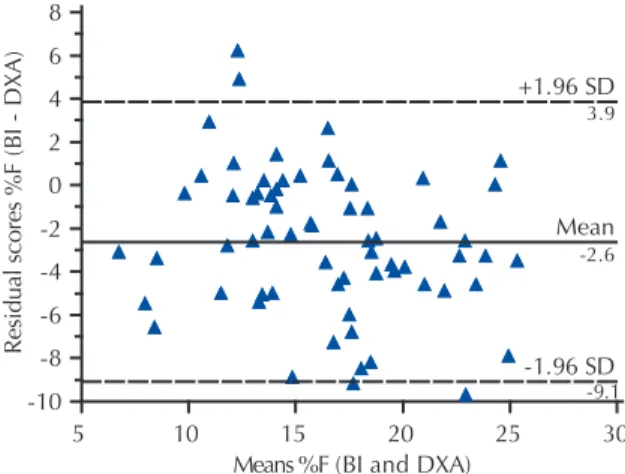
Comparison of the two methods (Table 2) in-dicates that BI tends to signiicantly underestimate (p<0.05) %F, on average 2.6% in relation to DXA. The correlation between methods ranged from moderate to high (r=0.769; p<0.05). The SEE (3.3%)
was below the criterion established14. Residue
analy-sis (Figure 1) conirmed the tendency of BI (Omron BF 300) to underestimate %F when compared to DXA. There was a higher concentration of resi-dues below point zero, with a mean error of -2.6% (95%CI: -9.1;3.9). As can be seen in Figure 2, the SEE for %F was £3.5% in only 58% of the sample studied, whereas 42% presented an SEE above the cut-off considered to be acceptable(3.5%)14.
Table 1. Descriptive analysis of anthropometric variables and relative body fat in the sample studied (n = 66).
Variable Mean ± SD Range
Height (cm) 175.1 ± 6.5 161.2 – 188.0
BW (kg) 73.7 ± 8.4 54.6 – 90.2
BMI (kg/m2) 23.9 ± 2.2 18.8 – 28.6
%FBI 15.1 ± 4.4 5.1 – 25.1
%FDXA 17.7 ± 5.1 8.3 – 28.9
SD: standard deviation; BW: body weight; BMI: body mass index; %FBI: relative body fat measured by bioelectrical im-pedance; %FDXA: relative body fat measured by dual-energy X-ray absorptiometry.
Table 2. Statistical comparison of relative body fat (%F) obtained by dual-energy X-ray absorptiometry (DXA) and bioelectrical impedance (BI) in adult men.
x _
%FDXA x_ %FBI t r CE SEE
17.7 ± 5.1 15.1 ± 4.4 6.43a 0.769a - 2.6 3.3
t: t-test; r: Pearson’s correlation coefficient; CE: constant error (%FBI – %FDXA); SEE: standard error of the estimate; a p<0.05.
Figure 1. Comparison of residual scores of relative body fat (%F) measured by dual-energy X-ray absorptiometry (DXA) and bioelectrical impedance (BI) (%FBI – %FDXA) with mean %FDXA and %FBI. The dotted lines indicate the 95% confidence interval. The continuous line corresponds to the mean error.
BI
%FDXA 23.1 ± 2.4%) (p<0.01), but were similar in the group with %F <20% (%FBI 12.95 ± 3.38% vs
%FDXA 14.4 ± 3.12%).
Figure 2. Analysis of the standard error of the estimate (SEE) for agreement between relative body fat estimation by dual-energy X-ray absorptiometry and bioelectrical impedance (BI).
Figure 3. Comparison of mean errors of relative body fat (%F) obtained by dual-energy X-ray absorptiometry and bioelectrical impedance (BI) between subjects with %F <20% and %F ≥20%. * p<0.05 (paired t-test).
DISCUSSION
Despite the excellent applicability of BI measures in ield studies18,19, the validity and accuracy of
the equipment and of the regression equations used to estimate %F should be determined for a given population. The Omron BF 300 BI device underestimated %F when compared to DXA in the sample studied (Table 2). Bipolar BI has also been shown to underestimate %F by 5.75% in adult women (20-40 years)20, by 4.5% in Indians21, and
by 11% in youngsters22 when DXA was used as
the reference method. The same trend has been reported in another study23, but no difference
(p>0.05) was observed between the Omron BF
the lack of accuracy of this method/device for the estimation of %F.
Although the correlation between methods was moderate and the SEE was acceptable14, indicating
agreement between the two techniques, residue analysis (Figure 1) conirmed the tendency of BI to underestimate %F when compared to DXA. In this respect, the results showed that, if the Omron BF 300 BI model was applied to estimate %F in adult men, the SEE was ≤ 3.5% inonly 58% of the subjects. Therefore, the use of this method/device may lead to incorrect diagnoses. As a consequence, possible interventions may also not be the most adequate. A study comparing bipolar and tetrapolar BI analysis revealed no differences between the two models and there was also no inluence of the amount of body fat on the estimation of %F25. However, these indings
should be interpreted with caution since no reference method was used for comparison of the two models.
The constant error and residual scores indicate that a subject may present %F of 16%, whereas, in fact, it is much higher than 20%. As a con-sequence, the subject is erroneously classiied as overweight, although he should be in the normal/ adequate group.
The BI device used in the present study can yield a large number of false-positive and, especially, false-negative results. Users should therefore be aware of this fact in order to correctly interpret the results, taking into account an error in %F quantiication of at least 3.5% as recommended14.
Once demonstrated that the Omron BF 300 device tends to underestimate %F, an SEE of ±3.5% should be added to the value estimated in order to obtain a more reliable diagnosis. The advantage of this BI device seems to be its low cost and practicality, even permitting self-evaluation by the subject.
With respect to the effect of excess adiposity on the estimation errors of bipolar BI compared to DXA, these errors tend to be higher in men with higher adiposity. These results agree with Glaner9, who tested the validity of BI equations
by comparing a tetrapolar modelwith DXA and observed that few of the equations developed in other countries are valid for the Brazilian popu-lation. In addition, this author9 showed that the
Bipolar bioelectrical impedance Rech & Glaner
The Omron BF 300 BI device was not valid for the estimation of %F in men. However, other models(Omron BF 550) have shown good agree-ment with DXA measureagree-ments in women26, and no
difference in %F estimates was observed between the Omron BF 306 BI and DXA22.
One limitation of the present study is that DXA was used as the gold standard for the quan-tiication of %F, although the manufacturer of these devices only recommends their use for the quantiication of bone density27. This may increase
the possibility of errors and reduce the validity of the results. However, in vitro experiments found no differences (p ≥ 0.05) in the estimates of di-fferent body components28,29, a fact justifying the
use of this method in the present study. Another limitation is the use of only one bipolar BI model. As a consequence, the present results can only be extrapolated if the same device is used.
CONCLUSIONS
The present results demonstrate that the Omron BF 300 BI modelis not accurate for the estimation of %F in adult men, with the estimation error in-creasing with inin-creasing body fat.
REFERENCES
1. Lee CD, Blair SN, Jackson AS. Cardiorespiratory itness, body composition, and all-cause and cardio-vascular disease mortality in men. Am J Clin Nutr 1999;69(3):373-80.
2. Minderico CS, Silva AM, Keller K, Branco TL, Martins SS, Palmeira AL, et al. Usefulness of different techni-ques for measuring body composition changes during weight loss in overweight and obese women. Br J Nutr 2008;99(2):432-41.
3. Lin YC, yen LL, Chen SY, Kao ND, Tzeng MS, Huang PC, Pan WH. Prevalence of overweight and obesity and its associated factors: indings from National Nutrition and Health Survey in Taiwan, 1993-1996. Prev Med 2003;37(3):233-41.
4. Wannamethee SG, Shaper AG, Lennon L, Whincup PH. Decreased muscle mass and increased central adi-posity are independently related to mortality in older men. Am J Clin Nutr 2007;86(5):1339-46.
5. Assumpção CL, Cabral MD. Complicações clínicas da aneroxia nervosa e bulimia nervosa. Rev Bras Psiquiatr 2002;24(3):29-33.
6. Bosi MLM, Oliveira FP. Comportamentos bulímicos em atletas adolescentes corredoras de fundo. Rev Bras Psiquiatr 2004;26(1):32-4.
7. Heyward VH & Stolarczyk LM. Avaliação da com-posição corporal aplicada. São Paulo: Manole; 2000.
8. Fett WCR. Comparação entre a antropometria e o raio X de dupla varredura para a avaliação da composição corporal de idosas diabéticas tipo 2 e sua associação com a força de preensão da mão. [Dissertação de Mes-trado], Faculdade de Medicina, Universidade de São Paulo, Ribeirão Preto, 2005.
9. Glaner MF. Validação cruzada de equações de impe-dância bioelétrica em homens. Rev Bras Cineantropom Desempenho Hum 2005;7(1):5-11.
10. Rech CR, Cordeiro BA, Petroski EL, Vasconcelos FA. Validation of bioeletrical impedance for the prediction of fat-free mass in Brazilian elderly subjects. Arq Bras Endocrinol Metabol 2008;52(7):1163-71.
11. Stacy RW, Williams DT, Worden RE, Migorris RO. Princípios de biofísica y de física médica. Buenos Aires: El Ateneu; 1958.
12. Alvarez BR, Pavan AL. Alturas e Comprimentos. In: Petroski EL. editor. Antropometria: técnicas e padro-nizações. Nova Letra, Blumenau, 2007.
13. Caterson IA, Hubbard V, Bray GA, Grunstein R, Hansen BC, Hong Y, et al. American Heart Associa-tion PrevenAssocia-tion conference VII: Obesity, a worldwide epidemic related to heart disease and stroke. Group III: worldwide comorbidities of obesity. Circulation 2004,110(18):476-84.
14. Lohman TG. Advances in body composition assess-ment. Champaign: Human Kinetics Publishers, 1992.
15. Bland JM, Altman DG. Statistical methods for as-sessing agreement between two methods of clinical measurements. Lancet 1986;1(8476):307-10.
16. Lohman TG, Houtkooper L, Going SB. Body fat me-asurement goes high-tech: not all are created equal. ACSM’S Health & Fitness J 1997;1(1),30-5.
17. WHO (Word Heath Organization). Obesity status: preventing and managing the global epidemic. Report of a WHO consultation on obesity. Geneva, 1998.
18. Kuczmarski RJ. Bioelectrical impedance analysis me-asurements as part of a national nutrition survey. Am J Clin Nutr 1996; 64(3):s453-s8.
19. Dehghan M, Merchan AT. Is bioelectrical impedance accurate for use in large epidemiological studies? Nutr J 2008;7(26):7-26.
20. Marques MB, Heyward V, Paiva CE. Validação cruzada de equações de bio-impedância em mulheres brasileiras por meio da absortometria radiológica de dupla energia (DXA). Rev Bras Cien Mov 2000;8(4):14-20.
21. Vasudev S, Mohan A, Mohan D, Farooq S, Raj D, Mohan V. Validation of body fat measurement by skinfolds and two bioelectric impedance methods with DEXA – The Chennai urban rural epidemiology study. J Assoc Physicians India 2004;52(1):877-81.
22. Lintsi M, Kaarma H, Kull I. Comparison of hand-to--hand bioimpedance and anthropometry equations ver-sus dual-energy X-ray absorptiometry for the assessment of body fat percentage in 17-18-year-old conscripts. Clin Physiol Funct Imaging 2004;24(2):85-90.
measurement on 481 men and women aged from 16 at 72 years. Br J Nutr 1974; 32(1):77-97.
25. Jambassi Filho JC, Cyrino ES, Gurjão ALD, Braz IA, Gonçalves R, Gobbi S. Estimativa da composição corporal e análise de concordância entre analisadores de impedância bioelétrica bipolar e tetrapolar. Rev Bras Med Esporte 2010;16(1):13-7.
26. Barnes JT, Pujol TJ, Wiliams RJr. Accuracy of ive bioelectrical impedance analysis instruments for the measurement of body composition in college females. Med Sci Sports Exerc 2008;40(5):261-71.
27. Glaner MF. Absortometria de raio X de dupla energia. In: Petroski EL, Pires Neto CS, Glaner MF. Biométrica. Jundiaí: Fontoura; 2010. p. 229-47.
28. Svendsen OL, Haarbo J, Hassager C, Christiansen C. Accuracy of measurements of body composition by dual energy X-ray absorptiometry in vivo. Am J Clin Nutr 1993;57(5):605-8.
tion measurements in the rat using X-ray-based dual photon absorptiometry. Can J Physiol Pharmacol 1997;75(1011):1257-61.
Address for correspondence
Cassiano Ricardo Rech
Departamento de Educação Física Carlos Cavalcanti, 4748.
Av. Uvaranas