DOI: http://dx.doi.org/10.5007/1980-0037.2017v19n2p251
Tactical behavior of U-15 soccer players:
assessment of changes over a season
Comportamento tático de atletas sub-15 no futebol:
avaliação das alterações ao longo de uma
temporada esportiva
Gibson Moreira Praça1
Raphael Brito e Sousa1
Jorge Victor de Oliveira Silva1
Frederico Gonçalves Constantino1
Pedro Emílio Drumond Moreira1
Igor Junio de Oliveira Custódio1
Juan Carlos Pérez Morales1
Pablo Juan Greco1
Abstract – his study aimed to compare the tactical behavior of U-15 soccer players over a season. Sixteen high-level athletes (mean age 14.5 years) from the city of Belo Horizonte participated in the study. Athletes were monthly evaluated by means of the ield test using the System of Tactical Assessment in Soccer – FUTSAT, which allowed the characterization of the incidence of tactical principles and place of action in the game ield, as well as the percentage of positive ofensive and defensive tactical principles. Data were analyzed by Friedman’s test (incidence of tactical principles and place of the action) and one-way ANOVA for repeated measures (percentage of positive tactical principles), adopting signiicance level of p<0.05. Results showed diferences in the incidence of of-fensive and deof-fensive units tactical principle, as well as the place of actions in the game ield. An improvement in ofensive and defensive tactical behavior was also observed throughout the season.
Key words: Physical education and training; Soccer; Task performance and analysis.
Resumo – Este estudo objetivou comparar o comportamento tático de jogadores de futebol sub-15 ao longo de uma temporada esportiva. Participaram do estudo 16 atletas (idade média 14,5 anos) de uma equipe de alto nível da cidade de Belo Horizonte. Atletas foram avaliados mensalmente por meio do teste de campo do Sistema de Avaliação Tática no Futebol – FUTSAT -, o qual permitiu a caracterização da incidência dos princípios táticos e do local da ação tática do campo de jogo, além do percentual de acerto dos princípios táticos ofensivos e defensivos. Dados foram analisados por meio do teste de Friedman (incidência de princípios táticos e local da ação) e ANOVA One-Way de medidas repetidas (percentual de acerto dos princípios táticos), adotando--se nível de signiicância de p<0,05. Resultados apontaram diferenças na incidência de ações de unidade ofensiva e defensiva, além da localização das ações táticas no campo de jogo. Observou-se
1 Federal University of Minas Gerais. Belo Horizonte, MG. Brazil.
Tactical Behavior in Soccer Praça et al.
INTRODUCTION
he context of action in Team Sports, including soccer, is characterized by a high unpredictability, randomness and variability1, which demands from
athletes a constant ability to read the game for correct decision-making for the solution of emerging problems in the context of action2. Decision
making, in turn, is based on the eminently tactical knowledge that the athlete has about the game3, which is the basis for the development of the
tactical skills of soccer players.
Given the nuclear aspect of tactics in the soccer training process4, there
is a clear need for the development of systems that allow the evaluation of this ability - and the consequent possibility of adjustments in the contents and in the training process. he System of Tactical Assessment in Soccer - FUT-SAT-5 assesses tactical skills based on fundamental tactical
princi-ples, which represent a set of guidelines for the players’ action during the game, providing a rapid reach of tactical solutions for emerging problems6, 7. Recently, diferent studies have used FUT-SAT to compare the tactical
behavior of athletes from diferent age groups8-10 and positions11, reinforcing
the importance of tactical evaluation for the qualitative evolution in the soccer training process.
Previous studies have pointed to changes in the incidence of tactical principles after 2012 and 3713 soccer training sessions, indicating potential
use of FUT-SAT to assess longitudinal changes in the tactical skills of soccer players. Moreover, literature suggests that the motor skills of soccer athletes change during a sports season14. At this point, as tactical ability is
based on knowledge structures2, which are potentially developed through
teaching-learning-training processes15, it is hypothesized that tactical skills
and therefore tactical behavior changes during a sports season in soccer players. To date; however, studies have characterized the tactical behavior of U-15 athletes only at a particular point in the sport season8, which does
not ill this gap.
Given the growing interest in assessing tactical ability in soccer, as well as the proposal of new methodological approaches for the teaching-learn-ing-training process, studies on possible variations in tactical skills over the season will allow teachers and coaches to better adjust contents in the soccer training process. In this sense, this study aimed to analyze the tac-tical behavior in relation to the incidence of tactac-tical principles and tactac-tical performance in relation to the percentage of positive tactical actions of U-15 soccer players during a sports season. It is hypothesized that both behavior and tactical performance will change throughout the season.
METHODOLOGICAL PROCEDURES
Participants and ethical aspects
prevented the participation of 30 athletes in all collections. At the end, data from athletes who participated in at least 75% of collections were considered, with 16 participants remaining. All athletes, as well as their legal representatives, gave written consent for participation in the study. his study received a favorable opinion from the Research Ethics Com-mittee of the Federal University of Minas Gerais, which was registered under CAE number 51011915.9.0000.5149.
he athletes’ sports season comprised 48 games and 236 training sessions, totaling 20511 minutes of practice. During the season, 65% of the training time was devoted to technical-tactical activities (with ball), 18% to speciic strength and speed training, and 17% to preparatory and regenerative activities. Athletes participated in 5 competitions, 3 interna-tional and 2 regional.
Procedures
Data collection comprised a period of 10 months between March and December 2016. During this period, 9 collections were carried out, one per month (collection 1: March, collection 2: April, collection 3: May, col-lection 4: June, colcol-lection 5: August, colcol-lection 6: September, colcol-lection 7: October, collection 8: November, collection 10: December), excluding the month of July due to the holidays of athletes. Collections were separated by 25-35-day intervals, with dates set accordingly to the club’s competitive schedule. All collections occurred in the afternoon prior to the day’s train-ing session in order to reduce the inluence of fatigue on observed behavior. Duly trained researchers conducted all data collection sessions, which took place at the club’s training center, in the same place where athletes traditionally perform training sessions. Each collection session started with a preparatory activity - according to a routine standardized by the club - lasting 10 minutes. In the sequence, athletes performed the ield test of the System of Tactical Assessment in Soccer - FUT-SAT -5. he test
included a game in the GR3-3GR structure (goalkeeper plus three line players per team) in a 36 m x 27 m soccer ield with all the rules inherent to the formal game and duration of 4 minutes. Each collection lasted ap-proximately 30 minutes, including the preparatory activities and the ield test. In all collections, teams were composed of a defender, a midielder and a forward, as previously performed16 in order to reduce the inluence
of positional status on observed behaviors11,17. All tests were recorded using
a JVC HD Everio GZ-HD520 digital camcorder for further analysis.
Tactical Behavior Analysis
defen-Tactical Behavior in Soccer Praça et al.
sive coverage, balance (defensive and recovery), concentration and defensive unit, previously stated in literature5. Also within this Macro-Category,
place of action in the game ield was evaluated, which includes actions of attack carried out in the ofensive and defensive midield, in addition to defensive actions, also carried out in the ofensive and defensive midield. From the observation protocol, the percentage of positive ofensive and defensive tactical principles was also established, adopted as the measure of tactical performance in the present study.
he evaluation of the items that make up the Observation Macro-Cat-egory of FUT-SAT emerges from the analysis of recordings, using the Soccer Analyzer ® software, which allows the insertion of the ield diagram on the video of the game and the establishment of the game ield and ball line, references adopted for the deinition of tactical principles. All analyses were conducted by experts trained in the use of the observation system.
Data analysis
Data regarding the incidence of tactical principles and place of action on the playing ield were analyzed using the Friedman test, using Dunn post hoc in cases where signiicant values were reported. his analysis was conducted in the Prism 7 for Windows software (GraphPad Prism, Version 7.03, GraphPad Software, Inc.). For these variables, the median incidence of tactical principles was reported and the interquartile range (25% -75%) was adopted as a measure of dispersion.
In order to compare the percentage of positive tactical principles, data were initially checked for distribution normality (Shapiro-wilk test), homosce-dasticity of variances (Levene test) and sphericity (Mauchly test). Based on assumptions, one-way ANOVA of repeated measures was used to compare values in the nine collection sessions, followed by Tukey post hoc when sig-niicant p values were reported. he efect size (partial h²) was also calculated according to literature recommendations and classiied as “no efect” (h²p< <0.04), minimal efect (0.04 <h²p< <0.25), moderate efect (0.25 <h²p< <0.64) and strong efect (h²p< > 0.64) 18. he analysis procedures were conducted in
the statistical package SPSS (SPSS Version 20.0 for Windows, SPSS Inc., Chicago, IL, USA), adopting 5% signiicance level. In these cases, data were reported on average, adopting the standard deviation as a measure of dispersion.
Data Quality
Procedures for verifying the inter- and intra-rater reliability were also conducted in order to verify agreement in the expert’s observations. In this sense, 4 of the 32 games performed during the season were re-evaluated (12.5%), as recommended in literature19. Re-analyses occurred after 21
days, minimizing the familiarity of evaluators with the evaluated scenes20.
Table 1 below presents the median (interquartile range) of incidence of ofen-sive tactical principles throughout the season. As observed, diferences were reported only in the incidence of ofensive unit actions (F = 40.39, p = 0.001). Data point to the reduction in ofensive unit actions throughout the season.
Table 1: Comparison of the incidence of fundamental attack tactical principles throughout the season.
Penetration Offensive coverage Space without ball Space with ball Depth Mobility Offensive unit
March1 4 (2-5.75) 9(7-11) 9(7.25-10) 1(0.25-2) 3(2-3.75) 14.5(12.5-16.75)
April2 3(2-4) 9.75(8.25-11.75) 11.5(6.25-14.75) 1.5(1-2.75) 1(0.125-2.75) 10.5(8.625-12)
May3 3.5(2-4) 9(8-10.75) 9(5.5-13) 1(1-2.75) 1(0.25-3) 8(3-10)
June4 3(1.25-4.75) 10(7.25-13.5) 12(8-14.75) 2(1-2.75) 1.25(0.25-3) 8.5(5-11)
August5 4(2.25-5) 9.5(9-12.25) 12.5(8-14) 2(1-3) 0.5(0-3) 7.5(5.125-12.5)
September6 4(2.25-4.75) 9(8-14) 10(6.25-14.75) 1(1-2) 1(0.25-2.75) 6.5(5.125-9.75)
October7 3(2-4) 8.5(7-10.75) 12.5(8.25-14.75) 2(1-3) 2(0.25-2.75) 6(4.25-8)
November8 3.75(3-4) 9(6.5-11) 10.5(8-12.75) 1.25(0.25-2.75) 2(1-2.375) 5.25(3.25-7.5)
December9 2.5(2-4) 9(8-10) 9.5(6.5-11.75) 1.5(1-2) 1(0.25-4) 6(2.5-8)
F 8.131 4.668 8.854 6.548 12.38 40.39
p-value 0.42 0.792 0.354 0.586 0.135 0.001*
Post Hoc 1<3,4,6,7,8,9
* Significant differences
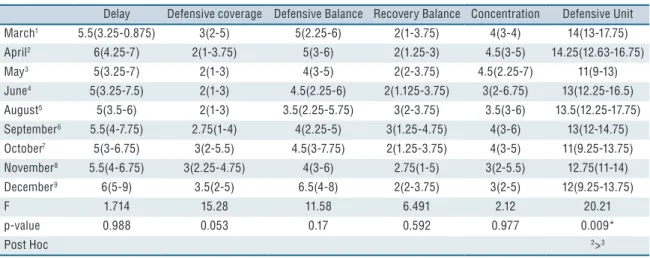
Table 2 below presents the median (interquartile range) of the fun-damental tactical defense principles throughout the season. Results show signiicant diferences only in the incidence of defensive unit actions (F = 20.21, p = 0.009), with higher incidence in April than in May. However, consistent diferences throughout the season were not reported in any defensive tactical principles.
Table 2: Comparison of the incidence of fundamental tactical defense principles throughout the season.
Delay Defensive coverage Defensive Balance Recovery Balance Concentration Defensive Unit
March1 5.5(3.25-0.875) 3(2-5) 5(2.25-6) 2(1-3.75) 4(3-4) 14(13-17.75)
April2 6(4.25-7) 2(1-3.75) 5(3-6) 2(1.25-3) 4.5(3-5) 14.25(12.63-16.75)
May3 5(3.25-7) 2(1-3) 4(3-5) 2(2-3.75) 4.5(2.25-7) 11(9-13)
June4 5(3.25-7.5) 2(1-3) 4.5(2.25-6) 2(1.125-3.75) 3(2-6.75) 13(12.25-16.5)
August5 5(3.5-6) 2(1-3) 3.5(2.25-5.75) 3(2-3.75) 3.5(3-6) 13.5(12.25-17.75)
September6 5.5(4-7.75) 2.75(1-4) 4(2.25-5) 3(1.25-4.75) 4(3-6) 13(12-14.75)
October7 5(3-6.75) 3(2-5.5) 4.5(3-7.75) 2(1.25-3.75) 4(3-5) 11(9.25-13.75)
November8 5.5(4-6.75) 3(2.25-4.75) 4(3-6) 2.75(1-5) 3(2-5.5) 12.75(11-14)
December9 6(5-9) 3.5(2-5) 6.5(4-8) 2(2-3.75) 3(2-5) 12(9.25-13.75)
F 1.714 15.28 11.58 6.491 2.12 20.21
p-value 0.988 0.053 0.17 0.592 0.977 0.009*
Post Hoc 2>3
* Significant differences
Tactical Behavior in Soccer Praça et al.
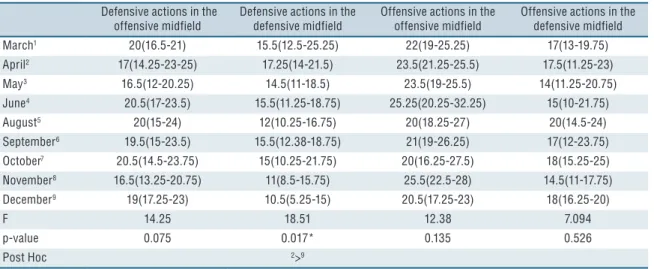
incidence of defensive actions in the defensive midield was reported in April compared to December (F = 18.51, p = 0.017), with no diferences in the other variables investigated.
Table 3: Comparison of the incidence of tactical actions on the playing field during the season. Defensive actions in the
offensive midfield
Defensive actions in the defensive midfield
Offensive actions in the offensive midfield
Offensive actions in the defensive midfield
March1 20(16.5-21) 15.5(12.5-25.25) 22(19-25.25) 17(13-19.75)
April2 17(14.25-23-25) 17.25(14-21.5) 23.5(21.25-25.5) 17.5(11.25-23)
May3 16.5(12-20.25) 14.5(11-18.5) 23.5(19-25.5) 14(11.25-20.75)
June4 20.5(17-23.5) 15.5(11.25-18.75) 25.25(20.25-32.25) 15(10-21.75)
August5 20(15-24) 12(10.25-16.75) 20(18.25-27) 20(14.5-24)
September6 19.5(15-23.5) 15.5(12.38-18.75) 21(19-26.25) 17(12-23.75)
October7 20.5(14.5-23.75) 15(10.25-21.75) 20(16.25-27.5) 18(15.25-25)
November8 16.5(13.25-20.75) 11(8.5-15.75) 25.5(22.5-28) 14.5(11-17.75)
December9 19(17.25-23) 10.5(5.25-15) 20.5(17.25-23) 18(16.25-20)
F 14.25 18.51 12.38 7.094
p-value 0.075 0.017* 0.135 0.526
Post Hoc 2>9
* Significant differences.
Finally, Table 4 presents the comparison of the percentage of positive tactical principles throughout the season. Results indicate an improvement in the percentage of positive ofensive (F = 15.367, p = 0.001, moderate efect) and defensive (F = 6.642, p = 0.001, moderate efect) tactical prin-ciples throughout the season.
Table 4: Comparison of the percentage of positive offensive and defensive tactical principles throughout the season.
% Positive offensive
prin-ciples
% Positive defensive prin-ciples
March1 0.58 (0.09) 0.50 (0.15)
April2 0.78 (0.09) 0.69 (0.15)
May3 0.69 (0.13) 0.54 (0.24)
June4 0.79 (0.08) 0.56 (0.25)
August5 0.78 (0.09) 0.60 (0.20)
September6 0.79 (0.09) 0.59 (0.20)
October7 0.71 (0.10) 0.53 (0.16)
November8 0.85 (0.08) 0.73 (0.13)
December9 0.92 (0.05) 0.87 (0.07)
F 15.367 6.642
P-value 0.001* 0.001*
Effect size 0.484 0.289
Post-Hoc
9>1,2,3,4,5,6,7 9>1,3,4,5,6,7
8>1,3,7 8>1
1<2,3,4,5,6,7
his study aimed to compare the tactical behavior of youth soccer players throughout a sports season. Results have shown consistent diferences along the season only in the incidence of ofensive unit actions. Improvement in tactical defensive and ofensive actions throughout the analyzed period was also observed.
Aquino et al.13 reported an improvement in the ofensive and
defen-sive tactical performance indexes of 10 and 11-year-old practitioners after 37 soccer training sessions guided by a tactical-based teaching model. Similarly, the present study pointed to improvements in both ofensive and defensive tactical behavior of athletes throughout the sporting season, with higher values for both variables in the last test procedure compared to the irst measurement. he acquisition of tactical skills is justiied by the constant exposure of athletes to learning situations, which allow them a better use of knowledge structures, which results in greater capacity to perceive-act in problem situations of the game22.
In a complementary way, consistent longitudinal modiications were observed throughout the sports season in only one fundamental tactical principle. his result is in line with the indings of Souza et al.12, who
reported diferences in the incidence of only one tactical principle after 20 training sessions in soccer. At this point, previous studies have also shown diferences in a few tactical principles among U-14 and U-158 athletes,
although there is a greater convergent and divergent tactical knowledge in U-15 athletes compared to U-14 athletes23 and a higher percentage of
positive tactical principles in athletes of higher training levels (U-17)24.
Literature also reports no efect of age on the incidence of technical ac-tions in soccer, although greater eicacy is observed25. In this sense, it
is suggested that the soccer training process allows athletes not only to acquire knowledge about “what to do”, but, at the same time, leads to the development of knowledge structures related to “how”, “where” and “when” to do26, that is, the ability to manage decision-making to solve problems
and to relate, in the game, declarative and procedural tactical knowledge. hus, throughout the sporting season, in spite of performing similar actions (same incidence in diferent tactical principles), athletes are able to execute them with higher quality (greater percentage of positive principles), which represents an improvement in tactical skills. At this point, the present re-sults reinforce the “proceduralization” model of tactical knowledge27, that
is, the transfer from declarative knowledge - what to do - into procedural knowledge - how to do.
Previous studies have shown lower incidence of ofensive unit actions in small-sized games 6x6 compared to 3x328, in addition to lower incidence
of this principle in midielders compared to attackers11. In both cases, it is
Tactical Behavior in Soccer Praça et al.
the playing ield, or by the speciicities of each positional status11. In this
sense, it is suggested that the reduction in the incidence of ofensive unit actions shown in the present study represents an increase in the players’ ability to position themselves near the game ield, increasing support to the player with the ball and creating closer pass lines, a process also resulting from the improvement in the tactical capacity discussed above.
his study represented the irst attempt to characterize the tactical skills of youth players throughout a sports season. However, limitations regarding the sample size and speciicity of the team play model suggest caution in extrapolating the present results to other practice contexts. Speciically, the behaviors observed in this study refer to elite athletes of the U-15 category, for which future studies are recommended, including athletes from lower-level teams (regional and local) and other age groups. In this sense, further studies complementing the information presented here are suggested, namely by performing interventions in the T-L-T pro-cesses. hus, through the manipulation of training contents and teaching models, the possibility of qualiied intervention of coaches and teachers for the development of tactical skills in youth soccer players will be expanded.
CONCLUSION
his study reported an improvement in the percentage of positive ofen-sive and defenofen-sive tactics throughout the sports season, accompanied by a change in the incidence of ofensive unit actions. Results indicate changes in tactical skills as a result of a sports season in U-15 athletes.
Acknowledgments
he authors would like to thank the professionals of the “Clube Atlético Mineiro” for the support in data collection and to the Pró-reitoria de Pes-quisa of the Universidade Federal de Minas Gerais and the Foundation for Research Support of the State of Minas Gerais for inancial support.
REFERENCES
1. Garganta J. Trends of tactical performance analysis in team sports: bridging the gap between research, training and competition. Rev Port Cien Desporto 2009;9(1):81-89.
2. Kannekens R, Elferink-Gemser MT, Visscher C. Tactical skills of world-class youth soccer teams. J Sports Sci 2009;27(8):807-812.
3. Greco PJ. Conhecimento tático-técnico: eixo pendular da ação tática (criativa) nos jogos esportivos coletivos. Rev Bras Educ Fís Esporte 2006;20(sup.5):210-2.
4. Teoldo I, Greco PJ, Garganta J, Costa V, Mesquita I. Ensino-aprendizagem e treinamento dos comportamentos tático-técnicos no futebol. Rev Mackenzie Educ Fís Esporte 2010;9(2):41-61.
5. Teoldo I, Garganta JM, Greco PJ, Mesquita I, Maia J. System of tactical assess-ment in Soccer (FUT-SAT): Developassess-ment and preliminary validation. Motri 2011;7(1):69-83.
8. Brito e Sousa R, Soares VOV, Praça GM, Matias CJAS, Teoldo I, Greco PJ. Avaliação do comportamento tático no futebol: princípios táticos fundamentais nas categorias sub-14 e sub-15. Rev Bras Cienc Mov 2014;23(2):59-65.
9. Machado G, Gonçalves E, Teoldo I. Comparação entre o comportamento tático de jogadores de futebol das categorias sub-11 e sub-13. Rev Min Educ Fis 2013;9(supp):701–707.
10. Costa BRS, Almeida RF, Teoldo I. Estudo comparativo do comportamento tático desempenhado por jogadores de futebol das categorias sub-13 e sub-15. Rev Educ Fís/UEM 2015;26(4):557-66.
11. Praça GM, Pérez-Morales JC, Greco PJ. Inluência do estatuto posicional no comportamento tático durante jogos reduzidos no futebol: um estudo de caso em atletas sub-17 de elite. Rev Port Cien Desporto 2016;16(S2A):194-206.
12. Souza CRBC, Muller ES, Teoldo I, Graça, A. Quais comportamentos táticos de jogadores de futebol da categoria sub-14 podem melhorar após 20 sessões de treino? Rev Bras Ciênc Esporte 2014;36(1):71-86.
13. Aquino RLQT, Marques RFR, Gonçalves LGC, Vieira LHP, Bedo BLS, Moraes C, Menezes RP, Santiago PRP, Puggina EF. Proposta de sistematização de ensino do futebol baseada em jogos: desenvolvimento do conhecimento tático em jogadores com 10 e 11 anos de idade. Motri 2015;11(2):115-28.
14. Güllich A, Kovar P, Zart S, Reimann A. Sport activities diferentiating match-play improvement in elite youth footballers – a 2-year longitudinal study. J Sports Sci 2017;35(3):207-215.
15. Mesquita I, Hastie P. he impact of a hybrid Sport Education-Invasion Games Competence Model soccer unit on student’s decision making, skill execution and overall game performance. Eur Phys Educ Rev 2012;18(2):205-219.
16. Praça GM, Folgado H, Andrade AGP, Greco PJ. Inluence of additional players on collective tactical behavior in small-sided soccer games. Rev Bras Cineantropom Desempenho Hum 2016;18(1):62-71.
17. Bush M, Barnes C, Archer DT, Hogg B, Bradley P. Evolution of match perfor-mance parameters for various playing positions in the English Premier League. Hum Movement Sci 2015;39:1-11.
18. Ferguson CJ. An efect size primer: A guide for clinicians and researchers. Prof Psychol Res Pr 2009;40(5):532–538.
19. Tabachnick BG, Fidell LS. Using multivariate statistics. 5ª. Boston: Pearson Education. Inc., 2007.
20. Robinson G, O’Donoghue PG. A weghted kappa statistic for reliability testing in performance analysis of sport. Int J Perform Anal Sport 2007;7(11):12-9.
21. Landis JR, Koch GC. he measurement of observer agreement for categorical data. Biometrics 1977;33(1):159-174.
22. Johnson J. Cognitive modeling of decision-making in sports. Psychol Sport Exerc 2006;7(6):631-52.
23. Giacomini DS, Greco PJ. Comparação do conhecimento tático processual em joga-dores de diferentes categorias e posições. Rev Port Cien Desporto 2008;8(1):126-36.
24. Américo HB, Cardoso F, Machado G, Andrade MOC, Resende ER, Teoldo I. Análise do comportamento tático dos jogadores de futebol de categoria de base. Rev Educ Fís/UEM 2016;27(1):e2710.
25. Gastin PB, Tangalos C, Torres L, Robertson S. Match running performance and skill execution improves with age but not the number of disposals in young Australian footballers. J Sport Sci in press.
26. Matias CJAS, Greco PJ. Cognição & ação nos jogos esportivos coletivos. Ciênc Cogn 2010;15(1):252-71.
27. Anderson JR. Acquisition of cognitive skill. Psychol Rev 1982;89(4):369-406.
28. Silva B, Garganta J, Santos R, Teoldo I. Comparing Tactical Behaviour of Soccer Players in 3 vs. 3 and 6 vs. 6 Small-Sided Games. J Hum Kinet 2014;41:191-202.
CORRESPONDING AUTHOR
Gibson Moreira Praça
Departamento de Esportes. Escola de Educação Física, Fisioterapia e Terapia Ocupacional. Universidade Federal de Minas Gerais. Avenida Presidente Antônio Carlos, 6627. Campus Pampulha. Belo Horizonte, MG, Brasil.
CEP 31270-901