Procedures adopted by orthodontists for space closure
and anchorage control
André da Costa Monini1, Luiz Gonzaga Gandini Júnior2, Ary dos Santos-Pinto2, Luiz Guilherme Martins Maia1, Willian Caetano Rodrigues3
How to cite this article: Monini AC, Gandini Júnior LG, Santos-Pinto A, Maia LGM, Rodrigues WC. Procedures adopted by orthodontists for space closure and anchorage control. Dental Press J Orthod. 2013 Nov-Dec;18(6):86-92.
Submitted: August 29, 2011 - Revised and accepted: March 24, 2012
» The authors report no commercial, proprietary or inancial interest in the prod-ucts or companies described in this article.
Contact address: Luiz Gonzaga Gandini Júnior
Av. Casemiro Perez, 560 – Vila Harmonia – Araraquara/SP — Brazil — CEP: 14.802-600
E-mail: [email protected] 1 PhD in Orthodontics, FOAr-UNESP.
2 Full professor in Orthodontics, FOAr-UNESP.
3 MSc in Laser in Dentistry, USP.
Objective:The aim of this study was to identify the procedures adopted by Brazilian orthodontists in the follow-ing situations: extraction space closure, anchorage control in case of necessary anchorage for group A and frequency of skeletal anchorage use, especially in the upper jaw. Method: A questionnaire was sent to the e-mail address of all dentists registered in the Brazilian Federal Council of Dentistry. Results: The results showed that most Brazilian or-thodontists usually perform extraction space closure by means of sliding mechanics. The use of palatal bar, inclusion of second molars in the archwire and space closure performed in two phases are the most used techniques for anchorage control in the upper jaw. The skeletal anchorage is referenced by 36.5% of specialists as a routine practice for the upper jaw anchorage. Conclusions: There is a wide variety of procedures adopted by Brazilian orthodontists for orthodontic space closure and anchorage control.
Keywords:Orthodontic anchorage procedures. Orthodontic space closure. Questionnaires.
Objetivo:esse trabalho tem o objetivo de identificar as condutas adotadas pelos ortodontistas brasileiros para o fecha-mento ortodôntico de espaços de extrações, controle de ancoragem em caso de necessidade de ancoragem do grupo A, e frequência de uso de ancoragem esquelética nesses casos, especialmente na arcada superior. Métodos: um questio-nário foi enviado para o endereço eletrônico de todos os ortodontistas inscritos no Conselho Federal de Odontologia.
Resultados: os resultados mostraram que a maioria dos ortodontistas brasileiros usualmente faz fechamento de espaço de extrações com mecânicas de deslizamento. O uso de barra palatina, incorporação de segundos molares no arco e fe-chamento de espaço em duas fases são as condutas mais utilizadas para controle de ancoragem na arcada superior. A an-coragem esquelética é referenciada por 36,5% dos especialistas como forma rotineira de anA an-coragem na arcada superior.
Conclusões: existe uma grande variedade de condutas adotas por ortodontistas brasileiros tanto para o fechamento ortodôntico de espaço quanto para o controle de ancoragem em casos de maior necessidade de retração anterior.
introduction
Since the introduction of dental extractions as a treatment resource, many space closure and anchor-age control procedures have been developed. Space closure mechanics can be classified into two forms: with or without friction. Friction mechanics is that in which the teeth slide on the archwire or the arch-wire slides on the brackets, whereas in frictionless mechanics the teeth are moved by loop action. An-chorage is classified in accordance with the differ-ential space closure required between anterior and
posterior teeth.2 Group A anchorage is that in which
posterior segments must remain in their original po-sition and space is fully closed by anterior retraction. Group B anchorage requires that approximately half of the space be used for retraction. Group C anchor-age requires that nearly the entire space be closed by protraction of the posterior teeth.
Studies assessing clinical procedures for space
clo-sure and anchorage control are not common,10
espe-cially in Brazil. Assessing the procedures employed by Brazilian practitioners may be beneicial for clinicians who can compare their own practice with those pre-sented by the researches and re-evaluate them in future studies. Furthermore, it is a way of identifying the most common clinical practices and those that are in disuse, in addition to the professional training received, which can result in changes in personal practice.
Thus, this paper aims at identifying the procedures adopted by Brazilian orthodontists for extraction space closure, anchorage control in case of necessary anchor-age for Group A and frequency of skeletal anchoranchor-age use in these cases, especially in the upper jaw.
Material and Methods
On October 23rd, 2008, the Brazilian Federal
Council of Dentistry (FCD) had 10,121 orthodon-tists duly registered, 7,572 of which were registered as specialists in Orthodontics and Facial Orthope-dics and 2,549 in Orthodontics. There were 5,423 electronic mails registered. A questionnaire (Fig. 1) was sent to these e-mails with objective and discur-sive questions about their practice regarding anchor-age control and space closure. Out of the total num-ber of electronic addresses, 1,464 were not active and 337 were repeated. Thus, 3,650 electronic mails were actually sent.
The questionnaire comprised six questions, two of which were objective while four were discursive. Ques-tion 1 asked about the space closure technique most commonly adopted by the practitioner in his oice routine. Question 2 asked about the resources used by them for anchorage control in the upper jaw, in cases of maximum control, with no restrictions on the conduct adopted. Questions 3.1 and 3.2 were about professional conduct for space closure and anchorage control in a case
1. What is the MOST COMMON technique for extraction space closure used in your oice?
a ( ) Elastomeric chain from molar to molar
b ( ) Active ligature (elastomeric chain combined with ligature)
c ( ) Bull loop d ( ) NiTi coil spring
e ( ) Laceback
f ( ) Other. What?______________
2. In extraction cases requiring maximum anchorage in the upper jaw (the lowest mesial molar movement possible) ROUTINELY, which feature (s) is/are
used in your oice?
a ( ) Palatal bar
b ( ) Nance palatal button c ( ) Cortical bone anchorage
d ( ) Molar tip-back
e ( ) Including second molar in the archwire
f ( ) Canines retraction followed by incisors retraction g ( ) Headgear
h ( ) Class II elastic
i ( ) TAD - temporary anchorage device
j ( ) Other resource. What?______________________
3. Consider the following case: adult patient with complete bilateral Class II.
The proposed treatment included extraction of two upper irst premolars and retraction of anterior teeth. The patient WILL NOT USE EXTRAORAL APPLIANCE
NEITHER MINI-SCREW. In your oice, in this situation:
3.1 - How is extraction space closure performed?
3.2 - How is anchorage control performed?
4. Consider the following case: adult patient with class I. The proposed treatment included extractions of four irst premolars with maximum
retraction of anterior teeth. The patient WILL NOT USE EXTRAORAL APPLIANCE NEITHER MINI-SCREW. In your oice, in this situation:
4.1 - How is extraction space closure performed?
4.2 - How is anchorage control performed?
requiring greater control in the upper posterior anchor-age, in an adult patient with restrictions on the use of headgear (HG) and mini-screws. Questions 4.1 and 4.2 were about professional conduct for space closure and anchorage control in a case requiring greater control of posterior anchorage in both arches, in an adult patient with restrictions on the use of HG and mini-screws.
The data obtained in the questionnaires were com-puterized by means of a database created by a Microsot Excel 2007 spreadsheet. The same sotware was used to survey the frequency of responses. The results were analyzed by descriptive statistics.
results
A total of 597 (16.38%) e-mails were sent back. Taking into account the total number of members en-rolled in the Brazilian Federal Council of Dentistry, the percentage of response was 5.90%.
The responses were tabulated according to the number of answers the professional chose. Thus, score 1 corresponded to one answer; score 2 represented
two answers and score 3 corresponded to three alter-natives and so on.
The results of Question 1 are shown in Table 1. They demonstrate that 63.81% use sliding mechan-ics (friction) while 36.18% use mechanical attraction (frictionless) for space closure. 19.26% of the special-ists indicated more than one answer to this question.
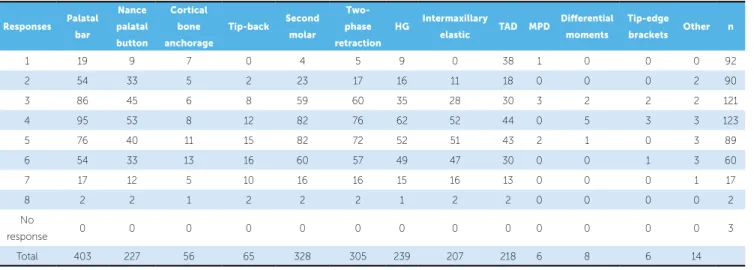
As for Question 2, when asked about the re-sources used for anchorage control in the upper jaw, the two most frequent responses were the use of pal-atal bar (403) and the inclusion of the second molar in the arch (328) (Table 2). Approximately 36.5% of the respondents claimed to routinely use skeletal anchorage devices in cases of maximum anchorage in the upper jaw.
Table 3 shows the results of Questions 3.1 and 4.1 regarding the space closure technique used in hypothet-ical cases of Class II and I in Group A anchorage.
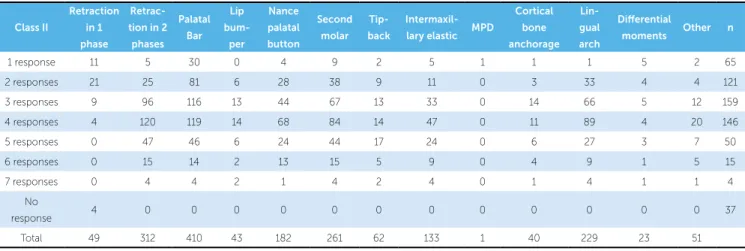
Tables 4 and 5 show the results regarding the special-ist’s conduct of anchorage control in case of hypothetical treatment of Class II and I malocclusion, respectively,
Responses Active ligature
Elastomeric chain
Bull loop
NiTi Coil
Spring Laceback T loop
DKL loop
Ricketts loops
Other
resource n
1 141 75 116 29 28 19 23 21 34 482
2 50 26 29 32 23 7 7 1 3 88
3 11 9 15 14 9 6 3 0 2 23
4 3 2 2 4 4 1 0 0 0 4
Total 205 112 162 79 64 33 33 22 39
Table 1 - Absolute frequency of responses to Question 1.
n = number os specialists. The values of the answers correspond to the number of options given by the same professional.
Table 2 - Absolute frequency of responses to Question 2.
Second molar = second molar must be included in the arch as an anchorage element; two-phase retraction = canine retraction followed by incisors retraction; HG= headgear; TAD= Temporary Skeletal Anchorage Devices; MPD = Mandibular propulsion devices; N= number of specialists.
Responses Palatal
bar
Nance
palatal
button
Cortical
bone
anchorage
Tip-back Second
molar
Two-phase
retraction
HG Intermaxillary
elastic TAD MPD
Diferential
moments
Tip-edge
brackets Other n
1 19 9 7 0 4 5 9 0 38 1 0 0 0 92
2 54 33 5 2 23 17 16 11 18 0 0 0 2 90
3 86 45 6 8 59 60 35 28 30 3 2 2 2 121
4 95 53 8 12 82 76 62 52 44 0 5 3 3 123
5 76 40 11 15 82 72 52 51 43 2 1 0 3 89
6 54 33 13 16 60 57 49 47 30 0 0 1 3 60
7 17 12 5 10 16 16 15 16 13 0 0 0 1 17
8 2 2 1 2 2 2 1 2 2 0 0 0 0 2
No
response 0 0 0 0 0 0 0 0 0 0 0 0 0 3
Table 4 - Frequency of responses to Question 3.2.
Retraction in 1 phase = retraction of incisors and canines in one step; retraction in 2 phases = retraction of the canines and posterior retraction of the incisors; second molar = inclusion of second molar in the archwire as an anchor; MPD = Mandibular propulsion device, N = number of specialists.
class ii
retrac-tion in 1
phase two-phase retraction Palatal Bar lip bum-per nance palatal button second molar tip-back intermaxil-lary elastic MPd
cortical bone anchorage lin-gual arch diferential
moments other n
1 response 14 5 41 0 9 3 1 9 4 0 0 2 0 72
2 responses 14 64 108 0 29 40 3 63 5 2 0 4 1 160
3 responses 9 148 150 0 78 94 9 103 2 7 3 7 6 201
4 responses 1 97 98 0 57 88 12 78 1 4 4 0 4 111
5 responses 1 33 31 1 22 33 9 31 0 5 2 2 0 34
6 responses 0 2 2 0 2 2 1 1 0 2 0 0 0 2
7 responses 0 1 1 0 0 1 1 1 0 0 0 1 1 1
No
response 0 0 0 0 0 0 0 0 0 0 0 0 0 16
Total 39 350 431 1 197 261 36 286 12 20 9 16 12
Table 5 - Frequency of responses to Question 4.2.
Retraction in 1 phase = retraction of incisors and canines in one step; retraction in 2 phases = retraction of the canines and posterior retraction of the incisors; second molar = inclusion of second molar in the archwire as an anchor; MPD = Mandibular propulsion device, N = number of specialists.
class ii
retraction
in 1 phase
retrac-tion in 2 phases Palatal Bar lip bum-per nance palatal button second molar tip-back intermaxil-lary elastic MPd
cortical bone anchorage lin-gual arch diferential
moments other n
1 response 11 5 30 0 4 9 2 5 1 1 1 5 2 65
2 responses 21 25 81 6 28 38 9 11 0 3 33 4 4 121
3 responses 9 96 116 13 44 67 13 33 0 14 66 5 12 159
4 responses 4 120 119 14 68 84 14 47 0 11 89 4 20 146
5 responses 0 47 46 6 24 44 17 24 0 6 27 3 7 50
6 responses 0 15 14 2 13 15 5 9 0 4 9 1 5 15
7 responses 0 4 4 2 1 4 2 4 0 1 4 1 1 4
No
response 4 0 0 0 0 0 0 0 0 0 0 0 0 37
Total 49 312 410 43 182 261 62 133 1 40 229 23 51
Table 3 - Absolute (n) and relative (%) frequency of responses to questions 3.1 and 4.1.
Malocclusion Bull loop n (%) DKLV loop n (%) Ricketts loops n (%) Segmented T-Loop n (%) Continuous T-Loop n (%) Others loops n (%) Sliding mechanics n (%)
Sliding to the canine and loop to the incisors n (%)
No response n (%)
Class II 60 (10.05) 27 (4.52) 24 (4.02) 26 (4.36) 17 (2.85) 54 (9.05) 215 (36.01) 79 (13.23) 95 (15.91)
Class I 42 (7.04) 34 (5.70) 19 (3.18) 16 (2.68) 9 (1.51) 45 (7.54) 223 (37.35) 82 (13.74) 127(21.27)
in Group A anchorage. The two most frequent respons-es in both malocclusions are the use of palatal bar and space closure initially performed with canine retraction, followed by incisors retraction.
discussion
This research was carried out by means of electronic mail, with 16.38% of response rate. International studies
using questionnaires report a response rate of about
50% with questionnaires being applied to patients.15
Some studies carried out in Brazil with questionnaires being applied to professionals presented similar rates
in comparison to the present research.4,6,14 Studies
in-volving a sample of orthodontists presented a response
rate of 6%3 to 7.7%.10 Our results had the response rate
The interest and/or knowledge about the subject involved in the research could have influenced the
re-sponse rates.4,9 Presenting a short questionnaire was
of paramount importance to increase the response
rate.15 Despite the fact that the questionnaire applied
in this research comprised six questions, only, the presence of four open questions may have influenced the response rates. The results showed that the ma-jority of specialists (63.81%) prefer the technique based on friction mechanics for orthodontic space closure. Moreover, active ligature and elastomeric chain proved to be the most used resources in this technique (Table 1). Space closure is the most sig-nificant change occurring during the transition peri-od from standard edgewise to preadjusted appliance
systems.13 The preadjusted brackets allowed the use
of different techniques for sliding mechanics and the results proved this technique to be highly accepted, when applied. The results of this research are lower than the ones yielded by a British study, in which loops were practically not used for space closure and
the sliding technique was used at a rate of 98%.1
With regard to Question 2, which questioned about the resources used for anchorage control in the upper jaw, the use of palatal bar and inclusion of the second molar in the archwire were the most cited answers (Table 2). Although it has been widely used for an-chorage, the palatal bar does not signiicantly improve
molar mesialization control in extraction cases.5,11,12,16,18
A longitudinal study concerning the techniques used by American orthodontists showed a decrease in the use of palatal bars. In 2008, only 20% of those who answered the questionnaire stated the use of that
de-vice.10 Likewise, a British study showed a percentage
of 24.6%.1 Even though it is not possible to assert that
the device has not been widely used due to being inef-fective for anchorage control, that is probably the rea-son. Nearly half of the specialists (40.8%) combine at least 3 or 4 diferent techniques for anchorage control in the upper jaw, which means they chose 3 or 4 an-swers to the same question. As for this question, the specialists could choose skeletal and headgear anchor-age techniques. More than 35% (36.5%) of the ex-perts claimed to use the skeletal anchorage technique on a daily basis for group A anchorage in the upper jaw.
Previous studies revealed that 20.3%3 to 39.3%10 of
interviewed orthodontists claim that they have never
used mini-screws. These researches are used as refer-ence, but cannot be compared to the present study be-cause the latter used the skeletal anchorage technique for anchorage control in space closure while the
oth-ers3,10 have considered all clinical cases. One of these
re-searches9 showed that using skeletal anchorage for
an-chorage control is the second technique orthodontists recommend the most, while molar mesialization is the irst. However, another study demonstrated that molar intrusion followed by Class II malocclusion treatment
are the main indications for the use of mini-screws.10
Additionally, it is worth noting that the skeletal an-chorage technique is used by Brazilian orthodontists
more than it is used by the British. Only 0.2%1 have
claimed to use that technique. However, we must bear in mind that this British study was conducted 2 years before the current study.
Questions 3.1 and 4.1 questioned about extrac-tion space closure techniques in cases of Class I and II in which anchorage is strictly necessary (Table 3). The percentage regarding the use of the sliding technique was 36% and 37.3% in Class II and I, re-spectively. These results decrease when compared to the results of the first question (63.81%). Ap-parently, specialists take special care with the cases that have been presented in comparison to common cases. Unfortunately, a high percentage of specialists did not clearly state the answer for these questions, which may result in biased interpretation. With re-gard to anchorage control, no studies suggesting that retraction performed by means of frictionless me-chanics is superior to friction meme-chanics have been carried out. It has been widely accepted that the use of loops allows clinicians to calibrate forces and mo-ment ratios employed during retraction. However, although this situation is extremely advantageous since it provides knowledge of the force systems involved in the mechanics used, there is no scien-tific evidence of it being associated with a better an-chorage control. A few studies have compared both mechanics, however, they do not allow anchorage loss between both space closure techniques to be as-sessed, since patients used headgear or were submit-ted to skeletal anchorage. In other words, the arch sides were not independent from each other, thus, not allowing assessment on the response of the space
Conducts concerning the high need of posterior anchorage control in Class I and II malocclusions are the subject of Questions 3.2 and 4.2 (Tables 4 and 5). When the answers to these questions are compared, nearly 40% of the experts are worried about the use of palatal arch as an anchorage device used for Class I cases, and even more specialists try to avoid the use of intermaxillary elastics. The most common answers with regard to both malocclusions were the use of palatal bar and space closure performed by means of canine retraction at early stages, followed by incisor retraction. To date, two studies aimed at assessing the difference in anchorage loss between space closure performed with unique retraction (one phase) and retraction in two phases (canine retraction followed
by incisors retraction).8,17 The results of both
stud-ies showed no significant difference between these different treatment approaches. There is no support in the literature that states the use of two retractions aiming at preserving anchorage. It is probable that such technique is recommended for cases in which partial canine retraction creates spaces for alignment
of incisors, in cases of crowding.17
Our study reflects the challenges inherent to re-search-based practice. These include not only diffi-culty in recruiting patients who may not be motivat-ed to participate in research, but also self-selection of orthodontists who are eager to participate, both of
which can lead to biased findings.1,9
conclusions
The present study demonstrated that:
» The sliding technique is more commonly pre-scribed by specialists for extraction space closure;
» When specialists are free to choose the technique that is going to be used for anchorage control, they usually perform control based on the use palatal bar with incorporation of second molars. Additionally, when the use of headgear and skeletal anchorage is not possible, the palatal bar and the two-phase space clo-sure technique are the conducts mostly prescribed;
1. Banks P, Elton V, Jones Y, Rice P, Derwent S, Odondi L. The use of fixed appliances in the UK: a survey of specialist orthodontists. J Orthod. 2010;37(1):43-55.
2. Burstone CJ. The segmented arch approach to space closure. Am J
Orthod. 1982;82(5):361-78.
3. Buschang PH, Carrillo R, Ozenbaugh B, Rossouw PE. 2008 survey of
AAO members on miniscrew usage. J Clin Orthod. 2008;42(9):513-8. 4. Cimardi ACBS, Fernandes APS. Câncer bucal: a prática e a realidade clínica
dos cirurgiões-dentistas de Santa Catarina. RFO. 2009;14(2):99-104.
5. Feldmann I, Bondemark L. Anchorage capacity of osseointegrated and
conventional anchorage systems: a randomized controlled trial. Am J Orthod Dentofacial Orthop. 2008;133(3):339 e19-28.
6. Glasberg J, Horiuti L, Novais MAB, Canavezzi AZ, Miranda VDC, Chicoli
FA, et al. Prevalence of the Burnout syndrome among Brazilian medical oncologists. Rev Assoc Med Bras. 2007;53(1):85-9.
7. Hayashi K, Ueshi J, Murata M, Mizogushi I. Comparison of maxillary
canine retraction with sliding mechanics and a retraction spring: a three dimensional analysis based on a midpalatal orthodontic implant. Eur J Orthod. 2004;26(6):585-9.
8. Heo W, Nahm DS, Baek SH. En masse retraction and two-step retraction
of maxillary anterior teeth in adult Class I women. A comparison of anchorage loss. Angle Orthod. 2007;77(6):973-8.
9. Hyde JD, King GJ, Greenlee GM, Spiekerman C, Huang GJ. Survey of
orthodontists’ attitudes and experiences regarding miniscrew implants. J Clin Orthod. 2010;44(8):481-6.
10. Keim RG, Gottlieb EL, Nelson AH, Vogels DS 3rd. 2008 JCO study of orthodontic diagnosis and treatment procedures, part 1: results and trends. J Clin Orthod. 2008;42(11):625-40.
REFERENCES
11. Kojima Y, Fukui H. Effects of transpalatal arch on molar movement produced by mesial force: a finite element simulation. Am J Orthod Dentofacial Orthop. 2008;134(3):335 e331-7; discussion 335-6. 12. Liu YH, Ding WH, Liu J, Li Q. Comparison of the differences in
cephalometric parameters after active orthodontic treatment applying mini-screw implants or transpalatal arches in adult patients with bialveolar dental protrusion. J Oral Rehabil. 2009;36(9):687-95. 13. McLaughlin RP, Bennett JC. The transition from standard edgewise to
preadjusted appliance systems. J Clin Orthod. 1989;23(3):142-53. 14. Moana Filho EJ. Levantamento das atitudes e crenças dos ortodontistas
com relação à disfunção têmporo-mandibular e dor orofacial. Rev Dental Press Ortod Ortop Facial. 2005;10(4):60-75.
15. Nakash RA, Hutton JL, Jorstad-Stein EC, Gates S, Lamb SE. Maximizing response to postal questionnaires: a systematic review of randomized trials in health research. BMC Med Res Method. 2006;6:5.
16. Stivaros N, Lowe C, Dandy N, Doherty B, Mandall NA. A randomized clinical trial to compare the Goshgarian and Nance palatal arch. Eur J Orthod. 2010;32(2):171-6.
17. Xu TM, Zhang X, Oh HS, Boyd RL, Korn EL, Baumrind S. Randomized clinical trial comparing control of maxillary anchorage with 2 retraction techniques. Am J Orthod Dentofacial Orthop. 2010;138(5):544.e541-9; discussion 544-5.
18. Zablocki HL, McNamara Jr JA, Franchi L, Baccetti T. Effect of the transpalatal arch during extraction treatment. Am J Orthod Dentofacial Orthop. 2008;133(6):852-60.