Applicability of Moyers analysis in mixed dentition:
A systematic review
Mariana de Aguiar Bulhões Galvão1, Gladys Cristina Dominguez2, Sérgio Thomaz Tormin3, Alex Akamine3, André Tortamano4, Solange Mongelli de Fantini4
How to cite this article: Galvão MAB, Dominguez GC, Tormin ST, Akamine A, Tortamano A, Fantini SM. Applicability of Moyers analysis in mixed dentition: A systematic review. Dental Press J Orthod. 2013 Nov-Dec;18(6):100-5.
Submitted: December 26, 2011 - Revised and accepted: February 20, 2012
Contact address: Mariana de Aguiar Bulhões Galvão
Av. Dr. Alberto Benedetti, 348 – Sala 1 – Bairro Vila Assunção – Brazil Santo André/SP – CEP: 09.030-340
E-mail: [email protected]
1 PhD Student in Orthodontics, School of Dentistry, USP. 2 Full Professor, School of Dentistry, USP.
3 Professor of Orthodontics, School of Dentistry, USP. 4 Professor of Orthodontics, School of Dentistry, USP.
» The authors report no commercial, proprietary or inancial interest in the prod-ucts or companies described in this article.
Introduction:Moyers analysis is widely used for analyzing mixed dentition, however, the accuracy of its theoretical probability tables has been recently questioned. Taking into consideration the fact the mixed dentition analysis is of paramount importance to precisely determine the space needed for alignment of canines and premolars, this research aimed at objectively assessing in the literature such an important step for orthodontic diagnosis. Methods: A comput-erized search involving articles published on PubMed and Lilacs between 1990 and September, 2011 was conducted in accordance with the method described in the Cochrane 5.1.0 handbook. Results: The research resulted in a sample composed of 629 articles. The inclusion criteria were: Articles using the Moyers analysis with a sample greater or equal to 40 patients. Conversely, the exclusion criteria were: Dental casts of patients with syndromes or oral cleft, researches conducted with a literature review, only, or clinical case reports and researches conducted before 1990. For this systematic review, 19 articles were selected. Conclusion: Based on the literature available, we can conclude that the Moyers mixed dentition analysis must be carefully used, since the majority of the articles analyzed showed that the probability of 75% was not as accurate as expected, leading to the need of adapting the probability levels depending on the study population.
Keywords:Mixed dentition. Malocclusion. Dental eruption.
Introdução:a análise de Moyers é amplamente adotada para a análise da dentição mista, porém, recentemente, a acu-rácia das suas tabelas de probabilidade está sendo questionada. Objetivo: sabendo-se da importância da análise da den-tição mista, na determinação mais precisa possível do espaço necessário para o alinhamento de caninos e pré-molares, o objetivo dessa pesquisa foi avaliar de forma objetiva na literatura este importante passo do diagnóstico ortodôntico.
Métodos: foi realizado um levantamento computadorizado de artigos publicados entre os anos de 1990 a setembro de 2011 nas bases de dados PubMed e LILACS, segundo o método descrito no manual Cochrane 5.1.0. Resultados: a estratégia de busca resultou em 629 artigos. Para ser selecionado, o artigo deveria utilizar a análise de Moyers e ter uma amostra superior ou igual a 40 pacientes. Os critérios de exclusão foram: modelos de gesso de pacientes com algum tipo de síndrome ou fissurados, pesquisas cuja proposta era apenas uma revisão da literatura ou apenas relato de um caso clí-nico, e pesquisas anteriores ao ano de 1990. Para essa revisão sistemática, 19 artigos foram selecionados. Conclusões:
com base na literatura disponível, pode-se concluir que a utilização da análise de Moyers na análise da dentição mista deve ser utilizada de maneira cautelosa, pois, na maioria dos artigos avaliados, 75% não apresentou a acurácia desejada, necessitando de adaptações nos níveis de probabilidade, dependendo da população em estudo.
INTRODUCTION
A correct diagnosis is the first step towards a suc-cessful orthodontic treatment, and mixed dentition analysis1 is considered a fundamental step to make a good diagnosis.2,3
The mixed dentition analysis enables the identi-fication of a tooth size-arch length discrepancy and, according to the results obtained, proposes different treatment approaches such as: Eruption guidance, space regaining, serial extractions or not to inter-vene by keeping the development of the dentition under observation.2,4
The use of an accurate method for predicting the mesiodistal diameter of unerupted canines and pre-molars is essential when verifying the discrepancy between the size of the teeth and the size of den-tal arches in mixed dentition.2 Several methods are used to assess the required space, i.e., to estimate the mesiodistal diameters of unerupted canines and premolars.1,2,4
Most methods use the mandibular permanent in-cisors to predict the sum of mesiodistal dimensions of the canine and premolars, since these incisors are the first to erupt in mixed dentition, have less vari-ability in shape and size, can be easily and accurately measured and have a high correlation with other groups of teeth.5,6,15
The Moyers mixed dentition space analysis meth-od is currently the most widely used.3,4,5,7,8 It estab-lished a probability table to predict the mesiodistal diameter of unerupted canines and premolars, in both arches.9 This table uses the sum of mesiodistal diam-eters of the four mandibular incisors and, for each value obtained in the sum of the four mandibular in-cisors, there is a corresponding value for unerupted canines and premolars of each quadrant. It was de-veloped at the University of Michigan from a sample comprising northern European white subjects.7,9
The probabilities range from 5% to 95% and the author suggests the use of the table at a level of 75% in order to overestimate the value and avoid poten-tial crowding. According to the author, this method has some advantages, such as: Minimum systematic error, it can be easily and safely used by beginners or specialists, it is fast and does not require the use of radiographies and also may be carried out directly in the mouth.9
The purpose of this study was to carry out a sys-tematically review about the effectiveness of Moy-ers mixed dentition space analysis in predicting un-erupted teeth.
MATERIAL AND METHODS
The systematic review was carried out in accor-dance with the Cochrane Handbook for Systematic Reviews of Interventions 5.1.0.
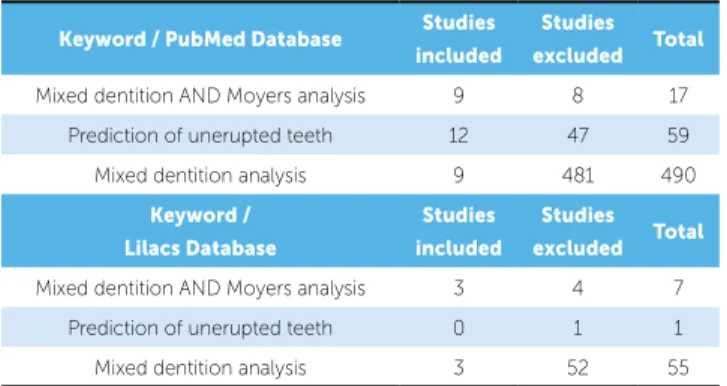
A computerized search was conducted by means of researching articles published from January 1990 to September 2011 on PubMed (http://www.ncbi.nlm. nih.gov/pubmed/) and Lilacs (http://regional.bvsalud. org/php). The keywords used and the number of ar-ticles found are shown in Table 1. The keywords were inserted into the databases without restricting the pe-riod of publication of articles. The inclusion criteria were as follows: Sample greater than or equal to 40 dental casts and the use of Moyers mixed dentition space analysis to predict unerupted canines and pre-molars. Conversely, the exclusion criteria were: Den-tal casts of patients with some type of syndrome or cleft patients, literature reviews, clinical case reports and researches carried out prior to 1990.
Two reviewers independently assessed all the ar-ticles abstracts. All abstracts meeting the initial inclu-sion criteria were selected, those that did not provide enough information to determine their suitability to the inclusion criteria were selected too, so that the i-nal decision would be made with the complete article.
RESULTS
The research resulted in a sample composed of 629 articles. Ater analyzing them according to the inclu-sion/exclusion criteria, 36 articles were selected for analysis, 30 from PubMed database and 6 from Li-lacs. The inal total number of selected articles was 19, since 17 articles were duplicated in the search results. The number of selected articles and methodological criteria of systematic review are shown in Table 2.
The Kappa index of agreement between reviewers was 1.00.
were excluded, while in the PubMed database 536 articles were excluded.
Most articles were excluded because they were not related to prediction of unerupted canines and premolars, followed by articles published out of the stipulated period and by studies that did not use the Moyers analysis.
All 19 articles were entirely read, except for one article written in Chinese which had to be evaluated by the title and abstract in English.
Among 19 articles, only two14 enabled the use of a probability level of 75% in both arches and for both genders.
In 10 articles,2-5,7,16-20 the probability table had to be adapted in order to make the Moyers analysis
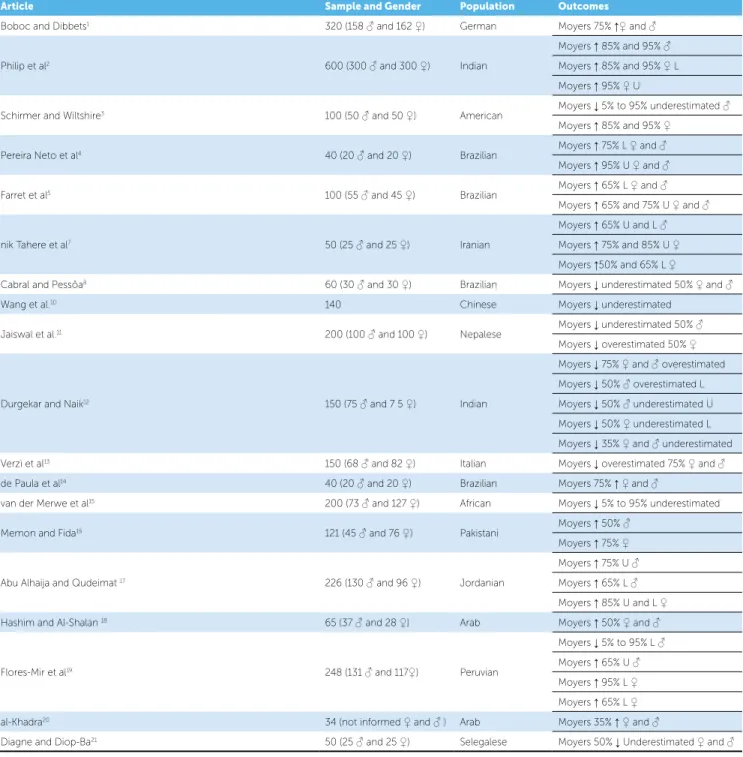
appropri-ate to their population and, in 7 articles,8,10-13,15,21 the Moyers mixed dentition space analysis was not suit-able for prediction of canines and premolars. Summa-rized data of the articles are shown in Table 4.
DISCUSSION
A systematic review is a literature review focused on a research question that tries to identify, appraise, select and synthesize all high quality research evi-dences relevant to that question in order to help our clinical approach.
Inclusion and exclusion criteria for this systematic review were determined with the aim of selecting the most relevant papers on the subject in question, only.
The mixed dentition analysis is a fundamental step that should always be performed in orthodontic diagnosis and planning of patients with mixed den-tition.2,3 The use of an inappropriate method may hinder the entire treatment plan because both over-estimation and underover-estimation of crown diameters of unerupted canines and premolars can influence treatment planning, especially decisions regarding extractions.
Moyers mixed dentition space analysis method is currently the most widely used (1963),3,4,5,7,8 but re-cently, its accuracy has been questioned, mainly be-cause its probability table was developed on the basis of a population with a Northern European ancestry.
In recent years, studies have shown that the pre-diction tables formulated by Moyers is neither accu-rate nor applicable when applied to a population of different ethnic origin, due to the fact that the values obtained at 75% (as recommended by the author) do not correspond to the real values.2,3,5,7,12,13,15,19
The biggest clinical problem exists when, at 75%, the predicted values underestimate the real values, in which case there will not be enough space to properly align the teeth. When the values overestimate the real values, it means that there will be more space to ac-commodate the posterior teeth, which is not consid-ered a real clinical problem.
Table 4 shows that in several studies, Moyers prob-ability tables underestimated2,3,4,8,10,15 the real values at 75%. In other studies,5,7,12,13 the predicted values overestimated the real ones. This means that Moy-ers mixed dentition space analysis was not appropriate for most populations evaluated.
Number Keyword PUBMED LILACS
1 Mixed dentition AND Moyers analysis 17 7
2 Prediction of unerupted teeth 59 1
3 Mixed dentition analysis 490 55
Table 1 - Strategy for literature research.
Table 2 - Studies included and excluded after reviewers’ analyses.
Keyword / PubMed Database Studies
included
Studies
excluded Total
Mixed dentition AND Moyers analysis 9 8 17
Prediction of unerupted teeth 12 47 59
Mixed dentition analysis 9 481 490
Keyword / Lilacs Database
Studies included
Studies
excluded Total
Mixed dentition AND Moyers analysis 3 4 7
Prediction of unerupted teeth 0 1 1
Mixed dentition analysis 3 52 55
Table 3 - Reasons for articles exclusion.
Reasons for exclusion LILACS PubMed Total
Sample with less than 40 subjects 5 3 8
Patients with some type of syndrome or
cleft patients 0 4 4
Moyers analysis was not used 4 37 41
Research was not about predicting space 43 392 435
Literature review/case reports 3 4 7
Research conducted prior to 1990 2 96 98
Table 4 - Summarized data of the 19 articles included in this review.
↑ = High correlation of real values with the values found after Moyers analysis.
↓= Low correlation of real values with the values found after Moyers analysis.
♀ = Female.
♂ = Male. U = Upper arch. L = Lower arch.
Article Sample and Gender Population Outcomes
Boboc and Dibbets1 320 (158 ♂ and 162 ♀) German Moyers 75% ↑♀ and ♂
Philip et al2 600 (300 ♂ and 300 ♀) Indian
Moyers ↑ 85% and 95% ♂ Moyers ↑ 85% and 95% ♀ L Moyers ↑ 95% ♀ U
Schirmer and Wiltshire3 100 (50 ♂ and 50 ♀) American Moyers ↓ 5% to 95% underestimated ♂
Moyers ↑ 85% and 95% ♀
Pereira Neto et al4 40 (20 ♂ and 20 ♀) Brazilian Moyers ↑ 75% L ♀ and ♂
Moyers ↑ 95% U ♀ and ♂
Farret et al5 100 (55 ♂ and 45 ♀) Brazilian Moyers ↑ 65% L ♀ and ♂
Moyers ↑ 65% and 75% U ♀ and ♂
nik Tahere et al7 50 (25 ♂ and 25 ♀) Iranian
Moyers ↑ 65% U and L ♂ Moyers ↑ 75% and 85% U ♀ Moyers ↑50% and 65% L ♀
Cabral and Pessôa8 60 (30 ♂ and 30 ♀) Brazilian Moyers ↓ underestimated 50% ♀ and ♂
Wang et al.10 140 Chinese Moyers ↓ underestimated
Jaiswal et al.11 200 (100 ♂ and 100 ♀) Nepalese Moyers ↓ underestimated 50% ♂
Moyers ↓ overestimated 50% ♀
Durgekar and Naik12 150 (75 ♂ and 7 5 ♀) Indian
Moyers ↓ 75% ♀ and ♂ overestimated Moyers ↓ 50% ♂ overestimated L Moyers ↓ 50% ♂ underestimated U Moyers ↓ 50% ♀ underestimated L Moyers ↓ 35% ♀ and ♂ underestimated Verzì et al13 150 (68 ♂ and 82 ♀) Italian Moyers ↓ overestimated 75% ♀ and ♂
de Paula et al14 40 (20 ♂ and 20 ♀) Brazilian Moyers 75% ↑♀and ♂
van der Merwe et al15 200 (73 ♂ and 127 ♀) African Moyers ↓ 5% to 95% underestimated
Memon and Fida16 121 (45 ♂ and 76 ♀) Pakistani Moyers ↑ 50% ♂
Moyers ↑ 75% ♀
Abu Alhaija and Qudeimat 17 226 (130 ♂ and 96 ♀) Jordanian
Moyers ↑ 75% U ♂
Moyers ↑ 65% L ♂ Moyers ↑ 85% U and L ♀ Hashim and Al-Shalan 18 65 (37 ♂ and 28 ♀) Arab Moyers ↑ 50% ♀ and ♂
Flores-Mir et al19 248 (131 ♂ and 117♀) Peruvian
Moyers ↓ 5% to 95% L ♂ Moyers ↑ 65% U ♂ Moyers ↑ 95% L ♀ Moyers ↑ 65% L ♀ al-Khadra20 34 (not informed ♀ and ♂ ) Arab Moyers 35% ↑♀ and ♂
For the Brazilian population, at 75%, the Moyers analysis overestimated the real values in one article (Farret et al5), underestimated the real values in an-other article (Cabral and Pessôa8), and was appropri-ate in two articles (De Paula et al14)and for the lower arch, only, in one article (Pereira Neto et al4).
Due to the wide variability of results found for the Brazilian population, perhaps the use of a differ-ent method is necessary to evaluate mixed ddiffer-entition space in Brazilian subjects.
CONCLUSIONS
1. Boboc A, Dibbets J. Prediction of the mesiodistal width of unerupted permanent canines and premolars: a statistical approach. Am J Orthod Dentofacial Orthop. 2010;137(4):503-7.
2. Philip NI, Prabhakar M, Arora D, Chopra S. Applicability of the Moyers mixed dentition probability tables and new prediction aids for a contemporary population in India. Am J Orthod Dentofacial Orthop. 2010;138(3):339-45. 3. Schirmer UR, Wiltshire WA. Orthodontic probability tables for black patients of
African descent: mixed dentition analysis. Am J Orthod Dentofacial Orthop. 1997;112(5):545-51.
4. Pereira Neto JS, Carvalho ST, Magnani MBBA, Siqueira VCV de. Avaliação do espaço na dentição mista por meio da análise de Moyers e de Tanaka-Johnston. Ortho Sci. 2010;3(10):116-20.
5. Farret MMB, Jurach EM, Lopes LFD, Porto SS, Porto VS. Aplicabilidade da tabela de Moyers na predição do tamanho dos caninos e pré-molares em brasileiros leucodermas descendentes de europeus. Ortodontia. 2005;38(2):163-8. 6. Moorrees CF, Reed RB. Correlations among crown diameters of human teeth.
Arch Oral Bio. 1964;9:685-97.
7. nik Tahere H, Majid S, Fateme M, Kharazi FARD, Javad M. Predicting the size of unerupted canines and premolars of the maxillary and mandibular quadrants in an Iranian population. J Clin Pediatr Dent. 2007;32(1):43-7.
8. Cabral ED, Pessôa AG. Análise de dentição mista: avaliação das tabelas de Moyers em Campina Grande, Paraíba. J Bras Ortodon Ortop Facial. 2002;7(39):235-7.
9. Moyers RE. Handbook of orthodontics. 4th ed. Chicago: Year Book; 1991. p. 198-201.
10. Wang Y, Li Y, Wang J, Zhao ZH. A comparison of methods for predicting the dentition space for Chinese population. Sichuan Da Xue Xue Bao Yi Xue Ban. 2008;39(4):658-60, 672.
11. Jaiswal AK, Paudel KR, Shrestha SL, Jaiswal S. Prediction of space available for unerupted permanent canine and premolars in a Nepalese population. J Orthod. 2009;36(4):253-9.
12. Durgekar SG, Naik V. Evaluation of Moyers mixed dentition analysis in school children. Indian J Dent Res. 2009;20(1):26-30.
13. Verzì P, Leonardi M, Palermo F. Mixed dentition space analysis in a eastern Sicilian population. Minerva Stomatol. 2002;51(7-8):327-39.
ReFeRenCeS
14. de Paula S, Almeida MA, Lee PC. Prediction of mesiodistal diameter of unerupted lower canines and premolars using 45 degrees cephalometric radiography. Am J Orthod Dentofacial Orthop. 1995;107(3):309-14. 15. van der Merwe SW, Rossouw P, van Wyk Kotze TJ, Trutero H. An
adaptation of the Moyers mixed dentition space analysis for a Western Cape Caucasian population. J Dent Assoc S Afr. 1991;46(9):475-9. 16. Memon S, Fida M. Comparison of three mixed dentition analysis
methods in orthodontic patients at AKUH. J Coll Physicians Surg Pak. 2010;20(8):533-7.
17. Abu Alhaija ES, Qudeimat MA. Mixed dentition space analysis in a Jordanian population: comparison of two methods. Int J Paediatr Dent. 2006;16(2):104-10.
18. Hashim HA, Al-Shalan TA. Prediction of the size of un-erupted permanent cuspids and bicuspids in a Saudi sample: a pilot study. J Contemp Dent Pract. 2003;15;4(4):40-53.
19. Flores-Mir C, Bernabé E, Camus C, Carhuayo MA, Major PW. Prediction of mesiodistal canine and premolar tooth width in a sample of Peruvian adolescents. Orthod Craniofac Res. 2003;6(3):173-6.
20. al-Khadra BH. Prediction of the size of unerupted canines and premolars in a Saudi Arab population. Am J Orthod Dentofacial Orthop. 1993;104(4):369-72.