Ab Initio Calculation of Linear and Nonlinear Optical
Properties of Semiconductor Structures
F. Bechstedt, B. Adolph and W. G. Schmidt
Friedrich-Schiller-Universitat, Max-Wien-Platz 1, 00743 Jena, GermanyReceived 27 May, 1999
The theoretical and numerical approaches are discussed forab initiocalculations of optical proper-ties. The density functional theory (DFT) combined with the local-density approximation (LDA) allows the calculation of the geometry of crystalline solids and their surfaces with a precision of about one percent. The DFT-LDA band structure and single-electron states therefore provide a reasonable starting point for the calculation of linear and nonlinear susceptibilities within the independent-particle approximation. However, this approach has to be improved by taking into account many-body interactions: self-energy eects, local-eld corrections, and electron-hole at-traction. Three types of optical spectra are studied: the frequency-dependent dielectric function, the second-harmonic generation, and surface reectance anisotropy spectra. The systems considered are two-atomic semiconductors, their polytypes and their surfaces.
I Introduction
The recent major advances in the quantitative compu-tation of ground-state properties of solids are essentially related to the development of density-functional the-ory (DFT) in local-density approximation (LDA) [1]. However, spectroscopic properties, as optical spectra, are not accessible in this theory, since its single-particle eigenvalues or dierences of them cannot be directly identied with electronic excitation energies. For in-stance, energy gaps of semiconductors and insulators are remarkably underestimated within DFT-LDA [2]. Instead, quasiparticle (QP) energies have to be com-puted. The basic approach to quasiparticles is Hedin's GW approximation [3], in which the spatially nonlocal and energy-dependent exchange-correlation (XC) self-energy is approximated by a convolution of single-particle Green function G and dynamically screened Coulomb interaction W. Vertex corrections are ne-glected. Full numerical calculations of the single-particle excitations can now be performed on real crys-tals starting from the DFT-LDA results [4,5].
Despite of the complications with the inclusion of the many-body eects, DFT-LDA has been used to determine the atomic structure and to dene a rea-sonable starting point for the description of the elec-tronic structure. Optical spectra have been calculated [6] within the independent-particle approximation [7]. Meanwhile, quasiparticle shifts have been included also
in calculations of the complete dielectric function [6,8]. Moreover, the eects of XC beyond the independent-particle approximation have been demonstrated within DFT-LDA for bulk semiconductors, and local-eld ef-fects are taken into account [9]. Very recently the com-pensation eect of the dynamical screening in quasipar-ticle and vertex corrections has been found [10]. Fur-thermore, the Coulomb attraction of excited electrons and holes has been indeed calculated in the limit of static screening [11].
In the last years such kind ofab initiocalculations
in the framework of DFT-LDA and the independent-particle approximation has been also applied to non-linear optical properties of semiconductors, e.g. the second-harmonic generation (SHG) [12,13], and to semiconductor surfaces [14-16]. The surface activities have been focused on the reectance anisotropy (RA) spectra [17]. The inclusion of the many-body self-energy and excitonic eects is an unsolved problem. However, at present many activities occur in this eld. They mainly concern the inclusion of the QP shifts.
After a brief description of the calculational meth-ods and basic expressions, the status of the ab initio
description of the optical properties is demonstrated for three examples, the frequency-dependent dielectric function, the second-harmonic generation and the sur-face reectance anisotropy. The semiconducting mate-rials considered are the group- IV semiconductor Si as
well as the compounds SiC and InP. In the SHG case also other III-V compounds are studied. Silicon car-bide (SiC) crystallizes in the two-atomic zinc- blende structure (3C) but also in a variety of polytypes (nH), i.e., in natural superlattices with hexagonal (H) sym-metry and n dierently stacked Si-C bilayers in a unit cell [18,19]. The polar surfaces InP(001) show a variety of reconstructions. The most important ones exhibit a 24 translational symmetry [20], the atomic structure
of which varies with the surface stoichiometry.
II Methods
The equilibrium atomic congurations of the SiC poly-types [18,19] and InP(001) surfaces [20] are determined
from fully converged self-consistent total-energy calcu-lations [21]. The electron-ion interaction is treated by normconserving,abinitio,fully separable
pseudopoten-tials in the Kleinman-Bylander form [22]. The elec-tronic wave functions are expanded in terms of plane waves. The energy cutos are 34 Ry (SiC) and 15 Ry (Si, InP, other III-V).
In order to examine optical properties we rst cal-culate the imaginary parts of the elements of the second-rank dielectric tensor (!) or the
polarizabil-ity (!). Within the independent-particle
approxi-mation (RPA) and the optical limit [6,8] one has,
c
Im(!)2e
2 ~ 2 V X c;v X k
< ckjvjvk>< vkjvjck>
[c(k),v(k)]
2 [c(
k),v(k),~!]; (1)
d
where Bloch eigenfunctions jnk > belonging to a
band index n = v;c (occupied, empty), the wave vector
kin the rst Brillouin zone (BZ), and the band energy
nkare introduced.
The real parts of the components of the dielec-tric tensor, Re(!), are calculated from the
imagi-nary parts by means of the Kramers-Kronig transfor-mation. Local-eld eects are neglected. To investigate many-body eects, the DFT-LDA eigenvalues n(k),
are shifted by quasiparticle corrections calculated ac-cording to a scheme developed by Cappellini et al. [23].
The calculated quasiparticle shifts depend on the band index and the wave vector. The renormalization of the spectral strengths due to the energy dependence of the XC self-energy is treated according to Ref. [6]. The generalization of expression (1) for the case of inclu-sion of excitons is described elsewhere [11]. Within the independent-particle approximation and using the Coulomb gauge, the imaginary part of the tensor of the SHG susceptibility (2)
(!) := (2)
(,2!;!;!) for
a crystal of arbitrary symmetry can be described by (! > 0)
c Im(2) (!) =, 2V e~ m 3 X k X c;v 1 [cv]3
(
X
c0
16Gvcc0(cv ,2~!)
c0v+ c0c
,
Gvc0c(cv ,~!)
cv+ cc0
+ Gcc0v(cv ,~!)
cv+ c0v !
(2)
, X
v0
16Gcvv0(cv ,2~!)
cv0+ vv0
,
Gcv0v(cv ,~!)
cv+ v0v
+ Gvv0c(cv ,~!)
cv+ cv0
!)
with interband energies abbreviated by mn0 = n( k),n
0(
k) and the combination of the optical matrix elements
Gmn0n "= Im
fpmn0(k)[p
n0n
"( k)p
n"n(
k) + p
n0n
"( k)p
n"n(
The latter ones are given by the matrix elements of the optical transition operator between Bloch states pmn0(
k) = m < nkjvjn 0
k > : From the imaginary
parts of the SHG susceptibility, the real parts and ab-solute values can be calculated using a Kramers-Kronig-like transformation. In equation (2) both virtual-electron (vcc0) and virtual-hole (cvv0) contributions are
taken into account [12,13].
Even for cubic crystals polarization-dependent cor-rections to the Fresnel reectance appear. The origin of these reectance anisotropies is located in the surface region. In the case of normal incidence the polarization-induced relative change is given by [17],
R
R := R,R
R = 4!dc Im
4[(!),(!)]
"b(!),1
; (3) where "b(!) is the bulk dielectric function, and and
are components of the optical polarizability tensor
of the slab with thickness d. In the following we iden-tify the subscripts and with the [110] and [110] directions, respectively.
To model the InP(001) surface we consider a peri-odic supercell along the surface normal. It contains 12 atomic (001) layers and a vacuum region equivalent in thickness to 8 atomic layers. The dangling bonds at the bottom layer of the slab are saturated with fractionally charged pseudohydrogens [20].
III Optical properties
A. Frequency-dep endentdielectricfunction
As typical results of ab initio calculations within
the independent-particle or independent-quasiparticle approximation the spectral variation of the dielectric function is plotted in Fig.1 for the semiconductor sili-con, crystallizing in diamond structure. In addition to the real and imaginary part, also the reectivity R(!) is plotted according to the Fresnel formula. The the-oretical spectra are compared with experimental ones [24,25]. QP eects are taken into account in the frame-work of the scissors operator approach. The theoretical spectra have been shifted to higher energies by 0.47 eV, which brings the zeros in the real part together.
The spectra in Fig.1, calculated within the independent-QP approach, reproduce all main struc-tures of the experimental spectra. This holds in partic-ular for the E2peak at about 4.3 eV in the absorption
spectrum. The E1peak at about 3.4 eV appears only
as a shoulder in the spectrum. For many years we know that the underestimation of its oscillator strength is re-lated to the neglect of excitonic eects [26]. The
bind-ing of the saddle-point excitons near E1is enforced due
to the nearly parallel bands along the ,L direction in the BZ. The low-photon-energy region is accompanied with an overestimation for higher energies. A treatment beyond the independent-QP approach [11] strongly im-proves the agreement between theory and experiment in the case of the dielectric function. On the other hand, the Fresnel reectivity is already reasonably described within the independent-QP approach. This holds for its absolute values but also its spectral variation.
Figure 1. Real and imaginary part of the dielectric func-tion and the Fresnel reectivity versus photon energy for silicon. Solid line: calculation within independent-QP ap-proach, dotted line [24] and dashed line [25]: experimental data.
The atomic geometry strongly inuences the elec-tronic structure and thereby the resulting optical prop-erties of crystals. A prototypical material to study the inuence of the crystal structure on optical spectra is SiC. Silicon carbide occurs in more than 200 polytypes [18]. The two most extreme polytypes are zinc blende (3C) with pure cubic stacking of the Si-C bilayers in the [111] direction and wurtzite (2H) with pure hexagonal stacking in the [0001] direction. Other hexagonal (H) polytypes, nH, represent combinations of these stack-ing sequences with a periodicity of n double layers in the stacking direction [19,27]. It is well known that the polytypism strongly inuences the physical and chem-ical properties. For example, the energy gaps and the location of the conduction-band minimainkspace vary
[28,29], SiC represents an extraordinary example for the polytype inuence on the electronic structure. Optical spectroscopy should make visible the drastic changes in the electronic properties with the polytype. A system-atic investigation of the vacuum-ultraviolet reectivity
has been presented for 3C, 4H, and 6H crystals [30,31]. Recently complete dielectric functions have been also measured by means of the spectroscopic ellipsometry [32,33].
Figure 2. Real and imaginary part of the dielectric function for light polarization perpendicular to the c-axis of the SiC polytypes. Results of the spectroscopic ellipsometry are indicated by dotted lines [33].
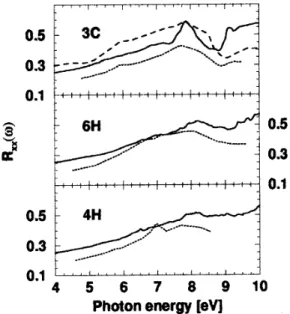
Figure 3. Reectivity for normal incidence and light po-larization perpendicular to the c-axis of the SiC polytypes. Measured spectra are given as dotted lines [30] or dashed lines [31].
Results calculated according to expression (1) are presented in Fig.2 for the dielectric function and in Fig.3 for the reectivity for normal incidence and light polarization perpendicular to the c-axis. To compare with experimental spectra [30,31,32], the theoretical spectra are shifted to higher photon energies by a con-stant quasiparticle shift of about 0.75 eV. The
spec-tra are strongly inuenced by the polytypism. For the hexagonal polytypes 4H and 6H, the pronounced dou-ble peak structure in the imaginary part of 3C shifts to lower energies and becomes broadened. A similar tendency is observed for the real part and the reec-tivity. We conclude that the BZ folding eect accom-panying the enlargement of the unit cell induces an ef-fective smearing out of the structures. It is therefore related to the period of the translational symmetry in c-axis direction, but not to the relative number of the twisted bonds, i.e., the hexagonality of the polytype. The hexagonality much stronger inuences the polar-ization dependence of the spectra.
B. Second-harmonic generation
decoupling may indicate the way to introduce correctly excitonic eects. On the other hand, there are also complications to determine the absolute value and the frequency dependence of nonlinear optical coecients from the spectroscopic data.
Figure 4. Imaginary part of the SHG coecient for four III-V compounds.
In order to test the description of nonlinear coef-cients within the independent-particle approximation we compare the SHG coecient (cf. expression (2)) with results of measurements in Fig.5 for several III-V compounds crystallizing in zinc-blende structure. The calculations are performed using 505 k points and 24
bands. The fact that the SHG coecient (expression (2)) is related to three optical transitions has remark-able consequences. The simplied picture of superpos-ing two combined densities of states at 2! and !
ac-cording to the contributions to Eq. (2) is not valid. First, the 2!-term dominates the SHG coecient.
Sec-ond, the spectral behaviour of Im (2) xy z(
!) (Fig.4) can
be explained by the two prominent categories of opti-cal transitions,E
1 and E
2, in the linear absorption of,
at least, the III-V compounds. However, matrix ele-ment eects are much stronger in the nonlinear case. In comparison to the linear absorption the peaks are sharpened and their sign could be negative in accor-dance to the prefactor. The sign of the imaginary part of the product of three momentum matrix elements is not xed. The spectra for the four III-V compounds are rather similar. They look like the superposition of the spectra of more or less four pronounced oscillators with resonance frequencies close to theE
1- and E
2-like
structures appearing in the 2! and ! - terms of the
imaginary parts.
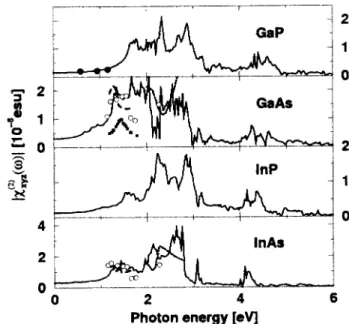
Figure 5. Module of the SHG susceptibility for four III-V compounds versus photon energy. Calculation: solid line, measurements: GaP: dots [36], GaAs and InAs: open circles [37], dotted line [38], dashed line [39], squares [40].
The comparison of the module of the total SHG co-ecients with experimental data [36-40]for GaP, GaAs, and InAs (Fig.5) indicates a reasonable description of the SHG spectra by the presented theory. This holds especially for the order of magnitude and the principal spectral behaviour. Consequently, we conclude that the presented theoretical description of the SHG coecient should allow the prediction of the second-harmonic gen-eration for new materials.
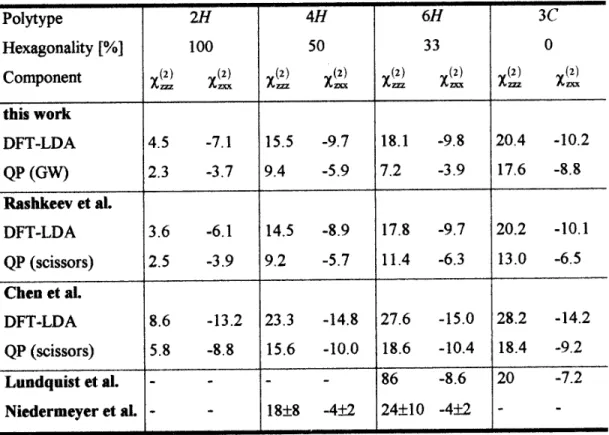
As an example of such a prediction the SHG coe-cients of the most important SiC polytypes are given in Table I for incident light with a frequency small com-pared to the energy gap. The two independent tensor components zzz and zxx are listed for!= 0. The three
1.68 eV) compared to the scissors operators used in Ref. 41 ( = 1eV) and Ref. 42 ( = 1:04:::1:27eV). The
reduction of the static SHG coecients itself is mainly
related to the energy denominators in expression (2).
Table I. Static SHG coecient (in pm/V) of independent tensor components for several polytypes. Values are calculated within DFT-LDA as well as including QP corrections within a GW treatment or a scissors operator approach. The results are compared with other theoretical (Rashkeev et al. [41], Chen et al. [42]) and experimental (Lundquist et al. [43], Niedermeyer et al. [44]) data.
The comparison with recent experimental values is also rather successful for the static SHG coecients of the three polytypes 3C, 6H, and 4H [43,44]. The agree-ment of the absolute values and the signs is reasonable considering the experimental and theoretical uncertain-ties. This holds in particular for the zxx tensor com-ponents. The zzz tensor components seem to be over-estimated by the procedure of data extraction. This is already obvious for the cubic SiC polytype, where the ratio
(2) z z z=
(2) z xx=
,2 should be exactly fullled.
The-oretically one can show that the absolute value of this ratio should decrease with increasing hexagonality of the polytype.
C. Reectanceanisotropysp ectra
Since in the case of cubic crystals the only origin
of an reectance anisotropy is the surface region, RA spectra can be used to clarify the atomic structure and the stoichiometry of a surface. We probed a variety of structural models proposed for the InP(001)24 surface
[16,20]. It turns out that dimer reconstruction models are energetically most favoured. For In-rich surfaces we predict the formation of mixed In-P dimers on top of an In-terminated surface (Fig.6). Under less In-rich conditions the structure gives the lowest total energy. In the case of intermediate preparation conditions the top-P dimer and the structure (Fig.6) cannot be
ex-cluded. Meanwhile, it has been found that a modied
2 structure with only one top -P dimer, the so-called structure [45], is more favourable from the energetical
Figure 6. Top view of InP(001)24 surfaces. Empty (lled) circles represent In (P) atoms. The circle size indicates the
atomic layer.
In Fig.7 we show the RA versus photon energy calculated according to expression (3) for the four favourable surface geometries. The explicit calculations of the slab polarizabilities are performed using a re-cently developed real-space multigridmethod [47]. This approach provides for eective convergence acceleration and preconditioning on all length scales and, hence, re-duces the numerical eort. Furthermore, it allows for an ecient parallelization and is thus particularly suit-able for large surface reconstructions as studied here. In Fig.7 a negative anisotropy appears around 1.7 eV for the mixed-dimer model, which contains 6 In-In sur-face bonds along [110]. This anisotropy is reduced in strength for the top-P-dimer model with 4 In-In surface bonds and is even weaker in case of thestructure with
2 In-In bonds. This feature is correlated to the exis-tence of cation-cation bonds at the surface and caused by transitions between -like In-In bonding states and
empty dangling bonds localized at the surface cations. The RA spectra show also a dependence on structural details for higher energies: A relatively broad positive anisotropy between about 2 and 4 eV appears and the \three-buckle" shape in the high-energy region attens for the2 (and also, not shown) geometry with 3
P-P dimers parallel to [110]. This is due to transitions between P-P dimer states and surface resonances. The structure, with 2 P- P dimers, gives rise to a very similar line shape. Its spectrum, however, is somewhat down-shifted. All structures exhibit a derivative-like feature around 2.5 eV, caused by transitions between surface-modied bulk states. Its energetical position coincides with the calculated position of the E
1 peak. The
de-scribed evolution of the spectra parallels closely the ex-periments [48,49], which observe similar trends in the RA of InP(001)24 surfaces exposed to varying P
par-tial pressures or dierent temperatures. This supports the view that the corresponding \ngerprints" in the measured spectra are caused by the dimerized In and P atoms.
More in detail, the evolution of the RA spectra with annealing temperature between 470 and 590 C
[48] clearly exhibits a similar variation as the spectra calculated for the mixed-dimer model 2 and the struc-ture. Therefore, we identify the mixed-dimer model (2
structure) with the stable 24 reconstruction at In-rich
(less In-rich) preparation conditions of the InP(001) surface.
Figure 7. Calculated RA spectra of favourable InP surface structures.
IV Summary
In conclusion, we have shown that in principle it is possible to calculate optical spectra of semiconduc-tor structures without taking into account any exper-imentally determined parameter. The resulting agree-ment between ab initio results and experimental data
a wide frequency range is already possible within the independent-particle approximation. In certain cases the optical transition energies have to be enlarged by quasiparticle eects. However, for the correct descrip-tion of the ne structure of the spectra, excitonic and local-eld eects have to be considered as well. The independent- quasiparticle approach also seems to be a reasonable starting point forab initiocalculations of
nonlinear optical coecients. The spectral behaviour and the absolute values of SHG coecients can be pre-dicted with a reliable accuracy. Only the numerical ef-forts concerning number ofkpoints and bands have to
be enforced. Similar experiences have been made with a parameter-free description of the spectral dependence of the surface anisotropy. However, the accuracy of the calculations is already high enough to predict spectra for certain surface reconstructions and, hence, identify the real surface geometries and stoichiometries.
Acknowledgement
This work was nancially supported by the Deutsche Forschungsgemeinschaft (Sonderforschungs-bereich 196, Project No. A8).
References
[1] P. Hohenberg and W. Kohn, Phys. Rev. 136, B864
(1964); W. Kohn and L. J. Sham, Phys. Rev. 140,
A1133 (1965).
[2] F. Bechstedt, Adv. Solid State Phys.32, 161 (1992).
[3] L. Hedin, Phys. Rev.139, 796 (1965); L. Hedin and S.
Lundqvist, Solid State Phys.23, 1 (1969).
[4] M. S. Hybertsen and S. G. Louie, Phys. Rev. Lett.55,
1418 (1985); Phys. Rev. B34, 5390 (1986).
[5] R. W. Godby, M. Schluter and L. J. Sham, Phys. Rev. Lett.56, 2415 (1986); Phys. Rev. B37, 10 159 (1988).
[6] B. Adolph, V. Gavrilenko, K. Tenelsen, F. Bechstedt and R. Del Sole, Phys. Rev. B53, 9797 (1996).
[7] R. Del Sole and R. Girlanda, Phys. Rev. B48, 11 789
(1993).
[8] B. Adolph, K. Tenelsen, V. I. Gavrilenko and F. Bech-stedt, Phys. Rev. B55, 1422 (1997).
[9] V. I. Gavrilenko and F. Bechstedt, Phys. Rev. B54,
13 416 (1996); B55, 4343 (1997).
[10] F. Bechstedt, K. Tenelsen, B. Adolph and R. Del Sole, Phys. Rev. Lett.78, 1528 (1997).
[11] S. Albrecht, L. Reining, R. Del Sole and G. Onida, Phys. Rev. Lett.80, 4510 (1998); L. X. Benedict, E.
L. Shirley, and R. B. Bohn, Phys. Rev. Lett.80, 4514
(1998); M. Rohlng and S. G. Louie, Phys. Rev. Lett.
81, 2312 (1998).
[12] D.J. Moss, J.E. Sipe and H.M. van Driel, Phys. Rev. B36, 1153 (1987).
[13] B. Adolph and F. Bechstedt, Phys. Rev. B 57, 6519
(1998); Phys. Rev. B (submitted).
[14] V. I. Gavrilenko and F. Bechstedt, Phys. Rev. B 56,
3903 (1997).
[15] O. Pulci, B. Adolph, U. Grossner and F. Bechstedt, Phys. Rev, B58, 4721 (1998).
[16] W. G. Schmidt, E. L. Briggs, J. Bernholc and F. Bech-stedt, Phys. Rev. B59, 2243 (1999).
[17] R. Del Sole, in PhotonicProbesofSurfaces, ed. by P.
Halevi (Elsevier, Amsterdam, 1995).
[18] N. W. Jepps and T. Page, inProgressinCrystalGrowth andCharaterization, edited by P. Krishna (Pergamon
Press, Oxford, 1983).
[19] F. Bechstedt, P. Kackell, A. Zywietz, K. Karch, B. Adolph, K. Tenelsen and J. Furthmuller, Phys. Stat. Sol. (b)202, 35 (1997).
[20] W. G. Schmidt and F. Bechstedt, Surf. Sci. 409, 474
(1998).
[21] R. Stumpf and M. Scheer, Comput. Phys. Commun.
79, 447 (1994).
[22] L. Kleinman and D. M. Bylander, Phys. Rev. Lett.48,
1425 (1982).
[23] B. Wenzien, P. Kackell, F. Bechstedt and G. Cap-pellini, Phys. Rev. B52, 10897 (1995).
[24] H. R. Philipp and H. Ehrenreich, Phys. Rev.129, 1550
(1963).
[25] D. E. Aspnes and A. A. Studna, Phys. Rev. B27, 985
(1983).
[26] W. Hanke and L. J. Sham, Phys. Rev. B 21, 4656
(1980)
[27] P. Kackell, B. Wenzien and F. Bechstedt, Phys. Rev. B50, 17 039 (1994).
[28] W. J. Choyke, D. R. Hamilton and L. Patrick, Phys. Rev.133, 1163 (1964).
[29] L. Patrick, D. R. Hamilton and W. J. Choyke, Phys. Rev.143, 526 (1966).
[30] W. R. L. Lambrecht, B. Segall, M. Yoganathan, W. Suttrop, R. P. Devaty, W. J. Choyke, J. A. Edmond, J. A. Powell and M. Alouani, Phys. Rev. B50, 10 722
(1994); Appl. Phys. Lett.63, 2747 (1993).
[31] B. E. Wheeler, Solid State Commun.4, 173 (1966).
[32] S. Logothetidis, H. M. Polatoglou, J. Petalas, D. Fuchs and R. L. Johnson, Physica B185, 389 (1993).
[33] M. Cardona, R. L. Johnson, and G. Junck, private com-munication.
[34] S. L. Adler, Phys. Rev. 126, 413 (1962); N. Wiser,
Phys. Rev.129, 62 (1963).
[35] P. N. Butcher and T. P. McLean, Proc. Phys. Soc. Lon-don81, 219 (1963);83, 579 (1964).
[36] M. M. Choy and R. L. Byer, Phys. Rev. B 14, 1693
(1976).
[38] F. G. Parson and R. K. Chang, Opt. Commun.3, 173
(1971).
[39] D. Bethune, A. J. Schmidt and Y. R. Shen, Phys. Rev. B11, 3867 (1975).
[40] H. Loten, G. Koren and Y. Yacoby, Phys. Rev. B 9,
3532 (1974).
[41] S. N. Rashkeev, W. R. L. Lambrecht and B. Segall, Phys. Rev. B57, 3905 (1998); 9705 (1998).
[42] J. Chen, Z. H. Levine and J. W. Wilkins, Phys. Rev. B50, 11514 (1994).
[43] P. M. Lundquist, W. P. Lin, G. K. Wong, M. Razeghi and J. B. Ketterson, Appl. Phys. Lett.66, 1883 (1995); 67, 2919 (1995).
[44] S. Niedermeier, H. Schillinger, R. Sauerbrey, B. Adolph and F. Bechstedt, Appl. Phys. Lett. (submitted).
[45] W. G. Schmidt and F. Bechstedt, Phys. Rev. B 55,
13051 (1997).
[46] N. Esser, W. G. Schmidt, J. Bernholc, A. M. Frisch, P. Vogt, M. Zorn, M. Pristovsek, W. Richter, F. Bechst-edt, T. Hannappel and S. Visbeck, J. Vac. Sci. Technol. (submitted).
[47] E. L. Briggs, D. J. Sullivan and J. Bernholc, Phys. Rev. B32, R 5471 (1995); B54, 14362 (1996).
[48] K. B. Ozanyan, P. J. Parbrook, M. Hopkinson, C. R. Whitehouse, Z. Sobiesierski and D. I. Westwood, J. Appl. Phys.82, 474 (1997).
[49] J. Kinsky, C. Schultz, D. Pahlke, A. M. Frisch, T. Her-rmann, N. Esser and W. Richter, Appl. Surf. Sci.123,