http://dx.doi.org/10.1590/s2175-97902017000300061
A
r
*Correspondence: O. Ammar. Department of Pharmacy. Faculty of Medical Sciences. Université de Batna 2. Route de Tazoult – 05000. Batna – Algeria. Tel: +213-667479052. E-mail: [email protected].
In silico pharmacodynamics, toxicity profile and biological activities
of the Saharan medicinal plant
Limoniastrum feei
Ouahab Ammar
*Department of Pharmacy, Faculty of Medical Sciences, University of Batna 2, Algeria
In-silico study was performed to ind the pharmacodynamics, toxicity proiles and biological activities of three phytochemicals isolated from Limoniastrum feei (Plumbagenaceae). Online pharmacokinetic tools were used to estimate the potential of Quercetin, kaempferol-3-O-β-D-glucopyranoside (astragalin) and quercitin-7-O-β-D-glucopyranoside as speciic drugs. Then the prediction of potential targets of these compounds were investigated using PharmMapper. Auto-Dock 4.0 software was used to investigate the diferent interactions of these compounds with the targets predicted earlier. The permeability of quercetin was found within the range stated by Lipinski ׳s rule of ive. Hematopoietic prostaglandin (PG) D synthase (HPGDS), farnesyl diphosphate synthetase (FPPS) and the deoxycytidine kinase (DCK) were potential targets for quercetin, astragalin and quercetin 7, respectively. Quercetin showed antiallergic and anti-inlammatory activity, while astragalin and quercetin 7 were predicted to have anticancer activities. The activity of Astragalin appeared to be mediated by FPPS inhibition. The inhibition of DCK was predicted as the anticancer mechanisms of quercetin 7. The compounds showed interesting interactions and satisfactory binding energies when docked into their targets. These compounds are proposed to have activities against a variety of human aliments such as allergy, tumors, muscular dystrophy, and diabetic cataracts.
Keywords:Limoniastrum feei/pharmacokinetics. Limoniastrum feei/biological activity. Quercetin. Astragalin. Quercetin 7. Medicinal plants. Molecular docking.
INTRODUCTION
Nowadays, the world of pharmaceutical industry is inclining towards inding new chemical entities of natural source with biological activities (Neamati, Barchi, 2002). Therefore, the identiication of diferent lead compounds follow many approaches (Sams-Dodd, 2006), recently,
the utilization of in silico approach was found cost and time effective especially that several regulations and standardizations are under way (Pakomwit et al., 2015).
The proper pharmacokinetics and toxicity proile along with eicacy are the major determinants for successful drug development. Hence, the poor ADMET proile and the risk of toxicity are the major cause of late costly failure of drug development. Therefore, these fundamental criteria
have to be studied carefully at the beginning of the chain of
drug discovery (Chuai, 2017; Van de Waterbeemd, Giford,
2003). In an aim to achieve reliable results, a number of
tools were developed (Moroy et al., 2012; Gabrielle et al., 2014). The high cost and lengthy time needed to conduct these in vitro screens have called for the development of
in silico approaches. Computational docking as a means to prioritize small molecules in drug discovery projects
remains a highly popular in silico screening approach.
Contemporary docking approaches without experimental
parametrization can reliably differentiate active and inactive chemo types in a protein binding site (Pakomwit et al., 2015, Van de Waterbeemd, Gifford, 2003). The diversity of content in natural plants and the presumably safe chemical nature of most of them placed their research in the core of drug discovery process. Many plants have
their ethno medical uses, however many other curative potentials of those same plants remain unraveled. Herein,
the medicinal plant Limoniastrum feei (plumbagenaceae)
is not an exception. It is a Saharan medicinal plant, used in Saharan ethnopharmacopeae to treat gastric tract,
of researchers from Algeria has recently isolated and
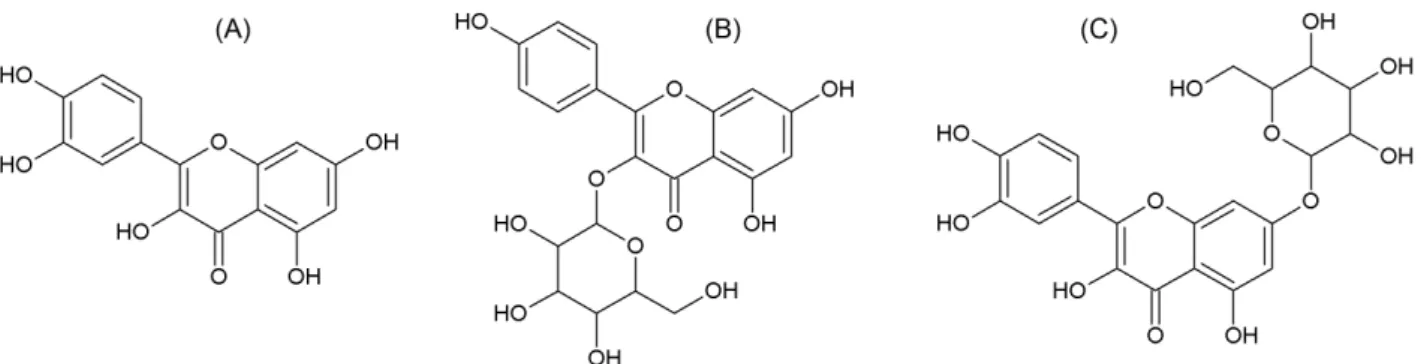
identified three antimicrobial phytochemicals namely, quercetin 1, kaempferol-3-O-β-D-glucopyranoside 2 (astragalin) and quercetin-7-O-β-D-glucopyranoside 3 (quercetin 7) (Ziane et al., 2015). Their chemical structures are displayed in Figure 1. To further estimate the drug
ability of these phytochemicals, we herein report their ADMET proiles and potential biological activities using
several in silico approaches.
MATERIALAND METHODS
Generation of the chemical structures
To estimate the in silico pharmacokinetic parameters
of each one of the compounds, some web based in silico
pharmacokinetic tools were used by submitting the chemical structure in the form of canonical simplified molecular input line entry system (SMILE).
1. Quercetin: C1=CC(=C(C=C1C2=C(C(=O)C3=C(
-C=C(C=C3O2)O)O)O)O)O
2. Kaempferol-3-O-β-D-glucopyranoside (astragalin):
C1=CC(=CC=C1C2=C(C(=O)C3=C(C=C(C=
-C3O2)O)O)OC4C(C(C(C(O4)CO)O)O)O)O
3. Quercetin-7-O-β-D-glucopyranoside: C1=CC(=C(
-C=C1C2=C(C(=O)C3=C(C=C(C=C3O2)OC4C(
-C(C(C(O4)CO)O)O)O)O)O)O)O
Molecular parameters
The estimation of the molecular parameters of the three lead compounds was performed using Molinspiration online server (http://www.molinspiration.com/). The
estimated molecular properties were LogP, Topological polar surface area (TPSA), the number of hydrogen bond donors (HBD) and hydrogen bond acceptors (HBA).
Drug likeliness property of the tested molecules was
investigated as Gprotein coupled receptor (GPCR) ligands, ion channel modulators (ICM), kinase inhibitors (KI),
nuclear receptor ligands (NRL), protease inhibitors (PI)
and enzyme inhibitors (EI).
Admet properties
The ADMET proiles of the lead Chemicals were
predicted using Admet SAR online server (http://lmmd.
ecust.edu.cn:8000/) (Cheng et al., 2012).
Metabolic transformations
The metabolic transformations of the three compounds were obtained using MetaPrint2D online
server (http://www-metaprint2d.ch. cam.ac.uk/) (Carlsson et al., 2010).
Pharmacological activities
The sdf formats of the lead compounds were
submitted to PASS online tool (http://www.pharmaexpert.
ru/passonline/) (Poroikov et al., 2003), and then their probable pharmacological activities and toxicities were
predicted.
Ligand preparation
The chemical structure of the compounds was drawn
using ACD/ChemSketch v.12.0 software, and the obtained
MDL format was converted into PDB format using Open Bable software (O’Boyle et al., 2011).
Pharmmapper calculations
For each lead compound, the PharmMapper server
(http:// 59.78.96.61/pharmmapper/) (Liu et al., 2010) was used to identify its potential target based on its it score. The lead compounds were submitted in MDL. sdf format, the target set was limited to human targets, and all other
parameters were kept as default.
Preparation of the target protein
The pdb files of the identified top targets were obtained from protein databank (http://www.rcsb.org/
pdb/home/home.do). Then, the protein iles were prepared
by removal of all water molecules and hetero groups
except metals. The structures of the target molecules were
optimized and the energy was minimized using Swiss
PDB viewer V.4.1.0 software (Guex, Peitsch, 1997). Metapocket 2.0 online server (http://projects.biotec. tu-dresden.de/metapocket/index.php) was then used to
predict the best active pocket and residues of the target proteins. MetaPocket 2.0 is a meta server to identify ligand
binding sites on protein surface, metaPocket is a consensus method, in which the predicted binding sites from eight methods: LIGSITEcs, PASS, Q-SiteFinder, SURFNET, Fpocket, GHECOM, ConCavity and POCASA are
combined together to improve the prediction success rate (Zengming et al., 2011; Bingding, 2009)
In silico molecular docking
Molecular docking was performed using Autodock
4.0 software (Michel, 1999), based on Lamarckian Genetic Algorithm; which combines energy evaluation
through grids of affinity potential to find the suitable binding position for a ligand on a given protein (Morris et al., 1998). Polar hydrogen atoms were added to the protein targets and Kollman united atomic charges were
computed. All hydrogen atoms were added to the ligands
before the Gastiger partial charges were assigned. The cocrystal ligand was removed, and the bond orders were
checked. The target’s grid map was calculated and set with appropriate grid spacing to include the whole protein.
The grid box was then allocated properly in the target
to include the active residue in the center. The default docking algorithms were set in accordance with standard
docking protocol. Finally, ten independent docking runs were carried out for each ligand, and results were retrieved
as binding energies. Poses that showed lowest binding
energies were visualized using MGL tools 1.5.6.
RESULTS AND DISCUSSION
Molecular parameters
According to ‘Lipinski’s rule of five’, the lead
compounds with poor absorption or permeation are known
when there are more than 10 HBA, 5 HBD, the molecular
weight is greater than 500 Da and the calculated LogP
(CLogP) is greater than 5 (or MilogP>4.15) (Lipinski et
al., 2001). Moreover, good bioavailability is more likely for compounds with rotatable bonds≤10 (nrotb) and total polar surface area (TPSA) of ≤140 Å (Veber et al., 2002). In this study; only Quercetin was predicted to have a
high probability for good oral bioavailability where the calculated LogP values agreed with Lipinski’s rule of
ive. Furthermore, TPSA, total hydrogen bond count and
the number of rotatable bonds felt within the limit ranges
(Table I). In addition, the number of hydrogen bond acceptors (HBA) and hydrogen bond donors (HBD) for
Quercetin was found to be within Lipinski’s limit range
of 7 HBA and 5 HBD. Drug molecules of molecular weight less than 500 Da are easily transported, difuse and
absorbed as compared to heavy molecules (Srimai et al., 2013). Case in point, Quercetin has a molecular weight (MW) of 302.24. Astragalin and Quercetin 7 displayed poor bioavailability according to Lipinski’s rule of ive, however, that does not prevent from applying other
methods to enhance their bioavailability given that they
show great therapeutic beneit.
Drug ability likeliness property of quercetin, astragalin and quercetin 7 as GPCR ligands, ion channel modulators (ICM), kinase inhibitors (KI), nuclear receptor ligands (NRL), protease inhibitors (PI) and enzyme inhibitors (EI) were studied, and results were obtained as bioactivity scores. In this context, scores>0.00 indicate high activity, while scores between 0.00 to −0.5 indicate moderate activity and scores <−0.5 indicate inactivity
(Paramashivam et al., 2015). The results of the present study demonstrated that the three leads showed high bioactivity
scores as KI, NRL and EIs (score>0.00) with Astragalin and Quercetin 7 being the most active as EIs (0.41 and 0.42, respectively) and Quercetin being the most active as KI
and NRL (Table II). Nuclear receptors (NRs) are important pharmaceutical targets because they are key regulators
of many metabolic and inlammatory diseases, including diabetes, dyslipidemia, cirrhosis and fibrosis (Yang, Li, Li, 2014). Based on our results, quercetin, qstragalin and
quercetin 7 could be envisioned as potential ligands for NRs representing interesting and promising therapeutic
alternatives to cure relevant disorders. Considerable TABLE I - Physicochemical parameters of the three lead compounds
Lead miLogP TPSA MW HBA HBD nrotb
Quercetin 1.68 131.35 302.24 7 5 1
Astragalin 0.12 190.28 448.38 11 7 4
bioactivity against GPCR was revealed by astragalin and quercetin 7 (0.05 and 0.04 respectively); Quercetin, on the other hand, produced moderate activity (−0.06). All three compounds exhibited moderate activities as ion channel modulators (−0.19, −0.05 and −0.10, respectively).
Moderate protease inhibition was also predicted for all three
of them. Quercetin, astragalin and quercetin 7 were found active as kinase inhibitors (0.28, 0.10 and 0.15, respectively),
and they could be used to treat diseases due to hyperactive
protein kinases, including mutant or overexpressed kinases in cancer, or to modulate cell functions to overcome other disease drivers (Adam, Laszlo, David, 2016). In fact, a
previous study proved that even a low concentration of quercetin decreased the activity of 16 kinases by more than 80%. Quantitative video microscopy analyses revealed that
quercetin displayed strong anti-mitotic activity, leading to
cell death (Boly et al., 2011). In another study, quercetin 7 was found to possess anti-inlammatory activity, inhibiting expression of inducible nitric oxide synthase and release of nitric oxide by lipopolysaccharide-stimulated RAW 264.7
macrophages in a dose-dependent manner. Quercetin 7
also inhibited overexpression of cyclooxygenase-2 and
granulocyte macrophage-colony-stimulating factor (Legault et al., 2011).
Admet properties
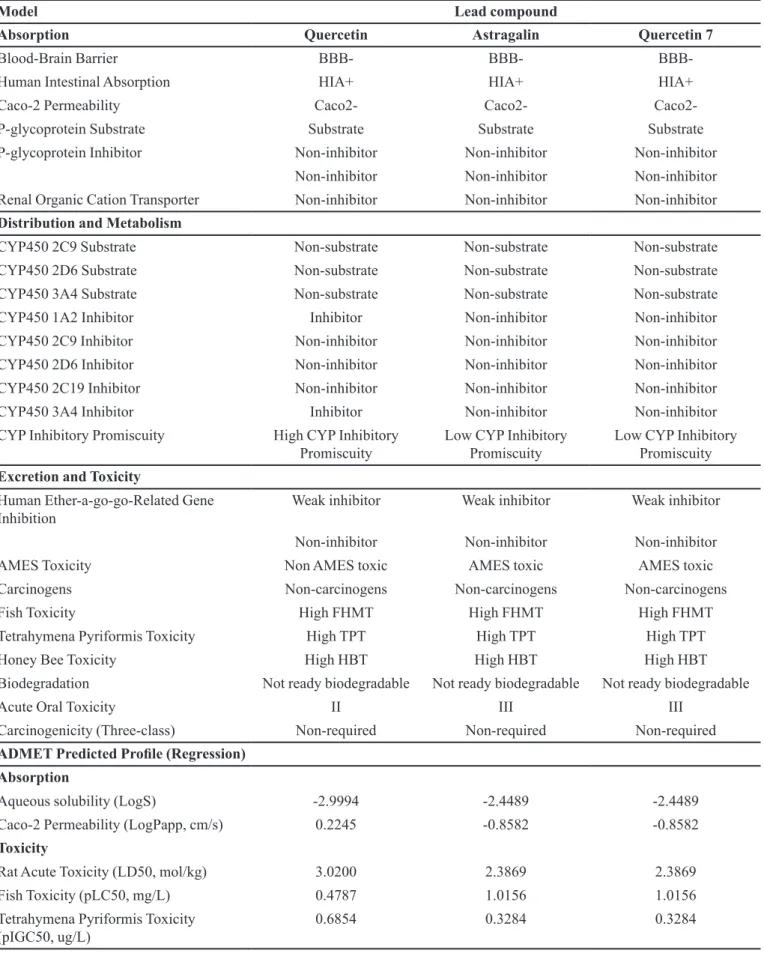
The ADMET properties of the studied leads were calculated using admetSAR. Blood-Brain Barrier (BBB)
penetration, Human Intestinal Absorption (HIA),
Caco-2 cell permeability and Ames test were calculated. The results obtained for BBB penetrability greatly agreed with structures of the studied compounds. It was also found that all tested compounds could be absorbed by the human
intestine, but they cannot penetrate to Caco-2 (Table III). Nevertheless, the tested compounds proved to be potential substrates for Pglycoprotein (P-gp) which eluxes drugs
and various compounds to undergo further metabolism
and clearance (Amin, 2013) resulting in therapeutic failure
because the drug concentration would be lower than
expected (Levin, 2012). Many of the human microsomal
P450s aromatase catalyze the metabolism of a wide variety
of compounds including xenobiotic and drugs (Ghosh et al.,
2012). Thus, inhibition of cytochrome P450 isoforms might
cause drug-drug interactions in which co-administered drugs
fail to be metabolized and accumulate to toxic levels (Lynch, Price, 2007). Notwithstanding, some of the cytochrome
P450 isoforms could be inhibited by one or more of the
tested compounds. Fortunately, Quercetin did not show any acute toxicity and mutagenic efect with respect to the Ames test data. Surprisingly, astragalin and quercetin 7 were found mutagenic (Mortelmans, Zeiger, 2000) and they need to be administered cautiously. The diferent Chemical compounds were classiied into four categories based on the criterion of WHO (WHO, 2010). Category I contains
compounds with LD50 values less than or equal to 50 mg/kg.
Category II contains compounds with LD50 values greater than 50mg/kg but less than 500mg/kg. Category
III includes compounds with LD50 values greater than
500mg/kg but less than 5000mg/kg. Category IV consisted
of compounds with LD50 values greater than 5000mg/kg.
Hence, quercetin is slightly hazardous while astragalin
and quercetin 7 are unlikely to present acute hazard.
Metabolic transformations
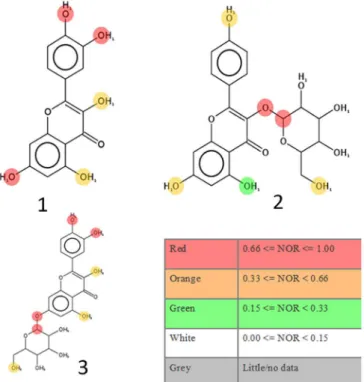
MetaPrint2D predictions revealed that the red
colored hydroxyl groups for the three compounds
represented good sites for metabolism (Figure 2).
Metabolic transformations (Glucuronidation, Sulfation, Methylation, Dehydroxylation, Glucosidation, Hydroxylation, Acylation, and Phosphorylation) were predicted for the hydroxyl groups. Dealkylation, on the other hand, was proposed for the ether group.
The color highlighting an atom indicates its Normalized Occurrence Ratio (NOR). A high NOR indicates a more frequently reported site of metabolism in the metabolite database. Atoms are colored according
to the likelihood of a metabolic site; High: red, Medium: orange, Low: green, very low is not colored, and No data:
grey.
PASS online server
The chemical structure is described in PASS by original descriptors called Multilevel Neighborhoods
TABLE II - Estimation of drug ability of the three lead compounds
Lead GPCR ICM KI NRL PI EI
Quercitin1 -0.06 -0.19 0.28 0.36 -0.25 0.28
Astragalin 0.05 -0.05 0.10 0.20 -0.05 0.41
TABLE III - ADMET properties of the three lead compounds
Model Lead compound
Absorption Quercetin Astragalin Quercetin 7
Blood-Brain Barrier BBB- BBB-
BBB-Human Intestinal Absorption HIA+ HIA+ HIA+
Caco-2 Permeability Caco2- Caco2-
Caco2-P-glycoprotein Substrate Substrate Substrate Substrate
P-glycoprotein Inhibitor Non-inhibitor Non-inhibitor Non-inhibitor
Non-inhibitor Non-inhibitor Non-inhibitor
Renal Organic Cation Transporter Non-inhibitor Non-inhibitor Non-inhibitor
Distribution and Metabolism
CYP450 2C9 Substrate Non-substrate Non-substrate Non-substrate
CYP450 2D6 Substrate Non-substrate Non-substrate Non-substrate
CYP450 3A4 Substrate Non-substrate Non-substrate Non-substrate
CYP450 1A2 Inhibitor Inhibitor Non-inhibitor Non-inhibitor
CYP450 2C9 Inhibitor Non-inhibitor Non-inhibitor Non-inhibitor
CYP450 2D6 Inhibitor Non-inhibitor Non-inhibitor Non-inhibitor
CYP450 2C19 Inhibitor Non-inhibitor Non-inhibitor Non-inhibitor
CYP450 3A4 Inhibitor Inhibitor Non-inhibitor Non-inhibitor
CYP Inhibitory Promiscuity High CYP Inhibitory Promiscuity
Low CYP Inhibitory Promiscuity
Low CYP Inhibitory Promiscuity Excretion and Toxicity
Human Ether-a-go-go-Related Gene Inhibition
Weak inhibitor Weak inhibitor Weak inhibitor
Non-inhibitor Non-inhibitor Non-inhibitor
AMES Toxicity Non AMES toxic AMES toxic AMES toxic
Carcinogens Non-carcinogens Non-carcinogens Non-carcinogens
Fish Toxicity High FHMT High FHMT High FHMT
Tetrahymena Pyriformis Toxicity High TPT High TPT High TPT
Honey Bee Toxicity High HBT High HBT High HBT
Biodegradation Not ready biodegradable Not ready biodegradable Not ready biodegradable
Acute Oral Toxicity II III III
Carcinogenicity (Three-class) Non-required Non-required Non-required
ADMET Predicted Proile (Regression)
Absorption
Aqueous solubility (LogS) -2.9994 -2.4489 -2.4489
Caco-2 Permeability (LogPapp, cm/s) 0.2245 -0.8582 -0.8582
Toxicity
Rat Acute Toxicity (LD50, mol/kg) 3.0200 2.3869 2.3869
Fish Toxicity (pLC50, mg/L) 0.4787 1.0156 1.0156
Tetrahymena Pyriformis Toxicity
of Atoms (MNA). For each investigated activity, PASS calculates two probabilities, Pa and Pi, based on statistics
of MNA descriptors. Pa and Pi values vary from 0.000 to 1.000 indicating the probabilities of the compound to
be active or inactive, respectively. Our indings revealed
that Quercetin is a potential chlordecone reductase
inhibitors (Pa=0.986) (Table IV). The clinically important
chlordecone reductase belongs to a family of enzymes known as aldo-ketoreductases. These enzymes are
involved in the metabolism of xenobiotics and have been
implicated in the pathogenesis of diabetic cataracts and
muscular dystrophy (Molowa, Andrew, Shayne, 1986). Nonetheless, chlordecone reductase inhibition could be
a drawback in the sense that risk of developing prostate cancer is positively associated with the chlordecone concentration in blood (Multigner et al., 2016). Astragalin showed a higher probability to function as Membrane
integrity agonist (Pa = 0.989). Thus playing an important
role in the anti-inlammatory mechanism, Case in point,
the results of a recent study showed that astragalin
suppressed the expression of tumor necrosis factor α, interleukin 6, and nitric oxide in a dose-dependent manner
in primary cultured mouse mammary epithelial cells (Li et al., 2014). Quercetin 7 on the other hand was found useful as hemostatic.
In silico molecular docking
PharmMapper server has predicted that hematopoietic
prostaglandin (PG) D synthase (HPGDS) (PDB ID: 1V40), Farnesyl diphosphate synthetase (FPPS) (PDB ID: 1YQ7) and the deoxycytidine kinase (DCK) (PDB ID: 1P60) are the best targets, in terms of it scores (3.596, 3.647 and 6.265), for quercetin, astragalin and quercetin 7, respectively. HPGDS is responsible for the production of PGD (2) as an allergy or inlammation mediator in mast
and Th2 cells (Inoue et al., 2004). It has shown promise as a potential target for anti-allergic and anti-inlammatory
drugs (Fredrik et al., 2015). Quercetin was successfully docked into HPGDS with a binding energy of -6.28 kcal/
mol. Analysis of the binding interactions revealed that quercetin formed a hydrogen bond with the active pocket via two residues namely Arg 412 and Lys 598 (Figure 3A). The above-mentioned interaction of Quercetin with the two amino acids results in a recognizable conformational
change in the active pocket. Thus, the active pocket will
no longer be complementary with the natural substrate.
Being an HPGDS inhibitor, Quercetin can be considered
as a potential lead for development of novel drugs
for allergy and inflammation. As shown in Figure 3B,
Docking of astragalin into FPPS enzyme (binding energy
= -2.72 kcal/mol) showed hydrogen bonding with Tyr 363, Arg 74, Asn 73, which are central binding residues
for the top active pocket as predicted by Metapocket 2.0. FPPS is a key enzyme in isoprenoid biosynthesis which
catalyzes the formation of farnesyl diphosphate (FPP),
a precursor for several classes of essential metabolites
including sterols, dolichols, carotenoids, and ubiquinones.
FPP also serves as substrate for protein farnesylation
and geranylgeranylation. Catalyzes the sequential
TABLE IV - Prediction of biological activities of the compounds
Lead compound Pa Pi Activity
Quercetin 0.986 0.001 Chlordecone reductase inhibitor
Astragalin 0.989 0.001 Membrane integrity agonist
Quercetin 7 0.986 0.001 Hemostatic
Pa: Probability of activity. Pi: Probability of inactivity.
condensation of isopentenyl pyrophosphate with the
allylic pyrophosphates, dimethylallyl pyrophosphate,
and then with the resultant geranylpyrophosphate to
the ultimate product farnesyl pyrophosphate (Manoj, Archana, Sanjana, 2013). Recent studies have validated
FPPS as a molecular target of bisphosphonates for drug development against tumors as well as human pathogens (Raikkonen et al., 2011; Oldield, 2010). It appears that Astragalin activity could be mediated through FPPS- inhibition. Quercetin 7 docked nicely within the fourth
active pocket of DCK enzyme (binding energy = -4.04 kcal/mol). The hydrogen bonds were formed with Gln
168, Arg 20, Gln 165, and Lys 23 (Figure 3C). It is worth noting that DCK is required for the phosphorylation of several deoxyribonucleosides and their nucleoside analogs. Deiciency of DCK is associated with resistance
to antiviral and anticancer chemotherapeutic agents.
Conversely, increased deoxycytidine kinase activity is
associated with increased activation of these compounds
to cytotoxic nucleoside triphosphate derivatives. DCK
is clinically important because of its relationship to drug
resistance and sensitivity (Hazra et al., 2011). Thus, an anticancer activity is predicted for quercetin 7 through
DCK inhibition.
CONCLUSION
The ADMET profiles for the lead compounds; quercetin, astragalin and quercetin 7, isolated from Limoniastrum feei have been estimated using diferent web based in silico tools. In addition, their biological activity
spectra were also investigated. Quercetin was proposed to
have potential antiallergic and anti-inlammatory activity through inhibition of HPGDS and was also proposed
to play a role in the treatment of diabetic cataracts and muscular dystrophy through inhibition of chlordecone reductase enzyme. Astragalin was predicted to have
anticancer activity mediated by FPPS inhibition. While
quercetin 7 was proposed to have an anticancer and
antiviral activity through DCK inhibition and hemostatic
activity as well.
ACKNOWLEDGMENT
The author acknowledges the members of the
Department of Pharmacy, University of Batna 2 in Algeria
for support and assistance.
CONFLICT OF INTERESTS
The author declares no conlict of interest.
REFERENCES
Adam JR, Laszlo G, David WL. Molecular pathways: emergence of protein kinase CK2 (CSNK2) as a potential target to inhibit survival and DNA damage response and repair pathways in cancer cells. Clin Cancer Res. 2016;22(12):2840-2847.
Amin ML. P-glycoprotein inhibition for optimal drug delivery. Drug Target Insights. 2013;7:27-34.
Bingding H. MetaPocket: a meta approach to improve protein ligand binding site prediction. Omics. 2009;13(4):325-330.
Boly R, Gras T, Lamkami T, Guissou P, Serteyn D, Kiss R, Dubois J. Quercetin inhibits a large panel of kinases implicated in cancer cell biology. Int J Oncol. 2011;38(3):833-42.
Carlsson L, Spjuth O, Adams S, Glen RC, Boyer S. Use of historic metabolic biotransformation data as a means of anticipating metabolic sites using MetaPrint2D and bio clips. BMC Bioinformatics. 2010;11:362.
Cheng F, Li W, Zhou Y, Shen J, Wu Z, Liu G, Lee PW, Tang Y. AdmetSAR: a comprehensive source and free tool for assessment of chemical ADMET properties. J Chem Inf Model. 2012;52(11):3099-3105.
Fredrik E, Johan E, Matti L, Ward A, Petersen J, Wissler L, et al. Identiication of indole inhibitors of human hematopoietic prostaglandin D2 synthase (hH-PGDS). Bioorg Med Chem Lett. 2015;25(12):2496-2500.
Gabrielle LA, Maria AAC, Maria ASV, Silva SCT, França FD, Chaves MM, Tagliati CA. Alternative methods in toxicity testing: the current approach. Braz J Pharm Sci. 2014;50(1):55-62.
Ghosh D, Lo J, Morton D, Valette D, Xi J, Griswold J, Hubbell S, Egbuta C, Jiang W, An J, Davies HM. Novel aromatase inhibitors by structure-guided design. J Med Chem. 2012;55(19):8464-8476.
Guex N, Peitsch MC. SWISS-MODEL and the swiss-Pdb viewer: an environment for comparative protein modeling. Electrophoresis. 1997;18(15):2714-2723.
Chuai GH, Wang QL, Liu Q. In silico meets in vivo: towards computational CRISPR-Based sgRNA design. Trends Biotechnol. 2017;35(1):12-21.
Hazra S, Szewczak A, Ort S, Konrad M, Lavie A. Post-translational phosphorylation of serine 74 of human deoxycytidine kinase favors the enzyme adopting the open conformation making it competent for nucleoside binding and release. Biochemistry. 2011;50(14):2870-2880.
Inoue T, Okano Y, Kado Y, Aritake K, Irikura D, Uodome N, et al. First determination of the inhibitor complex structure of human hematopoietic prostaglandin D synthase. J Biochem. 2004;135(3):279-283.
Legault J, Perron T, Mshvildadze V, Girard-Lalancette K, Perron S, Laprise C, et al. Antioxidant and anti-inlammatory activities of quercetin 7-O-β-D-glucopyranoside from the leaves of Brasenia schreberi. J Med Food. 2011;14(10):1127-1134.
Levin GM. P-glycoprotein: why this drug transporter may be clinically important. Curr Psychiatry. 2012;11:38-40.
Lipinski CA, Lombardo F, Dominy BW, Feeney PJ. Experimental and computational approaches to estimate solubility and permeability in drug discovery and development settings. Adv Drug Deliv Rev. 2001;46(1-3):3-26.
Liu X, Ouyang S, Yu B, Liu Y, Huang K, Gong J, et al. Pharm mapper server: a web server for potential drug target identiication using pharmacophore mapping approach. Nucleic Acids Res. 2010;38:W609-14.
Lynch T, Price A. The efect of cytochrome P450 metabolism on drug response, interactions, and adverse efects. Am Fam Physician. 2007;76(3):391-396.
Manoj KD, Archana K, Sanjana K. Farnesyl pyrophosphate synthase: a key enzyme in isoprenoid biosynthetic pathway and potential molecular target for drug development. N Biotechnol. 2013;30(2):114-123.
Michel FS. Python: a programming language for software integration and development. J Mol Graphics Mod. 1999;17(1):57-61.
Molowa DT, Andrew G, Shayne V. Purification and characterization of chlordecone reductase from human liver. J Biol Chem. 1986;261(127):12624-12627.
Moroy G, Martiny VY, Vayer P, Villoutreix BO, Miteva MA. Towards in silico structure-based ADMET prediction in drug discovery. Drug Discov Today. 2012;17(1-2):44-55.
Morris GM, Goodsell DS, Halliday RS, Huey R, Hart WE, Belew RK. Automated docking using a Lamarckian genetic algorithm and empirical binding free energy function. J Comput Chem. 1998;19(14):1639-1662.
Mortelmans K, Zeiger E. The Ames Salmonella/microsome mutagenicity assay. Mutat Res. 2000;455(1-2):29-60.
Multinger L, Kadhel P, Rouget F, Blanchet P, Cordier S. Chlordecone exposure and adverse efects in French west indies populations. Environ Sci Pollut Res. 2016;23(1):3-8.
Neamati N, Barchi JJ. New paradigms in drug design and discovery. Curr Top Med Chem. 2002;2(3):1-73.
O’boyle NM, Banck M, James CA, Morley C, Vandermeersch T, Hutchison GR. Open babel: an open chemical toolbox. J Cheminf. 2011;3:33.
Oldield E. Targeting isoprenoid biosynthesis for drug discovery: bench to bedside. Acc Chem Res. 2010;43(9):1216-1226.
Pakomwit S, Prashant M, Paul T, Cross M, Coster MJ, Gorse AD, Krasavin M, Hofmann A. Panel docking of small-molecule libraries: prospects to improve eiciency of lead compound discovery. Biotechnol Adv. 2015;33(pt.1):941-947.
Paramashiwam SK, Elayaperumal K, Natarajan BB, Ramamoorthy MD, Balasubramanian S, Dhiraviam KN. In silico pharmacokinetic and molecular docking studies of small molecules derived from Indigofera aspalathoides Vahl targeting receptor tyrosine kinases. Bioinformation. 2015;11(2):73-84.
Poroikov VV, Filimonov DA, Ihlenfeldt WD, Gloriozova TA, Lagunin AA, Borodina YV, et al. Pass biological activity spectrum predictions in the enhanced open NCI database browser. J Chem Inf Comput Sci 2003;43(1):228-236.
Rahmani S, Ziane L, Belboukhari N, Cheriti A. The Saharan medicinal plant Limoniastrum feei: ethnomedical survey and preliminary phytochemical screening of antibacterial extracts. PhytoChem BioSub J. 2012;6(2):83-87.
Raikkonen J, Taskinen M, Dunford JE, Mönkkönen H, Auriola S, Mönkkönen J, et al. Correlation between time-dependent inhibition of human farnesyl pyrophosphate synthase and blockade of mevalonate pathway by nitrogen-containing bisphosphonate in cultured cells. Biochem Biophys Res Commun. 2011;407(4):663-667.
Sams-Dodd F. Drug discovery: selecting the optimal approach. Drug Discov Today. 2006;11(9-10):465-472.
Srimai V, Ramesh M, Parameshwar KS, Parthasarathy T. Computer-aided design of selective cytochrome P450 inhibitors and docking studies of alkylresorcinol derivatives. Med Chem Res. 2013;22(11):5314-5323.
Van de Waterbeemd H, Gifford E. ADMET in silico modelling: towards prediction paradise. Nat Rev Drug Discov. 2003;2(3):192-204.
Veber DF, Johnson SR, Cheng HY, Smith BR, Ward KW, Kopple KD. Molecular properties that inluence the oral bioavailability of drug candidates. J Med Chem. 2002;45(12):2615-2623.
Yang C, Li Q, Li Y. Targeting nuclear receptors with marine natural products. Mar Drugs. 2014;12(2): 601-635.
Zengming Z, Yu L, Biaoyaong L, Schroeder M, Huang B. Identification of cavities on protein surface using multiple computational approaches for drug binding site prediction. Bioinformatics. 2011;27(15):2083-2088.
Ziane L, Lazouni HA, Moussaoui A, Hamidi N, Djellouli M, Belabbes A. Flavonoid from methanolic extract of Limoniastrum Feei (Girard) batt (Plumbaginazeae). Asian J Pharm Clin Res. 2015;8(2):218-219.
Received for publication on 23rd September 2016