http://dx.doi.org/10.1590/s2175-97902017000300140
A
r
*Correspondence: B. Malaekeh-Nikouei. School of Pharmacy, Mashhad Uni-versity of Medical Sciences, P.O. Box 91775-1365 - Mashhad, Iran. Phone: 98 513 8823255 / Fax: 98 513 8823251. E-mail: [email protected]
Cholesterol improves the transfection efficiency of polyallylamine
as a non-viral gene delivery vector
Reza Kazemi Oskuee
1,2, Mahdieh Ramezanpour
3, Leila Gholami
4, Bizhan Malaekeh-Nikouei
5*
1Targeted Drug Delivery Research Center, Mashhad University of Medical Sciences, Mashhad, Iran,2Department of Medical
Biotechnology, School of Medicine, Mashhad University of Medical Sciences, Mashhad, Iran, 3School of Pharmacy, Mashhad
University of Medical Sciences, Mashhad, Iran, 4Neurogenic Inlammation Research Center, Mashhad University of Medical
Sciences, Mashhad, Iran, 5Nanotechnology Research Center, School of Pharmacy, Mashhad University of Medical Sciences,
Mashhad, Iran
Cationic polymers such as polyallylamine (PAA) having primary amino groups are poor transfection agents and possess a high cytotoxicity index when used without any chemical modiication. In this study, PAA was modiied with cholesterol in order to improve transfection eiciency and to reduce cytotoxicity. PAA polymers with molecular weights of 15 and 65 kDa were selected and grafted with cholesterol at percentages of 5, 10, 15, 30, and 50. After puriication, the eicacy of the synthetic vectors was evaluated in terms of DNA condensation using the ethidium bromide test, bufering capacity, particle size, zeta potential, transfection eiciency, and cytotoxicity assay in Neuro2A cell lines. According to the ethidium bromide test, these vectors can condense DNA at moderate and high carrier to plasmid (C/P) ratios. The bufering capacity of the prepared vector in both molecular weights was less than unmodiied PAA. Particle size measurements demonstrated that modiied PAAs were able to form nanoparticles ranging in size from 125 to 530 nm. The vectors based on PAA 15 kDa demonstrated a better transfection eiciency than the vectors made of PAA 65 kDa. Cytotoxicity studies showed that toxicity of all vectors was less than PAA. Some cholesterolmodiied polymers composed of PAA (15 kDa) were suitable vectors for gene delivery with low cytotoxicity.
Keywords: Cholesterol/ eiciency. Gene delivery. Non-viral vectors/evaluation. Polyallylamine
Transfection eiciency. Cytotoxicity/study.
INTRODUCTION
Research in recent years has witnessed major concern about gene therapy providing novel approaches to the treatment of many diseases caused by genetic disorders (Guo et al., 2008). The delivery of nucleic acids to target cells and tissues, despite all achieved advances, still remains challenging (Li, Huang, 2000; Chesnoy, Huang, 2000). Speciically, gene therapy pursues the development of non-toxic effective gene carrier encapsulating and carrying foreign genetic materials into speciic cell types including cancerous cells (El-Aneed, 2004).
Gene delivery carriers are generally divided into two major groups named viral and non-viral vectors (Liu,
Huang, 2002). Each of these vectors demonstrates its own advantages and drawbacks (Cusack, Tanabe, 2002). Many deiciencies in several areas including the induction of host inlammatory and immune response are reported for viral vectors, though they provide high gene delivery eiciency (Tros-de-Ilarduya, Sun, Duzgunes, 2010). Non-viral vectors, especially polymers, show remarkably lower safety risks that can be applied for speciic therapeutic purposes. Their most speciic feature is being capable of carrying large DNA molecules and being produced most cost-efectively and in large quantity (Dehshahri et al., 2014). However, low transfection eiciency remains the major drawback of non-viral systems (Merdan, Kopecek, Kissel, 2002).
2006; Boussif et al., 1999). Negatively charged DNA can be bound and packaged by PAA carrying a strong positive charge. However, PAA application as a gene delivery system has severely been restricted by cytotoxicity of PAA that is due to its strong polycationic character (Pathak et al., 2007). The lack of provision of endosomal escape resulting from the low bufering capacity of PAA is another disadvantage of this polymer (Pathak, Patnaik, Gupta, 2009). Numerous modiications have been carried out on this polymer to make it an efective and non-toxic carrier, including the preparation of nanocomplexes composed of PAA-dextran-DNA with an average size of about 150 nm, by Nimesh, Kumar, and Chandra (2006). Compared to the PAA-DNA nanoparticles, the evaluation of transfection eiciency of the prepared nanoparticles in HEK 293 cells showed an increase in the transfection eiciency and decrease in cytotoxicity. Moreover, in order to improve the endosomal release and enhance the gene transfer eiciency of the polymer, Pathak, Patnaik, and Gupta (2009) replaced primary amino groups of PAA (17 kDa) with imidazolyl moieties. Recently, we modiied PAA with bromoalkane derivatives (Oskuee et al., 2015a) and acrylate derivatives (Oskuee et al., 2015b). Better transfection activity and less cytotoxicity were observed in some of the prepared vectors.
The present study aims at enhancing PAA transfection eiciency through replacing primary amino groups with cholesterol, reducing the polymer cytotoxicity, developing polymer hydrophobic interaction with the cell membrane, and maintaining the polymer buffering capacity. It is expected that as nanoparticles cross the cell membrane, vector release from the endosome becomes easier (through endosome membrane instability) and polymer toxicity decreases.
MATERIALS AND METHODS
Materials
Dimethylformamide, cholesterol chloroformate and [3-(4,5-dimethylthiazol-2-yl)-2,5-diphenyl tetrazolium bromide] (MTT) were purchased from Sigma (USA). PAA (average MW 15 kDa) and PAA (average MW 65 kDa) were obtained from Polyscience Inc. (USA) and Aldrich (USA), respectively.
Modification of PAA
For the preparation of PAA-cholesterol conjugates, both were dissolved separately in dimethylformamide. A solution of cholesteryl chloroformate was drop-wised to
the stirring solution of PAA over 2 hours. The reaction was stirred for 24 additional hours at room temperature. The resulting solution was poured into a dialysis membrane (10 kDa cut-of dialysis tubing for derivate of PAA 15 kDa and 25 kDa cut-of dialysis tubing for derivate of PAA 65 kDa) and dialyzed against double distilled water for 2 days to remove unreacted material. The aqueous solution was lyophilized to yield lufy powders that were characterized by 1HNM (DMSO) spectroscopy using a Bruker Avance
III-300 MHz NMR spectrometer (Bruker, Germany).
Determination of the degree of grafting percent by TNBS
The primary amine content of modified PAA derivatives was determined using quantification of accessible primary amines through coupling with 2,4,6-trinitrobenzene sulfonic acid (TNBS) (Snyder, Sobocinski, 1975). Briefly, 20 μl of freshly prepared aqueous TNBS solution (15 mg/ml) was added to the wells of a 96-well tray containing various amounts of modiied PAA (dissolved in 600 μl of double distilled water). The mixtures were diluted with 200 μl of sodium bicarbonate bufer solution (0.8 M, pH 8.5) and the UV absorbance was measured at 405 nm.
Measurement of buffering capacity of modified PAA
A solution of 0.4 mg/ml of each PAA derivative in double distilled water was prepared and adjusted to the pH of 12 using 1 M NaOH. Then, 5 μl aliquots of 1 M HCl were subsequently added until the pH was reduced to 2. The reciprocal slopes of graphs plotting pH versus the amount of HCl added were used to determine the bufering capacity of PAA derivatives.
Preparation of polyplexes
For preparation of polyplexes, diferent amounts of PAA derivatives were separately diluted into the HEPES bufered glucose solution (20 mM HEPES in 5% aqueous glucose solution) and mixed with pDNA at diferent carrier to pDNA weight ratios (C/P) ranging from 0.5:1 to 6:1. The mixture was incubated at room temperature for 30 min before use.
Characterization of polyplexes
NanoZS, Malvern Instruments, UK). Condensation ability of cholesterol modiied PAA was examined by the ethidium bromide (EtBr) test. This DNA-intercalating dye was used to examine the association of DNA with the modified polymer. The fluorescence intensity of this dye was measured at 510 nm (excitation wavelength) and 590 nm (emission wavelength) with a spectroluorometer (Jasco, Japan). The fluorescence intensity was set to 100%. Equal amounts of the solution containing modiied PAA were added stepwise to the pDNA–EtBr solution and the variation in luorescence intensity was recorded. All measurements were done in triplicate.
Gene transfer studies
Neuro2A murine neuroblastoma cells (ATCC CCL-131) were cultured in Dulbecco’s Modiied Eagle Medium (DMEM) supplemented with fetal bovine serum (10%), streptomycin (100 μg/ml), and penicillin (100 U/ml). Cells were seeded at a density of 1×10⁴ cells per well in 96-well
plates. Polyplexes were prepared in C/P ratios of 0.5, 2, 4, and 6 and added to the cells. After 4 h incubation, the medium was removed and replaced with fresh medium. Cells were harvested 24 h post transfection and lysis bufer was added to each well. The percentage of transfected cells was determined using a fluorescent plate reader (Victor X5, Perkin- Elmer, USA). Green luorescent protein (GFP) fluorescence was excited at 498 nm and emission was detected using a 535 nm band-pass ilter. Polyethyleneimine (PEI) 25 kDa was used as positive control.
Cytotoxicity assay by MTT
Cytotoxicity studies were carried out in Neuro2A cells using polymer/pDNA complexes. 1×10⁴ cells per
well were seeded in 96-well plates and treated after 24 h with the same amounts of polyplexes used for transfection experiment. After 4 h, the medium was replaced by 100 μl fresh culture medium. The metabolic activity of each well was determined after 24 h using MTT assay as follows: 10 μl of a 5 mg/ml solution of MTT in sterile phosphate-buffered saline buffer was added to each well. After incubation for 2 h at 37 °C, the medium was removed, 100 μl of dimethyl sulfoxide added, and the samples further incubated at 37 °C for 30 min under constant shaking. Optical absorbance was measured at 590 nm (reference wavelength 630 nm) using a microplate reader (Statfax-2100; Awareness Technology, USA), and cell viability was expressed as a percent relative to untreated control cells. Values of metabolic activity are presented as mean ± SD of triplicates.
Statistical analysis
We used one-way ANOVA and the Tukey-Kramer test to analyze our data. Diferences between means were statistically signiicant if the p-value was less than 0.05.
RESULTS
Cholesterol was grafted on 15 and 65 kDa PAA primary amines in diferent degrees of substitutions. The compositions of the modiied polymers were conirmed by 1H NMR. As an example, the obtained data from 1H
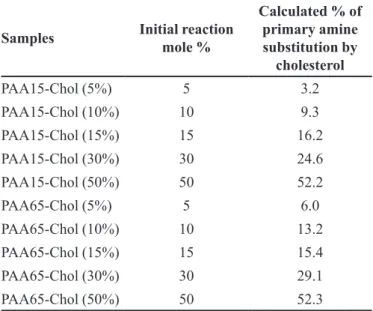
NMR (DMSO) spectrum of PAA15-Chol (15%) was: 0.65 (s, 3H, CH3), 0.84 (d, 6H, J=6.0, 2×CH3), 0.91 (d, 3H, J = 6.0, CH3), 0.94 (s, 3H, CH3), 0.84–1.53 (m, 23H), 1.61–2.3 (m,7H), 3.2–3.6 (m, NCH2), 4.63–4.65 (m, 1H), 5.27 (d, 1H). TNBS assay was done to determine the amount of primary amines of the modiied polymers and the coverage of primary amines with cholesterol. As summarized in Table I, the degree of substitution was near to initial reaction feed.
The results of acid-base titration studies were presented in Figure 1. This test was performed to assess the buffering capacity of modified polymers. Because of the relationship between the efficiency of polymer to facilitate endosome escape, this test was done on all samples. As indicated by results of Figure 1, cholesterol grafted PAA was led to a reduction of bufering capacity for both molecular weights of PAA.
TABLE I - Degree of primary amine substitution in cholesterol
modiied polyallylamine (PAA) (15 and 65 kDa) estimated by TNBS assay
Samples Initial reaction
mole %
Calculated % of primary amine substitution by
cholesterol
PAA15-Chol (5%) 5 3.2
PAA15-Chol (10%) 10 9.3
PAA15-Chol (15%) 15 16.2
PAA15-Chol (30%) 30 24.6
PAA15-Chol (50%) 50 52.2
PAA65-Chol (5%) 5 6.0
PAA65-Chol (10%) 10 13.2
PAA65-Chol (15%) 15 15.4
PAA65-Chol (30%) 30 29.1
The particle size and zeta potential of polyplexes were summarized in Table II. The particle sizes of all polyplexes prepared with modified cholesterol were found to be in the range of 125-530 nm. As the cholesterol content was increased, a concomitant increase in the size of the nanoparticles was observed. The vectors based on PAA 15 kDa had positive zeta potential. Only in the case of PAA with 50 % grafting, polyplex showed negative
zeta-potential. All vectors based modiied PAA 65 kDa had negative surface charge.
Both 15 and 65 kDa PAAs condensed the pDNA at C/P ratio of 0.5 (Figure 2). The interaction of DNA and synthetic polymers by substitution was decreased. The
FIGURE 1 - Bufering capacity of A) polyallylamine (PAA) 15
KDa derivatives, B) PAA 65 KDa derivatives.
TABLE II - Mean size, PDI, and zeta potential of polyplexes prepared by polyallylamine (PAA) (15 and 65 KDa) or cholesterol
modiied PAA /DNA (mean±SD, n=3)
Samples Mean Size (nm) PDI Zeta Potential(mV)
PAA15 161.6±9.7 0.39±0.07 19.2±3.0
PAA15-5% 255.2 0.368 25.1±1.9
PAA15-10% 124.0±7.8 0.34±0.08 24.6±1.1
PAA15-15% 308.1±28.3 0.40±0.04 28.8±3.4
PAA15-30% 322.1±24.9 0.51±0.06 34.5±0.5
PAA15-50% 320.8±20.3 0.58±0.15 -23.9±4.3
PAA65 75.4±20.9 0.43±0.16 13.3±1.4
PAA65-5% 533.0±23.6 0.64±0.03 -20.5±1.8
PAA65-10% 372.2±73.8 0.92±0.08 -13.9±2.0
PAA65-15% 344.2±21.5 0.64±0.10 -22.1±2.7
PAA65-30% 371.1±110.6 0.81±0.09 -27.5±0.7
PAA65-50% 414.5±14.6 0.88±0.12 -16.7±6.6
FIGURE 2 - The DNA condensation ability of polyallylamines
complete condensation occurred at a higher C/P ratio by modiication of PAA.
Gene transfer efficiency and cytotoxicity of pDNA polyplexes were evaluated in Neuro2A cells at four different C/P ratios as shown in Figures 3 and 4. Generally, transfection eiciency in vectors based PAA 15 kDa increased and in vectors based PAA 65 kDa, modiication of the polymer with cholesterol did not afect the transfection activity of the vector. The transfection activity of polyplexes composed of PAA 15 kDa was higher than PAA 65 kDa. The highest gene transfer ability belonged to PAA 15 kDa modiied with 10% cholesterol at C/P ratio of 4.
The efect of conjugation of PAA with cholesterol on cytotoxicity was examined on Neuro2A cells using the MTT assay. The cytotoxicity of PAA decreased remarkably by covering the amine groups of the polymer, especially in the higher C/P. It can be seen that the
cytotoxicity of synthetic vectors in C/P 4 was less toxic than the unmodiied PAA. It can be concluded that PAA toxicity may be alleviated by cholesterol modiications.
DISCUSSION
Gene therapy is a promising approach toward acquired or inherited disease treatment (Smith, 1999; Romano et al., 2000). To be applied in vitro, it is vital for gene delivery vectors to be eicient in transfection activity with low toxicity (Hasegawa, Hirashima, Nakanishi, 2002). Some features including low immunogenicity and toxicity, ease of development, and lack of pathogenicity have particularly attracted more attention to non-viral vectors (Putnam, 2006; Li, Huang, 2006). However, in comparison to viral vectors, non-viral vector low transfection eiciency is introduced as the main drawback of these carriers (Tros-de-Ilarduya, Sun, Duzgunes, 2010).
Polyallylamine (PAA) has recently drawn much attention as a non-viral gene delivery system (Pathak et al., 2007; Oskuee et al., 2015b, Mahmoudi et al., 2014). Low bufering capacity and prevention of easy endosomal escape are introduced as the main disadvantages of this
FIGURE 3 - Transfection activity of polyplexes prepared by
polyallylamine (PAA) (15 and 65 KDa) or cholesterol modiied PAA in Neuro2A cells. Complexes were formulated at three diferent C/P ratios, A) PAA 15 KDa derivatives, B) PAA 65 KDa derivatives. Comparison was made between cholesterol modiied PAAs and unmodiied PAA, **: p<0.01, ***: p<0.001 (mean±SD, n=3).
FIGURE 4 - Cytotoxicity of polyplexes prepared by
polymer (Pathak, Patnaik, Gupta, 2009). If cationic polymers such as PAA are used without any chemical modification, they possess high cytotoxicity index (Gholami et al., 2014). Also, they usually require
lysosomotropic agents or some modiications to improve endocytosis in order to achieve efficient gene transfer (Pathak et al., 2007). As an instance, Neu, Fischer, and Kissel(2005) argue that PAA interaction with endosome membranes improves and endosomal escape possibility increases if hydrophobic groups are used in the polymer structure. In the present study, primary amine groups of PAA with two molecular weights (15 and 65 kDa) were modified with cholesterol in five grafting percentages (5, 10, 15, 30, and 50) to enhance hydrophobicity. High transfection activity and low toxicity are the main justiication criteria for cationic derivatives application (Hasegawa, Hirashima, Nakanishi, 2002; Hattori, Maitani, 2007). Since cholesterol exists in the human body, its use in gene therapy is harmless. As indicated by the results of the previous study, polyethyleneimine (PEI)- cholesterol joined through a carbamate linkage are nontoxic and biodegradable (Kim et al., 2001). Although DNA and PAA have high aqueous solubility, due to lipophilic nature of cholesterol, the synthesized polymers showed lower aqueous solubility compared to PAA alone. As grafting percent increases, modiied polymer aqueous solubility decreases.
The ability of carriers in DNA condensation is assessed through the ethidium bromide test. As indicated by Oskuee et al. (2015a), the interaction between polymer positive charge and plasmid negative charge causes condensation. According to the results of the present study, unmodiied PAA is more capable of DNA condensation, since primary amines of PAA are not surrounded by cholesterol. It is indicated that increasing grafting percent reduces modiied polymer condensation ability, which is caused by the presence of voluminous amount of cholesterol. Therefore, DNA condensation happened through a higher C/P ratio.
Cellular uptake is heavily inluenced by some factors such as surface charge and particle size. The efectiveness of transfection eiciency in polyplexes depends on particle size (Almofti et al., 2003; Zaric et al., 2004). In the present study, polyplexes in the 125 to 530 nm size range were formed by synthesized polymers. It is reported that as grafting percent increases, the size of polyplexes increases. According to the results of the previous study in the same ield, compared to the unmodiied PAA, the size of the polyplex increases as polymer hydrophobicity increases. Forrest, Koerber, and Pack (2003) suggest that reduced protonated ability makes binding polymers modiied by
DNA weaker, resulting in lower compact complexes. As reported by Rejman et al. (2004), particles with the size of
500 nm enter through non-phagocytic paths. On the other hand, smaller than 200 nm particles enter through clathrin-mediated endocytosis while 200–500 nm particles enter into the cell through the caveolae-mediated endocytosis path. Finally, as Khalil et al. (2006) argue, larger than 500 nm particles entering through phagocytosis have low gene delivery eiciency. As far as the vectors of this study are concerned, particle size was in the 125 to 500 nm range making uptake occur through the caveolae-mediated endocytosis. Lysosomic decomposition, in this pathway, does not afect the polyplexes route. Therefore, Khalil et al. (2006) argue that this path is a useful gene delivery route. Moreover, Kim et al. (2006) reported that the binding of cholesterol to speciic serum ligands increases the rate of polyplex entrance into the cell by ligand-mediated endocytosis. Oskuee et al. (2008) emphasized
that compact and positively charged particles can interact more efectively with lipid bilayer membranes resulting in more efficient transfection. The results of the study report that transfection eiciency increases in vector-based PAA15 kDa enhanced by increased grafting percentage. Vector lipophilicity increase caused by cholesterol addition resulting in enhanced vector cellular uptake may be the main reason for transfection eiciency increase. Vector suitable bufering capacity and favorable hydrophobic-hydrophilic balance cause transfection eiciency variation after PAA modiication with cholesterol (Oskuee et al., 2015a, Oskuee et al., 2008).
Considering the limitations of measurement of the mitochondrial metabolic activity (MTT assay) in evaluating diferent aspects of toxicity raised by vectors, it was observed that in both molecular weights, polymer modiication reduced viability signiicantly. As shown by viability proile, grafting percentage increase led to cytotoxicity reduction. Evidently, negatively charged cholesterol groups placement is the main reason for PAA toxicity reduction. According to Kim et al. (2001), the toxicity of polyplex embedded with PEI-cholesterol is reduced by cholesterol, and cell viability increase is remarkably afected by cholesterol percentage increase. PAA 65 kDa was more toxic than PAA 15 kDa. Hunter (2006) pointed out that polyplex with high positive charge results in interaction with the cell membrane causing damage to the cell.
CONCLUSION
A series of vectors based on PAA15 kDa and 65 kDa were successfully synthesized. The results of transfection study showed that modiied polymer composed of PAA (15 kDa) modiied with cholesterol in 10% grafting is a suitable vector for gene delivery with low cytotoxicity.
ACKNOWLEDGMENTS
This study was supported by a grant from the Vice Chancellor for Research of Mashhad University of Medical Science, Mashhad, Iran. Authors declare that there is no conlict of interests in this study. The results presented in this paper were part of a PharmD student thesis.
REFERENCES
Almofti MR, Harashima H, Shinohara Y, Almofti A, Li W, Kiwada H. Lipoplex size determines lipofection eiciency with or without serum. Mol Membr Biol. 2003;20(1):35-43.
Boussif O, Delair T, Brua C, Veron L, Pavirani A, Kolbe HV. Synthesis of polyallylamine derivatives and their use as gene transfer vectors in vitro. Bioconjug Chem. 1999;10(5):877-883.
Chesnoy S, Huang L. Structure and function of lipid-DNA complexes for gene delivery. Annu Rev Biophys Biomol Struct. 2000;29:27-47.
Cusack JR JC, Tanabe KK. Introduction to cancer gene therapy. Surg Oncol Clin. 2002;11(3):497-519.
Dehshahri A, Sadeghpour H, Kazemi Oskuee R, Sabahi Z, Fadaei M, Hossaini Alhashemi S, et al. Interleukin-12 plasmid DNA delivery using L-thyroxine-conjugated polyethylenimine nanocarriers. J Nanopart Res. 2014;16:1-14.
El-Aneed A. An overview of current delivery systems in cancer gene therapy. J Control Release 2004;94(1):1-14.
Forrest ML, Koerber JT, Pack DW. Degradable polyethylenimine derivative with low toxicity for highly eicient gene delivery. Bioconjug Chem. 2003;14(5):934-940.
Gholami L, Sadeghnia HR, Darroudi M, Kazemi Oskuee R. Evaluation of genotoxicity and cytotoxicity induced by diferent molecular weights of polyethylenimine/DNA nanoparticles. Turk J Biol. 2014;38:380-387.
Guo XD, Tandiono F, Wiradharma N, Khor D, Tan CG, Khan M, et al. Cationic micelles self-assembled from cholesterol-conjugated oligopeptides as an eicient gene delivery vector. Biomaterials. 2008;29(36):4838-4846.
Hasegawa S, Hirashima N, Nakanishi M. Comparative study of transfection efficiency of cationic cholesterols mediated by liposomes-based gene delivery. Bioorg Med Chem. 2002;12(9):1299-1302.
Hattori Y, Maitani Y. Low-molecular-weight polyethylenimine enhanced gene transfer by cationic cholesterol-based nanoparticle vector. Biol Pharm Bull. 2007;30(9):1773-1778.
Hunter AC. Molecular hurdles in polyfectin design and mechanistic background to polycation induced cytotoxicity. Adv Drug Deliv Rev. 2006;58(14):1523-1531.
Khalil IA, Kogure K, Akita H, Harashima H. Uptake pathways and subsequent intracellular trafficking in nonviral gene delivery. Pharmacol Rev. 2006;58(1):32-45.
Kim S, Choi JS, Jang HS, Suh H, Park J. Hydrophobic modiication of polyethyleneimine for gene transfectants. Bull Korean Chem Soc. 2001;22(10):1069-1075.
Kim WJ, Christensen LV, Jo S, Yockman JW, Jeong JH, Kim YH, Kim SW. Cholesteryl oligoarginine delivering vascular endothelial growth factor siRNA effectively inhibits tumor growth in colon adenocarcinoma. Mol Ther. 2006;14(3):343-350.
Li SD, Huang L. Gene therapy progress and prospects: non-viral gene therapy by systemic delivery. Gene Ther. 2006;13(18):1313-1319.
Liu F, Huang L. Development of non-viral vectors for systemic gene delivery. J Control Release. 2002;78(1-3):259-266.
Mahmoudi A, Oskuee RK, Ramezani M, Malaekeh-Nikouei B. Preparation and in-vitro transfection eiciency evaluation of modified cationic liposome-polyethyleneimine-plasmid nanocomplexes as a novel gene carrier. Curr Drug Deliv. 2014;11(5):636-642.
Merdan T, Kopecek J, Kissel T. Prospects for cationic polymers in gene and oligonucleotide therapy against cancer. Adv Drug Deliv Rev. 2002;54(5):715-758.
Neu M, Fischer D, Kissel T. Recent advances in rational gene transfer vector design based on poly(ethylene imine) and its derivatives. J Gene Med. 2005;7(8):992-1009.
Nimesh S, Kumar R, Chandra R. Novel polyallylamine–dextran sulfate–DNA nanoplexes: Highly eicient non-viral vector for gene delivery. Int J Pharm. 2006;320(1-2):143-149.
Oskuee RK, Dehshahri A, Shier WT, Ramezani M. Modiied polyethyleneimine: self assemble nanoparticle forming ploymer for pDNA delivery. Iran J Basic Med Sci. 2008;11(1):33-40.
Oskuee RK, Dosti F, Gholami L, Malaekeh-Nikouei B. A simple approach for producing highly efficient DNA carriers with reduced toxicity based on modiied polyallylamine. Mater Sci Eng C Mater Biol Appl. 2015b;49:290-296.
Oskuee RK, Zakeri V, Gholami L, Malaekeh-Nikouei B. Preparation, characterization and transfection efficiency of nanoparticles composed of bromoalkane modified polyallylamine. Nanomed J. 2015a;2(2):111-120.
Pathak A, Aggarwal A, Kurupati RK, Patnaik S, Swami A, Singh Y, et al. Engineered polyallylamine nanoparticles for eicient in vitro transfection. Pharm Res. 2007;24(8):1427-1440.
Pathak A, Patnaik S, Gupta KC. Recent trends in non-viral vector-mediated gene delivery. Biotech J. 2009;4(11):1559-1572.
Putnam D. Polymers for gene delivery across length scales. Nat Mater. 2006;5:439-451.
Rejman J, Obevle V, Zuhom IS, Hockstar D. Size-dependent internalization of particle via the pathways of clothrin and caveoline-mediated endocytosis. Biochem J. 2004;377(Pt 1):159-169.
Romano G, Micheli P, Pacilio C, Giordano A. Latest developments in gene transfer technology: achievements, perspectives, and controversies over therapeutic applications. Stem Cells. 2000;18(1):19-39.
Smith AE. Gene therapy-where are we? Lancet. 1999;354:S1-S4.
S n y d e r S L , S o b o c i n s k i P Z . A n i m p r o v e d 2 , 4 , 6-trinitrobenzenesulfonic acid method for the determination of amines. Anal Biochem. 1975;64(1):284-288.
Thomas M, Lu JJ, Ge O, Zhang C, Chen J, Klibanov AM. Full deacylation of polyethylinimin deramatically boosts its gene delivery eiciency and speciicity and speciicity to mouse lung. Proc Natl Acad Sci USA. 2005;102(16):5679-5684.
Tros-de-Ilarduya C, Sun Y, Duzgunes N. Gene delivery by lipoplexes and polyplexes. Eur J Pharm Sci. 2010;40(3):159-170.
Zaric V, Weltin D, Erbacher P, Remy JS, Behr JP, Stephan D. Effective polyethylenimine-mediated gene transfer into endothelial cells. J Gene Med. 2004;6(2):176-184.
Zintchenko A, Philipp A, Dehshahri A, Wagner E. Simple modiications of branched PEI lead to highly eicient siRNA carriers with low toxicity. Bioconjug Chem. 2008;19(7):1448-1455.