Gender and deep emotional loss in old age
1Jenny Sousa & Maria Manuel Baptista
Abstract
The loss of a spouse in old age has a profound impact on the life and well-being of the elderly person, as it creates a series of discrepancies between the world that they knew and that which happens to exist. This aspect is even more striking if, in addition, the grieving widow or widower is also ousted of his or her home, for institutionalising accentuates the disruption of identity. In this context of widowhood and permanent institutionalisation, the elderly person is assigned to loss, and the ability to (re) construct everyday Praxis is closely related to critical con-ditions that favour a profile of greater or lesser ability to overcome the grief. Among these vari-ous critical conditions is the genus, as the main differentiator of behaviours in the processes of adaptation to loss. From these assumptions, this article is divided into two basic parts: the first, a theoretical framework focusing on the most striking aspects of grief in old age and the role of institutionalization in this context of deep emotional loss; Secondly, we will analyze and discuss the results obtained in the qualitative research produced within the framework of the doctoral program in Cultural Studies.
Keywords
Old age; mourning; gender; Cultural Studies
Introduction
Old age is a peculiar life step. Although it has already exceeded the traditional idea of growth, maturity and decline (Gomes, 2010), the truth is that the aging process in-volves a set of losses which can influence the quality of life of the elderly person and their degree of subjective satisfaction (Afonso, 2012; Paúl, 2006; Santos & Encarnação, 1998).
Among the various types of losses occurring are in the body, the cognitive and psy-chological domains, in addition to those due to social aging and the consequent loss of social roles (Barreto, 2006). Widely associated with the latter is the loss of the people who are closest and who influence in their own sense of identity. The loss of friends, of family members, but, above all, of the spouse, is one of the greatest factors of stress in the lives of elderly people, as it requires a reconstruction of the world and the hereafter that has arguably different contours (Bennet, 1997; Carr, 2004; Carr, Ben Mahmoud, Kessler, in Sonnega & Wortman, 2000; Rebelo, 2009). As Colin Parkes (1998) explains, in any mourning, it is very rarely known exactly what has been lost. The loss of a spouse may or may not mean the loss of a sexual partner, of a companion, of financial support, 1 The data presented here is part of a broader investigation, conducted within the framework of the doctoral project in
Cul-tural Studies, which is the joint responsibility of the Universities of Minho and of Aveiro, whose theme focuses on the study of how the elderly and residential structures align in overcoming deep emotional loss, specifically the loss of a spouse, and how socio-cultural activities can facilitate strategies to adapt to the loss.
of support for specific tasks, for example. Therefore, a loss also leads to other losses, forcing a (re) construction of identity and the learning of new social roles.
This process of reconstruction is called grieving. According to John Bowlby (1984), mourning is a transitional process that encompasses a range of procedures for adapting to the loss. This process, although highly individual, is influenced by a set of factors, the so-called determinants of mourning. According to the specific literature (Bowlby, 1984; Parkes, 1998; Rebelo, 2007; Twycross, 2003; Worden, 2002) two of the most impor-tant determinants are the age and gender of the person grieving as well as stressful life events, namely changes and crises that can occur after death. We are aware that all these determinants are important when we want to understand the different coping processes and the elaboration of mourning. However, at this time, we will focus our examination on the determinants relating to age and sex.
For Barros de Oliveira (2010), it is necessary to take into account that the grieving process in old age is complex, ambiguous and often painful and difficult to overcome, depending on the idiosyncrasy of the person and the support of the surrounding social context. Although the experience of this type of loss is influenced by numerous aspects, there are, however, some grieving patterns in advanced adulthood that deserve to be watched more closely. The dissolution of the lifelong couple – through the death of a spouse - pushes the survivor into a complex reality, where the sense of self is inevitably changed. The first year after the death of a spouse is particularly difficult, and this period is especially related to a high level of mortality and suicide (Erlangsen, Jeune, Bille-Brahe & Vaupel, 2004; FRY, 1998), due precisely to the sense of loss, disorientation and loneli-ness, but especially the breakdown of roles that were the cornerstones of the surviving spouse’s identity (McGoldrick & Walsh, 1998). In fact, as Parkes (1998) explains, the loss of a spouse is a traumatic event because of the attitude changes which occur, including the way in which society itself treats the widower. This change in attitudes also occurs in society in relation to the person who loses the spouse, is due to «stigma». Culturally, marriage is an integral part of social organization, providing personal and social identi-ties, when widowhood occurs, an emptying of the social role also occurs.
We are aware of the complex relationship between mourning and the characteristics of marriage. However, we also have knowledge of the fact that regardless of marital satis-faction, the loss of a spouse in late adulthood always forces a reconstruction of personal and social identity (Carr et al., 2000). Following this line of argument, in correlation with Colin Parkes (1998), women always come out of the experience of grief with more psy-chological problems than men, bringing the importance of gender issues in contesting adaptation to loss and the reconstruction of identity in old age. However, regarding this particular determinant — gender — not all studies reach the same conclusion.
In fact, as Deborah Carr (2004) explains, gender differences in adjusting to wid-owhood in late adulthood have been studied extensively, but the results remain quite inconclusive. There are studies which indicate that women suffer greater distress than men in adapting to loss (Carr et al., 2000; Ha, Carr, Utz & Nesse, 2006; Parkes, 1998); other studies indicate that older men have greater difficulties in coping with the loss of a
companion and need more time than women to overcome grief (Erlangsen et al., 2004; Stroebe, 1998). According to Neto (2004, 2000), apart from the biological, psychological or social differences, several studies have made it clear that there are in fact other dif-ferences between the sexes. For example, studies have highlighted the fact that those of female gender often have greater abilities in verbal language, in decoding nonverbal cues - particularly facial expressions - as they seem to possess greater emotional sensitivity; but because of this, they also seem to present a greater tendency for depression. When it comes to those of masculine gender, the same author states that studies tend to indicate that they have more skills in quantitative and spatial tasks and are more aggressive.
Women on average show more positive socio-emotional behaviours, such as acting friendly, agreeing with others, offering emotional support. Men show more task-oriented behaviours, such as giving and asking for opinions, try-ing to solve group tasks. […] In short, these differences in group behaviour suggest that men are more focused on the achievement of tasks and rewards and women are more focused on social aspects of interaction and maintain-ing positive feelmaintain-ings among the members of the group. (Neto, 2000, p. 87)
Thus, the explanation for the fact that women have more extreme emotional lives than men
may be found mainly at the gender roles level prescribed by society. The traditional gender roles of women take into account greater responsibility in taking care of others that can encourage more emotional responses in women than in men. This may result in women having a greater desire to experience and express emotions. (Neto, 2004, p. 369)
Sources of happiness also differ between male and female individuals: men are more affected by work and economic satisfaction; women are more concerned about their children, the health of their family, and are also more self-critical (Neto, 2004).
Although, as the author points out, gender differences are smaller than the differ-ences between individuals within groups of men and women, we must bear in mind that sociocultural influences relating to gender issues are striking and influence behaviour, self-concept, the choices and the perceptions of individuals and, as such, should be tak-en into account whtak-en studying the (re) construction of the idtak-entity of elderly people who have lived their entire lives conditioned by “what it means to be a man, what it means to be a woman” (Raja, 2002, p. 124). As Carr (2004) explains, gender differences in over-coming loss are closely related to the gender differences that affected the socialisation of the couple and their family roles throughout their lives were also defined by gender. Therefore, the author goes on to explain, the more the experience of the couple is influ-enced by gender roles, the greater the difficulties in overcoming grief and adapting to the loss of a spouse. Similarly, several studies (Carr, 2004; Guinther, Segal & Bogaards, 2003; Ha et al., 2006) show that the traditional division of tasks and roles poses different challenges to widows and widowers and these are influenced in adapting to marital loss
by the gender roles with which they have been socialised. Thus, while women tend to do more housework than their husbands, they are also much more likely to manage tasks re-lated to the welfare of the family. Typically, they have a strong network of affective bonds with family and neighbours. However, they are more dependent on economic, financial and legal levels. Still according to the same studies, men usually direct their energies in fulfilling their function in providing for the family financially and have wider networks of contacts and links with the community.
Therefore, overcoming grief implies organizing multiple inter-individual factors with intra-individual aspects. We realize how culture aids in the integration process of death and the transformation of the survivors, determining the meaning that the individ-ual gives to death, to life and adaptation modes of loss (Padmini et al., 2006). In this ad-aptation to loss, the strategies used by the bereaved are conditioned by the perceptions of the community and their own perceptions, of widower’s adjusted behaviour (Parkes, 1998; Rebelo, 2009; Twycross, 2003). In this sense, the emotional support strategies for overcoming grief are ingrained in cultural references and are influenced by specific sym-bolic frames that determine the re-signification that the grieving person makes of their life and their way of living. Hence, the strategies used for the elaboration of mourning are always forms of symbolic effectiveness in relation to the world and require of the elderly person a feeling of autonomy and control in finding the necessary resources to start over (Parkes, 1998; Rebelo, 2009; Twycross, 2003).
According to the literature (Parkes, 1998; Rebelo, 2007; Twycross, 2003), if social and cultural environments can offer conditions for the bereaved elderly person to de-velop according to their abilities, interests and specific needs, despite all their problems, the loss of the spouse may have effects of growth and maturity. In discovering and real-izing their own potential, the overcoming of grieving is possible, regardless of age and sex. In this process there are no recipes, but a set of adaptive responses that can be ap-plied in the continuation of a former professional activity, in adherence to a new activity, in participating in cultural and artistic activities, in travelling, in strengthening family relations and in increasing relational and associative life (Fonseca, 2005). However, the subject’s capacity to deal with loss is significantly affected if it has a cumulative nature and involves structural changes (Carr, 2004; Parkes, 1998). Thus, for the purposes of this research, we interviewed widowers and widows about what happens when, after the death of the spouse, they are forced to abandon the space shared with their life partner, when the death of the spouse leads to institutionalisation.
1. Widowhood and institutionalisation: the two stress factors
Widowhood and institutionalisation are two of the major stress factors of elder-ly adult life, due to requiring an adaptive effort and because of the emotional impact caused (Moragas, 1998; Paúl, 1997). Leaving home, a space of memories and memora-bilia, of emotional comfort and identity, is a further blow, a loss with extensive repercus-sions (McGoldrick & Walsh, 1998). By being forced out of their homes — due to reasons
ranging from the inability to live alone, to a lack of monetary conditions to keep the house or a lack of their own housing conditions —, the elderly leave the environment that once belonged to the couple, the last link to the loved one who has died as well as their own sense of self. The losses pile up and the loneliness intensifies.
In this context, how can residential structures contribute to overcoming the deep emotional losses of bereaved elderly people? Just as non-institutionalised elderly people, and people residing in residential structures also continue to face the future and have mechanisms of resilience and of coping (Afonso, 2012;Barreto, 2006). However, for the institutionalized elderly to trigger those mechanisms, they need to be given the neces-sary freedom and autonomy, and the residential atmosphere should be as humanised and personalised as possible (Born 2002). Thus, a crucial aspect is promoting the pres-ervation of identity and self-concept of the elderly person, as well as control over their own lives and in relation to their lives within an institution. As a matter of fact, perceived control is extremely important as a coping strategy — strategies used by subjects to respond to stressful situations (Afonso, 2012) — in overcoming losses, particularly in widowhood. If this aspect is important for the non institutionalized elderly, it assumes vital importance for those individuals who permanently reside in residential structures.
Closely related with control are social exchanges (Fonseca, 2005). The circles of confidence, either with relatives or with companions and teams of professionals in insti-tutions, are also important strategies to combat loneliness, of adaptation to loss and (re) construction of identity, the last stage of the grieving process.
In this sense, in overcoming the grieving process, gender stands out as a crucial element amongst individual, social and cultural factors. Indeed, especially in the elderly who more easily recognize in gender stereotypical roles, this indicator should be taken into account as a structuring element of social practices, to the extent of being a key dimension in symbolic differentiation, and in the social and personal life patterns of the institutionalised elderly. With a definite entry to a residential structure, the elderly lose their individuality as well as access to resources that could eventually be used in adapt-ing to loss of a spouse (includadapt-ing daily routine activities, domestic tasks, a network of neighbours and friends). Therefore, how do people deal with grief in a uniform institu-tion? What is the importance of gender in the institutionalization of anomia (Bourdieu, 1989), where the rigid control of the lives of each elderly person seems to be the essential foundation of the whole organization?
The study below was developed in order to understand how gender influences the meaning of loss and the ability to adapt and (re) construct everyday praxis in the context of widowhood and permanent institutionalisation.
2. The study
The results discussed throughout this article are the result of an investigation, elab-orated from the theoretical framework of Cultural Studies, where we try to understand how gender influences the identity reconstruction of the institutionalized elderly person in adapting to profound emotional losses.
As our aim is an empirical study of the behaviours which are constructed through the interactions between individuals, this research falls within the paradigm of general qualitative research with strong ethnographic outlines, enriched by interpretive-human-istic, phenomenological and symbolic perspectives
The primary data collection method and production of the fundamental source of information were “mini life stories” (O’Neill, 2009), collected from fifteen elderly resi-dents in four residential structures in the region of Leiria. As we aimed to understand how the gender of elderly institutionalized people influences their adaptation to deep emotional loss, “loss of spouse in old age” was the criterion of choice of our subjects. All the elderly people who lost their spouses when aged 65 years and over, and who be-cause of this loss, came to live permanently in a residential structure for the elderly were invited to participate. A fundamental aspect in selecting participants for the study was their capacity for understanding and verbal communication. Given these criteria, of the 209 residents in four institutions, 15 individuals were selected to become the subject group of our investigation.
2.1 The participants
The participants were grouped according to their characteristics and according to the individual and contextual factors that first and foremost interested us in studying this topic: age, sex, place of origin, academic qualifications, economic income and participa-tion in cultural and entertainment activities.
Thus, a general description of those participating in the study shows that the re-spondents were, in their overwhelming majority, between the ages of 80 and 90 years; as regards sex, 10 were female and 5 male; in respect of academic qualifications, 5 did not have any level of schooling, 6 had schooling up to the fourth grade and 4 had schooling up to secondary education. Regarding economic income, 4 had a low level of income, 5 medium and 6 participants had a high level of economic efficiency. Finally, with regard to participation in cultural and entertainment activities, 9 participated regularly, while 6 would not participate in any activity of this nature. This study will not exploit all the vari-ables listed, but only the gender variable2
2.2 Collection and data analysis
Against the backdrop of the criteria explained in the previous paragraph, the first contact with the subjects was organised through the management of the residential struc-tures where they lived. In all cases, the institutions’ management team carried out the task of introducing the researcher to each individual. This first contact was, essentially, a moment of mutual knowledge, where a significant relationship and proximity began.
For the interview, an attempt was made, in all cases, that these were conducted in private spaces, with no strangers permitted to enter.
2 For full details and extensive data treatment of the different variables, please consult the doctoral thesis “Old Age in
As we were opening closets which could have a few skeletons, we were aware that this wealth of memories and emotions could trigger a “re-experiencing of feelings and emotions associated with them” (Brandão, 2007, p. 2); so it was our concern to conduct the interview as respectfully as possible, leaving the narrative flow to the rhythm of each individual (Bertaux, 1999; Ferrarotti, 2007). Thus, the interviews followed the structure recommended by Medrano and Cortés (2007). In this regard and as already mentioned, there was a phase prior to the interview which consisted of the introduction of the re-searcher and of the study, but also of the interviewees themselves. This first contact comprised an implicit contract (Bertaux, 1999). The next phase focused more on open-ended questions about the participants’ life experiences, focusing on childhood and ado-lescence. This step was critical for the individual to relax, to relive significant moments, rummaging through and revealing past identities, but, above all, to start building a rela-tionship of trust and empathy between interviewee and interviewer. In the next step, in the central phase of the interview, more complex and specific questions about specific is-sues were posed. In these narrative moments, the interviewed subjects relived the life in common with their spouses: the daily routines, the hardships, the joys, the sorrows and their death, reflecting on the feelings experienced the most relevant aspects of the griev-ing process and practices of overcomgriev-ing grief. In the last phase of the interview, easier and calming issues were addressed. With regard to questions concerning the future, we followed the advice of Medrano and Cortés (2007) and therefore decided to merge them in the course of the interview, given the complexity and depth that these questions could represent for some subjects.
In the initial negotiation protocol, subjects gave their permission for the conversa-tions to be taped, which facilitated their subsequent treatment. Thus, after the interviews, came the stage of transcription. In this process, the main concern was fidelity to the dis-course, and ensuring that the meaning of what was said could be understood. Finally, the texts were subjected to content analysis. Through content analysis, we have sought, in each case, the content, meaning and the systems of perception - in short, understanding the meanings behind the narrative (Bardin, 2004). Thus, the basic pillar of the content analysis performed was the analysis of categories that, according to Laurence Bardin (2004), is one of the most frequently employed for qualitative data.
2.3 Presentation of results
Departing from the content analysis of the “mini life stories” (O’Neil, 2009) data is presented according to the structural axes of the themes that emerged transversally in the subjects discourses. The data presented in this paper relates only to the analysis of the variable “sex”.
With an analysis of this dimension, we aim to realize the influence that gender holds in the meaning of loss and the capacity to adapt and (re) construct the everyday praxis. In this sense, the dimension “sex” will be considered in relation to the three emerging themes of the interviews and the respective categories and subcategories, as shown in the table below (see table 1).
Themes Categories Subcategories
Family System
1.1. Relationship with extended family 1.2. The marriage – re-lationship with the deceased spouse
Life in residen-tial structure
2.1. Institutionalisation - affec-tive and emotional impact
2.2. Daily institutional life
2.2.1 Quality of hygiene, health care and food 2.2.2 Entertainment activities offered 2.2.3 Relationship with the residential community
2.2.3.1 Relationship with the other residents 2.2.3.2 Relationship with employees 2.2.4 Relationship with the external community The loss 3.1. Loss caused changes 3.1.1 Loneliness after loss of spouse
3.1.2 Loneliness in daily institutional life Table 1- Thematic analysis grid
Family system
The family system is understood as the relationship with the extended family— which encompasses direct and indirect relatives— and the kind of relationship with the deceased spouse.The following table (table 2) synthesizes the data in relation to the family system.
Category level Sexo
Men Women Total
Relationship with ex-tended family Very good 4 6 10 Medium -- -- --Poor -- 3 3 Non-existent 1 1 2 Total 5 10 15 Representation of the relationship with the
deceased spouse Very good -- 6 6 Medium 5 -- 5 Poor -- 4 4 Non-existent -- -- --Total 5 10 15
Table 2 –The Family System, according to gender
According to the data presented, we note the existence of two different standards, between the subject of male and female subjects with regard to representations of affec-tive and emotional relationships.
Thus, we can see that men envisage more positive and satisfactory relations with significant family members than women. With regard to the relationship with the de-ceased spouse, male subjects manifest a tendency to represent their relationship with moderation, while women envisage their relationship in a more extreme way.
The loss of the spouse
At this point, we considered the subjects’ representations in relation to two broad categories stemming from the loss of a spouse: “loneliness after the loss of a spouse” and “enabling strategies for overcoming loss”.
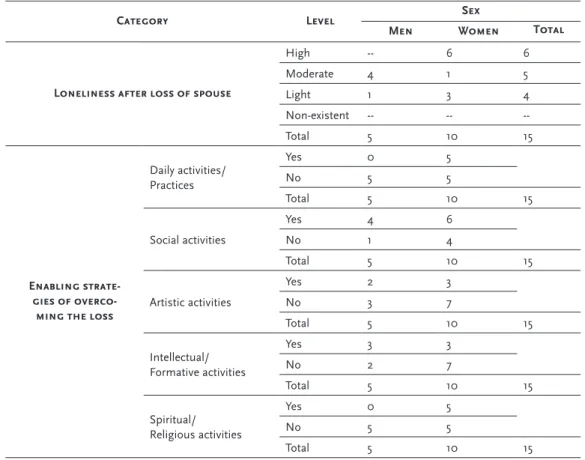
In the category “loneliness after the loss of a spouse” the subjects’ perceptions were analysed in relation to the degree of loneliness experienced after the death of a spouse — a feeling of emptiness following the loss of a binding figure who provided security, stability and support. In the category of “enabling strategies for overcoming loss” we examined the representations of the people interviewed about the strategies employed to assist in overcoming loss. The support strategies for overcoming grief were divided into five types of activities: daily activities/practices, social activities, artistic ac-tivities, intellectual /formative activities and spiritual/religious acac-tivities, according to the table below (table 3).
Category Level Sex
Men Women Total
Loneliness after loss of spouse
High -- 6 6 Moderate 4 1 5 Light 1 3 4 Non-existent -- -- --Total 5 10 15 Enabling strate-gies of
overco-ming the loss
Daily activities/ Practices Yes 0 5 No 5 5 Total 5 10 15 Social activities Yes 4 6 No 1 4 Total 5 10 15 Artistic activities Yes 2 3 No 3 7 Total 5 10 15 Intellectual/ Formative activities Yes 3 3 No 2 7 Total 5 10 15 Spiritual/ Religious activities Yes 0 5 No 5 5 Total 5 10 15
Table 3 -The loss of a spouse, according to gender
As shown in the above data shown, women felt loneliness after the death of spouse in greatest number and with a greater degree than men, who expressed more moder-ate feelings of loneliness, with a distinctive pattern. However, with regard to facilitating strategies for overcoming loss, we can observe the existence of four different standards within the choices of men and women. In fact, according to the data presented, men admit to preferring the artistic activities and intellectual/training activities, while women choose daily activities/practices and spiritual/religious activities. With regard to social
activities, although both sexes chose these activities as the main adaptation strategy, it is noted that this kind of strategy had greater importance for men rather than for women.
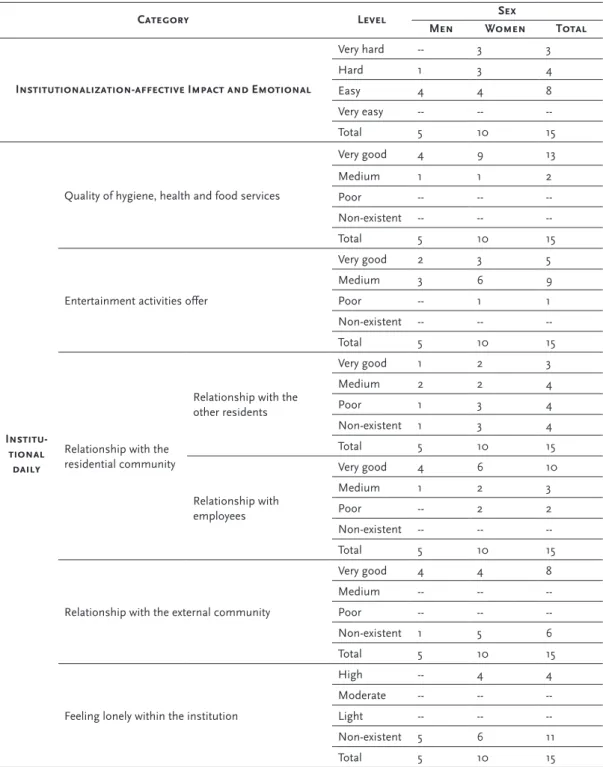
In the next diagram (table 4), we will present the data relating to representations of the study participants regarding life in residential structures, according to gender.
Category Level Sex
Men Women Total
Institutionalization-affective Impact and Emotional
Very hard -- 3 3 Hard 1 3 4 Easy 4 4 8 Very easy -- -- --Total 5 10 15 Institu-tional daily
Quality of hygiene, health and food services
Very good 4 9 13
Medium 1 1 2
Poor -- --
--Non-existent -- --
--Total 5 10 15
Entertainment activities offer
Very good 2 3 5
Medium 3 6 9
Poor -- 1 1
Non-existent -- --
--Total 5 10 15
Relationship with the residential community
Relationship with the other residents Very good 1 2 3 Medium 2 2 4 Poor 1 3 4 Non-existent 1 3 4 Total 5 10 15 Relationship with employees Very good 4 6 10 Medium 1 2 3 Poor -- 2 2 Non-existent -- -- --Total 5 10 15
Relationship with the external community
Very good 4 4 8
Medium -- --
--Poor -- --
--Non-existent 1 5 6
Total 5 10 15
Feeling lonely within the institution
High -- 4 4
Moderate -- --
--Light -- --
--Non-existent 5 6 11
Total 5 10 15
Table 4 – Life in the residential structure, according to gender
Life in the residential structure
This topic consists of two broad categories: the institutionalisation — namely, the affective and emotional impact of the process — and institutional everyday life, which
encompasses the quality of health, hygiene and nutrition services, the provision of enter-tainment activities, the relationship with the residential community and with the external community.
According to the data presented, we can see the existence of a differentiated set of standards between the representations of men and women regarding life in the residen-tial structure. From the start, the male participants believe that entry into the institution was an easier process than female subjects. Also, with regard to the relationship with the residential community and with the community outside the institution, from the male re-spondents’ perspective more positive and satisfying relationships were established, than for the female respondents. As for the loneliness experienced in an institutional context, we found that the general trend of men is to not feel alone, while the female tendency is to divide representations between the two most disparate points in the table, and there is a considerable number of women foreseeing a feeling of great loneliness. Thus, men seem to develop more meaningful emotional relationships and have a lesser degree of solitude, while women have tend to more negative representations of their affective rela-tionships and have a greater tendency to feel alone.
3. Sex as the main critical condition in adapting to profound emotional loss: discussion of data
In the speeches that the participating in this study subjects made about them-selves, several key elements associated with specific personal and socio-cultural condi-tions emerged, which proved decisive in the way that, in institutional settings, mourning in advanced adulthood is overcome.
In this sense, and considering the way in which individuals analyzed and reflected on their actions and behaviours from a phenomenological perspective, we can perceive the existence of two differentiated profiles of reaction according to deep emotional loss-es: an adaptive profile, oriented towards loss-overcoming behaviours, and a non-adap-tive profile, associated with denial and a posture of not overcoming loss.
The adaptive profile concerns participants presenting a tendency towards adapting to losses and to situations which cause stress, of emotional reorganization through sig-nificant affective and emotional links, the performance of new roles and the employment of strategies for emotional support. The non-adaptive profile is associated with partici-pants that could not adapt to loss, interiorizing a profile of withdrawing from emotional reorganization, hindering the creation of ties and affective bonds, denying and avoiding restructuring changes.
Throughout the data analysis, we noticed that gender is a determining factor in adapting to loss, as the investigation clearly revealed differentiated patterns between the male and female participants’ discourses. Thus, the results of our study indicate that men show a more positive trend of adaptation to stressful events, related to more satis-factory affective links and a greater perception of control, while women tended to show patterns of greater emotional fragility, less satisfactory emotional relations and a minor
perception of control, which is reflected in a higher propensity for denial and withdrawal of adaptation to loss.
In fact, one of the determinant aspects for overcoming loss is the perception of control because, as defended by Santos and Paúl (2006), the needs of people living in institutional environments are fulfilled in a much more positive way when solid social support networks exist, particularly the family networks. In reality, and as we noticed in our participants’ discourses, affective relationships with family members do not de-crease in importance due to the institutionalization of the subject, but rather continue to be decisive in the quality of life of older people and constitute the central axis of the life cycle, a space of belonging, of identification and of continuity in existence.
Nevertheless, family relationships, and the support which they provide, are not per-ceived in a unanimously manner by our subjects, as differentiated patterns emerge in the way that male and female participants understand their family connections.
Thus, with regard to men, the vast majority consider themselves to have a very good family relationship. Actually, these subjects represent the link with their families as being quite close, since they still feel part of the family dynamic. According to the research data, as male subjects reflect on their family relationship, they focus on the material well-being of the family, an aspect that takes is essentially related to money: “I like having some money here because sometimes my grandchildren or children come here [...] I’m the one that helps them when they need it… “(Int. 11, man). In this sense, we realized that the men possess a representation of their family relationship in a more instrumental manner, in which their role is more associated with the well-being — in particular financial and material — of the family: “my nephew comes here asking for advice on agriculture, about business he’s doing...I can’t complain about my family!” (Int, 6 man). As a matter of fact, these subjects view their family role and frame it in the continuation of their life experience. As mentioned in the first part of the article, the male participants who were interviewed are highly influenced by gender roles, in which it was up to the man to provide the family’s sustenance. So, just as they did throughout their lives, the male respondents continue to view themselves in the family dynamics, based on the support they can provide on the levels of finances and resources.
When we analyze the discourses of the female participants, we understand that women tend not to view their family relationships in such a positive way as men. Strict-ly speaking, and as we can see in table 2, a considerable number of women consider their family relationships in negative levels. In fact, for the respondents, satisfaction with family relations is closely related to the constant presence and affective closeness of their families, requiring, for their well-being, to feel the regular presence of these family members in their residential homes: “the older one [daughter] came last Sunday and it’s natural that she’ll come next Sunday. The youngest [daughter] is the one who makes me the groceries and came yesterday to bring me the bundle! And that’s the way it goes! Typically they come every 15 days. They don’t leaver it longer than that! “(Int. 14, woman). When physical presence is impossible, due to the geographic distance that separates them, the women attach a higher importance to feeling cherished and a constant matter
of concern for their family members: “they [son and grandchildren] are in Germany, but I often speak with them on the phone. Practically every day! And when they’re not con-vinced that I’m well, they’ll ask to speak to the director! [laughs] So, they’re always wor-ried! “(Int., 9 woman).
In fact, female subjects who consider themselves to have a negative relationship with the family blamed the absence of family members and the lack of attention and af-fection from them, as we can see in the three following testimony: “the lack of afaf-fection from my children is something that [crying]…it’s a mess, it upsets me so much” (Int., 2 woman); “I helped raise my grandchildren ... their mother died and now they no longer know me... [crying] they do not know me as grandmother ... they never come here to visit me ever... “(Int., 4 woman); “look, about my kids, I’ve been here seven years and they never came to see me! And I did so many good things for them! So much! “(Int., 5 woman). Indeed, and similar to the male interviewees, women also view themselves in the family dynamic according to their life experience. Strictly speaking, these women have been socialised to think and act according to traditional gender roles, and therefore they had a greater responsibility in taking care of their families on affective and emo-tional levels. Hence, as explained by several studies (Neto, 2000, 2004; Carr et al., 2000; Guinther et al., 2003), women, especially this generation, reveal a more acute emotional sensitivity, closely connected to the affective support they receive.
These different representations in relation to satisfaction with family relationships also affect the type of needs which the study participants require from their families. Thus, while men expect their relatives to integrate them in family dynamics, pleasing them with the role of providers of financial support, especially associated with the perception of control, women expect attention and continuous care in emotional and affective dimen-sions, requiring the assiduous presence of family members and their constant availability. These different patterns between male and female representations are also visible when it comes to the relations with the employees of residential structures.
In fact, as already mentioned, the residential community can, for bereaved elderly people, constitute a privileged context for the development of interpersonal relations and the reinvestment in new relationships and life projects, undoubtedly contributing to their emotional reorganization and quality of life (Santos & Encarnação, 1998). In this context, the institutions’ professionals play a crucial role in the well-being of the institutionalized. In many cases, employees of the institutions assume the role of a new family, with dif-ferent links and relations, but which are fundamental to the quality of life of the elderly person: “they help a lot! They are very important in these phases. They comfort us with words and are always ready to give us a treat, a bit of affection ... “(Int., 10 woman).
In spite of the fact that all the subjects of our study attach great importance to these caregivers, the truth is that the relationship with employees is viewed more positively by male subjects and is less satisfactory for female subjects. As Felix Neto (2004, 2000), explains, this aspect seems to be related to the fact that women are more critical and have more emotional responses than men, which ultimately influences the type of rela-tionships developed with others.
We reiterate (Bennet, 1997; Parkes, 1998; Rebelo, 2009, 2007) the importance, in the process of adapting to loss, of the (re) construction of new affections, as the percep-tion of support and protecpercep-tion is a crucial determinant in the process of overcoming grief. This aspect is so pressing in our participants’ speeches, that it crushes the idea that social support networks directly influence the quality of life of those in mourning, as we can see with the following testimony: “I don’t have anyone ... […] so I’m here alone ... Since I became a widow I lost my voice… I feel very sad “(Int., 7 woman).
In a profoundly individualistic society, the “we” has particular value in relation to the sense of belonging and of identity; thus, besides the importance that relations with significant family members and employees of the residential structure acquire, their own informal support networks formed by friends, neighbours and the community, are also key elements. Indeed, and as we can see in the discourses of the respondents, by re-suming connections with community spaces and contexts, the participants experience a feeling of control, an aspect closely related to the individual’s identity and their ability to adapt to loss: “I go about my normal life, I’m not here all the time! […] I’m often up to my house: I still have many important documents and notes there. And I take the chance to visit people and catch up with them! “(Int., 3 man).
According to Silva (2005), relations outside the residential structure outside offer a certain perception of continuity, which is necessary in facing the experienced changes by offering a satisfactory balance in dealing with the impact of the psychological losses. However, the data reveals different patterns between the representations of men and women regarding their relations with the wider community.
In fact, men tend to see their surrounding community connections as more posi-tive and satisfactory than women, who tend to have less satisfactory representations of their surrounding community connections.
Even after the final entry in the residential structure, the data suggest that men enjoy a broader and deeper network of social relations in the community (“I was a board member of various associations, they were always pushing me into these things [laughs] I’ve was involved in a lot of things until I came here! So when I go out I always bump into people I know “(Int., 3 man) than women, for whom the main focus of social contact concerns relations with significant relatives: “since I entered this place I went out a few times and it was only to go to my children’s home for lunch! But, where else would I go? “(Int., 2 woman).
In fact, while men who participated in our study see their space of belonging as be-ing more associated with “the street”, the women are perceive as bebe-ing more confined to the “the house” space, which greatly influences in type of social relations which are es-tablished: the male subjects have broader and more dispersed social contacts through-out the community, while the female subjects have more restricted social contacts and are more focused on family and neighbours.
The results of our study suggest that the different recurrent patterns that appear in male and female representations concerning the relational sphere strongly correlate with the gender issue, demonstrating that the women’s self-representations tend to be less
supported and bolstered by relatives or by the employees of the residential structure, or by the community outside the host institution.
In fact, we reiterate the fact that the interviewees participating in this survey being were “transitional participants”, individuals belonging to a historical and socio-cultural context, with traditional characteristics, where sociability and forms of existence were ac-commodated in different spaces of belonging (Santos & Encarnação, 1998). Indeed, the participants in our study were born in the second decade of the last century, and lived during a period of Portuguese history — the New State — in which gender roles were conditioned by practices and by ways of being in society. Thus, due to being assigned to different social roles, depending on gender, many of the behaviours were acquired, based on differences of traits that were accepted as belonging to women or to men, influencing their behaviour, self-concept and perception of others (Neto, 2000) - in short, affecting a specific attitude in the process of adapting to loss.
In this way, the data from the study suggests that interpersonal relationships, and the resulting network of affective and emotional supports, are perceived by male subjects as social contexts of support that favour facilitating strategies in the process of over-coming grief. The “being-in-world”, which implies “being-with-the-other” — whether this means family, colleagues, employees or residents in the outside community —, is repre-sented by the male subjects in a non-problematic way, as they perceiving themselves in relationships that do not present difficulties and which contribute to their enrichment.
With regarding to women, through the interview narratives, we understood that there is a greater tendency towards negative representations and an unsatisfactory net-work of relationships, with an increased inability to turn their existing emotional connec-tions into support strategies for adapting to loss.
We have realized that the women in our study, whilst perceiving interpersonal re-lationships in a more emotional and expressive way, also reveal a greater tendency for emotional weakness when they think of their circle of relationships. Everything indicates that this issue is related to the emotional insecurity with which many of these women lived up to their advanced adulthood, and which may have given rise to a set of social and emotional difficulties. In fact, when our subjects narrate the scope of their social relations, this social and affective incompetence is visible, from the very first moment, in their representations regarding the relationship with the deceased spouse. Indeed, the negative perceptions emerging associated with the marital relationship are replicated in the way they describe their everyday life in the institution and the very process of insti-tutionalisation: In fact, these women present the worst relations with significant family members, with employees and with the external community, revealing higher levels of loneliness, in comparison with male subjects. This led us to realise that women have tend to have greater emotional fragility in how they relate to others, which influences the type of affective and emotional support they derive from these relationships, causing major difficulties for the recognition of belonging and a leading to a minor perception of control perception over their own lives, strongly influencing their ability to adapt to loss and organise themselves emotionally.
We would like to point out that these differences between sexes are not only notori-ous in social relationships, but also in the nature of support strategies that are chosen and the way that these are employed in adapting to loss.
In reality, the various differentiated patterns that emerge between the female and male interviewed subjects, which can be analyzed in table 3, lead us to raise the ques-tion of whether the female participants in this study chose more limited and condiques-tioned specific strategies and ways of overcoming grief, because they have fewer abilities and skills to make use of more fruitful activities in the process of adapting to loss: “I clung to God! Was there anything else I could do? No! “ (Int., 2 woman) than men who resorted to more diversified activities with greater adaptive potential: “I need to be entertained so that I don’t think about bad things... then, I like to sing some little songs, and get myself singing some fados I invented in the living room! [laughs] See this, just now I was upstairs in my room, and when I start thinking of bad things, I like writing poems or songs! [gets a set of papers from his pocket] look, I’ve got a song here, want to hear it? “(Int. 12, man)
Indeed, all the signs indicate that, once again, that we are faced with gender issues, which seem to strongly influence the participants’ processes of development, adaptation and resilience. In fact, as already discussed, the elderly of today continue to recognize themselves according to their gender roles, formed by socially and culturally constructed aspects which influence their behaviour, their experiences and their representations of what they face in life and the emotional attachments that give them meaning (Neto, 2004, 2000; Parkes, 1998; Santos & Encarnação, 1998). Thus, the men and women of this study have lived in different ways — conscious of the gender roles that have con-ditioned their experiences and their forms of sociability — and therefore old age also presents differentiated features for the adaptation to loss.
As discussed earlier in the article, we find studies in the literature (Erlangsen et al., 2004; Stroebe, 1998) which show that the elderly men have greater difficulties in dealing with the loss of a companion and need more time to overcome their grief, whereas wom-en have greater facility in adapting to the loss of a spouse (Carr et al., 2000). However, we are aware of the fact that these studies were conducted with non-institutionalized elderly people. Thus, when it is claimed that women adapt better because they have more ease in managing the house, in completing of domestic chores or because they have a stronger social network of neighbours and relatives (Guinter, Segal & Boggaards, 2003), these resources and strategies do not apply to institutionalised women who cannot par-ticipate in domestic chores, who cannot make use of their knowledge and who see their connection between their community and their neighbour as broken. On the other hand, men see their daily needs fulfilled (as indeed happened throughout their life), and since they have a wider and more satisfying network of relations, they feel that they fit in, and reveal greater facility in adapting to loss.
Conclusions and recommendations
In the light of the results of this research, we realise that social relationships are fundamental to emotional reorganization and the overcoming of grief, and that the daily
lives of the elderly, apart from being institutionalised, continues to be based on networks of solidarity, both internal and external to the institution, promoting social participation and the promotion of their own culture.
We also understand that social and cultural conditions influence the way in which the mourning person adapts and overcomes grief, although there are no universal cat-egories to organise the grieving process, the results of this investigation show that the gender seems to be a decisive factor, as a critical condition between a greater or lesser adaptation to loss.
Thus, the male participants demonstrate a profile which is more orientated to-wards an adaptive and balanced restructuring, with a more affective and emotional con-nection to family members, employees and the community external to the institution, which leads them to feel less alone in the residential structure. However, the women we studied have profiles which are more oriented towards loss, where a weaker liaison with their families, with the residential community and with the outside community tends to emerge, which also explains why women tend to feel more alone in their host institution.
Assuming the existence of an extricable link between culture, grief and ageing (Pa-palia et al., 2006), we were able to conclude that not only are losses differently experi-enced culturally and symbolically for men and women, but also, the answers given to aspects involving the overcoming of loss are determined by questions relating to cultur-ally assimilated gender roles.
Therefore, and in order to prevent institutionalisation from becoming another deep emotional loss, the residential structure should be able to provide the elderly with ac-cess to different support strategies for overcoming grief, anchored in the life experiences of each subject. The interventions provided in these structures should recognize the individuality of each elderly person. The whole cannot be ignored, as lives are lived in interdependently, and are shaped by social and cultural influences. Furthermore, the pro-fessionals of these institutions must pay special attention to elderly people presenting profiles of non-adaptation to loss, in order to organise appropriate intervention which is consistent with the social and cultural universe of the resident, so that they can counter-act the tendency to desist and refrain from (re)constructing their identity, giving them the potential to control their lives.
References
Afonso, M. (2012). Stress, coping e resiliência em pessoas idosas. In C. Paúl & O. Ribeiro (Coord.), Manual
de Gerontologia: Aspetos Biocomportamentais, Psicológicos e Sociais do Envelhecimento (pp. 163-175).
Lisboa: Lidel,
Bardin, L. (2004). Análise de conteúdo. Lisboa: Edições 70. Tradução de Luís Antero Reto e Augusto Pinheiro. Barreto, J. (2006). Relação terapêutica com o paciente idoso. In H. Firmino (Ed.), Psicogeriatria (pp. 113-132),
Coimbra: Psiquiatria Clínica.
Bennet, K. M. (1997). Widowhood in elderly women: The medium-and long-term effects on mental and physical health. Mortality, 2(2),137-149.
Bennet, K. M. (1998). Longitudinal changes in mental and physical health among elderly, recently widowed Men. Mortality, 3(3), 265-274.
Bertaux, D. (1999). El enfoque biográfico: su validez metodológica, sus potencialidades. Proposiciones, 29, 1-22. Acedido em http://www.sitiosur.cl/publicacionescatalogodetalle.php?PID=3258&doc=&lib=&rev=& art=&doc1=&vid=&autor=&coleccion=&tipo=ALL&nunico=15000029
Bowlby, J. (1984). Loss: Sadness and depression. Vol. 3. Nova Yorque: Basic Books.
Born, T. (2002). Cuidado ao idoso em instituição. In M. Netto (Org.), A Velhice e o Envelhecimento em Visão
Globalizada (pp. 403-414). São Paulo: Editora Atheneu.
Bourdieu, P. (1989). O poder simbólico. Lisboa: Difel. Tradução de: Fernando Tomaz.
Brandão, A. (2007). Entre a vida vivida e a vida contada: A história de vida como material primário de investigação sociológica. Configurações. Revista de Ciências Sociais. 3, 83-106. Acedido em http:// repositorium.sdum.uminho.pt/bitstream/1822/9630/3/Entre%20a%20Vida%20Vivida%20(2).pdf Carr, D. (2004). Gender, preloss marital dependence, and older adults’ adjustment to widowhood. Journal of
Marriage and Family, 66, 220–235.
Carr, D., House, J., Kessler, R., Nesse, R., Sonnega, J. & Wortman, C. (2000). Marital quality and psychological adjustment to widowhood among older adults: A longitudinal analysis. Journal of
Gerontology: Social Sciences, 55 B(4), 197-207.
Carr, D., & Bodnar-Deren, S. (2009). Gender, aging and widowhood. In P. Uhlenberg (Ed.),
International Handbook of Population Aging (pp. 705-728), New York: Springer-Verlag.
doi:10.1007/978-1-4020-8356-3_32.
Erlangsen, A., Jeune, B, Bille-Brahe, U & Vaupel, J. (2004). Loss of partner and suicide risks among old: a population-based register study. Age and Ageing. 33 (4), 378–383. doi: 10.1093/ageing/afh128.
Ferrarotti, F. (2007). Las historias de vida como método. Convergência. Revista de Ciências Sociais, 44 (14), 15-40. Acedido em http://www.redalyc.org/articulo.oa?id=10504402
Fry, P.S. (1998). Spousal loss in late life: A 1-year follow-up of perceived changes in life meaning and psychosocial functioning following bereavement. Journal of Personal and Interpersonal Loss, 3, 369-391. Gomes, A. (2010). Envelhecimento: Memórias da velhice pelas terras do sempre e do nunca. Lisboa: Santa Casa
da Misericórdia.
Guinter, P., Segal, D. & Boggaards, J. (2003). Gender diferences in emotional processing among bereaved older adults. Journal of Loss andTrauma, 8, 15-33.
Ha, J., Carr, D., Utz, R. & Nesse, R. (2006). Older adults’ perceptions of intergenerational support after widowhood - How do men and women differ?. Journal of Family Issues, 27(1), 3-30.
Mcgoldrick, M. & Walsh, F. (1998). Um tempo para chorar: A morte e o ciclo de vida familiar. In F. Walsh & M. Mcgoldrick (Coord.), Morte na Família: Sobrevivendo às Perdas (pp. 56-75). Porto Alegre: Artmed. Tradução de Cláudia Dornelles.
Medrano, C. & Cortés, A. (2007). La investigación narrativa y su relación com la educación. In C. Medrano (Coord.), Las Histórias de Vida. Implicaciones Educativas (pp. 21-46). Buenos Aires: Alfagrama, Neto, F. (2000). Psicologia social. Volume 2. Lisboa: Universidade Aberta.
Neto, F. (2004). Psicologia social da felicidade. In F. Neto (Coord.), Psicologia Social Aplicada (pp. 351-392), Lisboa: Universidade Aberta.
O’ Neil, B. J. (2009). Histórias de vida em antropologia: estilos e visões, do etnográfico ao hipermoderno. In E. Lechner (Org.), Histórias de Vida: Olhares Interdisciplinares (pp. 109-117), Porto: Edições
Afrontamento.
Papalia, D., Olds, S. & Feldman, R. (2006[8ªedição]). Desenvolvimento humano. Porto Alegre: Artmed. Tradução de Daniel Bueno.
Parkes, C. M. (1998). Luto - Estudos sobre a perda na vida adulta. São Paulo: Summus Editorial. Tradução Maria Helena Franco Bromberg.
Paúl, C. (1997). Lá para o fim da vida. Coimbra: Livraria Almedina.
Paúl, C. (2006). Psicologia do envelhecimento. In H. Firmino (Ed.), Psicogeriatria (pp. 43-65), Coimbra: Psiquiatria Clínica.
Rebelo, J. E. (2007[3ª edição]). Desatar o nó do luto: Silêncios, receios e tabus. Lisboa: Casa das Letras. Rebelo, J. E. (2009). Amor, luto e solidão. Lisboa: Casa das Letras.
Ribeiro, A. (2002) Sexualidade na terceira idade. In M. Netto (Org.), A Velhice e o Envelhecimento em Visão
Globalizada (pp. 124-135), São Paulo: Editora Atheneu.
Santos, F. & Encarnação, F. (1998). Modernidade e gestão da velhice. Faro: Centro Regional da Segurança Social do Algarve.
Silva, M. E. (2005). Saúde mental e idade avançada. In C. Paúl & A. Fonseca (Coord.), Envelhecer em Portugal (pp. 137-156). Lisboa: Climepsi Editores.
Stroebe, M. S. (1998). New directions in bereavement research: Exploration of gender differences. Palliative
Medicine, 12, 5-12.
Twycross, R. (2003 [2ªedição]). Cuidados paliativos. Lisboa: Climepsi Editores. Tradução de José Nunes de Almeida.
Worden, W, J. (2002). Grief counselling and grief therapy - A handbook for the mental health practitioner. Nova Yorque: Springer Publishing Company.
Jenny Gil Sousa is a PhD in Cultural Studies from universities of Minho and Aveiro, master of Art and Education from Universidade Aberta and a degree in Socio-educative Animation from the Education College at the Polytechnic Institute of Coimbra. Is lecturer at College of Education and Social Sciences in the Polytechnic Institute of Leiria and co-ordinates the Leiria core of the Iberoamerican Network of socio-cultural Animation. Is a researcher of the CECS – Centre for communication studies and society at the University of Minho and a member of NIDE - Investigation Center and Educational Development at Polytechnic Institute of Leiria.
E-mail: [email protected]
Escola Superior de Educação e Ciências Sociais/IPLeiria / CECS (Centro de Estu-dos de Comunicação e Sociedade) Universidade do Minho Campus de Gualtar, 4710-057, Braga, Portugal
Maria Manuel Rocha Teixeira Baptista is a professor and researcher in cultural stud-ies in the Department of languages and cultures at the University of Aveiro and Director of the doctoral program in cultural studies at the University of Aveiro (3rd cycle taught in collaboration with the University of Minho). With several publicatons at national and in-ternational levels, in cultural studies area, she is a doctor of culture, from the University of Aveiro, since 2002, has a master’s degree in educational psychology from the Faculty of psychology and educational sciences of the University of Coimbra, 1996 and gradu-ated in philosophy from the Faculty of languages at Porto University, 1986.
E-mail: [email protected]
Departamento de Línguas e Culturas - CLLC (Centro de Línguas Literaturas e Culturas) Universidade de Aveiro Campus Universitário de Santiago, 3810-193, Aveiro, Portugal
* Submitted: 16-02-2015 * Accepted: 20-04-2015