Prediction of the nutritional value of grass species
in the semiarid region by repeatability analysis
Janerson José Coêlho(1), Alexandre Carneiro Leão de Mello(2), Mércia Virginia Ferreira dos Santos(2), José Carlos Batista Dubeux Junior(3), Marcio Vieira da Cunha(2) and Mário de Andrade Lira(2)
(1)Waterford Institute of Technology, Department of Science, Cork Road, Waterford, Ireland. E-mail: [email protected] (2)Universidade Federal Rural de Pernambuco(UFRPE), Rua Dom Manoel de Medeiros, s/no, Dois Irmãos, CEP 52171-900 Recife, PE,
Brazil. E-mail: [email protected], [email protected], [email protected], [email protected] (3)University of Florida, North Florida Research & Education Center, 155 Research Road, 32351, Quincy, FL, USA. E-mail: [email protected]
Abstract – The objective of this work was to estimate the repeatability (r) and the number of samples required to measure the nutritional value of four warm-season forage grasses growing in a semiarid region. The grasses evaluated were Urochloa mosambicensis, Cenchrus ciliaris, Digitaria pentzii, and Megathyrsus maximus. Evaluations occurred under two forage management conditions: stockpiling and grazing. Hand-plucked forage samples were analyzed for dry matter (DM), crude protein (CP), neutral detergent fiber (NDF), acid detergent fiber (ADF), lignin, and in vitro DM digestibility (IVDMD). Four methods were used to estimate r and the number of samples required: analysis of variance, method of principal components based on the covariance (PCCOV) and the correlation (PCCOR) matrices, and structural analysis (EVCOR). Species were compared by the probability of the difference using the t-test. The method PCCOV presents the highest coefficient of repeatability and, therefore, a lower number of samples required. Lignin is the trait that have the highest number of samples required. In terms of qualitative traits, D. pentzii and M. maximus show the best forage qualities among the species evaluated.
Index terms: chemical composition, IVDMD, sampling, warm-season grasses.
Predição do valor nutricional de gramíneas na região
semiárida por meio da análise de repetibilidade
Resumo – O objetivo deste trabalho foi estimar a repetibilidade (r) e o número de amostragens necessárias para mensurar o valor nutricional de quatro gramíneas forrageiras tropicais numa região semiárida. As gramíneas avaliadas foram Urochloa mosambicensis, Cenchrus ciliares, Digitaria pentzii e Megathyrsus maximus. As avaliações ocorreram sob duas condições de manejo da forragem: diferimento e pastejo. Amostras de forragem coletadas por pastejo simulado foram analisadas para matéria seca (MS), proteína bruta (PB), fibra em detergente neutro (FDN), fibra em detergente ácido (FDA), lignina e digestibilidade in vitro da MS (DIVMS). Para a análise de r e número de amostragens necessárias, utilizaram-se quatro métodos: análise de variância, componentes principais da matriz de covariância (CPCOV) e de correlação (CPCOR), e análise estrutural (AECOR). As espécies foram comparadas pela probabilidade da diferença, tendo-se utilizado o teste t. Para o método CPCOV, observa-se maior coeficiente de r, portanto, menor número de amostragens necessárias. A lignina é a característica que apresenta o maior número de amostragens necessárias. Em termos qualitativos, D. pentzii e M. maximus mostram melhores características entre as espécies forrageiras avaliadas.
Termos para indexação: composição química, DIVMS, amostragem, gramíneas tropicais.
Introduction
The evaluation of the chemical composition of forage
species has a significant impact on the understanding of their nutritional value and also a great influence
on animal nutrition (Zhao et al., 2008; Dewhurst et al., 2009). Their chemical composition generally
is estimated by the combination of crude protein
(CP), neutral detergent fiber (NDF), acid detergent fiber (ADF), lignin, and total digestible nutrients (TDN) (Guo et al., 2010). The estimation of these forage components might be subjected to significant
the phenological stage can directly affect the chemical composition of grass species and that dry matter digestibility (DMD), CP, and metabolic energy were reduced in several types of grass with the increment of the harvesting period. In a trial with different
warm-season grasses, Velásquez et al. (2010) reported that in vitro dry matter digestibility (IVDMD) varied
among grass species, but that there was no effect of harvesting time. It should be noted that the interaction between forage species and season of the year can be a determinant factor for the variability of these results. The phenological and seasonal oscillations that forage species are subjected to create uncertainties related to the number of evaluations necessary to provide a reliable result regarding their chemical composition, taking into account variations in time.
Specifically in the semiarid of Brazil, the native
grasslands are characterized by a low carrying capacity of 12–15 animal-units per hectare per year (Lira et al., 2004) and a low forage quality. Among the forage quality issues, is the high percentage of
fibrous components of these native grasses (Formiga
et al., 2011), which can impact directly on DMD and animal performance. To increase the carrying capacity and forage quality of the grasslands in the semiarid region of the country, the cultivation of semiarid exotic grasses from Africa, such as Digitaria spp., Cenchrus ciliaris L., and Urochloa mosamibicensis Hackel Dandy (Lira et al., 2004), has been encouraged. These species are specially recognized by their adaptability to produce under arid environments. Another exotic grass that has been noticed naturally or cultivated in the semiarid region of Brazil are the natural genotypes of Megathyrsus maximus (Jacq.) B.K.Simon & S.W.L.Jacobs. Due to the importance and potential of the use of these exotic grasses for the livestock systems in the semiarid, it is necessary to evaluate and understand their forage quality aspects under different management practices such as grazing and stockpiled.
Using repeatability analysis, it is possible to outline
the number of samples required (NSR) to predict the
genotypic value of an individual along sequenced measurements along time.
The repeatability analysis has been used to analyze different productive and structural traits in warm-season grasses (Lédo et al., 2008; Basso et al., 2009;
Viana et al., 2009; Teixeira et al., 2011; Martuscello
et al., 2015). Although the efforts that were made to
estimate the repeatability of productive and structural traits in forage species, there is a gap in relation to the chemical composition. Only few publications were found in the literature (Shimoya et al., 2002; Teixeira et al., 2011); also, these publications only focused on isolated factors of chemical composition, in these cited
cases, CP and N%, respectively.
The objective of this work was to estimate the repeatability (r) and the number of samples required to measure the nutritional value of four warm-season forage grasses growing in a semiarid region.
Materials and Methods
The study was conducted at the experimental station of the Instituto Agronômico de Pernambuco (IPA), located in the municiaplity of Caruaru, a semiarid region of the state of Pernambuco, Brazil, 8°14'18"S and 35°55'20"W, at an altitude of 550 m. The
climate of the region is defined as semiarid (Ramos
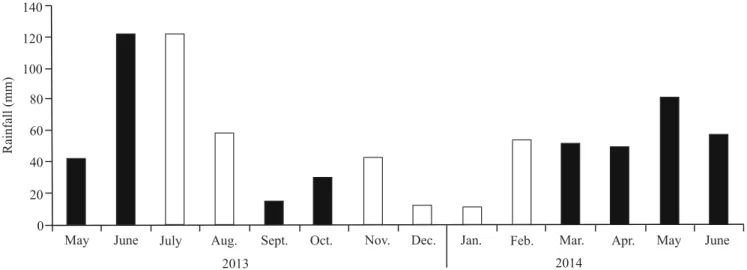
et al., 2008), and its predominant vegetation is the hypo-xerophytic Caatinga. Average annual rainfall is 609 mm, with a potential evaporation of 1,393 mm. Monthly average rainfall during the sampling periods
is shown in Figure 1. Average temperature ranges from 19 to 28°C (INMET, 2014). The soils of the region are classified as a Neossolo Regolítico (Santos et al., 2013), i.e., Udorthent. Soil fertility of the field site was
determined by individual samples collected in each
plot in May 2013 (0–20 cm depth). Nutrient average
concentration in the soil is shown in Table 1. There were no fertilization practices during the experimental period. However, cow feces were deposited when the grasses were subjected to grazing activities from March to June 2014.
Forage species analyzed were four warm-season
grasses: Urochloa mosambicensis Hackel Dandy,
Cenchrus ciliaris L., Digitaria pentzii Stent, and
Megathyrsus maximus (Jacq.) B. K. Simon & S. W. L. Jacobs (spontaneous genotype from the region). The experimental design was randomized blocks with four replications. The plots had a total area of 25 m2, with
9 m2 of sampling area, and total experimental area was
625 m2. Plots were sown in June of 2009, and had been
only subjected to sporadic cuts targeting weed control or pasture regrowth.
During the experimental time, grass swards were managed under two conditions, stockpiled and grazed. Samplings were performed during eight evaluations, divided into four under stockpiled
conditions and four subjected to grazing. Grasses
evaluated under stockpiled conditions started to grow by the end of March 2013, and were sampled by the end of May, and the end of June, accounting for an interval of approximately 60 and 90 days of growth. Stockpiled grass swards could grow freely without any type of management or harvesting. The only activity performed was the sampling of approximately 150±50 g of fresh herbage, in May and June. In early July of 2013, a total harvesting of the plots was performed targeting to renew grass sward. Plants were cut at a stubble height of approximately 5 cm (U. mosambicensis and D. pentzii), 10 cm (C. ciliaris) and 20 cm (M. maximus). In early September and October of 2013, more two samplings under stockpiled conditions were performed, accounting again for a growth interval of approximately 60 and 90 days,
respectively. Under grazing, samplings were performed in March, April, May, and June 2014, with an interval of 35 days between each of them. Plots under grazing management were mob-stocked by crossbred lactating dairy cows (Holstein x Zebu), with an average weight of 400±50 kg, also calves/steers of different ages.
Grazing activity was performed targeting to renew
grass swards, and animals remained in the plots until canopy height reached the desirable stubble height cited above for each species.
Samples of fresh forage (150±50 g per plot) were collected by hand-plucking along the whole plot,
exploring the variability. Fresh samples were
individually weighed and dried subsequently in an oven with forced air circulation at 55°C for 72 hours. After that, samples were grinded in a mill with a sieve
of 1 mm mesh. Forage samples were analyzed for their
content of dry matter (DM) at 105ºC. Crude protein (CP) was accessed by the percentage of total Kjeldahl nitrogen and multiplied by the correction factor of 6.25.
Neutral detergent fiber (NDF) and acid detergent fiber (ADF) followed procedures described in Detmann et
al. (2012). Lignin was accessed by solubilization of
Figure 1. Monthly rainfall levels in the experimental site from May 2013 to June 2014, using IPA’s pluviometer. The forage samplings were carried out in the months represented by black columns.
Table 1. Soil chemical composition of samples collected in May 2013 at 0–20 cm depth layer in the experimental area.
pH water P K+ Ca2+ Mg2+ Na H+Al Organic carbon Organic matter
(mg dm-3) ---(cmol
c dm-3)--- ---(g kg-1
cellulose in sulfuric acid (72% w/w) after digestion in
acid detergent; following that, samples were corrected
in their ash content. The IVDMD was determined using
the ruminal fermenter Daisy II (Ankon, Technology
Corp., Fairport, NY, USA) following the methodology
described by Holden (1999).
Repeatability for DM, CP, NDF, ADF, lignin, and IVDMD were calculated using four methods of
analysis: analysis of variance (Anova), methods of principal components based on the covariance matrix
(PCCOV), method of principal components based on the correlation matrix (PCCOR), and methods of
structural analysis, based on the theoretical eigenvector
of the correlation matrix (EVCOR), described by
Mansour et al. (1981). To explore the chemical composition variability attributed to the possible effects of plant species, sward management and time of the year, repeatability was estimated combining the results of all plant species for each chemical trait, in both sward managements and in eight sampling cycles.
Classification of the repeatability followed Resende (2002), being high repeatability (r ≥0.60); medium
repeatability (0.30< r <0.60), and low repeatability
(r ≤0.30). The NSR to predict the value of the chemical traits and IVDMD were estimated for the following coefficients of determination (R2): 0.80, 0.85, 0.90, 0.95,
0.99, given by the formula: Η = R2 (1 - r) / (1 - R2) r;
in which: η, minimum number of samples to predict
the value of the characteristic; and r, repeatability
coefficient. Statistical analyses were performed using the software Genes (Cruz, 2007).
Statistical analyses of chemical composition and
IVDMD were based on repeated measurements
along time, separated for each sward management:
stockpiled and grazing. Anova considered as fixed
factors: species, block, sampling cycle (separately for each sward management) and interaction (species x sampling cycle). Means were estimated using the
procedure LSMEANS in Proc Mixed of statistical package SAS 9.3 (SAS Institute, Cary, NC, USA), and compared by the probability of the difference (PDIFF) using t-test, at 5% probability.
Results and Discussion
The PCCOV presented highest coefficient of
repeatability among the methods tested (Table 2). All values of repeatability for each chemical trait were
classified as high (>0.60) in the PCCOV method. The range of the r coefficients found in this study for most
forage chemical traits and methods of analysis can
be considered high. Repeatability was calculated for
four different forage species, under two management conditions and along eight sampling cycles along the year.
In view of only the range of r calculated by the
PCCOV method, all the forage nutritional traits evaluated showed only high repeatability coefficients. Studies related to the r and R2 for traits associated
with nutritive value of the forage grasses are scarce, and generally have been based on the analysis of repeatability within a set of cultivars from the same species. In the studies of Shimoya et al. (2002) and Teixeira et al. (2011), the coefficients of repeatability found were close to or above 0.60 for crude protein, and this value is considered high. It is necessary to
Table 2. Repeatability (r) and coefficient of determination (R2) of dry matter (DM), crude protein (CP), neutral detergent fiber (NDF), acid detergent fiber (ADF), lignin, and in vitro dry matter digestibility (IVDMD) from hand-plucking samples of warm-season grasses kept under stockpiled and grazing management.
Variable Anova(1) PCCOV(2) PCCOR(3) EVCOR(4)
r R2 r R2 r R2 r R2
Dry matter 0.65 93.6 0.79 96.7 0.72 95.3 0.64 93.3
Crude protein 0.53 90.1 0.82 97.4 0.59 92.1 0.55 90.8
NDF 0.60 92.2 0.78 96.6 0.70 94.9 0.68 94.4
ADF 0.67 94.2 0.76 96.2 0.76 96.2 0.75 96.0
Lignin 0.39 83.8 0.71 95.2 0.60 92.2 0.46 87.2
IVDMD 0.69 94.7 0.74 95.8 0.76 96.3 0.75 96.0
(1)Anova, analysis of variance. (2)PCCOV, methods of principal components based on the covariance matrix. (3)PCCOR, method of principal components
based on the correlation matrix. (4)EVCOR, method of structural analysis based on the theoretical eigenvector of the correlation matrix. Calculations
consider that when evaluating warm-season grasses in forage trials, the low repeatability presented by some productive characteristics (Lédo et al., 2008; Souza
Sobrinho et al., 2010) may not reflect the same for
characteristics associated to the nutritional value of the forage, which might reduce the number of samples required for an effective estimation of the nutritional traits.
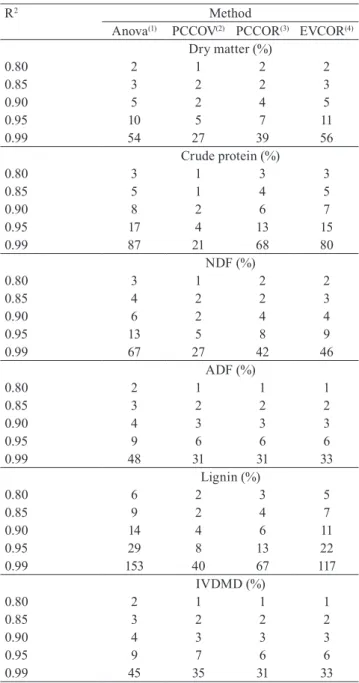
The minimal NSR to predict the value of the
chemical traits evaluated in the forage, and considering
a minimum R2=0.90, were higher for the methods
Anova, PCCOR, and EVCOR than for PCCOV. The PCCOV generally presented lower values of NSR for a R2=0.90, requiring two samplings for DM, CP, and
NDF, three for ADF and IVDMD, and four for lignin. The NSR for a R2=0.95 or 0.99 were considered too
high and not feasible for Anova, PCCOR, and EVCOR. However, for the method PCCOV, the maximum NSR in an R2=0.95 was eight samplings. Generally,
the Anova showed higher NSR in different R2 values
(Table 3). Among the chemical traits evaluated, lignin
stood out for presenting higher NSR in different R2
values.
Due to differences between the methods to calculate
the repeatability, the NSR can vary significantly
depending on the statistical method used to compare the nutritional traits of warm-season grasses. Botrel et al.
(2000) reported that with a coefficient of determination of 90%, it is possible to establish a satisfactory NSR
for productive traits in forage species. Applying this
logic to the qualitative traits and IVDMD, it could be possible to have a satisfactory NSR by performing 2 to
4 evaluations in the forage grasses analyzed in this trial,
considering PCCOV as statistical method of analysis. It is noteworthy that the calculations of r and NSR
in this study were made using four different grasses species, under two different management systems, in eight sampling cycles, and this probably decreased the values of repeatability found. It is possible to suppose
that the NSR to predict the qualitative traits and IVDMD in trials with just one forage species would be
lower than the ones found in the present trial.
Among the nutritional traits evaluated, lignin was the
one that required the highest NSR when compared to the
other variables analyzed. This fact may be associated with the experimental error related to the lignin analysis.
According to Gomes et al. (2011), the lignin analysis
using the method of solubilization in sulfuric acid may
be subject to protein contamination, although the most accurate method to analyze lignin in warm-season
Table 3. Number of samples required (NSR) for dry matter (DM), crude protein (CP), neutral detergent fiber (NDF), acid detergent fiber (ADF), lignin, and in vitro digestibility of the DM (IVDMD), obtained from hand-plucking samples of warm-season grasses kept under stockpiled and grazing management.
R2 Method
Anova(1) PCCOV(2) PCCOR(3) EVCOR(4)
Dry matter (%)
0.80 2 1 2 2
0.85 3 2 2 3
0.90 5 2 4 5
0.95 10 5 7 11
0.99 54 27 39 56
Crude protein (%)
0.80 3 1 3 3
0.85 5 1 4 5
0.90 8 2 6 7
0.95 17 4 13 15
0.99 87 21 68 80
NDF (%)
0.80 3 1 2 2
0.85 4 2 2 3
0.90 6 2 4 4
0.95 13 5 8 9
0.99 67 27 42 46
ADF (%)
0.80 2 1 1 1
0.85 3 2 2 2
0.90 4 3 3 3
0.95 9 6 6 6
0.99 48 31 31 33
Lignin (%)
0.80 6 2 3 5
0.85 9 2 4 7
0.90 14 4 6 11
0.95 29 8 13 22
0.99 153 40 67 117
IVDMD (%)
0.80 2 1 1 1
0.85 3 2 2 2
0.90 4 3 3 3
0.95 9 7 6 6
0.99 45 35 31 33
(1)Anova, analysis of variance. (2)PCCOV, methods of principal compo
-nents based on the covariance matrix. (3)PCCOR, method of principal
components based on the correlation matrix. (4)EVCOR, method of struc
grasses is still not well defined. Another factor that may have contributed to the increments in the NSR to predict
the lignin was the management used – warm-season grasses under stockpiled conditions rapidly increase
lignified tissues after they reach maturity (Euclides et al., 2007; Velásquez et al., 2010), and it may have led to
substantial differences between the species, in terms of
accumulation of lignified tissues.
Under stockpiled conditions, DM, CP, NDF, ADF, and IVDMD did not differ (p<0.0001) among
grasses. Under grazing, C. ciliaris and M. maximus
presented higher DM concentrations (p<0.0001) (Table 4). Cenchrus ciliaris under grazing presented lower CP concentrations than the other species (p<0.0001). Digitaria pentzii showed the lowest
NDF and ADF concentrations compared to the other
species under grazing. Cenchrus ciliaris presented
the highest concentration for NDF, but did not differ
from M. maximus and U. mosambicensis in the
ADF concentrations. Cenchrus ciliaris presented
higher ADF concentration under grazing (p<0.0001).
Digitaria pentzii and M. maximus presented higher
IVDMD, although M. maximus did not differ from
U. mosambicensis (p<0.0001). Cenchrus ciliaris
presented the lowest IVDMD.
Under stockpiled conditions, all species presented similarities in their chemical traits, but the same was not observed during the grazing period. This fact may be associated to the lack of plant tissue renew provided by monthly harvesting or grazing. The frequency of harvesting in general can promote improvement in the quality of the nutritional traits of warm-season grasses
(Arzani et al., 2004; Velásquez et al., 2010).
Higher DM concentrations in C. ciliaris and
M. maximus may be associated with intrinsic characteristics of the species or the cultivar used in this trial. Concentrations of CP were in general similar for three species (U. mosambicensis, D. pentzii, and M. maximus) under grazing. The average CP of
U. mosambicensis, D. pentzii, and M. maximus under
grazing was 14.2%. According to Minson (1990), warm-season grasses have CP values around 10% on
average, thus, the values obtained in this research were above the expected average, which could be associated to variations due to the species analyzed, management factors or differences produced by the laboratory method adopted.
NDF concentrations of all grasses stockpiled were relatively high, which can influence directly the forage
quality. Keeping warm-season grasses under stockpiled conditions should be carefully analyzed, because high
NDF values might be negatively correlated with dry
matter intake by ruminants (Arelovich et al., 2008). Waramit et al. (2012) considered that the maturity of warm-season grasses is the main factor that affects negatively forage quality, with expected decrements in
CP and IVDMD, and increments of NDF.
The average lignin concentrations presented under grazing (U. mosambicensis, D. pentzii, and
M. maximus) were below 2%. According to Jung &
Vogel (1986), lignin concentration below 2% generally promotes IVDMD above 60% in forage grasses. Higher fiber concentrations and lignin observed in
C. ciliaris may have contributed to the lowest IVDMD
observed during the grazing. Studies have shown that
forage grasses at mature stages present lower IVDMD
Table 4. Chemical composition and in vitro dry matter digestibility (IVDMD) of warm-season grasses under stockpiled and grazing management, under semiarid conditions(1).
Grass Dry matter (%) Crude protein (%) NDF (%) ADF (%) Lignin (%) IVDMD (%)
Stockpiled
Cenchrus ciliaris 37.0 9.8 68.5 33.7 2.6 45.2
Urochloa mosambicensis 32.9 10.4 68.4 32.2 2.5 56.8
Digitaria pentzii 29.9 10.9 62.0 26.5 1.7 56.9
Megathyrsus maximus 34.0 11.6 66.5 33.6 1.6 52.4
Grazing
Cenchrus ciliaris 31.8a 11.1b 68.8a 34.9a 3.7a 50.1c
Urochloa mosambicensis 23.5bc 13.7a 63.2b 27.5b 1.9b 57.7b
Digitaria pentzii 22.1c 14.4a 54.3c 24.0b 1.3b 64.1a
Megathyrsus maximus 23.3ab 14.5a 60.4b 26.7b 1.0b 60.7ab
coefficients (Martins-Costa et al., 2008; Waramit et al.,
2012), with a negative correlation occurring between
digestibility and lignin concentration (Jung & Vogel, 1986). Higher IVDMD on D. pentzii during grazing may be associated with the fact that this grass also
presented the lowest NDF. Minson (1990) reported that the IVDMD of forage grasses tend to decrease as a
result of plant maturity, and the most effective way to
prevent decrement of forage digestibility coefficients
is to keep the forages at constant renovation, by cutting or grazing. Digitaria pentzii is a grass species with thin stems and high leaf/stem ratio; it may also
have contributed to the lowest fiber concentration and highest IVDMD observed. The average coefficients of IVDMD above 60% presented by D. pentzii
and M. maximus under grazing were considered satisfactory for the semiarid conditions in which they were growing.
Conclusions
1. The number of samplings required to access chemical composition of warm-season grasses under stockpiled and grazing management in semiarid conditions varies substantially according to the method selected to evaluate the repeatability.
2. PCCOV method shows higher repeatability coefficients, and lower number of samples required to estimate chemical composition and IVDMD.
3. Stockpiled conditions reduces nutritional differences between different forage species.
4. Digitaria pentzii and Megathyrsus maximus
present considerably better qualitative traits among the grasses species under periodic grazing.
Acknowledgments
To Instituto Agronômico de Pernambuco
(IPA-Caruaru), for the provision of the field site and facilities to conduct this research; to Banco do Nordeste S/A (BNB), for financial support; and to Conselho Nacional de Desenvolvimento Científico e Tecnológico (CNPq),
for scholarship granted.
References
ARELOVICH, H.M.; ABNEY, C.S.; VIZCARRA, J.A.; GALYEAN, M.L. Effects of dietary neutral detergent fiber on
intakes of dry matter and net energy by dairy and beef cattle:
analysis of published data. The Professional Animal Scientist, v.24, p.375-383, 2008. DOI: 10.15232/S1080-7446(15)30882-2.
ARZANI, H.; ZOHDI, M.; FISH, E.; ZAHEDI AMIRI, G.H.; NIKKHAH, A.; WESTER, D. Phenological effects on forage quality of five grass species. Journal
of Range Management, v.57, p.624-629, 2004. DOI:
10.2111/1551-5028(2004)057[0624:PEOFQO]2.0.CO;2.
BASSO, K.C.; RESENDE, R.M.S.; VALLE, C.B. do; GONÇALVES, M.C.; LEMPP, B. Avaliação de acessos de
Brachiaria brizantha Stapf e estimativas de parâmetros genéticos
para caracteres agronômicos. Acta Scientiarum. Agronomy, v.31, p.17-22, 2009. DOI: 10.4025/actasciagron.v31i1.6605.
BOTREL, M.A.; FERREIRA, R. de P.; CRUZ, C.D.; PEREIRA, A.V.; VIANA, M.C.M.; ROCHA, R.; MIRANDA, M. Estimativas de coeficientes de repetibilidade para produção de matéria seca
em cultivares de alfafa, sob diferentes ambientes. Revista Ceres, v.47, p.651-663, 2000.
CRUZ, C.D. Programa GENES: aplicativo computacional em
genética e estatística. Viçosa: Ed. da UFV, 2007. 442p.
DETMANN, E.; SOUZA, M.A. de; VALADARES FILHO, S. de C.; QUEIROZ, A.C. de; BERCHIELLI, T.T.; SALIBA, E. de O.S.; CABRAL, L. da S.; PINA, D. dos S.; LADEIRA, M.M.; AZEVEDO, J.A.G. (Ed.). Métodos para análise de alimentos:
INCT – ciência animal. Visconde do Rio Branco: Suprema, 2012.
214p.
DEWHURST, R.J.; DELABY, L.; MOLONEY, A.; BOLAND, T.; LEWIS, E. Nutritive value of forage legumes used for grazing and
silage. Irish Journal of Agricultural and Food Research, v.48, p.167-187, 2009.
EUCLIDES, V.P.B.; FLORES, R.; MEDEIROS, R.N.; OLIVEIRA, M.P. de. Diferimento de pastos de braquiária
cultivares Basilisk e Marandu, na região do Cerrado. Pesquisa
Agropecuária Brasileira, v.42, p.273-280, 2007. DOI: 10.1590/
S0100-204X2007000200017.
FORMIGA, L.D.A.S.; PEREIRA FILHO, J.M.; OLIVEIRA, N.S.; SILVA, A.M.A.; CÉZAR, M.F.; SOARES, D.C. Valor nutritivo da vegetação herbácea da caatinga enriquecida e pastejada por
ovinos e caprinos. Revista Brasileira de Saúde e Produção
Animal, v.12, p.403-415, 2011.
GOMES, D.I.; DETMANN, E.; VALADARES FILHO, S. de C.; FUKUSHIMA, R.S.; SOUZA, M.A. de; VALENTE, T.N.P.; PAULINO, M.F.; QUEIROZ, A. de C. Evaluation of lignin
contents in tropical forages using different analytical methods
and their correlations with degradation of insoluble fiber. Animal
Feed Science and Technology, v.168, p.206-222, 2011. DOI:
10.1016/j.anifeedsci.2011.05.001.
GUO, X.L.; WILMSHURST, J.F.; LI, Z. Comparison of laboratory and field remote sensing methods to measure forage quality.
International Journal of Environmental Research and Public
Health, v.7, p.3513-3530, 2010. DOI: 10.3390/ijerph7093513.
INMET. Instituto Nacional de Meteorologia. Normais
climatológicas do Brasil 1961-1990. Available at: <http://www.
inmet.gov.br/portal/index.php?r=clima/normaisclimatologicas>.
Accessed on: Dec. 2 2014.
JUNG, H.G.; VOGEL, K.P. Influence of lignin on digestibility
of forage cell wall material. Journal of Animal Science, v.62, p.1703-1712, 1986.
LÉDO, F.J. da S.; PEREIRA, A.V.; SOUZA SOBRINHO, F. de; AUAD, A.M.; JANK, L.; OLIVEIRA, J.S. e. Estimativas
de repetibilidade para caracteres forrageiros em Panicum maximum. Ciência e Agrotecnologia, v.32, p.1299-1303, 2008. DOI: 10.1590/S1413-70542008000400040.
LIRA, M.A.; MELLO, A.C.L.; SANTOS, M.V.F.; FERREIRA, M.A.; FARIAS, I.; SANTOS, D.C. Considerações sobre a produção leiteira no semiárido pernambucano. Anais da
Academia Pernambucana de Ciência Agronômica, v.1,
p.112-123, 2004.
MANSOUR, H.; NORDHEIM, E.V.; RUTLEDGE, J.J. Estimators
of repeatability. Theoretical and Applied Genetics, v.60,
p.151-156, 1981. DOI: 10.1007/BF00264520.
MARTINS-COSTA, R.H. de A.; CABRAL, L. da S.; BHERING, M.; ABREU, J.G. de; ZERVOUDAKIS, J.T.; RODRIGUES, R.C.; OLIVEIRA, Í.S. de. Valor nutritivo do capim-elefante obtido
em diferentes idades de corte. Revista Brasileira de Saúde e
Produção Animal, v.9, p.397-406, 2008.
MARTUSCELLO, J.A.; BRAZ, T.G. dos S.; JANK, L.; CUNHA, D. de N.F.V. da; LIMA, B.P. da S.; OLIVEIRA, L.P. de. Repeatability and phenotypic stabilization of Panicum maximum
accessions. Acta Scientiarum. Animal Sciences, v.37, p.15-21, 2015. DOI: 10.4025/actascianimsci.v37i1.23206.
MINSON, D.J. Forage in ruminant nutrition. San Diego: Academic Press, 1990. 483p.
RAMOS, M.A.; MEDEIROS, P.M. de; ALMEIDA, A.L.S. de; FELICIANO, A.L.P.; ALBUQUERQUE, U.P. de. Use and knowledge of fuelwood in an area of Caatinga vegetation in NE
Brazil. Biomass and Bioenergy, v.32, p.510-517, 2008. DOI: 10.1016/j.biombioe.2007.11.015.
RESENDE, M.D.V. de. Genética biométrica e estatística
no melhoramento de plantas perenes. Brasília: Embrapa
Informação Tecnológica; Colombo: Embrapa Florestas, 2002.
975p.
SANTOS, H.G. dos; JACOMINE, P.K.T.; ANJOS, L.H.C. dos; OLIVEIRA, V.A. de; LUMBRERAS, J.F.; COELHO, M.R.; ALMEIDA, J.A. de; CUNHA, T.J.F.; OLIVEIRA, J.B. de.
Sistema brasileiro de classificação de solos. 3.ed. rev. e ampl.
Brasília: Embrapa, 2013. 353p.
SHIMOYA, A.; PEREIRA, A.V.; FERREIRA, R. de P.; CRUZ, C.D.; CARNEIRO, P.C.S. Repetibilidade de características
forrageiras do capim-elefante. Scientia Agricola, v.59, p.227-234, 2002. DOI: 10.1590/S0103-90162002000200004.
SOUZA SOBRINHO, F.S.; BORGES, V.; LÉDO, F.J. da S.; KOPP, M.M. Repetibilidade de características agronômicas e número de cortes necessários para a seleção de Urochloa ruziziensis.
Pesquisa Agropecuária Brasileira, v.45, p.579-584, 2010. DOI:
10.1590/S0100-204X2010000600007.
TEIXEIRA, V.I.; DUBEUX JR., J.C.B.; MELLO, A.C.L. de; LIRA JR., M.A.; LIRA, M. de A.; SARAIVA, F.M. Repetibilidade de variáveis produtivas e qualitativas da forragem e da excreta bovina em pastagem de braquiária. Pesquisa Agropecuária Brasileira, v.46, p.655-662, 2011. DOI: 10.1590/S0100-204X2011000600012.
VELÁSQUEZ, P.A.T.; BERCHIELLI, T.T.; REIS, R.A.; RIVERA, A.R.; DIAN, P.H.M.; TEIXEIRA, I.A.M. de A.
Composição química, fracionamento de carboidratos e proteínas e digestibilidade in vitro de forrageiras tropicais em diferentes idades de corte. Revista Brasileira de Zootecnia, v.39, p.1206-1213, 2010. DOI: 10.1590/S1516-35982010000600007.
VIANA, B.L.; MELLO, A.C.L. de; LIRA, M. de A.; DUBEUX JUNIOR, J.C.B.; SANTOS, M.V.F. dos; CUNHA, M.V. da; FERREIRA, G.D.G. Repetibilidade e respostas de características morfofisiológicas e produtivas do capim-elefante de porte
baixo sob pastejo. Pesquisa Agropecuária Brasileira, v.44, p.1731-1738, 2009.
WARAMIT, N.; MOORE, K.J; FALES, S.L. Forage quality of
native warm-season grasses in response to nitrogen fertilization and harvest date. Animal Feed Science and Technology, v.174, p.46-59, 2012. DOI: 10.1016/j.anifeedsci.2012.02.008.
ZHAO, D.; MACKOWN, C.T.; STARKS, P.J.; KINDIGER, B.K.
Interspecies variation of forage nutritive value and nonstructural carbohydrates in perennial cool-season grass. Agronomy
Journal, v.100, p.837-844, 2008. DOI: 10.2134/agronj2007.0178.