
Effect of Thermal Aging on Colour and Glossiness of U System Varnish-applied Laminated Parquet Layers
8
0
0
Texto
(2) PEER-REVIEWED ARTICLE. bioresources.com. When subjecting laminate flooring to heat, the changes on the surface are due not only to changes in the coating adhesive, but also in wood. In accordance with Meints et al. (2017), the wood colour ranges between almost white as for example white poplar, passing through various yellowish, reddish and brownish hues to almost black, like ebony. These differences have been attributed to chemical components that interact with light. Shafizadeh and Chin (1977) stated that wood suffers an alteration of chemical composition through a thermal degradation that depends not only on temperature, but also on the exposure time at that temperature. Although the components of wood generally present a good thermal stability at 100 °C until about 48 h, if they are heated long enough, the chemical bonds of the structural macromolecule begin to break to a significant extent, even for temperatures below 100 °C. The temperature at which the thermal degradation of wood starts depends on the wood species (Kollmann and Fengel 1965) and on the molecular weight and degree of crystallinity of the components (Belville 1982). In the natural ageing process the changes on wood colour are attributed mainly to photodegradation, which starts with lignin decomposition by UV light (Liu et al. 2017). Nevertheless, temperature is known to accelerate the chemical processes, significantly influencing wood ageing (Tolvaj et al. 2013; Liu et al. 2017). Several works have shown that when the temperature is increased, the lightness (L*) decreases and the decrease is proportional to the temperature and time of exposure (Esteves et al. 2007; Barcík et al. 2015; Ayata et al. 2017b). This decrease is higher in oxidative media, as shown before for Pinus pinaster and Eucalyptus globulus wood (Esteves et al. 2007). In accordance to Chen et al. (2012) the presence of oxygen plays a vital role in the darkening of wood during heat treatment. In relation to a* and b* the changes with temperature depend on the species and on the initial value (Korkut et al. 2013; Ayata et al. 2017a). In some cases, a* increases with increased temperature as for instance, for Scots pine (Aksoy et al. 2011), larch (Wang et al. 2016) or spruce (Torniainen et al. 2015), and in another cases a* decreases, as in the case of Pinus nigra (Guller 2014) or wild cherry (Korkut et al. 2013). The increase in a* and consequently in redness has been attributed to the formation of condensation, degradation and/or oxidation products during heat treatments, mainly due to the condensation of lignin and other related extractives forming products that absorb the complementary light of reddish color (Chen et al. 2012). Similarly, different behaviour for b* with increasing temperature has been reported for several species. For example, an increase was obtained for wild cherry (Korkut et al. 2013) and a decrease for spruce (Torniainen et al. 2015). The increase in yellowness (b*) was in accordance with Chen et al. (2012) due to hydrolysis reactions in wood resulting in the formation of lower molecular weight yellow phenolic substances, such as flavonoids. Extractives play an important role on the colour changes at higher temperatures and depend on the species (Wei et al. 2017), reinforcing the need to study colour changes for each individual species. Glossiness of the wood surface is known to decrease with increased temperature (Aksoy et al. 2011; Karamanoglu and Akyildiz 2013; Korkut et al. 2013; Gurleyen et al. 2017). This paper reports the changes in perpendicular and parallel glossiness, lightness (L*), red colour (a*) tone, and yellow colour (b*) tone on thermally aged wood from several species, coated with a UV system commonly used on laminated parquets.. Ayata et al. (2018). “Thermal aging parquet,”. BioResources 13(1), 861-868.. 862.
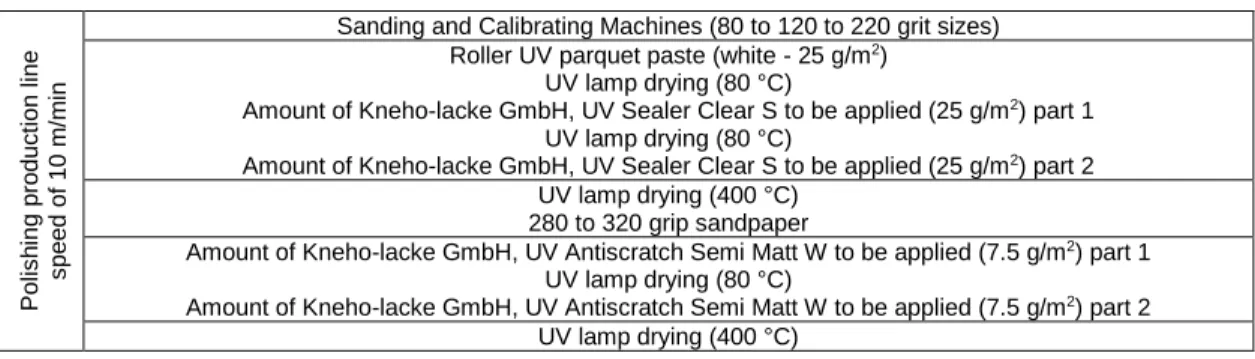
(3) bioresources.com. PEER-REVIEWED ARTICLE. EXPERIMENTAL Materials In this study, the wood species selected were beech (Fagus orientalis Lipsky), maple (Acer pseudoplatanus L.), northern red oak (Quercus rubra L.), American black walnut (Juglans nigra L.), and walnut (Juglans regia L.) wood. Samples with dimensions 60 cm × 10 cm × 2 cm (longitudinal × tangential × radial) were prepared from each untreated wood. Afterwards, samples from each wood were coated with a UV system commonly used for laminated parquet. The application process is described in Table 1. This application was done at the KPS factory (Duzce, Turkey). After the application, the samples were cut into smaller samples of 10 cm × 10 cm × 2 cm. All of the samples were kept in a conditioned room with 65% ± 3% relative humidity and 20 °C ± 2 °C until constant weight was achieved in accordance to the TS 2471 (1976) standard.. Polishing production line speed of 10 m/min. Table 1. Laminated Parquet Flooring Production Process Sanding and Calibrating Machines (80 to 120 to 220 grit sizes) Roller UV parquet paste (white - 25 g/m2) UV lamp drying (80 °C) Amount of Kneho-lacke GmbH, UV Sealer Clear S to be applied (25 g/m2) part 1 UV lamp drying (80 °C) Amount of Kneho-lacke GmbH, UV Sealer Clear S to be applied (25 g/m2) part 2 UV lamp drying (400 °C) 280 to 320 grip sandpaper Amount of Kneho-lacke GmbH, UV Antiscratch Semi Matt W to be applied (7.5 g/m2) part 1 UV lamp drying (80 °C) Amount of Kneho-lacke GmbH, UV Antiscratch Semi Matt W to be applied (7.5 g/m2) part 2 UV lamp drying (400 °C). Thermal aging process The thermal aging was conducted in a Mikrotest MST Series oven (Mikrotest, Ankara, Turkey) with different aging temperatures and duration in accordance to Table 2. One control sample was kept with no aging to compare colour and glossiness with the aged samples. Table 2. Thermal Aging Process by Using an Oven 1. Process Control (unaged). Thermal Aging Temperature and Duration 2. Process 3. Process 30 °C for 30 days 60 °C for 60 days. 4. Process 90 °C for 90 days. Methods Colour measurement The colour change of the control and thermally aged samples coated with a common UV system used in laminated materials (Table 1) was determined using an X Rite Ci62 Series Portable Spectrophotometer (X Rite) made in Regensdor, Switzerland (Wavelength Resolution 10 nm, Measurement Geometry D/8°) with a D65 standard illuminant (Fig. 1). The CIELAB system is characterized by three parameters, L*, a*, and b*. The L* axis represents the lightness, +a* is the red, -a* for green, +b* for yellow, -b* for blue, and L* varies from 100 (white) to zero (black) (Zhang et al. 2009). The corresponding variations ΔL*, Δa*, and Δb*, with the thermal aging process, were calculated using the unaged control as a reference. The total colour difference (ΔE*) was calculated by using Eq. 1, ΔE* = [(ΔL*)² + (Δa*)² + (Δb*)²]1/2 Ayata et al. (2018). “Thermal aging parquet,”. BioResources 13(1), 861-868.. (1) 863.
(4) PEER-REVIEWED ARTICLE. bioresources.com. where ΔL* is the difference L*aged – L*unaged, Δa* is a*aged – a*unaged, and Δb* is b*aged – b*unaged. Glossiness measurement Surface brightness measurements in perpendicular and parallel directions were made for all samples, thermally aged and unaged, according to ISO 2813 (1994) with a Gloss Meter Poly-gloss GL0030 TQC device (TQC BV, Neuss, Germany), as shown in Fig. 1. The first gloss measurements at 60º angle showed that the correct angle measurement in accordance to ISO 2813 was 85º, so this angle was chosen for the measurements.. Fig. 1. (A) Mikrotest MST Series Oven, (B) Portable Spectrophotometer X-Rite Ci62 Series, and (C) Glossmeter Poly-gloss GL0030 TQC. Statistical analysis The perpendicular and parallel glossiness at 85°, red colour (a*) tone, lightness (L*), and yellow colour (b*) tone values were measured using ten replicates of each sample and an average value was reported for all materials. The SPSS 17 Software programme (Sun Microsystems, Inc., Santa Clara, CA, USA.) was used for determining the statistical analysis.. RESULTS AND DISCUSSION The initial colour parameters from all of the tested species were different, as was shown by the variance analysis (Table 3). Lightness was higher for maple (75) followed by beech (69), oak (60), walnut (59), and American black walnut (50). The surface of walnut was more red than the other species, which was indicated by the higher a* (a* = 11.81), while maple had the lowest red content (a* = 6.24). In contrast, beech had the highest yellow content (b* = 23.89), and American black walnut had the lowest (b* = 17.78). Lightness (L*) decreased for all species and processes and the decrease was higher for more severe thermal aging, as shown in Fig. 2. Even at 30 ºC, lightness decreased for all of aged samples proving that chemical changes can occur at temperatures lower than 100ºC if heated for a long time. The variance analysis showed that the differences in L* were significant at a 95% confidence level. The highest decrease was observed for maple and the lowest for American black walnut, which was probably due to the initial lightness of these samples. The decrease in lightness at increased temperature was reported earlier for Pinus radiata sapwood boards during drying at various schedules starting at 50 °C (McCurdy et al. 2005).. Ayata et al. (2018). “Thermal aging parquet,”. BioResources 13(1), 861-868.. 864.
(5) bioresources.com. PEER-REVIEWED ARTICLE. Fig. 2. Initial L*, a*, b*, and ΔE* after different thermal aging processes for the studied species. Table 3. SPSS Analysis Results for Colour Parameters and Glossiness of the Studied Species Aging. Test. Wood Type N. Maple. A. Black Walnut. Walnut. Beech. N. Red Oak. 85°//. 85°⊥. b*. a*. L*. Mean HG Mean HG Mean HG Mean HG Mean HG A 10 75.38 (0.18) A* 49.71 (0.42) P 59.18 (0.10) J 68.66 (0.40) D 60.49 (0.14) I B 10 74.73 (0.20) B 48.44 (0.16) R 57.65 (0.39) L 65.60 (0.28) F 58.32 (1.05) K C 10 73.25 (0.16) C 47.19 (0.16) S 55.75 (0.26) M 64.62 (0.29) G 55.83 (0.62) M D 10 68.23 (0.86) E 46.34 (0.25) T 54.87 (0.12) N 62.70 (0.23) H 53.98 (0.13) O A 10 6.24 (0.04) J 10.30 (0.31) DE 11.81 (0.14) B 9.39 (0.13) H 9.05 (0.05) I B 10 5.99 (0.06) L 10.17 (0.14) DEF 11.65 (0.30) B 9.75 (0.11) G 10.21 (0.42) DEF C 10 5.68 (0.09) L 10.00 (0.04) F 10.09 (0.64) EF 9.51 (0.13) H 9.44 (0.32) H D 10 6.30 (0.17) J 10.93 (0.12) C 13.73 (0.17) A* 9.15 (0.06) I 10.35 (0.05) D A 10 19.10 (0.05) J 17.78 (0.22) K 22.09 (0.11) H 23.89 (0.18) E 23.36 (0.09) F B 10 17.60 (0.14) K 17.75 (0.09) K 22.20 (0.92) H 23.48 (0.11) F 24.09 (0.25) DE C 10 19.19 (0.11) J 16.66 (0.08) L 19.99 (0.57) I 24.43 (0.05) C 22.99 (0.20) G D 10 23.82 (0.68) E 19.11 (0.15) J 25.45 (0.47) B 26.32 (0.26) A* 24.24 (0.12) CD A 10 7.46 (0.47) B 4.08 (0.36) F 5.88 (0.30) D 4.04 (0.31) F 6.37 (0.09) C B 10 7.79 (0.13) A* 3.85 (0.08) FG 4.21 (0.14) F 3.42 (0.33) H 6.13 (0.24) CD C 10 5.89 (0.34) D 3.66 (0.21) GH 3.96 (0.36) FG 3.96 (0.11) FG 4.81 (0.28) E D 10 5.19 (0.22) E 3.91 (0.36) FG 3.86 (1.17) FG 2.65 (0.17) I 2.20 (0.11) J A 10 25.16 (0.72) A* 19.72 (0.29) D 21.61 (0.41) B 16.21 (1.28) FG 21.08 (0.73) BC B 10 18.36 (0.67) E 12.39 (0.23) IJ 20.78 (0.58) BCD 14.55 (1.64) H 19.87 (3.96) CD C 10 11.43 (0.73) J 17.49 (1.36) EF 17.15 (1.43) EF 12.88 (0.12) I 16.56 (0.62) F D 10 19.65 (0.54) D 16.79 (0.48) F 20.60 (0.23) BCD 15.05 (2.65) GH 14.71 (1.46) H Values in parentheses are standard deviations, HG: Homogeneous Group, N: Number of measurements, Mean: Average, *: Maximum value, A: Control, B: 30°C for 30 days, C: 60°C for 60 days, D: 90°C for 90 days. In the last few years several authors reported this decrease for higher temperatures (Aksoy et al. 2011; Korkut et al. 2013; Barcík et al. 2015) which has been attributed before to coloured degradation products from hemicelluloses and extractives (Sundqvist and Ayata et al. (2018). “Thermal aging parquet,”. BioResources 13(1), 861-868.. 865.
(6) PEER-REVIEWED ARTICLE. bioresources.com. Morén 2002; Sehlstedt-Persson 2003) or lignin. In relation to a* and b*, the variation is dependent on the species, as previously reported, for heat-treated wood (Bekhta and Niemz 2003; Aksoy et al. 2011). For maple, American black walnut, and walnut a* decreased for the first two thermal aging processes and increased for the third. In contrast, for beech wood there was an increase followed by a decrease, and for northern red oak all of the samples showed an increase in relation to the control sample, but with no consistent variation according to the severity of the aging process (Fig. 2). The variation in b* was inconsistent for the studied species, increasing or decreasing for different thermal aging processes. Nevertheless, for the thermal aging at 90 °C for 90 days, the final b* was higher than the control’s for all of the species studied (Fig. 2). The variance analysis showed that the differences in a* and b* were not significant at a 95% confidence level. Results showed that colour parameters changed with thermal aging, even at temperatures as low as 30 °C, considering they were exposed for periods long enough. The initial gloss measurements at 60º angle showed gloss ranges between 10.48 and 14.74 for perpendicular glossiness and from 14.30 to 20.19, which means that the samples can be considered to have near matt surfaces in accordance to ISO 2813. Therefore the correct angle for gloss measurements is 85º. Glossiness parallel to the fibres direction was much higher than in the perpendicular direction for unaged and aged samples. The differences along the aging process were only significantly different at 95% confidence level for maple (Table 3). Nevertheless, in general, glossiness decreased for all of the species studied, and this decrease was proportional to the severity of the thermal aging. Even at 30 °C, there was a decrease in glossiness of the surface. The highest differences were observed for northern red oak, while the smallest differences were observed for American black walnut. These results reinforced the hypothesis that thermal aging was different for each species. Earlier findings have shown that temperature and time have a significant effect on glossiness (Aksoy et al. 2011; Demirci et al. 2013). The total colour difference (ΔE*) increased for all thermal aging processes and the increase was higher for more severe aging. Major differences were observed for maple, and smaller differences for American black walnut, as shown in Fig. 2. This work can bring some enlighten on the contribution of temperature in colour changes suffered by aging of the studied species. CONCLUSIONS With thermal aging, L* decreased for all species, and the decrease was higher for more severe thermal aging processes while, for a* and b*, the variation was dependent on the species and on the conditions of the aging process. Results showed that colour parameters changed with thermal aging even at temperatures as low as 30 °C, under the assumption that they were exposed for long periods of time. Generally, glossiness decreased for all of the species studied and this decrease was proportional to the severity of the thermal aging. ACKNOWLEDGMENTS The authors would like to thank KPS for the laminated parquets and this research was supported by the Ataturk University, Research Project Coordination Unit, under project number 2015/380. Ayata et al. (2018). “Thermal aging parquet,”. BioResources 13(1), 861-868.. 866.
(7) PEER-REVIEWED ARTICLE. bioresources.com. REFERENCES CITED Aksoy, A., Deveci, M., Baysal, E., and Toker, H. (2011). “Colour and gloss changes of Scots pine after heat modification,” Wood Res. 56(3), 329-336. Ayata, U., Gurleyen, L., and Esteves, B. (2017a). “Effect of heat treatment on the surface of selected exotic wood species,” Drewno 60(199), 105-116. DOI: 10.12841/wood.1644-3985.198.08 Ayata, U., Gurleyen, L., Esteves, B., Gurleyen, T., and Cakicier, N. (2017b). “Effect of heat treatment (ThermoWood) on some surface properties of parquet beech (Fagus orientalis Lipsky.) with different layers of UV system applied,” BioResources 12(2), 3876-3889. DOI: 10.15376/biores.12.2.3876-3889. Barcík, Š., Gašparík, M., and Razumov, E. Y. (2015). “Effect of temperature on the color changes of wood during thermal modification,” Cellulose Chemistry and Technology, 49(9–10), 789-798. Bekhta, P., and Niemz, P. (2003). “Effect of high temperature on the change in color, dimensional stability and mechanical properties of spruce wood,” Holzforschung 57(5), 539-546. DOI: 10.1515/HF.2003.080 Belville, P. (1982). Modelling of the Kinetics of Pyrolysis of Large Size Wood Particles and the Material Balance of the Pure Oxygen Gasification, Ph.D. Dissertation, Université de Compiègne, Compiègne, France. Chen, Y., Fan, Y., Gao, J., and Stark, N. M. (2012). “The effect of heat treatment on the chemical and color change of black locust (Robinia pseudoacacia) wood flour,” BioResources 7(1), 1157-1170. Demirci, Z., Sonmez, A., and Budakci, M. (2013). “Effect of thermal ageing on the gloss and the adhesion strength of the wood varnish layers,” BioResources 8(2), 1852-1867. Esteves, B., Velez Marques, A., Domingos, I., and Pereira, H. (2007). “Heat-induced colour changes of pine (Pinus pinaster) and eucalypt (Eucalyptus globulus) wood,” Wood Science and Technology 42(5), 369-384. DOI: 10.1007/s00226-007-0157-2 Feller, R. L. (1995). Accelerated Aging: Photochemical and Thermal Aspects, Getty Publications, Los Angeles, CA, USA, pp. 280. Guller, B. (2014). “Effects of heat treatment on density, dimensional stability and color of Pinus nigra wood,” African journal of biotechnology 11(9), 2204-2209. DOI: 10.5897/AJB11.3052 Gurleyen, L., Ayata, U., Esteves, B., and Cakicier, N. (2017). “Effects of heat treatment on the adhesion strength, pendulum hardness, surface roughness, color and glossiness of Scots pine laminated parquet with two different types of UV varnish application,” Maderas. Ciencia y Tecnología 19(2), 213-224. DOI: 10.4067/S0718221X2017005000019 Holzhausen, U., Millow, S., and Adler, H. J. (2002). “Studies on the thermal ageing of organic coatings,” Macromol. Symp. 187, 939-952. DOI: 10.1002/15213900(200209)187:1<939::AID-MASY939>3.0.CO;2-E ISO 2813 (1994). “Paints and varnishes – Determination of specular gloss of non-metallic paint films at 20 degrees, 60 degrees, and 85 degrees,” International Organization for Standardization, Geneva, Switzerland. Karamanoglu, M., and Akyildiz, M. H. (2013). “Colour, gloss and hardness properties of heat treated wood exposed to accelerated weathering,” Pro Ligno 9(4), 729-738.. Ayata et al. (2018). “Thermal aging parquet,”. BioResources 13(1), 861-868.. 867.
(8) PEER-REVIEWED ARTICLE. bioresources.com. Kollmann, F., and Fengel, D. (1965). “Changes in the chemical composition of wood by thermal treatment,” Holz Als Roh-Werkst 23(12), 461-468. Korkut, D. S., Hiziroglu, S., and Aytin, A. (2013). “Effect of heat treatment on surface characteristics of wild cherry wood,” BioResources 8(2), 1582-1590. Liu, X. Y., Timar, M. C., Varodi, A. M., and Sawyer, G. (2017). “An investigation of accelerated temperature-induced ageing of four wood species: Colour and FTIR,” Wood Science and Technology 51(2), 357-378. DOI: 10.1007/s00226-016-0867-4 McCurdy, M., Pang, S., and Keey, R. (2005). “Measurement of colour development in Pinus radiata sapwood boards during drying at various schedule,” Maderas. Ciencia y Tecnología 7(2), 79-86. DOI: 10.4067/S0718-221X2005000200002 Meints, T., Teischinger, A., Stingl, R., and Hansmann, C. (2017). “Wood colour of central European wood species: CIELAB characterisation and colour intensification,” European Journal of Wood and Wood Products 75(4), 499-509. DOI: 10.1007/s00107-016-1108-0 Sehlstedt-Persson, M. (2003). “Colour responses to heat treatment of extractives and sap from pine and spruce,” in: 8th International IUFRO Wood Drying Conference, 459464. Shafizadeh, F., and Chin, P. P. S. (1977). “Thermal deterioration of wood,” in: Wood Technology: Chemical Aspects, I. S. Goldstein (ed.), American Chemical Society, Washington DC, USA, pp. 57-81. Sonmez, A., Budakcı, M., Demirci, Z., and Akkus, M. (2011). “Effects of thermal aging on the film hardness of some wood varnishes,” BioResources 6(4), 4594-4605. Sundqvist, B., and Morén, T. (2002). “The influence of wood polymers and extractives on wood colour induced by hydrothermal treatment,” European Journal of Wood and Wood Products 60(5), 375-376. Tolvaj, L., Molnar, Z., and Nemeth, R. (2013). “Photodegradation of wood at elevated temperature: Infrared spectroscopic study,” Journal of Photochemistry and Photobiology B: Biology 121, 32-36. Torniainen, P., Elustondo, D., and Dagbro, O. (2015). “Industrial validation of the relationship between color parameters in thermally modified spruce and pine,” BioResources 11(1), 1369-1381. DOI: 10.15376/biores.11.1.1369-1381 TS 2471 (1976). “Wood - determination of moisture content for physical and mechanical tests,” Turkish Standards Institution, Ankara, Turkey. Wang, Z., Sun, B., and Liu, J. (2016). “Effect of thermo-vacuum treatment on the color and chemistry of larch wood,” BioResources 11(1), 2349-2360. DOI: 10.15376/biores.11.1.2349-2360 Wei, Y., Wang, M., Zhang, P., Chen, Y., Gao, J., and Fan, Y. (2017). “The role of phenolic extractives in color changes of locust wood (Robinia pseudoacacia) during heat treatment,” BioResources 12(4), 7041-7055. DOI: 10.15376/biores.12.4.70417055. Zhang, J., Kamdem, D. P., and Temiz, A., (2009). “Weathering of copper-amine treated wood,” Appl. Surf. Sci. 256(3), 842-846. DOI: 10.1016/j.apsusc.2009.08.071 Article submitted: February 26, 2017; Peer review completed: May 22, 2017; Revised version received and accepted: November 24, 2017; Published: December 5, 2017. DOI: 10.15376/biores.13.1.861-868. Ayata et al. (2018). “Thermal aging parquet,”. BioResources 13(1), 861-868.. 868.
(9)
Imagem


Documentos relacionados
Effect of Thermal Aging on the Interfacial Reactions of Tin-Based Solder Alloys and Copper Substrates and Kinetics of Formation and Growth of Intermetallic Compounds.. Data obtained
20 and 30 wt%) of linear low-density polyethylene (LLDPE) with and without maleic anhydride- grafted LLDPE (LLDPE-g-MA) were prepared by melt blending and aging resistance, thermal and
The effect of mesh discretization, scaffold geometry, bracing system, and number of modules (layers) on the critical load and buckling mode will be analyzed using
The aging process comprises all layers of the face: skin, subcutaneous fat, muscles, and skeleton, and the signs of aging depend mainly on which layer is mostly affected.. Aging
Neste estudo a resposta foi a quantidade mínima de água gasta para neutralização do catalisador presente no biodiesel após o processo de transesterificação. A conversão do
The effect of different preservation treatments (thermal treatment and high hydrostatic pressure) applied on packaged mango bars on the microbial counts and aroma release
Using Fe sheets and Cu and Ti foils, Fe-intermetallic phases laminated composites have been fabricated through reactive sintering at 900 o C for 15, 30 and 120 minutes in
The present work was designed to experimentally study the effect of construction on tensile properties of woven fabrics and more specifically the effect of the number of load
