MIGUELJEREZ-MIR
I
JOSÉ REAL-DATOI
RAFAEL VAZQUEZ-GARCÍA CoordinatorsIBERIAN ELITES AND THE EU:
PERCEPTlONS TOWARDS THE EUROPEAN lNTEGRATlON PROCESS lN POLITlCAL AND SOClOECONOMIC ELITES
lN PORTUGAL AND SPAIN
Granada 2015
COLECCIÓN DE CIENCIAS POLíTICAS y SOCIOLOcíA
© LOS AUTORES
© UNIVERSIDAD DE GRANADA
IBERIAN ELITES AND THE EU: PERCEPTIONS TOWARDS THE EUROPEAN INTEGRATION PROCESS lN POLITICAL AND SOCIOECONOMIC ELITES lN PORTUGAL AND SPAIN
ISBN: 978-84-338-5838-2 Depósito legal: GR./1649-2015
Edita: Editorial Universidad de Granada
Diseflo de la edición: Francisco Vega Álvarez
Cualquier forma de reproducción, distribución, comunicación pública o trans-formación de esta obra sólo puede ser realizada con la autorización de sus
titu-lares, salvo excepción prevista por la ley.
CONTENTS
Foreword ... 9 Preface... 11 CHAPTER I
lntroduction: lberian elites, the European Union
and the Intune Project ... ... ... ... ... ... 15
MIGUEL JEREz-Mm
I
RAFAEL VÁZQUEz-GARCÍAI
JOSÉ REAL-DATOCHAPTER 2
Portugal and Spain in the process ofEuropean integration... 25
SANTIAGO DELGADO FERNÁNDEZ I FILIPA RAIMUNDO I MIGUEL JEREZ-MIR ANTÓNIO COSTA PINTO
CHAPTER 3
Still Euro-optimists? European ideotity amoog Spanish
and Portuguese elites and public opinioo ... 57
ALEKSANDRA SOJKA I RAFAEL VÁZQUEZ-GARCÍA I MIGUEL JEREz-MIR
CHAPTER 4
National Elites and the European PoliticaI System: Portugal
and Spain in a Comparative Perspective... 85
JOÃo PEDRO RUIVO
I
PEDRO TAVARES DE ALMEIDACHAPTER 5
lberian Elites and their Attitudes Towards the Europeaoization ofPolicy Makiog ... 115
CHAPTER 6
Citizens' and elites' support for the EU, before and after the financial crisis: The Southern European Peripheries (Greece, Portugal,
and Spain) in Comparative Perspective ... 155 ANDRÉ FREIRE I CATHERINE MOURY
CHAPTER 7
Conclusion: lberian elites, the European Union, and its future ... 183 MIGUEL JEREZ-MIR
I
JosÉ REAL-DATOI
RAFAEL VÁZQUEZ-GARCÍAGeneral Annex ... 203 References ... 227 List of contributors ... 243
CHAPTER2
PORTUGAL AND SPAIN lN THE PROCESS OF
EUROPEAN INTEGRATION
SANTIAGO DELGADO FERNÁNDEZ
I
FILIPA RAIMUNDO MIGUEL JEREZ - MIRI
ANTÓNIO COSTA PINTOlntroduction
Following a long negotiation process, which took almost eight years, Portu-gal and Spain signed the Treaty of Accession to the European Com muni-ties on the 12th ofJune 1985. The signature was accompanied by solemn acts organized at the cloister of the Jerónimos Monastery in Lisbon and the Royal Palace in Madrid. The accession took effect some months later, on the 1st ofJanuary 1986. For both countries this moment meant put-ting an end to a long period ofisolation from Europe, especially prolonged in the case Df Spain, for which it started with the Treaty of Vienna in 1815, almost two centuries earlier. Even though Portugal participated in the First World War on the side of the Entente and its troops fought in France together with the Brits, in 1939 both lberian countries coincided in declaring neutrality as the new world conilict broke out. However, in the case of Spain, its initial neutral position was further changed to non-belligerent, a status which was maintained by the government of General Francisco Franco for three long years. During this time Spanish troops actual1y got involved in the military conflict, but only to fight the Soviet troopS.l Contrary to Spain, and in spite of the ideological proximity Df
1 Actually, the legal term of non-belligerence, which Spain adopted between the 12'h of
June 1940 and the 1 SI of October 1943, was also used by Italy and United States during
the sarne conflict, however, for shorter periods of time. ln June 1941 the government of Franco availed itself of its non-belligerent status in order to send troops to the Russian
lberian Elites and lhe EU
Antonio Oliveira Salazar to the fascist Italy and the lhird Reich, Portugal maintained its neutrality during the war due to strategic reasons, the only
exception being Portuguese limited involvement on the Pacific front, when its colony of East Timor was invaded by the
J
apanese in 1942.2 ln spite of these differences in positioning during the war, neither of the twocoun-tries was admitted to the recently created United Nations (UN) when the conflict ended. ln the case ofFranco's regime, the General Assembly even
officially condemned the regime qualifying its government as fascist and
recommended the withdrawal of diplomatic representatives from Madrid for alI UN member states. ln the case ofPortugal, however, in 1949, shortly after the commencement of the Cold War, Salazar made it possible for his
country to join the North Atlantic Treaty Organization (NATO), in spite
of being the only member state of the alliance which has never actualIy
broken off its diplomatic relations with Germany3. Some years later, in a similar context and equally taking advantage of the anti-communist
argu-ment, Franco's regime initiated a process which led to the overcoming ofits complete international isolation with the signature of the Pacto de Madrid
with the United States in 1953, followed by the Concordat with the Holy See in the sarne year. Even though both Spain and Portugal were finally
admitted to the UN in 1955, they remained marginalized from the process of European integration due to a lack of acceptance on part of the states
which were shaping the European project at that point. 1he objections in relation to the undemocratic character of both regimes-especialIy strong
in the case of France and the United Kingdom-remained present for a long time.1his situation has been reinforced by the fact that both Salazar
and Franco initially kept the democratic Europe at a distance, afraid of a
contagion effect. Nevertheless, as time passed, they were obliged to recon-sider and soften their positions.4
front -the Blue Division and the Blue Squadron-to fight the Soviet troops under the Germans. Even though the Blue Division was officially dissolved in 1943, the last
Span-ish troops have not been repatriated until March 1944.
2 Even though Portugal never formally proclaimed war on Japan, Portuguese military and civil staff fought together with Australian and Dutch troops against the Japanese
invad-ers.
3 Salazar even sent an official message of condolence on the death of Adolf Hitler. 4 ln the case ofGeneral Franco, his position was induced by the fear ofhumiliation which
he and his regime would suffer upon a possible rejection on part of the European institu-tions.
26
-Chapte,· 2 . Portugal and Spain iII the process of ElIropean illtegmtioll
ln spite of these seemingly similar paths, during the three decades
which passed between the start of the European integration process and
the accession of Portugal and Spain, the positions adopted by their
respec-tive governments and their paths towards the EU were not entirely
coinci-dental. Spain, which unlike Portugal has been excluded from the Marshall Plan, joined the Organisation for Economic Cooperation and Develop-ment (OECD) in 1959 and three years later commenced the negotiation process seeking an economic agreement with the European Communities. Portugal, on the other hand, chose to support its traditional ally, the United Kingdom, and its proposal of creating the European Free Trade Associa-tion (EFTA) together with other states like Austria, Denmark, Norway, Sweden, and Switzerland (Royo and Manuel,2003: 1). ln the case ofSpain,
which, as we will see below, witnessed substantial economic development by the end of the 1960s, a preferential trade agreement with the EEC was signed in 1970. However, no further steps were taken, no doubt due to the obvious lack of democratic rule and the absence of a will to at least devel-op in that way, which contravened the requirements included explicitly in documents such as the Bilkerbach Report and the Saragat Memorandum.5 However, the situation became quite different with the processes of
democratic transition experienced by both lberian nations in the 1970s (Linz and Stepan, 1996). From the start, their new democratic
govern-ments exhibited a strong desire to emulate the politicaI stability and eco-nomic prosperity of their European neighbours, convinced that EEC
ac-cession would contribute substantially to the consolidation of their recently established democratic institutions and that it would have a positive impact
5 The Bilkerbach Report concerned politicai and institutiooal aspects of membership and association with the EEC and it was presented at the European Parliamentary Assembly
00 the 1511, ofJanuary 1962. The Saragat Memorandum, 00 the other hand, was prepared
by the Italian government io May 1964 and it was addrcssed at the Council ofMinisters.
Both documents established the impossibility of inclllding a non-democratic state in
the European Commllnities. Nevertheless, the former document inclllded the possibil-ity of association for those states that attained a certain level of economic and political development, under the condition of demonstrating sllfficient wiU to evolve towards democratic rllle (Powell, 2007). ln the case of Spain, the Law of the State (Ley Orgânica de! Estado - LO E) entailed a certain degree of constitlltionalization of the regime as it
introduced the distinction between the Hcad of State and the President of the Govern-ment, even though it did not actually imply any real democratization of the system.
Ibe1"ian Elites and the EU
011 the process of economic modernization in both countries (Royo and Manuel, 2003: 1).
Since the accession to the European Communities until nowadays, Portuguese and Spanish politics, economy and society seem to have be-come successfully accommodated within the community framework. 1heir inclusion in the European project resulted in important and clear advan-tages for both countries. Stntctural funds received from the EC allowed for considerable improvements in both infrastructure, as well as social capital. Moreover, trade with other member states intensified considerably and for-eign investment increased substantially i11 both countries. Since the 1980s the per capita income in Spain and Portugal has been steadily rising, and after two decades it reached the level of83 and 74 per cent of the EU mean, respectively (Royo and Manuel, 2003: 5). However, due to the serious eco-nomic difficulties both countries experience since 2008 and the role of the EU in the remedies applied, we might put these gains into perspective. ln any case, it must be noted that the parallel inclusion ofPortugal and Spain in the European Communities triggered a substantial improvement of their bilateral relations, reflected in a considerable increase of trade between them. Only two years after the accession, the value of goods imported from Portugal to Spain increased to a much greater extent than that of any other country, while Spain became one of the second supplier to the Portuguese economy, surpassed only by the Federal Republic of Germany. What is more, Spanish direct foreign investment in the neighbouring country, and vice versa, increased substantially in the years that followed the accession.
Apart from the benefits and losses which might have been derived from joining the European project, Spain and Portugal have contributed substantially to the general process of European integration by promot-ing the development of European institutions and politics. ln this sense, both countries cooperated in the passing of the Single European Act in 1986, and the European Union Treaty (Maastricht) in 1991, as well as its subsequent revision in Amsterdam in 1999. 1hey also participated actively in the establishment of the European Single Market; in the enlargement to fifteen member states with the accession of Sweden, Finland and Aus-tria in 1995; in the negotiations leading to the signature of the Schengen Treaty in 1995, as well as in debates related to the Eastern enlargement process during the Nice summit in 2000. Portugal and Spain most certainly
28
Chapter 2· Portugal and Spaill iII the process ofEl/mpeall integratioll
have proved to be unyielding supporters of the process of integration, and contributed actively to moving forward in the direction of more and better Europe.
On the pages which follow we summarize the milestones of the process of European integration in Spain and Portugal and assess their experience after 25 years of membership in politicai, institutional, and partially eco-nomic terms. As far as the milestones of the EU integration are concerned, portuguese membership in the EU can be divided into three main periods. lhe first period covers until the first Portuguese Presidency in 1992, which was characterized by the pragmatic approach of the centre-right Cabinet of Cavaco Silva.1he second period was characterized by a significantly more Euro-enthusiast approach, almost a "golden-age," until the emergence of the first signs of economic stagnation and the negative impact of the cen-tral and Eastern European enlargement at the beginning of this century. lhis new juncture opened what some called the "realistic phase" (Soares, 2007).6 ln the case of Spain, we can distinguis h four main periods. The initial stage starts with the accession of Spain in January 1986 and ends with the European Council ofMaastricht in 1991. A second phase, which might be deemed as that of crisis and redefinition of European politics, lasts from Maastricht tiU the resignation of socialist Prime Minister Felipe González in 1996. A third period can be linked to the two terms of Prime Minister José María Aznar from the People's Party (PP), until March 2004, when the Spanish Socialist Workers' Party (PSOE) returned to power.7 The last period of interest is that between the return to power of the socialists and their electoral defeat in 2011 and the formation of the government of Mariano Rajoy, in December 2011. 8 As far as the second objective of as-sessing Portuguese and Spanish experience of 25 years of EU membership is concerned, we present various indicators related to politics, economy, and society. ln this manner we obtain an accurate image of lights and shadows of Spanish and Portuguese membership in the European community.
6 We adopt here the periodization of Soares (2007), although without using the main definitions of each period which the author characterizes as: the Euro-sceptical period, the Euro-enthusiastic phase and the Euro-realistic stage.
7 These initial three periods fit those proposed by Charles Powell (2003: 147; 2008:109). 8 The politicai and institutional phases do not coincide with the economic developments
(see Forner, 2012: 257).
[bel'ian Elile5 alld lhe EU
The process of incorporation of Portugal and Spain to the
European Community
7he Portuguese Case
Portugal's approach to the construction of Europe between 1945 and 1974 was determined by several factors: it accepted the economic aspects of intergovernmental co-operation whilst rejecting the politicaI facets and any supranational or integrationist model; it was dependent upon the nar-row scope of the regime's foreign policy-that is to say, it was determined by economic and social factors (e.g., foreign trade, emigration, and tourism) and not as a result of any strategic choices-Europe was a necessity, not a projecto If during the 1940s and 1950s Portugal's attitude towards the con-struction of Europe seemed compatible with its idea of the complementa-rity of Africa and Europe, then during the 1960s and 1970s its economic approximation to Europe and the ongoing colonial wars put an end to this illusion, a conception that was now seen to be politically antagonistic (Pinto and Teixeira, 2004).1he maintenance of the African colonial empire required the continuation of authoritarianism, while Portugal's integration into Europe required decolonisation and democratization. Opting for the European path was the great politicaI innovation of the nascent Portuguese democracy.
Portugal did not experience the sarne levels of international isolation as its Spanish neighbour following the Second World War. Its status as a founder member of NATO and participant within other international organizations, such as the European Organization for Economic Co-oper-ation (EOEC) and the European Payments Union (EPU), and its receipt of Marshall Plan funds-albeit on a relatively small scale-are alI exam-pIes of the country's international acceptance. Being excluded from, and remaining mistrustful of, the Treaty ofRome which marked the foundation of the EEC, and following positions adopted by the United Kingdom (its major trading partner), membership of the European Free Trade Associa-tion (EFTA) was to be an important economic aim for the dictatorship throughout the 1960s. Negotiated on terms that were favourable to Por-tugal, which saw the majority of its economic activities largely protected,
30
=
Chapler 2 . Porlllgal and Spaill iII lhe Proce55
0/
ElIropeall il1tegraliol1the EFTA agreement was one of the roots of 1960s economic growth and for the significant incre ase in commercial relations with Europe. It was also behind the emergence of interest groups with fewer associations with the colonies.1he development of a pro-European outlook was essentially a consequence of decolonization and the institutionalization of democracy, however.
ln a situation in which conditioning factors weighed heavily and the roam for manoeuvre of Portuguese foreign policy was limited, EFTA pro-vided the only alternative with economic advantages and without politi-caI cost. Politically, therefore, EFTA represented the optimum solution for Salazar as it enabled him to reconcile Portugal's economic integration into a European free trade zone with the regime's politicaI and diplomatic posi-tions.1he strictly intergovernmental character.of the organisation elimi-nated any supranational or integrationist ambition, and, while it incorpo-rated some continental countries, Britain's involvement allowed Portugal to keep its essentially Atlanticist orientation and the continuation of the British Alliance, one the country's traditional foreign policy strategies. Most importantly, the fact that EFTA was a free trade zone rather than a customs union, allowed Portugal to remain within the organisation whilst maintaining its privileged relationship with its colonies. ln the context of Portuguese foreign policy's limited scope for manoeuvre, this represented an enormous politicaI advantage and was the main reason for Portugal's membership ofEFTA.
With the United Kingdom's renewed request for EEC membership and its resignation from EFTA, this organization's future was irredeem-ably compromised. Once again the unilateral nature ofBritain's application ruled out any opportunity for multilateral EFTA-EEC negotiations capa-ble of dealing with the Portuguese case. Portugal had to form some type of relationship with the EEC, and it would have to negotiate it directly and bilaterally. Following Britain, in May 1970 Portugal requested talks with
the EEC and formed an ad hoc commission, the Inter-Ministerial
Com-mission for External Economic Co-operation that was charged with ana-lysing the situation and proposing possible alternatives.1he Commission's report suggested three alterna tive ways forward for Portugal: accession to the EEC, association with it, or the establishment of trade agreements with it. Accession was out of the question for reasons mentioned above.
Iberiall Elites alld the EU
ciation would be difficult given that Article 238 of the Treaty of Rome
ef-fectively prevented the EEC from compromising to such an extent for the
convenience of a country such as Portugal. Establishing trade agreements with the EEC thus emerged as the only politically possible alterna tive. The
Commission recommended that Portugal adopt a moderate and flexible
negotiating position: moderate in order to avoid raising the colonies in such a way as could undermine any agreement, and flexible in the formu-lation of the agreements so as not to undermine any future membership application (Pinto and Teixeira, 2004).
The trade agreement with the EEC was signed inJuly 1972 and ratified
short1y after without any problem. The room for manoeuvre in Portugal's foreign policy was too narrow to allow the flexibility required to step
be-yond the limits of a trade agreement, and its approximation to Europe and
the weakening ofEFTA required it to establish new multilateral economic
relations. This being the case, an agreement with the EEC was an
impera-tive, and a trade agreement was the formula that involved the minimum degree of politicai compromise.
With the breakdown of the Dictatorship and the beginning of
decolo-nization in 1974, the European Commission granted Portugal economic assistance while the European Council made its politicai position clear: it was ready to begin negotiations, but only on the condition that a pluralist democracy was established. Nevertheless, the country's economic condi-tion, the politicai instability and continuing uncertainty regarding the des-tiny of the democratic regime during the transitional period ruled out any advance from the European front.
It was the first constitutional government, led by Mário Soares that adopted the 'European option'. The first step in this process occurred in
August 1976 when the Portuguese government successfully applied for
membership of the Council of Europe. Once a member of this
organisa-tion-which ais o consolidated the international community's recognition of the new democratic regime-Lisbon began to outline its next and deci-sive step: application for accession to the EEC.
Following a series of successful negotiations in a number of European
capitais between September 1976 and February 1977, the government
made its formal application for EEC membership in March 1977. ln May
1978, the Commission presented a favourable report, clearing the way for
32
Chapter 2 . POI'llIgal m.d Spai" i1l the pracess of ElIl'Opeall integraliall
the formal negotiations to begin in Luxembourg the following October.
With the formal application made, and accession negotiations under way,
the hesitations and polemics over the nature of Portugal's integration had finally been superseded, placing Portugal firmly on the European path.
1he government was motivated by, and based its decision to follow this strategic option on, two main objectives. First, EEC membership would
consolidate Portuguese democracy, and second, EEC assistance would
guarantee the country's modemisation and economic development.
Sev-eral Portuguese economists remained fearful, with the majority expressing
grave reservations regarding the impact EEC membership would have on
some sectors of the Portuguese economy.
A complex series of negotiations, lasting seven years, followed Portu-gal's membership applicatioll. An earlier step had been taken in September 1976, prior to the country's formal application, with the revision of the
1972 EEC trade agreement through the conclusion of the Additional and
Financial Protocols, which Portugal interpreted as representing a form of
pre-membership agreement. Despite these prior agreements, formal
ne-gotiations on Portugal's membership lasted from October 1978 until June
1985.
1here are two important domestic factors that can help explain just why the accession negotiations for such a small country with a relatively weak economy were so complex and drawn out. First1y, Portugal's economic situ-ation immediately prior to the transition and, more important1y, the eco-nomic measures that had been taken during the revolutionary period-in particular the nationalization of important economic sectors. Secondly, continuing governmental instability and the politicai and constitutional nature of the Portuguese regime. Following 1976, the democratic regime was undeniably pluralist, and was generally considered as such; however, the 1976 constitution was a product of the revolutionary period, and con-secrated within it the Council of the Revolution. It was a democracy, but it was a democracy under the tutelage of an undemocratic mílitary institu-tion. These factors weighed heavily in the negotiations, and delayed their conclusion (Teixeira, 2012).
During the early-1980s, Portugal's democratic regime overcame all of these objections. The constitution was revised in 1982 to abolish the Coun-cil of the Revolution and the National Defence Law, and the armed forces
Iberiarz Elites al1d lhe EU
finallyaccepted their subordination to the civilian politicai authorities. By 1983 Portugal's democracy had been consolidated, thereby eliminating all of the domestic obstacles that were preventing the successful conclusion of the entry negotiations.
One external hurdle remained, however. During Europe's southern en-largement, the EEC was also conducting accession negotiations with Spain, a country that had a much larger economy than Portugal's, and which did not share its smaller neighbour's history of close relations with European economíc institutions. Portugal's diplomatic strategy was to keep its entry negotiations separate from those of Spain, in the hope of securing EEC accession more rapidly, thus giving it the important status of member state
prior to Spain's entry. 'lhis tactic was not successful, however, as the Com-munity's policy was to negotiate with both lberian countries
simultane-ously, with the result that Portugal's accession was delayed a further two years, after ali the dossiers on Spain had been concluded. 'lhe culmination of the accession process finally arrived in June 1985, when the new
govern-ment, led by Mário Soares, signed the Treaty of Accession.
1he Spanish Case
'lhe establishment of the European Communities (EC) in the 1950s sparked a debate within the Francoist regime, between those who argued
for the necessity of joining the Communities (EEC, ECSC, and EUR-ATOM) and the supporters ofjoining EFTA. Finally, the Spanish
govern-ment opted for the former option and in the early 1960s it made public its intention of joining the EC. 'lhis coincided with an internal process of liberalization and opening of the Spanish economy, which had started in 1959 with the adoption of the so-called National Plan of Economic Sta-bilization. Soon enough it became quite clear that the EC was indeed the best option as export oriented agriculture constituted an essential element of the Spanish economy and the EC established a common agricultural
policy as one of its main objectives. On the contrary, EFTA did not make agriculture part of its treaties. Another strong argument in favour of the EC was that the volume of trade exchange with the six countries was 50% higher than that with the EFTA member countries. Last but not least, a potential preferential trade agreement with EC countries would suppose
34
tr
Cbapter 2 . Porlugal alld Spairz iII tbe process 01 Europeall integralion
an incentive to expand some of the markets which have already become important for Spanish exports whiJe at the sarne time it would drive and speed up funhe .. structural reforms which were deemed necessary at that momento Nevertheless, the admission to E was adjourned sine die due to twO basic circumstances: the non-democratic character of Franco regime, and the substantial differences in the principal economic indicators be-tween Spain and the countries of the EC.
ln spite of these obstacles, in December 1964, following a formal
appli-cation submitted by the Spanish Minister of Foreign Relations Fernando María Castiella, the negotiation process was initiated. 'lhese initial nego-tiations resulted in the signature of a preferential trade agreement between Spain and the EC on the 29th ofJune 1970 (Banús, 2002), followed by a
Protocol signed Oll the 29th ofJ anuary 1973. 'lhe signature of these agre
e-ments had two fundamental consequences. On the one hand, trade
advan-tages -such as the reduction of trade tariffs- boosted commercial exchange between Spain and the EC, and, thu5, allowed for a development of the Spanish economy towards the leveis of the member states of the European Communities. On the other hand, the agreement also implied the
opportu-nity for a first group ofhigh levei officials to become experts on European affairs, a group which would become key elite actors in the subsequent stages of the negotiation process with the EC.
After General Franco's death in November 1975, in a context of strong unrest stirred by politicai and trade union opposition, King Juan Carlos together with Prime Minister Adolfo Suárez led the return to democracy via an elite-driven transition process (Higley and Gunther, 1992; Gunther et a!. 1995). The resulting dismantling of the Francoist regime in the spring
oE
1977 was marked by the celebration of the first democratic elections in almost four decades, and the passing of the constitution the following year, which reconstituted the Spanish state as a parliamentary monarchy. 'lhe transition ais o implied a renewed interest in a ful! integration of Spain in the international arena. 'lhe first democratic government presided over b)' Suárez, initiated talks regarding the complete and defini tive incorporation of Spain in the European Communities. For the new democraticauthori-ties, accession to the EC constituted the ultimate recognition of the newl)' reconstituted Spanish institutions.'lhe response was positive and the
acces-sion negotiations commenced officially on the 5th ofFebruar)' 1979, onl)'
Iberiall Elites and the EU
two months after the approval of the new constitution in a referendum. Meanwhile, Spain became a member ofCouncil ofEurope in 1978, which was also considered a necessary (but not sufl1cient) condition to be able to join the European Economic Community (Díez Nicolás, 2003: 120).
Initially, EC members, and particularly France, had serious doubts con-cerning the convenience of enlargement towards the Iberian countries
es-pecially as far as the admission of Spain was concerned.1he issues
rel~ted
to textiles, fishing, free movement of workers, and agricultural policy turned out to be the most difl1cult to tack1e during the negotiations, the latter being the source of the strongest conflict, where the defence by France ofits agrarian and fishing interest constituted the principal obstacle to the advancement of the processo It was estimated that the accession of Spain would increase in 30% the agricultural area of the EC, and, thus, Spain would become a direct competitor to France in the production of fruit olive oil,. and vegetables. 1herefore, the French government together with Italy (dnven by the same concerns), tried to protect their products at all costs and put obstacles to the Spanish negotiations in all possible ways, while the governments ofGermany, the Netherlands and United Kingdom, sup-ported openly the accession of Spain. Germany, however, included the
ac-cession negotiations in the wider debates concerning the shape of the com-mon agricultural policy (CAP) and budgetary issues (Royo and Manuel, 2003: 12). French objections only started to vanish which the election of
François Mitterrand as President of the French Republic in 1981 and the socialist electoral victory in Spain the following year, with Felipe González
becoming Prime Minister. 1hen German supportive stance towards Spain and Portugal became crucial. On the occasion of the European Council summit in Stuttgart in 1983, the Federal Republic ofGermany conditioned
their approval of the increase in community budget on the accession of the two lberian states.9 Shortly afterwards, during the Fontainebleau summit,
French opposition was finally overcome.
1he last phase of Spanish accession negotiations was initiated in 1983.
~t this p~int the talks .were divided into negotiation packages concerning
dlfferent IS sues, the mam obstacle being, in most cases, the agreement over
9 "!e should also take into account the link between German support for Spanish
acces-slOn and the commitment ofPrime Minister González to the incorporation ofSpain in the European defence system, most importantly through NATO membership.
36
Chapter 2 . Portugal alld Spaill ill lhe pracess if Europemz inlegratioll
transitory periods. ln spite of these difl1culties, between December 1984
and March 1985 agreements were reached regarding the main negotiation
topics.111C
l'emaining chapter were closed on the 26th ofMarch 1985, be-ing the only issue left the bilateral negotiation between Spain andPortu-gal on e1'1liJlg their spccial transitor)' regime and the specific instruments
of accession. FinaJly, the Trcaty of Accession of Spain has been signed on the 12th ofJune 1985, in Madrid.
During all these years of arduous negotiations, a widespread consensus
existed among the principal politicaI and social actors in Spain. Even if different conceptions ofEuropean integration coexisted, the prevailing
dis-course was markedly pro-European. Since the end of the dictatorship and
alI through the transition process, Spanish politicaI parties, together with most representative trade unions and business associations understood that joining the European Communities constituted a guarantee for democratic
consolidation in Spain. Moreover, it was believed that EC accession would not only be instrumental for obtaining a defini tive international
accept-ance, but also for the modernization of the Spanish productive structure.1O European integration was also favoured by the full support Spanish
society showed to the process right from the beginning (López Gómez, 2011). According to public opinion surveys, the perception of the Euro-pean Communities exhibited by Spanish citizens was already quite positive during the last years of the dictatorship and remained that way during the whole period of negotiations between 1979 and 1985. ln 1968, according to the studies developed by the Spanish Public Opinion lnstitute (renamed
Centre for Sociological Research after 1977) 74% of Spaniards supported
joining the EC (with only 2% against it).1hese figures remained basically
constant in the subsequent waves of the survey: 73% versus 7% in 1971, 73% versus 4% in 1976, 68% versus 4% in 1979, and 70% versus 6% in 1984.11 ln a similar vein, in the Eurobarometer survey of October and
No-vember 1985 we can observe that the responses to the question "Do you
10 Spanish parties attitudes towards European integration are further discussed in the works of Avilés (2004:409-423) and Folguera (2012:126). For h,rther discussion of the
role of trade unions in the accession process and the strengthening of the negotiation position ofSpain, see Zufiaur (2007: 62).
11 REIS, "La opinión pública espanola ante la Comunidad Económica Europea,
1968-1985," in Revista Espaiiola de Investigaciones Sociológicas (REIS) (1985),29: 289-396.
Ibe1"ian Elites anel the EU
think your country membership in the European Community would be: a goocl tbing / a bad thing / neithcr good nor bad thing" in Spain remain at simiJar levels as in Belgium and France 12.
Portugal and Spain in the European Union
Portugal
1he Single Ellropean Act (SEA), signed in February 1986, one month after Portugal's accession, re eived a discreet welcome in the COlll1try. lhe politicai elite doubted Portugal's ability to meet the new demands. 131n tlle final Act and Declarations of the EA, Portugal introduced a declaration on Arricles 59, second paragraph, and 84 of the EEC Treaty where it was
~on~idere~
that "as the change from unanimous to qualified majority vot-Ing Hl Arttcles 59, second paragraph, and 84 was not contemplated in the
negotiations for che acces ion ofPortugal to the Comml1nity and substan
-tiallyalters the Community acqllÍS, it must not damage sensitive and vital se tor of the Portl1guese economy, and, whercver necessary, appropriate and specific transitional measures hOllld be introdllced to fore tall the ad
-verse consequences that could ensue for these sectors."
ln this respect, tbe opening ofPortugal's economy meant the country's accession had to be followed by compcnsatory economi measures.1l1e Portuguesc government, led since 1987 by Anibal Cavaco Silva, followed a s~ratcgy that focused 011 the credibiJity offull Portuguese membership,
whlle at the sarne time secking to protit from the economic and social ad-vantages arising from EEC participation. Following the approval of the DeJors 1 plnn, lreland and the countdes of southern Europe received con
-siderable leveis of financial compensation to help them roeet tbc chalJeng-es of an increasingJy liberalized European rnarket. This was decisive for changing Portugal's perception of Europc, as the Lisbon government was one of the main beneficiaries of tbese mensures and tbe massive financial transfel's reodered clear and visible the advantages of intcgratiol1. At tbe
12 Data from Eurobarometer n. 24, December 1985. Public Opinion in the European Commullity and in Spain and Portugal at the end of 1985.
13 Wc largcly base this section in Teixeira (2012), and Teixeira and Pinto (2003).
38
Chapter 2 . Portugal al1d Spain in lhe p"oeess of European inlegratioll
same time, during the early years of membership, Portuguese prudence and the pragmatism of Cavaco Silva's governments ensured Portugal re-taíned its Atlanticist position. Portugal remained alígned wíth the United Kíngdom, belíeving Mal'garet 'lhatcher' .government .were safe and .pr~ den t allies with which to face the growwg supranatlOnal trends wlthm Europe.
After the end of the Cold War and wíth the central European enlarge-ment and deepening that was the result of the Maastricht Treaty, Lisbons
osition evolved into a more flexible one. 'lhis became evident in 1992,
~hen
for the first time Portugal assumed the presidency of the EU, whichmarked a change in the process of Portugal's integration. 'lhe Portuguese success in ensuring reform of the Common Agricultural Polícy (CAP), contributed to changes in the position of Cavaco Silva's cabinet, initiating a period of enthusiasm towards more active particip.ation in :he .European project. While the EU entered a ne~ stage followmg the slg.nmg of the Maastricht Treaty, Portugal revealed Itself to be truly comnutted to the European processo With the end of the Cold War, Portugal's international position became increasingly Euro-Atlantic, reflecting the Europeaniza-tion of Portllgal's strategic orientaEuropeaniza-tion.
1l1e followíng ten years were a 'golden era' during which there was a large degree of pro-European consensus within the Portuguese party sys-tem, accompanied by economic growth and rising incomes as well as real social change. It was in such an environment that the proportion of the population believing EEC membership was a good thing rose from 24.4% in 1980-82 to 64.5% in 1986-90, rising to more than 70% during the early 1990s. ln 1993,65% of Portuguese interviewees believed the coun-try's economic development had been great1y boosted as a result of EEC membership (Cruz, 1993).
lnternationally, Portugal used its stronger position as a member of the EU to resolve the tensions with its former colonies in Africa. 'lhe opti-mism of the 1990s was also marked by Portugal's meeting the conver-gence criteria for adhesion to the European single currency, the Euro, and joining it in 1999-2000.
'lhis momentum of the 1990s would be in contrast with the situation at the beginning of the following decade.'lhe EU's movement towards in-stitutional reform and enlargement, as well as the eventual reduction of
lberian Elites alld the EU
EU financial support, led Portuguese public opinion to a slight but steady trend of decreasing Euro-optimism (Pinto and Lobo, 2004).
On the whole, Portuguese citizens' attitudes towards the EU have been positive, both in terms of affective and instrumental views. However, it is important to stress that the Portuguese consensus has been mostly based on a narrow instrumental view of the benefits of membership for Portugal rather than on wider perceptions of the EU as 'a good thing.'
ln the internal politicai sphere, a large amount of pro-European con-sensus persisted among the parties holding government positions. The mainstream centre-Ieft PS and centre-right PSD, who for many years shared around 80% of the e1ectorate, remained largely supPQrtive of ropean integration, being this coherent with the wide trend across Eu-ropean member-states that the mainstream parties concentra te the bulk of politicai support for the EU. It should be noted, however, that in the Portuguese case, Sanches and Pereira (2010) found a quite consistent vari-ation within parties according to their governmentl opposition status in what regards specific issues of European integration. When in govern-ment, parties have tended to be strongly in favour of European integration in a11 the issues, when in opposition, criticism arises here and there. This government/opposition status-based variation deviates from the wider spectrum of Southern European member-states, where such variation was found to be rather limited. The only exception to the consensual support of governing parties was the shift of the right-wing CDS (when it was in oppositlon) towards an anti-Maastricht Europe, which was put forward bya new generation of party leaders in 1992. This stance would last until 2002, when CDS was constrained to get back to Europhilia by PSD, as a condition to form a new coalition government.
When the PS won the e1ections in 1995, the socialist government led by António Guterres adopted the European monetary union project as its main goal in the European integration processo The Lisbon government assumed the goal of placing Portugal at the head of the integration pro-cesso This strategy was reflected in the swift adoption oflegislative changes outlined in the EU treaties, particularly, the Amsterdam Treaty. The zenith of this strategy was reached when Portugal met all the conditions and was accepted into the se1ect c1ub ofEuropean states admitted to the euro.
40
Chapte/' 2 ' Portugal aud Spaill iII the process o( EU1'Opeall illtegmtion
Table 2.1. Portuguese European Commissioners (1986-2010)
Period 1986-1988 1989-1993 1993-1994 1995-1999 1999-2004 2004-2010 2010-Name
António Cardoso e Cunha
João de Deus Pinheiro
António Vitorino
José Manuel DurãoBarroso Role
Commissioner for Agriculture and Fisheries
Commissioner for Energy
Commissioner for Development Commissioner for Justice and Home Affairs
President
Source: Portugal e Espanha 1986-2006, VillteA'7os de IntegmfãoEuropeia, Assembleia da República, Lisboa, February 2006.
Portugal entered its second presidency of the EU in 2000 with Europe as the priority of its national interests. Unlike in 1992, during this presi-dency the Portuguese government transmitted the image of a country that was comfortably in.tegrated into the European proje t, and abJe to mobilize its peers to ensure the development and improvement of the Union. ln the European Council ofMareh 2000, the Portuguese presidency obtained approval for the Lisbon Strategy, a de laration of principIes that sought to pJa e thc EU as the world's leading economy withln a decade. The issue of empLoyment was put high on the agenda by Prime Minlster Guterres, and on that matter the Lisbon Council introduced the issue of new technolo-gies and the information society, 'eCommerce' and the 'knowledge economy' (Edwards and WessaLa, 2001). Portugal was successful in projecting an im-age of a devoted advocate of the European project (Ferreira-Pereira, 2008).
The intergovernmental conference ln. Nice, which sought to solve the questions left over by the Amsterdam Treaty culminated in a moment of Euro-optimism: it gave Portugal a platform upon which it was able to fulfil a leadership role in respect of the medium and smaller European states, de-fending their interests from the demands of the larger states.1his role was paramount during the negotiations over institutional reform, at a time that
Iberian Elites and lhe EU
was without doubt one of the most active moments ofPortugal's participa-tion in the process of European integraparticipa-tion (Soares, 2007).
At the external level, the Portuguese presidency sought to strengthen
the EU's international presence, benefiting from Portugal's historical
rela-tions with regional areas traditionally linked to its national interest.
Suc-cesses included the approval of the EU Common Strategy for the
Mediter-ranean and the launch of tbe EU-lndia Strategic Partnership following the Lisbon Summit.1he Portuguese presidency's two main goals in relation to
Africa were also achieved: the EU-ACP Cotonu partnership agreement,
which replaced the Lomé Convention, and the first EU-Africa Summit
,
which took place in Cairo.
1he euro-enthusiastic climate felt until the beginning of the 2000s
con-trasted with the mood in the following years. With the EU's movement
towards institutional reform, enlargement and the eventual reduction of
EU fiscal transfers, there is some evidence of a fear that Portugal could be
'returning to the periphery,' this perception resulting in the return of'Atlan-ticist'views in the country following lraq War of2003.
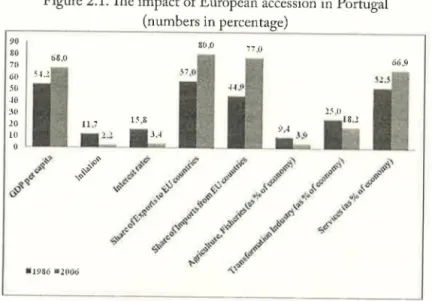
90 80 70 6(1 5(1 ~O JO 10 10 o
Figure 2.1. The impact ofEuropean accession in Portugal
(numbers in percentage) 80,0 77,0
68,0
Source: Portugal e Espanha 1986-2006, Vinte Anos de Integração Europeia, Assembleia da República, Lisboa, February 2006.
42
-Chapter 2 ' Portugal alld Spaill iII the process of EUJ'Opeall integra/ioll
1he conclusions of the Nice Treaty, coupled with the eastern
enlarge-l11ent of the EU, signalled the beginnlng of the end of Portuguese Euro
-< nthusiasm. At this point, botb internal and externa! factors contribtlten
rownrds the Portuguese gaining a more realistic perception of their
belong-ing to thc ElIropean Union. On the one hand, in. 2001, the resignation
01'
Prime Minjster António lIterres aod the call for early ele tions, wasaccompanled by an economic and financial downturn based on the faU in
clomesti consumption and the loss of competitiveness. On the other hand,
the new member states were more attractive to multinational corporations
seeking to benefit from the lower wages and skHled labour available in
Central and Eastern Europe.
Table 2.2. The Portuguese Presidencies of the EU (1992-2007)
Year
1992 "Rumo à U niãoEuropeia"
2000 "A Europa no Limiar do Século XXI"
2007 "A Stronger Europe in
a Better World"
Events and Achievements
Signature of the Maastricht Treaty
Consolidation of the Atlantic relations; Lisbon Strategy;
Security and Defence policy;
Accession negotiations with the 'He1sinki Six'
Preparation Df the Intergovernmental Conference 1st EU-Africa Summit
Lisbon Treaty; 1st EU-Brazil Summit;
Source: Ferreira-Pereira (2008).
ln this respect, Portugal was unquestionably one of the most affected
countries by the re1ocation of companies to the east. At this point, it should
be noted the financial constraints deriving from economic and monetary
union and adhesion to the euro, as well as the ongoing eco no mie issues
af-fecting Portugal, were aggravated from 2008 by the global financial crisis.
During the first decade of this century, Portugal's GDP diverged from the
EU average and from those of its cohesion partners. ln 1999 Portugal's
Iberia1/ Elites al1d lhe EU
GDP per capita was 68 per cent ofEU GDP per capita and by 2008 it had fallen to 63 per cento
Despite these circumstances, Portugal was committed to playing a more
important role in the EU. lhe 2007 Presidency of the EU represented an
excellent opportunity with José Manuel Barroso as President of the Euro-pean Commission.1he second EU-Africa Summit and the first EU-Brazil Summit are dear examples of that.
Spain
lhe admission of Spain in the EU coincided with the signature of the
Single European Act. As a consequence, Spain confronted a double
chal-lenge upon its accession. On the one hand, the country had to fulfil the requirements ofbilateral economic liberalization, as stipulated in the Treaty of Accession. On the other hand, it had to simultaneously go beyond that
and move forward together with the rest ofEC member states towards the
construction of a single market. At that point, there was much debate about
the results of the accession negotiations and the toughness of the
condi-tions imposed upon the country. As Jordan Galduf recalls, "in 1985, after
a decade of a profound economic crisis, the situation of the country was very difficult" (2003: 114). Until then, the country's attention was focused on politicaI transition and democratic consolidation. However, at that
mo-ment it became necessary to broaden the scope of the process and apply
economic measures which could not be postponed anymore. Integration of
Spain in the European Communities constituted a formal path to achieve
the necessary economic changes, in spite of having to accept and endure
tough conditions imposed by the new European partners.
As mentioned above, the first phase ofSpanish participation in the Eu-ropean project commenced with the accession of Spain in January 1986 and ended with the European Council ofMaastricht in 1991. During these years, the primary objective of the Spanish government was to formulate
a coherent approach to the EC, which would maximize both internal and
external benefits of the newly achieved status of member state. 1hree gov-ernments of socialist majority, presided over by Felipe González, a fervent defender of the European project, were entrusted with the task of defining the position ofSpain within the European Communities. It is important to
44
Chapter 2 . Portllgal alui Spaill ÍlI lhe proelSS tif Europeall i1/tegraliol1
note that in sp.ite of some riti i5m from the sectors most severeJy affected
by the newly acce~te~ conditions, thc acce sioll ?:Spain and the process of
defining its role wlthlO the European CommulHtles were alway
accompa-nied by a steady support from all social sectors, as well the most prominent
olitical figures, a situation very different from that in Portugal. pedfical1y,
~ince
the beginning of the Spanish politicaI transition, European integra-tion remained the point of reference in terms of the internaintegra-tional recogni-tion of the newly reinstated democratic regime for all democratic politicaI parties. Therefore, one could observe a perfect continuity in main parties' aims and objectives in this respect (Powell et al, 2005: 29-30). A dear ex-ample of that is the unanimous support for the passing of the Law for the authorization of ratification of the Treaty of Accession in the Spanishparliament by both lower (Congreso de los Diputados) and upper (Senado)
parliamentary chambers (Congreso de los Diputados and Senado) the 26th
of June and the 17th of July 1986 respe tively. Moreover, as mentioned
above, this was accompanied by a positive evaluation on part of the Spanish citizens.
ln order to overcome the doubts that some member states had expressed
regarding Southern enlargement, following the signature of the Single
Eu-ropean Act, Spain made a de ar effort to demonstrate that it would assume
a constructive position within the EC.14lhis initial predisposition
crystal-lized in a steady support for all initiatives which would contribute to the advancement of European integration.
Such a constructive attitude succeeded in portraying Spain as a
respon-sible partner, capable of commitment to further advancements in the
Eu-ropean project even beyond its vested interests. 1his was accompanied by an understating of the country's difficulties by European institutíons. 1he
enactment of the single market coincided with the transitory periods
fol-lowing the accession, and, thus, during this time Spanish industrial prod-ucts, as well as a large part ofits agricultural production became exposed to its European competition. 1his is why the European Commission, in the 1988-1992 financial perspectives (the so-called 'Delors I Package') dupli-cating the budget aUocated to the previously existing structural funds (the European Regional Development Fund and the European Social Fund)
14 lhe Organic Law autharizing the ratificatian of the Single European Act by Spain was passed by the lower chamber of the Spanish parliament on the 2nJ of October 1986.
Iberiau Elites al/d lhe EU
(Morata, 2000: 150), which made it possible for Spain and other under-developed members states to adjust more easily to the reality of the single
market. I ,ti 1,4 1,2 O,H 0,6 0,4 0,2
Figure 2.2. European funds in relation to GDP, (measured according to prices in 2004)
O~~~~~~~~~~~~~-L~~-L~~~~
86 87 88 89 90 9192 9.194959697989900 (lI 020304050607 OS09 10 II 1113
Souree: Month1y report, La Caixa FOllndation, December 2006.
It was also during this initial stage when Spain identified its principal European allies. lt was commonly thought that the main objective was to obtain influence in the European Commission. This was the reason why Felipe González, even while in the opposition, cultivated his good relations
with the president of the European Commission, Jacques Delors
(1985-94), whose vision of the European project González fully shared. ln
addi-tion, the years of tough accession negotiations, taught the Spanish
govern-ment that the best way of gaining influence in the EC was through keeping good bilateral relations with the governments of Germany and France.15
15 During these years the frequency of international summits and bilateral meetings
in-creased, especially with Germany and France, but also with Italy and Portugal.
46
Chapler 2 . Portllgal aud Spain iu lhe troem of Europeml integmlion
1herefore, during these first years of membership, the Spanish government
did everything that was possible to maintain its position within the
mar-gins of the Franco-German axis. .
Relations with France experienced a clear improvement after joining the EC, in spite of initial objections to Spain's accession. Regarding Ger-rnany, prior to Spanish accession, Felipe González supported conservative leader Helmut Kohl in his decision to deploy Pershing missiles on German sai!, in spite of an open and clear opposition of a significant part of the
rnembers of the fellow German Social Democratic Party (SPD). ln return,
Kohl became one of the main advocates of Spanish accession.16 ln paral-lel, perceptions of panish public opinion aligned with this strategy
dur-íng thesc years. Thus, while opinions regarding Germany and the Germans
werc stable during ali this ime, the improvement of the perceptions of
France and the French was substantial.
ln the first semester of 1989, Spain held the rotating Presidency of the European Communities for the first time. At that moment, the rather suc-cessful functioning of the single market reactivated the ambitions to create
an Economic and Monetary Union, as it was established by the Single European Act. Upon the conclusion of the Spanish presidency the De-10rs Plan was approved.17 Thus, in a way, the Spanish presidency witnessed
the outset of the process which would lead to a more intense politicaI and
economic union. Furthermore, Spain contributed to the creation of an
at-mosphere of stability and trust which made possible the signature of the Treaty ofMaastricht two years later. Most importantly, some of the greatest
16 The importance of nurturing the relations with Germany can be nlrther understood
whel1 we are reminded ofhow Kohl correctly identified the lil1k betweel1 Spanish
mem-bership in the NATO and its accessiol1 to the EC. Kohl understood that by means of putting pressure on the Freneh government to lift offits opposition lowards lhe 1berian
enlargement, he was helping González lo win lhe vole in lhe conlroversial referendum
ove r lhe penllanence ofSpain wilhin lhe NATO, to be held in March of 1986.
17 lhe famous Delors Plan was designed to facilitate the progress towards a monetary
union in three phases, with the creation of a common currency as its final objective. Its
initial phase was completed in 1993 with the agreement on free movement of capitais and the establishmcnt of convergence eriteria for the countries whieh intended to join the common currency. The seeond phase was completed in 1998 with the evaluation of
those countries which complied with thc convergence criteria and the creation of the
European Central Bank (ECB). The last stage was initiated in 1999 and finalized on the
1" ofJanuary 2002 when the single currency bcgan to circulate.
lberitm Elites aud the EU
advancements of the treaty, such as the concept of European citizenship
and the development of the European policies in the area of Justice and Interior AfEürs, were introduced thanks to the Spanish input.
ln economic terms, the balance of this initial period of Spanish mem-bership was, in general, positive. ln this sense, between 1986 and 1990, its GDP increased at a pace of about 4.8% annual1y, a growth much stronger than that experimented in the years prior to the accession. Moreover, the volume of trade between Spain and other EC member states grew
substan-tial1y, from 30200 to 69200 million Euros (Forner and Senate, 2012: 270).
Table 2. 3. Spaniards in EU institutions
Enrique Barón Crespo José María Gil-Robles y Gil-Delgado José Borrei Fontelles Manuel Marín González Abel Matutes Juan Position
President of the European Parliament
Commissioner for Fisheries, Development and Cooperation, and Relations with
Mediterranean Countries President of the European Commission
Commissioner responsible for EC relations with Latin America, Asia and Mediterranean countries and Commissioner for Transport and Energy 48 Term in office From 25 July 1989 until13 January 1992 From 14 April 1997 until 19 July 1999 H'om 20 J uly 2004 until 16 January 2007 From 1 January 1986 until15 March 1999 From 15 March 1999 until16 September 1999 From 8 December 1988 until 21 April 1994
Chapter 2 . Portllga! flnd Spail1 iII lhe proem of Ellropean integra/ion
Position Term in office
Marcelino Commissioner for Transport and From 27 April Energy and Commissioner for 1994 until15 Oreja
Institutional Relations, Culture, September Aguirre
and the Audio-visual Sector 1999
Vice-President and From 1
Loyola de
November PaJacio y Commissioner for Relations
1999 until 22
dei Valle with the European Parliament,
November Lersundi Transport, and Energy
2004 From 16 Pedro Solbes Commissioner de for Economic September
Mira and Monetary Affairs 1999 untill0
April2004 Commissioner for Economic 24 April
Joaquín and Monetary Affairs, Vice- 2004 untill0
Almunia Prcsident and Commissioner for February 2010,
Competition and currently
From 18
Javier High Representative of the October
Solana de Union for Foreign Affairs and 1999 until30
Madariaga Security Policy November
2009 From 7 Gil Carlos
President of the Court of] ustice October 1994 Rodríguez
ofthe European Union until November
Iglesias
2003
Pasqual President of the Council of From 10 March
European Municipalities and Maragall i
RegiollS, and Vice-President of 1994 until Mira
the Committee of the Regions February 1998 Carlos Ferrer President of the European
Salat Economic and Social
Committee
From 16 Juan Manuel President of the European Court January 2002
Fabra of Auditors untilJanuary
2005 Source: own c1aboration.
lberian Eliles alld lhe EU
1he second period which can be discerned in Spanish membership in the EU commenced in 1993, after the signature and passing in Spain of the
Treaty of the European Union, and lasted until the end of Felipe
Gonza-lez's last government, in 1996. During these years, the socialist leader knew how to compensate his growing internal discredit, with a strong presence in the European politicaI scene, remaining in line with the Franco-German
axis.1his was a phase of maturing in Spanish participation in the European
integration processo lt is at this point that Spain was able to combine its
steady support for the development of the European project, with a defence
of its legitimate interests as a country.1herefore, even though in the previ-ous years Spain occupied positions relevant to the European project, it is in this period when its presence was intensified.
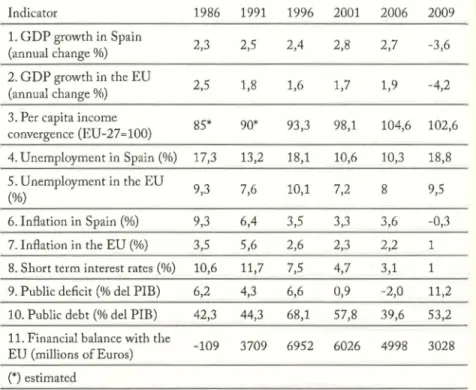
Table 2. 4. Economic change in Spain, 1986-2009
Indicator 1986 1991 1996 2001 2006 2009 1. GDP growth in Spain 2,3 2,5 2,4 2,8 2,7 -3,6 (annual change %) 2. GDP growth in the EU 2,5 1,8 1,6 1,7 1,9 -4,2 (annual change %)
3. Per capita incorne
85* 90' 93,3 98,1 104,6 102,6 convergence (EU-27=100) 4. Unernployrnent in Spain (%) 17,3 13,2 18,1 10,6 10,3 18,8 5. Unernployrnent in the EU 9,3 7,6 10,1 7,2 8 9,5 (%) 6. Inflation in Spain (%) 9,3 6,4 3,5 3,3 3,6 -0,3 7. Inflation in the EU (%) 3,5 5,6 2,6 2,3 2,2 1
8. Short terrn interest rates (%) 10,6 11,7 7,5 4,7 3,1 1
9. Public deficit (% dei PIB) 6,2 4,3 6,6 0,9 -2,0 11,2
10. Public debt (% dei PIB) 42,3 44,3 68,1 57,8 39,6 53,2
11. Financial balance with the
-109 3709 6952
EU (rnillions ofEuros) 6026 4998 3028
(*) estirnated
Sources: Elcano Foundation, Piedrafita tI aI. (2006), Eurostat, and Spanish National Statistics
Institute (INE).
50
=
Chapler 2 . Portugal alld Spain in lhe process of E/lropeau inlegralion
'Ibe second Spanish presidency of the EU took place during this
sec-ond pbase, between June and Decembe( 1995. DlIring this Presiden
y, and
within the framework of the EU Mediterranean policy, Spain organized
in Barcelona the ElIro-Mediterranean Ministerial onfercnce where EU
ITlcJ11ber states met witb the principal Mediterranean non-member
COlUl-tries in order to dls uss the economic stability and prosperity of the region.
La t but not least, in this period Spain progre ively hanged the
di-rection of its economic policy. Markcd ln the initial years of membersrup
by high levels of inAation and public deficit, the conditions imposed by
the Trcaty of European Union, which aimed at forging an Ecollornic and
Monetary Union, obliged the Spanish Government to shift the direction in
its economy policy to achieve a reduction in both indicators.
The third period ofSpanish membership in the EU covers the two terms
José María Amar was president of the government, between 1996 and
2004. During these years Spain faced important new challenges, of which joining the MonetalY Union undoubtedly constituted the most significant
one. ln order
to
meet the Convergence Criteria established by the EU, thefirst government of the Popular Party (PP) made an effort to reduce infla-tion, public defici t, interest rates, and public debt.18 As a result, Spain joined
the common European currency in 1999 and on the 1st ofJanuary of2002
after meeting the tough criteria. The introduction of Euro notes and coins
into circulation coincided with the second Spanish Presidency of the EU. The other two milestones of this period were the signatures of the
trea-tíes of Amsterdam and Nice.1he former was ratified by the lower chamber
ofthe Spanish Parliament on the 1st ofOctober 1998 and carne into force
in May 1999.1he treaty implied the strengthening of the role of the EU in
some policy areas, such as the establishment of an employment policy and
the creation of the Area ofFreedom, Security and Justice. ln addition, the
Treaty aimed at addressing the issue of the distribution of power among the
18 lhe Sllccess in meeting these objectives was partly due to the policies of liberalization
and deregulation.lhese policies resulted in privatizations, already initiated by the
previ-ous socialist government; land market liberalization, with the consequent increase in
public incorne due to the parallel growth of the construction sector; as well as a decrease in taxes for cornpanies and, to a lesser extent, families, among other measures. Neverthe-less, the general fiscal pressure did not decrease in comparison to previous periods. Credit
cxpansion caused by a reduction in interest rates which accompanied the introduction of
the cornmon currency was the key factor which triggered the real estate bubble.
lberian Elites alld lhe EU
different member states in the decision-making structures of the Council of the EU; however, it only did so in a vague and provisional manner. One of the institutional innovations introduced by the Treaty of Amsterdam was the figure of the High Representative of the Union for Foreign Affairs and Security Policy, who at the sarne time held the position of Secretary General of the Council of the European Union. Javier Solana, who pre-viously served as a Spanish Minister and NATO Secretary General, was
appointed to the newly created position in 1999. 1he Treaty of Nice, on
the other hand, was ratified on the 6th ofNovember 2001, and carne into
force on the 1st ofFebruary 2003. By approving the Treaty ofNice, Spain accepted the redistribution of power in aU democratic institutions of the EU.1he Spanish government attained a favourable position in terms of the new power distribution in the Council; nevertheless, it was achieved at the expense of a rela tive loss of power in the European Parliament-from 64 to 50 seats, which represented a decrease in the relative weight from a 10.2% to a 6.8%. Besides, Spain (like other large member states) lost one of the
two seats in the European Commission.
1he second term ofJosé María Aznar as prime minister entailed a
radi-cal shift in Spanish foreign policy and a transformation of its policy
to-wards the European community. Transatlantic relations, especially with the
USA, became prioritized over relations with the EU and, especial1y ove r the traditional allies of the Franco-German axis. 1hus, the integrationist position which traditionally had characterized Spanish participation in the European project was substituted by an intergovernmentalist stance. Dur-ing the first semester of 2002 Spain took over the EU Presidency for the third time, coinciding with the issuance of the Euro.
1his review of Spain's membership in the EU doses with the period initiated with the socialist victory in the 2004 parliamentary election and concludes in the late 2011 with the formation of the new government
pre-sided over by Máriano Rajoy Brey. 1his last stage was characterized by a
new strategic shift aiming to recover good re1ations within the EU, es-pecially with Germany and France. Moreover, the new socialist govern-ment became one of the firmest supporters of the Treaty Establishing a Constitution for Europe. 1hus, Spain became the first country in which the Constitutional referendum was held with a result of a 76.7% of the vote in favour of the Constitution. Both main national parties, PSOE and
52
Chapler 2 . Portugal alld Spaill i1/ lhe process of Europeall illlegralio1/
PP, together with the Catalan nationalists of Convergencia i Unió, and the Basque Nationalist Party called for a favourable vote on the treaty. On the contrary, most of the formations 011 the left of the PSOE opposed the treaty and, thus, campaigned for a negative vote.
Following a definitive rejection of the constitutional Treaty as a conse-quence of the negative Dutch and French votes, the European Union was forced to change its objectives. After long debates which went on for more than two years, finally on the 13th ofDecember 2007 the Treaty ofLisbon
was signed, amending the Treaty on European Union and the Treaty
estab-lishing the European Community.
Table 2.5. Spanish and Portuguese Presidency of the EU
1 January 1989 1 January 1995 1 January 2002 1 January 2010
Progress in directives regarding the establishment of the Single
Market and the Economic and Monetary Union
Adoption ofthe Community Charter ofFundamental Social Rights ofWorkers
Progress in Common Foreign Policy Name for the Common Currency
Establishment of a schedule for the introduction of the Common
Currency
Introduction of Euro notes and coins in twelve countries Announcement of the Convention for the future of Europe Foundations for a common policy on illegal immigration Ratification of the Kyoto protocol
European Financial Stabilisation Mechanism and European Financial Stability Facility (better known as bailout or rescue fund)
Source: Based on Ferreira-Pereira, 2008. (http://www.scielo.oces.mctes.ptlpdf/ri/n20/n20all.pdf.
available 01 December 2013)
nis last period conduded with the fourth Spanish Presidency of the Union in the first semester of 2010.1he development of the different sec-tions of the Lisbon Treaty and the introduction of some changes which would contribute. to the improvement in the efficiency of the EU