ABSTRACT
Title: The impact of eWOM on consumers’ purchase intention - the moderation role of products’ category
Author: Madalena Mauhin Trigueiros Ventura
Online content is becoming an increasingly important tool for consumers and marketeers relationship to grow closer and last-longing. Namely, eWOM, which derived from the need of sharing knowledge and information among consumers, allowed them to reach information perceived as more trustful and real.
Nowadays, this type of communication is part of the purchasing process and has been proved to influence consumers’ buying decisions. Besides being perceived as consumer generated information, eWOM can also be managed by marketeers, aiming at influencing individuals to provide useful information, which ideally would be positive but can also be negative, and managing potential future customers’ expectations and needs.
In addition, this research quantifies the purchase intention among different types of eWOM, namely by exposing different sources, valences and structures and evaluating the impact on consumers’ buying decisions within different products’ categories.
Therefore, quantitative data was generated by an online questionnaire which presented the different illustrative scenarios for each of the four categories of products being tested: pricey tech electronics, high touch retail, household staples and no touch services.
The conclusions obtained were mostly opposing to literature, which may be explained by the various range of eWOM limitations and characteristics, as lack of physical contact, but also, were helpful to perceive that its influence is not linear and that it could depend on the scenario and the circumstances in which the information was developed and shared.
Keywords: eWOM, purchase intention, consumer generated information, expert generated information, need of eWOM, pricey-tech electronics, high touch retail products, household staples, no touch services, online information, written reviews, numerical ratings
iii SUMÁRIO
Título: O Impacto da eWOM na Intenção de Compra dos Consumidores – o papel moderador da Categoria de Produto
Autor: Madalena Mauhin Trigueiros Ventura
O conteúdo online é uma ferramenta cada vez mais importante para tornar a ligação entre consumidores e marketeers mais próxima e duradora.
Atualmente, este tipo de comunicação é parte integrante do processo de compra e, apresenta um efeito influenciador na decisão dos consumidores. Apesar disso, esta informação é vista como sendo originária de comuns consumidores, mas, esta também pode ser gerida por marketeers com o objetivo de influenciar indivíduos a providenciar informação útil, - que idealmente seria positiva, mas que acontece por vezes ser negativa também-, e, assim, gerir as expectativas e as necessidades de potenciais e atuais clientes.
Adicionalmente, este estudo quantifica a diferença na intenção de compra consumidores entre diferentes tipos de eWOM, através da exposição de diferentes tipos de fontes, valências e estruturas, de modo a avaliar o impacto na decisão de compra dos consumidores, no seio de diferentes categorias de produto.
Consequentemente, foi gerada data quantitativa através de um questionário online que apresentava diferentes cenários ilustrativos em relação aos tipos de eWOM que estavam a ser testados no âmbito das categorias de produto escolhidas.
Na verdade, as conclusões obtidas nesta dissertação foram, maioritariamente, contra os factos revelados na literatura considerada, o que, pode ser explicado pela variedade de limitações e características peculiares da eWOM, mas, estas conclusões podem também ser úteis para perceber que a sua influência não é linear e pode depender dos cenários e circunstâncias em que a eWOM foi criada e desenvolvida.
Palavras-chave: eWOM, WOM, intenção de compra, informação gerada por consumidores, informação gerada por experts, necessidade de recorrer a eWOM, produtos pricey-tech electronics, produtos high touch retail, produtos household staples, serviços no touch, informação online, reviews escritos, ratings numéricos
ACKNOWLEDGEMENTS
First I would like to thank my Mother Catarina and my Father Henrique not only for the amazing opportunity to study in of the finest and most prestigious universities of Europe but also for the constant and extraordinary support throughout these last months.
Additionally, I would like to show my gratitude to my supervisor, Professor Paulo Romeiro, for his advice and help during this entire process. Thank you for your constant availability and help.
To all my family but, specially, to my mother, father, grandmother and aunt, who always encouraged me to continue and to do my best, even in the most stressful moments.
To all my friends, thank you for being there through these months, for all the encouragement and patience to deal with all the stressful moments I went through. Specially, to Sara Pinheiro, who helped me during the most difficult stage of my thesis and to Inês Flora Ribeiro, who was the best thesis partner I could asked for.
To Inês’ parents, Aníbal and Flora Ribeiro, for the support during the last effort of these months.
Lastly, I would like to show my appreciation to all the participants of my survey, who took some of their personal time to help me. Thank you for making this research possible.
v TABLE OF CONTENTS ABSTRACT ... II SUMÁRIO ... III ACKNOWLEDGEMENTS ... IV TABLE OF CONTENTS ... V TABLE OF FIGURES ... VII TABLE OF TABLES ... VIII TABLE OF APPENDICES ... IX
CHAPTER 1: INTRODUCTION ... 1
1.1 BACKGROUND AND PROBLEM STATEMENT ...1
1.2 AIM AND SCOPE ...2
1.3 RESEARCH METHODS ...3
1.4 RELEVANCE ...3
1.5 DISSERTATION OUTLINE ...4
CHAPTER 2: LITERATURE REVIEW ... 4
2.1TRADITIONAL WORD-OF-MOUTH (WOM) ...4
2.2FROM WOM TO EWOM ...5
2.3 EWOM ...6
2.3.1 Valence: Positive, Neutral and Negative Information ... 7
2.3.2 Type: Reviews and Ratings ... 8
2.3.2 Source ... 9
2.3.2.1 Known source vs unknown source ... 10
2.3.2.2 Consumer generated information (CGI) ... 11
2.3.2.3 Expert generated information ... 11
2.4PURCHASE INTENTION ...12
2.5PRICE ...13
2.6PRODUCT CATEGORIES ...14
2.6.1 Pricey Tech-Electronics ... 14
2.6.2 High Touch Retail ... 14
2.6.3 Household Staples ... 14 2.6.4 No Touch Services ... 15 CHAPTER 3: METHODOLOGY ... 16 3.1RESEARCH APPROACH ...16 3.2SECONDARY DATA ...16 3.3PRIMARY DATA ...17 3.3.1 Data Collection ... 17 3.3.2 Measurements ... 18 3.3.3 Data Analysis ... 22
CHAPTER 4: RESULTS AND DISCUSSION ... 23
4.1RESULTS ...23
4.1.2 Results from the Hypothesis Test ... 24
4.1.2.1 Hypotheses 1, 2 and 3 ... 26
4.1.2.2 Hypothesis 4... 30
4.1.2.3 Hypothesis 5... 32
4.1.3 Other conclusions ... 36
CHAPTER 5: CONCLUSIONS AND LIMITATIONS ... 38
5.1MAIN FINDINGS &CONCLUSIONS ...38
5.2MANAGERIAL /ACADEMIC IMPLICATIONS ...40
5.3LIMITATIONS AND FURTHER RESEARCH ...40
REFERENCE LIST ... I APPENDICES ... VI
vii TABLE OF FIGURES
Figure 1: eWOM Communication Process ...6
Figure 2: Conceptual Model ...15
Figure 3: Communication Flow ...18
Figure 4:Mix valence set of reviews-Pricey Tech Electronics–H1a. ...19
Figure 5:Neutral valence set of reviews–No Touch Services- H1a. ...20
Figure 6:Numerical rating and a written review- Household Staples-H2a. ...20
Figure 7:Expert and a consumer generated rating-No Touch Services-H3a. ...20
Figure 8:Review with an unknown source and a review with a known source-High Touch Retail –H3b. ...21
Figure 9:Same product with a higher and a lower price to test the need to resort to eWOM in both situations-H4 ...21
Figure 10:Sample Filtering and Characterization ...23
Figure 11: Conceptual Model-H4 ...33
Figure 12: Conceptual Model - Moderation Role of Product's Category on the Relationship between Known/Unknown Sources and PI ...33
Figure 13: Conceptual Model - Moderation Role of Product's Category on the Relationship between Expert/Consumer Generated Rating and Purchase Intention ...34
Figure 14: Conceptual Model - Moderation Role of Product's Category on the Relationship between Ratings/Reviews and Purchase Intention ...34
Figure 15: Conceptual Model - Moderation Role of Product's Category on the Relationship between a Neutral/Mixed Set of Reviews and Purchase Intention ...35
TABLE OF TABLES
Table 1:Descriptive Statistics by Product Category and eWOM characteristics ...25
Table 2:Descriptive Statistics by eWOM characteristics ...26
Table 3: Sample’s normality test – Neutral vs Mixed set of reviews ...28
Table 4: Sample’s normality test – Written review vs Numerical rating ...28
Table 5: Sample’s normality test – Consumer vs Expert generated rating ...28
Table 6: Sample’s normality test – Unknown source vs Known source ...29
Table 7: Levene’s–eWOM vs purchase intention ...29
Table 8 :Independent Samples t-tests-hypotheses 1 to 3 ...30
Table 9:Descriptive statistics-Overall need to resort to eWOM ...31
Table 10: Descriptive statistics – price vs need to resort to eWOM ...31
Table 11:Sample’s normality test-price vs need to resort to eWOM ...31
Table 12: Levene’s-price vs need to resort to eWOM ...32
Table 13: Independent Samples t-test – hypothesis 4 ...32
Table 14 : Regression analysis – moderation role of product’s category on the effect of known and unknown sources on consumers’ purchase intention ...33
Table 15 : Regression analysis – moderation role of product’s category on the effect of expert and consumer generated ratings on consumers’ purchase intention ...34
Table 16 : Regression analysis – moderation role of product’s category on the effect of ratings and reviews on consumers’ purchase intention ...35
Table 17 : Regression analysis – moderation role of product’s category on the effect of a neutral and a mixed set of reviews on consumers’ purchase intention ...35
ix TABLE OF APPENDICES
Appendix 1: Survey (English version) ... VI Appendix 2: Survey (Original version - Portuguese) ... XII Appendix 3: Figures used on the online survey ... XVIII Appendix 4: Demographics ... XXV Appendix 5: Testing hypotheses 1, 2, 3 and 4 – Independent Samples t-test ... XXVI Appendix 6: Testing hypothesis 5 – Regression analysis: Moderation effect of Product’s Category ... XXXI
GLOSSARY
WOM - Word-of-mouth
eWOM- Electronic word-of-mouth CGI – Consumer generated information EGI – Expert generated information MGI – Market generated information PI – Purchase Intention
1 CHAPTER 1: INTRODUCTION
1.1 Background and problem statement
Internet development has brought to our society a whole new range of opportunities which have been changing consumers’ behaviours and consequently, companies marketing strategies. Word-of-Mouth (WOM), which is the process of sharing information and opinions regarding a specific product or service between customers (Jalilvand 2012), has been proved that influences both pre-purchase decisions as well as post-purchase decisions (de Matos and Rossi 2008). Therefore, consumers started increasingly to use web 2.0 tools, such as customer review sites, and social network sites, to communicate and exchange product information (Lee, Park, and Han 2008), resulting in a new meaning to the WOM concept, the eWOM.
Presented as a less personal form of communication, eWOM describes any positive or negative statement made by current or prospect consumers about organizations or its products and services, which is made available to a wide range of people through the Internet (Hennig-Thurau et al. 2004), concretely it consists on the sharing of products’ evaluations of a wide range of products by customers through review websites, discussion forums, blogs and virtual communities (Xinxin LiHitt 2010).
Despite the fact that is equally important to identify and reach influencers with persuasive brand communications online and offline (Fulgoni and Lipsman 2015), research has proven that eWOM may have higher credibility, empathy and relevance to customers than marketeer-created sources of information on the web (Gruen, Osmonbekov, and Czaplewski 2006) and, thus, marketeers might focus on this type of communications in order to develop proper marketing strategies.
It is known that eWOM highly impacts consumers’ purchase decisions, - being already proved that the rating of products affects the likelihood that an item will be bought (Leskovec, Adamic, and Huberman 2007)-, but, there is still an existing gap related to the different effects that this type of communication has within different product categories, which is one of the main reasons for choosing this topic.
Therefore, the focus of this dissertation is to study the impact that eWOM might have on consumers’ purchase intent by focusing on the direct impact of reviews and ratings, and its valence and different sources. Moreover, it also considers the potential influence of two moderators, price and product category, and the relationship between both.
1.2 Aim and Scope
As mentioned, this research might be useful for future marketeers properly adapt their marketing strategies to new media standards and characteristics.
eWOM is presented free of any standard format, which means that consumers can freely write, or even evaluate numerically, their experience with the product or the service they are testing. In this sense, one of the main characteristics of eWOM is informality and, thus, format-free (Park and Kim 2008). Therefore, in order to narrow the scope of this dissertation, the main focus was on reviews and ratings, - respectively written and numerical types of eWOM. Thus, the following research questions were addressed.
Due to time constraints, and given the complexity of eWOM concept, I chose to focus the analysis on the potential impact that the valence, type and sources of ratings and reviews might have on consumers’ PI.
RQ1 – How does eWOM impacts consumers’ PI?
a. How does the type of ratings’ and reviews’ sources impacts consumers’ PI? b. How does the valence of reviews impacts consumers’ PI?
c. How does the type of eWOM influences consumers’ PI?
RQ2 – Does the category of the product influences the impact that eWOM will have on consumers’ PI?
RQ3 – Does the variable price impacts the need to resort to eWOM? Therefore, these research questions lead to the next hypotheses.
H1: The valence of the reviews will impact the consumers’ PI
H1. a. A set of positive and negative reviews will have a higher impact on consumers’ PI than a neutral set of reviews.
H2: The type of eWOM will impact consumers’ PI
H2. a. A numerical rating has higher impact on PI comparing to written reviews. H3: The source of a rating and a review will impact the consumers’ PI
H3. a. One single expert generated rating has higher impact on consumers’ PI than one generated by a common consumer.
H3. b. A review posted online with a known source has higher impact on consumers’ PI that one signed with unknown.
H4: The higher the price of the product/service, the higher the need to resort to eWOM H5: The impact that eWOM has on consumers’ PI differs amongst different categories of products.
3 Therefore, as independent variable we have PI and, thus, the study will focus on the impact that different characteristics of eWOM, as type, valence and source, would impact consumers’ PI. Thus, the effect of the variable price on the need to resort to eWOM (in order to evaluate a product or a service), will be tested as an addition to the model.
1.3 Research Methods
In order to address the presented research questions, primary and secondary data, including journal articles, academic papers and data, generated by an online survey, were collected. Secondary data will be used mostly within the Literature Review chapter and slightly within the conclusion of the results obtained in the end of the research. Regarding to primary data, the research will be supported by quantitative data, with the development of an online survey, which will be applied to a random sample.
Furthermore, the sampling technique applicable to this research is representative sampling. With this technique, the probability of each case being selected from the total of the population is usually equal for all the cases. Hence, this technique is used to obtain inferences from the total sample regarding a population to answer research questions (Saunders, Lewis, and Thornhill 2009). Therefore, the survey was randomly distributed amongst different channels, including the social network Facebook, and personal and organizational e-mails, which allowed an extended reach.
Afterwards, in order to analyse the results from the survey (primary data), first, in order to estimate and test the hypothesis about the population itself, namely its characteristics, statistics were applied through a process denominated as statistical inference (David R. Anderson, Dennis J. Sweeney, and Thomas A. Williams 1989). Within this process, the first step was composed by a normality test, followed by t-tests which allowed to compare means among different groups of analyses. The final stage of statistical analysis consisted on a set of regression tests in order to study the potential existing relationship within the variables of the conceptual model.
Additionally, this dissertation addresses some topics outside the pre-defined model that would be relevant for the overall study, namely regarding the impact that a lower and a higher price might have on the consumers’ willingness to look for eWOM before making a purchase decision.
1.4 Relevance
Giving the growing importance of Internet and its usages, it is getting increasingly important to study all of the opportunities that are arising. Therefore, brands need to be aware of technology
fast development and its impact on consumers’ behaviours and decisions. Being eWOM communications one of the most used tool to evaluate the potential of a product and/or a service, online feedback mechanisms have appeared as a viable tool for fostering cooperation among strangers in such settings by ensuring that the behaviour of a trader toward any other trader becomes publicly known and probably will affect the behaviour of the entire community toward that trader in the future (Dellarocas 2003). In this sense, it is increasingly important to study the influence that different types of online information, may display on consumers’ purchase intent in order to properly adapt each brand’s marketing strategy to the new trends of the market.
1.5 Dissertation Outline
This dissertation presents a total of five chapters. Being this introduction the first chapter, chapter 2 presents a literature review on eWOM, PI, online search for information and different product categories.
Following to that, this dissertation presents the third chapter with the methodology used within this research. Afterwards, the collection and consequent analysis of the data collected are presented within chapter 4, being the results obtained presented and discussed in line with the proposed research questions and hypotheses.
To conclude, chapter 5 provides the main conclusions and limitations of this dissertation as well as some limitations and topics for future research.
CHAPTER 2: LITERATURE REVIEW
The intent of this chapter is to present a theoretical framework, based on previous studies and empirical evidences provided on some journals, on the concepts presented on the conceptual model of this research. Therefore, it starts with a brief reference to the evolution of WOM, to eWOM and also, includes an introduction to MGI, CGI and EGI, as well as PI and price. These subjects are followed by a detailed approach to written reviews and numerical ratings namely to its valence and source. Additionally, it presents a framework of four possible categories of products, to which the analysis will be extended.
2.1 Traditional Word-of-mouth (WOM)
Currently, internet as an increasing clutter, with high selectivity, interactive possibilities and relatively low cost (Kotler and Keller 2009), facilitates continuous technological innovations and fosters new business practices as well as alters the competitive landscape of may industry sectors (Xiang, Magnini, and Fesenmaier 2015). In this sense, in order to feed their long-term
5 strategic objectives, brands need to identify the most suitable technology that will allow them to identify and develop effective and sustainable marketing communication strategies.
One of the most significant development regarding to marketing over the past decade has been an increasing focus on understanding the antecedents and consequences of customer-to-customer (C2C) interactions (Libai et al. 2010), - or as denominated within this dissertation, WOM. WOM can be described as a process of sharing opinions and information about specific products between customers (Jalilvand 2012).
2.2 From WOM to eWOM
For many years, WOM, has been acknowledge as a major influence on what people know, feel and do, namely it is more influential on behaviour than other marketeer-controlled sources, like advertising. The spectrum of WOM influence regards consumers’ awareness, attitudes, expectations, perceptions, intentions and behaviours (Buttle 1998) and, according to Sheth (1967), WOM has also more importance than advertising in which regards to raising awareness of an innovation and in ensuring the decision to try a certain product.
During the last decade, we witness the fast development of the social media which had a direct and significant impact to our society and daily lives. This rapid development brought the need to further research the impacts of social media to different facets in the society through the theoretical lens of information systems (IS) (See-To and Ho 2014). That said, the need to identify and reach influencers with persuasive brand communications is equally important online as it is offline (Fulgoni and Lipsman 2015) and, hence, this sharp growth of internet, among side with its improved communication skills, led to an amplification of the scope of WOM communications, which presented a “fertile base” to eWOM communications (Bataineh 2015).
WOM and eWOM present, thus, significant differences. Most notably, WOM is commonly shared face-to-face between people who know each other, whereas eWOM not only can occur between people who are personally familiar with each other, but also, there are a subset of electronic channels developed so users can share information with people they do not know. In this sense, eWOM builds a communication flow with different levels of influence (Meuter, McCabe, and Curran 2013) but, on the other hand, there is also a lack of strong ties between the individuals, making more difficult to use the similarity between sources to determine the credibility of the information (Park and Lee 2009). Despite of that, due to its speed, convenience and absence of face-to-face pressure, eWOM is proved to be more influential than WOM (Sun et al. 2006), but consumers are more likely to choose a service with positive interpersonal WOM than when they receive diverse forms of positive eWOM (Meuter et al. 2013).
7 to Mcknight, Choudhury, and Kacmar (2002), a belief on the trustworthiness of a source leads to a positive attitude towards the information provided, which, in turn, have a significant impact on the consumer’s intention to purchase that item. Thus, this presupposes that consumers’ beliefs are implicit in their intention to buy a certain product or service which allows to obtain results regarding the entire flow of communication.
2.3.1 Valence: Positive, Neutral and Negative Information
The valence of a review regards to the direction of the evaluation that is being made on the review, being, hence, positive, neutral or negative. In a neutrally valenced review it is possible to find descriptive information about the product, or service, without any evaluative direction. On the other hand, positive reviews provide information that evaluates the object positively and, contrarily, negatively valenced reviews evaluate in a negative way (Purnawirawan, De Pelsmacker, and Dens 2012).
Readers are motivated to find trusted people opinions and to reduce perceived risk. In addition to that, the time constraints when searching for products, as well as the need to know more about new products in the marketplace, in a trustful way, are motives linked to a high predisposition to read negative reviews (Khammash and Griffiths 2011). Previous studies showed a predisposition to consumers to pay more attention to negative information rather than positive (Cheung and Thadani 2012) (Pan and Zhang 2011), as well as has been found to be more important for consumers’ evaluation of a product or a service, showing thus a higher impact on their purchase decisions. Even previous studies presented an asymmetrical influence of word-of-mouth, which means that negative reviews have a stronger effect on consumers’ brand evaluations and their PIs (Park and Lee 2009) (Brown and Reingen 1987).
Nevertheless, although previous studies stated that an excess of positive information may break consumers’ trust due to questions regarding the source’s motives and its potential lack of authenticity (Schindler and Bickart 2012), East and Lomax (2008), stated that positive WOM has higher impact on consumers’ purchase probability than negative information.
Moreover, it is proved that the exposition to negative information allow customers to categorize the product, or service, as low in quality – known as negativity bias-, however, positive and neutral reviews can be found in many high-, average- and low-quality products. Explicit positive reviews help readers make a purchase they will value, contrarily, clearly negative information led consumers to avoid a purchase they may otherwise regret (Forman, Ghose, and Wiesenfeld 2008). The negativity bias is then explained by the tendency that consumers have to consider that any product or service must have, at least, one positive or neutral attribute but
never one negative, given, thus, higher weight to the most distinctive ones (Folkes and Patrick 2003).
In this sense, the following hypothesis resulted considering the controversial range of results obtained and added a new scenario, a set of neutral reviews. Namely, to study the impact that a set of mix valence reviews (negative and positive reviews) might have on consumers’ PI, comparing to a neutral set of reviews.
H1. a. A set of positive and negative reviews will have a higher impact on consumers’ PI than a neutral set of reviews.
2.3.2 Type: Reviews and Ratings
eWOM is a type of communication which can take the form of reviews – user comments, ratings – numerical scale evaluations, or videos (Chatterjee, 2001).
Focusing this research on the reader’s perspective, potential consumers’ attributions about the motivations that led a reviewer to post a certain review will include whether the opinions expressed are based on external (product) reasons or internal (reviewer) reasons. If a reader make the attribution that the review he is reading is based on external motives, he will perceive it as legitimate, believable, actionable and useful information. On the other hand, if the review is based on internal reasons, consumers that will read it, will then discount it (Sen and Lerman 2007).
eWOM is presented on the internet without any standard format, meaning that consumers can freely write, or evaluate in value, their experience with the product or the service they are testing. Nevertheless, online sellers tend to present the information about a product, or service, framed in a cognitively fitted way but, in which regards to consumers’ reviews, it is unnatural for them to provide a standard review format for the buyers once the main characteristics of word-of-mouth are informality and, in this way, format-free (Park and Kim 2008).
Therefore, due to the higher complexity of visual perceptions, - in which regards to video evaluations-, the scope of this dissertation includes only the written comments, usually denominated as reviews, and the ratings, which concerns to numerical evaluations.
That said, the following hypothesis was formulated to test whether these two types of eWOM can present different impact on consumers’ purchase intent.
9 2.3.2 Source
Reducing risk in a purchase, and the pursuit of unique experiences are both motives strongly linked to the impact of reading reviews on purchase behaviours (Khammash and Griffiths 2011). Online feedback platforms arose as a trustful mechanism for cherish cooperation among random people in such “settings by ensuring that the behaviour of a trader toward any other trader become publicly known and may, therefore, affect the behaviour of the entire community toward that trader in the future” (Dellarocas 2003).
According to previous studies, there are two types sources: personal and non-personal. Personal sources are, persons who belong to the close circle of friends or are family members or colleagues, meaning that they know the receiver and consequently are familiar with their expectations and requirements. This type of source might also include experts that are in direct contact with the receiver in situations like medical services and academic environment, for instance. On the other hand, non-personal sources are unknown people that may provide personalised or non-personalised information, which can result from previous purchases or consumer reports received from anonymous people, correspondingly (Senecal and Nantel 2004).
As an information source, and compared to other communication channels, WOM’s influence presents credibility as the unique and its most salient characteristic (O’Reilly and Marx 2011) (Cheung et al. 2009), which characterises a trustworthy and expert information (Wathen and Burkell 2002).
Due to the anonymity of eWOM, its credibility is hence explained only by the linguistic quality of the information and technical aspects, like (1) the polarity and the quantity of reviews and ratings, (2) the logic and articulation of the ratings and reviews, (3) their ability to find corroborating sources and, also, (4) their previous experiences with those sellers (O’Reilly and Marx 2011). Although when comparing to WOM, eWOM seems to be less credible in which regards to unknown sources and the lack of physical contact, the level of credibility associated to it will also depend on the type of the source. In this sense, the expected value of the information presented will depend on the credibility of a source (Cheung, Lee, and Rabjohn 2008).
Consumers’ intention to trust will hence be explained by the willingness to rely on others’ behaviour (Buttner and Goritz 2007) and so, the higher the source’s level of trust, the higher its influence on the receiver (Lis 2013). Consequently, the higher this influence, the higher the probability of influence consumers’ PI.
2.3.2.1 Known source vs unknown source
This type of communication can be easily understandable by exploring the opinion leadership process. This process evolves opinion leaders, who influence the behaviours/attitudes of others, the opinion seekers. Internet as, hence, improved this process by not only providing new ways to opinion leaders to share their information, but also facilitated the search for information by opinion seekers (Sun et al. 2006).
According to the paradigm of attribution theory, consumers who are deciding whether to use, or not, eWOM as a reference, will base their decision on the causal inferences they make regarding the reviewer’s motivation on posting that review (Sen and Lerman 2007). In this sense, the development of digital media, raised the complexity of evaluating the credibility of a source as well as the determination of the accuracy of the information. Therefore, considering the format-free of eWOM and also the inexistence of universal standards for posting online and the consequent huge spreading of the information, consumers nowadays need to be more willing to evaluate if they can rely, or not, on the data that it is being presented.
In order to do so, consumers usually base their judgement on personal knowledge or on common information like reputation, as well as they rely on traditional information intermediaries, like experts and opinion leaders (Metzger and Flanagin 2013).
Due to this, people are more likely to rely on sources that are either recommended by known users, or that are in the form of aggregated testimonials, reviews or ratings and are suggested by unknown others (Metzger, Flanagin, and Medders 2010). For the purpose of this dissertation, I assumed that reviews with known sources are the ones signed with the name of a common user, whereas, unknown sources regard to the anonymous signatures, ignoring hence, the fact that the reader might know, or not, that user personally.
Therefore, the authors were studying the impact of having a known and an unknown source, being, hence, expected that a review with an unknown source does not influence consumers’ PI in the same extension as reviews signed by other users, which has enabled the formulation of the following hypothesis:
H3. a. A review posted online with a “known” source has higher impact on consumers’ purchase intent that one signed with “unknown”
11 2.3.2.2 Consumer generated information (CGI)
Consumer generated websites are mainly product review sites where internet users are rating and reviewing all kinds of service and products (Bronner and ; De Hoog 2010). Additionally, consumer to consumer communication can occur through electronic channels like recommendation websites, social networking sites, blogs, online communities and chat rooms (Meuter et al. 2013). and have been in use for many years (Riegner 2007).
The influence of CGI varies among different types of products and its variety of characteristics. Namely, CGI has a higher impact on purchase intent of products that present a high level of complexity, a high price and a high level of desire – like technology and consumer electronics. On the other hand, if we consider products that have a low level of involvement, products that are commonly purchased in stores - like consumer packaged goods-, and also products that consumers need to feel, see and try-on, as well as products with privacy issues – such as travel and financial services-, CGI does not have a big influence within consumer’s intent or decision (Riegner 2007).
Due to the level of technology adoption amongst different generations, it is common to verify that younger buyers are the ones that are subject to a higher impact of CGI, due to their everyday and sometimes, hourly, use of social media and dependency of society approval. Nevertheless, the extent in which CGI influences consumers’ purchase intent is likely to grow with the increasingly tendency to go online within all types of generations. In addition, although it is verified a trend that shows a clear higher impact of CGI on technological and consumer electronic product, it is expected to observe an expansion, at a slower pace, of its influence to other type of product – less tech-oriented-, with the identification of lovers of this type of product that would be more willing to spread the word among online communities (Riegner 2007).
2.3.2.3 Expert generated information
EWOM is composed not only for information generated by common users/consumers but also by people usually recognized as experts. Consumers with product expertise are then considered experts and, consequently, their reviews and ratings present a high level of credibility (Smith, Menon, and Sivakumar 2005). Subsequently, EGI appears when a consumer or user, of certain product or service, due to his experience or specific knowledge about a topic or a situation, presents a significant expertise and, consequently, is perceived by others as having a great deal of experiential credibility. (Flanagin and Metzger 2013).
According to Alba, Hutchinson, and Hutchinson (1987), consumer knowledge is divided into two dimensions: expertise and familiarity. Whereas expertise refers to the ability to perform product-related tasks successfully, such as advertising exposures, information search, interactions with salespersons, choice and decision-making, purchasing and product usage in different situations, familiarity is measured by the quantity of product-related experiences that a consumer have been accumulating. Therefore, considering the same research, an increased product familiarity leads to an increased consumer expertise.
Volume is the variable that may impact the effect that EGI has on consumers’ perception of review credibility, meaning that, experts are seen as more reliable than common users at a low volume of ratings. In a situation where the volume of ratings and reviews is low, consumers are more willing to rely on EGI rather than on CGI, otherwise, the congruence between consumers’ own and others’ ratings and reviews is greater when the source is common consumers rather than experts (Utz, Kerkhof, and Van Den Bos 2012). On the other hand, people who were faced with a high number of ratings from common users demonstrated greater congruence than others who saw a high number of ratings made by experts. These facts confirm the idea that values like credibility, accuracy and reliance, are significantly higher in EGI rather than on CGI (Flanagin and Metzger 2013). As a result, the different impact that a single expert source of eWOM might have on consumers’ purchase intent should be different than a single consumer rating, which resulted on the following hypothesis to test:
H3. b. One single expert generated rating has higher impact on consumers’ PI than one generated by a common consumer.
2.4 Purchase intention
With the main goal of reducing perceived risk, consumers usually resort to available information, either offline and online, concerning the product or the service they want to purchase (Khammash and Griffiths 2011).
When evaluating a product, consumers carefully examine the importance of specific attributes in order to estimate its value, and then, decide whether they want to buy it or not. This shows that a consumers’ PI derives from their perception of product value, and, although some consumers have general standards for their evaluations, others do not.
Furthermore, we can distinguish two different types of product evaluation criteria: quality and preference, which derive from the objective domain and the subjective domain,
13 correspondingly. Thus, these criteria must be considered as major antecedents to the PI, therefore, reunited as the consumer’s perceived value, an estimation of the value of a product made by a customer (Lee and Lee 2009).
2.5 Price
Being a primary mean with which retailers often communicate with consumers, the way price is presented its proven to be a major influence on consumers’ PI (Levy, Grewal, and Levy 2007) (Harlam, Bari; Krishna, Aradhna; Lehmann, Donald; Mela 1995) (Lichtenstein et al. 2017). Moreover, price can be perceived either as an indicator of a product/service’s quality or also as an indicator of the amount of sacrifice needed to buy that product or service. Therefore, in situations of high prices, there is not only, a higher willingness to purchase that product or service due to a higher perceived quality but also, simultaneously, a decrease of that willingness to buy attached to the high level of monetary sacrifice needed to the purchase (Monroe, Kent; Grewal 1991).
Furthermore, price is a major influence on customers’ satisfaction and hence, it is expected that it has significant impact in the way that people evaluate a certain product, namely, regarding products’ perceived value. The perceived value of a product encompasses the difference of its perceived quality and price – concretely measured by the perceived sacrifice needed to the purchase (Monroe, Kent; Grewal 1991), which is usually taken into account on consumer’s reviews, namely, in situations with uncertainty regarding quality, where price is used as a measure of it (Xinxin LiHitt 2010). Subsequently, if a price is considered as unacceptable to be paid, the consumer’s perception will have little or even no net perceived value (Monroe, Kent; Grewal 1991).That said, the perception of value will directly impact the willingness to buy – PI. Considering the conceptual relationship of price effect developed by Szybillo and Jacoby in 1994, the value of the money presents a more significant influence on the likelihood of buying, than would perceived quality.
Consumers may have a number of price-based cognitions for a certain product, in which he/she considers the lowest price for which the product can be bought, the fair price for the product, the price that is actually being used for selling it and, also, the highest price the consumer is willing to pay for it. Therefore, consumers may use these cognitions as references to compare to the offering price which will influence their purchases evaluations (Lichtenstein et al. 2017). Moreover, it has been proved that CGI, - or as we can denominate, WOM/eWOM-, has a higher impact on purchase intent of products that present a high level of complexity, a high price and a high level of desire – like technology and consumer electronics (Riegner 2007). In this sense,
the need to resort to eWOM during these evaluations might depend on the price of the product/service which, subsequently, might mediate the influence that eWOM has on PI.
H4: The higher the price of the product/service, the higher the need to resort to eWOM.
Just as a reminder, within the scope of my dissertation, this effect of the variable price will be tested as an addition to the model.
2.6 Product Categories 2.6.1 Pricey Tech-Electronics
Pricey Tech-Electronics product category include all the technology and electronics items, which in turn tend to be more expensive, more complex and highly desired by their buyers. Therefore, these characteristics led to a high amount of time spent by consumers to research and consider the views of other buyers prior to purchase. Although retail stores continue to be a huge influence in purchase decision of this type of products, consumer generated content sites are still the second most influential source to decisions (Riegner 2007).
2.6.2 High Touch Retail
Products such as clothing, appliances and furniture are included within the category of High Touch Retail. This type of product requires a higher need to see and touch physically rather than an intellectual evaluation, therefore, offline sources are the major source of information for potential buyers, which can affect the potential influential power of eWOM in consumers’ purchase intent. Nevertheless, online sources also play a significant role in this purchase decision and would probably increase its weight in this process as retail sites offer more participatory features and youngest generations gain sufficient income that will allow them to invest and settle into new houses (Riegner 2007).
2.6.3 Household Staples
The range of products, within this category, vary from beverages to pet supplies and, hence, include all the products needed to supply a house. Therefore, Household Staples products have a high emotional level attached and thus, eWOM impact can be limited. Despite of that, the PI is slightly influenced by online sources and it is likely to increase its impact as retail sites offer more participatory features, and retailers starting to “learn how to successfully combine bricks-and-clicks” take grocery orders online through existing supermarkets” (Riegner 2007).
CHAPTER 3: METHODOLOGY
The purpose of this chapter is to present the methodology adopted in this study, namely, by describing how data was collected, measured and analysed.
3.1 Research Approach
Marketing research is defined by Malhotra (2010) as a procedure that, objectively, through the use of scientific methods, leads to accurate and supported results. This procedure is, thus, part of this dissertation’s methodology and it consists in two steps, problem-identification research and problem-solving research.
First of all, we need to consider that there are three different types of research methods, the exploratory, the descriptive and the confirmatory (Saunders et al. 2009). For the purpose of this dissertation, the three types of research were applied. In an initial phase, an exploratory research was conducted to obtain new insights and gain familiarity, namely to understand the current state of research regarding this subject. It consisted on a deep literature search, in order to analyse potential existing theories about the purpose being studied. Afterwards, the main goal consisted in working on a clear picture of the topic under investigation and, for that, a descriptive research was applied. With this method was possible to describe and explain factually what is happening regarding the subject, and to fill missing parts and expanding the knowledge about it. Lastly, a confirmatory research was conducted to connect both exploratory and descriptive researches, that consisted in testing the primary data by launching an online survey designed to test the research hypothesis, which in turn, through statistical analysis, exposed the quantitative secondary data.
According to Creswell (2007), by analysing the relationship between the variables, quantitative approach seeks to test objective hypothesis, which allowed me to draw conclusions and explain the main findings regarding the conceptual model of my thesis.
3.2 Secondary Data
Secondary data is obtained through the collection of data from the literature, in order to build support, namely evidences, to the conclusions of our own research. This data was gathered on the previous chapter, the literature review, and consisted in information collected from top journals and recognized books.
17 This selection of information was a key step to obtain the necessary insights about this subject being study and, also, to be able to choose the most suitable methodology to apply. Namely, it was essential to develop the survey that later provided the primary data of the research.
3.3 Primary Data
Being the primary data, - which can be qualitative or quantitative -, obtained in a primary research made in the first person, it consists in information derived from the online survey developed and consequent results.
3.3.1 Data Collection
That said, an online survey, on the online platform Qualtrics, was developed, that would allow me to reach customers directly in order to test the hypotheses already presented before. This survey was distributed among social networks, such as Facebook, corporate, and personal, email addresses, and a Portuguese university internal e-mail system. In this way, the sample is totally random and includes all types of individuals from different generations.
The survey was divided into the four categories of product being studied. Therefore, in order to make it easy to answer, each person only answered to a set of questions regarding one category of product. This means that, at the beginning of the survey, the respondent selected which type (or types) of product(s)/service(s) that once, or usually, led him to resort to eWOM before the purchase and, then, randomly, the software selected one of those categories selected and presented the questions regarding it.
Hence, for each of these categories, all of the hypotheses presented were tested and, for that, were used one exemplary product of each category. Moreover, for the tech electronics products, an electric toothbrush was used, for the high touch retail product category the product selected was a sofa, on the other hand, for the category of household staples, it was used a bottle of wine and, finally, for the no touch services category, the exemplary was an hotel.
This product attribution derives from the need to choose four products which would represent the category and also, would reach the maximum number or respondents, by being, hence, a well-known product on the market.
In which regards to the sample size, according to the INE – Instituto Nacional de Estatística, in 2016, the population of Portugal was of 10 309 573 persons. Moreover, in order to obtain a representative sample of this population, the online survey should gather 384 answers, considering a confidence level of 95% and a margin of error of 5% (Saunders et al. 2009).
Therefore, the perceived value a consumer may attribute to a product or service depends on each individual’s perception regarding quality, price, and even personal taste.
Thus, the evaluation of each consumer’s PI was translated on a single direct question: “What is your intention to purchase this product after considering this review/rating?”.
3.3.3 Data Analysis
The data collection was followed for its consequent data analysis and, for that step, the program IBMÒ Statistics SPSSÒ version 23 was used. This tool allowed to accurately quantify the consumers’ PI within the situations presented on each hypothesis and also, to evaluate the moderation effect of product’s category on the relationship between eWOM and PI.
Starting by defining the sample of the research, descriptive statistics analysis concerning demographics and the overall PI means of each category of product was performed. In addition, in order to validate the reliability of the constructs used, the Cronbach’s Alpha, which consists on an internal consistency reliability test (Malhotra 2010), was analysed.
For the analysis regarding the veracity of the hypothesis 1, 2, 3 and 5, parametric tests were used. This type of tests is applicable when variables are measured in a scale interval, namely t tests. According to Malhotra (2010), a t test’s main goal is to compare means of two samples, paired or independent. The scope of this dissertation includes two independent samples, once each respondent of the survey only answered to one of the two questions which were testing one hypothesis. A t test requires a metric dependent variable, - in this research purchase intention-, and a categorical independent variable, (Malhotra 2010) - represented in this dissertation by eWOM. This test was applicable for each hypothesis within each of the four categories of product being considered, as well as an on overall overview with all the categories considered as one sample.
Moreover, for these tests, was used a confidence level of 95%, which means that the hypotheses were then rejected with a p-value inferior to 0.05 and, accepted for a p-value equal or superior to 0.05.
Regarding the fifth hypothesis, which consists in evaluating the impact of the moderating role of products’ categories on the relationship between eWOM and PI, a regression analysis was conducted through the use of the add-on Process.
Despite the large number of respondents, this size cannot be considerate representative of the Portuguese population as quotas for gender and age ranges are not balanced and also because it is not sufficiency. (as already mentioned on the previous chapter, the methodology, in order to be representative of the Portuguese population, the sample should have a total of 1.536 respondents).
Further information on demographics can be found in the Appendix 4.
4.1.2 Results from the Hypothesis Test
The main goal of this research is the measurement of PI in each scenario of eWOM being tested. Therefore, by simulating different scenarios among the four categories of product, it is possible to compare the means in each situation and take conclusions regarding the impact of that eWOM on consumers’ PI.
Furthermore, PI is being measured on a Likert scale, from 1 to 5, and, to summarize the information obtained, we conducted a descriptive analysis which resulted in the following table.
Product
Category eWOM N Mean (PI) Std.Deviation
Pricey Tech Electronics
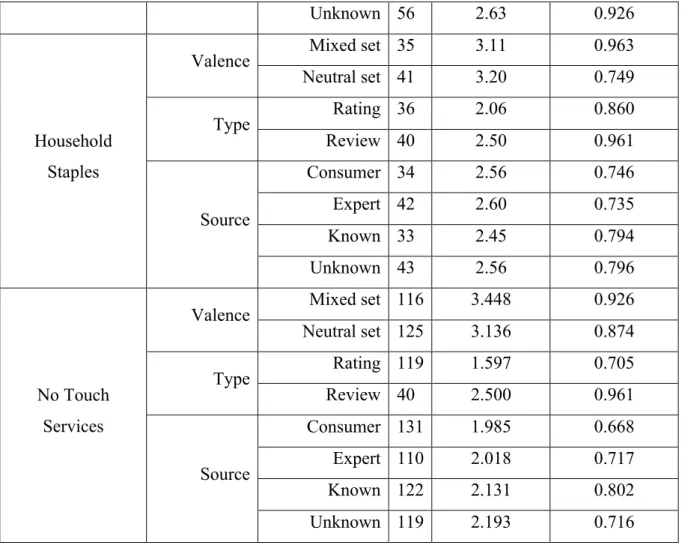
Valence Mixed set 79 3.16 0.940
Neutral set 96 3.56 0.805 Type Rating 90 1.88 0.977 Review 85 2.34 0.670 Source Consumer 98 2.70 0.789 Expert 77 2.52 0.788 Known 92 2.35 0.844 Unknown 83 2.54 0.915 High Touch Retail
Valence Mixed set 59 3.61 0.851
Neutral set 52 3.38 1.012 Type Rating 58 2.12 0.993 Review 53 2.51 0.933 Source Consumer 61 2.67 0.700 Expert 50 2.66 0.717 Known 55 2.35 0.844
25
Unknown 56 2.63 0.926
Household Staples
Valence Mixed set 35 3.11 0.963
Neutral set 41 3.20 0.749 Type Rating 36 2.06 0.860 Review 40 2.50 0.961 Source Consumer 34 2.56 0.746 Expert 42 2.60 0.735 Known 33 2.45 0.794 Unknown 43 2.56 0.796 No Touch Services
Valence Mixed set 116 3.448 0.926
Neutral set 125 3.136 0.874 Type Rating 119 1.597 0.705 Review 40 2.500 0.961 Source Consumer 131 1.985 0.668 Expert 110 2.018 0.717 Known 122 2.131 0.802 Unknown 119 2.193 0.716
Table 1:Descriptive Statistics by Product Category and eWOM characteristics
As it is possible to notice, the differences between means of different product categories are not too significant. Moreover, to proceed to the parametric tests and, hence, reach conclusions regarding both groups, it was necessary to merge the means of the values attributed to PI of all the categories of product, by computing new variables. Thus, we obtained an overall PI regardless the product type.
eWOM N Mean (PI) Std.
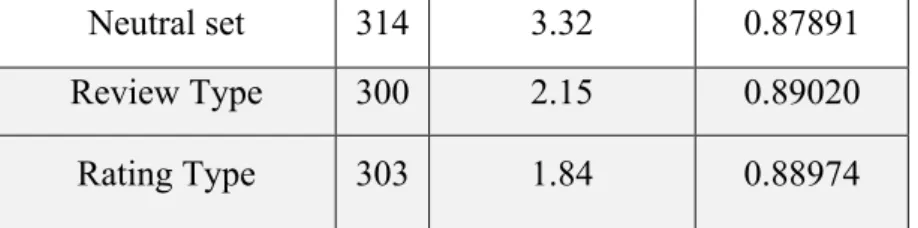
Deviation Known Source 302 2.27 0.82674 Unknown Source 301 2.42 0.84344 Expert Source 279 2.36 0.78694 Consumer Source 324 2.39 0.79320 Mixed set 289 3.36 0.93328
Neutral set 314 3.32 0.87891
Review Type 300 2.15 0.89020
Rating Type 303 1.84 0.88974
Table 2:Descriptive Statistics by eWOM characteristics
Given the values presented on the previous table, it is easy to verify that consumers’ PI, within this research, does not vary significantly when faced with different eWOM types, valences and sources. Although, in order to correctly test the veracity of the hypotheses regarding this impact it is necessary to conduct independent-samples t-tests.
An independent-samples t-test is used to compare the means of the two groups using a measure of the spread of the scores, when a numerical variable can be split in two different groups using a descriptive variable (Saunders et al. 2009). This means that this is the most applicable test to this research once each respondent only answered to one question of each group, turned the samples independent within each other.
In addition, t-test, as a parametric test assumes that the population follows a particular distribution, either Normal, Poisson or Binomial. Therefore, only an interval or ratio data can be used (White and Ryner 2014). Thus, it is of our best interest to confirm that the population of this research follows, or approximately follows, a normal distribution and, in order to do so, a Shapiro-Wilk test was conducted, before the t-tests were performed.
Moreover, this test also assumes that the variances are equal across samples and thus, it is also need to compare the variances with a Levene’s test. This test assumes equal variances when sig. £ 0.05, which means that the variability in the two scenarios is similar, and, on the other hand, when sig. > 0.05, the equality of the variances are not assumed and the values of the two situations are significantly different (Saunders et al. 2009).
Finally, in order to study the impact that the moderator variable Product’s category might have on the effect of eWOM on consumers’ PI, a regression analysis was conducted.
4.1.2.1 Hypotheses 1, 2 and 3
27 H1a. A set of positive and negative reviews will have a higher impact on consumers’ PI than a neutral set of reviews.
(H1. a.:
µ
mixed_set >µ
neutral_set) => H0:µ
mixed_set =µ
neutral_set (null hypothesis)H1:
µ
mixed_set ¹µ
neutral_set (alternative hypothesis)- H2: The type of eWOM will impact consumers’ PI
H2. a. A numerical rating has higher impact on PI comparing to a written review. (H2. a.:
µ
rating >µ
review) => H0:µ
rating =µ
review (null hypothesis)H1:
µ
rating ¹µ
review (alternative hypothesis)- H3: The source of a rating and a review will impact the consumers’ PI
H3. a. One single expert generated rating has higher impact on consumers’ PI than one generated by a common consumer.
(H3. a.:
µ
expert>µ
consumer)=>H0:µ
expert=µ
consumer (null hypothesis)H1:
µ
expert¹µ
consumer (alternative hypothesis)H3. b. A review posted online with a known source has higher impact on consumers’ PI that one signed with unknown.
(H3. b.:
µ
known>µ
unknown)=>H0:µ
known=µ
unknown (null hypothesis)H1:
µ
known¹µ
unknown (alternative hypothesis)Starting by testing the normality of the sample, it is possible to conclude that it follows, approximately a normal distribution.
- on the first hypothesis, the sample regards to all the respondents who answered to the questions concerning the effect of numerical ratings and written reviews on their PI;
- on the second one it includes all the individuals who answered the questions related to the kind of source of the eWOM and its impact on their PI;
- regarding the third, and last, hypothesis, its sample includes all the respondents who read a set of either neutral, or mixed valence, set of reviews and afterwards evaluated their PI regarding one item or service.
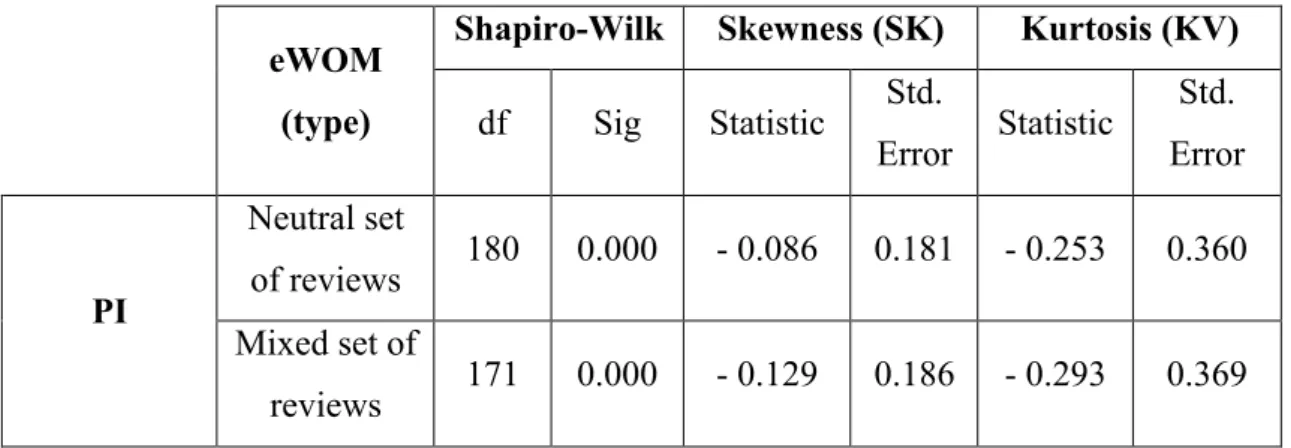
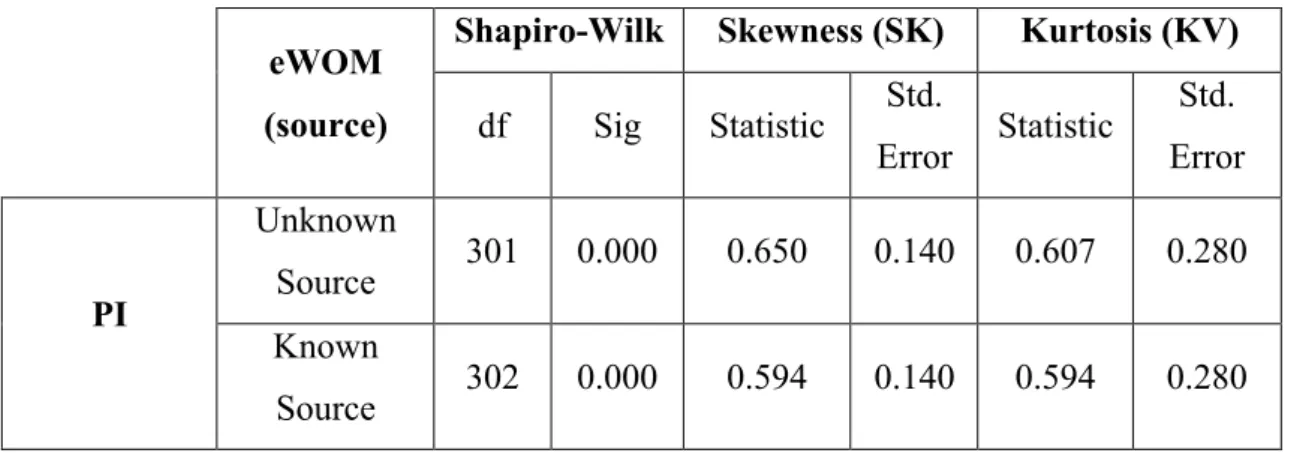
Namely, according to Kline (1998), if a normality test does not reveal the existence of a clear normal distribution (sig.<0.05) – which is verified within all of these samples-, we should look to the values of Skewness and Kurtosis, - which in turn should be lower than 3 and 7, correspondingly, and, this, confirms that these samples follow an approximately normal distribution.
eWOM (type)
Shapiro-Wilk Skewness (SK) Kurtosis (KV) df Sig Statistic Std. Error Statistic Std. Error PI Neutral set of reviews 180 0.000 - 0.086 0.181 - 0.253 0.360 Mixed set of reviews 171 0.000 - 0.129 0.186 - 0.293 0.369
Table 3: Sample’s normality test – Neutral vs Mixed set of reviews
eWOM (type)
Shapiro-Wilk Skewness (SK) Kurtosis (KV) df Sig Statistic Std. Error Statistic Std. Error PI Written Review 300 0.000 0.725 0.141 0.736 0.281 Numerical Rating 303 0.000 1.118 0.140 1.379 0.279
Table 4: Sample’s normality test – Written review vs Numerical rating
eWOM (source)
Shapiro-Wilk Skewness (SK) Kurtosis (KV) df Sig Statistic Std. Error Statistic Std. Error PI Consumer Generated 324 0.000 0.565 0.135 0.797 0.270 Expert Generated 279 0.000 0.788 0.146 1.248 0.291
29 eWOM
(source)
Shapiro-Wilk Skewness (SK) Kurtosis (KV) df Sig Statistic Std. Error Statistic Std. Error PI Unknown Source 301 0.000 0.650 0.140 0.607 0.280 Known Source 302 0.000 0.594 0.140 0.594 0.280
Table 6: Sample’s normality test – Unknown source vs Known source
Being the independent samples t-test the following step, the first value to analyse is the one regarding the Levene’s test, which concerns to the homogeneity of the variances, which shows that the equality of the variances is assumed on all of the hypotheses (sig=0.774, sig.=0.698, sig=0.310 and sig.=0.554, which are higher than 0.05), and then values of the two groups are not significantly different.
Levene’s Test for Equality of Variances F Sig. H1a. Neutral set & Mixed set of reviews 0.082 0.774 H2a. Written Reviews & Numerical Ratings 0.151 0.698 H3a. Consumer Generated Rating & Expert Generated Rating 0.351 0.554 H3b. Unknown Source & Known Source 1.030 0.310
Table 7: Levene’s–eWOM vs purchase intention
Hence, by performing independent samples t-tests to these three hypotheses it is possible to reach the following conclusions.
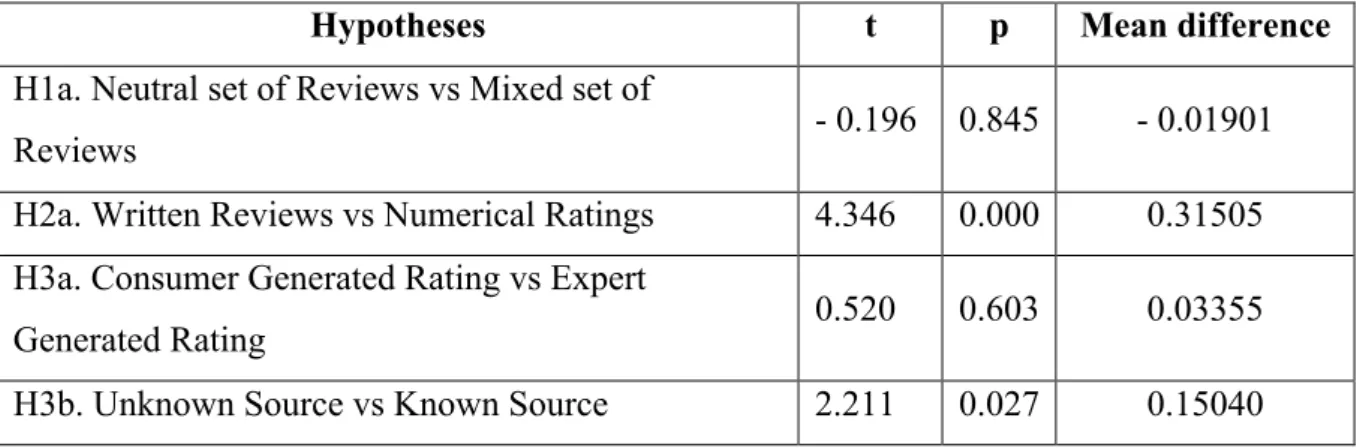
- H1a. – The null hypothesis is fail to be rejected (p=0.845>0.05), and, thus, the difference among the average of consumers’ PI after reading a set of neutral reviews and after reading a set of a mixed reviews is not significant. Moreover, the difference between these means is of - 0.00358, which shows that the mean PI of individuals who read the set of mixed reviews presented a higher willingness to buy the product. However, we have to consider that this is not a significant difference and, therefore, H1 is rejected, eWOM valence will not impact consumers’ PI.
- H2a. – The null hypothesis is rejected (p=0.000=>p£0.05), meaning that the average of consumers’ PI is different when faced with written reviews or numerical ratings. Furthermore, with a Mean Difference=0.31505, the difference between the average consumers’ PI with written reviews is higher, by 0.31505, than the average consumers’ PI with numerical ratings. Therefore, H2a. is not rejected, and, meaning that the form in which eWOM is presented (namely reviews vs ratings) will impact consumers’ PI.
- H3a. – With a p=0.603 (p>0.05), the null hypothesis of this test is not rejected. Moreover, the difference on the averages of consumers’ PIs when faced a consumer generated rating and with an expert generated rating is not significantly different and, thus, H3a. is rejected.
- H3b. – The null hypothesis is rejected (p=0.027=>p£0.05), which means that the difference between the average of consumers’ PI when they are faced with a “known” and an “unknown” source is significant. Namely, these means present a difference of 0.15040 and, thus, in this case, an “unknown” source presented a higher impact on consumers’ PI than a known one. H3b. is not rejected.
Hypotheses t p Mean difference
H1a. Neutral set of Reviews vs Mixed set of
Reviews - 0.196 0.845 - 0.01901
H2a. Written Reviews vs Numerical Ratings 4.346 0.000 0.31505 H3a. Consumer Generated Rating vs Expert
Generated Rating 0.520 0.603 0.03355
H3b. Unknown Source vs Known Source 2.211 0.027 0.15040
Table 8 :Independent Samples t-tests-hypotheses 1 to 3
For further details on the previous independent samples t-tests presented, please consult the Appendix 5.
4.1.2.2 Hypothesis 4
As mentioned before, the following hypothesis includes another dependent variable, rather than PI, namely, it is measured on the need to resort to eWOM.
31 To test the fourth hypothesis, two variables have to be computed. The variables to create are eWOM need_lower, which is the need to resort to eWOM in a situation of a lower price product/service, eWOM need_higher, that is the necessity to consult eWOM to evaluate a higher price product or service and, finally, a dummy variable which when 0 represents the lower price product/service, and when 1, represents the higher price product/service.
In addition, to later conduct an independent samples t-test, a third variable is needed. This last variable regards the overall need to resort to eWOM, without splitting both of the situations. (Overall_eWOM_need)
Table 9:Descriptive statistics-Overall need to resort to eWOM
Price N Min. Max. Mean (Need to resort to eWOM) Std.Deviation
Lower 310 1.00 5.00 2.4387 1.11526
Higher 293 1.00 5.00 2.5734 1.34937
Table 10: Descriptive statistics – price vs need to resort to eWOM
Furthermore, the main goal is to test whether a higher price is associated with an average higher need to consult eWOM, or not, which is translated on the following hypotheses.
(H4.:
µ
higher_price>
µ
lower_price) => H0:µ
higher_price=µ
lower_price(null hypothesis) H1:µ
higher_price¹µ
lower_price(alternative hypothesis)Price
Shapiro-Wilk Skewness (SK) Kurtosis (KV) df Sig. Statistic Std. Error Statistic Std. Error Need to resort to eWOM Lower 310 0.000 0.606 0.138 - 0.359 0.276 Higher 293 0.000 0.449 0.142 -1.506 0.284
Table 11:Sample’s normality test-price vs need to resort to eWOM
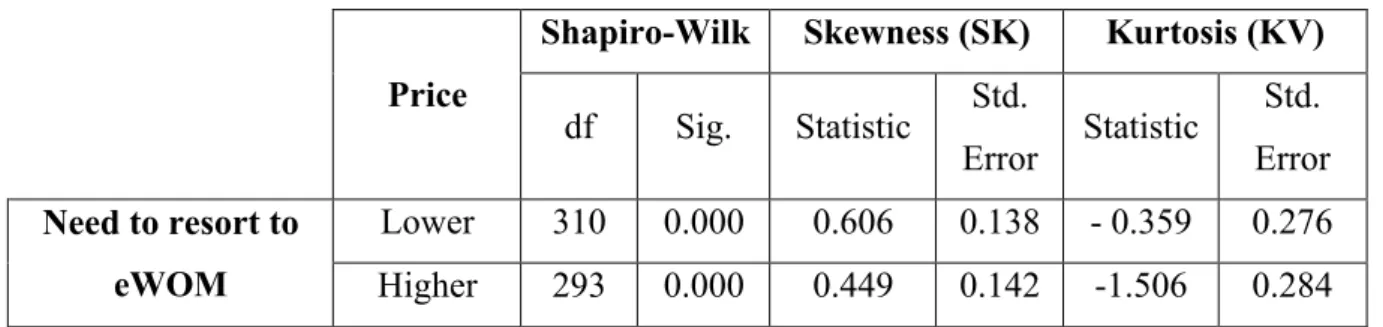
With a Sig. < 0.05, in order to verify if the sample is approximately follows a Normal distribution, the values of SK must be inferior to 3 and KV must be inferior to 7. Therefore, these conditions are confirmed, with a SK = 0.606 and KV = - 0.359, and a SK = 0.449 and a KV = -1.506.
N Min. Max. Mean (Need to resort to
eWOM) Std.Deviation Overall eWOM need 603 1.00 5.00 2.5041 1.23537
Levene’s Test for Equality of Variances
Need to resort to eWOM H4. Lower price vs Higher price
F Sig.
23.476 0.000
Table 12: Levene’s-price vs need to resort to eWOM
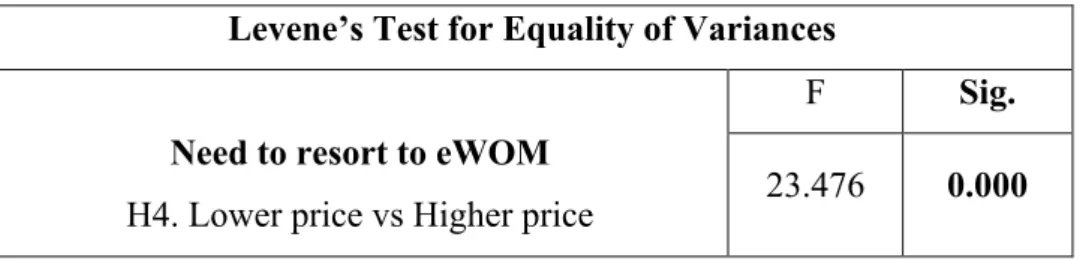
Afterwards, with a Levene’s test, it is possible to verify that sig.=0.000£0.05 and, thus, it means that equal variances are assumed and there is no significant difference between both scenarios’ average of need to resort to eWOM (lower price vs higher price).
Regarding the veracity of the hypothesis presented, the independent samples t-test shows a p-value of 0.181, which is superior to 0.05 and, hence, the difference between both groups’ averages is not significant.
Therefore, with these values, we do not reject the null hypothesis and reject H4, meaning that the impact of higher price products/services on the need of eWOM is not different from the impact of lower price products/services.
Hypotheses t p Mean difference
H4. Higher price products/services lead to a higher need to resort to eWOM than lower price
products/services do
- 1.339 0.181 - 1.3467
Table 13: Independent Samples t-test – hypothesis 4
For further details on the previous independent sample t-test presented, please consult the Appendix 5.
4.1.2.3 Hypothesis 5
H5: The impact that eWOM has on consumers’ purchase intention differs amongst different categories of products.
Given the structure of the online survey applied, eWOM is divided into seven types, written review with a known source, written review with an unknown source, a consumer generated rating, an expert generated rating, a simple rating, a simple review and a mix valence set of reviews. Therefore, in order to evaluate the potential moderation effect of product category in