DOI: http://dx.doi.org/10.5007/1980-0037.2016v18n2p233
Comparison study of resistance exercise
nomenclature adopted among professionals and
undergraduate physical education students
Estudo de comparação da nomenclatura dos exercícios
resistidos entre proissionais e discentes de educação
física.
Leonardo Mendes Leal de Souza1 Gabriel Andrade Paz1
Viviane Schultz Straatmann2 Humberto Miranda1
Abstract – In the past few years, increased popularity of resistance training (RT) and a signiicant increase in the number of professionals and undergraduate in Physical Educa-tion students have been observed. A variety of names has been usually adopted for the same resistance exercise in ields. he aim of the study was to compare the resistance exercise nomenclature adopted by physical education professionals and students, and also to iden-tify the frequencies of names adopted for these resistance exercises. he study included 191 graduate students and active physical education professionals of RT centers and gyms in the state of Rio de Janeiro, Brazil. Ten exercises traditionally performed on RT programs were selected. he results indicated that there was no association between the nomencla-ture of exercises and academic degree for all exercises included in the survey. However, there was signiicant diference (p <0.001) among response frequencies for each exercise, for the whole sample. In this sense, this study enabled identifying signiicant diferences in the nomenclature of resistance exercises. herefore, nomenclature standardization is essential to establish a direction and clearness in communication among professionals.
Key words: Exercise; Physical activity; PE; Strength training.
Resumo – Nos últimos anos, observa-se um aumento signiicativo na popularidade do treina-mento de força (TF), bem como autreina-mento signiicativo no número de proissionais e estudantes de Educação Física no Brasil. Neste sentido, uma variedade de nomes têm sido adotadas para os exercícios resistidos. O objetivo do estudo foi comparar a nomenclatura dos exercícios resistidos adotados por proissionais de Educação Física e estudantes de graduação, bem como veriicar a frequência de nomes adotados para cada exercício, respectivamente. O estudo incluiu 191 alunos de pós-graduação e proissionais de Educação Física atuantes no TF em centros e academias do estado do Rio de Janeiro, Brasil. Dez exercícios tradicionalmente realizados em programas de TF foram selecionados. Os resultados indicaram que não houve associação entre a nomencla-tura dos exercícios e grau acadêmico para todos os exercícios incluídos na pesquisa. No entanto, houve diferença signiicativa (p <0,001) entre as frequências de respostas para cada exercício, considerando toda a amostra. Neste sentido, no presente estudo, foi possível identiicar diferença signiicativa da nomenclatura dos exercícios resistidos. Logo, a padronização da nomenclatura
1. Federal University of Rio de Janeiro. Post-graduate lato-sensu program in strength training. Rio de Janeiro, RJ. Brazil.
2. State University of Rio de Janeiro. Institute of Social Medicine. Epidemiology Departament. Rio de Janeiro, RJ. Brazil.
Resistance Training Nomenclature Souza et al.
INTRODUCTION
Resistance training (RT) has been one the most popular training modali-ties adopted by coaches and general population with the aim of developing physical itness, health and/or, athletic performance1. RT prescription is
based on the manipulation of several methodological variables such as exercise order, number of sets and exercise, external load, frequency, rest interval between sets and exercises, and muscle actions2. he exercise
selec-tion during RT programs often includes the use of diferent implements and materials such as, dumbbell, barbell, elastic band and machine3.
Despite the increased RT popularity, signiicant increases in the number of Physical Education (PE) professionals have been also observed in the past few years in Brazil. he scientiic production in the RT area signiicantly increased in the last 20 years, and consequently, there has been a wide implementation of new training methods and techniques4-6.
A variety of names has been adopted for the same resistance exercise7-9.
his variety of names adopted in RT programs becomes a limiting factor in communication among RT professionals, students, general population, and also researchers from diferent areas10.
In addition, the lack of standardization of nomenclature may com-promise the comparison of results observed among studies11. Faulkner 12
showed diiculties related to inappropriate use of terminologies related to muscle contractions during dynamic or static muscle actions, and also emphasized the need for clear and concise communication to an immedi-ate understanding among researchers. Recently, Jackson et al.10,observed a
signiicant inconsistency in the nomenclature adopted by RT professionals through the application of a survey to 205 volunteers from diferent areas such as, personal trainers, clinicians, academicians, athletic trainers and strength and conditioning coaches. he authors pointed out the need to establish a standard nomenclature, given the variety of names recorded for each type of exercise. Moreover, Sawyer and Rivenes13 suggested that the
knowledge about human movement is fragmented and disorganized. In this contest, the present study aimed to search whether this inconsistency remains on a diferent population and equipment. his context may become a limiting factor in professional practice, considering that RT profession-als and researchers are often investigating diferent exercise performance patterns and applications.
Despite the discordance surrounding resistance exercise nomenclature, the establishment of standard nomenclatures would facilitate communica-tion, listening and writing of researchers, and also avoid discordance among physical education researchers, student and other health professionals11.
his standardization is essential to the scientiic development of RT stud-ies, considering reproducibility of procedures and data interpretation10.
to compare the resistance exercises nomenclature adopted by physical educa-tion professionals and undergraduate students, and also to identify whether there are diferences in the frequencies of names cited by the entire sample.
METHODOLOGICAL PROCEDURES
Participants
he present study included and interviewed 191 male and female under-graduate students and RT professionals at PE center and gyms in the state of Rio de Janeiro, Brazil, between August 2013 and May 2014. A cross survey was conducted with a sample selected by convenience, adopting a non-probabilistic procedure. Before volunteers answered the survey, they should meet the following inclusion criteria: a) to be a professional or un-dergraduate physical education student; b) to work with RT for at least 1 year at the time of the experimental procedures (e.g., professionals); c) to undergo a trainee program for at least 1 year in RT area at the time of the experimental procedures (e.g., undergraduate students). However, subjects who did not meet the above criteria were excluded from the study. All par-ticipants were request to read and sign the informed consent form. his study was approved by the Ethics Research Committee of the Federal University of Rio de Janeiro (nº 43249815.4.0000.5257) in accordance with resolu-tion 466/12 of the Naresolu-tional Health Council and Declararesolu-tion of Helsinki.
Procedures
Researchers selected a survey for this study that used pictures of common upper and lower limb resistance exercises. his allowed collecting responses from multiple participants and locations at once. Firstly, participants were instructed to answer an interview, in which personal information such as age, work region, and academic background was obtained. In respect to academic background, professionals were instructed to report RT experi-ence (years); and for undergraduate students, they were request to indicate their experience on RT programs as trainees (years). Secondly, participants answered an illustrated survey. he present study tried to cover exercises that usually have a diversity nomenclature on practical application. he survey consisted of 10 common RT exercises, eight of upper limbs and two of lower limbs, using implements such as barbells, dumbbells and a cable crossover equipament. Images showed the start and end of each exercise (see Figure 1 and Figure 2). For all exercises, three nomenclature options were available, and one opened alternative that was described as miscellaneous, in which the participant could write a convenient answer according to his preference. herefore, the volunteers made a choise of only one option.
Resistance Training Nomenclature Souza et al.
Figure 1. Exercises 1 to 5. Two pictures are illustrating each exercise describing the beginning
(A) and end (B) of the movement.
viation for continuous variables and frequencies for categorical variables, presented by the academic degree of participants (e.g., professionals and students). he frequency of response naming exercise was analyzed per academic degree and for the whole sample. We veriied whether there are associations between response options and academic degree, and if there are associations comparing the proportions of response naming exercise in whole sample. Associations were analyzed using the T test with inde-pendent samples for continues variables and Chi Square test for categorical variables. he Partitioned Chi square test was used to compare proportions in the same group. Alpha level was set a priori at ≤ 0.05. Statistical analysis was performed using SPSS 20.0 software and Win Pepi version 11:43.
RESULTS
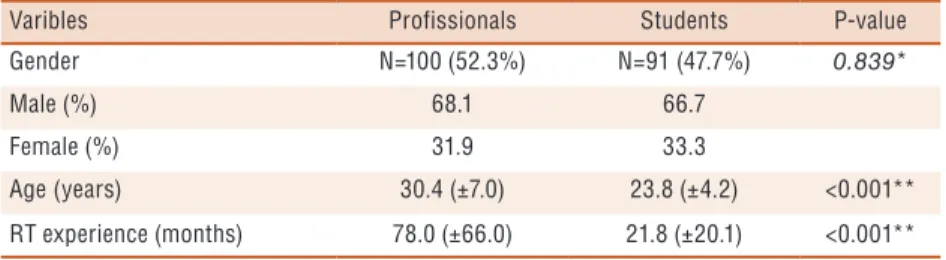
he sample was predominantly composed of professionals and graduate students (52.3%; 47.7%), without statistically diferences between them. he average age of professionals was signiicantly (p<0.001) higher than graduate students (professionals = 30.4±7.0 years; students = 23.8±4.2 years). Resistance training experience was also signiicantly higher for professionals than for graduate students (p < 0.001) (professionals = 78.0 ± 66.0 months; students = 21.8 ± 20.1 months).
Table 1. Demographic characteristics and resistance training experience between physical
education professionals and students in Rio de Janeiro, RJ - Brazil (2013/2014).
Varibles Profissionals Students P-value
Gender N=100 (52.3%) N=91 (47.7%) 0.839*
Male (%) 68.1 66.7
Female (%) 31.9 33.3
Age (years) 30.4 (±7.0) 23.8 (±4.2) <0.001**
RT experience (months) 78.0 (±66.0) 21.8 (±20.1) <0.001**
*Chi-square test; **T-test for independent samples. RT: Resistance training.
Resistance Training Nomenclature Souza et al.
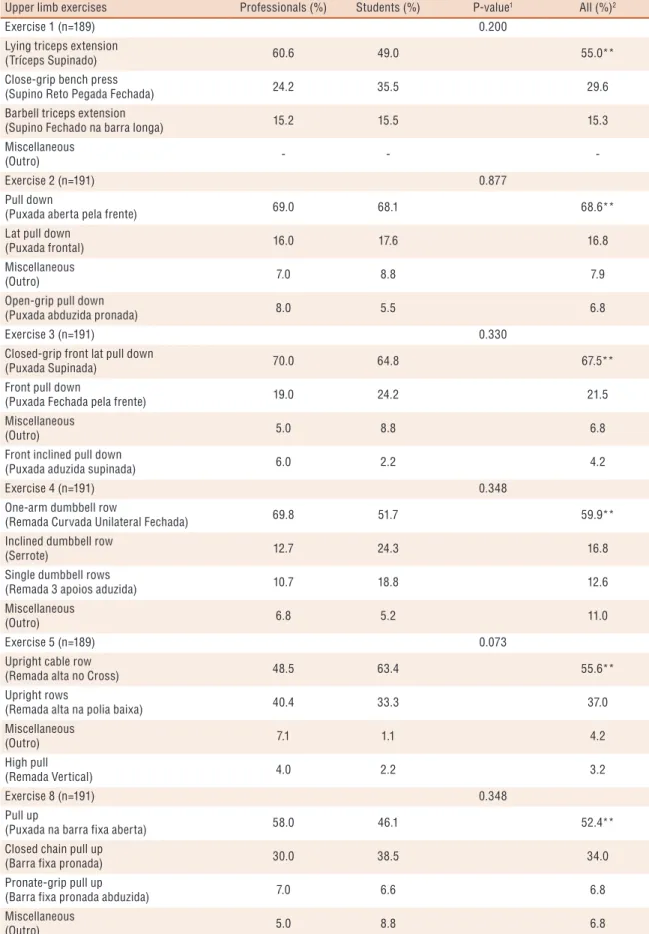
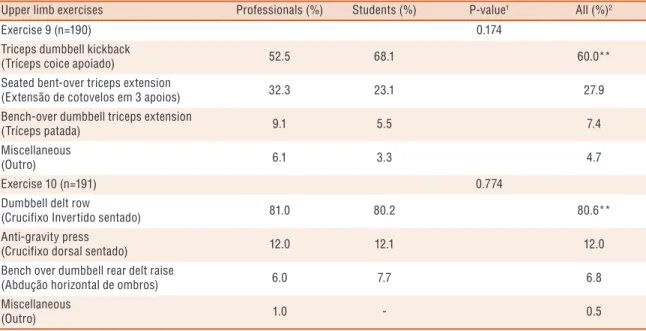
Table 2. Naming response frequency pattern of upper body exercises from Rio de Janeiro, RJ, Brazil (2013/2014). The original Portuguese
nomenclatures were described in parentheses. Nomenclatures are ordered from most to least cited.
Upper limb exercises Professionals (%) Students (%) P-value1 All (%)2
Exercise 1 (n=189) 0.200
Lying triceps extension
(Tríceps Supinado) 60.6 49.0 55.0**
Close-grip bench press
(Supino Reto Pegada Fechada) 24.2 35.5 29.6
Barbell triceps extension
(Supino Fechado na barra longa) 15.2 15.5 15.3
Miscellaneous
(Outro) - -
-Exercise 2 (n=191) 0.877
Pull down
(Puxada aberta pela frente) 69.0 68.1 68.6**
Lat pull down
(Puxada frontal) 16.0 17.6 16.8
Miscellaneous
(Outro) 7.0 8.8 7.9
Open-grip pull down
(Puxada abduzida pronada) 8.0 5.5 6.8
Exercise 3 (n=191) 0.330
Closed-grip front lat pull down
(Puxada Supinada) 70.0 64.8 67.5**
Front pull down
(Puxada Fechada pela frente) 19.0 24.2 21.5
Miscellaneous
(Outro) 5.0 8.8 6.8
Front inclined pull down
(Puxada aduzida supinada) 6.0 2.2 4.2
Exercise 4 (n=191) 0.348
One-arm dumbbell row
(Remada Curvada Unilateral Fechada) 69.8 51.7 59.9**
Inclined dumbbell row
(Serrote) 12.7 24.3 16.8
Single dumbbell rows
(Remada 3 apoios aduzida) 10.7 18.8 12.6
Miscellaneous
(Outro) 6.8 5.2 11.0
Exercise 5 (n=189) 0.073
Upright cable row
(Remada alta no Cross) 48.5 63.4 55.6**
Upright rows
(Remada alta na polia baixa) 40.4 33.3 37.0
Miscellaneous
(Outro) 7.1 1.1 4.2
High pull
(Remada Vertical) 4.0 2.2 3.2
Exercise 8 (n=191) 0.348
Pull up
(Puxada na barra fixa aberta) 58.0 46.1 52.4**
Closed chain pull up
(Barra fixa pronada) 30.0 38.5 34.0
Pronate-grip pull up
(Barra fixa pronada abduzida) 7.0 6.6 6.8
Miscellaneous
Exercise 9 (n=190) 0.174 Triceps dumbbell kickback
(Tríceps coice apoiado) 52.5 68.1 60.0**
Seated bent-over triceps extension
(Extensão de cotovelos em 3 apoios) 32.3 23.1 27.9
Bench-over dumbbell triceps extension
(Tríceps patada) 9.1 5.5 7.4
Miscellaneous
(Outro) 6.1 3.3 4.7
Exercise 10 (n=191) 0.774
Dumbbell delt row
(Crucifixo Invertido sentado) 81.0 80.2 80.6**
Anti-gravity press
(Crucifixo dorsal sentado) 12.0 12.1 12.0
Bench over dumbbell rear delt raise
(Abdução horizontal de ombros) 6.0 7.7 6.8
Miscellaneous
(Outro) 1.0 - 0.5
DISCUSSION
his study investigated the nomenclature of RT exercises adopted by physi-cal education professionals and graduate students. he main indings of the present study were the signiicant diferences of the nomenclature of each resistance exercise cited in the survey. Additionally, there was no
associa-1Chi-square test for naming exercise frequency between academic degrees; 2 Partitioned Chi-square test for comparing proportions of
naming exercises adopted for each exercise in the whole sample; **Significant differences between proportions of naming exercises adopted for each exercise in the whole sample (p ≤ 0.001).
Table 3. Naming response frequency pattern of lower body exercises from Rio de Janeiro, RJ. Brazil (2013/2014). The original Portuguese
nomenclatures were described in parentheses. Nomenclatures are ordered from most to least cited.
Lower limb exercises Professionals (%) Students (%) P-value1 All (%)2
Exercise 6 (n=187) 0.814
Deep squat
(Agachamento profundo) 40.8 39.3 40.1**
Back squat
(Agachamento total) 33.7 29.2 31.6
Miscellaneous
(Outro) 15.3 18.0 16.6
Squat
(Afundo) 10.2 13.5 11.8
Exercise 7 (n=190) 0.299
Barbell walking lunge
(Agachamento unilateral) 50.6 54.9 52.6**
Walking lunge
(Passada frontal) 24.2 18.7 21.6
Alternate leg diagonal bound
(Avanço) 13.1 19.8 16.3
Miscellaneous
(Outro) 12.1 6.6 9.5
1Chi-square test for naming exercise frequency between academic degrees; 2 Partitioned Chi-square test for comparing proportions of
Resistance Training Nomenclature Souza et al.
tion in naming frequency between professionals and graduate students. hese data are in agreement with previous studies in scientiic literature10-12.
In the present study, it was observed that naming exercise with the largest consensus was ‘Exercise 10’, with a choice of more than 80% of participants to “Dumbbell delt row”. On the other hand, naming exercise with fewer agreements was ‘Exercise 6’, in which the most cited nomen-clature was chosen by only 40.1% of participants, adopting “Deep Squat”. Furthermore, signiicant diferences were also observed among the other naming options of each exercise. Despite the numerous investigations on RT since the last 20 years and the irst studies aimed to develop terminol-ogy standards, there are still inconsistencies in the deinitions of concepts and applications of strength performance variables 14. hese inconsistencies
extend to the nomenclature adopted for resistance exercises, and may be limiting nomenclature standardization in this ield. At this time, this vari-ation in the denominvari-ation of exercises is perceived in the practice routine of RT professionals, but still little explored and discussed in scientiic literature.
Recently, Jackson e al.10 investigated the naming frequencies of
tradi-tional multi-joint and free-weight exercises among diferent professionals who worked in RT ields (e.g., coaches, personal trainers, academicians, strength and conditioning coach, and clinicians). hese authors observed inconsistency among naming responses concerning the nomenclature chosen for each exercise. hey suggested that this inconsistency might create confusion for individuals being instructed by diferent professionals and confusion among professionals attempting to communicate with one another. he results observed by Jackson and colleagues10 corroborate with
those observed in the present study, with regard to the high variation among naming frequencies of resistance exercise, regardless the academic degree. Several studies in RT literature have designed pictures to illustrate exercises15-17. his condition may be due to the use of inconsistent
termi-nology associated with RT exercises. For example, in exercise number 6 of this study, previous authors have adopted diferent names for the same exercise, such as “squat”16, “back squat”18 and “barbell squat”9. Another
example to be cited is the use of exercise “seated row”19, often called as
“bench pull”20. hese distinctions show the challenge of deining a
pos-sible standardization for exercise names. hus, inconsistency of names adopted in practice among RT professionals is consequently extended to the scientiic literature.
However, it is possible to propose the standardization of resistance exercise nomenclature, considering the same movement such as used a pattern of “equipment, specification, exercise” (e.g., barbell-lying bench press)10. hese naming patterns may provide clear comprehension, but there
sug-body performing the exercise. hus, the author recommends the description of the joint axis and imaginary plans as a reference (e.g., shoulder adduc-tion). Additional information about the instrument or equipment used, as well as the type of grip (e.g., supine, pronated or neutral) may be useful for communication among teachers, coaches and students.
he present study has some limiting factors such as sample size that does not represent the universe of professionals and students involved with RT in the metropolitan region of Rio de Janeiro, Brazil. Future studies should be developed with the purpose of reaching a representation of the population of individuals active in the RT area in a speciic state or coun-try. Another limitation refers to the survey used for the assessment of the resistance exercise nomenclature. he survey applied has not been previously tested in relation to sensitivity and reproducibility. However, considering that the scientiic discussion on the topic is still embryonic, the data of the present study may help professionals and researchers to develop future studies reining the methodology procedures and assessment instruments. Furthermore, it is important to emphasize the scientiic relevance of this study, which would be considering one of the pioneers on the inves-tigation of standardization of resistance exercises nomenclature between physical education professionals and graduate students. herefore, the standardization of resistance exercise nomenclature adopted by profes-sionals, teachers, students and coaches working in RT ields may beneit the communication and understanding of exercises prescribed in training programs often used in gyms, schools and also in the scientiic literature. he evaluation and the identiication of the current context is the irst step for the development of strategies aimed at improving the scientiic terminology and standardized nomenclature.
Acknowledgements
he authors thank the Foundation for State Research of Rio de Janeiro (FAPERJ).
REFERENCES
1. Miranda H, Figueiredo T, Rodrigues B, Paz GA, Simao R. Inluence of exercise order on repetition performance among all possible combinations on resistance training. Res Sports Med 2013;21(4):355-66.
2. Faigenbaum AD, Myer GD. Resistance training among young athletes: safety, eicacy and injury prevention efects. Br J Sports Med 2010;44(1):56-63.
3. Warburton DE, Nicol CW, Bredin SS. Health beneits of physical activity: the evidence. Can Med Assoc J 2006;174(6):801-9.
4. Heinrich KM, Patel PM, O’Neal JL, Heinrich BS. High-intensity compared to moderate-intensity training for exercise initiation, enjoyment, adherence, and intentions: an intervention study. BMC Public Health 2014;14:789.
Resistance Training Nomenclature Souza et al.
CORRESPONDING AUTHOR
Gabriel Andrade Paz
Av. Carlos Chagas Filho, Cidade Universitária
21941-590 - Rio de Janeiro, RJ. Brazil.
E-mail: gabriel.andrade.paz@gmail. com
6. Smith MM, Sommer AJ, Starkof BE, Devor ST. Crossit-based high-intensity power training improves maximal aerobic itness and body composition. J Strength Cond Res 2013;27(11):3159-72.
7. Chtara M, Chaouachi A, Levin GT, Chaouachi M, Chamari K, Amri M, et al. Efect of concurrent endurance and circuit resistance training sequence on mus-cular strength and power development. J Strength Cond Res 2008;22(4):1037-45.
8. Escamilla RF. Knee biomechanics of the dynamic squat exercise. Med Sci Sports Exer 2001;33(1):127-41.
9. Marshall PW, Robbins DA, Wrightson AW, Siegler JC. Acute neuromuscular and fatigue responses to the rest-pause method. J Sci Med Sport 2012;15(2):153-8
10. Jackson MC, Brown LE, Coburn JW, Judelson DA, Cullen-Carroll N. Towards standardization of the nomenclature of resistance training exercises. J Strength Cond Res 2013;27(5):1441-9.
11. Knuttgen HG, Kraemer WJ. Terminology and measurement in exercise perfor-mance. J Appl Sport Sci Res 1987;1:1-10.
12. Faulkner JA. Terminology for contractions of muscles during shortening, while isometric, and during lengthening. J Appl Physiol 2003;95(2)455-9.
13. Knudson DV. Correcting the use of the term “power” in the strength and condi-tioning literature. J Strength Cond Res 2009;23(6):1902-8.
14. Burke DG, Pelham TW, Holt LE. he influence of varied resistance and speed of concentric antagonistic contractions on subsequent concentric agonistic eforts. J Strength Cond Res 1999;13(3),193-7.
15. Escamilla RF, Fleisig GS, Zheng N, Lander JE, Barrentine SW, Andrews JR, et al. Efects of technique variations on knee biomechanics during the squat and leg press. Med Sci Sports Exer 2001;33(9):1552-66.
16. Queiroz BC, Cagliari MF, Amorim CF, Sacco IC. Muscles activation during four Pilates core stability exercises in quadruped position. Arch Phys Med Rehabil 2010;91(1): 86-92.
17. Shimano T, Kraemer WJ, Spiering BA, Volek JS, Hatield DL, Silvestre R, et al. Relationship between the number of repetitions and selected percentages of one repetition maximum in free weight exercises in trained and untrained men. J Strength Cond Res 2006;20(4):819-23.
18. Paz GA, Willardson JM, Simão R, Miranda H. Efect of diferent antago-nist protocols on repetition performance and muscle activation. Med Sportiva 2013;17(3):106-12.
19. Robbins DW, Young WB, Behm DG. he efect of an upper-body agonist-antagonist resistance training protocol on volume load and eiciency. J Strength Cond Res 2010;24(10):2632-40.