DOI: http://dx.doi.org/10.5007/1980-0037.2016v18n2p177
Relationship Between Jumping Ability,
Agility and Sprint Performance of Elite Young
Basketball Players: A Field-Test Approach
Relação entre capacidade de salto, agilidade e
velocidade em jovens jogadores de Basquetebol: uma
abordagem com testes de campo
Abbas Asadi1
Abstract – he purpose of this study was to determine the relationships between sprint, agility and jump performance of elite young basketball players. Sixteen elite national level young male basketball players participated in this study. he jumping ability of each player was determined using countermovement jump (CMJ), and broad long jump (BLJ). he agility T test (TT) and Illinois agility test (IAT) were assessed to determine the agility, and 20-m sprint time was also measured to determine sprint performance. he results of Pearson Product Moment Correlation analysis indicated moderate correlation between training age and IAT (r = -0.57; p = 0.021). Strong correlations were found between CMJ and BLJ (r = 0.71; p = 0.002), and between TT and IAT (r = 0.70; p = 0.002). Similarly, 20-m sprint time was strong correlated with CMJ (r = -0.61; p = 0.011), BLJ (r = -0.76; p = 0.001), TT (r = 0.77; p = 0.001), and IAT (r = 0.68; p = 0.003). In addition, CMJ was strongly correlated with TT (r = -0.60; p = 0.013), and IAT (r = -0.64; p = 0.007), and also strong correlation between BLJ with TT (r = -0.85; p = 0.001) and IAT (r = -0.76; p = 0.001). he indings of the present study indicated signiicant correlation between sprint and agility, jumping ability and sprint performance and between jumping ability and agility performance in basketball players. herefore, the results suggest that sprint, agility and jumping ability share common physiological and biomechanical determinants.
Key words: Athletic performance; Muscle Strength; Physical education and training.
Resumo – Objetivou-se determinar a relação entre velocidade, agilidade e capacidade de salto em jovens jogadores de Basquetebol. Dezesseis jovens atletas de basquetebol de Elite (Iran) foram avaliados. A capacidade de salto foi avaliada por meio do teste contramovimento ( Jump Test - CJT) e o salto em comprimento (Long Jump – LJ). A agilidade foi avaliada por meio do Teste T (TT) e do Teste de Illinois (TI). A velocidade foi avaliada por meio do teste de 20 metros. Os resultados do Coeiciente de Correlação de Pearson (r) indicaram moderada correlação entre a idade e o TI (r = -0,57; p = 0,021). Correlações de magnitude forte foram encontradas entre CJT e LJ (r = 0,71; p = 0,002), o TT e TI (r = 0,70; p = 0,002). As correlações com o teste de velocidade de 20 metros foram de magnitude elevada com o CJT (r = -0,61; p = 0,011), LJ (r = -0,76; p = 0,001), TT (r = 0,77; p = 0,001), e o TI (r = 0,68; p = 0,003). Além disso, CJT foi fortemente correlacionado com TT (r = -0,60; p = 0,013), e TI (r = -0,64; p = 0,007), e também entre o LJ com TT (r = -0,85; p = 0,001) e TI (r = -0,76; p = 0,001). Os achados desse estudo indicaram correlação entre velocidade e agilidade, capacidade de salto e velocidade e entre capaci-dade de salto e agilicapaci-dade em jovens atletas de basquetebol. Os resultados sugerem que velocicapaci-dade,
1 Roudbar Branch. Islamic Azad University. Roudbar. Iran.
Maximal-intensity exercise performance in basketball Asadi
INTRODUCTION
In basketball, the ability to generate maximal strength levels in the short-est period of time (muscular power) has been considered as essential to obtain high sport performance level1. Moreover, sprint and agility are
vital components for the success in basketball. High-intensity movements such as jumping (for rebound, blocks and shots), turns, dribbles, sprints, screens and low intensity activities such as walking, stopping and jogging are necessary during basketball games2. Many authors have also suggested
that power, agility and sprint are important characteristics for basketball players1,3. Jump height or jumping ability is very important for a basketball
player, because of the player must jump as high as possible for achieving the ball during rebound task4. Also, sprinting ability play a critical role
in basketball game, because during turns the players must run as fast as possible for the ofensive and defensive structures5. Agility has been
considered a physiological prerequisite in basketball5, because players are
frequently involved in a variety of sudden directional changes during the game in crossing the ball6.
Assessment of the physical capacities of athletes is one of the most important issues in modern sports, many test used in order that selection procedures, for screening candidates, or to monitor the eicacy of training regimes7. Although, sports scientists focus on performance assessment,
there are lacks of research examining the relationships between various performance tests. With regard to a lot of performance tests in diferent sports, examining correlations between these tests and sport discipline such as basketball has been elusive and determining the proper test for monitor-ing performance status of athletes who involved in speciic sport is vital. Many authors reported a relationship between various measures of sprint and jump performance. With regard to jump performance, Barr and Nolte8 found a signiicant correlation between jump performance and
10 m sprint (r = 0.66). Bissas and Havenetidis9 also found a relationship
between jump performance and maximal running velocity (r = 0.73). Kale et al.10 found a signiicant correlation between jump height and maximum
velocity as well. Squat jump power output has been correlated to 5 m sprint time11 and 10 m running velocity12. Countermovement jump height has also
been reported to correlate to acceleration from 0 to 10 m13 and 25 to 35 m
sprint time14. he standing long jump has also been shown to signiicantly
correlate to 10, 20, 30, and 40 m average velocity and acceleration values15.
Very few studies, if any, have examined these various measures of jumping and sprinting ability and agility performance in basketball players. For example, Shalfawi et al.16 reported a signiicant correlation between
CMJ and 10 m (r = 0.41), 20 m (r = 0.46) and 40 m (r = 0.74) sprint times in professional men (27 years old) basketball players. Chaouachi et al.17
ity, agility and vertical jump performance in men (25 years old) basketball players and found signiicant correlation between countermovement jump and squat jump (r = 0.80), 30 m sprint (r = - 0.61), and agility T test (r = - 0.59), without any correlations between 10 m sprint and jumping ability and agility performance.
While previous authors investigated the relationship between sprinting ability, agility and jump performance in other athletes8-13, an insuicient
number of studies have been conducted on basketball players especially young (under 20 years old) and elite (national level) male basketball players and with regard to efects of several factors such as age and training status of athletes19 on performance results, a work for determining the relationship
between maximal-intensity exercise performance tests in elite and national level young male basketball players is vital and the knowledge about this aspect and age is little. In addition, previous studies used laboratory tests, but the novel approach in this study was ield tests. In general, the reliability and validity of the laboratory tests are greater than ield tests, but the ield approach test are often more valid because of their greater speciicity to sport events20. herefore, the purpose of the study was to determine the
relationship betweenjumping ability (countermovement jump and broad long jump), agility (T test and Illinois agility test) and sprint (20-m) per-formance in elite young (< 20 years) male basketball players.
METHODOLOGICAL PROCEDURES
Subjects
Sixteen young male professional basketball players (age 19.5 ± 0.8 y; height 180.2 ± 7.4 cm; body mass 72.1 ± 10.4 kg and training age 5.1 ± 1.6 y), who were in National level (Guilan province team, Iran), volunteered to participate in this study. All athletes were informed about the risks and beneits of participation in the study and signed informed consent forms. Inclusion criteria included (a) no history of ankle, knee or back injuries, (b) any lower extremity reconstructive surgery in the past two years or unresolved musculoskeletal disorders, and (c) not use of ergogenic aids. All procedures were approved by Islamic Azad University’s Human Research Ethics Committee.
Study Design
Maximal-intensity exercise performance in basketball Asadi
No static stretching exercises were allowed before any test. To determine reliability, two measurements were made in 10 athletes, 72 hours apart.
Testing Methods
Anthropometric measurements:Height was measured using a wall mounted stadiometer (Seca 222, Terre Haute, IN) recorded to the nearest 0.5 cm. Body mass was measured to the nearest 0.1 kg, using a digital scale (Tanita, BC-418MA, Tokyo, Japan).
Jumping ability: he countermovement jump (CMJ) was assessed using a Vertec (Power System, Knoxville, Tennessee) which ixed in bas-ketball court. Jump height was determined using an acknowledged Vertec technique calculation21. During the jump, the athletes were instructed to
use their hands while performing a downward movement followed by a maximal-efort vertical jump. All athletes were instructed to land in an upright position and to bend the knees following landing. For the broad long jump (BLJ), the athletes were required to stand with their toes behind the zero point of the tape measure prior to jumping. Each athlete initiated the jump with countermovement and arm swing. Each athlete jumped horizontally as far as possible and landed over the top of a tape measure secured to the loor. Distance was determined measuring the point at which the heel of the trial leg touched the ground. Each athlete was given three trials, and the highest score was recorded for analysis. A 30-second break between trials was allowed for recovery21.
Agility: Agility was assessed using the T-Test (TT) and Illinois Agil-ity Test (IAT). he tests were conducted on a wooden basketball court. Agility time was recorded using a stopwatch (Joerex, ST4610-2, China). In TT the athletes were instructed to sprint from a standing starting position to a cone 10 m away, followed by a side shule left to a cone 5 m away. After touching the cone, the athletes side shuled to the cone 10 m away and then side shuled back to the middle cone. he test was concluded by back pedaling to the starting line. Athletes were disqualiied if they failed to touch the base of any cone, crossed the one foot in front of the other, or failed to face forward for the entire test. he IAT is set up with four cones forming the agility area (10 m long × 5 m wide). A cone was placed at each point A) to mark the start, B and C) to mark the turn spots, and D) to mark the inish. Another four cones were placed in the center of the testing area, 3.3 m from each other. For all agility tests, the athlete started on the loor, face down, and begins with a random sound. he athletes must complete, as fast as possible, the agility circuit. he test score was recorded as the best time of 2 trials, to the nearest 0.01 second. A 2-minute rest period was allowed between each trial22.
timing system and procedures were same as the agility tests23.
Statistical Analysis
he mean and standard deviation values for each test were calculated for all players. he relationships between jumping ability, agility and sprint performance were analyzed using the Pearson Correlation Analysis (r), with the level of statistical signiicance set at p ≤ 0.05 in SPSS for Windows, version 16.0 (SPSS, Inc., Chicago, IL). he intraclass correlation coeicient (ICC) was used to determine the reliability of the measurements.
RESULTS
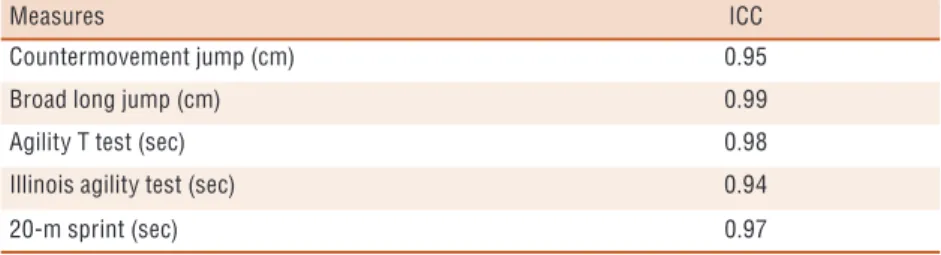
he results of ICC and players’ performance tests are shown in Table 1 and 2, respectively.
Table 1. The intraclass correlation coefficient (ICC) for the performance tests.
Measures ICC
Countermovement jump (cm) 0.95
Broad long jump (cm) 0.99
Agility T test (sec) 0.98
Illinois agility test (sec) 0.94
20-m sprint (sec) 0.97
Table 2. Basketball players’ performance tests.
Variables n Min Max Mean ± SD
Countermovement jump (cm) 16 35 59 48.2 ± 7.2
Broad long jump (cm) 16 200 255 222.4 ± 18.3
Agility T test (sec) 16 9.9 13.3 11.7.1 ± 0.9
Illinois agility test (sec) 16 15.5 18.2 16.8 ± 0.8
20-m sprint (sec) 16 3.25 3.96 3.5 ± 0.2
SD: standard deviation.
Maximal-intensity exercise performance in basketball Asadi
DISCUSSION
he purpose of this study was to determine the relationship between jumping ability, agility and sprint performance in young male basketball players. he second purpose of the study was to determine the association between maximal-intensity performance tests with athletes’ characteristics. One of the important approaches for the current study was to ield tests compared to previous studies which used laboratory tests. Although, the reliability and validity of the laboratory tests are greater than ield tests, the ield approach tests are often more valid because of their greater speciicity to sport events.
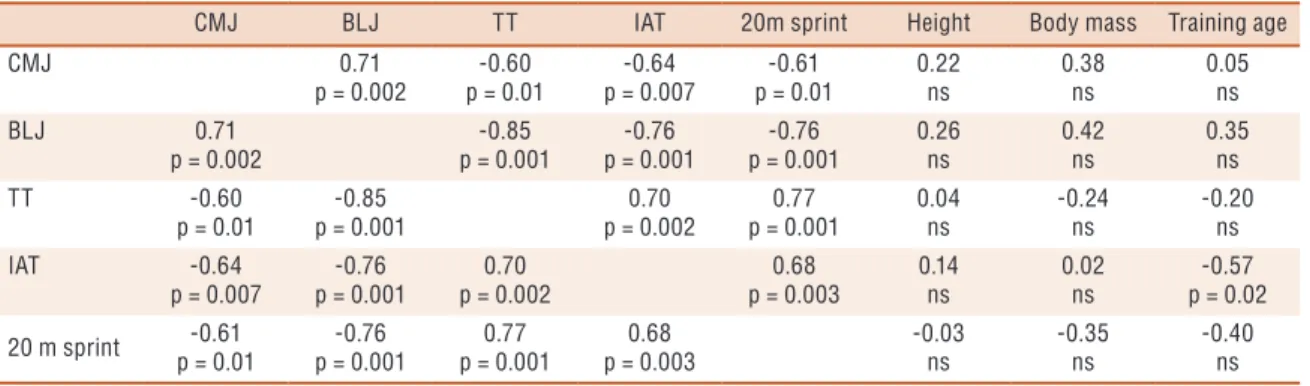
In this study, the Pearson correlation analysis indicated signiicant relationship between CMJ and TT (r = -0.60), CMJ and IAT (r = -0.64), BLJ and TT (r = -0.85) and BLJ and IAT (-0.76) in basketball players. Agility is a multifactorial physical ability which afected by strength, speed, balance, lexibility, and muscular coordination17. he indings of the present
study showed moderate to strong correlations between jumping ability and agility performance of young basketball players. In this study, agility considered as performance in a basketball-speciic test (i.e., TT and IAT) was signiicantly related to CMJ and BLJ performance. In accordance with the present study, Koklu et al.24 reported signiicant correlations between
CMJ and zigzag agility test with (r = -0.45) and without (r = -0.76) the ball in soccer players. Chaouachi et al.17 found a signiicant negative correlation
between TT and jump test performance (r = - 0.61) in elite male (23 years old) basketball players. In a recent correlation study by Alemdaroglu18, the
author reported signiicant correlation between CMJ and TT (r = - 0.59) in professional men (25 years old) basketball players. Based on the current indings and previous reports, it could, however, be speculated that the physiological proile of agility and jump performance is similar in basketball players and the strength and conditioning coaches in the ield of basketball can use one of these tests to determine the status of athletes.
he results from the present study indicated signiicant relationship between CMJ and 20 m (r = -0.61), and between BLJ and 20 m (-0.76) sprint performance in basketball players.Inaccordance with these indings,
Table 3. Pearson’s (r) correlations between athletes’ characteristics and performance tests
CMJ BLJ TT IAT 20m sprint Height Body mass Training age
CMJ 0.71
p = 0.002
-0.60 p = 0.01
-0.64 p = 0.007
-0.61 p = 0.01
0.22 ns 0.38 ns 0.05 ns BLJ 0.71
p = 0.002
-0.85 p = 0.001
-0.76 p = 0.001
-0.76 p = 0.001
0.26 ns 0.42 ns 0.35 ns TT -0.60
p = 0.01
-0.85 p = 0.001
0.70 p = 0.002
0.77 p = 0.001
0.04 ns -0.24 ns -0.20 ns IAT -0.64
p = 0.007
-0.76 p = 0.001
0.70 p = 0.002
0.68 p = 0.003
0.14 ns
0.02 ns
-0.57 p = 0.02
20 m sprint -0.61 p = 0.01
-0.76 p = 0.001
0.77 p = 0.001
0.68 p = 0.003
-0.03 ns -0.35 ns -0.40 ns
between jump performance and maximal running velocity (r = 0.73). Kale et al.10 found a signiicant correlation between jump height and maximum
velocity as well. Countermovement jump height has also been reported to correlate to acceleration from 0 to 10 m 16 and 25 to 35 m sprint time14.
he standing long jump has also been shown to signiicantly correlate to 10, 20, 30, and 40 m average velocity and acceleration values15. In basketball
players, Shalfawi et al.16 reported a signiicant correlation between CMJ
and 10 m (r = 0.41), 20 m (r = 0.46) and 40 m (r = 0.74) sprint times in professional men (27 years old) basketball players. Chaouachi et al.17 also
found signiicant correlations between 30 m sprint time and CMJ in elite male (23 years old) basketball players. In a recent correlation study by Alemdaroglu18, the author investigated the relationship between sprinting
ability and jump performance in men (25 years old) basketball players and found signiicant correlation between CMJ and 30 m sprint (r = - 0.61) performance. he explanation for the association between jumping abil-ity (i.e., CMJ and BLJ) and measures of sprint performance (i.e., 20 m) could be due to needs to maximal efort action at the start of the sprint. As the athletes starts to sprint, the body accelerates forward to a maximal velocity. his velocity is determined by the force that muscle can generate against the ground, multiplied by the time during which the forces are applied which in turn equals power. As the athletes accelerate towards top speed through 20 m, the foot contact time on the ground becomes relatively short, which makes force and leg strength more important than power in this phase25,26.
In this study, the Pearson correlation analysis indicated signiicant relationship between TT and 20 m (r = 0.77), and IAT and 20 m (r = 0.68) in basketball players. he indings of the present study showed moderate to strong correlations between agility and sprint performance of young basketball players. In agreement with the results of the current study, Alemdaroglu18 reported positive relationship between 30 m sprint and TT
(r = 0.50) in Turkish professional men (25 years old) basketball players. he relationship between sprint and agility performance have been examined by very few studies14,27,28. Moderate correlation was reported between
agility TT and sprint performance in a group of college-aged women28.
In contrast, Little and Williams27 reported a weak but signiicant
correla-tion between 10 m sprint and zigzag agility test in a group of professional male soccer players. In contrast, Buttifant et al.29 reported no signiicant
correlations between 20 m sprint and agility. In basketball athletes, Cha-ouachi et al.17 did not ind signiicant correlations between agility TT and
5, 10, and 30 m sprint times in elite male (23 years old).he reasons for discrepancy between studies could be due to usingdiferent agility tests17,29
and diferences between participants in the studies because of Chamari et al.30 suggests a potential efect of age or experience when examining the
Maximal-intensity exercise performance in basketball Asadi
his study did not ind correlations between maximal-intensity perfor-mance tests and the status of athletes. Only the Pearson correlation analysis showed signiicant relationship between IAT and training age (r = -0.57) in basketball players and there were no signiicant correlations between body mass, height and performance tests. Little is known, in literature, about the relationship betweenathletes’ characteristics and performance tests in basketball players and therefore discussion about this subject is diicult. In accordance with the results of this study, Chaouachi et al.17
did not ind correlations between height, body fat and sprint performance, but they addressed positive association between body mass and agility TT (r = 0.58) in Tunisian men basketball players. he negative correlation be-tween IAT and training age could be the positively transfer of basketball task during games and competitions to IAT. Based on the speciicity of basketball movements, several change of direction, zigzag drill and dribble movements would be occur and resulting agility adaptations.
In light of the present study, indings on jumping ability, agility and sprint should be regarded as a major physiological ability in young male elite basketball players. Short-term, maximal-intensity exercise perfor-mance should be considered as a basketball-related activity. Because of the association between jump performance and agility and sprint times, jump exercises should be considered in basketball conditioning. As a result of the nature of basketball tasks, the jump exercise and short sprint event and agility may be used emphasizing the maximal force mobilization. he result of the study is that performances in a variety of ield tests were correlated with each other in a group of basketball players. It can be state that either the tests assess similar attributes or performance on one test is able to predict performance on another and athletes with greater training age is agile than others.
CONCLUSION
In summary, the indings of the present study indicated a signiicant correlation between jumping ability and agility performance and sprint time in young male basketball players. One of the possible reasons for these indings could be that all maximal-intensity exercise performance tests include dynamic movements requiring high muscle power. Since, all maximal-intensity exercise performance tests have same energy systems; it seems that ATP-PC pathway play a critical role for basketball players and therefore suggests that jumping ability, agility, and sprint performance share common physiological and biomechanical determinants.
REFERENCES
1. Klinzing JE. Training for improved jumping ability of basketball players. Nat Strength Cond Ass J 1991; 13(3): 27-32.
elite under-19-year-old basketball players during competition. Br J Sports Med 2007; 41(2): 69-75.
5. Erculj F, Blas M, Bracic M. Physical demands on young elite European female basketball players with special reference to speed, agility, explosive strength, and take-of power. J Strength Cond Res 2010; 24(11): 2970–8.
6. McInnes, SE, Carlson JS, Jones CJ, McKenna MJ. he physiological load imposed upon basketball players during competition. J Sports Sci 1995; 13(5): 387–97.
7. Norkowski H. Anaerobic power of handball players representing various sport levels. J Hum Kinetics 2002; 7(1): 43-50.
8. Barr MJ, Nolte VW. Which measure of drop jump performance best predicts sprinting speed? J Strength Cond Res 2011; 25(7): 1976–82.
9. Bissas AI, Havenetidis K. he use of various strength-power tests as predictors of sprint running performance. J Sports Med Phys Fitness 2008; 48(1): 49–54.
10. Kale M, Asci A, Bayrak C, Acikada C. Relationships among jumping performances and sprint parameters during maximum speed phase in sprinters. J Strength Cond Res 2009; 23(8): 2272–9.
11. Cronin JB, Hansen KT. Strength and power predictors of sports speed. J Strength Cond Res 2005; 19(2): 349–57.
12. Smirniotou A, Katsikas C, Paradisis G, Argeitaki P, Zacharogiannis E, Tziortzis S. Strength-power parameters as predictors of sprinting performance. J Sports Med Phys Fitness 2008; 48(4): 447–54.
13. Young W, Cormack S, Crichton M. Which jump variables should be used to as-sess explosive leg muscle function? Int J Sports Physiol Perform 2011; 6(1): 51–7.
14. Vescovi JD, McGuigan MR. Relationships between sprinting, agility, and jump ability in female athletes. J Sports Sci 2008; 26(1): 97–107.
15. Brechue WF, Mayhew JL, Piper FC. Characteristics of sprint performance in college football players. J Strength Cond Res 2010; 24(5): 1169–78.
16. Shalfawi SAI, Sabbah A, Kailani G, Tonnessen E, Enoksen E. he relationship between running speed and measure of vertical jump in professional basketball players: a ield-test approach. J Strength Cond Res 2011; 25(11): 3088-92.
17. Chaouachi A, Brughelli M, Chamari K, Levin GT, Ben Abdelkrim N, Laurencelle L, Castagna, C. Lower limb maximal dynamic strength and agility determinants in elite basketball players. J Strength Cond Res 2009; 23(5): 1570–7.
18. Alemdaroglu U. he relationship between muscle strength, anaerobic performance, agility, sprint ability and vertical jump performance in professional basketball players. J Hum Kinetics 2012; 31(2): 99-106.
19. Salaj S, Markovic G. Speciicity of jumping, sprinting, and quick change-of-direction motor abilities. J Strength Cond Res 2011; 25(5): 1249-55.
20. MacDougall D, Sale D. he physiology of training for high performance. Oxford University press, 2014.
21. Arazi H, Coetzee B, Asadi A. Comparative efect of land and aquatic based plyometric training on the jumping ability and agility of young basketball players. South African J Res Sport Phys Edu Rec 2012; 34(1): 1-14.
22. Miller MG, Herniman TJ, Ricard MD, Cheatham CC, Michael TJ. he efects of a 6-week plyometric training program on agility. J Sport Sci Med 2006; 5(3): 459-65.
23. Rimmer E, Sleivert G. Efects of a plyometric intervention program on sprint performance. J Strength Cond Res 2000; 14(3): 295-301.
24. Koklu Y, Alemdaroglu U, Ozkan A, Koz M, Ersoz G. he relationship between sprint ability, agility and vertical jump performance in young soccer players. Sci Sport 2015; 30(1): 1-5.
Maximal-intensity exercise performance in basketball Asadi
CORRESPONDING AUTHOR
Abbas Asadi
Guilan. Roudbar. Imam Khomeini Street.
Islamic Azad University, Iran PO Box 44615-1146.
E-mail: abbas_asadi1175@yahoo. com
26. Mero A, Luhtanen P, Komi PV. A biomechanical study of the sprint start. Scan J Sports Sci 1983; 5(1): 20-8.
27. Little T, Williams AG. Speciicity of acceleration, maximum speed, and agility in professional soccer players. J Strength Cond Res 2005; 19(1): 76-8.
28. Paoule K, Madole K, Garhammer J, Lacourse M, Rozenek R. Reliability and va-lidity of the t-test as a measure of agility, leg power, and leg speed in college-aged men and women. J Strength Cond Res 2000; 14(4): 443-50.
29. Buttifant D, Graham K, Cross K. Agility and speed in soccer players are two diferent performance parameters. In: Spinks W, Reilly T, Murphy A, editors. Proceedings of science and football IV. London: Routledge, 2002.