P
P
ABSTRACT
RESUMO
THE COMPATIBILITY OF DENTURE CLEANSERS AND
RESILIENT LINERS
INFLUÊNCIA DOS AGENTES QUÍMICOS DE LIMPEZA SOBRE REEMBASADORES
RESILIENTES DE PRÓTESES
Luciana Valadares OLIVEIRA1, Marcelo Ferraz MESQUITA2, Guilherme Elias Pessanha HENRIQUES2, Rafael Leonardo Xediek CONSANI2, Wagner Sotero FRAGOSO1
1- DDS, MSc, Graduate student, Department of Prosthodontics and Periodontology, Piracicaba Dental School, State University of Campinas, Piracicaba, São Paulo, Brazil.
2- DDS, MSc, PhD, Associate Professor, Department of Prosthodontics and Periodontology, Piracicaba Dental School, State University of Campinas, Piracicaba, São Paulo, Brazil.
Corresponding address: Dr. Marcelo Ferraz Mesquita - Department of Prosthodontics and Periodontology University of Campinas/UNICAMP
Av. Limeira 901 Caixa Postal 52 - Cep.: 13414-018 Piracicaba, São Paulo Brazil - Fax: 00-55-19-34125218 - e-mail: [email protected]
Received: November 16, 2005 - Modification: March 09, 2006 - Accepted: June 23, 2006
urpose: Difficulty in cleaning resilient denture liners remains a material disadvantage. The purpose of the present study was to evaluate the effect of denture cleansers on hardness of resilient liner materials. Materials and Methods: Three resilient liners, Luci Sof® (Dentsply),
Molloplast-B® (Dentax), and Sofreliner® (Tokuyama), and two denture cleansers, Efferdent® (Warner-Lamber), and 0.5% alkaline hypochlorite
preparation were used. Twenty specimens of each material were prepared, measuring 25X15X3mm. Two denture cleansing approaches were used: 1) alkaline hypochlorite, for 20 minutes; 2) alkaline peroxide, for 30 minutes. This procedure was repeated 8 times a day, during 90 days. The specimens were evaluated before and after 360 and 720 cycles, to simulate 1 and 2 years of clinical cleaning procedures, respectively. The Shore A hardness was evaluated in a durometer (Teclock GS-709A), with a penetrating load of 10N for 1 second. Any macroscopic changes, such as loss of color or alteration in surface texture were recorded by one observer. All numeric data were subject to ANOVA with repeated measures followed by Tukey’s test (α= 0.05). Results: All materials were significantly different, independently to
time and treatment. Initially, Luci Sof® and Sofreliner® immersed in either hypochlorite or peroxide increased the hardness mean values
significantly. These hardness mean values decreased significantly after 720 cycles. Molloplast-B® showed no significant difference after the
treatments, in any time. Conclusions: Denture cleansers had no effect on hardness of the resilient denture liners evaluated after 2 years of in vivo simulated conditions of hygiene. Sofreliner® was the smoothest material before and after all treatments.
Uniterms: Denture, complete; Resilient denture liner; Silicones; Hardness.
roposição: A maior desvantagem dos materiais reembasadores resilientes é a dificuldade em mantê-los limpos. Esse trabalho avaliou o efeito de agentes de limpeza sobre a dureza de reembasadores resilientes. Material e Métodos: Foram utilizados os materiais Luci Sof®
(Dentsply), Molloplast-B® (Dentax) e Sofreliner® (Tokuyama), e os agentes de limpeza Hipoclorito de Sódio a 0,5% (Medicinallis-Farmácia
de Manipulação) e Efferdent® (Warner-Lamber). Foram confeccionadas 20 amostras de cada material, com dimensões de 25X14X3mm.
Foram realizados 2 tratamentos: 1) Hipoclorito de Sódio a 0,5% a 37 + 1ºC, durante 20 minutos; 2) Peróxido Alcalino, a 37 + 1ºC, durante 30 minutos. Após as imersões, as amostras foram lavadas e imersas em água destilada, a 37 ± 1ºC, pelo período restante das 24 h. Esse processo foi repetido 8 vezes por dia, durante 90 dias. A dureza foi avaliada antes e após 360 e 720 ciclos, correspondente a 1 e 2 anos de uso clínico, respectivamente. O ensaio de dureza Shore A foi realizado em durômetro modelo GS-709 (Teclock-Japão), com aplicação de carga de 10 N por 1 segundo. Alterações macroscópicas, como perda de cor e alteração da superfície, foram avaliadas por um observador. Os resultados obtidos foram submetidos à ANOVA com medidas repetidas e ao Teste de Tukey (5%). Resultados: Os materiais apresentaram diferença significante nos valores médios de dureza, independente do tratamento e do tempo. Luci Sof® e Sofreliner® aumentaram os valores
médios de dureza inicialmente, os quais diminuíram após 720 ciclos significativamente, para ambos os tratamentos. Molloplast-B® não
apresentou diferença significante nos diferentes tempos e tratamentos. Conclusões: Os tratamentos em agentes de limpeza não alteraram os valores de dureza dos reembasadores resilientes após 2 anos de simulação clínica. Sofreliner® apresentou os menores valores de dureza, em
todos os tempos e tratamentos, apresentando-se como o material mais macio.
INTRODUCTION
Even though acrylic resin is commonly used for complete denture bases, patients often prefer resilient denture liners to conventional hard denture bases20. The use of resilient
liners is designed to distribute functional and nonfunctional stresses more evenly and to have a dampening effect because of elastic behavior4. These properties make resilient liners
useful for treating patients with atrophic ridge or resorption, bony undercuts, bruxism, congenital or acquired oral defects requiring obturation, xerostomia and dentures opposing natural teeth. Commercially available products include rubbery acrylic-, silicone-, fluoric- and olefin-type materials. However, there are some disadvantages to the use of these materials. It has been shown that resilient liners are easily colonized by Candida albicans12, which may cause an oral
pathologic condition known as denture stomatitis when associated with poor oral and denture hygiene1. Prosthetic
cleansing that removes Candida albicans is a necessary and important factor in preventing non-traumatic causes of denture stomatitis18. Consequently, the greatest
disadvantage of the resilient lining material is the difficulty to maintain it clean10.
Routine methods commonly used for denture cleaning include the use of immersion cleansers and brushing2, 7.
Brushing with or without an abrasive cleanser is also very effective in removing plaque; consequently, this cleansing method is very common2. It is still questionable whether
brushing causes abrasion of resilient lining materials10, 17.
While Wright20 and Schmidt and Smith17 observed no
evidence that resilient liners are more difficult to clean than conventional dentures, neither were there any evidence of abrasion or wear of its surface, Makila and Honka10 found
wear of the material when submitted to brushing.
The immersion type denture cleansers may be defined as alkaline peroxides and hypochlorites, acids, disinfectants, and enzymes2. Ideally these solutions should be effective
in removing stains and deposits from the denture; it should be simple to use and compatible with all denture base materials7. Although chemical denture cleansers have been
considered to be an efficacious method to prevent C.
albicans colonization and denture plaque formation6, 13, it is
cited that a daily use of denture cleansers can affect the properties of both denture acrylic resin and resilient liners8,
11. Thus, dentists should choose denture cleansers by taking
into account the compatibility of denture cleansers with resilient liners on both materials and biological aspects.
Resilient liners are made of materials from several chemical families. These materials undergo chemical changes over time as patients immerse their dentures in either the aqueous environment of the mouth or, when not in use, in tap water or denture cleansers. Since hardening of the material is one of the major reasons for failure of some resilient liners, and difficulty in cleaning these materials remains their disadvantage, the purpose of the present study was to investigate the effect of immersion denture cleansers on the hardness of three resilient liners. The hypothesis tested was that the immersion cleansers would not affect the hardness of the resilient liners evaluated.
MATERIAL AND METHODS
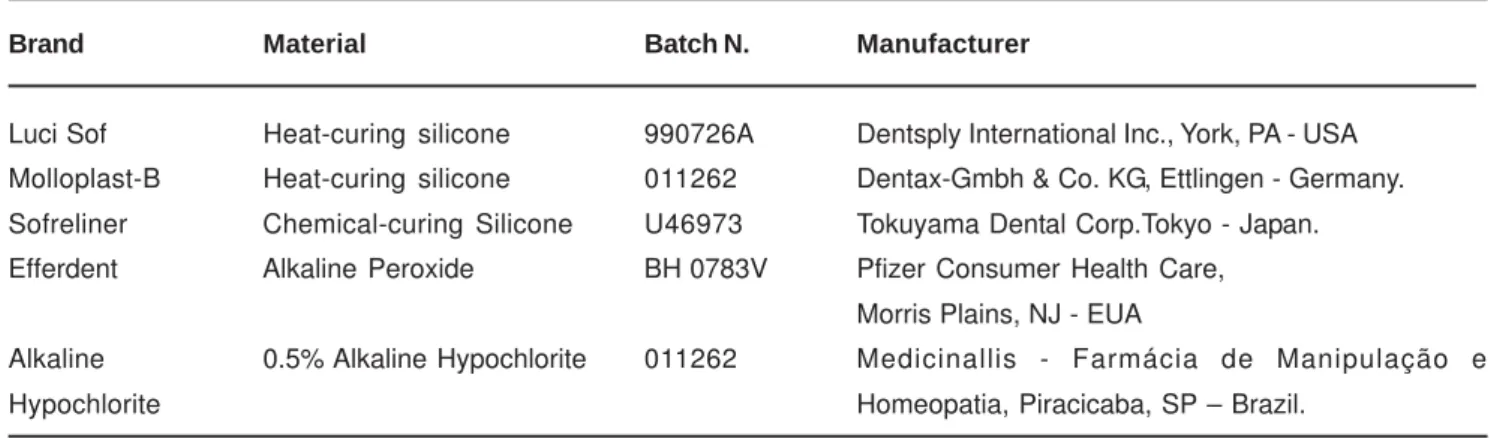
The resilient liner materials and the denture cleansers used in this study are listed in Table 1. The resilient liners, Luci Sof ®, Molloplast-B® and Sofreliner® were select because
they are commonly used by clinicians. The test solutions consisted of one commercially available denture cleanser and one alkaline hypochlorite solution.
Thirty specimens (24 X 14 X 3 mm) of each material were prepared by investing dies in a standard metal dental flask (Uraby; DLC, São Paulo, Brazil).The thickness of the tested specimens chosen for this study was, as far as practical, representative of the clinical situation16, 17. The dies were
invested in flexible silicone rubber (Zetalabor; Zhermack, Badia Polesine, Rovigo, Italy) to allow easy removal of the processed specimens from the flask. The flask was then completed with Type III dental stone (Herodent Soli-Rock; Vigodent, Rio de Janeiro, Brazil). After the complete setting of the gypsum, the two halves of the flask were separated and the dies removed. A separated medium (Cel Lac; S. S. White, Rio de Janeiro, Brazil) was applied to the exposed areas of the mold. Specimens were made by processing the resilient denture liners in the resulting mold according to the manufactures’ instructions. Luci Sof® was processed
by heating the flask in a water bath at 100 ºC for 2 ½ hours. Molloplast-B® was processed in a water bath at 100 ºC for 2
hours. Sofreliner® was processed at room temperature. After
Brand Material Batch N. Manufacturer
Luci Sof Heat-curing silicone 990726A Dentsply International Inc., York, PA - USA Molloplast-B Heat-curing silicone 011262 Dentax-Gmbh & Co. KG, Ettlingen - Germany. Sofreliner Chemical-curing Silicone U46973 Tokuyama Dental Corp.Tokyo - Japan. Efferdent Alkaline Peroxide BH 0783V Pfizer Consumer Health Care,
Morris Plains, NJ - EUA
Alkaline 0.5% Alkaline Hypochlorite 011262 Medicinallis - Farmácia de Manipulação e Hypochlorite Homeopatia, Piracicaba, SP – Brazil.
the polymerization, specimens were removed from the flask, and any flash was trimmed with a sharp knife. The specimens were then removed and stored in water at 37 º C for 24 hours, and randomly divided into 2 groups.
The immersion periods were chosen to resemble normal domestic usage. The alkaline peroxide solution was prepared by adding one tablet of Efferdent® to 200ml tap water
(equivalent to the dilution recommended by the manufacturer) which was at initial temperature of 37 ºC. The solution changed from blue to clear, and after 15 minutes, the specimens were washed thoroughly with tap water and distilled water. The specimens were immersed into 200 ml of 0.5% alkaline hypochlorite solution at initial temperature of 37 ºC for 20 minutes. Fresh solutions were used for each immersion. Ten specimens of each material were immersed into the solution of each denture cleanser 8 times each day for a total of 720 treatments extending over a period of 90 days. Between the immersion periods, the specimens were stored in distilled water at 37 ºC for the remainder of the 24 hours period.
Shore A Hardness Test
Hardness was measured using a Shore Durometer (GS-709, Teclock – Osaka, Japan), under a load of 10N for 1 second. The instrument consists of a blunt-pointed indenter attached to a scale by lever arrangement with a recording scale from 0 to 100 Shore A units. The more the indenter penetrates the specimen, the lower the hardness value is. The shaft was lowered onto the middle of the specimen, and the highest reading was noted. Five readings were obtained for each specimen, and the final hardness mean value calculated for each specimen. One representative specimen was selected of each group. The data from the each assay were subjected to Analysis of Variance with repeated measures and Tukey test (5%).
Visual Assessment
All specimens were examined visually on days 360 and 720 and were compared with the controls so that one observer could note any macroscopic changes such as loss
of color or alteration in surface texture. Any changes were recorded on a grading system of slight, moderate or marked3.
All numeric data were submitted to Analysis of Variance followed by Tukey’s test (α= 0.05).
RESULTS
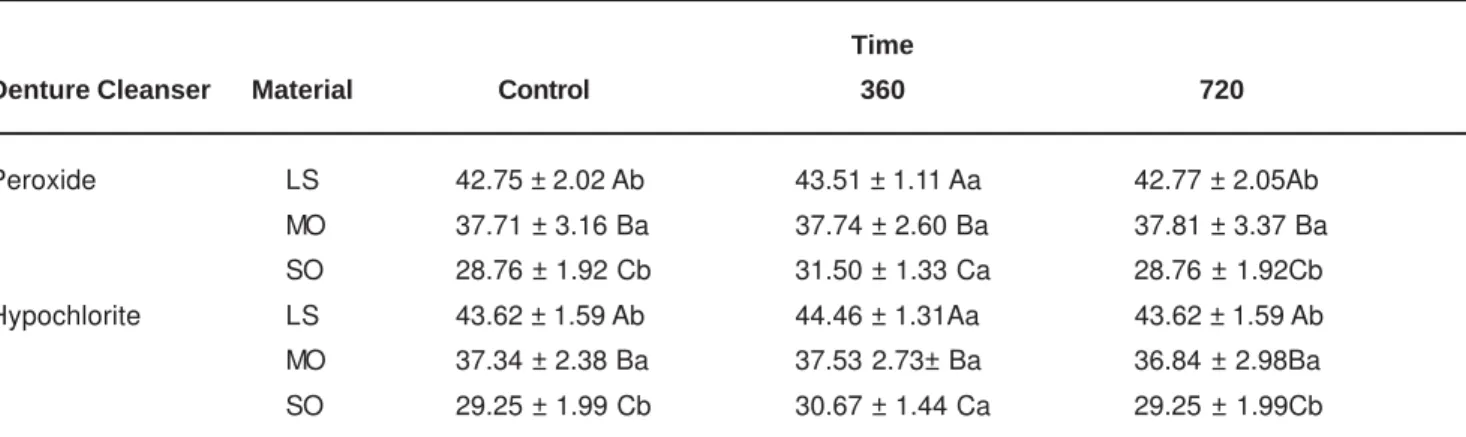
Table 2 lists the hardness mean values of the resilient liners subjected to the cleansing treatments. Before the immersion treatments, Sofreliner® presented the lowest
hardness mean values, followed by Molloplast-B® and Luci
Sof®. The denture cleansers treatment significantly
increased the hardness mean values of Luci Sof® and
Sofreliner® after 360 immersion cycles. However, these values
decreased significantly after 720 immersion cycles. The denture cleansers treatment did not significantly affect Molloplast-B® mean values, either after 360 or 720 immersion
cycles.
The changes observed after 360 and 720 are summarized in Table 3. Marked color loss was observed after 720 immersion cycles for all materials. The peroxide treatment promoted loss of surface sheen of all materials.
DISCUSSION
Resilient liners undergo through changes over time as patients immerse their dentures in either aqueous environment of the mouth or, when not in use, in tap water or denture cleansers. Hardening of the material is one of the major reasons for failure of resilient liners9. Therefore, it is
important to evaluate if denture cleansers can affect the hardness of the resilient liners.
Initial measurements showed that Luci Sof® presented
the highest hardness mean values, followed by Molloplast-B® and Sofreliner®. Hardness mean values for the heat-cured
materials (Luci Sof® and Molloplast-B®) were significantly
greater than those for the self-curing one, in agreement with other studies9,14,15. This difference might be explained
Time
Denture Cleanser Material Control 360 720
Peroxide LS 42.75 ± 2.02 Ab 43.51 ± 1.11 Aa 42.77 ± 2.05Ab MO 37.71 ± 3.16 Ba 37.74 ± 2.60 Ba 37.81 ± 3.37 Ba SO 28.76 ± 1.92 Cb 31.50 ± 1.33 Ca 28.76 ± 1.92Cb Hypochlorite LS 43.62 ± 1.59 Ab 44.46 ± 1.31Aa 43.62 ± 1.59 Ab MO 37.34 ± 2.38 Ba 37.53 2.73± Ba 36.84 ± 2.98Ba SO 29.25 ± 1.99 Cb 30.67 ± 1.44 Ca 29.25 ± 1.99Cb
TABLE 2- Mean hardness and ± standard deviation of denture materials before and after 360 and 720 cycles (n=10)
Means followed by the same upper case letter in a column (time and treatment) and the same lower case letter in a row (material and treatment) do not differ statistically by Tukey at a 5% probability level.
because of the polymerization mode of the materials as well as their composition. Increased processing temperatures were expected to result in a more complete polymerization reaction and thus a harder polymer15. Although Luci Sof®
and Molloplast-B® are heat-cured materials, they have
different polymerization periods. Luci Sof® was processed
for 2½ hours in boiling water, and Molloplast-B® was
processed for 2 hours in boiling water, following the manufacturer ’s directions. This different period of processing resulted in a more complete polymerization reaction14, and this might lead to higher hardness mean
values. Sofreliner® is a chemically cured material, and this
processing type might result in incomplete initial polymerization and thus lower hardness values.
Luci Sof® and Sofreliner® hardened significantly after
360 immersion cycles. This was likely due to continued polymerization of those, as cited by Dootz, et al.4 (1993).
The materials softened during the remainder of the test period, approaching the initial hardness mean values by the end of the study period, in agreement with Kiat-Amnuay, et al.9 (2005), who tested resilient liners’ hardness after water
storage. Silicone-based materials do not contain plasticizer, but does contain filler16, and the absorption of water by the
filler could lead to increased softness of the materials evaluated. The decrease of hardness mean values after immersion in denture cleansers occurred because of the absorption of water by the fillers. However, denture cleansers had no effect on Molloplast-B® mean hardness values, after
either 360 or 720 cycles. Tan, et al.19 (2000) did not find
significant differences in Molloplast-B® mean values after
immersion treatment in either hypochlorite or peroxide. The authors suggest that this was resulted because of an arbitrary test period and a small experimental group. However, the present study evaluated a longer test period and twenty specimens, and the material presented a linear behavior during it.
Although hypochlorite caused a marked loss of color in all materials tested, it is questionable whether this change would be of importance clinically. However, it is advisable to warn patients who are provided with a denture relined
with these materials that although fading of the lining might occur, this does not indicate that the resilient liner is unsatisfactory. The resilient liners also showed some mirror surface change in the form of loss of sheen. Davenport, et al.3 (1986) suggests that this is the result of an increase in
surface roughness. Plaque retention is increased in this situation. However, this is less likely to be of significance when the denture cleanser being used is effective in removing plaque from prostheses.
Within the limitations of this study, Sofreliner® displayed
the lowest hardness values before and after the immersion in denture cleansers. According to Gonzalez5 resilient liners
should have a Shore A Durometer hardness of approximately 20 to 25 units and not change hardness with service. Only Sofreliner® presented values close to those suggested.
However, it should be elucidated if this difference is clinically relevant. In addition, selection of a resilient liner cannot be based on any single property. Lower hardness values is a desirable property for these materials, but other factors, such as bond strength to denture base, lower surface roughness values, tear strength, water sorption and solubility, must also be considered when selecting these materials.
CONCLUSIONS
Under the conditions of this study, the following conclusions were drawn:
1. Denture cleansers significantly increased Luci Sof®
and Sofreliner® hardness mean values after 360 immersion
cycles, and decreased significantly after 720 cycles. 2. Denture cleansers had no effect on Molloplast-B®
hardness mean values either after 360 or 720 immersion cycles.
3. Sofreliner® was the smoothest material under the
conditions of the present study, before and after the treatments.
Treatment Material 360 720
Hypochlorite Luci Sof Slight colour loss Slight colour loss
Molloplast-B Slight colour loss; Marked colour loss; Marked loss of surface sheen. Slight loss of surface sheen.
Sofreliner Slight loss of surface sheen. Marked colour loss; Slight loss of surface sheen.
Peroxide Luci Sof Moderate colour loss Marked colour loss
Molloplast-B Slight colour loss; Marked colour loss; Marked loss of surface sheen. Moderate loss of surface sheen.
Sofreliner Slight loss of surface sheen. Moderate colour loss; Moderate loss of surface sheen.
REFERENCES
1- Budtz-Jorgersen E. The significance of Candida albicans in denture stomatitis. Scand Dent Res. 1974;82(2):151-8.
2- Budtz-Jorgersen E. Materials and methods for cleaning dentures. J Prosthet Dent. 1979;42(6):619-3.
3- Davenport JC, Wilson HJ, Spence D. The compatibility of soft lining materials and denture cleansers. Br Dent J. 1986;161(1):13-7.
4- Dootz ER, Koran A, Craig RG. Physical property comparison of 11 soft denture lining materials as a function of accelerated aging. J Prosthet Dent. 1993;69(1):114-9
5- Gonzalez JB. Use of tissue Conditioners and resilient liners. Dent Clin North Am. 1977;21(2):249-9.
6- Gornitsky M, Paradis I, Landaverde G, Malo A, Velly AM. A Clinical and Microbiological Evaluation of Denture Cleansers for Geriatric Patients in Long-Term Care Institutions. J Can Den Assoc.. 2002;68(1): 39-5.
7- Jagger DC, Harrison A. Denture cleansing – the best approach. Br Dent J. 1995;178(11): 413-7.
8- Jin C, Nikawa H, Makihira S, Hamada T, Furukama M, Murata H. Changes in surface roughness and colour stability of soft denture lining materials caused by denture cleansers. J Oral Rehabil. 2003;30(2):125-0.
9- Kiat-Amnuay A, Gettleman L, Mekayarajjananonth T, Khan, Goldsmith LJ. The influence of water storage on Durometer hardness of 5 soft denture liners over time. J Prosthodont. 2005;14(1):19-4.
10- Makila E, Honka O. Clinical study of heat-cured silicone soft lining material. J Oral Rehabil. 1979;6(2):199-4.
11- Nikawa H, Iwanaga H, Hamada T, Yuhta S. Effects of denture cleansers on direct soft denture lining materials. J Prosthet Dent. 1994;72(6):657-2.
12- Nikawa H, Yamamoto T, Hamada T. Effect of components of resilient denture-lining materials on the growth, acid production and colonization of Candida albicans. J Oral Rehabil. 1995;22(11):817-4.
13- Nikawa H, Jin C, Makihira S, Egusa H, Hamada T, Kumagai H. Biofilm formation of Candida albicans on the surfaces of deteriorated soft denture lining materials caused by denture cleansers in vitro. J Oral Rehabil. 2003;30(3): 246-0.
14- Parr GR, Rueggeberg FA. In vitro hardness, water sorption, and resin solubility of laboratory-processed and autopolymerized long-term resilient denture liners over one year of water storage. J Prosthet Dent. 2002;88(2):139-4.
15- Polysois GL, Frangou MJ. Influence of curing method, sealer, and water storage on the hardness of a soft lining material over time. J Prosthodont. 2001;10(1):42-5.
16- Qudah S, Harrison A, Huggett R. The effect of thermocycling on the hardness of soft lining materials. Quintessence Int.1991;22(7):575-80.
17- Schmidt WF; Smith, DE. A six-year retrospective study of Molloplast-B-lined dentures. Part II: Liner serviceability. J Prosthet Dent. 1983;50(4):459-5.
18- Tamamoto M, Hamada T, Miyake Y, Suginaka H. Ability of enzymes to remove Candida. J Prosthet Dent. 1985;53(2):214-6.
19- Tan H, Woo A, Kim S, Lamoureux M, Grace M. Effect of denture cleansers, surface finishing, and temperature on molloplast b resilient liner color, hardness, and texture. J Prosthodont. 2000;9(3):148-5.