ISSN 0100-879X
BIOMEDICAL SCIENCES
AND
CLINICAL INVESTIGATION
www.bjournal.com.br
www.bjournal.com.br
Volume 44 (11) 1070-1193 November 2011
Institutional Sponsors
The Brazilian Journal of Medical and Biological Research is partially financed by
Faculdade de Medicina de Ribeirão Preto Campus
Ribeirão Preto
Ex plor e H igh - Pe r for m a n ce M S Or bit r a p Te ch n ology I n Pr ot e om ics & M e t a bolom ics
analit icaw eb.com .br S C I E N T I F I C
Braz J Med Biol Res, November 2011, Volume 44(11) 1141-1147
doi: 10.1590/S0100-879X2011007500127
Involvement of ß -adrenergic receptors in the control of food intake
3in rats
Involvement of β
3
-adrenergic receptors in
the control of food intake in rats
S.A. Kanzler, A.C. Januario and M.A. Paschoalini
Departamento de Ciências Fisiológicas, Centro de Ciências Biológicas, Universidade Federal de Santa Catarina, Florianópolis, SC, Brasil
Abstract
This study examined the food intake changes evoked by intracerebroventricular (icv) injection of a selective agonist (BRL37344,
2 and 20 nmol) or antagonist (SR59230A, 10 and 50 nmol) of β3-adrenergic receptors in 24-h fasted rats (adult male Wistar
rats, 200-350 g, N = 6/treatment). The animals were also pretreatedwith saline icv (SAL) or SR59230A (50 nmol) followed by BRL37344 (20 nmol) or SAL in order to determine the selectivity of the effects evoked by BRL37344 on food intake or the selectivity of the effects evoked by SR59230A on risk assessment (RA) behavior. The highest dose of BRL37344 (N = 7) de-creased food intake 1 h after the treatment (6.4 ± 0.5 g in SAL-treated vs 4.2 ± 0.8 g in drug-treated rats). While both doses of SR59230A failed to affect food intake (5.1 ± 1.1 g for 10 nmol and 6.0 ± 1.8 g for 50 nmol), this treatment reduced the RA frequency (number/30 min) (4 ± 2 for SAL-treated vs 1 ± 1 for 10 nmol and 0.5 ± 1 for 50 nmol SR59230A-treated rats), an ethological parameter related to anxiety. While pretreatment with SR59230A (7.0 ± 0.5 g) abolished the hypophagia induced by BRL37344 (3.6 ± 0.9 g), BRL37344 suppressed the reduction in RA frequency caused by SR59230A. These results show
that the hypophagia caused by BRL37344 is selectively mediated by β3-adrenergic receptors within the central nervous
sys-tem. Moreover, they suggest the involvement of these receptors in the control of anxiety.
Key words: Food intake; CNS; Intracerebroventricular injection; β3-adrenergic receptor
Introduction
Correspondence: M.A. Paschoalini, Departamento de Ciências Fisiológicas, CCB, Universidade Federal de Santa Catarina, 88040-900 Florianópolis, SC, Brasil. Fax:+55-48-3231-9672. E-mail:[email protected]
Received February 17, 2011. Accepted September 9, 2011. Available online September 30, 2011. Published November 14, 2011.
The initial evidence that the noradrenergic circuit is involved in the control of food intake was indicated by the decrease in feeding behavior evoked by the administration of 6-hydroxydopamine into the hypothalamus (1). Studies using a push-pull cannula have shown noradrenaline (NA) release in the paraventricular nucleus during food consump-tion (2,3). In addiconsump-tion, NA microinjecconsump-tion into hypothalamic nuclei such as the ventromedial hypothalamus and the paraventricular nucleus has been reported to increase food intake in satiated rats (4-6), whereas injections into more lateral sites including the perifornical region decreased feeding (7).
The effects on feeding evoked by NA could be mediated
by α1- and α2-adrenoceptors present in the hypothalamus. The medial hypothalamus, especially the ventromedial area,
was reliably sensitive to the α-agonists, which increased
food intake (8). In other brain areas, such as the paraven-tricular nucleus of the hypothalamus, while the injection of
clonidine, an α2-adrenergic agonist, stimulated food intake
(9,10), the activation of α1-adrenoceptors suppressed it
(11,12). NA could also modulate feeding by acting through
either β1- or β2-adrenergic receptors.
Intracerebroventricu-lar (icv)injection of salbutamol, a β2-adrenergic receptor
agonist, decreases food intake in rats (13). Stimulation
of β2-adrenergic receptors in the perifornical lateral hy-pothalamus suppressed milk intake in pups (14). In the same perifornical site, the food intake of hungry rats was
reliably suppressed by the α-antagonist phentolamine, and the β-agonist isoproterenol (8). The lateral hypothalamus
was found to be reliably sensitive, in the same way as
the perifornical area, to the β-receptor drugs; the agonist,
isoproterenol, suppressed food intake and the antagonist, propranolol, produced a very small but reliable enhance-ment of food intake (8).
The hypothesis that β3-agonists may be inhibitors of
food intake is supported by the finding that injections of
BRL37344 into the third ventricle of obese rats produce
a significant and dose-related depression in food intake
1142 S.A.Kanzler et al.
intake is mediated by β-adrenergic receptors is supported
by the fact that this hypophagic response was blocked by
propranolol, a β-adrenergic antagonist (13,15).
Since BRL37344 has a high affinity for β3-adrenergic
receptors (Ki values of 287, 1750, and 1120 nM for β3-,
β1-, and β2-receptors, respectively) but also interacts with
β2-adrenoceptors at a much lower affinity (16) and that propranolol is a non-selective antagonist of β-adrenergic
receptors, the suppressive effects of food intake induced
by BRL37344 may occur due to interactions with β2- but
not with β3-adrenergic receptors. In the present study, we
used a potent and selective β3-adrenoceptor antagonist
(SR59230A, IC50 values of 40, 408, and 648 nM for β3-,
β1-, and β2-receptors, respectively), in order to identify the
β-receptor subtype found in the central nervous system that
mediates the effects of BRL37344 on food intake.
Material and Methods
Animals
Adult male Wistar rats weighing approximately 200-350 g were supplied by the animal breeding division of Universidade Federal de Santa Catarina. The animals were housed in a polypropylene box (49 x 34 x 16 cm) kept at a constant temperature of 21 ± 2°C, on a 12:12-light-dark cycle (lights on at 6:00 h) with free access to food (CR-1, Nuvilab, Brazil) and water. The animals were housed in groups of 5 per cage until the beginning of the experiments. After surgery, rats were housed individually. The experimental procedures used in this study are in accordance with the ethical principles of animal experimentation of the Brazilian College of Animal Experimentation and were approved by the Ethics Committee for the Use of Animals (CEUA) of Universidade Federal de Santa Catarina. All experiments were carried out between 8:00 and 13:00 h.
Stereotaxic surgery
The animals were anesthetized with a mixture of xylazine hydrochloride (13 mg/kg) and ketamine hydrochloride (87 mg/kg) injected intraperitoneally and placed in a stereotaxic apparatus (Insight Instruments, Brazil) for the implantation of a unilateral stainless steel guide cannula (30 G, 15 mm length), aimed at the right lateral cerebral ventricle according to the coordinates described by Paxinos and Watson (17). The cannula was anchored to the skull with dental cement and the whole implant stabilized with jeweler screws and more dental cement. A removable stylet was introduced to keep the cannula free from blockages until the day of the experiment.
Drug injections
The drugs used were BRL37344 (a β3-adrenergic receptor agonist at doses of 2 and 20 nmol), purchased
from Sigma, USA, and SR59230A (a β3-adrenergic receptor antagonist at doses of 10 and 50 nmol) obtained from Tocris
Bioscience, USA, both dissolved in saline, which was also used as vehicle (VEH) in the control experiments. Injections were made through an inner cannula (33G), which extended 2 mm beyond the tip of the guide cannula connected by
polyethylene tubing to a Hamilton microsyringe (1 μL) fit -ted to an injection pump. The injec-ted volumes (1 µL) were administered over a period of 60 s and a further 60 s were allowed for the solution to diffuse from the cannula.
Experimental procedures
All experiments were carried out 7 days after surgery on rats submitted to an overnight fast and with free access to water.
Experiment 1. The aim of this experiment was to investi-gate the separate effects of the agonist or the antagonist of
β3-adrenergic receptors on ingestive and non-ingestive
be-haviors. To this end, during the experimental session, naive
fasting rats were treated icv with VEH (N = 6), BRL37344 at
doses of 2 nmol (N = 8) or 20 nmol (N = 7), and SR59230A at doses of 10 nmol (N = 6) or 50 nmol (N = 6).
Experiment 2. In order to determine the selectivity of the effects evoked by the adrenergic agonist on food intake or the selectivity of the effects evoked by the antagonist on risk assessment behavior, naive fasting rats (N = 6/treatment)
were treated icv with VEH 10 min before the icv injection of
VEH or of the β3-adrenergic agonist (BRL37344 at a dose
of 20 nmol). Another group was injected icv with the
antago-nist of the β3-adrenergic receptor (SR59230A at a dose of 50 nmol) administered 10 min before VEH or BRL37344. After the injections, each animal was placed in the feeding recording chamber to evaluate ingestive behavior.
Food intake behavior
Immediately after the injection, the rats were placed in a recording chamber constructed with transparent glass (49 x 34 x 32 cm), containing food and tap water (in a bottle placed outside the test cage with a spout projecting through the wall of the cage). The session was recorded by a webcam perpendicularly located 60 cm above the
cage floor, for subsequent detailed behavioral analysis by
the Etholog 2.2 software (18). The back and lateral walls,
as well as the floor cage, were coated with black adhesive
plastic paper. In order to facilitate behavioral recording, the front wall of the test cage had a mirror with the same
dimensions arranged at a 45°angle in relation to the
vertical plane. This mirror arrangement also prevented
the animal from seeing its reflection on the mirror. At the
end of the recording period, any food that occasionally
spilled on the cage floor was recovered and weighed
with the food that remained in the feeder. The difference between food or water weight at the beginning and at the
end of the recording period was taken to bethe amount
the animal mouth was either touching or chewing a food
pellet), feeding frequency, grooming duration (defined as
paw strokes over the face or licking of the paws or body),
locomotion duration (defined as front-to-back cage cross
-ings), rearing duration (defined as front paws raised from the cage floor and either placed on the side of the cage
or placed in front of the body), stretched-attend postures (SAP) duration (exploratory posture in which the body is stretched forward then retracted to the original position without any forward locomotion) (19), and resting time (tucking head against chest without movement for >5 s). After this period, the animal was returned to the house-cage and the consumption of food and water continued to be monitored at 1, 2, 3, and 4 h after injection.
Histological analysis
At the end of the experiments, the rats were anesthe-tized deeply and Evans blue dye (1% in water, 1 µL) was
injected through the guide cannula to confirm the injection
in the lateral ventricles. The animals were then perfused transcardially with 0.9% saline, followed by 10% formalin. The brains were removed and subsequently cut with a vibratome on the transverse plane (100 µm). Sections were stained with cresyl violet and the cannula sites were examined and documented with a camera lucida attached to a light microscope. Data from rats with the cannula not
in the icv space were not included in the analysis.
Statistical analysis
The food intake data were analyzed by one-way analysis of variance (ANOVA) for repeated measures. The other in-gestive and non-inin-gestive data were evaluated by one-way ANOVA. All of these tests were followed, when appropriate,
by the post hoc Duncan test, and P < 0.05 was accepted as
being statistically significant in these procedures.
Results
Experiment 1 - icv injections of a β3-agonist or antagonist
Data analysis of food intake by one-way ANOVA for
repeated measures revealed a significant interaction
between treatment and time [F(6,48) = 3.73; P = 0.0039].
The icv treatment with 20 nmol BRL37344 decreased food
intake 1 h after injection in fasting rats. While the VEH-treated animals ingested 6.4 ± 0.5 g, the drug-injected rats ingested 4.2 ± 0.8 g (Figure 1). This hypophagic response was not accompanied by changes in the latency to start feeding, feeding duration, or feeding frequency (Table
1). Food intake remained unchanged for 3 h after the icv
injection of 2 nmol BRL37344; however, an increase in food intake was observed 4 h after drug administration. While the VEH-treated animals ingested 0.1 ± 0.1 g, the drug-injected ones ingested 3.3 ± 0.6 g (Figure 1). One-way ANOVA indicated that feeding behavior remained
unchanged after icv injection of both doses of β3-adrenergic
receptor antagonist (SR59230A) in fasting rats [F (2,15) = 1.14; P = 0.34; Figure 2 and Table 1]. Food consumption evoked by 10 nmol SR59230A was 5.1 ± 1.1 g and that
evoked by 50 nmol was 6.0 ± 1.8 g. The icv treatment with
both doses of SR59230A decreased the risk assessment frequency (Table 2). Drinking and non-ingestive behaviors such as frequency and durations of rearing, grooming,
im-mobility, and locomotor behaviors were not affected by icv
treatment with either dose of BRL37344 and SR59230A (data not shown).
Figure 1. Effects of icv injection of BRL37344 [a β3-adrenergic
receptor agonist at doses of 2 (striped bars) and 20 nmol (gray bars)] on food intake of 24-h fasted rats. Vehicle (saline) are open bars. Data are reported as means ± SEM. *P < 0.05 compared to the group that received microinjection of vehicle (one-way ANOVA followed by the Duncan post hoc test for multiple comparisons).
Table 1. Effects of icv injection of BRL37344 (a β3-adrenergic
agonist) or SR59230A (a β3-adrenergic antagonist) on feeding
behavior of 24-h fasted rats.
Treatment Food intake
Latency (s) Duration (s) Frequency
Vehicle 363 ± 179 836 ± 163 6 ± 2
BRL37344 (2 nmol) 257 ± 60 445 ± 221 4 ± 1 BRL37344 (20 nmol) 292 ± 111 593 ± 209 5 ± 2 SR59230A (10 nmol) 182 ± 96 648 ± 219 3 ± 1 SR59230A (50 nmol) 99 ± 28 816 ± 277 7 ± 2
1144 S.A.Kanzler et al.
Experiment 2 - icv pretreatment with SR59230A followed by icv injection of BRL37344
Data analysis of food intake by one-way ANOVA for
re-peated measures revealed a significant interaction between
treatment and time [F (9,60) = 3.26; P = 0.002]. Previous
icv injection of SR59230A abolished the hypophagic
re-sponse evoked by icv treatment with 20 nmol BRL37344
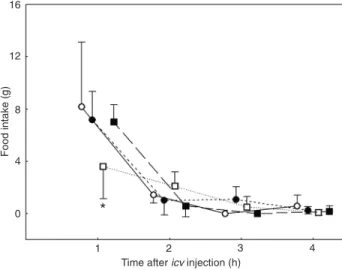
1 h after the agonist injection in fasting rats. While the rats treated with the adrenergic agonist ingested 3.6 ± 0.9 g, the animals pretreated with the antagonist followed by the adrenergic agonist ingested 7.2 ± 0.8 g, a food intake re-sponse similar to that shown by VEH-treated rats, 8.2 ± 0.9 g (Figure 3). Furthermore, the risk assessment decrease induced by SR59230A was blocked by the presence of the
β3-adrenergic receptor agonist (Table 2).
Discussion
The results of this study revealed that food intake during
refeeding after 24 h of fasting decreased after icv injection
of BRL37344 at a dose of 20 nmol, corroborating previous
data in the literature (13,15) for lean rats. The β3-adrenergic receptor agonist, BRL37344, caused a longer and deeper
decrease in feeding when injected icv or peripherally in
obese rats (13,15).
The present data also showed that the hypophagic
response induced by BRL37344 is mediated by specific
β3-receptors located in the central nervous system, since
icv injection of the permeable selective antagonist of
adren-ergic receptors SR59230A abolished the reduction of food intake caused by BRL37344. Previous studies (13) have
indicated that icv treatment with propranolol, a
nonselec-tive antagonist of β-adrenergic receptors, suppressed the
hypophagia induced by icv injection of BRL37344 only
in obese rats and not in lean rats, which differs from the results obtained in the present study. The reasons for this
Figure 2. Effects of icv injection of SR59230A [β3-adrenergic
re-ceptor antagonist at doses of 10 (gray bars) and 50 nmol (striped bars)] on food intake of 24-h fasted rats. Vehicle (saline) are open bars. Data are reported as means ± SEM.
Figure 3. Effects of icv injection of 20 nmol BRL37344 (BRL20,
a β3-adrenergic receptor agonist) in rats fasted for 24 h and
pretreated with the antagonist of the β3-adrenergic receptor
[SR59230A (SR50) at a dose of 50 nmol] or vehicle (VEH, saline). Data are reported as means ± SEM. *P < 0.05 compared to the group that received microinjection of vehicle (one-way ANOVA followed by the Duncan post hoc test for multiple comparisons). Table 2. Effects of icv injection of BRL37344 (a β3-adrenergic
agonist) or SR59230A (a β3-adrenergic antagonist) on the fre
-quency of risk assessment behavior in 24-h fasted rats.
Treatment Risk assessment
(stretched-attend posture)
Frequency (number/30 min)
Vehicle 4 ± 2
BRL37344 (2 nmol) 3 ± 1
BRL37344 (20 nmol) 3 ± 1
SR59230A (10 nmol) 1 ± 1*
SR59230A (50 nmol) 0.5 ± 1*
Vehicle + vehicle 3 ± 1
SR59230A (50 nmol) + vehicle 0.5 ± 1* Vehicle + BRL37344 (20 nmol) 2.5 ± 1
SR59230A + BRL37344 2 ± 1
Data are reported as means ± SD. The vehicle was saline. The
table shows that the presence of a β3-adrenergic receptor
ago-nist prevented the risk assessment decrease induced by the β3
-receptor antagonist. The stretched-attend posture is defined as
discrepancy may be due to the fact that in our study we
used a selective antagonist of the β3-receptor, propranolol,
which is a weak antagonist of β3-adrenergic receptors,
but is an effective antagonist of β1- and β2-adrenergic receptors. Furthermore, our investigation was conducted in male rats and not in females. This evidence suggests that the changes in ovarian hormone secretion during the
estrous cycle could modify the influence of β3-adrenergic receptors on food intake.
Several studies have shown that fluctuations in ovar -ian hormones during the estrous cycle affect food intake. A reduction in food intake occurs during estrus relative to diestrus in rats with a normal estrous cycle (20-22).
In addition, these hormones also affect the influence of
serotonin or neuropeptides on food intake (23). Similarly, ovarian hormones could affect food intake in response to BRL37344. In females, the hypophagic response induced
by BRL37344 occurred later, 6 h after the icv injection of
BRL37344 (13). In the present study, the reduction of food
intake was observed 1 h after icv treatment with BRL37344.
Thus, our results indicate that activation of β3-receptors in the central nervous system also results in inhibition of food intake in non-obese rats.
Studies carried out by Grujic et al. (24) demonstrated that
transgenic mice without β3-receptors show no reduction in
food intake when treated with β3-adrenergic agonists. The hypophagic effect could be restored by the expression of
β3-receptors in white and brown adipose tissues but not in
brown adipose tissue alone. This result led to the sugges-tion that white adipose tissue releases an inhibitory factor
in response to stimulation of β3-receptors in brown adipose tissue that reduces food intake. Studies by Mohamed-Ali et al. (25) have attributed to interleukin-6 a partial contri-bution to the anorectic effect induced by activation of the
β3-adrenergic receptor. Thus, the activation of β3, through the activation of the sympathetic nervous system, could
activate the β3-receptor in white adipose tissue and cause the secretion of interleukin-6, which in turn would trigger hypophagia. However, the hypophagic response induced
by icv injection of BRL37344 could also contribute to the
activation of central circuits that trigger satiety. This
sug-gestion is reinforced by the finding that icv injection of a
β3-adrenergic receptor agonist increases the expression
of the Fos protein in neurons of the paraventricular and ventromedial nuclei of the hypothalamus and those found in the lateral hypothalamic area and dorsal regions of the hypothalamus involved in the control of food intake (26). Although there was no change in the latency to start
eat-ing or the duration and frequency of this response after icv
injection of the drug, satiety signals from the periphery (27) could be operating on the central circuits, inducing slower food consumption, causing the animal to eat a smaller amount of food.
Food consumption by animals that received an icv
in-jection of 2 nmol BRL37344 was not significantly affected
for 3 h after icv injection; however, treatment with the β3
-adrenergic agonist at this dose caused an increase in food consumption 4 h after administration. This increase was also blocked by pretreatment with a selective antagonist
of the β3-receptor. This result indicates that this increase is
selectively mediated by the β3-adrenergic receptor subtype found in the central nervous system. The reasons for the
effect of β3-receptor activation on food intake are unclear but the effect could be mediated by a signal of slower action such as a chemical endocrine hormone. Evidence
in the literature indicates that treatment with a β3-agonist suppresses both serum leptin and the expression of leptin mRNA in white adipose tissue (28,29). Although the
hypo-phagia induced by treatment with a β3-adrenergic receptor agonist is not associated with a reduction in leptin levels (28), the decrease in blood leptin concentration could contribute to the increase in food consumption induced by the lower dose of BRL37344. Since rearing, grooming, immobility, and locomotion behaviors remained unchanged
after icv treatment with the β3-adrenergic receptor agonist,
we suggest that the hypophagic effects triggered by the administration of BRL37344 cannot be attributed to mo-tor abnormalities. Water intake was not affected by the
activation of β3-receptors, indicating that β3-receptors in the central nervous system are involved only in the neural control of food intake.
The icv injection of the β3-antagonist SR59230A alone did not involve changes in food consumption. This result differs from that obtained by Tsujii and Bray (15), which indicated an increase in food intake after injection of propranolol alone in the third ventricle of non-obese fast-ing rats. Since propranolol is a nonselective antagonist
of β-adrenergic receptors, this effect on food intake can be attributed to a tonic inhibitory influence exerted by the activation of β1- or β2-adrenergic receptors. The present
data exclude the involvement of β3-receptors in this tonic inhibitory control of food intake
Except for the frequency of risk assessment behavior, non-ingestive behaviors and water intake were not affected
by the icv injection of the β3-receptor antagonist SR59230A.
1146 S.A.Kanzler et al.
related to avoidance (19,32,33). Additionally, the evaluation of the frequency of risk assessment during the recording
of feeding behavior confirmed the anxiolytic effect induced
by injection of the AMPA receptor antagonist in the nucleus accumbens shell of rats exposed to the elevated plus- maze (34). On the basis of these considerations, our data
suggest that β3-receptors were active, inducing anxiety in
rats starved for 24 h, and that the β3-adrenergic receptor blockade caused this anxiolytic effect. However, recent studies (35,36) have shown that systemic administration
or direct administration of a β3-agonist into the basolateral amygdala reduces the display of anxiety-related behavior in different models of anxiety assessment, contrary to the data obtained in the present study. These contradictory data could be attributed to the route of drug administration (directly into the brain parenchyma or systemically in the investigation of Silberman et al. (35) and Stemmelin et al. (36), respectively), nutritional status of the animal (free ac-cess to food in the experiments conducted by Silberman et al. (35) and Stemmelin et al. (36)), or different drugs
(SR58611A in the study by Stemmelin et al. (36)). To confirm the anxiolytic effect induced by the β3-adrenergic receptor antagonist, it would be important to test 24-h fasted animals
treated icv with SR59230A in the elevated plus-maze, a
classic procedure for the study of anxiety.
The β3-adrenergic receptor subtype is found mainly in peripheral tissues, but small amounts are found in the
human and rat brain (37,38). Initially, the existence of β3 -adrenergic receptors in the brain was questioned, since classical binding studies failed to detect its presence in nervous tissue. However, some experiments with RT-PCR
revealed the existence of mRNA for the β3-adrenoceptor in different brain regions of rats and humans, including the hip-pocampus, hypothalamus, amygdala and cerebral cortex, areas known to be involved in modulating anxiety-related behavior and the control of food intake (39,40).
The present study confirms that the activation of β-adrenergic receptors found in the central nervous system
causes hypophagia in non-obese rats. This response is
selectively mediated by the β3-adrenergic receptor subtype since pretreatment with an antagonist of this adrenergic receptor subtype (SR59230A) suppressed the reduction
of food intake caused by BRL37344, the β3-adrenergic receptor agonist.
Acknowledgments
Research supported by CNPq to M.A. Paschoalini.
References
1. Evetts KD, Fitzsimons JT, Setler PE. Eating caused by release of endogenous noradrenaline after injection of 6-hy-droxydopamine into the diencephalon of the rat. J Physiol 1971; 216: 68P-69P.
2. Martin GE, Myers RD. Evoked release of [14
C]norepineph-rine from the rat hypothalamus during feeding. Am J Physiol 1975; 229: 1547-1555.
3. Paez X, Leibowitz SF. Changes in extracellular PVN
mono-amines and macronutrient intake after idazoxan or fluoxetine
injection. Pharmacol Biochem Behav 1993; 46: 933-941. 4. Grossman SP. Direct adrenergic and cholinergic stimulation
of hypothalamic mechanisms. Am J Physiol 1962; 202: 872-882.
5. Leibowitz SF. Pattern of drinking and feeding produced by hypothalamic norepinephrine injection in the satiated rat. Physiol Behav 1975; 14: 731-742.
6. Leibowitz SF. Paraventricular nucleus: a primary site mediat-ing adrenergic stimulation of feedmediat-ing and drinkmediat-ing. Pharma-col Biochem Behav 1978; 8: 163-175.
7. Leibowitz SF, Rossakis C. Pharmacological characteriza-tion of perifornical hypothalamic beta-adrenergic receptors mediating feeding inhibition in the rat. Neuropharmacology 1978; 17: 691-702.
8. Leibowitz SF. Hypothalamic beta-adrenergic “satiety” sys-tem antagonizes an alpha-adrenergic “hunger” syssys-tem in the rat. Nature 1970; 226: 963-964.
9. Leibowitz SF, Weiss GF, Yee F, Tretter JB. Noradrenergic
innervation of the paraventricular nucleus: specific role in
control of carbohydrate ingestion. Brain Res Bull 1985; 14: 561-567.
10. Goldman CK, Marino L, Leibowitz SF. Postsynaptic alpha 2-noradrenergic receptors mediate feeding induced by paraventricular nucleus injection of norepinephrine and clonidine. Eur J Pharmacol 1985; 115: 11-19.
11. Wellman PJ, Davies BT, Morien A, McMahon L. Modulation of feeding by hypothalamic paraventricular nucleus alpha 1- and alpha 2-adrenergic receptors. Life Sci 1993; 53: 669-679. 12. Wellman PJ. Norepinephrine and the control of food intake.
Nutrition 2000; 16: 837-842.
13. Tsujii S, Bray GA. Food intake of lean and obese Zucker rats following ventricular infusions of adrenergic agonists. Brain Res 1992; 587: 226-232.
14. Capuano CA, Leibowitz SF, Barr GA. The pharmaco-ontoge-ny of the perifornical lateral hypothalamic beta 2-adrenergic and dopaminergic receptor systems mediating epinephrine- and dopamine-induced suppression of feeding in the rat. Brain Res Dev Brain Res 1992; 70: 1-7.
15. Tsujii S, Bray GA. A beta-3 adrenergic agonist (BRL-37,344) decreases food intake. Physiol Behav 1998; 63: 723-728. 16. Emorine LJ, Feve B, Pairault J, Briend-Sutren MM, Marullo
S, Delavier-Klutchko C, et al. Structural basis for functional diversity of beta 1-, beta 2- and beta 3-adrenergic receptors. Biochem Pharmacol 1991; 41: 853-859.
17. Paxinos G, Watson C. The rat brain in stereotaxic coordi-nates. 6th edn. New York: Academic Press & Elsevier Inc.; 2007. p 9-34.
18. Ottoni EB. EthoLog 2.2: a tool for the transcription and tim-ing of behavior observation sessions. Behav Res Methods Instrum Comput 2000; 32: 446-449.
PF. Corticosterone response to the plus-maze: high correla-tion with risk assessment in rats and mice. Physiol Behav 1999; 68: 47-53.
20. Geary N. Estradiol, CCK and satiation. Peptides 2001; 22: 1251-1263.
21. Eckel LA, Rivera HM, Atchley DP. The anorectic effect of
fenfluramine is influenced by sex and stage of the estrous
cycle in rats. Am J Physiol Regul Integr Comp Physiol 2005; 288: R1486-R1491.
22. Asarian L, Geary N. Modulation of appetite by gonadal ste-roid hormones. Philos Trans R Soc Lond B Biol Sci 2006; 361: 1251-1263.
23. Brown LM, Clegg DJ. Central effects of estradiol in the regu-lation of food intake, body weight, and adiposity. J Steroid Biochem Mol Biol 2010; 122: 65-73.
24. Grujic D, Susulic VS, Harper ME, Himms-Hagen J, Cun-ningham BA, Corkey BE, et al. Beta3-adrenergic receptors on white and brown adipocytes mediate beta3-selective agonist-induced effects on energy expenditure, insulin se-cretion, and food intake. A study using transgenic and gene knockout mice. J Biol Chem 1997; 272: 17686-17693. 25. Mohamed-Ali V, Flower L, Sethi J, Hotamisligil G, Gray R,
Humphries SE, et al. ß-Adrenergic regulation of IL-6 release from adipose tissue: in vivo and in vitro studies. J Clin Endo-crinol Metab 2001; 86: 5864-5869.
26. Castillo-Melendez M, McKinley MJ, Summers RJ. Intracere-broventricular administration of the beta(3)-adrenoceptor agonist CL 316243 causes Fos immunoreactivity in discrete regions of rat hypothalamus. Neurosci Lett 2000; 290: 161-164.
27. Adan RA, Vanderschuren LJ, la Fleur SE. Anti-obesity drugs and neural circuits of feeding. Trends Pharmacol Sci 2008; 29: 208-217.
28. Mantzoros CS, Qu D, Frederich RC, Susulic VS, Lowell BB, Maratos-Flier E, et al. Activation of beta(3) adrenergic receptors suppresses leptin expression and mediates a leptin-independent inhibition of food intake in mice. Diabetes 1996; 45: 909-914.
29. Li H, Matheny M, Scarpace PJ. beta 3-Adrenergic-mediated suppression of leptin gene expression in rats. Am J Physiol 1997; 272: E1031-E1036.
30. Blanchard R, Blanchard C. Handbook of behavioral
neuro-science. Vol. 17. 2008.
31. Pinel JPJ, Mana MJ. Adaptive interactions of rats with dan-gerous inanimate objects: support for a cognitive theory of defensive behavior. In: Blanchard RJ, Brain PF, Parmigiani S, Blanchard DC (Editors), Ethoexperimental approaches to the study of behavior. Dordrecht: Kluwer. Molewijk, van der Poel and Olivier; 1995. p 137-155.
32. Griebel G, Rodgers RJ, Perrault G, Sanger DJ. Risk assess-ment behaviour: evaluation of utility in the study of 5-HT-related drugs in the rat elevated plus-maze test. Pharmacol Biochem Behav 1997; 57: 817-827.
33. Setem J, Pinheiro AP, Motta VA, Morato S, Cruz AP. Ethopharmacological analysis of 5-HT ligands on the rat elevated plus-maze. Pharmacol Biochem Behav 1999; 62: 515-521.
34. da Cunha I, Lopes AP, Steffens SM, Ferraz A, Vargas JC, de Lima TC, et al. The microinjection of AMPA receptor antagonist into the accumbens shell, but not into the accum-bens core, induces anxiolysis in an animal model of anxiety. Behav Brain Res 2008; 188: 91-99.
35. Silberman Y, Ariwodola OJ, Chappell AM, Yorgason JT, Weiner JL. Lateral paracapsular GABAergic synapses in the basolateral amygdala contribute to the anxiolytic effects of beta 3 adrenoceptor activation. Neuropsychopharmacology 2010; 35: 1886-1896.
36. Stemmelin J, Cohen C, Terranova JP, Lopez-Grancha M, Pichat P, Bergis O, et al. Stimulation of the beta3-adrenocep-tor as a novel treatment strategy for anxiety and depressive disorders. Neuropsychopharmacology 2008; 33: 574-587. 37. Evans J, Goedecke JH, Soderstrom I, Buren J, Alvehus M,
Blomquist C, et al. Depot- and ethnic-specific differences in the relationship between adipose tissue inflammation and
insulin sensitivity. Clin Endocrinol 2011; 74: 51-59.
38. Guillaume JL, Petitjean F, Haasemann M, Bianchi C, Eshdat Y, Strosberg AD. Antibodies for the immunochemistry of the human beta 3-adrenergic receptor. Eur J Biochem 1994; 224: 761-770.
39. Summers RJ, Papaioannou M, Harris S, Evans BA. Expres-sion of beta 3-adrenoceptor mRNA in rat brain. Br J Phar-macol 1995; 116: 2547-2548.
![Figure 1. Effects of icv injection of BRL37344 [a β 3 -adrenergic receptor agonist at doses of 2 (striped bars) and 20 nmol (gray bars)] on food intake of 24-h fasted rats](https://thumb-eu.123doks.com/thumbv2/123dok_br/15813967.651983/4.918.471.809.389.656/figure-effects-injection-adrenergic-receptor-agonist-striped-intake.webp)