Tsallis scaling in the long-range Ising chain with competitive interactions
E. M. Carvalho Neto and R. F. S. Andrade
Instituto de F´ısica, Universidade Federal da Bahia, 40210-340 Salvador, Brazil (Received on 19 January, 2009)
A numerically efficient transfer matrix approach is used to investigate the validity of the Tsallis scaling hy-pothesis in the long-range Ising spin chain with competitive interactions. In this model, the interaction between two spinsiand jplacedrlattice steps apart isJi,j= (−1)ζ(i,j)J0/rα, whereζ(i,j)is either 0 or 1. This proce-dure has succeeded to show the validity of the scaling hypothesis for the well investigated ferromagnetic version of the model, i.e.,ζ(i,j) =0,∀i,j,∀α≥0. Results are reported for some models of a set, which is defined by requiringζ(i,j)to be a periodic sequence of 0′s and 1′s. As expected from symmetry arguments, we find
that the hypothesis is not valid whenζ(i,j) =1,∀i,jandα<1. However, it is verified, with high degree of numerical accuracy, whenα<1, for sequences in which the occurrence ofζ(i,j) =0 is more frequent than that ofζ(i,j) =1.
Keywords: Competitive interactions, Long-range Ising chain
1. INTRODUCTION
The properties of the ferromagnetic long-range Ising chain have been investigated by a large number of authors in the past five decades [1–10]. However, the anti-ferromagnetic and other more general versions of the model, where both ferro and anti-ferromagnetic interactions are present, have been almost neglected by the statistical physics community. A possible explanation for this is the fact that, in opposition to the ferromagnetic case, the cumulative effect of long-range anti-ferromagnetic interaction is not of producing cooperative effect responsible for spin ordering even in the linear chain. Therefore, such system is not likely to produce any critical behavior. Another possible reason to the lack of interest in the model is the known mathematical and computational dif-ficulties that one must overcome to obtain results already for the simple ferromagnetic model.
A few years ago, one of us has developed an alternative transfer matrix (TM) approach to investigate the thermody-namical properties of the ferromagnetic Ising chain, which is suitable to produce very accurate numerical results. Be-sides that, it can be numerically implemented in relatively small computational facilities [11]. The procedure, which amounts to working with small TM’s, is optimized with re-spect to storing the energy values for all distinct spin con-figurations and to avoiding the numerical evaluation of the TM largest eigenvalue. Within this framework, interactions among spins placed up tog=25 lattice sites apart could be taken into account also in the evaluation of the critical proper-ties [12]. When discussing the results for the thermodynamic function, special attention was devoted to verifying the valid-ity of the Tsallis scaling hypothesis [13, 14], which had not been addressed in the investigations prior to 1995.
It is worthy stressing that, besides the direct evaluation of the thermodynamical properties of long range magnetic mod-els by ensemble averages, an alternative approach to this clas-sical problem has been followed by several authors for about a decade. It refers to evaluating time average of the corre-sponding quantities, by numerically integrating the equations of motion that follow from the system’s Hamiltonian. The time integration approach, which seems more adequate for the models with continuous valued variables, as theXY spin model [15], has been mainly motivated by the problem of identifying whether long range models may be described by
the non extensive statistical mechanics [16].
This work has two main purposes. The first one, which has a more technical aspect, is to adapt the previously developed TM approach and obtain the thermodynamical properties of Ising chains with the presence of both ferro and anti-magnetic interactions. The second one is to verify the validity of Tsallis conjecture [14] for a broad class of models, which can be written in terms of the following spin Hamiltonian:
H
=−∞
∑
i=−∞∞
∑
r=i+1
Jrσiσi+r−H ∞
∑
i=−∞σi. (1)
In Eq. (1),Jr=Ji,j= (−1)ζ(i,j)J0/rα,j=i+r, andζ(i,j) =0 or 1 controls the ferro- or anti-ferromagnetic character of the interaction between spinsi and j. Note that, sinceJi,j
de-pends only on the distance between spinsiandj, the models that can be described by Eq. (1) are homogeneous in space. Even though, many distinct situations can be described by the functionζ(i,j). In this work, we restrict our investigation to a restricted class ofζ(i,j), namely, those periodic sequences of 0′s and 1′s that can be expressed in terms ofF(k, ℓ)and A(k, ℓ)as follows:
F(k, ℓ): ζ(i,i+r) =0, f or 1≤r≤m
ζ(i,i+r) =1, f or m+1≤r≤n A(k, ℓ): ζ(i,i+r) =1, f or 1≤r≤m
ζ(i,i+r) =0, f or m+1≤r≤n r=r mod(m+n+1).
(2)
Due to the dependence of Jr on r, the frequency of values
of 0’s or 1’s and the relative strength of the corresponding bonds impose different dominant ferro or anti-ferromagnetic character to theF(k, ℓ)andA(k, ℓ)defined models. The pure ferro- or anti-ferromagnetic models, corresponding toζi,i+r=
0 or 1,∀r situations, become degenerated in theF(k, ℓ)and A(k, ℓ)definitions. For the sake of simplicity, these limit cases will be denoted byF(1,0)andA(1,0).
free energy. Results are presented and discussed in Sec. IV. There we indicate, based on the behavior of the free energy, the parameter range where we observe the validity of Tsallis scaling. Finally, conclusions and perspectives of future works are discussed in Sec. V.
2. THE TSALLIS SCALING CONJECTURE
The Tsallis scaling conjecture (TSC) [13, 14, 17, 18] addresses, in an adequate way, the problem of defin-ing any intensive energy-like thermodynamical property for d−dimensional systems, where the energy interaction de-creases with the distance ras r−α. Due to the presence of long-range interactions, measured by the ratio α/d, the to-tal energyU may increase faster than the numberNof con-stituents, i.e., the usual ratioU/N diverges in theU,N→∞
limit. TSC generalizes, for instance, the mean field results for the free Gibbs energy of a homogeneous ferromagnetic sys-tem with constant interaction among any pair of spins, where the ratio between the intensive function f(T,H,N) and the logarithm of the partition function, logZ(T,H,N), is 1/N2.
The TSC for Gibbs free energy is synthesized by the fol-lowing expression, where tildes indicate the re-scaled inten-sive quantities:
˜
f(T˜ =T/N˜,H˜ =H/N˜) =f(T,H,N)/N˜, (3) whereH denotes the magnetic field and the scaling variable
˜
Nis defined as
˜ N=N
1−α/d−α/d
1−α/d . (4)
In the N→∞limit, ˜N may be simplified by the following expressions, which depend on the ratio between the system dimensionalitydand the exponentα:
˜ N= α/d
α/d−1 if α/d>1
lnN if α/d=1
1
1−α/dN1−α/d if 0≤α/d<1
. (5)
The different dependence of ˜Nonαclearly distinguishes the extensive region (α/d>1), where ˜Nbecomes independent of Nin the limitN→∞, from the non-extensive region, where
˜
Nexplicitly depends onNin the same limit.
TSC states further that otherN−dependent intensive ther-modynamical functions, like the entropys(T,H,N), specific heatc(T,H,N)and magnetizationm(T,H,N), have theirN -independent counterparts ˜s,c˜,and ˜m, defined by
˜
s(T˜,H˜) =s(T,H,N),
˜
c(T˜,H˜) =c(T,H,N),
˜
m(T˜,H˜) =m(T,H,N).
(6)
The TSC applies only to situations where the ”effective” range of interaction decreases as a power law. For instance, screening effects reduces the effective range of the interac-tion, of systems of positive and negative charges interacting
via the long-range Coulomb interaction. In such situations, intensive energies are obtained just by dividing the total en-ergy byN, not byN2. A similar effect is observed in spin sys-tems where all long-range couplings are anti-ferromagnetic. Here, the screening effect is replaced by bond frustration that results from the competing spin interactions. Therefore, in-tensive energies are obtained by dividing the total energy of lowest-energy spin configurations byN.
Intensive energies of mixed systems, in which long interac-tions of alternating signs coexist, may require the introduction of TS. This will be explored in Sec. IV, where we concentrate on a few situations described byF(k, ℓ),k≥ℓ,sequences.
Before closing this section, we would like to state that TSC gave rise to a series of investigations to test its validity. Sev-eral long-range interaction models have been studied by dif-ferent methods. They include spin models in connection with mean-field, renormalization group and Monte Carlo simula-tion [19–23] .
3. TRANSFER MATRIX FORMULATION
Since one must resort to numerical evaluation of the ther-modynamical properties, we are forced to describe the infi-nite system described by Eq.(1) with help of the fiinfi-nite size approximations, which may depend both on the total num-berN of spins in the chain, and on the maximal rangegof interaction couplings. Thus, we consider a finite chain with N=g+c+1≥g+1 spins, andgdistinct coupling constants Jr,r=1,2, ...g. Fixing the value ofg, we notice that the
in-clusion ofcnew spins in the chain amounts to addg×cnew interactions. In Figure 1 we show, for the purpose of illustra-tion, the interactions for the first 3 values ofcfor fixedg=3. Although the method we use herein has been discussed in detail elsewhere [11, 12], let us briefly comment on the most relevant steps that allow the evaluation of the partition func-tion. Thus, let us define a 2×2 TMMg,cby
Mg,c= ( g
∏
k=1Pk)(Qg·Pg)c·Lg≡Rg,cLg. (7)
Lg denotes a 2g+1×2 matrix with elements(Lg)i,j =1(0),
wheni+jis even (odd). The matrix elements of the 2g+1×2g matrixQgare defined by
(Qg)i,j=
1 fori=jori=j+2g
0 otherwise . (8)
On the other hand, the matrix elements of the auxiliary ma-tricesPkare recursively defined by:
(Pk)i,j=
(Pk−1)i,ja(−1) j−1
k fori≤2k−1,
and j≤2k (Pk)2k−i+1,2k+1−j+1 for 2k−1≤i≤2k,
and 2k≤j≤2k+1
0 otherwise
(9)
whereak=exp(Jk/T)are the problem Boltzmann weights.
These expressions lead to the partition function
Zg,c=2λ+g,c=2((Mg,c)1,1+ (Mg,c)1,2) =
∑
i,j
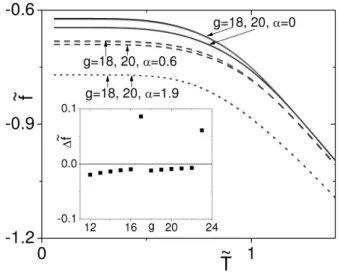
FIG. 1: ModelF(5,1): TS free energy ˜f forα=0.0 (solid), 0.6 (dashes), and 1.9 (dots), whenc=90,95, andg=18,20. Good convergence of ˜f with respect tocis observed for all values ofα. Convergence with respect to the values ofgweakens asαdecreases. In the inset, differences∆g,δf˜whenα=0.0,c=95,δ=1, as
func-tion ofg∈[12,23], for ˜T =0.02. Periodic oscillations are related to appearance of aJ<0 at every sixth value ofg, when the magnitude of∆g,1f˜increases and changes sign. After such jumps, the decreas-ing tendency is resumed, indicatdecreas-ing that ˜f converges for all values ofα.
and to the free energy per spin, fg,c=−Tln(Zg,c)/N.
From Eq.(10) it is possible to obtain expressions for the derivatives of f with respect toT andH in terms of proper sums of Boltzmann weights. This way, thermodynamic func-tions like s,c andmcan be evaluated with high degree of precision, avoiding numerical differentiation procedures.
4. TS AND FREE ENERGY
We discuss results obtained by the method described in the previous sections for chains with coupling constants intro-duced according to the following sequences:F(2,1),F(4,1), F(5,1),A(1,0), andA(1,1).
Since the focus of this work is the scaling properties of the free energy, our discussion is based on numerical evidences that support the validity of TS for several of the quoted se-quences and values ofα. However, for some other specific sequences, the results indicate that the free energy is exten-sive, even for values ofαwhere the ferromagnetic model is non-extensive. This evidences a break of validity of TS, since Eq. 3 no longer holds.
Let us start by considering theF(k,1)sequences. We think it is more suitable to start the discussion with the behavior of the system for large values ofm, as the pure ferromagnetic F(1,0)chain can be reproduced when the limitk→∞is con-sidered. We have found that the valuesk≤5 are sufficient large to provide a clear picture of the validity of TSC. Our results have been summarized in Figs. 2-5, which show the behavior of ˜f as function of ˜T for decreasing values ofk.
In order to test the validity of TS, it is important to call the attention to the different roles played bygandNin our approach. As explained in Sec. 2, it allows the possibility of working with a numberN of constituents larger than the maximal distancegbetween interacting spins. This contrasts with the TS definition based on Eq. (4), which makes no distinction betweenNandg. As discussed previously [11], it turns out thatg, instead ofN, is the relevant parameter to be substituted in all Tsallis scaled quantities. This is related to the fact that TS accounts for the rangegof interactions, while the number of constituentsNis accounted for by dividing the total energy byN. This has been made clear in the results for theF(1,0)Ising chain, where one easily notes that, for small values ofg, the curves for f at different values ofcare Tsallis scaled as distinct systems.
Fig. 1 illustrates, for theF(5,1)sequence, the dependence of ˜f ong=18 and 20, for fixed values ofc=90,95, when
α=0.0, 0.6, and 1.9. The collapse for the different sets of 4 curves have quite good quality with respect to the dependence onc, but the picture changes when we consider the difference with respect tog. First note that, the 4 curves for ˜f in the extensive region(α=1.9)are almost indistinguishable. Re-garding the dependence ong, we recall that for large values ofg, TS amounts only to scaling both axes by ang indepen-dent factor. Thus, the corresponding plots actually show the dependence of both f and ˜f ongand, as a consequence, the validity of TS in this particular range is an expected result. For the values of α in the non-extensive region, we notice that the convergence of ˜f forα=0.6, measured by the dif-ference between the curves forg=18 and 20 is not so fast. This effect is related to the stronger dependence of f and ˜N ongfor smaller values ofα, and has also been found for the F(1,0)chain. The convergence is actually much more com-plex, as can be quantitatively estimated by evaluating the dif-ferences∆g,δf˜=f˜g+δ,c(T˜)−f˜g,c(T˜). For the sake of a better
visualization, we draw in the inset values of∆g,δforδ=1 as function of g∈[12,23], for a fixed value of ˜T =0.02. We clearly see an oscillating behavior of period 6, which is re-lated to the introduction of bonds withJ<0. Whenever this occurs, the total energy of the system is reduced in compar-ison to the previous value ofg, causing a jump in the value of∆g,δ. After such jumps, the values of ∆g,δ become nega-tive while its absolute value has again decreasing tendency. It is also possible to notice that the height of such jumps also decreases asgincreases.
Such effects are enhanced for α=0.0, in the sense that both the absolute values of∆g,δ in the decreasing region, as well as the height of the jumps, are larger. Nevertheless, they keep showing the monotonic behavior. Such results can be compared with those obtained for theF(1,0)chain where TS is valid. This is a clear indication that, despite slower conver-gence, TS holds for the wide range of values ofα.
FIG. 2: ModelF(4,1): TS free energy ˜f forα=0.6,c=95, while g=16,17,18,19,20 and 21. For the whole range of values of ˜T, the curves clearly change their tendency of getting together when a J<0 is introduced in the chain. The period of oscillations is reduced to 5. In the inset, differences∆g,δf˜whenc=95,δ=1 andg= 16,17,18,19 and 20. The behavior of∆g,δf˜suggests TS is valid for both values ofα=0.0 (back squares) and 0.6 (red open circles).
FIG. 3: ModelF(2,1): TS free energy ˜f for the same values ofg as in Fig. 2, with exception ofg=16. The magnitudes of∆g,δf˜
(inset), for the same values ofαas in Fig.2 are considerably larger. The overall decreasing tendency suggests validity of TS for both values ofα. The oscillation period 3 fits well into the overall frame discussed before.
model, the discussion is restricted to the analysis of conver-gence in the non-extensive range ofα.
The features in Figs. 2 and 3 confirm the overall tracts described before. By comparing the explicit temperature de-pendence of the curves forα=0.6 we note a decrease in the absolute value of ˜f when a negative coupling constant is in-troduced atg=15 and 20 forF(4,1), and atg=15,18 and 21 for F(2,1). The tendency of an oscillatory dependence of ∆g,δf˜with respect tog is observed again, but the period
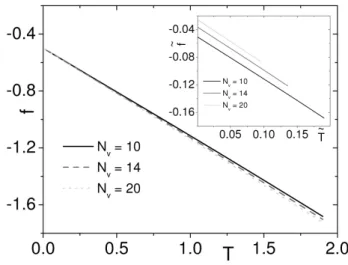
FIG. 4: ModelA(1,0): Usual free energy f=F/Nas function of T forα=0, c=0, g=10,14,20. The curve collapse indicates that f is intensive. The inset shows that TSC is not valid, as the corresponding ˜fcurves do not collapse.
is reduced, respectively, to 5 and 3. After each jump,∆g,δf˜ decreases monotonically withg, much as observed in Fig.1.
Now let us consider the two A sequences. Due to high configurational symmetry, the models defined by the selected sequences are amenable to exact results in some parameter and temperature ranges. If we choose an arbitrary spin in the pure AF (A(1,0)) model, its minimum energy state oc-curs when it is anti-parallel to all other spins. As this hap-pens to any spin, we immediately see that a large number of frustrated bonds necessarily occurs in the large degeneracy ground state. When α=0, it is possible to exactly com-pute the ground state energyE0=−J0N/2 and degeneracy N!/[(N/2)!(N/2)!]. This shows that the free energy is ex-tensive, and that entropy per spins=kBln 2 is temperature
independent. As advanced in Sec. 2, this shows that TS does not apply. We observe that no magnetization or sub-lattice staggered magnetization are observed, even atT =0. In the otherα→∞limit situation, the ground state of the system is characterized by a simple minimum energy configuration consisting of anti-parallel neighboring spins. In such situa-tion, TS is trivially verified as ˜N=1.
Such features were reproduced by the numerical evaluation of the partition function. In Fig.4, the quite good collapse of curves for g=10,14 and 20 make it clear that the free energy f =F/Nis an intensive quantity. In the inset, the ˜f×
˜
T curves for the same values ofgconfirm that, as expected, TSC is not valid for the current model.
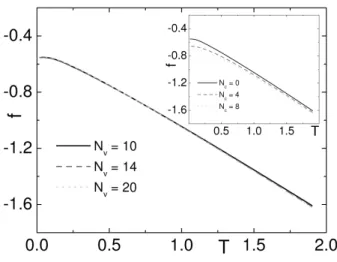
The situation changes continuously for intermediate values ofαin the interval(0,1). Although we cannot compute ex-actly the value of the ground state energy, the numerical eval-uation ofZconfirms that f is intensive, as shown in Fig.5 for
FIG. 5: ModelA(1,0): f as function ofT forα=0.2,c=0,g=
10,14,20. The collapse confirms that the free energy is extensive in the whole range ofαvalues. The inset shows the dependence of f on values ofc>0, when fixing the valueg=10.
different f curves, especially in the low temperature region, is not observed. This is exemplarily shown in the inset of Fig.5.
The next sequence, A(1,1), leads to a situation that can be understood on the basis of the traditional ferromagnetic chain. Indeed, the sequence indicates that the model is com-posed of constant couplings of alternating signs, starting with aJr=1<0: spins in neighboring sites have a tendency to align anti-parallel to each other. As the second-neighbor coupling J2>0, this results no competition between the two bonds. The same is valid for all other values ofrand, as a result, the system is decomposed into two sub-lattices, which are dis-tinguished only by the fact that the spins align in opposite direction. Therefore, the total energy increases faster than the number of constituents, and TS is verified in a similar way as observed for the quotedF(1,0)chain.
Finally, let us comment on the scaling properties of the model described by the F(1,1) sequence. If we consider
α=0, it is clear that frustration occurs for a very large num-ber of bonds. The situation is much similar to the one we find for the already discussedA(1,0)sequence. There, all pairs of spinsσiσi+r separated by even (odd)rwould like to point in
the same (opposite) directions. In theF(1,1)case, the situa-tion is the opposite, i.e., all pairs of spins separated by even (odd)rwould like to point in the opposite (same) directions. This indicates that energy is extensive, entropy is constant, and TS is not valid.
5. CONCLUSIONS
In this work we presented some preliminary results on the behavior of the Ising chain with the presence of long-range
interactions of competing character. Our main focus was to establish for which parameter interval the free energy of the system continues to follow the scaling properties proposed by Tsallis.
Our results were obtained within a previously introduced framework for the analysis of the simplest ferromagnetic ver-sion of the general problem. The procedure, which can be formulated with the help of transfer matrices, amounts to the precise numerical evaluation of the partition function Z(T,N=g+c+1), where the range of interaction and num-ber of spins in the system have been as large as 24 and 200, respectively.
We selected five different systems, which distinguish them-selves by the order in which interactions with coupling cou-plingsJ>0 andJ<0 are introduced. We also discussed some limiting situations which, due to high symmetry, are amenable for analytical results.
In the extensive regionα>1, the value of ˜N approaches a constant value whenN→∞, what has less impact in the search of an intensive free energy. Because of that, we concentrate our discussion of the validity of TS in the non-extensive region 0≤α<1.
As a general result, we have shown that continuously in-creasing the number of AF interactions on a basic model where, initially, all J>0 contribute to decrease the speed at which TS is attained. We have uncovered the emergence of periodic oscillations in the convergence process of ˜f. De-spite the reduction in the convergence, our results show that, as long as the number of F bonds exceeds that of AF counter-parts, the validity of TSC is observed.
On the other hand, systems where allJ<0 do not obey TS when 0≤α<1. Such result was obtained from exact counting and confirmed by the numerical evaluation of the partition function.
The situation when the number of F and AF bonds is equal has also been addressed. We have indicated that the model described by theA(1,1) sequence is analogous to the pure ferromagnetic chainF(1,0). Thus, the total free energy is non-extensive and TS is valid. Much in a symmetric way, the behavior of the F(1,1)model is analogous to the pure ferromagnetic chainA(1,0): the free energy is extensive and TS is not valid forα=0.
Acknowledgements
This work was partially supported by the Brazilian agen-cies CNPq and CAPES. The authors acknowledge useful dis-cussions with S.T.R. de Pinho.
[3] J. L. Cardy, J. Phys. A14, 1407 (1981).
[4] M. Aizenman, J. T. Chayes, L. Chayes, and C. M. Newman, J. Stat. Phys.50, 1 (1988); M. Aizenman and R. Fern´andez, Lett. Math. Phys.16, 39 (1988).
[5] J. F. Nagle and J. C. Bonner, J.Phys. C3, 352 (1970). [6] M. E. Fisher, S. K. Ma and B. G. Nickel, Phys. Rev. Lett.29,
917 (1972).
[7] J. L. Monroe, R. Lucente, and J. P. Hourlland, J. Phys. A23, 2555 (1990).
[8] Z. Glumac and K. Uzelac, J. Phys. A22, 4439 (1989). [9] Z. Glumac and K. Uzelac, J. Phys. A26, 5267 (1993). [10] S. A. Cannas and A. C. N. de Magalh˜aes, J. Phys. A30, 3345
(1997).
[11] R. F. S. Andrade and S. T. R. Pinho, Phys. Rev. E71, 026126 (2005).
[12] R. F. S. Andrade and S. T. R. Pinho, Eur. J. Phys. B50, 33
(2006).
[13] P. Jund, S. G. Kim, and C. Tsallis, Phys. Rev. B52, 50 (1995). [14] C Tsallis, Fractals3, 541 (1995).
[15] C. Anteneodo and C. Tsallis, Phys. Rev. Lett.80, 5313 (1998). [16] C. Tsallis, J. Stat. Phys.52, 479 (1988).
[17] C. Tsallis, Braz. J. Phys.29, 1 (1999).
[18] S. Abe and A.K. Rajagopal, Phys. Lett. A337, 292 (2005). [19] F. Tamarit and C. Anteneodo, Phys. Rev. Lett.84, 208 (2000). [20] H. H. A. Rego, L. S. Lucena, L. R. da Silva, and C. Tsallis,
Physica A266, 42 (1999).
[21] S. A. Cannas, Phys. Rev. B52, 3034 (1995).
[22] S. A. Cannas and F. A. Tamarit, Phys. Rev. B 54, R12661 (1996).