Cosmi Aelerators and Terrestrial Detetors
RonaldCintraShellard
CentroBrasileirodePesquisas Fsias
RuaDr. XavierSigaud150,
Rio deJaneiro,22290-180, RJ,Brasil
and
Departamento deFsia,
PontifiaUniversidadeCatolia
RuaMq. S~aoViente225,
Riode Janeiro, 22451-041,RJ,Brazil
Reeivedon6April,2001
Wereviewthestatusofultrahigh energyosmiraysstudies,disussingthemehanismsfor their
produtionandpropagationthroughspae. Welookintothestrategytomeasurethoseeventsand
desribeanewobservatory,whihis inonstrution, toobservethosepartiles, thePierre Auger
Observatory.
I Introdution
The existene of osmi rays with energies above
10 20
eV oers a puzzling problem in high energy
as-trophysis. The rstevent ofthis lass of phenomena
wasobservedatthebeginningofthe60'sbyJohn
Lind-sayat theVolanoRanh experiment, in NewMexio
[1,2℄. Sinethen,manyeventsweredeteted,at
dier-entsites,usingquitedistinttehniques[3-7℄. Ifthose
osmi raysare ommon matter, that is, protons,
nu-leiorevenphotons,theyundergowellknown nulear
and eletromagneti proesses, during their
propaga-tion through spae. Their energies are degraded by
theinterationwiththeCosmiRadiationBakground
(mb), waybeforetheyreahedtheEarth[8,9℄. After
travellingdistanesoftheorderof 50Mp,their
ener-gies shouldbeunder10 20
eV,thusrestritingthe
pos-sible onventional astrophysial objets, whih ould
be soures of them, and those should be easily
loal-ized through astronomialinstruments. Onthe other
hand,explainingtheaelerationofhargepartiles,on
known astrophysial objets, by mean of
eletromag-netial fores up to energiesof 3 10 20
eV, or even
greater, theonly ones apable of longrange and long
periodsaeleration,isverydiÆult.
Wewilldisussinthispaperthepossiblesouresfor
the ultrahigh energyosmi rays(uher), onfronting
what onemay all onventional orbottom-up
meha-nisms,whihattemptstoexplainthetheultrahigh
en-ergy osmi rays through the aeleration of harged
partiles by eletromagnetial fores in astrophysial
objets, to the top-down senario whih invoke new
physial proess, that is, new partiles and fores of
thedetetionoftheuherandtheirlimitationsand
de-sribethestatusofthePierreAugerObservatory,whih
isbeingbuild in Argentina,thelargestprojetat this
momentaimed atsolvingthis puzzle. There are
exel-lentreviews onthissubjetpublishedreentlyand we
urgethereaderto goto themformoredetails [10-15℄.
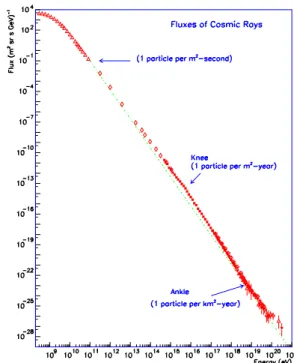
Figure1. Theosmirayspetrummeasuredatthetopof
theatmosphere. Abovetheenergyof10 9
eVthespetrum
shows apower-lawbehavior. Thereis ahange inslopeat
theknee(410 15
eV)andattheankle(510 18
eV).The
integrated uxabovethe ankle is about1 osmi ray per
II The high energy end of the
osmi ray spetrum
The osmi rayspetrum, measuredat the top ofthe
atmosphere(seeFig. 1) oversahugerangeinenergy,
goingfrom 10MeVto energiesabove10 20
eV, with a
dierentialuxthat spans31deades.
23
24
25
26
log(FLUX * E
3
eV
2
m
-2
s
-1
sr
-1
)
AGASA E*0.9
Akeno 1km
2
Haverah Park
23
24
25
26
Stereo Flys Eye
23
24
25
26
17
17.5
18
18.5
19
19.5
20
20.5
21
log(ENERGY eV)
Yakutsk
Figure2. Thehighenergyendoftheosmirayspetrum
measuredbydierenttehniques.Thereisahintofaseond
kneeat610 17
eV(fromreferene[12℄).
Thetehniques to surveythis spetrum goes from
instrumentsaboardsatellitesights,balloonsborne
de-tetors,toountersthatmonitorstheuxesofneutrons
andmuonsattheEarthsurfae,andathigherenergies
towideareaarraysofpartiledetetors. Thespetrum
anbedivided intofour regionswithverydistint
be-havior (see Fig.1). Therst one, with energies below
1GeV,haveaverydistintiveharaterfrom therest
ofit. Itsshapeandut-oisstronglydependentonthe
phase of the solar yle, aphenomenon known as
so-larmodulation. Atually,thereisaninverseorrelation
between theintensity of osmiraysat thetop ofthe
The region above 1 GeV show aspetrum with a
powerlawdependene,N(E)dE =K E x
dE,where
thespetralindexxvariesas2:7 < x < 3:2. The
re-gionbetween1GeVandthekneeregionat410 15
eV,
is haraterized by an index x ' 2:7. These
os-mi raysmostlikelyareprodued atsupernova
explo-sions,itssignaturebeingintheirhemialomposition.
Whenompared withthe hemialomposition of the
solarsystem, thatof theosmiraysshowsome
strik-ing dierenes[18, 19℄, oeringsomelueto their
ori-gin. Theelementsarbon,nitrogen, oxygen andthose
from theirongrouphavethesamerelativeabundane
inthesolarsystemandintheosmirays. Theyarethe
primary produts of supernovaexplosions. There is a
relativeexessin thelightelementslithium, beryllium
and boron, asfor those with atominumbers just
be-lowiron. Thisexessisproduedbythenulear
inter-ationof theprimary nulei,arbon,nitrogen, oxygen
and other elementsinluding iron, andtheatoms and
moleules of the interstellar gas, a proess known as
spallation. Thedetailed studyof thehemial
ompo-sitionoftheosmi raysoerawindowtounderstand
thethegasdistributionwithinthegalaxy. Attheknee
(410 15
eV)the powerlawindex steepens to3.2
un-til the so alled ankle, at 510 18
eV. The origin of
theosmiraysinthisregionisunlearandsubjetof
muh onjeture. Above the anklethe spetrum
at-tensagainto anindexx ' 2:8andthisisinterpreted
bymanyauthorsasarossoverfromthesteeper
gala-tiomponenttoaharderextragalatisoureforthe
osmirays[11,13℄.
Wewillfous, inthis summary,ontheosmi rays
with energies above10 19
eV.We show in Fig. 4, this
endofthespetrum,saledbyE 3
,asseenbythe
exper-iments,whihusedierenttehniquestomeasurethem
(gure from [12℄). From this lass of events one an
pik up at least a dozen with energies whih exeeds
10 20
eV
An energy of 10 20
eV orresponds to the lassial
energy of 16 J, onentrated on a single partile. To
haveaninsightofitsmeaning,the100kmorsoof
at-mosphereis Lorentzontratedtoless thanamiron,
from the pointof viewof a partile likethis. At this
energy,ifwas aneutron, itwould haveadeaylength
of about 860 kp, allowing it to overmore than ten
times the distane from the Center of the Galaxy to
the Earth. Atually, ifneutrons would beemitted, at
theseenergies,inourneighboringgalaxyAndromeda,a
substantialamountofthem wouldsurviverossingthe
voidtotheMilkyWay.
III Cosmi aelerators
Therearetwosenariosfortheprodutionoftheultra
lesfromresttotheirnalenergiesorthroughthedeay
of some very heavyexoti objetstill unknown to us.
Protons lose their energy through pion
photoprodu-tion reations with the osmi mirowavebakground
(mb), leading to an eetive uto on the distanes
theyantravel,atenergiesabove510 19
eV.Therole
of this reation, + p ! (1236) ! + N ,
wasreognizedbyGreisen,ZatsepinandKuzmin(GKZ
uto)[8,9℄.
Figure 3. The energyattenuation of partile as the ross
theosmibakgroundradiation mb[20 ℄.
The gammas interat with bakground photons
from themb,orwithinfraredorradiowaves,leading
to similarutosatlowerenergies. Neutrinosareonly
known partiles apable of rossingthe mb haze, up
toosmologialdistanes,withoutdegradingitsenergy.
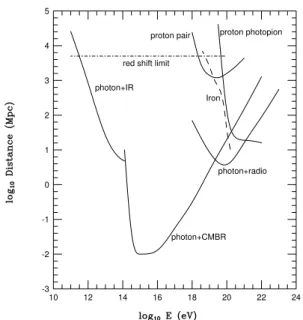
WeshowinFig. 3thedegradationinenergyofprotons
with dierent initial energies as they ross the 2.7 K
osmi mirowave bakground. The high energy
pho-tonsrossingtheintergalatispaeollidewiththe
in-frared,optial,mbandradiowaves,produinge +
e
pairs. This is shown in Fig. 4, where it anbe seen
that above310 12
eV theirattenuationlengthis
be-low100Mp,makingtheUniversequiteopaqueto
en-ergetiphotons. Eletronsandpositronsannotsurvive
tofaratveryhighenergy,theywillveryquiklyradiate
10
12
14
16
18
20
22
24
-3
-2
-1
0
1
2
3
4
5
photon+IR
photon+CMBR
photon+radio
proton pair
proton photopion
Iron
red shift limit
Figure4. The attenuationlength forphotons. Theupper
line(redshiftlimit)isthe distanelimitduetothe ageof
theUniverse.
III.1 Partile aeleration
There areat least twomehanismsforthe
aeler-ationof partilesuptohigh energies. Theyeither
un-dergoaone shotproess, in alargedistane oherent
eld, suh asthose nearbyhighly magnetized neutron
starsortheregionofthearetiondisksofblakholes,
ortheyould be aeleratedto veryhigh energies, by
largesale shok waves with a turbulent ow of
ele-tromagnetields,inasortofosmipinballmahine.
Theseshokwavestravelatspeedslosetothatofthe
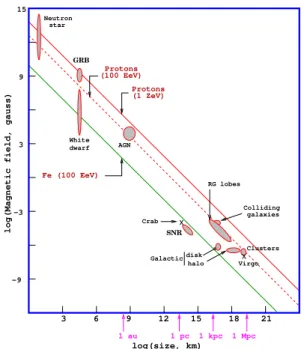
light. The maximumenergy, that anbe arhived by
partilesaeleratedbythese large saleelds, is
lim-itedbytherequirementthatthegyroradiusofthe
parti-lemustbeontainedintheaelerationregion. Thus,
E
max
= ZeBL;
whereZeisthehargeofthepartile,B themagneti
eld harateristi of the region and L the length of
ohereneof themagneti elds. Thediagram in Fig.
7showsthe typialsales for the dimensions and the
magnetieldsofthepossibleastrophysialsouresfor
theultrahighenergyosmirays[21℄. FromtheHillas
diagramonemayidentify someastrophysialsoures:
Neutronstars: Neutronstarsareapableof
aeler-ating ultrahigh energy osmi rays [14℄, howeverthis
mehanism is limited by the synhrotron losses that
evenprotonswillsuerin smallregions.
Ative galati nulei(AGN): Theosmiraysan
beaeleratedin AGN, either at theentral regionor
attheirradiolobes. AttheentralregionsoftheAGN
there are powerful engines that give rise to jets and
theradiolobes. Theyaresupermassiveblakholes
hit large louds of gas in the galaxy. It is estimated
that the most powerful will aelerate partiles above
the GKZ uto via the rst order Fermi mehanism
[22, 23,24, 25℄. Here againthemost severelimitation
tothepowerofthisaeleratoromesfromthesoures
oflossesduetointenseradiationpresentattheAGNs.
Clusterofgalaxies: Clustershoksouldbethesites
forosmi raysaeleration,sinetheaelerated
par-tilesanbeontainedwithintheluster. However,the
losses due to photopionprodution during the
propa-gationinsidethelusterregionlimitstheenergywhih
anbeahieved,tovaluesatmostof10 19
eV[26℄.
Gamma ray bursts: There is speulation that the
souresofthehigh energytransientphenomena,know
asgammaraybursts,andthehighenergyosmirays
maybethe same[27, 28, 29℄. Thegamma raybursts
are distributed isotropially in the sky, howevertheir
highfrequenyarguesagainstaommonorigin,ifthey
aretobeproduedwithinthegkzbounds [30℄.
(100 EeV)
(1 ZeV)
Neutron
star
White
dwarf
SNR
Crab
AGN
Protons
Colliding
galaxies
GRB
Virgo
Galactic
disk
halo
Clusters
RG lobes
1 au 1 pc 1 kpc 1 Mpc
-9
-3
3
9
15
3 6 9 12 15 18 21
x
log(Magnetic field, gauss)
log(size, km)
Fe (100 EeV)
Protons
x
Figure5. Sizeof astronomialobjets versus theirtypial
magnetield(fromA.H.Hillas[21 ℄).
III.2 Exoti partile deay
Thealternativetotheaelerationsenario,orthe
bottom-upsenario, is to introdue newkind of
meta-stable superheavypartiles, saythe Z partiles. This
partiles, if theyexist, mustdeay into ommon
mat-ter,madeofquarksandleptons. There areafew
on-straintsonthenature ofthese partiles: a)theirmass
mustbelargerthanthehighestenergymeasuredin
os-mi rays,largerthan310 20
eV.Partilesassoiated
to GrandUniedTheories(gut), intherangeof 10 24
to 10 25
eV,are naturalandidates for those partiles;
b) the deay should have happened within the region
of 100 Mp radius, so that the harged partiles an
beompatible withtheobservedux ofultrahigh
en-ergy osmi rays. At least two lasses of prodution
mehanismhavebeendisussedintheliterature[14℄:
Ripples in spae-time: The annihilation of
topo-logial defets were the rst mehanisms to be
pro-posed aspossible soures of ultra high energy osmi
rays [31, 32, 33℄. The defets are reated at the end
of the inationary period and survive until they
ol-lapse or annihilate. The deay produts are jets of
hadrons, mostly pions. They havea predominaneof
-raysand neutrinosand aQCDfragmentation
spe-trumwhihisharderthanintheaseofshok
aeler-ation. There are manyproposalsthat ome under the
headingof topologialdefets,likemonopoles [34,35℄,
osmi strings [36, 37℄, vortons [38, 39℄, neklaes of
stringsandmonopoles[34,40℄, tonameafew.
Super heavyarheologial partiles: Thepossibility
that theuher are the produts of the deays of
su-permassivemetastabledarkmatterwhihwould
popu-late thegalati halo,wasput forwardsometime ago
[41, 42,43℄. Theywouldleadtoanearlyisotropi
dis-tribution of uher. Supermassive bound states from
string hidden setors, the ryptons are motivated by
string M-theories [44℄. In this lass of theories there
areproposalsinspiredbysupersymmetry[45℄,that
in-voke new stable partiles whih do not interat with
matter and haveahigh energy thresholdin the
inter-ationwiththebakgroundradiation.
As amore radial solution to evade the gkz limit
suggests the possibility that Lorentz invariane ould
bebroken[46℄
IV Terrestrial detetors
Theultrahighenergyosmirayshittheairmoleules
startinganextensiveairshowerasthefragmentsofthe
rstollisionhitothernulei,produingasadesof
pi-ons. Theneutralpionsstartaneletromagnetishower
of photons,eletronsand positrons. Thehargedones
will strike other atoms or deay into muons and
neu-trinosoreventuallysurviveuntil theground. The
ex-tensiveairshoweranbeimaginedasaverythin
pan-akeofpartiles, gammas,eletrons,positrons,muons
andsomehadronimatter, rossingtheatmosphereat
the speed of light. The atmosphere works as agiant
alorimeter,were theMoliere radiusis of theorder of
76m,inontrasttothefewmwhihitisinlead. The
ore of the disk has a high density of partiles whih
then fallssharplyasonegetawayfrom it. Forosmi
raysat10 20
eV,thelateraldensityofpartilesanbe,
still,aboveonehargedpartilepersquaremeterat
dis-tanesofafewkilometersfromtheoreoftheshower.
As a rule of thumb one may say that in the shower,
for everymuon, there is 10 eletronsorpositronsand
rayshavetodeterminetheirdiretionofarrival,whih
is reasonablyeasyto do,theirenergy,whihis
moder-ately easyto ahieveand, theirhemial omposition,
whihisverydiÆult.
To measure the osmi rays onemay takea
snap-shot of the ross setion of the shower, as it hits the
ground. However, as the ux is very low, one has to
exposeanextensivearea,whihrunsintothehundreds
of squarekilometersat presentto thousandsof square
kilometers in the next generation of experiments (see
below). A typial arrangement onsists of measuring
stations, with an exposure area of a few square
me-ters, whihis sensitiveto theamount ofpartilesthat
transversesit. Thestationsarespreadoveralarge
ar-eas, withaseparationbetweenthemdependentonthe
thresholdof energyonewantstoset in thearray. The
footprintof atypial10 19
eV showerisabout10km 2
,
sothataseparationof1.5kmbetweenthestationswill
ativate about 10 stations, allowing for a good
dire-tion reonstrution. The separation between stations
varyamongthesurfaearrays,butaretypiallyonthe
rangebetweenafewhundredmetersandalittleabove
1.5 km. The angular resolution in this sort of array
is better than 3 Æ
. The detetor stations in this lass
of arrays are either sintillation ounters or
Cerenkov
detetors. Some arrangementsuse buried sintillation
ounterstoidentifythemuoniomponentofashower.
Theenergyoftheshowerisidentiedbythedensityof
hargedpartilesinaring,atalargedistanefromthe
ore, typially about 600 m [47℄. The orrelation
be-tween this density and the primary energy is inferred
fromshowersimulationandisquiteindependentofthe
primaryomposition.Theidentiationoftheprimary
hemial omposition using surfae arrays is diÆult,
for it relies on subtle diereneson themuoni radial
distribution in relationto the eletromagneti
ompo-nentoftheshower[48,49℄.
The other tehniquewhih has beenused to
mea-suretheultrahighenergyosmirays,makeuseofthe
lightemittedbytheuoreseneoftheexitednitrogen
atomsandmoleulesalongthepathoftheshower.This
light,emittedmostlyintheUVregion,withwavelength
between300and400nm,anbeolletedbytelesopes
standing far away. The yield of photons varies very
little with the altitude, about 4.6 photons per meter
of eletrontrakof the shower. Theintensity of their
emissionisproportionaltothetotalnumberofeletrons
traksateahstageoftheshower,givingalongitudinal
prole measurement of theshowerdevelopment. This
allowsforadiretandmorepreisemeasurementofthe
energy of theshower,without dependene on
theoret-ial models for showers. The diretion of the shower
is extrated from a geometrial reonstrution of the
evolutionofthesignal.
The depth of the shower maximum (dened in
g/m 2
), for a given energy is dependent on the
pri-issuÆientlyne,themeasurementofX
max
,the
posi-tionofmaximumdevelopmentoftheshower,will bea
disriminatorofthenature of theprimaryosmi ray.
However, uoresene detetors an only operated in
theevenings,whentheskyislearandmoonless,whih
amountstoa10%dutyyleduringtheyear.
Figure6. Longitudinal proleofthe Fly's Eye event with
energy310 20
eV(fromrefe. [50 ℄).
V The Pierre Auger Observ
a-tory
The Pierre Auger Observatory, whih is omposed of
twosites,oneintheSouthernHemisphereandtheother
intheNorthern,isoptimizedtomeasurethe
harater-istisofosmirayswithenergiesabove10 19
eV.Ituses
ahybridtehnique, that is, ithas agroundarray, the
SurfaeDetetor (SD), made of1600
Cerenkov
dete-torsandfouruoresenelightdetetors (FD)ateah
hemispheresite[51℄.
TheSouthern site,nearbytheity ofMalargue,in
theProvineofMendoza,oversanareaof3000km 2
withstationsset inatriangulargrid,with1.5 km
sep-arationbetween them. Eah tankis a
Cerenkovlight
detetor,aylinderwithanexposureareaof10m 2
and
about 1.5 m high, lled with 12 000l of puried
wa-ter. Thetanks havean internal liner, made of Tyvek
sandwihedwith plasti,designed todiuse the
ultra-violet
Cerenkov light. The light is olleted by three
photomultiplier tubes, with20.3mdiameter,set ina
symmetripatternontopofthetanks. Theeletronis
forthedetetorsarehousedin aboxoutsidethetanks
and ommuniate with the entral station through a
radiowlan,operatingat915MHzband. Thestations
are powered by solar panels and batteries. The time
synhronizationofthetanksisbasedonagpssystem,
apableofatimealignmentpreisionofabout10ns.
The Fluoresene Detetor (FD) is omposed of 5
in azimuth and 30 Æ
elevationfrom thehorizon. Three
oftheeyesarein theperipheryofthesite,looking
in-wards, while the other two are at the same loation,
near the enter of the surfae array, atually overing
an angle of 360 Æ
. Eah eye has six independent
tele-sopes, with a eld of view of 30 Æ
30 Æ
. The
uo-resene light isolletedbyamirrorwith aradiusof
3.1m andreetedintoaamera,loatedat thefoal
surfaeofthemirror. Theimage ofapoint oflightin
the sky is kept foused into a spot, at the foal
sur-fae,of0.25 Æ
radius,byadiaphragm,withadiameter
of1.87m,attheenterofurvatureofthemirror. The
amera,whihhasanareaofonesquaremeter,is
om-posedof 440pixels,eah ahexagonalphotomultiplier,
whih monitorsa solid angle of (1.5 Æ
) 2
projeted into
thesky. Thedeadspaesbetweenthephotomultipliers
is orretedbya devie, alled theMeredes orretor
[52℄. TheoperationoftheFDislimitedtolearnights,
withverylittlemoonlight,whihineet,meanaduty
yle alittle bit over10%of the overallrunning time
oftheexperiment. TheSDoperatesatalltimesduring
theyear.
The hybrid mode operation oers a way to
ross-alibrate the detetors and improves the energy and
angularresolutionoftheobservatory. Forshowerswith
energies above 10 19
eV (10 EeV), the triggering
eÆ-ienyisabove90%,whileitreahesvirtually100%at
100EeV.Theenergyresolutionforshowersof10EeVis
estimatedtobearound30%fortheSDoperatingalone,
improvingto better than 20%for the hybridmode of
operation. At100EeVtheresolutionisimprovedquite
alot,to15%and10%respetively. As fortheangular
resolutionat 100EeV, itis estimated tobe1 Æ
for
op-erationwiththesurfaedetetoralone,but goesdown
to 0.20 Æ
for the hybrid mode. The statistis for the
100EeVosmiraysisexpetedtoinreaseten-foldin
relationtothenumberofshowersmeasureduptodate,
injust oneyearoffulloperationoftheObservatory.
During the year 2001, the rst stage of the
on-strutionofthePierreAugerObservatorywillbe
om-pleted. That is theso alled Engineering Array (EA)
phase. Theteam workingat thesitehavealreadylaid
40
Cerenkovtanks, set in ahexagonalarray, overing
anareaof54km 2
,withtwoofthetanks,attheenter
ofthe array,laying sidebyside, in orderto ross
ali-bratedtheirsignals.Thisgroundarrayisoverlookedby
twotelesopessittingon topofthehillof LosLeones,
60 m abovethe plan of the array. Atthe moment of
writing,theeletronisofthetanksarebeingmounted
and before the middle of 2001, the whole EA will be
operational. Oneofthehallengesof thisrststageof
theobservatorywillbetohektheobservationbythe
AGASA experiment of a 4:5 event exess, oming
from the diretion of the enter of ourGalaxy, in the
region between8 10 17
eV and2 10 18
eV [53℄(see
0
100
200
300
-90
-30
30
90
-3
-2
-1
0
1
2
3
4
G.C.
anti G.C.
Right Ascention[degree]
Declination[degree]
Figure 7. Asymmetryat CG at 18.7 eV seen by Akeno.
(fromreferene[53 ℄).
OneoftheinterestingapabilitiesoftheAuger
ob-servatoryisitssensitivitytoultrahighenergyneutrinos
[54℄. TheEarthisopaquetoUHEneutrinos[55℄,
how-ever, they will interat deeply in the atmosphere, in
ontrast to hadrons oreletromagneti partiles. The
neutrinoshaveasmallrosssetionwiththematterin
theatmosphere,soithasahomogeneousprobabilityto
interat at any point ofit. The eletromagneti
om-ponent of the normal showers, with are generated in
theatmosphere,aresuppressedsharplyatslantdepths
whih orrespondto zenithal angles ofabout 60 Æ
[56℄.
Theestimateoftheaeptaneofasingleeye
Fluores-ene Detetor forthe AugerObservatoryis shown in
Fig. 8.
VI Summary and onlusions
We have given a brief review of the urrent status
of researh in the eld of ultra high energy osmi
rays. The existene of osmi rays with energy that
exeeds10 20
eVisonrmedbyexperimentsusing
dif-ferenttehniques. Theseosmirayshallenge
onven-tional explanations for their prodution and
propaga-tion through spae. Aeleration mehanisms, whih
invokeeletromagnetieldsforthis, assoiated to
as-trophysialobjets,donotoeraompelling
explana-tionfortheprodutionoftheseextremeenergies
parti-les. Ontheotherhand,thetop-downmehanisms
ap-peal to new partiles, notyet observed, implying new
kinds of physial laws. There is an observatory, now
in onstrution, the Pierre Auger Observatory, whih
will addressthese problems, pushingthe sensitivityof
detetorstohigherenergiesandaddingatleasttwo
or-der of magnitude to statistis of existing events. The
rstsiteofthisobservatory,beingbuiltintheSouthern
Hemisphere,will bepartiularlysensitiveto any
peu-liarativityassoiatedtotheenteroftheMilkyWay
galaxy. The onstrution of the southern observatory
18.0
18.5
19.0
19.5
20.0
1
10
100
>60
o
>70
o
>80
o
Accept
ance (
x
o
>2000 g/
cm
2
)
Energy (eV)
Figure8.Theneutrinoaeptaneoftheuoresene
dete-torofthePierreAugerObservatory. (fromreferene[54 ℄).
Referenes
[1℄ J.Lindsay. Phys.Rev.Lett.10,146(1963).
[2℄ J.Lindsay. Pro.8thInternationalCosmiRay
Con-ferene,volume4,page295. 1963.
[3℄ M.A.Lawrene,R.J.O.Reid,andA.A.Watson. J.
Phys.G17,733(1991).
[4℄ D.J.Birdetal. Phys.Rev.Lett.71,3401(1993).
[5℄ M.Takedaetal. Phys.Rev.Lett.81,1163(1998).
[6℄ N.N.Emovetal. Pro.Intl.Symp.onAstrophysial
Aspets oftheMostEnergetiCosmisRays,page20.
eds.M.NaganoandF.Takahara,WorldSienti,
Sin-gapore,1991.
[7℄ S.Yoshida,H.Dai,C.C.H.Jui,andP.Sommers.
As-trophys.J.479,547(1997).
[8℄ K.Greisen. Phys.Rev.Lett.16,748(1966).
[9℄ G.T.ZatsepinandV. A.Kuzmin. Sov.Phys.JETP
Lett.4,78(1966).
[10℄ T.K.Gaisser,F.Halzen, andT.Stanev. Phys.Rep.
258,173(1995).
[11℄ J.W.Cronin. Rev.Mod.Phys.71,S165(1999).
[12℄ M. NaganoandA. A.Watson. Rev.Mod.Phys.72,
689(2000).
[13℄ A.V.Olinto. Phys.Rep.333,329(2000).
[14℄ P. Bhattaharjee and G. Sigl. Phys. Rep. 327, 109
(2000).
[15℄ A.Letessier-Selvon. Theoretialandexperimental
top-isonultrahighenergyosmirays.astro-ph/0006111,
2000.
[16℄ Malom S.Longair. HighEnergy Astrophysis, Vol1:
Partiles,photonsandtheirdetetion,volume1.
Cam-bridgeUniv.Press, Cambridge,2edition,1992.
[17℄ M. A. Shea andD. F.Smart. 19th international
os-mirayonferene,volume4,page501.LaJolla,USA,
1985.
[18℄ J. A. Simpson. Ann. Rev.Astr. and Astrophys. 33
[19℄ J. P. Meyer. 19th Intl. onf. osmi rays, volume 9,
page141. LaJolla,1985.
[20℄ J.W.Cronin. Nul.Phys.Supp.B28213(1992).
[21℄ A.M. Hillas. Ann.Rev.Astron.Astrophys.22,425
(1984).
[22℄ P.L.BiermannandP.Strittmatter. Astropart.Phys.
322,643(1987).
[23℄ J.P.RahenandP.L.Biermann. Astron.Astrophys.
272,161(1993).
[24℄ P.L. Biermann. J.Phys. G:Nul.Part. Phys.23, 1
(1997).
[25℄ P.Blasiand A.V. Olinto. Phys.Rev.D59,023001
(1999).
[26℄ D.RyuH. Kang and T.W. Jones. Astropart. Phys.
MNRAS286,257(1997).
[27℄ E.Waxman. Phys.Rev.Lett.75,386(1995).
[28℄ E.Waxman. Astrophys.J.452,L1(1995).
[29℄ M.Vietri. Astrophys.J.453,883(1995).
[30℄ F.W.Steker. Astropart.Phys.14,207(2000).
[31℄ C.T.Hill. Nul.Phys.B224,469(1983).
[32℄ C.T.HillandD.N.Shramm. Phys.Lett.B131247
(1983).
[33℄ C.T.Hill,D. N.Shramm, andT.P.Walker. Phys.
Rev.D36,1007(1987).
[34℄ V.BerezinskyandA. Vilenkin. Phys.Rev.Lett. 79,
5202(1997).
[35℄ C.O.EsobarandR.Vazquez. Astropart.Phys.10,
197(1999).
[36℄ A.Vilenkin. Phys.Rev.Lett.46,1169(1981).
[37℄ H.J.M. Cuesta andD. M. Gonzalez. Phys.Lett. B
500,215(2001).
[38℄ P.Bhattaharjee. Phys.RevD40,3968(1989).
[39℄ L. Masperi and G. Silva. Astropart. Phys. 8, 173
(2000).
[40℄ J.J.Blano-Pillado and K.D. Olum. Phys.Rev.D
60,083001(1999).
[41℄ J.Ellis,T.K.Gaisser,andG.Steigman. Nul.Phys.
B177,427(1981).
[42℄ J.Ellis,G.B.Gelmini,J.L.Lopez,D.V.Nanopoulos,
andS.Sarkar. Nul.Phys.B373,399(1992).
[43℄ G.A. Medina-Tanoand A. A. Watson. Astropart.
Phys.12,25(1999).
[44℄ J.Ellis, J. L. Lopez, and D. V. Nanopoulos. Phys.
LettB247,257(1990).
[45℄ G.R. Farrar and P.L. Biermann. Phys.Rev.Lett.
81,3579(1998).
[46℄ S. Coleman and S. L. Glashow. Phys. Rev. D 59,
116008(1999).
[47℄ A.M. Hillas. AtaPhys.Aad.Si.Hung.29(Suppl
3),355(1970).
[49℄ R. Walker and A. A. Watson. J. Phys. G 8, 1131
(1982).
[50℄ D.J.Birdetal. Astrophys.J.441,144(1995).
[51℄ AugerCollaboration. The Pierre AugerObservatory
designreport,2 nd
ed. AugerNote,Fermilab,Batavia,
1999.
[52℄ G.Gallo etal. C.Aramo, F.Brai. The amera of
theuoresene detetor. AugerGAPNote1999-027,
1999.
[53℄ N.Hayashidaetal. Astropart.Phys.10,303(1999).
[54℄ R. C.Shellard J.C. Daz and M. G.Amaral. Nul.
Phys.B,Pro.Supp.toappear:.,2001.
[55℄ R. Gandhi, C. Quigg, M. H. Reno, and I. Sarevi.
Phys.Rev.D58,093009(1998).