From the Intensive Care Unit, Hospital Oswaldo Cruz Nursing School and Nutrition Group, Hospital das Clínicas, Faculty of Medicine, University of São Paulo.
Received for publication on December 4, 2001.
EFFECTS OF CONTINUOUS VERSUS BOLUS
INFUSION OF ENTERAL NUTRITION IN CRITICAL
PATIENTS
Letícia Faria Serpa, Miako Kimura, Joel Faintuch and Ivan Ceconello
SERPA LF et al. - Effects of continuous versus bolus infusion of enteral nutrition in critical patients. Rev. Hosp. Clin. Fac. Med. S. Paulo 58(1):9-14, 2003.
PURPOSE - Enteral alimentation is the preferred modality of support in critical patients who have acceptable digestive function and are unable to eat orally, but the advantages of continuous versus intermittent administration are surrounded by controversy. With the purpose of identifying the benefits and complications of each technique, a prospective controlled study with matched subjects was conducted.
PATIENTS AND METHODS - Twenty-eight consecutive candidates for enteral feeding were divided into 2 groups (n = 14 each) that were matched for diagnosis and APACHE II score. A commercial immune-stimulating polymeric diet was administered via nasogastric tube by electronic pump in the proportion of 25 kcal/kg/day, either as a 1-hour bolus every 3 hours (Group I), or continuously for 24 hours (Group II), over a 3-day period. Anthropometrics, biochemical measurements, recording of administered drugs and other therapies, thorax X-ray, measurement of abdominal circumference, monitoring of gastric residue, and clinical and nutritional assessments were performed at least once daily. The principal measured outcomes of this protocol were frequency of abdominal distention and pulmonary aspiration, and efficacy in supplying the desired amount of nutrients.
RESULTS - Nearly half of the total population (46.4%) exhibited high gastric residues on at least 1 occasion, but only 1 confirmed episode of pulmonary aspiration occurred (3.6%). Both groups displayed a moderate number of complications, without differences. Food input during the first day was greater in Group II (approximately 20% difference), but by the third day, both groups displayed similarly small deficits in total furnished volume of about 10%, when compared with the prescribed diet.
CONCLUSIONS - Both administration modalities permitted practical and effective administration of the diet with frequent registered abnormalities but few clinically significant problems. The two groups were similar in this regard, without statistical differences, probably because of meticulous technique, careful monitoring, strict patient matching, and conservative amounts of diet employed in both situations. Further studies with additional populations, diagnostic groups, and dietetic prescriptions should be performed in order to elucidate the differences between these commonly used feeding modalities.
DESCRIPTORS: Enteral nutrition. Tube feeding. Critical patients. Pulmonary aspiration.
Enteral alimentation is the pre-ferred modality of support for seriously ill patients who have acceptable gastrointestinal function but are un-able to maintain oral diet. Advantages of enteral alimentation include en-hancement of intestinal mucosal in-tegrity and nutrient absorption1,
im-provement of metabolic and immune response2,3, and reduction of costs4,5
and complications6-8.
Nevertheless, difficulties inherent in critical populations may still inter-fere with enteral feeding and create
Clinically, these abnormalities usu-ally present themselves in the form of vomiting, diarrhea, abdominal disten-sion, and increased gastric residue be-tween diet infusions. Pulmonary aspi-ration is the most dramatic conse-quence, resulting in high morbidity and mortality. Over the years, the role of continuous administration of the diet, in contrast with bolus infusions, has been suggested as a means of pre-venting complications, but few conclu-sive advantages have been demon-strated.
With the purpose of analyzing the contribution of each of these alternatives toward the occurrence of gastrointestinal problems and the technical efficiency of tube feeding, a prospective controlled study was undertaken.
PATIENTS AND METHODS
Population - Two groups of 14 critically ill patients each were ran-domly assigned to intermittent (Group I) or continuous (Group II) tube feed-ing. All cases had been admitted to the Intensive Care Unit (ICU) because of clinical or surgical emergencies. Pa-tients were individually matched as closely as possible to controls for di-agnosis and APACHE II index9 to
as-sure comparable samples.
Criteria of inclusion - Seriously ill adults, males or females, aged 18 to 80 years who were unable to ingest an oral diet, but who had conserved gastrointestinal function, and who had given informed consent.
Criteria of exclusion - Carcinoma-tosis, irreversible coma, terminal dis-ease; death or discharge before 72 hours of observation; intestinal fistula, obstruction, necrosis, peritonitis, or other contraindication to enteral diet; intolerance to the prescribed nutrients or infusion regimen.
Dietetic routine - All subjects re-ceived a complete, polymeric,
im-mune-stimulating commercial prepara-tion (1.0 kcal/mL, 56 g protein/mL), via nasogastric Dobhoff tube (10 French) and electronic infusion pump. Nurses were instructed to confirm gas-tric tube position on daily thorax X-ray images taken as a routine in these critical patients, both initially and dur-ing daily controls. Whenever the tube was revealed to be displaced, the epi-sode was registered, and the tube was reinserted or repositioned as appropri-ate. A standard prescription of 25 kcal/ mL was adopted, but actual adminis-tered volumes were one of the study variables, as discussed later in this re-port.
Continuous infusion - The daily desired amount was offered continu-ously for 24 hours;
Bolus infusion - The total daily feeding period was also 24 hours; however, 8 aliquots were administered over a 1-hour period each at intervals of 3 hours (1-hour infusion period fol-lowed by a 2-hour standby period);
General routines - Patients were managed by administration of addi-tional fluids or electrolytes, antibiot-ics, vasoactive drugs, mechanical ven-tilation, and other procedures accord-ing to medical indications.
Assessment methods - Documenta-tion of the results was done by daily anthropometric and biochemical nutri-tional assessments, hematologic counts, thorax X-ray, and measurement of ab-dominal circumference and gastric re-sidual volume. Consumption of vasoac-tive drugs, sedavasoac-tives, antibiotics, and mechanical ventilation was monitored, and duration of hospitalization in the ICU and interval between admission and start of enteral alimentation were also documented. Infused volumes along with gastrointestinal and respira-tory manifestations were accurately re-corded, and night-shift nurses as well as daytime professionals were trained to employ the same methodology. The to-tal observation time was 3 days (72
hours), with observations every 3 hours (24 periods).
Definitions and precautions - Ab-dominal distension was defined as whenever abdominal circumference increased 3 cm or more, and high gas-tric residue was defined as whenever 150 mL of fluid or more could be re-covered immediately before each 3-hour period. Diets were marked with anilin-blue dye so pulmonary aspira-tion could more easily be recognized, and pneumonia was affirmed whenever a new lung infiltrate at thorax X-ray was accompanied by clinical symp-toms, particularly in basilar segments and on the right lung, where aspiration is most common10. Isolation of
etiologic agents was not performed, since this is routinely done only in cases of transplantation procedures, cancer chemotherapy, immune-sup-pressive therapy, or AIDS, which did not occur in this study.
The complication rate was calcu-lated per patient and per period of 3 and 24 hours; a single episode of vom-iting, diarrhea, or distention was enough to define the case as compli-cated.
Ethical procedures - Informed con-sent was obtained from all subjects. The protocol was approved by the Ethical Committee of the Hospital.
Statistical analysis - Results were compared by Mann-Whitney, chi-square, and Student´s t tests, as appro-priate. A significance level of 5% was adopted.
Study population - Fifty patients were initially considered for the study, but due to exclusion criteria and matching requirements, only 28 were enrolled.
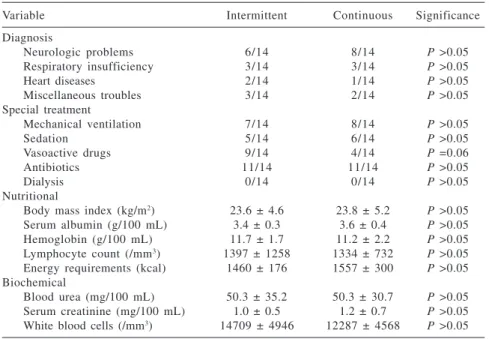
abnormalities, and others. APACHE II scores were 14.7 -/+ 3.7 for Group I and 15.6 -/+ 3.2 for Group II. No sta-tistical difference between groups could be demonstrated for these find-ings as well as for general biochemi-cal and nutritional measurements. One discrepancy was noticed concerning consumption of vasoactive drugs, which was more prevalent in Group I (P = 0.06) (Table 2).
RESULTS
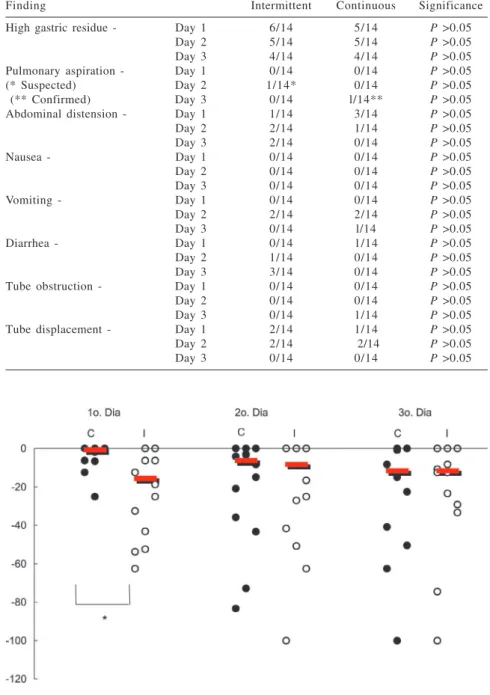
Infusion care - High gastric residue was comparatively common (46.4% of the total population), along with ab-dominal distension (28.6%), and gas-tric tube displacement (25.0%). Vom-iting and diarrhea were infrequent (14.3% each), and 1 case each of pul-monary aspiration and tube obstruc-tion were detected (3.6%). These com-plications are shown on Figure 1 and Table 3.
During continuous infusion, the most frequent aberration was high re-sidual volume and abdominal disten-sion. One confirmed and 1 suspected case of pulmonary aspiration were re-corded. The bolus infusion group had similarly high gastric residue volumes and rates of abdominal distension, as well as similar rates of diarrhea and tube displacement.
In almost all circumstances (26/28 or 92.9%), total daily input was smaller than prescribed. A difference of approximately 20% in the volume defi-cits could be noticed between the groups (P = 0.01) on the first day, with advantage for Group II (Figure 2 and Table 4). However, over the entire ob-servation period, both groups had similar deficits of approximately 10%, without significant differences.
The principal reasons for infusion delay or temporary discontinuation were high residual volume, as well as diagnostic or therapeutic procedures,
Table 1 - Comparison of patients receiving continuous versus intermittent therapy with regard to gender, age, length of stay in the Intensive Care Unit, mortality, and interval until the beginning of enteral feeding.
Variable Intermittent Continuous Significance
Age 64.9 ± 13.9 69.6 ± 13.2 P >0.05
Gender (M/F) 7/7 9/5 P >0.05
Time in Intensive Care Unit (days) 14.1± 9.3 14.2 ± 10.2 P >0.05 Delay until enteral nutrition (days) 4.5 ± 5.6 2.2 ± 1.4 P >0.05
Mortality 3/14 (21.4%) 3/14 (21.4%) P >0.05
Table 2 - General preoperative findings.
Variable Intermittent Continuous Significance
Diagnosis
Neurologic problems 6/14 8/14 P >0.05
Respiratory insufficiency 3/14 3/14 P >0.05
Heart diseases 2/14 1/14 P >0.05
Miscellaneous troubles 3/14 2/14 P >0.05
Special treatment
Mechanical ventilation 7/14 8/14 P >0.05
Sedation 5/14 6/14 P >0.05
Vasoactive drugs 9/14 4/14 P =0.06
Antibiotics 11/14 11/14 P >0.05
Dialysis 0/14 0/14 P >0.05
Nutritional
Body mass index (kg/m2) 23.6 ± 4.6 23.8 ± 5.2 P >0.05
Serum albumin (g/100 mL) 3.4 ± 0.3 3.6 ± 0.4 P >0.05 Hemoglobin (g/100 mL) 11.7 ± 1.7 11.2 ± 2.2 P >0.05 Lymphocyte count (/mm3) 1397 ± 1258 1334 ± 732 P >0.05
Energy requirements (kcal) 1460 ± 176 1557 ± 300 P >0.05 Biochemical
Blood urea (mg/100 mL) 50.3 ± 35.2 50.3 ± 30.7 P >0.05 Serum creatinine (mg/100 mL) 1.0 ± 0.5 1.2 ± 0.7 P >0.05 White blood cells (/mm3) 14709 ± 4946 12287 ± 4568 P >0.05
and these problems equally affected both study groups.
DISCUSSION
Physiologic disturbances of the di-gestive tract secondary to clinical or surgical conditions are common, and for many years, it has been recom-mended that enteral nutrition should be introduced slowly and adjusted ac-cording to tolerance11-13. High-risk
cases, such as those here investigated, are substantially more prone to motil-ity derangements14,15.
Certain authors advocate continu-ous administration of the diet as a means of overcoming possible gastric stasis and reflux, yet there is not wide consensus about the efficacy of such an approach5,6,10,14.
In the present protocol, great care was devoted to the selection of com-parable populations for continuous and bolus infusion to minimize any bias related to associated diseases and organ failures. Diet, gastric tube, di-etetic routine, and controls were all well standardized.
An observation period longer than 72 hours would perhaps amplify the differences between the techniques; however, this was not feasible under the conditions of a busy ICU having short overall durations of hospitaliza-tion. Also, more aggressive bolus feedings with syringe injections that are typically performed at high pres-sures and short times would poten-tially underscore the limitations of one versus the other method. However, it was not the purpose of this project to expose patients to elevated risks or costs, but rather to evaluate the safest and most acceptable hospital routines. It is also worth emphasizing that a se-rious attempt to recruit 50 patients was done, but because of protocol restric-tions, only 28 could be evaluated.
Only 1 variable, consumption of
Table 3 - Complications of feeding regimen.
Finding Intermittent Continuous Significance
High gastric residue - Day 1 6/14 5/14 P >0.05
Day 2 5/14 5/14 P >0.05
Day 3 4/14 4/14 P >0.05
Pulmonary aspiration - Day 1 0/14 0/14 P >0.05
(* Suspected) Day 2 1/14* 0/14 P >0.05
(** Confirmed) Day 3 0/14 l/14** P >0.05
Abdominal distension - Day 1 1/14 3/14 P >0.05
Day 2 2/14 1/14 P >0.05
Day 3 2/14 0/14 P >0.05
Nausea - Day 1 0/14 0/14 P >0.05
Day 2 0/14 0/14 P >0.05
Day 3 0/14 0/14 P >0.05
Vomiting - Day 1 0/14 0/14 P >0.05
Day 2 2/14 2/14 P >0.05
Day 3 0/14 l/14 P >0.05
Diarrhea - Day 1 0/14 1/14 P >0.05
Day 2 1/14 0/14 P >0.05
Day 3 3/14 0/14 P >0.05
Tube obstruction - Day 1 0/14 0/14 P >0.05
Day 2 0/14 0/14 P >0.05
Day 3 0/14 1/14 P >0.05
Tube displacement - Day 1 2/14 1/14 P >0.05
Day 2 2/14 2/14 P >0.05
Day 3 0/14 0/14 P >0.05
Table 4 - Discrepancies between prescribed and administered diet.
Diet volume (mL/24 h) Intermittent Continuous Significance
Prescribed - Day 1 8 0 0 8 0 0
Administered - Day 1 614 ± 169 766 ± 55 P <0.05
Prescribed - Day 2 1200 1200
Administered - Day 2 923 ± 357 951 ± 324 P >0.05
Prescribed - Day 3 1200 1200
Administered - Day 3 939 ± 357 900 ±350 P >0.05
Group I: Open circles; Group II: Black circles; Thick line: Mean daily intake:Statistical difference demonstrated for first day only.
vasoactive drugs, was not equivalent between the groups; vasoactive drugs were administered more frequently to patients assigned to Group I (bolus-fed protocol). The main vasoactive agent prescribed was dopamine, and accord-ing to Tarlaccord-ing16, dopamine sometimes
adversely interferes with gastric emp-tying. Despite this methodological flaw, the virtual lack of differences be-tween the compared techniques indi-cates that the findings reported in this study are reliable.
Intermittent alimentation did fail to provide as much volume as the continu-ous modality on the first day, but by the third day, the advantage had disap-peared. When true complications are considered, the differences between the two routines were even more subtle and could not be statistically confirmed. It should not be overlooked that both therapies were actually very successful, since total diet-related morbidity was quite low for such a critical population, and nearly 80% of the nutritional in-take goal was reached by 72 hours. It is accepted that whenever 80% of the energy needs of the patient are supplied
by 72 hours, the replenishment program should be considered adequate17.
Therefore, it is safe to affirm that the precautions adopted here, such as the use of electronic pumps, slow ad-ministration even in cases of bolus prescription, careful selection of diet and positioning of the tube, preven-tion of abdominal distension or high gastric residues, and constant monitor-ing of the patients, permitted good re-sults with both of the tested proce-dures. Further studies are certainly necessary to expand these observa-tions towards longer alimentation pe-riods, populations with other APACHE scores, and different diagnostic catego-ries, so all doubts concerning the choice of ideal feeding procedure in these contexts can be eliminated.
CONCLUSIONS
Under the conditions of this study it can be concluded that:
1) Total complication rate was com-paratively low with either bolus or continuous administration;
2) Continuous administration pro-vided a higher dietary intake on the first day in Group II, but by the third day, no difference remained between the two groups;
3) Both populations displayed a defi-cit of actually supplied volume when compared with diet prescrip-tion, but this shortcoming was small, similar in both groups, and justified in circumstances of criti-cal disease and intensive care; 4) Further studies should include
longer alimentation periods and populations with different risk scores to advance the knowledge about these widely adopted thera-peutic techniques.
ACKNOWLEDGMENTS
We are grateful to the staff of the ICU of Hospital Alemão Oswaldo Cruz for valuable assistance and coopera-tion during this study.
See Editorial related to this article on page 1.
RESUMO
SERPA LF e col. - Efeitos da admi-nistração contínua versus intermi-tente da nutrição enteral em pacien-tes críticos. Rev. Hosp. Clin. Fac. Med. S. Paulo 58(1):9-14, 2002.
ANTECEDENTES - A
alimenta-ção enteral é a modalidade preferida de suporte em pacientes graves com função digestiva aceitável porém inca-pazes de se alimentar por via oral, en-tretanto as vantagens da oferta contí-nua em contraste com a intermitente são rodeadas de controvérsias. Tendo
como objetivo identificar os benefíci-os e as complicações destas técnicas, realizou-se um estudo prospectivo e controlado com casos pareados.
PACIENTES E MÉTODOS: Vinte
e oito pacientes consecutivos candida-tos a alimentação enteral foram dividi-dos em dois Grupos (n= 14), pareadividi-dos segundo diagnóstico e índice APACHE II.Uma dieta polimérica comercial imuno-estimulante foi administrada por sonda nasogástrica e bomba de infusão na proporção de 25 kcal/kg/dia, em for-ma de bolo por ufor-ma hora a cada três
ho-ras (Grupo I), ou continuamente nas 24 horas (Grupo II), durante três dias. Os métodos incluiram antropometria, do-sagens bioquímicas, registro de uso de drogas e outras terapêuticas, RX de tó-rax, circunferência abdominal, resíduo gástrico, e avaliação clínica e nutri-cional, efetuada no mínimo uma vez por dia. Os principais desfechos colima-dos neste estudo foram frequência de distensão abdominal e aspiração pul-monar, e capacidade de atingir a meta calórica pretendida.
população total (46,4%) apresentou resíduos gástricos elevados em pelo menos uma ocasião, porém somente foi registrado um episódio confirmado de aspiração pulmonar (3,6%). Ambos os grupos padeceram de um número moderado de complicações, sem dife-renças. O ganho de dieta no Grupo II foi maior no primeiro dia, porém no terceiro dia ambos os grupos exibiam déficits pequenos e semelhantes no ganho dietético, quando comparados
com o volume prescrito.
CONCLUSÕES: Ambas as
moda-lidades de oferta permitiram a adminis-tração prática e eficiente da dieta, com freqüentes anormalidades registradas porém escassas complicações clinica-mente significativas. Os dois grupos se comportaram analogamente, com pou-cas diferenças nos resultados, prova-velmente devido à técnica meticulosa, monitorização cuidadosa, rígido parea-mento dos pacientes, e volumes
mo-destos da dieta empregados nas duas circunstâncias. Investigações subse-qüentes deveriam ser elaboradas com populações, grupos diagnósticos e prescrições dietéticas adicionais, a fim de elucidar as diferenças entre estas modalidades de alimentação comu-mente usadas.
DESCRITORES: Nutrição enteral. Alimentação por sonda. Pacientes críticos. Aspiração pulmonar.
REFERENCES
1 . GUENTER P, JONES S, ERICSON M - Enteral nutrition therapy. Nurs Clin North Am 1997; 23:651-68.
2 . CERRA FB, LEHMANN S, KONSTANTINIDES NN et al. -Improvement of immune function in ICU patients by enteral nutrition supplemented with arginine, RNA and menhaden oil is independent of nitrogen balance. Nutrition 1991; 7:193-9. 3 . BORLASE BC, BELL SJ, LEWIS SJ et al. - Tolerance to enteral tube feeding diets in hypoalbuminemic critically ill geriatric patients. Surg Gynecol Obstet 1992;174:181-188. 4 . SHIKORA AS, OGAWA AM - Enteral nutrition and the critically
ill. Postgrad Med J 1997; 72: 395-402.
5 . ROCCO O - Gastrointestinal motility and tube feeding. Crit Care Med 1998; 26:104-109.
6 . TWYMAN D - Nutritional management of the critically ill neurologic patient. Crit Care Clin 1997; 13:39-49. 7 . GIANOTTI L - Effect of route of delivery and formulation of
postoperative nutritional support in patients undergoing major operations for malignant neoplasms. Arch Surg 1997;132:1222-9.
8 . DALY JM, WEINTRAUB FN, SHOU I et al. - Enteral nutrition during multimodality therapy in upper gastrointestinal cancer patients. Ann Surg 1995; 221: 327-38.
9 . KNAUS WA, LEGALL JR, WAGNER DP et al. - Apache II: Severity of disease classification system. Crit Care Med 1985; 13 :818-29.
10. WINTERBAUER R H, DURNING R B, BARRON E et al.-Aspirated nasogastric feeding solution detected by glucose strips. Ann Intern Med 1985; 95:57-68.
11. MAIN BJ, MORRISON DL - Development of a clinical pathway for enteral nutrition. Nutr Clin Pract 1998;13: 20-4. 12. FUHRMAN M P - Diarrhea and feeding. Nutr Clin Pract
1999;14:83-4.
13. SPAIN DA, MCCLAVE SA, SEXTON LK et al. - Infusion protocol improves delivery of enteral tube feeding in the critical care unit. JPEN J Parent Enteral Nutr 1999;23:288-92. 14. ROMBEAU JL, TAKALA J - Summary of round table conference:
gut dysfunction in critical illness. Clin Nutr 1997;16:57-60. 15. RINGEL AF, JAMENSON GL, FOSTER ES - Diarrhea in the
intensive care patient. Crit Care Clin 1995; 11:465-477. 16. TARLING MM, TONER CC, WITHINGTON PS et al. - A model
of gastric emptying using paracetamol absorption in intensive care patients. Intensive Care Med 1997;.23:256-60. 17. BERRY JK, BRAUNSCHWEIG C A - Nutritional assessment of