ABSTRACT
BACKGROUND AND OBJECTIVES: Neck range of motion
may be decreased by vertebral and myofascial dysfunctions, which may be treated with osteopathic manipulation through the cervi-cal rhythmic articulatory technique. his study aimed at verifying whether osteopathic manipulation with rhythmic articulatory tech-nique improves cervical rotation range measured by leximetry.
METHODS:he group was made up of 58 individuals of both genders, mean age of 36±6.5 years, with chronic mechanical neck pain, who were randomized to cervical rotation control leximetry, to osteopathic manipulation through the rhythmic articulatory technique, to 5-minute rest and to cervical rotation study leximetry.
RESULTS:he comparison of cervical rotation leximetry means through Student’s t test for paired data at signiicance level of 0.05 (5%) has shown signiicant cervical rotation improvement in all cases (p<0.05), going from 151.4º to 162.5º in total movement arch (7.3% improvement).
CONCLUSION: Results were as expected, conirming that os-teopathic manipulation using the rhythmic articulatory technique generates signiicant improvement of cervical rotation range in all cases and may be an alternative to treat diseases related to vertebral mobility reduction, such as neck pain and cervical osteoarthritis.
Keywords:Joint range of motion, Neck pain, Osteopathic ma-nipulation, Specialty physiotherapy, Spinal manipulation.
RESUMO
JUSTIFICATIVA E OBJETIVOS: A amplitude de movimento do pescoço pode ser reduzida pela presença de disfunções verte-brais e miofasciais, as quais podem ser tratadas pela manipulação
Influence of manipulation at range of rotation of the cervical spine in
chronic mechanical neck pain*
Influência da manipulação osteopática na amplitude de rotação da coluna cervical em
indivíduos com cervicalgia mecânica crônica
Rafael Stelle1, Bianca Simone Zeigelboim1, Marcos Christiano Lange2, Jair Mendes Marques1
*Received from University Tuiuti of Paraná and Clinicas Hospital, Federal University of Paraná, Curitiba, PR, Brazil.
1. University Tuiuti of Paraná, Curitiba, PR, Brazil.
2. Federal University of Paraná, Clinicas Hospital. Curitiba, PR, Brazil.
Submitted in June 18, 2013.
Accepted for publication in November 25, 2013. Conlict of interests: None.
Correspondence to: Rafael Stelle
Rua Camões, 1825, Bairro Hugo Lange 80040-180 Curitiba, PR, Brasil. E-mail: [email protected]
© Sociedade Brasileira para o Estudo da Dor
osteopática através da técnica articulatória rítmica cervical. O objetivo deste estudo foi veriicar se a manipulação osteopática, através da técnica articulatória rítmica gera aumento da ampli-tude de rotação cervical mensurada por leximetria.
MÉTODOS: A casuística foi constituída de 58 indivíduos de ambos os gêneros, com idade média de 36±6,5 anos, com cer-vicalgia mecânica crônica, que foram submetidos de maneira randomizada à leximetria controle da rotação cervical, à ma-nipulação osteopática, através da técnica articulatória rítmica, ao repouso de 5 minutos e à leximetria estudo da rotação cervical.
RESULTADOS: A comparação entre as médias das leximetri-as de rotação cervical através do teste t de Student para dados pareados, ao nível de signiicância de 0,05 (5%), mostrou que houve aumento signiicativo da rotação cervical em todos os ca-sos (p<0,05) passando de 151,4º para 162,5º no arco total de movimento (aumento de 7,3%).
CONCLUSÃO: Os resultados foram dentro do esperado, con-irmando que a manipulação osteopática, através da técnica ar-ticulatória rítmica gerou aumento signiicativo da amplitude de rotação cervical em todos os casos, podendo servir de tratamento de doenças que se relacionam à redução da mobilidade vertebral, como cervicalgia e osteoartrite cervical.
Descritores: Amplitude de movimento articular, Cervicalgia, Fi-sioterapia especialidade, Manipulação da coluna, Manipulação osteopática.
INTRODUCTION
Somatic vertebral neck dysfunctions are in general caused by abrupt and unexpected movements1,2. hese dysfunctions
generate neural medullar peripheral and autonomous circuit sensitization, called sensitization phenomenon or spinal fa-cilitation. his neural sensitization may afect cervical spine nervous, vascular and musculoskeletal communications and induce neck pain, postural changes and decreased range of some movements2-6.
which maintain interfacet joint irm3,6,7 and may cause
myo-fascial tensions in temporomandibular joints (TMJ) and cra-nial bones2,3,7,8.
he presence of somatic vertebral dysfunctions may in the long term cause local osteoarthritis because hypomobility may induce structural changes2,3,9. Cervical spine
biomechan-ics and range of motion (ROM) may be afected or decreased by osteoarthritis2,9, by aging10-12 and by the presence of
so-matic vertebral dysfunctions, including cervical dysfunction (neck pain by mechanical dysfunction)3-7.
Osteopathic manipulative treatment (OM), which includes several techniques, among them cervical rhythmic articu-latory technique (CRAT) with sliding and rotation, aims at treating somatic vertebral dysfunctions or vertebral hy-pomobility, by sliding and rotation movements respecting the physiology3,7,8,13-15. Osteopathic manipulation (OM)
de-creases the spasm of deep muscles fixing vertebral dysfunc-tions, normalizes intervertebral movement, decreases joint and disk pressures, relieves discomfort and neck or cervico-brachial pain3,7,13-18 and improves muscle strength and
resis-tance19.
Arthrometry, which uses some pieces of equipment, such as goniometer, inclinometer and leximeter, aims at evaluating the musculoskeletal integrity of diferent body segments by measuring ROM4,5,10-12,20-22. To measure ROM of cervical
spine active rotation in supine position it is considered, in adults, that normal range is approximately 70o to 90o to each
side or, in complete arch, of approximately 140o to 180o12,23.
he hypothesis is that osteopathic manipulation with cervi-cal rhythmic articulatory technique (OM-CRAT) may imme-diately improve cervical spine range of rotation and may be more signiicant for the group with previous rest.
Face to the above, this study aimed at evaluating whether OM-CRAT may improve neck range of rotation in individu-als with chronic mechanical neck pain.
METHODS
he group was made up of 58 individuals (18 males and 40 females), with mean age of 36.0±6.5 years, being males 36.5±6.1 years and females 34.8±7.3 years, with common chronic mechanical neck pain of mild to moderate intensity according to the Neck Disability Index. Volunteers involved were employees of the Clinicas Hospital, Federal University of Paraná. Study period was from August 2010 to March 2012. Inclusion criteria were individuals aged from 25 to 45 years of both genders, complaining of neck discomfort or common mild to moderate pain, with mild or moderate reduction of neck ROM. Exclusion criteria were any change preventing the execution of the protocol, such as severe or disabling pain, dizziness or vertigo and other vertebrobasilar insuiciency signs and symptoms, severe neck hypomobility (e g.: uncoar-throsis, discopathy, bone malformation), spinal deformity (e g.: Scheuermann disease), individuals in post-surgical stage, sequelae by head or spine trauma, using clutches, walking frames or wheelchairs.
Individuals were randomized submitted to neck rotation con-trol leximetry (CF), to one OM-CRAT and to 5 min rest (and alternate sequence of rest and OM-CRAT), and to neck rotation study leximetry (SF). Procedures were carried out in a single session of 15 min. After the interview, data collection and signature of the Free and Informed Consent Term, indi-viduals laid down on a stretcher with small and low pillow (child style), remaining in silent environment until the end of the following sequence of procedures:
Group A (29 individuals): (1) CF, (2) OM-CRAT, (3) Rest, (4) SF.
Group B (29 individuals): (1) CF, (2) Rest, (3) OM-CRAT, (4) SF.
Methods were always performed by the same professional. Randomization was for procedures 2 and 3. Rest should help decreasing muscle tone and should release movement for both groups. However, group B should be further beneited, because people would be more relaxed for the passive OM-CRAT technique.
In group A, time between OM-CRAT and SF was 5 min and 20s, including rest and time for fleximeter replacement. For group B, time between OM-CRAT and SF was approxi-mately 20s.
Active cervical rotation fleximetry
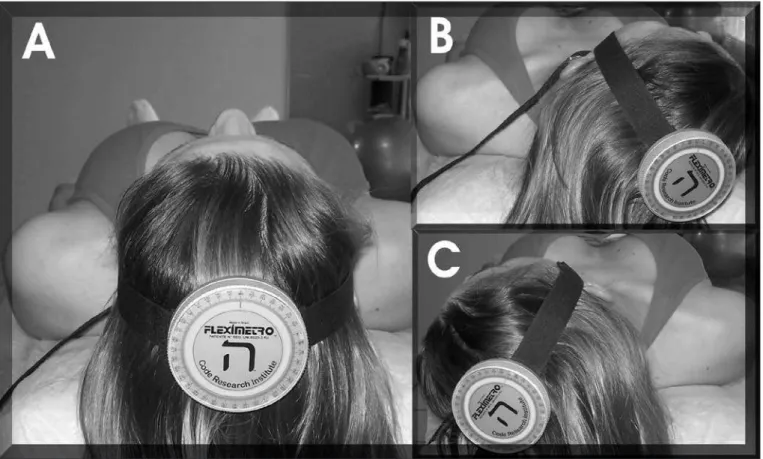
Cervical rotation amplitude was measured with a Brazilian leximeter, brand Instituto Code de Pesquisa (Reg. UM. 8320-3 – RJ – Brazil)23. Fleximeter was placed on the vertex of the
head being zero degree aligned by the base of the nose (Figure 1) and maximum active head rotation to the right was re-quested (Figure 1). ROM degrees indicated by the equipment were recorded. he same procedure was performed for the left side (Figure 1). All individuals have received previous orienta-tion: rotation movement looking the maximum to the right and then looking the maximum to the left, avoiding compen-sations, such as extension or lateral inclination. he pillow has helped and prevented cervical extension compensation, but not mild lateral inclination, both physiological.
Osteopathic manipulation – cervical rhythmic articula-tory technique
Figure 1: A: Fleximetry in zero degree, B and C: rotation leximetry
Figure 2: Osteopathic manipulation cervical rhythmic articulatory technique (A) Sliding in “8”, (B) C1-C2, C3 rotation.
Rest
Individuals were oriented to relax and rest for ive minutes aiming at decreasing muscle tone.
Statistical analysis
Descriptive statistical methods were used (mean, minimum, maximum and standard deviation) and Student’s t test for paired data was used to compare CF and SF, considering sig-niicant 0.05 (5%). Computer program used was Excel 2010 (Microsoft).
his study was approved by the Research Ethics Committee, Clinicas Hospital, Federal Unversity of Paraná, registration 2233.127/2010-06.
RESULTS
Table 1 shows ROM diferences in left and right rotation de-grees between leximetries before and after OM-CRAT, that is CF and SF. In average, there has been signiicant ROM improvement in all cases. For example, right rotation has in-creased from 75.1º to 81.0o. Total rotation was the sum of
left and right rotations and mean has increased from 151.4º to 162.5º.
Table 2 shows comparison between CF and SF means. he comparison between means by Student’s t test for paired data with signiicance level of 0.05 (5%) shows that mean rotation increase was signiicant for all cases.
Table 3 presents percentage of cervical range of rotation in-crease after OM-CRAT, which has been signiicant for all
cases, both for left and right rotation and total arch move-ment rotation.
Additional data
CF has shown that 22.4% (13 cases) were below 140º and 13,8% (8 cases) were above 180º, being that in SF 10.3% (6 cases) have remained below 140o and 17.2% (10 cases) have remained above
180o. here has been leximetry diference in the age group from
20 to 29 years (n=12 individuals) as compared to the group from 30-45 years (n=46 individuals), where mean and standard devia-tion were as follows: 20-29 group with 162o rotation (SD=24)
and 30-45 group with 149o rotation (SD=20).
here has been prevalence of T1 dysfunction or hypomobility to the atlanto-occipital joint (or OC) obtained by OM-CRAT, which is also an evaluation technique, however subjective and dependent on professional experience. Results were accord-ing to the vertebral hypomobility side (interfacet joint). Most prevalent vertebra with dysfunction (hypomobility) was C3. he order of prevalence considering each side of the vertebra (joint facet) was left C3 (37.9%), right C6 (31.0%), right C5 (17.2%) and, with the same prevalence (15.5%) C2, right C4 and OC pseudorotation (left and right), right C7 (13.8%), and so on. Lowest hypomobility incidence was observed in T1 and C1 (both with 1.7%). Atlas dysfunction (C1) was in left laterality and some secondary dysfunctions in rotation. For occipital condyle (OC) dysfunctions, there has been one case of bilateral dysfunction (in lexion or extension) and pseudorotation cases (anterior OC in one side and posterior OC in the other) and unilateral dysfunction.
Table 1. Fleximetry descriptive statistics (in degrees)
Fleximetry n Mean Minimum Maximum Standard deviation
Left rotation – CF 58 76.3 50.0 110.0 12.30
Left rotation – SF 58 81.5 63.0 109.0 10.49
Right rotation – CF 58 75.1 52.0 100.0 11.27
Right rotation – SF 58 81.0 58.0 107.0 9.62
Total rotation – CF 58 151.4 107.0 190.0 21.23
Total rotation – SF 58 162.5 121.0 205.0 18.01
CF: control leximetry (before osteopathic manipulation cervical rhythmic articulatory technique (OM-CRAT)); SF: study leximetry (after OM-CRAT).
Table 2. Comparison between control and study leximetry means
Fleximetry n Mean - CF Mean - SF p value
Left rotation 58 76.3 81.5 0.0000*
Right rotation 58 75.1 81.0 0.0000*
Total rotation 58 151.4 162.5 0.0000*
CF: control leximetry (before OM-CRAT); SF: study leximetry (after OM-CRAT).
Table 3. Percentage increase of control leximetry mean rotations as compared to study leximetry
Cervical rotation Calculation for difference CF & SF Rotation increase percentage
Left rotation (81.5 – 76.3)/76.3 = 0.068 (6.8)
Right rotation Total rotation
(81.0 – 75.1)/75.1 (162.5 – 151.4)/151.4
DISCUSSION
After OM-CRAT some individuals have reported muscle re-laxation or body comfort sensation. No participant had pain-ful symptoms immediately after OM-CRAT. his study has not aimed at verifying changes in pain severity and posture, but results suggest that decreased ROM is related to the pres-ence of somatic vertebral dysfunctions and muscle tension, because after OM-CRAT there has been signiicant cervical rotation ROM improvement conirmed by leximetry, among other potential beneits and correlations which may occur ac-cording to the following descriptions: OM signiicantly im-proves pain, mobility and functional capacity3,7,13-19. ROM
may decrease with age10-12 and with the presence of somatic
vertebral dysfunctions, including cervical dysfunction3-5,7.
here has been no signiicant diference in the randomization with alternate sequence of procedures (group A: OM-CRAT/ rest, and group B: rest/OM-CRAT), where group B should have had further beneits with the passive OM-CRAT tech-nique due to previous relaxation time. In group A, SF was 5 min and 20s after OM-CRAT and in group B SF was immedi-ately after OM-CRAT. his shows that the efect of the tech-nique to improve ROM is regardless of rest period being before or after OM-CRAT and has immediate efect which may last for more than 5 min. It is believed that the efect of the tech-nique may last for weeks or months, and long term studies are needed. According to the literature, the efect of rest on OM-CRAT would be that rest would decrease muscle activity24,25.
With regard to additional data, total leximetry has shown that some cases were below normal ROM and others were above normal ROM, being most within normal ROM estab-lished by the theory. his number of cases was decreased after OM-CRAT, as shown by SF. According to the theory, normal active rotation is approximately 70o to 90o to each side or
140o to 180o of total rotation arch12,23.
Other additional data have shown ROM decrease with age and CF showed less ROM with regard to theory10-12. ROM changes
conirmed by CF and SF may be related to the somatic verte-bral dysfunction theory3,7 and to mechanical neck pain1,22.
Some cases, at CF, had excessive ROM to one side and de-creased ROM to the other and, in SF, the excessive side has decreased ROM and the side with reduction has increased ROM, that is, there has been a search for ROM balance be-tween sides.
OM-CRAT as physical vertebral evaluation technique may be considered subjective and dependent on professional ex-perience; even so, it was considered relevant to present our results which were related to the osteopathic clinic theory. Additional data have shown signiicant presence of somatic neck dysfunctions (joint hypomobility) which, according to the literature, are associated to decreased neck ROM1,3-5,7.
OM-CRAT was efective for cervical rotation ROM gain and may be a treatment alternative for situations where there is ROM loss because, according to the literature, ROM loss and somatic dysfunctions may be related to neck pain, cervico-brachialgia, cervicogenic headache, temporomandibular joint
disorders, spinal osteoarthritis, etc.1,3-5,7,15,18,19. One may say
that OM-CRAT acts as prevention and treatment of mechan-ical neck pain and spinal arthritis because, according to the literature, vertebral and myofascial dysfunctions are related to joint movement loss, as well as to the arthritis process1,3-5,9,11.
CONCLUSION
Diferences in cervical rotation leximetry before (CF) and af-ter (SF) OM-CRAT application have shown signiicant range of motion improvement, from 151.4o to 162.5o (7.3%
im-provement), being signiicant for all cases. OM-CRAT was ef-fective for cervical rotation range gain and may be a treatment alternative for diseases related to vertebral hypomobility, such as neck pain and cervical arthritis.
ACKNOWLEDGMENTS
To all supporters and people in charge of this scientiic re-search, including professors and other professionals of Tuiuti University of Paraná, of the Clinicas Hospital, Federal Uni-versity of Paraná, Escuela de Osteopatia de Madrid, my aunt Viviane R. Zurro and my wife Karin Teuber Stelle.
REFERENCES
1. Bevilagua-Grossi D, Pegoretti KS, Gonçalves MC, Speciali JG, Bordini CA, Bigal ME. Cervical mobility in women with migraine. Headache. 2009;49(5):726-31. 2. Armijo Olivo S, Magee DJ, Paritt M, Major P, hie NM. he association between
the cervical spine, the stomatognathic system, and craniofacial pain: a critical review. J Orofac Pain. 2006;20(4):271-87.
3. Roberge RJ, Roberge MR. Overcoming barriers to the use of osteopathic manipula-tion techniques in the emergency department. West J Emerg Med. 2009;10(3):184-9. 4. Jasiewics JM, Treleaven J, Condie F, Jull G. Wireless orientation sensors: their suitability to measure head movement for neck pain assessment. Man her. 2007;12(4):380-5.
5. Strimpakos N, Sakellari V, Gioftsos G, Papathanasiou M, Brountzos E, Kelekis D, et al. Cervical spine ROM measurements: optimizing the testing protocol by using a 3D ultrasound-based motion analysis system. Cephalalgia. 2005;25(12):1133-45. 6. Fryer G, Morris T, Gibbons P. Paraspinal muscles and intervertebral dysfunction. J
Manipulative Physiol her. 2004;27(4):267-74.
7. Glossary of Osteopathic Terminology. AACOM. November 2011:28,53. Disponível em: http://www.aacom.org/resources/bookstore/Documents/GOT2011ed.pdf. 8. Mansilla-Ferragut P, Fernández-de-Las-Penãs C, Albuquerque-Sendínin, Cleland JA,
Boscá-Gandía JJ. Immediate efects of atlanto-occipital joint manipulation on active mouth opening and pressure pain sensitivity in women with mechanical neck pain. J Manipulative Physiol her. 2009;32(2):101-6.
9. Lakshmanan P, Jones A, Howes J, Lyons K. CT evaluation of the pattern of odontoid fractures in the elderly: relationship to upper cervical spineosteoarthritis. Eur Spine J. 2005;14(1):78-83.
10. Sforza C, Grassi G, Fragnito N, Turci M, Ferrario V. hree-dimensional analysis of active head and cervical spine range of motion: efect of age in healthy male subjects. Clin Biomech. 2002;17(8):611-4.
11. Wolfenberger VA, Bui Q, Batenchuk GB. A comparison of methods of evaluating cervical range of motion. J Manipulative Physiol her. 2002;25(3):154-60. 12. Youdas JW, Garret TR, Suman VJ, Bogard CL, Hallman HO, Carey JR.
Nor-mal range of motion of the cervical spine: an initial goniometric study. Phys her. 1992;72(11):770-80.
13. Cleland JA, Mintken PE, Carpenter K, Fritz JM, Glynn P, Whitman J, Childs JD. Examination of a clinical prediction rule to identify patients with neck pain likely to beneit from thoracic spine thrust manipulation and a general cervical range of motion exercise: multi-center randomized clinical trial. Phys her. 2010;90(9):1239-50. 14. Silva GR, Martins PR, Gomes KA, et al. O efeito de técnicas de terapias manuais nas
disfunções craniomandibular. Rev Bras Cien Med Saúde. 2011;1(1):17-22. 15. Martínez-Segura R, Fernández-de-las-Peñas C, Ruiz-Sáez M, Lópes-Jiménez C,
16. Maigne JY, Vautravers P. Mecanismo de acción del tratamiento manipulativo verte-bral. Osteopatía científica. 2011;6(2):61-66.
17. Pickar JG, Kang YM. Paraspinal muscle spindle responses to the duration of a spinal manipulation under force control. J Manipulative Physiol her. 2006;29(1):22-31. 18. Creighton D, Kondratek M, Krauss J, Huijbregts P, Qu H. Ultrasound analysis of the
vertebral artery during non-thrust cervical translatoric spinal manipulation. J Man Manip her. 2011;19(2):84-90
19. de Camargo VM, Albuquerque-Sendín F, Bérzin F, Stefanelli VC, de Souza DP, Fer-nández-de-las-Peñas C. Immediate efects on electromyographic activity and pressure pain thresholds after a cervical manipulation in mechanical neck pain: a randomized controlled trial. J Manipulative Physiol her. 2011;34(4):211-20.
20. Florêncio LL, Pereira PA, Silva ER, Pegoretti KS, Gonçalves MC, Bevilaqua-Grossi D. Agreement and reliability of two non-invasive methods for assessing cervical range of motion among young adults. Rev Bras Fisioter. 2010;14(2):175-81.
21. Chaves TC, Nagamine HM, Belli JF, Hannai MC. Reliability of leximetry and go-niometry for assessing cervical range of motion among children.Rev Bras Fisioter. 2008;12(4):283-9.
22. Malmström EM, Karlberg M, Melander A, Magnusson M. Zebris versus Myrin: a comparative study between a three-dimensional ultrasound movement analysis and an inclinometer/compass method: intradevice reliability, concurrent validity, in-tertester comparison, intratester reliability, and intraindividual variability. Spine. 2003;28(21):433-40.
23. Swartz EE, Floyd RT, Cendoma M. Cervical spine functional anatomy and the bio-mechanics of injury due to compressive loading. J Athl Train. 2005;40(3):155-61. 24. Bigongiari A, Franciulli PM, Souza FA, et al. Análise da atividade eletromiográica de
superfície de pontos gatilhos miofasciais. Rev Bras Reumatol. 2008;48(6):319-24. 25. Simons DG. Review of enigmatic MTrPs as a commom cause of enigmatic