Prognostic Relevance of the Histological Subtype of Renal Cell
Carcinoma
Marcos F. Dall’Oglio, Alberto A. Antunes, Antonio C. Pompeo, Alcides Mosconi, Katia R. M.
Leite, Miguel Srougi
Division of Urology, School of Medicine, University of Sao Paulo, USP, Sao Paulo, SP, Brazil
ABSTRACT
Objective: According to several studies, when the histological subtype of renal cell carcinoma is established it is possible to attribute a different life expectancy to each patient. We analyzed the prognostic significance of the histological subtype in renal cell carcinoma.
Materials and Methods: The authors retrospectively analyzed the follow-up of 230 patients after radical or conservative renal surgery. The histological characteristics of the different subtypes of tumor were obtained and the disease-free and cancer-specific survival curves for the clear cell, cromophobic, papillary, collecting duct (Bellini) subtypes and those with sarcomatoid differentiation were individualized.
Results: The disease-free and cancer-specific survival rates for clear cell tumors were 76.6% and 68.0% respectively, 71.2% and 82.1% respectively for the cromophobic type, 71.1% and 79.8% respectively for the papillary type, 26.9% and 39.3% respectively for the sarcomatoid type, and 0.0% and 0.0% respectively for the collecting ducts (p < 0.001).
Conclusion: The histological subtypes of renal tumors can stratify patients into different prognostic groups only when the sarcomatoid differentiation is present.
Key words: renal cell carcinoma; prognosis; histology; survival
Int Braz J Urol. 2008; 34: 3-8
INTRODUCTION
The distinct histological subtypes of renal cell carcinoma (RCC) have been widely studied as an in-dependent prognostic factor. The histological classifi-cation has recently been internationally standardized and accepted (1). However, the aggressive behavior of each biological pattern is still under discussion.
The most common RCC subtypes are: clear cell (75%); papillary (15%); cromophobic (5%) and collecting duct carcinoma (2%) (2). Sarcomatoid de-generation may occur in any of the four RCC
sub-types (1) and increases the risk related to the aggres-siveness of the disease.
Whether the histological types of RCC present differences regarding the survival rate is still a controversial issue (3-7). The aim of this study was to evaluate the RCC behavior after surgical treatment by histological subtype.
MATERIALS AND METHODS
institu-tion between March/1991 and June/2003 were as-sessed retrospectively. Their ages ranged from 44 to 80 years (median 63 years). The group evaluated was homogeneous and the follow-up occurred between three and two hundred months (median 48 months). The surgeries performed were 168 radical nephrec-tomies (73%), 44 enucleation (19%), and 18 polar nephrectomies (8%).
The surgical specimen for pathological analy-sis was fixed in formalin, soaked in paraffin, sectioned and fixed in the usual way with eosin-hematoxylin (EH). Classification by histological subtypes: (clear cell, papillary cromophilic), cromophobic and collect-ing duct was undertaken. Further, sarcomatoid differ-entiation, characterized by the stretching of the tumor cells, nuclear grade, pleomorphism, mitotic index and tumor necrosis, was analyzed. Immunohistochemical analysis was performed on eight patients with sarco-matoid differentiation tumors only and confirmed the presence of an epithelial component. The other seven had sarcomatoid differentiation in association with clear cell carcinoma.
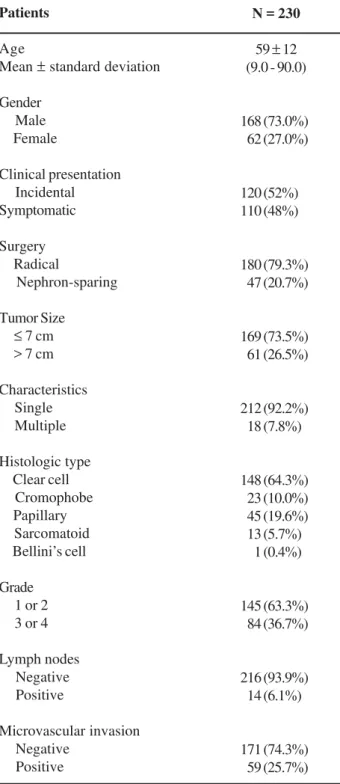
All patients were evaluated according to age, gender, symptoms upon presentation, disease stage, pathologic characteristics, administration of adjuvant im-munotherapy, time to disease recurrence, and survival. The demographic data is showed in the Table-1.
The follow-up after surgery was based on thorax X-ray, computerized tomography and/or ab-dominal ultrasound and hematological tests each four months during the first year, once per semester from the second to fifth years and annually thereafter.
The survival curve analysis was carried out by the Kaplan-Meier statistical method and the log Rank test was used to compare data. Statistical sig-nificance was considered as a p < 0.05.
RESULTS
Of the 230 tumors, there were 148 clear cell tumors (64%), 46 cromophilic tumors (20%), 23 cromophobic tumors (10%), 15 sarcomatoid tumors (5.6%) and 1 Bellini’s duct tumor (0.4%).
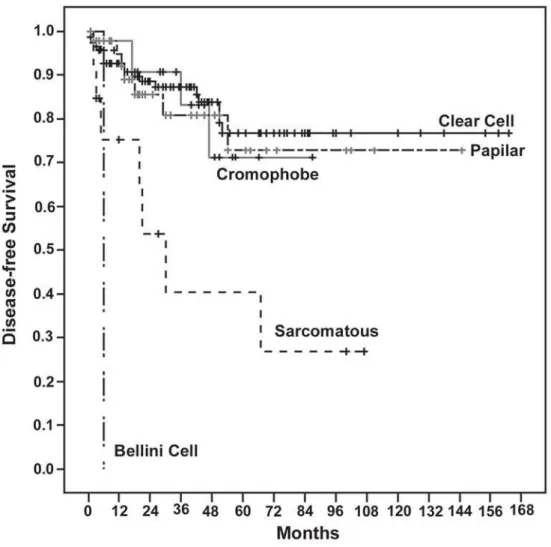
Regarding histological type, there was a 76.6% disease-free survival rate for the clear cell type, 71.2%
for the cromophobic type, 71.1% for the papillary type, 26.9% for the sarcomatoid type, and 0.0% for the Bellini duct type (Figure-1). The cancer-specific
sur-Table 1– Demographic data.
N = 230
59 ± 12 (9.0 - 90.0)
168 (73.0%) 062 (27.0%) 120 (52%) 110 (48%) 180 (79.3%) 047 (20.7%) 169 (73.5%) 061 (26.5%) 212 (92.2%) 018 (7.8%) 148 (64.3%) 023 (10.0%) 045 (19.6%) 013 (5.7%) 001 (0.4%) 145 (63.3%) 084 (36.7%) 216 (93.9%) 014 (6.1%) 171 (74.3%) 059 (25.7%) Patients Age
Mean ± standard deviation
Gender Male Female Clinical presentation Incidental Symptomatic Surgery Radical Nephron-sparing Tumor Size ≤ 7 cm > 7 cm
Characteristics Single Multiple Histologic type Clear cell Cromophobe Papillary Sarcomatoid Bellini’s cell Grade 1 or 2 3 or 4
vival rate was 68.0% for the clear cell histological type, 82.1% for the cromophobic, 79.8% for the pap-illary, 0.0% for the sarcomatoid and the Bellini duct (Figure-2).
For the sarcomatoid pattern, many tumors were medium size 9.5 cm (4 to 24 cm), and 86.6% were high-grade tumors and stage PT3-T4.
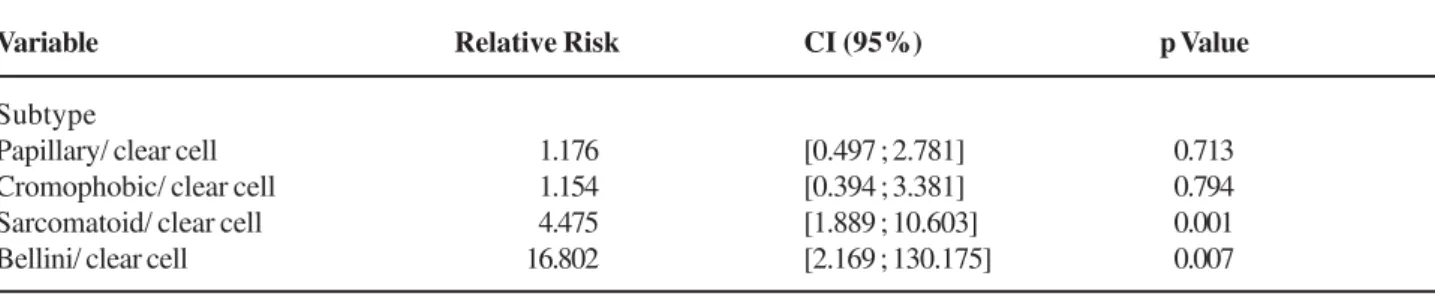
However, there was no statistical difference as regards survival rates for the distinct histological subtypes, except when there was an association with the sarcomatoid pattern (Figures-1 and 2). The pres-ence of only one patient with the Bellini duct subtype with extremely aggressive behavior was insufficient for more accurate evaluation. However, every time the different histological types were compared with
the common type (clear cell) with the Cox regression model for recurrence (Table-2), the risk was higher only in this single case (Bellini duct) and with the sar-comatoid tumors with a large confidence interval.
COMMENTS
Our study demonstrated that there was no difference regarding tumor behavior among the RCC histological subtypes, nor as regards survival rates related to the clear cell, papillary and cromophobic subtypes. The collecting duct subtype only occurred in one patient and led to premature death. Sarcoma-toid degeneration associated with the clear cell
Table 2 - Cox regression model for recurrence.
Variable
Subtype
Papillary/ clear cell Cromophobic/ clear cell Sarcomatoid/ clear cell Bellini/ clear cell
Relative Risk
01.176 01.154 04.475 16.802
CI (95%)
[0.497 ; 2.781] [0.394 ; 3.381] [1.889 ; 10.603] [2.169 ; 130.175]
p Value
0.713 0.794 0.001 0.007 type occurred in half of the cases, and life
expect-ancy dropped in these cases from 71-75% to 39% over five years.
It is believed that the cromophobic subtype has a better prognosis than the conventional clear cell
subtype, and that the papillary subtype is of interme-diate behavior (8). The renal cromophobic carcinoma seems to have a better prognosis than the clear cell subtype (9), however this is controversial since the series are short, the tumors were low grade, were
discovered in the initial stages, and presented behav-ior similar to that of the clear cell subtype (10). The cromophobic tumor was more indolent with a tendency to remain organ confined even when it grows (11), and affording a better survival rate than the clear cell subtype (78% versus 50%) (12). Aggressive variants of the cromophobic RCC have been described (13), which justifies further investigation.
Our study showed that all histological sub-types had similar behaviors. However, the survival time was reduced when sarcomatoid degeneration oc-curred. Another point to be emphasized is the clear cell association with the sarcomatoid pattern in 45% (7/15) of the cases. Among the cases of RCC, the sarcomatoid differentiation occurs within a range of 2% to 5%, frequently associated with the conventional clear cell carcinoma (14).
Usually, the papillary subtype is associated with a better prognosis than the clear cell pattern (15). Thus, the new classification divided it into type 1 (ba-sophilic) and type 2 (eosinophilic), thus its behavior is distinct, type 2 tumors being more aggressive, gener-ally of high grade and at more advanced stages (12). Solid papillary RCC variations identified only by cyto-genetic analysis may be responsible for more aggres-sive behavior (4).
The collecting duct tumors are highly aggres-sive and develop systemic metastases rapidly (16). In this study, only one patient that presented RCC at the collecting ducts underwent nephrectomy and died six months later. There is a consensus that the collecting duct carcinoma (or Bellini’s) is very rare (< 1%) and has a worse prognosis with the development of early metastases (11, 16, 17) and death in 67% (11) of pa-tients during the first two years. However, MacLennan et al. (18) identified collecting duct tumors with lesser aggression in RCC.
The metastatic potential of RCC shows that the aggression seems to be greater in the clear cell subtype (65%), decreases in the papillary (14%; in-termediary risk), and is least in the cromophobic sub-type (8%; lower risk) (19).
In our series we found no statistical signifi-cant differences among the histological types regard-ing the survival rate or recurrence, except as com-pared to tumors with sarcomatoid degeneration (mean
survival: 5 years - 40%, 10 years - 0%). However, Patard et al. (20) confirm the relative prognostic im-portance of histological subtype as compared to grade and stage. Our results may reflect the fact that pa-tients in Brazil are presenting with larger (more than a quarter had tumors > 7 cm) and more symptomatic tumors (almost 50%) and survival differences are elimi-nated across histological subtypes that when occurs.
CONCLUSION
The histological subtypes of renal tumors rep-resent an ominous prognostic factor only when there is associated sarcomatoid degeneration.
CONFLICT OF INTEREST
None declared.
REFERENCES
1. Storkel S, Eble JN, Adlakha K, Amin M, Blute ML, Bostwick DG, et al.: Classification of renal cell carci-noma: Workgroup No. 1. Union Internationale Contre le Cancer (UICC) and the American Joint Committee on Cancer (AJCC). Cancer. 1997; 80: 987-9.
2. Curti BD: Renal cell carcinoma. JAMA. 2004; 292: 97-100.
3. Medeiros LJ, Gelb AB, Weiss LM: Renal cell carci-noma. Prognostic significance of morphologic param-eters in 121 cases. Cancer. 1988; 61: 1639-51.
4. Amin MB, Corless CL, Renshaw AA, Tickoo SK, Kubus J, Schultz DS: Papillary (chromophil) renal cell carcinoma: histomorphologic characteristics and evalu-ation of conventional pathologic prognostic param-eters in 62 cases. Am J Surg Pathol. 1997; 21: 621-35. 5. Renshaw AA, Richie JP: Subtypes of renal cell
carci-noma. Different onset and sites of metastatic disease. Am J Clin Pathol. 1999; 111: 539-43.
6. Akhtar M, Kardar H, Linjawi T, McClintock J, Ali MA: Chromophobe cell carcinoma of the kidney. A clinico-pathologic study of 21 cases. Am J Surg Pathol. 1995; 19: 1245-56.
char-acteristics and evaluation of prognosis in 42 patients. BJU Int. 1999; 83: 937-43.
8. Kattan MW, Reuter V, Motzer RJ, Katz J, Russo P: A postoperative prognostic nomogram for renal cell car-cinoma. J Urol. 2001; 166: 63-7.
9. Frank I, Blute ML, Cheville JC, Lohse CM, Weaver AL, Zincke H: An outcome prediction model for pa-tients with clear cell renal cell carcinoma treated with radical nephrectomy based on tumor stage, size, grade and necrosis: the SSIGN score. J Urol. 2002; 168: 2395-400.
10. Mejean A, Oudard S, Thiounn N: Prognostic factors of renal cell carcinoma. J Urol. 2003; 169: 821-7.
11. Kontak JA, Campbell SC: Prognostic factors in renal cell carcinoma. Urol Clin North Am. 2003; 30: 467-80. 12. Moch H, Gasser T, Amin MB, Torhorst J, Sauter G,
Mihatsch MJ: Prognostic utility of the recently recom-mended histologic classification and revised TNM stag-ing system of renal cell carcinoma: a Swiss experience with 588 tumors. Cancer. 2000; 89: 604-14.
13. Renshaw AA, Henske EP, Loughlin KR, Shapiro C, Weinberg DS: Aggressive variants of chromophobe renal cell carcinoma. Cancer. 1996; 78: 1756-61.
14. Mydlo JH, Bard RH: Analysis of papillary renal adeno-carcinoma. Urology. 1987; 30: 529-34.
15. Carter MD, Tha S, McLoughlin MG, Owen DA: Col-lecting duct carcinoma of the kidney: a case report and review of the literature. J Urol. 1992; 147: 1096-8. 16. Kennedy SM, Merino MJ, Linehan WM, Roberts JR,
Robertson CN, Neumann RD: Collecting duct carci-noma of the kidney. Hum Pathol. 1990; 21: 449-56. 17. Chao D, Zisman A, Pantuck AJ, Gitlitz BJ, Freedland
SJ, Said JW, et al.: Collecting duct renal cell carcinoma: clinical study of a rare tumor. J Urol. 2002; 167: 71-4. 18. MacLennan GT, Farrow GM, Bostwick DG: Low-grade
collecting duct carcinoma of the kidney: report of 13 cases of low-grade mucinous tubulocystic renal carci-noma of possible collecting duct origin. Urology. 1997; 50: 679-84.
19. Kovacs G, Akhtar M, Beckwith BJ, Bugert P, Cooper CS, Delahunt B, et al.: The Heidelberg classification of renal cell tumours. J Pathol. 1997; 183: 131-3.
20. Patard JJ, Leray E, Rioux-Leclercq N, Cindolo L, Ficarra V, Zisman A, et al.: Prognostic value of histologic sub-types in renal cell carcinoma: a multicenter experience. J Clin Oncol. 2005; 23: 2763-71.
Accepted after revision: April 25, 2007
Correspondence address: Dr. Marcos F. Dall’Oglio Rua Barata Ribeiro, 398 / 501 São Paulo, SP, 01308-000, Brazil Fax: + 55 11 3159-3618