Abstract
An existing cut slope on Highway RS-471/BR-153 is studied. The slope is composed of the Serra Geral Formation's material: a highly altered volcanic breccia and above it a slightly altered and very fractured rhyolite. A numerical analysis of the slope is carried out in two dimensions. Fracturing of the rhyolite necessitates the use of a constitutive model for materials with families of discontinuities (Ubiquitous-joint). To simplify the analysis of the problem and to examine some of the most sensitive variables, two more analyses are made, replacing the initial model by a Mohr’s constitutive model, which considers the material as continuous. The results obtained from the Ubiquitous-joint model provide an acceptable representation of the ield conditions, showing a failure mechanism type of rockfall from the face of the slope in the rhyolite, and the rupture surface of the breccia, without propaga-tion of surface failure. In the analysis, when considering both materials as continuous, it is not possible to take account the fault conditions simultaneously, and this analysis also re-quires values of the mechanical parameters different from those recommended in literature.
Keywords: Volcanic breccia; Serra Geral Formation; Ubiquitous-joint; numerical models.
Ricardo Hundelshaussen Rubio Engenheiro Industrial, MSc, Doutorando Universidade Federal do Rio Grande do Sul - UFRS Departamento de Engenharia de Minas
Porto Alegre - Rio Grande do Sul - Brasil [email protected]
Jorge Hernan Florez Engenheiro Civil, Doutorando
Universidade Federal do Rio Grande do Sul - UFRS Departamento de Engenharia Civil
Porto Alegre - Rio Grande do Sul - Brasil [email protected]
André Cezar Zingano
Professor, Coordenador de mineração, Doutorando Universidade Federal do Rio Grande do Sul - UFRS Departamento de Engenharia de Minas
Porto Alegre - Rio Grande do Sul - Brasil [email protected]
Slope stability analysis
at highway BR-153
using numerical models
Mining
Mineração
http://dx.doi.org/10.1590/0370-44672015690040
1. Introduction
In general, numerical studies of slope stability, besides requiring good characterization of the materials involved, need prior knowledge about the possible mechanisms and situations that could lead the system to rupture. Analysis of slope stability using the limit equilibrium meth-od, even though it allows consideration of different layers in each case, does not take account of the effect of excessive mass deformations or of the structural control by the discontinuities that occur mainly in rocky layers. The level of fracture of a
rocky mass is closely related to the failure system that it may develop, as discussed by Norrish and Wyllie (1996). In the same paper, these authors describe cases where the level of fracture of the rocky mass is very high, in which structural control by the discontinuities may be less important than the overall conditions of resistance, which are capable of causing a rotational rupture, as is well known in homogeneous slopes formed by cohesive soil.
The present paper describes a study of a slope located in the state of
Rio Grande do Sul, Southern Brazil, in a section of Highway RS-471/BR-153 between the cities of Barros Cassal and Vera Cruz (see Figure 1), inaugurated at the end of 2010. The slope analyzed has not generated global conditions for rup-ture since its opening during the course of this investigation. This work aims to obtain a single representative numerical model for the ield conditions and those assumed in the study, through variations in the mechanical properties of the slope, as in the case of a continuous model.
2. Characterization of the area of study
The area of study is located in the acid sequence of the Serra Geral Formation (IBGE 1986), which is composed of rhyolites over a modiied volcanic breccia layer. This breccia is not related to acid spill, and so it can be inferred that the arrangement is a result of contact between the basic
sequence (with the volcanic breccia on the top) and the acid sequence (with the rhyolite as its base). The studied slope is at k55+340 of the construction project, between altitudes of 505 and 480 m, corresponding to a half-hillside and a homogeneous cut section. No regional faulting is found at this point
Figure 1
Location of the area of study in the state of Rio Grande do Sul (modified from DAER, 2002).
Figure 2
(a) Overview of the studied slope. (b) Fracture condition on the rhyolite layer.
(a) (b)
2.1 Geotechnical Parameters
The determination of physical characteristics and the resistance pa-rameters for the volcanic breccia was done by the Laboratory of Soil
Mechanics of the Federal University of Rio Grande do Sul, at the request of the design company for the project (ECOPLAN Engineering). The values of
the angles of friction and the cohesion were estimated from the results of CIU triaxial tests, made in undisturbed test bodies (see Figure 3).
Figure 3
Deviatoric stress versus axial
strain for k55+340 (LMS-UFRGS 2004).
Table 1 summarizes the values obtained in the laboratory for the volcanic breccia. The modulus of
elasticity was calculated from linear elastic sections obtained from each of the triaxial compression tests. The
Owing to a lack of test results for the rhyolite, the mechanical properties
of the particles were taken as estimated by Hoek and Brown (1997) for very
good quality hard rock masses, listed in Table 2.
Parameter Value
Density d 26 kN/m3
Angle of friction (at peak) φ′p 46°
Cohesion c′p 13 MPa
Modulus of elasticity E 42000 MPa
Poisson coefficient µ 0.2
Table 2 Summary of the parameters of the broken rhyolite (Hoek and Brown 1997).
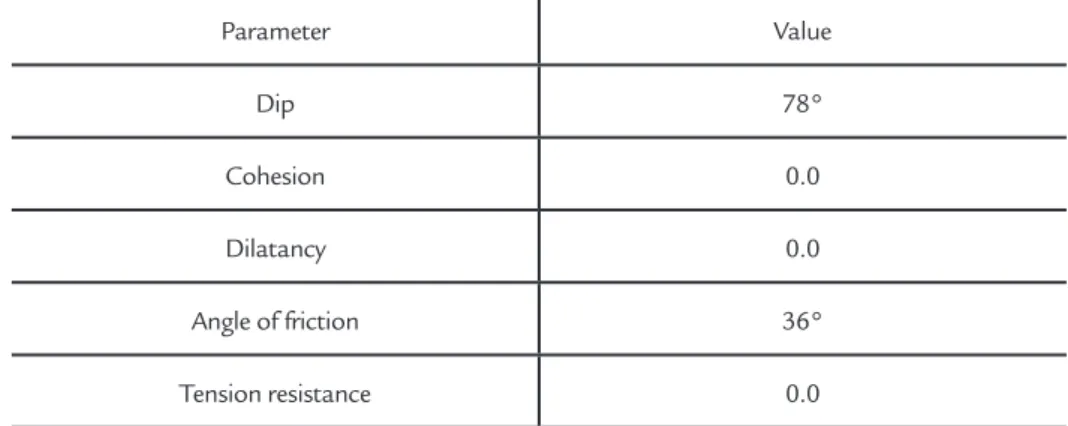
Table 3 summarizes the param-eters for the discontinuities of the rhyolite. These discontinuities were considered to be plain and with no inill-ings, and therefore the values of cohe-sion, dilatability, and tension resistance were taken as zero. The results for the
discontinuities were obtained through ield and laboratory studies for a sec-tion located between secsec-tions 55+840 and 56+200; however, in geologic and geotechnical terms, they are considered parts of the same project unit. An inter-face was established between the two
layers, which allowed neither relative slipping between the two layers nor their separation, but only elastic dis-placements. The tangential and normal rigidities were considered to be equal. Thus, the value taken for this interface was KN = KS = 253.33 MPa/m.
Table 3 Summary of the parameters for the discontinuities of the rhyolite (DAER 2010).
Parameter Value
Dip 78°
Cohesion 0.0
Dilatancy 0.0
Angle of friction 36°
Tension resistance 0.0
2.2 Structural model and element mesh for numerical analysis
Figure 4 presents the model tobe evaluated, including the system of discontinuities of the rhyolite. For the analyses ignoring the presence of discontinuities, the geometry of the
section remains constant, with some of the material properties being modi-ied in an attempt to reproduce the rupture mechanism from the irst case. The material parameters for the mass
without discontinuities are obtained as part of the results of the simulation process. Figure 5 presents the element mesh for this analysis, as well as the boundary conditions imposed on the
Parameter Value
Liquid limit LL 51.4 %
Plastic limit LP 38.1 %
Plasticity index Ip 13.3%
Density d 28.84 kN/m3
Angle of friction (at peak) φ’p 15.25°
Cohesion c′ 138.77 kPa
Modulus of elasticity E 146.63 MPa
Poisson coefficient µ 0.35*
*Parameter obtained from the current literature
3. Results
Results are presented for the three types of simulation conditions: a
discon-tinuous rocky mass, a condiscon-tinuous mass with a lat rupture, and a continuous mass
with a deep rupture.
Figure 4
Model of the evaluated section.
Figure 5
Mesh of elements with fixed areas.
3.1 Discontinuous rocky mass
To obtain a model that represents the current degree of fracture in the rocky mass, the Ubiquitous-joint model available in FLAC was applied. Since the simulation was carried out in two dimensions, only the discontinuities perpendicular to the model were taken into account. This type of constitutive model, besides allowingrupture surfaces for continuum materials according to the Mohr–Coulomb criterion, allows visualization of the effects of rup-tures associated with sliding along different discontinuities. Figure 6 presents different states for the elements of which the model is composed, enabling visualization of the elements under instability, either for the
curved surfaces of rupture (see the volcanic breccia) or for the sliding of the elements along the discontinuities. In the center of the rhyolite mass, it is also possible to observe the presence of consistent slide surfaces with the formation of alleviating tensions caused by the lateral expansion (in the lower part of the rhyolite layer).
The distribution of displacement vectors presented in Figure 7 conirms the main source of rock particle falls, which are deposited on the lower part of the slope as well as on the highway (see Figure 2b). There exist a few points
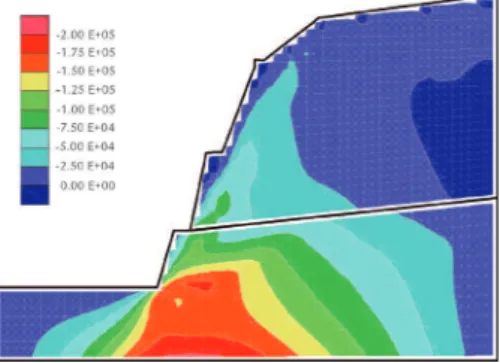
of origin of rock falls in the upper part of the layer, mainly caused by the slope declivity angle. The distribution of shear stress presented in Figure 8 is consistent with the condition imposed on the interface between the two layers,
namely, continuity of stresses above and below it. The highest levels of tension arise at the foot of the slope, reaching yielding levels in the breccia and caus-ing local rupture of the material (see Figure 2a).
Figure 6
States of the model (with Ubiquitous-joint).
model. The thick black line indicates the interface deined by the material
change. The analysis of the model for each condition was performed using
3.2 Continuous mass with flat rupture
In this case, a lat rupture similar to those obtained using the Ubiquitous-joint model was made, but for a rocky mass with no fractures or systems of discontinuities. As such, some variations were necessary: considering the rhyolite layer as a continuum and modifying its properties of resistance to a lat rupture in the rock layer, rather than to a deep rupture controlled by the volcanic breccia. Hoek and Brown (1997) suggest a reduction in the properties of the rock if it is fractured, and when the mass is conined.Because of the geometry of the slope, it is not possible to consider this mass as conined, and also the value for the angle of declivity of the slope has a strong effect on the volume of the material in rupture. The geotechnical parameters applied in this analysis were con-stant for the breccia; for the rhyolite, after multiple iterations with small increases, the following inal values were adopted:
• cohesion = 0.0, • angle of friction = 69°.
Figure 9 shows the results of this
simulation. The properties of the breccia were not decreased, since the existence of a rupture surface in the breccia inluences its propagation along the rhyolite layer. For the given angle of declivity of the slope, the angle of friction for the rhyolite given by the simulation is not consistent with any values in literature: however, it does predict shallow failures (see Figure 10). These lat ruptures retain the form predicted by a Mohr–Coulomb model, exhibiting a rupture surface curve.
Figure 8 Shear stress Sxy (with Ubiquitous-joint). Figure 7 Displacement vectors
(with Ubiquitous-joint).
Figure 10 Displacement vectors (continuous, flat rupture).
3.3 Continuous mass with deep rupture
In an attempt to simulate rup-tures located at the foot of the slope, while retaining the properties of the interface, the rupture surface was propagated discontinuously along the rhyolite layer, this being the worst-case representation of conditions in the ield. In this situation, the parameters of the rhyolite and the breccia were very different. The variations in the breccia were imposed by the necessity to generate the rupture surface in it, since the parameter values obtained from the triaxial tests could notcause rupture in this material. After several iterations, starting with the initial values for both materials, a qualitatively good representation was obtained with the following values: For the breccia, cohesion = 96.4 kPa,
angle of friction = 18°; and for the
rhyolite, cohesion = 13.0 kPa, angle
of friction = 60°.
Figure 12 presents different states of the model. No surface rup-ture was observed in the slope. The value for the angle of friction of the rhyolite was adopted because of the
sensitivity of this material to a rup-ture surface from the breccia. With this value of the angle of friction, the susceptibility of the rhyolite remained low, although it should be pointed out that it is a theoretical value, not necessarily representative of realistic situations. It can be seen from Figure 13 that it was not possible to obtain signiicant horizontal displacements along the slope face, confirming the absence of boulders in unstable condition, and therefore, denying the possibility of rockfalls.
Figure 11
Shear stress Sxy (continuous, flat rupture).
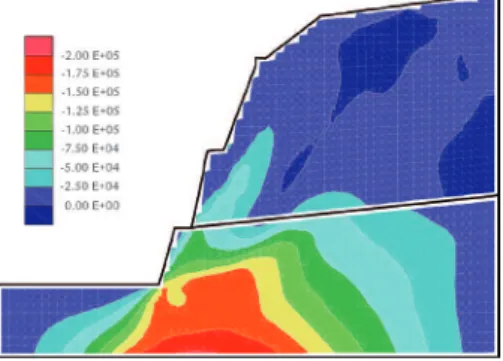
The distribution of shear stress pre-sented in Figure 11 suggests a reduction
in the levels of shear stress in the areas next to the slope face, but the condition of
maximum tension at the foot of the slope is maintained.
The distribution of shear stress presented in Figure 14 is similar to those obtained in the previous cases, but with a reduction in the stress concentration at the foot of the slope. Although the concentration of shear
stress at the foot is reduced, there is a concentration of the mechanical response in the volcanic breccia layer, representing a minor mechanical contribution for the rhyolite, with an absence of ruptures in the slope face.
The plastiication zones inside the rhyolite mass are associated with a Mohr–Coulomb failure surface along the slope, initiated by the rupture in the breccia.
Figure 13
Displacement vectors (continuous, deep rupture). Figure 12
4. Conclusions
Using the Ubiquitous-joint model, it has been possible to obtain a representation very close to the real conditions for the slope studied, deined by the following processes:
• supericial rupture of the rhyolite
layer and falls of blocks, mainly on the irst slope bed and on the shoulder of the road;
• supericial rupture of the volcanic
breccia at the foot of the slope, without affecting elements away from the slope.
When the rhyolite layer was con-sidered as continuous, it was not possible to simulate both processes simultaneously. It was therefore necessary to model each rupture separately and apply the
resis-tance parameters through a mathematical model. It can thus be inferred that it is not possible to represent a discontinuous mass satisfactorily by using a continuous model, because of the high degree of uncertainty in the parameters involved in the rupture, in the geometry of the surface, and in the rupture surfaces.
The effect of the slope angle was important when determining the areas subject to loss of material by sliding. Thus, the losses were small in the upper part of the slope, where the declivities are less than the dip of the discontinuities, but high in the lower part of the rhyolite layer,
in which the declivity is greater than the dip. In all the modeling cases, the need to reach a rupture state makes convergence of the system impossible, precluding the existence of a unique answer for each case. Therefore, further analysis and assessment of the results are necessary. Although the Ubiquitous-joint model allows analysis of a discontinuous mass, the analysis is limited by a number of important vari-ables, including variations in ambient temperature, volumetric and temperature gradients along the fractured mass, and vibrations imposed during the construc-tion of the highway, among others.
AUTONOMOUS DEPARTMENT OF HIGHWAYS – DAER. Stabilization of rock slopes Project: topographic saddle – km 55+840 to km 56+200 – Cut 21. RS/471 Highway, section Barros Cassal – Santa Cruz do Sul (in portuguese). Porto Alegre (Brazil), 2010. 58p.
AUTONOMOUS DEPARTMENT OF HIGHWAYS–DAER. Engineering inal Pro-ject: RS/471 Highway, section Barros Cassal – Santa Cruz do Sul (in portuguese). v. 1. Porto Alegre (Brazil), 2002. 246p.
BRAZILIAN INSTITUTE OF GEOGRAPHY AND STATISTICS – IBGE. SH.22 Sheet: Porto Alegre and part of SH.21 Uruguaiana and SI.22 Mirim Lagoon she-ets. Natural Resources Survey (in portuguese). Rio de Janeiro (Brazil). v. 33, 1986. 794p.
CRUDEN, D. M. & VARNES, D. J. Landslide types and processes. In: TURNER, A. K., SCHUSTER, R. L. (Eds.). Landslides: investigation and mitigation. Special Re-port 247. Washington, D. C.: Transportation Research Board, National Research Council. v. 247, p. 36-75, 1996.
HOEK, E., BROWN, E. T. Practical estimates of rock mass strength. International Journal of Rock Mechanics and Mining Sciences. v. 34, n. 8, p 1165-1186. 1997. ITASCA Consulting Group FLAC – Fast Lagrangian Analysis of Continua, Ver. 5.0
User’s Guide. Minneapolis: Itasca. 2005.
NORRISH, N. I., WYLLIE, D. C. Rock slope stability analysis. In: TURNER, A. K., SCHUSTER, R. L. (Eds.). Landslides: investigation and mitigation. Special Re-port 247. Washington, D. C.: TransRe-portation Research Board, National Research Council. p. 391 – 425, 1996.
SOIL MECHANICS LABORATORY (LMS) – UFRGS. RS 471 (Vera Cruz/RS) Test report (in portuguese). Porto Alegre (Brazil), 2004. 25p.
VARNES, D. J. Slope movement types and processes. In: SCHUSTER, R. L., KRIZEK, R. J. (Ed.).Landslides: analysis and control. Special Report 176. Washington, D. C.: Transportation Research Board, National Research Council. p. 11 – 33. 1978.
5. References
Received: 21 July 2015 - Accepted: 28 January 2016.