I
NCORPORATION OF PROBIOTICS IN CEREAL BARS
:
T
ECHNOLOGICAL VIABILITY AND STABILITY
by
Silvino Manuel da Silva Henriques
I
NCORPORATION OF PROBIOTICS IN CEREAL BARS
:
T
ECHNOLOGICAL VIABILITY AND STABILITY
Thesis presented to Escola Superior de Biotecnologia of the
Universidade Católica Portuguesa
to fulfill the requirements of Master of Science degree in Microbiology
by Silvino Manuel da Silva Henriques
Place: Process and Chemical Engineering & Microbiology Departments University College Cork, Ireland
Supervision: Ana Maria P. Gomes Maria José Sousa Gallagher Teresa M. Barbosa
iii
Abstract
The functional food market has been rapidly growing for the past years but the development of new products is still imperative due to the increasing demand for healthy, high quality foods associated to changes in consumers‟ life-style. Incorporation of probiotics into cereal-based products is therefore desirable since it can combine the healthy formulation of a cereal mixture, the added value of prebiotic ingredients, and the beneficial effects of the probiotic bacteria. Encapsulation tecnhiques have been recently applied to protect probiotic cells from storage conditions in order to increase shelf-life of probiotic products and to overcome other technological hurdles such as the food production stresses. The aim of this research study was to evaluate the maintenance of viability of encapsulated probiotics in a cereal bar after food processing and during storage. A cereal mixture was used to prepare cereal bars using a high-shear granulator and the baking process was optimized in terms of textural and physical properties by monitoring the water activity (aw), moisture content (MC)
and texture (bending force) of individual bars exposed for 10 and 15 minutes to 160 ºC. The probiotic strain Lactobacillus casei 01 was encapsulated in Ca-alginate beads and added to the cereal bar to a final concentration of 109 CFU.g-1 of product, followed by honey topping. The cereal bar was dried in an oven at 80 °C, 120 °C and 160 °C for 10 minutes. Viability above 108 CFU.g-1 was found at 80 and 120 °C, the latter with 0.81 ±0.33 log loss relative to the initial concentration (IC) of probiotics in the cereal bars. Despite some evidence of stickiness, quantitative evaluation showed no significant changes (p > 0.05) for water activity, moisture content and texture of the cereal bars dried at 120 °C. Probiotic viability on the cereal bars by 14 days of storage at 4 °C and 20 °C was 7.50 ±0.55 and 6.72 ±0.27 log CFU.g-1, respectively. Two other probiotic strains, Bifidobacterium animalis Bb12 and Lactobacillus
acidophilus L10, were studied with oven drying at 120 ºC, and similar viability log loss was
observed. This study indicated that it is feasible to incorporate probiotic bacteria into a cereal bar product, but further studies are required to determine the product shelf-life, viability during gastrointestinal passage and to assure probiotic functionality.
iv
Resumo
O mercado dos alimentos funcionais tem crescido rapidamente nos últimos anos, mas o desenvolvimento de novos produtos é ainda imperativo devido a uma crescente procura por alimentos saudáveis e de alta qualidade, associados a mudanças no estilo de vida dos consumidores. A incorporação de probióticos em produtos baseados em cereais é pois desejável, uma vez que pode conjugar a formulação saudável da mistura de cereais, o valor acrescentado dos ingredientes prébioticos, e os efeitos benéficos das bactérias probióticas. As técnicas de encapsulação têm sido recentemente aplicadas na protecção celular dos probióticos sobre as condições de armazenamento, para aumentar o tempo de prateleira dos produtos probióticos e para ajudar a superar outros obstáculos tecnológicos, de que são exemplo as agressões envolvidas na produção dos alimentos. O objectivo do presente estudo de investigação foi o de avaliar a manutenção de viabilidade de probióticos encapsulados, em barras de cereais, depois do processamento alimentar e durante o armazenamento. Uma mistura de cereais foi utilizada para preparar as barras de cereais, com recurso a um granulador de rápida mistura e o processo de cozedura foi optimizado em termos de propriedades físicas, pela monitorização da actividade da água (aw), do teor de humidade
(MC) e da textura (força de flexão) para barras individuais expostas por 10 e 15 minutos a 160 ºC. A estirpe probiótica Lactobacillus casei 01 foi encapsulada em esferas de alginato de cálcio, e adicionada à barra de cereal numa concentração final de 109 CFU.g-1 de produto, seguido por uma cobertura de mel. A barra de cereal foi seca em forno a 80 °C, 120 °C e 160 ºC por 10 minutos. Viabilidade acima de 108 CFU.g-1 foi descrita a 80 e 120 ºC, esta última com uma perda de 0.81 ±0.33 log relativamente à concentração inicial (IC) de probióticos nas barras de cereais. Apesar de alguma evidência em ser pegajoso, a avaliação quantitativa não mostrou diferenças significativas (p > 0.05) na actividade da água, teor de humidade e textura para as barras secas a 120 ºC. A viabilidade probiótica nas barras aos 14 dias de armazenamento a 4 ºC e a 20 ºC foi de 7.50 ±0.55 e de 6.72 ±0.27 log CFU.g-1, respectivamente. Outras duas estirpes probióticas, Bifidobacterium animalis Bb12 e
Lactobacillus acidophilus L10, foram estudadas na secagem de forno a 120 ºC, e uma perda
muito semelhante de viabilidade logarítimica foi observada. Este estudo indicou ser possível a incorporação de probióticos em barras de cereais, mas mais estudos são necessários para determinar o tempo de prateleira do produto, a viabilidade à passagem gastrointestinal e assegurar a funcionalidade probiótica.
v
Acknowledgments
Being in Ireland at UCC for eight months was, first and foremost, a truly invigorating experience. Out of your comfort zone, you quickly learn that there is no such thing as “my” research/thesis; the work that you may accomplish is only achievable due to countless other people, their contribution and invisible efforts. Maybe that‟s the reason why the second lesson you learn pretty fast is to be grateful for all the help, advice and opinions you find along the road; and lad ye better listen to a cupla of them at least once in a while.
That being said, hereby I would like to express my deepest gratitude to:
Ana Gomes, for “sending” me to Ireland, giving me the opportunity to grow both as a scientist and as a human being. Thank you for all the support, trust and freedom; the proof that being a teacher is much more than just giving lectures.
Maria de Sousa Gallagher, for accepting me as her masters student in the UCC Process and Chemical Engineering Department, and to whom I must thank the warm welcome since day one. Thank you for all the time and energy that made this work possible, in particular when the lab results were not that charming.
Teresa Barbosa, for accepting me as her student in the UCC Microbiology Department, for all the guidance, discussions and challenging ideas; even when I was absolutely clueless about what to do next. Thank you for all the priceless and practical working knowledge.
They were, unquestionably, the best three supervisors that you can ask for!
Also, a massive thank you to:
All the staff from the Process & Chemical Engineering and the Microbiology departments at UCC, for all the patience with the “portuguese boy”, with his permanent queries for lab supplies; and a special thank you to Paul and Paddy.
vi
Abina Crean, lecturer from the School of Pharmacy, for lending us the syringe pump system to automate the encapsulation (such a wonderful device!) and even for the opportunity to make some trials with the spray-dryer.
All my colleagues and friends from UCC: Carina and Isabel, Kevin, Oluwafemi, Pankaj, Pedro and Bruno; for all the technical help but also for the pleasant conversations, the shared lunches or dinners, and the filter coffees at the back of the department. Also, a special thanks to Rob from the microbiology lab, for being approachable and friendly, making the working space a relaxed and productive environment.
And to my other irish and non-irish friends, with whom I have shared a house, a party or a pint, to you all I quote that famous irish blessing: “And until we meet again, /May God hold you in the palm of His hand”. Either that, or on Facebook. Anyway, thanks a million!
Finally, this thesis would not have been possible without the love and support of my family: Mãe, Pai, Lita, César. O que fazemos nós sem uma família tão sui generis assim? São sem
dúvida a raison-d’être da minha persistência, mesmo que ao fim de cinco anos ainda perguntem “então isso da bio... micro-coiso serve mesmo para quê?”. E também uma palavra para a Sandra, a sister-in-law! E, claro, aos pestinhas mais terríveis do planeta, a Ana e o Gonçalo. And a very special thank you to Célia, for your permanent encouragement,
never-ending patience and hope.
The financial support from the Erasmus programme is greatly acknowledged, for the eight month grant given. The research funding was provided under the NDP, through FIRM (06/RDC/428), administered by the Department of Agriculture, Fisheries & Food, Ireland, and is hereby also acknowledged.
vii
Contents
Abstract ... iii Resumo ... iv Acknowledgments ... v List of Figures ... xiList of Tables ... xiii
1. Introduction ... 1 Literature Review ... 1 1.1 Functional foods ... 1 1.1.1 Type of products ... 1 1.2 Probiotics ... 2 1.2.1 Health claims ... 3
1.2.2 Selection properties of probiotic strains... 4
1.2.3 Design challenges ... 4 1.3 Prebiotics ... 5 1.4 Synbiotics ... 6 1.5 Granola ... 6 1.5.1 Production ... 6 1.5.2 Nutritional value ... 7 1.5.3 Prebiotic effect ... 7
1.5.4 Physical properties of cereal bars... 7
1.6 Encapsulation ... 8
1.6.1 Extrusion method ... 9
Objectives of the work ... 10
1.7 Rationale and structure ... 10
viii
2.1 Granola bar production ... 13
2.2. Physical parameters of the cereal bars ... 14
2.2.1 Baking of cereal bars and drying of extra honey layer ... 14
2.2.2 Texture analysis ... 14
2.2.3 Water activity and Moisture content ... 15
2.3 Bacterial strains and growth conditions ... 15
2.3.1 Maintenance and preparation of culture ... 15
2.3.2 Viable cell counts ... 16
2.3.3 Growth curve ... 16
2.4 Encapsulation of probiotic bacteria ... 16
2.4.1 Extrusion method ... 16
2.4.2 Size and shape of beads ... 17
2.4.3 Encapsulation efficiency and stability of bacteria ... 18
2.5 Incorporation of probiotic strain into the cereal bar ... 18
2.5.1 Free cells ... 18
2.5.2 Encapsulated bacteria ... 18
2.6 Viability of encapsulated probiotics in cereal bars during storage ... 19
2.7 Statistical analysis ... 19
3. Results and discussion ... 21
3.1 Granola bar production ... 21
3.1.1 Preparation of the granola product ... 21
3.1.2 Manufacturing of the cereal bars ... 21
3.1.3 Optimisation of the baking process ... 22
3.2. Probiotics growth phase and viable numbers ... 24
3.2.1 Lactobacillus casei 01 ... 24
3.2.2 Lactobacillus acidophilus L10 and Bifidobacterium animalis Bb12 ... 25
ix
3.3.1 Size and shape of beads ... 26
3.3.2 Encapsulation efficiency ... 28
3.3.3 Stability of the bacterial cells inside beads ... 29
3.3.4 Survival of encapsulated probiotic strains when submitted to heat exposure... 30
3.4. Incorporation of the probiotic strains into the cereal bar ... 31
3.4.1 Timing of incorporation ... 31
3.4.2 Carrier and binder technological options ... 31
3.4.3 Influence of the addition of extra honey on cereal bars physical properties... 32
3.4.4 Incorporation of probiotics into cereal bars as free cells. ... 34
3.5. Cereal bar drying and probiotic viability ... 35
3.5.1 Visual appearance of loaded beads on the cereal bar... 35
3.5.2 Viability of encapsulated L. casei 01 upon incorporation on the cereal bar ... 35
3.5.3 Incorporation of probiotic Lactobacillus acidophilus L10 and Bifidobacterium animalis Bb12 on the cereal bars ... 37
3.6. Cell stability during storage ... 39
3.6.1 Stability throughout time ... 39
3.6.2 Stability at different temperatures ... 40
4. General conclusions ... 43
5. Future work ... 45
xi
List of Figures
Figure 1.1 Diagram of relationship between sections of the work. ... 11 Figure 2.1. Photograph of (a) a high-shear granulator Formate 4M8, ProCepT and (b) a diagram of all major components. ... 14 Figure 2.2. A three-point bending rig. A compression force (white arrow) was applied over
the middle of the cereal bar and the peak force was registered. ... 15
Figure 2.3. Encapsulation apparatus. (a) Picture of the apparatus, and (b) diagram
illustrating the encapsulation procedure. ... 17
Figure 2.4. Probiotic cereal bars stored in plastic containers inside the temperature chamber at 4 or 20 ºC... 19 Figure 3.1. Granola production in a high-shear granulator: (a) mixing in granulating bowl, and (b) granola after mixing. ... 21 Figure 3.2. Manufacturing of the cereal bars. (a), bar cut with knife. (b), mixture in the
mould. (c), cereal bar prepared in the mould. ... 22
Figure 3.3. Values (average ± standard deviation) of (a) water activity (aw), (b) moisture
content (%) and (c) bending force (N) of granola bars baked at 160 ºC for 10 and 15 minutes. ... 23 Figure 3.4. Growth curve of Lactobacillus casei 01. Viable cells (CFU.mL-1, ) and OD600
(x) for 22 hours of growth. The first 12 hours are shown in red, and the following 10 hours in yellow. This experiment was conducted twice, and a representative result is here shown. ... 25
Figure 3.5. Size and shape of the beads prepared with a 30G needle and a syringe pump system. (a) 10x Magnification. (c) Direct examination. ... 27 Figure 3.6. Probiotic cells (L. casei 01) within bead alginate matrix. Visualization shows
the bacterial cells, rod-shaped and coloured in dark blue, entrapped within the semi-transparent gelled matrix. ... 28
Figure 3.7. Viability of encapsulated probiotic Lactobacillus casei 01 cells at 0, 1, 2, 3 and 5 days of storage at 4 ºC storage. ... 29 Figure 3.8. Optimization of the honey topping. Left, cereal bar with excess of honey (3 g)
(white arrows). Right, cereal bar covered with 2 g of honey. ... 32
Figure 3.9. Physical parameters of cereal bars with and without honey. Samples with
honey were submitted to the oven for 10 minutes at 80, 120 and 160 ºC, or left at room temperature, 20 ºC. The control samples had no extra honey. ... 33
xii
Figure 3.10. Visualization of the loaded beads on the cereal bar. Loaded beads spread over
the surface of the cereal bar, after honey pouring and after oven drying at 120 ºC. ... 35
Figure 3.11. Viability of L. casei 01 after drying of the cereal bar in the oven at temperatures of 80, 120 and 160 ºC for 10 minutes. IC: Initial Concentration; PT: Probiotic
Threshold (106 CFU.g-1); RT: Room Temperature related with control sample... 36
Figure 3.13. Viability loss for three different probiotic strains in cereal bars dried at 120 ºC for 10 minutes. Results are expressed in “ log”, i.e., the difference between initial and
final log CFU.g-1 for each strain. Bb12: B. animalis Bb12; L10: L. acidophilus L10; Lc: L.
casei 01. ... 38
Figure 3.14. Viability of L. casei 01 during product storage at 20 ºC. PT: Probiotic
Threshold (106 CFU.g-1). ... 39
Figure 3.15. Comparison of L. casei 01 viability during product storage at 4 and 20 ºC.
PT: Probiotic Threshold (106 CFU.g-1). The 20 ºC values are retrieved from the previous experiment. ... 40
xiii
List of Tables
1
1. Introduction
Literature Review
1.1 Functional foods
The term „functional food‟ was first introduced in the 1980‟s as a result of a number of research programs funded by the Japanese government on "systematic analysis and development of food functions" (Roberfroid, 2000). While the final report stated the primary and secondary function of food to be the supply of nutrients, and the sensory satisfaction, respectively, it also recognized the advent of a new category which included foods that were able to provide health benefits beyond basic nutrition. In the following years Japan implemented a specific label for these products: Foods for Specified Health Use (FOSHU) (Anon., 1991; Roberfroid, 2000).
These developments and studies were rapidly extended to the USA and Europe, although in here functional foods were not regarded as a different category but rather as a concept within the food industry (Kwak & Jukes, 2001). Interest on this topic has been fuelled by the demographic trend of increased life expectancy and the associated economic and social costs of geriatric and chronic diseases (Diplock et al., 1999; Kwak & Jukes, 2001). Functional foods may help to counterbalance this trend as a result of their ability to improve the population overall quality of life through diet; as well as by rising awareness to more conscious healthy food choices.
1.1.1 Type of products
The functional foods concept has been changing throughout the years, due to the increasing scientific studies in this field and due to a wider product range. Most of the initial functional food products were simply fortified; i.e. the formulation would be augmented or supplemented with vitamins or minerals, such as vitamin C, folic acid, iron and calcium. Further developments brought a different focus towards foods which contribute to health promotion and disease prevention such as those rich in omega-3 fatty acids, phytosterols, and soluble dietary fiber. More recently, efforts have been made to develop functional foods
2
which would be able to offer multiple health benefits in a single product e.g. calcium fortification along with calcium absorption promoters (Siró et al., 2008).
The food fermentation industry has also contributed to a different perspective on the functional food concept and application. Although the use of starter cultures aimed primarily the enhancement of food safety without the use of additives, it has also been a relevant approach to convey organoleptic, technological and nutritional or health advantages (Leroy & De Vuyst, 2004). In this respect, several starter cultures have been extensively studied for their potential benefits when incorporated in food vectors, designated therefore probiotics.
1.2 Probiotics
Probiotics are defined as live microorganisms that, when administered in adequate amounts, confer a health benefit to the host (FAO/WHO, 2001). Probiotic bacteria have been used both in pharmaceutical preparations and in food products, giving the latter a functional attribute. Therefore the use of such microorganisms can either be referred in a therapeutic context or in a health promotion perspective. Regulations to establish appropriate thresholds between both concepts are currently being discussed by policy makers. Lactic Acid Bacteria (LAB), especially Lactobacillus spp., and Bifidobacterium spp. are the most commonly used probiotic microorganisms. Many of their strains are included in the FDA group of „Generally Recognized as Safe‟, GRAS (Mattia & Merker, 2008) and they are generally perceived as safe by the consumer.
In the food industry, probiotics have been widely used in the dairy sector, such as yogurt-like products. The quick rise in this market sector may be associated with a better understanding and acceptance by the consumer of the presence of viable microorganisms within these traditional fermented products (Annunziata & Vecchio, 2011).
The last years have also witnessed an expansion to non-dairy probiotic products, as for example sausages, fruit juices, chocolates and cereals; however, the success of such products is still small either due to poor market share or to technological hurdles.
Nonetheless, it is commonly accepted that the incorporation of probiotics into a food product increases its commercial value, as shown by recent market studies (Euromonitor, 2010) which
3
describe an increasing awareness and preference of the general consumer for functional foods that incorporate probiotics.
1.2.1 Health claims
While the main health benefit attributed to probiotic bacteria is the improvement of the intestinal environment balance by modifying gut‟s microflora, specific health benefits appear to be, in general, strain-dependent (Santosa et al., 2006). For example, some clinical trials describe the specific therapeutic effects of probiotics in cases of diarrhoea, antibiotic-associated diarrhoea (ADD), constipation, and irritable bowel syndrome (IBS) (D'Souza et al., 2002; Moayyedi et al., 2010).
Many other health benefits are under investigation which includes a protective role against cancer. Nevertheless, the application of the scientific data is still controversial, since there is no clear-cut criterion about the amount of probiotic strain to be administered, and which anti-cancer mechanisms are most relevant. Furthermore, some studies point towards a probiotic stimulation of the immune system, the growth suppression of other bacteria that convert procarcinogenic metabolites, or the direct action against carcinogens present in the gut (de Moreno de LeBlanc et al., 2007).
Probiotic products have a very strict regulation, with only a few “permitted health claims” available for labelling. The EFSA (European Food Safety Authority) demands a strain-specific approach on efficacy, which is still out of range for most manufacturers, since there are no all-inclusive biological markers, and extensive clinical trials are very expensive.
In early stages of food development it is critical to consider consumer acceptance, from sensory evaluation to added value recognition. Intriguingly, the food industry still selects probiotic species and strains much on a basis of their technological properties rather than their potential health benefits. The main reason seems to be the reduction of development costs and time of a new product, giving priority to safety concerns rather than specific physiological mechanisms which require greater investments to evaluate.
4
1.2.2 Selection properties of probiotic strains
Different parameters have to be addressed when selecting probiotics strains. These include safety, technological production and efficacy or functionality (FAO/WHO, 2001).
Production of functional foods with probiotic strains demands extensive safety assessments. Probiotic strains must be non-pathogenic and with no antibiotic resistance, or when present this should not be linked with mobile genetic elements such as plasmids. Several studies indicate the safety of dairy strains of Lactobacillus spp. and Bifidobacterium spp. and no toxicity to concentrations as high as 1012 CFU.g-1 of product, which makes them suitable for food incorporation (Gomes & Malcata, 1999). Both of these probiotic genera are characterized as gram-positive, rod-shaped and non-sporeforming. They can be isolated from food samples by the use of complex culture media such as MRS (Man-Rogosa-Sharpe) or MRS added with specific selective agents; their presence confirmed and enumerated by their distinctive colonies, depending on the strain. Selected strains should also show high cell robustness, as well as high initial viable counts. These properties influence directly the maintenance of viability during process stages and storage time, subsequently promoting the effectiveness after consumption.
Functionality of probiotics has been associated with adhesion to enterocytes in order to block potential adhesion sites for pathogens, immunomodulatory potential and also to antagonistic effects against pathogens, namely by the production of antimicrobial substances.For example, the strain Lactobacillus casei 01 has exhibited antiproliferative activity on human colon cancer cells HT-29, and reduced the cytotoxicity of 4-NQO (4-nitroquinoline 1-oxide) against human intestinal epithelial cells, intestinal 407 (Liu et al., 2011).
1.2.3 Design challenges
It is generally accepted that in order to potentially promote a health effect, the oral intake of a probiotic will need to meet a pre-established threshold of viable cells. A concentration between 106 and 108 CFU.g-1 of product (Colony forming unit) at the time of consumption, assuming a serving size of about 100 g, is generally accepted as sufficient for a successful and proper colonization of the GI tract (FAO/WHO, 2001; Ishibashi & Shimamura, 1993). This implies that a sufficient number of probiotic cells must be present in the final product after all the manufacturing steps. Additionally, the viability of the cells should be maintained throughout the shelf-life of the product, what would be dependent on the physical and
5
chemical properties of the food matrix. Finally, after consumption, the cells must survive gastrointestinal (GI) passage, and therefore tolerate the acidity of the stomach, bile salt toxicity and enzymes activity, in order to be able to colonise the gut and promote their health effects (Lee & Heo, 2000).
The addition of probiotics to a food product should also regard the physiological state of the bacterial cells, i.e. from which part of the logarithmic or stationary growth phase the cells are harvested; in addition, the physical conditions of the product storage and the chemical composition of the environment to which the probiotics are added, e.g. temperature, dissolved oxygen levels, solids content or water activity need also to be considered.
1.3 Prebiotics
Prebiotics are non-digestible food ingredients, usually carbohydrates, which are delivered to the large bowel in order to provide fermentable substrates for selected bacteria, stimulating their growth and/or activity (Gibson & Roberfroid, 1995).
Prebiotics are ingredients rather than live microorganisms, therefore the main advantage of the incorporation of prebiotics over probiotic bacteria is their stability throughout the product shelf-life. Moreover they can be more easily used to claim health benefits on product labels and increase the consumer perception of reliability.
In recent years, some authors have underlined the importance of the prebiotic effects (Roberfroid et al., 2010; Salminen et al., 1998) on the gut microflora balance and consequently on host‟s gut health. Dietary consumption of such ingredients can result in changes of the gut microbiota composition, especially by increasing faecal concentrations of bifidobacteria (Rycroft et al., 2001) and therefore inhibit pathogen growth, which has been observed in co-culture experiments (Fooks & Gibson, 2002); production of short-chain fatty acids due to bifidobacteria metabolic degradation thereof further contributes to its beneficial health effects (Roberfroid et al., 2010).
6
1.4 Synbiotics
Synbiotics relate to products where the simultaneous presence of probiotic strains and prebiotic ingredients have a resulting synergetic effect (Steed et al., 2008). The synbiotic product is also relevant from a technological point of view, since the presence of prebiotics ingredients can potentially enhance the delivery of probiotics. These effects have been reported, in dairy matrices, during the period of storage and throughout the process of consumption (Madureira et al., 2011). Moreover, the industry is becoming increasingly interested in the synbiotics concept in order to explore new sectors of the market and enlarge their range of products, therefore contributing to increased competitiveness in the field.
1.5 Granola
Granola has emerged as an important breakfast cereal mixture product. It is considered a ready-to-eat (RTE) cereal, produced from the mixture of grain components with other ingredients such as chopped nuts and fruit pieces, through extensive processing, i.e. granulation. The principal grains used in the manufacture of granola include corn, rice, wheat, oats and barley, which are overall considered healthy ingredients (Pathare, 2010). In this respect, ready-to-eat cereals are a especially promising alternative to dairy products for incorporation of probiotics. They are a well-known fortified product which can be given to people with lactose intolerance.
The expansion of the market range for these kinds of granulated products can be associated with life-style trends, as fitness and well-being, and with their many already known health benefits; such as the reduction of satiety and improvement of bowel movement. Several multi-national companies are investing high amounts in research for new convenient healthy products, and much of the attention is now being drawn to cereal bars fortified with nutritional ingredients. Their portable and modern daily-routine concepts may carry out a larger perception of high added value (Annunziata & Vecchio, 2011).
1.5.1 Production
The mixture, the shear and aggregation of all ingredients is called “granulation” and comprises the basis of the granola making process. The aggregation where small particles
7
cluster into larger, physically stronger agglomerates, is mediated by one or more wet binders, such as vegetable oil, honey and water. The product is then baked at a temperature between 150 – 220 ºC until it is toasted to the desired extent. Both granulation and baking process parameters are of vital importance to the nutritional and physical properties of the final granola product, therefore affecting consumers‟ acceptability (Macedo, 2011; Pathare, 2010).
1.5.2 Nutritional value
Depending on the ingredient combinations (e.g. whole grain or refined cereals) used, granola mixtures can have different nutritional value. Nevertheless, granola constitutes a major source of nutrition, presenting high contents of both soluble and insoluble fibre and resistant starch. It is also a source for other carbohydrates, proteins, vitamins (e.g. vitamin B complex), minerals like iron and polyunsaturated fats like omega 3 linoleic acid, besides its low saturated fat content.
1.5.3 Prebiotic effect
High fibre foods such as cereal products can increase stool content in the bowel, resulting in increased movements and action and provide a good environment for beneficial gut bacteria. The fermentation of fibre can increase moisture content and lower pH in the bowel, which helps both stool movement and removal of harmful substances within the intestinal mucosa. Some specific ingredients, such as inulin or beta-glucan, can be added to a cereal mixture in order to promote a selective growth stimulation over Lactobacillus spp. and Bifidobacterium spp. thus increasing their metabolic activity after ingestion as well as their stability throughout product storage(Gomes & Malcata, 1999).
1.5.4 Physical properties of cereal bars
Consumer preference for cereal snack bars is largely determined by sensory characteristics. However, while the quality of a certain product can be assessed by sensory analysis, its physical properties can be of great value as a way to monitor and choose between different samples within early stages of a food product development. Determination of water activity, moisture content and texture can help to establish the dosage of new ingredients which do not substantially change the product from the desirable target value parameters.
8
Water activity (aw) is used by many regulatory agencies, it constitutes one of the most
important properties and most used parameter in food systems. The water activity describes the degree to which the water is available in the food to participate in biochemical reactions and growth of microorganisms and chemical deteriorative reactions (Labuza, 1970). As a consequence, this parameter can influence the stability, safety and even the texture of foods. The water content or moisture content (MC) is an indicator of the total amount of water contained in a certain food and can be expressed as the percentage of dry weight. Although without the same biological significance as the water activity, the MC can also be used to measure freshness and stability of a food product. It is therefore commonly monitored in the process and packaging research fields and throughout the food industry, in general.
Texture is fundamental for consumer acceptance in the ready-to-eat cereals products, and since sensory evaluation can be time consuming and expensive, textural instrumental methods are a useful tool in product development stages. A number of textural tests may be performed which measure either compressive or tensile forces. Texture Profile Analysis (TPA) is the most common used procedure where samples are compressed by a round plate, until a certain percentage of their original thickness is attained. For sheet-shaped foods, however, it has been widely used the three-point bending test (Kim et al., 2009), i.e. an apparatus with two support loads and one bending/breaking load. Since it measures the fracture properties for compression, it is more easily applied to low thickness or irregular surface samples.
1.6 Encapsulation
Probiotics survival in food products and subsequently during GI passage is a major issue for the food industry. Therefore a physical barrier which protects the bacteria against adverse environmental conditions may provide more robustness and reliability to this kind of products. The encapsulation of viable cells is a protection approach with increasing importance, and can either describe the entrapment of cells in a gel matrix or a continuous coating around an inner matrix (Rokka & Rantamäki, 2010). Encapsulation of probiotics can be achieved by several methods, such as extrusion, emulsion and spray drying. These methods have different technical features, from particle size range, to apparatus complexity, and production rate.
9
1.6.1 Extrusion method
The extrusion method produces beads by dispersion/extrusion of a suspension of bacterial cells and polymer through a needle or nozzle, generating droplets that fall into a hardening solution.
One of the most common combinations used is the cross-linking between alginate and calcium ions, entrapping viable cells in a gentle gelled matrix (Rokka & Rantamäki, 2010). Although most of the conventional methods generate alginate beads between 2 and 5 mm, smaller beads, usually desired in food products, have been reported with the use of gas shear, nozzle vibration and electrostatic fields (Rodrigues et al., 2011b). The size of the beads appear to be affected by the concentration of the alginate solution, the flow rate, and the needle gauge (Blackshields, 2009). The distance from the needle to the cross-linking solution seems to influence beads spherical shape, and calcium solution concentration may confer better hardening and shrinking.
The emulsion technique results in smaller beads (less than 1mm) but with a wide distribution of bead size, besides the vegetable oil waste (Capela et al., 2007). The spray drying requires an appropriate chamber, a more expensive nozzle, and the drying process compromises cells viability; although it holds the higher production rate and scalability.
The extrusion method is particularly suitable for laboratory scale work, such as the development of new applications, since it involves a very simple apparatus for encapsulation, with the use of syringes.
Alginate is a polyanionic material able to undergo crosslinking reactions with multivalent cations, such as calcium. Alginate is cheap and easy to handle and is by far the most common polymer used to prepare gelled beads. Alginic acid and sodium alginate present no toxicity and feature a GRAS (21 CFR 184.1724) status as food ingredient by the FDA. The calcium alginate (Ca-alginate) beads are also edible and relatively tasteless. Their stability in pure aqueous systems and their ability to dissolve under physiological conditions makes them a good choice as carriers in food products.
10
Objectives of the work
1.7 Rationale and structure
The general aim of this thesis was to address a technological solution for incorporating probiotic strains into cereal bars. Specifically, (1) the physical parameters of the cereal bars were monitored; (2) the protection of probiotic bacteria within alginate capsules was assessed, as well as (3) the definition of appropriate oven drying temperatures toward such protection stability; and finally, (4) changes in the viability of encapsulated probiotic strains in the cereal bars during storage were determined.
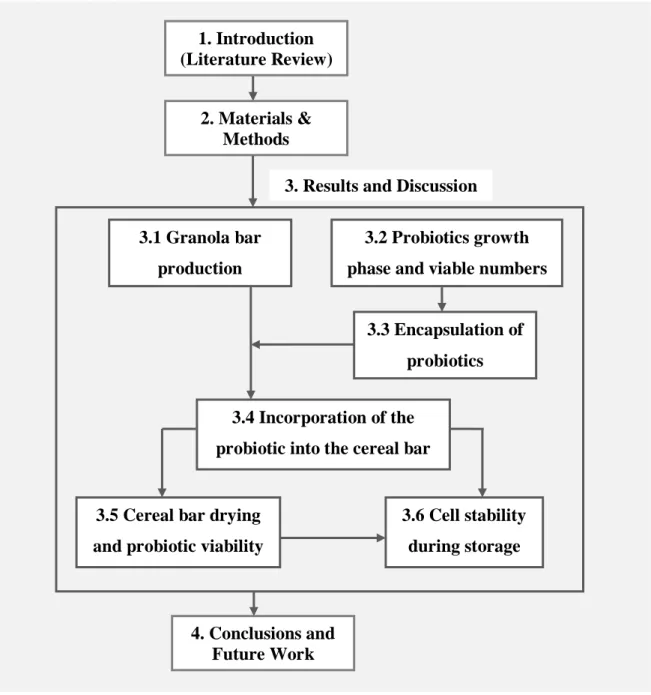
The organisation of this thesis is composed of 4 sequential chapters which together meet the general objective of this research work:
Chapter 1 is a comprehensive overview of the state of the art concerning the main objects of
this thesis, i.e. the functional foods market, the significance of probiotic bacteria, the prebiotic and synbiotic concept, the granola manufacturing and the encapsulation method. Chapter 1 ends with the listing of the general and specific objectives of this research work.
Chapter 2 covers all the materials and methods used throughout the experimental part of the
research work including both granola bar production and encapsulation of probiotic strains for incorporation in granola bars techniques.
Chapter 3 deals with the listing of results obtained in the different phases and the
corresponding discussion. After the initial phase of experiments, the favourable oven drying temperature was selected and used to develop probiotic granola cereal bars and their physicochemical characterisation and viability throughout storage is discussed.
The thesis ends with an overview of the main conclusions in Chapter 4 and the suggestion of follow-up experiments.
11
The structure of the thesis work, and the relationship between the different sections, is shown schematically in Figure 1.1:
Figure 1.1 Diagram of relationship between sections of the work. 3.1 Granola bar
production
3.2 Probiotics growth phase and viable numbers
3.3 Encapsulation of probiotics
3.4 Incorporation of the probiotic into the cereal bar
3.5 Cereal bar drying and probiotic viability
3.6 Cell stability during storage 1. Introduction (Literature Review) 2. Materials & Methods 4. Conclusions and Future Work
12
This thesis is associated with the following presentations:
Poster panel
Henriques S. S., Sousa-Gallagher M. J., Barbosa T. M., Gomes A. M. Incorporation of
Probiotics in a Granulated Cereal Product: Technological Hurdles. 40th Annual UCC Food
Research Conference, University College, Cork, 31 March - 1st April 2011
Oral communication
Henriques S. S., Sousa-Gallagher M. J., Barbosa T. M., Gomes A. M. Incorporation of
Encapsulated Probiotics in a Cereal Bar: Viability Assessment After Food Processing and During Storage. EuroCereal 2011, Campden BRI, Gloucestershire, UK 6-7th December 2011
13
2. Materials and Methods
2.1 Granola bar production
The granola recipe is described in Table 2.1. The production of the granola was carried out in a high-shear granulator (Formate 4M8, ProCepT, Zelzate, Belgium; Figure 2.1) as previously described (Macedo, 2011), with some modifications. With the exception of the binders (honey and vegetable oil), all the ingredients were placed into the bowl of the granulator. The granulator was put into operation with impeller and chopper speeds of 200 and 500 rpm (revolutions per minute), respectively. The vegetable oil was added straight away and the honey (Boyne Valley Honey, Mell, Drogheda, Co. Louth, Ireland) 2 minutes after. Both binders were added at a constant flow with the help of an adjustable funnel. When all the ingredients were present, the mixture was allowed to granulate for an additional 5 minutes.
Table 2.1. Ingredients of the granulated cereal mixture
Amount per batch (g) % Weight Dry Ingredients Corn flakes 7.47 4.0 Crisped rice 7.47 4.0 Oat flour 47.70 25.4 Wheat germ 5.17 2.8 Malt barley 5.75 3.1 Malt buckwheat 5.75 3.1 Brown sugar 12.64 6.7 Oat beta glucan 25.00 13.3
Inulin 10.06 5.4
Binders
Vegetable oil 12.07 6.4 Honey 95 % (w/w) 48.85 26.0
14
(a) (b)
Figure 2.1. Photograph of (a) a high-shear granulator Formate 4M8, ProCepT and (b) a diagram of all major components.
To prepare the granola bars, 10 g of the granulated mixture were placed into 5.5 x 3.5 cm foil covered trays and pressed flat to approximately 0.5 cm thickness. All the trays were placed into a preheated oven at 160 ºC for 10 or 15 minutes, after which they were left to cool for one hour at room temperature. A total of 16 bars were produced per batch.
2.2. Physical parameters of the cereal bars
2.2.1 Baking of cereal bars and drying of extra honey layer
The physical parameters of the cereal bars were assessed on two separated experiments: different baking times (production) and different drying temperatures (post-production). In the production, the baking procedure was tested for 10 or 15 minutes at 160 ºC. In the post-production, i.e. after pouring 2 g of honey over the surface of freshly prepared cereal bars, the drying temperature was tested for 10 minutes at 80, 120 and 160 ºC. Subsequent analysis were made to three physical parameters, as described below.
2.2.2 Texture analysis
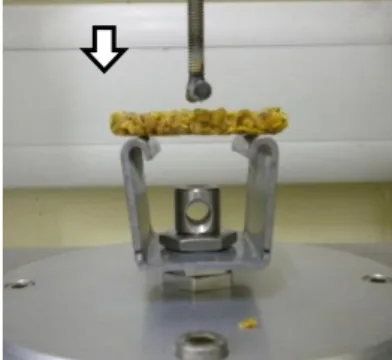
The texture of the granola bars was evaluated using a TA.HDplus Texture Analyser (Stable Micro Systems, Godalming, UK) equipped with a 50 N load cell and a three-point bending rig (Figure 2.2). The force data was recorded with the Texture Expert software (Stable Micro Systems) and the texture of each sample was expressed as the maximum compression force (N, Newton) when applying a vertical downward movement at the middle of the cereal bar,
adjustable funnel impeller chopper granulating bowl
15
referred to as bending force. Sampling was made from six individual bars; except for the experiment with extra honey added, where sampling was made in triplicate.
Figure 2.2. A three-point bending rig. A compression force (white arrow) was applied over
the middle of the cereal bar and the peak force was registered.
2.2.3 Water activity and Moisture content
The water activity (aw) was measured with ca. 3 g of crumbled sample using an AquaLab
Series 3 TE Water Activity Meter (Decagon Devices, Pullman, WA USA) at 20 ºC. The moisture content was measured using ca. 3 g of sample, by drying it in an oven at 105 ºC for 18 h, and calculating the percentage of weight loss. Sampling was made from six individual bars; except for the experiment with extra honey added, where sampling was made in triplicate.
2.3 Bacterial strains and growth conditions
2.3.1 Maintenance and preparation of culture
The probiotic strains Lactobacillus casei 01 and Bifidobacterium animalis Bb12 were obtained from Christian Hansen, Denmark, while Lactobacillus acidophilus L10 was obtained from DSM (Dutch State Mines), Australia. All the bacterial strains were routinely grown in MRS medium (De Mann-Rogosa-Sharpe, Merck, Germany) at 37 ºC for 48 hours, under aerobic or anaerobic conditions for lactobacilli or bifidobacteria strains, respectively, unless otherwise stated. Long term stocks stored at -80 °C were prepared from fresh MRS cultures with 20 % (v/v) glycerol. Short term stocks were prepared on MRS plates. Preparation of bacterial cells for the different experiments was achieved by inoculating 10 or 100 mL of
16
MRS broth with a fresh overnight MRS culture to an optical density of 600 nm (OD600)
of ~ 0.05. Cultures were put into incubation for 18h at same conditions before centrifugation and cell collection.
2.3.2 Viable cell counts
Viable cell counts, expressed as colony-forming units per mL or gram (CFU.mL-1 or CFU.g-1), were determined in duplicate by serial decimal dilutions, with peptone water [1 g peptone (Meat Peptone, Merck, Germany), 8.5 g NaCl (Sigma-Aldrich, Germany)]; and spread plated on MRS agar. CFU were determined after 48-72 hours incubation at 37 ºC, under aerobic or anaerobic (anaerobic chamber) conditions for lactobacilli or bifidobacteria strains, respectively.
2.3.3 Growth curve
An overnight culture was used to inoculate 100 mL of fresh MRS medium to an initial OD600
of ~ 0.05. Following incubation at 37 ºC, the optical density and viable counts were monitored every two hours for a period of 22 h. Due to the inability to monitor growth over twenty two consecutive hours, separate inoculums were prepared: one for each half period, with an overlap of sampling to ensure similar growth behaviour. Sampling was made in triplicate, and the full experiment was performed twice.
2.4 Encapsulation of probiotic bacteria
2.4.1 Extrusion method
Cells from 10 or 100 mL 18 h cultures were collected by centrifugation for 10 minutes, at 1300 g, 20 °C, and washed twice in peptone water using the same centrifugation conditions. The cell pellet was resuspended in 10 mL of peptone water (1/10 of original volume), and subsequently evenly mixed with an equal volume of sterile 4 % (w/v) sodium alginate solution (Alginic acid sodium salt from brown algae, Fluka, Norway). The final cell suspension (1/5 of original volume) contained 2 % (w/v) alginate.
The encapsulation of the probiotic cells was then performed by the extrusion technique by passing the cell mixture at a constant air pressure through a semi-automatic syringe pump
17
system (JBE1113 Dispenser, I&J Fisnar Inc, USA) coupled to a blunt tip needle of 30 G (See Figure 2.3). The droplets were collected in a sterile beaker containing 100 mL of 0.1 M CaCl2
(Sigma-Aldrich, Germany) under mechanical stirring at 100 rpm. This process resulted into gelled beads with immobilized bacterial cells – hereby referred to as “loaded beads”. These loaded beads were left to rest at room temperature in the calcium chloride solution for an hour before being washed with peptone water. When required beads were stored at 4 ºC.
(a) (b)
Figure 2.3. Encapsulation apparatus. (a) Picture of the apparatus, and (b) diagram
illustrating the encapsulation procedure.
2.4.2 Size and shape of beads
The diameter of the loaded beads was determined by an automated microscopy system (PharmaVision 830, Malvern Instruments, UK) and corresponding image analysis software. Each measurement determination was done on 30 randomly chosen beads from three different batches of loaded beads. The shape of the beads was assessed by stereo microscopy (Leica zoom 2000, Leica Microsystems, USA). Also, probiotic cells on the alginate matrix were observed by the cut of a small slice of a bead, fixed onto a slide, Gram stained, and visualized with the light microscope (Leica DM 1000, LeicaMicrosystems, USA).
Cell +alginate mixture syringe Loaded beads CaCl2 solution Stirring Pressure
18
2.4.3 Encapsulation efficiency and stability of bacteria
One gram of freshly prepared bacteria-loaded beads were dissolved in 9 mL PBS 0.4 M (mol.L-1) pH 7.0, for 5 minutes. Release of bacterial cells and homogeneity of the solution was achieved with a mechanical force provided by a single-speed stomacher (Colworth Stomacher 400, Colworth, London, UK). The number of viable cells in this homogenate was determined. The calculation of encapsulation efficiency was done using the logarithmic values of CFU.g-1 for the inoculum and for the total beads produced.
The stability of the bacteria was assessed by monitoring the number of viable cells during storage in peptone water at 4 ºC. Samples of loaded beads (one gram) were taken, in triplicate, at 0, 1, 2, 3 and 5 days of storage; and the experiment was performed twice.
2.5 Incorporation of probiotic strain into the cereal bar
2.5.1 Free cells
Cells from 10 mL overnight cultures were collected by centrifugation at 1300 g, 20 °C for 10 minutes, and washed twice in peptone water as previously described. The final cell pellets were mixed with 2 g of honey and poured over the cereal bar. Three individual bars were used for each different drying temperature to be tested: 80, 120 and 160 ºC, placed into an oven for 10 minutes, and left to cool at room temperature for 20-30 minutes. The viability of each probiotic strain upon heat exposure was determined by placing each 10 g cereal bar in 90 mL of 0.4 M PBS for 5 minutes, after which the bar was thoroughly shredded and mixed with the stomacher for 1 minute. Viable cell counts were determined as described in Section 2.3.2.
2.5.2 Encapsulated bacteria
One gram of loaded beads (encapsulated bacteria) (see Section 2.4.1) was equally spread over an individual cereal bar, followed by 2 g of honey which were evenly distributed over the entire surface of the bar. These bars were placed into the oven at the different drying temperatures under assessment for 10 minutes and then left to cool before assessing probiotic viability, as described above for the incorporation of free cells (section 2.5.1). Sampling was made in triplicate, and the experiments were performed twice.
19
2.6 Viability of encapsulated probiotics in cereal bars during storage
Cereal bars with probiotics were stored individually in closed plastic containers (Gosselin, France), in the absence of light, and under controlled temperature conditions 4 and 20 ºC (see Figure 2.4). Individual bars were removed at 0, 1, 4, 7 and 14 days of storage and used to determine probiotic viability as described in section 2.5.1. Sampling at each day was made in triplicate and the experiment was performed twice, except for the 4 ºC storage conditions with only one independent experiment.
Figure 2.4. Probiotic cereal bars stored in plastic containers inside the temperature chamber at 4 or 20 ºC.
2.7 Statistical analysis
Statistical differences were detected with a paired two-tailed t_Test, using the Microsoft Excel software (Microsoft Corp., Washington, USA). All analysis were performed with a significance level of 5 % (p < 0.05).
21
3. Results and discussion
3.1 Granola bar production
3.1.1 Preparation of the granola product
The granola was prepared using a high-shear granulator as previously described (Section 2.1). The resulting product, upon the granulation process, was a granulated mixture ready to be baked (Figure 3.1). The recipe of this mixture included some prebiotic ingredients such as inulin and beta-glucan, which was considered valuable for the subsequent incorporation of probiotics. The delivery of beneficial bacteria with the selective growth stimulation by the prebiotic ingredients makes the cereal bar a synbiotic product, with better chances to promote probiotic effects (Steed et al., 2008). For example, in a randomized study to ulcerative colitis patients (Fujimori et al., 2009), the synbiotic treatment showed greater improvements in the quality-of-life of the patients when compared to probiotic or prebiotic therapy alone. Furthermore, it has been reported that synbiotic products are the most popular among consumers and therefore have higher market value (Annunziata & Vecchio, 2011; Bogue & Ryan, 2000).
(a) (b)
Figure 3.1. Granola production in a high-shear granulator: (a) mixing in granulating
bowl, and (b) granola after mixing.
3.1.2 Manufacturing of the cereal bars
To generate small cereal bars (10 g), the totality of the granola mixture (~180 g) was initially placed and flattened in a large tray before being oven baked for 15 minutes at 160 ºC. A sharp knife was then used to tentatively cut the resulting product into small rectangles. However,
22
the brittle properties of the product resulted in cereal bars with jagged and uneven edges, which were visually unacceptable and made the desired homogeneity between cereal bars almost impossible (Figure 3.2A). As a result, subsequent bars were generated by moulding the cereal mixture into small baking trays with a defined shape and size (5.5 x 3.5 cm) (Figure 3.2B and C).
(a) (b) (c)
Figure 3.2. Manufacturing of the cereal bars. (a), bar cut with knife. (b), mixture in the
mould. (c), cereal bar prepared in the mould.
This optimised process resulted only in minor negligible variations in shape, size and weight between cereals bars. This procedure also resulted in cereal bars which more closely mimicked the most commonly found commercial cereal bar products (Figure 3.2C).
3.1.3 Optimisation of the baking process
Although the baking process was initially defined to 15 minutes at 160 °C, a visual analysis of the resulting product submitted to these conditions suggested that a shorter exposure to heat would be sufficient and beneficial, considering that further baking/drying would be required downstream following the incorporation of the probiotic bacteria. In order to confirm this, the effect of baking on the textural and physical properties of the cereal bars was examined by monitoring the water activity (aw), moisture content (MC) and texture (bending force) of
23
Figure 3.3. Values (average ± standard deviation) of (a) water activity (aw), (b) moisture
content (%) and (c) bending force (N) of granola bars baked at 160 ºC for 10 and 15 minutes.
As expected, samples incubated for only 10 minutes displayed higher water activity and higher moisture content, as well as decreased bending force. Although significantly different (p < 0.05), the changes in the physical parameters were considered to be small, because for 10 minutes of baking the aw (0.348 ± 0.018) and MC (5.85 ± 0.40 %) values were still close to
previously reported acceptable references: 0.3 and 5%, respectively (Macedo, 2011). These results allowed the addition of an extra post-production drying process, essential for the effective incorporation of probiotic strains, without compromising the initial product to an excessive water loss and cooking.
0.000 0.100 0.200 0.300 0.400 10 15 aw 0.00 2.00 4.00 6.00 8.00 10 15 M o is tu re c o n te n t (% ) 0.0 2.0 4.0 6.0 8.0 10.0 12.0 14.0 10 15 Ben d in g f o rc e (N) time (min) (a) (b) (c)
24
3.2. Probiotics growth phase and viable numbers
3.2.1 Lactobacillus casei 01
The probiotic isolate L. casei 01 was first used to ascertain the potential of incorporating a probiotic strain into a cereal product. Lactobacillus casei is widely recognized to be beneficial to the human health because of its immunostimulatory activity, it is largely introduced in the functional food market, and has therefore been reported as safe for consumption.
The time of incubation and harvesting of bacteria is important to maximise the concentration of viable cells, because it has to be ensured that high numbers such as 106-108 CFU.g-1 of product at time of consumption are maintained in order to sustain successful colonisation of the gut.
On the other hand, it has been well documented that the genetic, biochemical and physiological state of bacterial cells change throughout the different growth phases. It is also known that these properties can influence cell resistance to different environmental stresses such as those found during food processing and storage. For example, early exponential-phase cells may be less resistant to heat stress, since most viable cells are undergoing division and therefore have decreased energy resources available to deal with external aggressions. In order to establish the growth phase of the probiotic L. casei 01 at the time of harvesting for subsequent incorporation experiments, the optical density and associated CFUs were monitored for a period of 24 hours (see Figure 3.4).
25
Figure 3.4. Growth curve of Lactobacillus casei 01. Viable cells (CFU.mL-1, ) and OD600
(x) for 22 hours of growth. The first 12 hours are shown in red, and the following 10 hours in yellow. This experiment was conducted twice, and a representative result is here shown.
L. casei 01 appears to enter stationary phase after ~ 16 h incubation with no significant
increase in the numbers of viable cells thereafter. Therefore, subsequent experiments were carried out with cells harvested at 18 hours incubation (ca. 1.5 x10⁹ CFU.mL-1), which corresponded to a point in the stationary phase where a balance between an adequate viable cell number and cell resistance to stress conditions appeared to be met.
3.2.2 Lactobacillus acidophilus L10 and Bifidobacterium animalis Bb12
The probiotic strains L. acidophilus L10 and B. animalis Bb12 were harvested at 18 hours of incubation. The growth curve for both these strains was not established, but high viable counts between 5.0 x10⁸ and 1.0 x10⁹ CFU.mL-1 were also reported.
These two strains are also known to be robust from a technological point of view and were therefore used for relative comparison with L. casei 01 in viability changes associated to the drying process. 0.000 1.000 2.000 3.000 4.000 5.000 6.000 7.000 1.00E+07 1.00E+08 1.00E+09 1.00E+10 0 2 4 6 8 10 12 14 16 18 20 22 24 OD 600 CF U.m L -1 time (h)
26
3.3. Encapsulation of probiotics
The encapsulation of the probiotic cells in Ca-alginate beads was achieved by the extrusion method. The process was studied more thoroughly to evaluate its reproducibility and reliability as a carrier for probiotic cells.
3.3.1 Size and shape of beads
The size and shape of the beads are crucial as large visible beads would not be acceptable by the consumer. These parameters were also determined in order to establish the reproducibility of the encapsulation technique.
Initial use of a manual syringe for the dispersal of the alginate-cell mixture proved to be quite unreliable in terms of homogeneity of bead size and shape. This issue was drastically improved by the use of a syringe pump system, to continuously pressure the alginate and cell concentrate mixture though the needle.
Follow up experiments were targeted at establishing the needle optimal diameter (from 25 G to 30 G) as this would be directly proportional to the size of droplet, i.e. the smaller the diameter (bigger the gauge) of the needle, the smaller the droplet formed.
The 30 G needles produced the smallest beads with an average diameter size, measured from three randomly chosen production batches, of 2.40 ±0.24 mm. Additionally, the beads produced showed an almost perfect spherical shape (Figure 3.5). The beads size is already very near of optimal values. The incorporation of loaded beads with 1-0.5 mm would be sufficient to satisfy the visual aspect of the cereal bars, because the product has already a granulated mouth feel. This situation comprises one of the technological advantages of this product, since the mouth feel in liquid products as yogurt or milk would require beads smaller than 0.3 mm (Rodrigues et al., 2011b) and therefore more expensive techniques of encapsulation.
27
(a) (b)
Figure 3.5. Size and shape of the beads prepared with a 30G needle and a syringe pump system. (a) 10x Magnification. (c) Direct examination.
Besides needle diameter, both beads‟ size and shape are also influenced by a number of other parameters (Blackshields, 2009), which were set up in the current work and are listed below, with the first three parameters defining the flow rate.
Needle gauge, 30 G
Alginate concentration, 2 % (w/v) Air pressure, 2-4 bar
Tip needle distance to cross-linking solution, 5 cm Hardening time, 1 h
While the extrusion method can be optimized to obtain smaller beads, by using either an electrostatic field of high voltage or a vibration nozzle to break a continuous flow into smaller droplets (Seifert & Phillips, 1997), these techniques were not explored in this study.
The probioticcells within the alginate matrix were observed with the help of light microscope (400x and 1000x) (Figure 3.6) in a Gram stained bead slice. Clearly cell dispersion was not uniform within the bead and the alginate matrix was far from being saturated with cells. Although these observations are relevant to understand the protective role of this matrix, further studies (e.g. scanning electron microscopy) would be required to better understand such mechanism. Indeed, the gelled coating structure, the cells dispersion and/or their concentration may influence the water loss when exposed to high process temperatures.
28
400x
1000x
Figure 3.6. Probiotic cells (L. casei 01) within bead alginate matrix. Visualization shows
the bacterial cells, rod-shaped and coloured in dark blue, entrapped within the semi-transparent gelled matrix.
3.3.2 Encapsulation efficiency
Despite the inexistence of an official number for the desirable number of probiotic cells in a food product, minimal values of 106 or 108 CFU.g-1 of product are generally accepted (FAO/WHO, 2001; Ishibashi & Shimamura, 1993). Initial trial experiments where L. casei 01 was added to the cereal bars as free cells (Section 2.5.1) resulted in a drastic drop in cell viability after subsequent oven baking/drying of the bars. This suggested that alternative processes, for example encapsulation, which would protect the cells from environmental stresses, such as heat exposure, had to be used. Although in the current study the value of 106 CFU.g-1 was taken as the lowest reference value (Probiotic Threshold, PT), this still
29
required a high efficiency of probiotic encapsulation/immobilisation. This would allow avoiding a massive amount of beads over the surface of the cereal bar, and still guaranteeing the incorporation of sufficient numbers of bacteria. Therefore, these cells were concentrated to 1/5 of the original volume in the alginate solution before encapsulation. Furthermore, it was hypothesized that a slow stirring speed of the cross-linking solution would affect the encapsulation efficiency, and consequently stirring was kept between 50 and 100 rpm. Together this resulted in encapsulation efficiencies always above 90 %, which permitted to spread only 1 g of beads in 10 g cereal bars, with an average concentration of 108 CFU.g-1 in the final product.
3.3.3 Stability of the bacterial cells inside beads
After encapsulation, the loaded beads were stored at 4 °C in peptone water, and samples taken at day 0, 1, 2, 3 and 5 of storage were analysed for probiotic viability (see Figure 3.7) as described before.
Figure 3.7. Viability of encapsulated probiotic Lactobacillus casei 01 cells at 0, 1, 2, 3 and 5 days of storage at 4 ºC storage.
The number of viable cells remained relatively constant throughout the five days storage time, confirming that the alginate beads were indeed appropriate carriers for the probiotic cells. In addition, these loaded beads needed not to be used straight after encapsulation procedure as cells were stable when stored in the fridge.
9.00 9.50 10.00 0 1 2 3 5 lo g ( CF U.g -1) day of storage
30
The results obtained are similar to other studies (Sousa et al., 2010) with other microencapsulated probiotics, namely Lactobacillus acidophilus Ki, which showed good stability of viable cells in refrigerated conditions. Sousa et al. (2010) also showed that, when stored at 21 ºC, the alginate encapsulation did not revealed a protective effect upon cell viability, but with water activity maintained at 0.11.
3.3.4 Survival of encapsulated probiotic strains when submitted to heat exposure
Before proceeding with the incorporation of probiotics into the cereal bars, the protection from heat exposure conferred only by the alginate beads was evaluated. A preliminary assessment was performed using loaded beads with L. casei 01, which were exposed to different temperatures between 50 and 100 ºC for 10 minutes. Probiotic viability of treated loaded beads showed no substantial change, at any of the temperatures, between the initial cell numbers and the numbers after treatment – with average values of 9.81 and 9.59 log CFU.g-1 of beads, respectively.
One of the few published works with probiotics exposed to high temperature processes (Reid
et al., 2007) also reported a certain degree of viability maintenance. Specifically, it is
observed the survival of microencapsulated Lactobacillus rhamnosus R011 in whey protein when exposed to biscuit baking at 280 ºC. However with temperatures of 92 and 98 ºC at the center and at the surface of the biscuit, respectively.
Subsequent experiments with probiotic bacteria incorporated into cereal bars had a set of temperatures of 80, 120 and 160 ºC. Considering the high temperature range of food processing, in particular as far as granola bars are concerned, these three temperatures were used as a more systematic approach to evaluate the changes in the probiotic viability/survival when encapsulated in calcium-alginate beads.