Clinical profi le of long-living elderly at an intensive care unit
Perfi l clínico de longevos em uma unidade de terapia intensiva Perfi l clínico de longevos en una unidad de terapia intensiva
Joice Barbosa Vilas Boas da Silva1
Larissa Chaves Pedreira1
Jessica Lane Pereira Santos1
Cláudia Silva Marinho Antunes Barros1
Rose Ana Rios David1
Corresponding author Jessica Lane Pereira Santos
http://orcid.org/0000-0001-6528-0689 E-mail: [email protected]
DOI:
http://dx.doi.org/10.1590/1982-0194201800007
1Escola de Enfermagem, Universidade Federal da Bahia, Salvador, BA, Brazil. Confl icts of interest: none to declare.
Abstract
Objective: To identify the clinical and sociodemographic profi le of long-living elderly at an intensive care unit.
Methods: Cross-sectional, retrospective and quantitative study, developed at the ICU of a private hospital in Salvador. The participants were long-living elderly admitted between January 2014 and December 2015, hospitalized for 24 hours or longer. The data were collected in the patients’ electronic charts. The data collection instrument was constructed based on the information contained mainly in the nursing history, aiming to register the sociodemographic and clinical variables. The collected data were typed in Excel 2010 and analyzed using statistical software. For the sake of comparison between the variables, Pearson’s χ2 test was used. The results are presented in tables and their discussion rests on
evidence about the theme.
Results: Among the 252 long-living elderly identifi ed, 64.3% were female. 63.9% came from the emergency service, a statistically signifi cant factor if related to mortality, and 91.3% of them presented comorbidities, particularly non-transmissible chronic conditions, mainly cardiovascular conditions (81.7%) and diabetes mellitus (32.9%). Non-infectious manifestations (84.5%) were the main causes of hospitalization. Upon admission, 71.0% were hydrated, 65.1% eutrophic, 39.3% breathing environmental air spontaneously, 57.5% with spontaneous diurhesis and 77.0% with intact skin. The prevailing length of hospitalization was between 11 and 20 days (24.6%), with death as the main outcome (51.6%).
Conclusion: Even in favorable conditions upon admission, the duration of hospitalization at the unit was long and the percentage of deaths was high.
Resumo
Objetivo: Identifi car o perfi l clínico e sócio demográfi co de longevos em uma unidade de terapia intensiva.
Métodos: Estudo transversal, retrospectivo e quantitativo, realizado na UTI de um hospital privado de Salvador. Participaram os longevos admitidos entre janeiro de 2014 e dezembro de 2015, internados por um período igual ou superior a 24 horas. Os dados foram coletados nos prontuários eletrônicos dos pacientes. O instrumento de coleta foi construído a partir das informações contidas principalmente no histórico de enfermagem, para registro das variáveis sócio demográfi cas e clínicas. Os dados coletados foram digitados no programa Excel 2010 e analisados por meio de um Software estatístico. Para a comparação entre as variáveis foi utilizado o teste χ2 de Pearson. Os resultados são apresentados em tabelas e
sua discussão respaldada em evidências sobre o tema.
Resultados: Dos 252 longevos identifi cados, 64,3% eram do sexo feminino. 63,9% tiveram como procedência a unidade de emergência, fator estatisticamente signifi cante se relacionado com a mortalidade, e 91,3% deles apresentavam comorbidades, destacando-se as doenças crônicas não transmissíveis, principalmente as afecções
cardiovasculares (81,7%) e a diabetes mellitus (32,9%). As manifestações não infecciosas (84,5%) foram as principais causas de internação. Na admissão, 71,0% apresentavam-se hidratados, 65,1% eutrófi cos, 39,3% em ventilação espontânea ao ar ambiente, 57,5% com diurese espontânea e 77,0% com pele íntegra. O tempo de internação prevaleceu entre 11 e 20 dias (24,6%), com grande desfecho de óbito (51,6%).
Conclusão: Mesmo em condições favoráveis na admissão, os longevos tiveram alta permanência na unidade e elevado percentual de óbito.
Resumen
Objetivo: Identifi car el perfi l clínico y sociodemográfi co de longevos en una unidad de terapia intensiva.
Métodos: Estudio transversal, retrospectivo, cuantitativo, realizado en UTI de hospital privado de Salvador. Participaron los longevos admitidos entre enero de 2014 y diciembre de 2015, internados por período igual o superior a 24 horas. Datos recolectados de historias clínicas electrónicas de los pacientes, mediante instrumento construido a partir de la información incluida en el histórico de enfermería, para registro de variables sociodemográfi cas y clínicas. Los datos fueron registrados en planilla Excel 2010 y analizados por Software estadístico. Se utilizó test χ2 de
Pearson para comparación entre variables. Resultados presentados en tablas, discusión respaldada en evidencias temáticas.
Resultados: De 252 longevos identifi cados, 64,3% era de sexo femenino, 63,9% provenía de servicio de urgencias, factor estadísticamente signifi cativo al relacionárselo con mortalidad, y 91,3% presentaba comorbilidades, destacándose enfermedades crónicas no transmisibles, particularmente afecciones cardíacas (81,7%) y diabetes mellitus (32,9%). Las principales causas de internación fueron manifestaciones no infecciosas. En admisión, 71,0% estaba hidratado, 65,1% eutrófi co, 39,3% en ventilación espontánea ambiental, 57,5% con diuresis espontánea y 77,0% con integridad dérmica. Prevaleció tiempo de internación entre 11 y 20 días (24,6%), con notable desenlace en fallecimiento (51,6%).
Conclusión: Inclusive en condiciones favorables de admisión, los longevos tuvieron largas estadías en la unidad y elevado porcentaje de fallecimientos.
Descritores
Idoso de 80 anos ou mais; Idoso; Serviços de saúde para idosos; Unidade de terapia intensiva
Keywords
Aged, 80 and over; Aged; Health services for the aged; Intensive care units
Descriptores
Anciano de 80 o más Años; Anciano; Servicios de salud para ancianos; Unidades de cuidados intensivos
Submitted
October 16, 2017
Accepted
February 15, 2018
How to cite:
Introduction
The increased life expectancy and aging have generated changes in the age structure of the Brazilian population, with a growing increase
in the number of elderly people.(1) This fact also
promotes an increase in these people’s demand for hospitalization, including in intensive care units (ICU), where health professionals have per-ceived this reality.(2)
Regarding longevity, a prospective study car-ried out over a period of 30 months at a
gener-al ICU of Hospital do Servidor Público Estadual
de São Paulo, published in 2016, identified that 18.2% of the patients admitted in the period were 80 years old or older. Among these, ICU mortality was 26.3%, in hospital 45.7% and 48.4% in the 180 days after hospital admission.
(1) In Canada, a study published in 2015,
con-ducted in 22 hospitals, monitored the long-liv-ing elderly after 24 hours of hospitalization and for a period of 12 months, identified a mortality rate of 14% in the ICU, 26% in the hospital and
44% at home after hospital discharge.(3)
Prolonged hospitalization time may result in loss of autonomy, unfavorable prognosis and increased mortality of the long-living elderly, and may be related to the occurrence of adverse events. Thus, a careful evaluation of the hospi-talization decision and the appropriate time for discharge is recommended, in order to guarantee the minimum length of stay, reduction of com-plications and hospital costs.(4)
In this sense, health policies that encourage professional qualification focused on elderly care are essential for health professionals, especially nurses, to provide quality care. Therefore, it is important that the multiprofessional team pays attention to the profile of the long-living elderly hospitalized in the ICU, so that they can discov-er and attend to their particularities that demand specific care, necessary to avoid iatrogenic and unfavorable clinical outcomes.
In view of these findings, the aim of the study was to identify the clinical and sociodemographic profile of the elderly in an intensive care unit.
Methods
Type of research design
Cross-sectional, retrospective study with a quanti-tative approach.
Place of study
Held in the ICU of a private hospital in Salvador. This unit has 30 intensive care beds for adult/elder-ly patients, with clinical and surgical demands. It was chosen due to the large number of long-living elderly admitted.
Sample
A convenience sample was used. The participants were all 80-year-old or older persons admitted to the ICU between January 1st 2014 and December 31st 2015 and who remained in this unit for a peri-od equal to or longer than 24 hours.
Data collection and analysis
The data were collected through the search in the patients’ charts between May and June 2016. At the place of study, the medical records are electronic. Thus, access and data collection were performed us-ing the service password of one of the researchers, with the service’s authorization. She is a resident student in the Intensive Care Nursing Residency
Program of the Nursing School at Universidade
Federal da Bahia and was carrying out practical ac-tivities at the Unit.
The collection instrument was previously con-structed, based on the information contained in the nursing history of the institution, the patient registration form and most recent medical evolu-tion (outcome record), to identify the sociodemo-graphic variables: gender, age, city of origin, origin and religion; and clinical variables: comorbidities, reasons for hospitalization, suspected diagnosis, general health status upon admission, days of hos-pitalization and outcome. The variable diagnosis upon admission was not used, but rather a sus-pected diagnosis, as the nursing history, complet-ed upon admission, did not yet identify a closcomplet-ed medical diagnosis.
The collected data were entered into a database created for this purpose, using Excel 2010, and later imported and analyzed in statistical software IBM SPSS Statistics 14. For the sake of comparison be-tween the variables, Pearson’s χ2 test was used, con-sidering statistically significant differences at 5%. The presentation of the results was organized in ta-bles and their discussion was supported by scientific evidence on the subject.
The project received the Hospital’s agreement and approval from the Research Ethics Committee
of the Nursing School at Universidade Federal da
Bahia, under opinion 1.519.251. Exemption from the Free and Informed Consent Term was requested due to the collection of secondary data. To ensure patients’ anonymity, the forms were identified using numbers and the data were treated in groups.
Results
Of the 1,099 patients admitted to the ICU from January 1st 2014 until December 31st 2015, 732 (66.6%) were older than 60 years. Of these, 252 (34.4%) were long-living and participated in the study. The sociodemographic characteristics of this population are shown in table 1.
It could be observed that the majority of the long-living hospitalized patients were women who lived in the capital of the State, Salvador, were self-declared Catholic and came from the emergen-cy unit. A considerable part was transferred from
Table 1. Sociodemographic characteristics of the population
Sociodemographic variables n (%)
(n=252) p-value
Age range 0.142
80 and 90 years 200(79.4) > 90 years 52(20.6)
Sex 0.436
Male 90(35.7)
Female 162(64.3)
City 0.338
Capital (Salvador – BA) 231(91.7) Interior 21(8.3)
Religion 0.053
Catholic 148(58.7) Evangelical 36(14.3) Spiritist 7(2.8) Jehovah Witness 2(0.8) Candomblé 2(0.8) Did not answer 57(22.6)
Origin 0.000
Emergency 161(63.9) Inpatient unit 25(9.9) Operating room 24(9.5) Other health institutions 42(16.7)
other health institutions, both from the capital and from other cities.
When associated with the outcome, it is ob-served that the origin of these patients was the only statistically significant characteristic, and revealed that the long-living elderly who were admitted through the emergency service before admission to the ICU passed away.
In table 2, the distribution of the elderly is dis-played according to the presence of one or more comorbidities/problems and the main ones, as well as the causes of hospitalization and the suspected diagnoses upon admission, as well as their relation with the outcome.
An important percentage of the long-living (91.3%) had comorbidities. Chronic noncommu-nicable diseases (CNCD) were the most frequent, with high prevalence of systemic arterial hyperten-sion (90.8%), diabetes mellitus (DM) and neopla-sias, in that order. Among the comorbidities relat-ed to neurological diseases, the sequelae of stroke and some cases of dementia prevailed, especial-ly Alzheimer dementia, present in 82.1% of the long-living patients with this condition.
and dyspnea in 20.2% of these individuals. The main manifestation of the causes of hospitalization related to infectious occurrences was hyperthermia. It is noteworthy that, in 8.7% of the nursing re-cords investigated, this data was not completed.
Other causes of hospitalization were less fre-quent, such as abdominal pain, precordial pain, vomiting, syncope, intestinal hemorrhage, hemate-mesis and fall from one’s own height, as well as sei-zures and diarrhea.
Among the suspected diagnoses, the most fre-quent were also related to non-infectious causes, present in half of the elderly, with evidence of stroke in 32.5% and AMI in 10.3%, followed by infectious causes, sepsis in 41.3% of the patients, respiratory infection in 34.9% and septic shock in 23.8%. No records of suspected diagnosis were found in 25% of the charts, probably because the nursing history was completed before recording this data.
The association between these clinical vari-ables and the outcome did not reveal statistical significance.
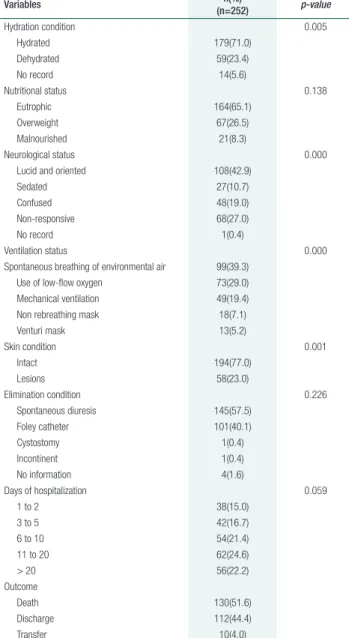
The data collected on the health conditions are presented in table 3. Most of the long-living patients were hospitalized in the ICU for a period between 11 and 20 days, followed by an inpatient period of more than 20 days. More than half of them, at the time of admission, were considered normal weight, hydrated, without skin lesions, lucid, oriented and breathing spontaneously. Little more than half of the individuals studied died. Hydration status, neu-rological status, ventilation status and skin
condi-Table 2. Distribution of the long-living elderly hospitalized at
the Intensive Care Unit.
Clinical variables n(%)
(n=252) p-value
Comorbidities/problems 0.732
One 74(29.4)
Two 87(34.5)
Three 69(27.4)
None 22(8.7)
Main comorbidities/problems* Chronic noncommunicable diseases**
Cardiopathies 206(81.7)
DM 83(32.9)
Neoplasia 25(9.9) Chronic respiratory disease 06(2.4) Neurological diseases
Stroke 43(17.1)
Dementia 28(11.1) Parkinson 04(1.6) Others
Smoking 18(7.1) Osteoarticular disease 10(4.0)
Causes of hospitalization 0.533 Non-infectious manifestations 213(84.5)
Infectious manifestations 17(6.7) No record 22(8.7)
Suspected diagnosis 0.478 Related to non-infectious causes 126(50.0)
Related to infectious causes 63(25.0) No record 63(25.0)
*For the main comorbidities/problems, “Chronic Noncommunicable Diseases”, “Chronic respiratory diseases”, “Neurological diseases” and “Others”, many long-living elderly presented more than one. Therefore, the p-value could not be calculated.
**The Chronic Noncommunicable Diseases (CNCD) were groups based on the strategic action plan for coping with CNCD in Brazil between 2011 and 2022.(5)
Table 3. Health conditions of long-living elderly hospitalized at
the Intensive Care Unit
Variables n(%)
(n=252) p-value
Hydration condition 0.005 Hydrated 179(71.0)
Dehydrated 59(23.4) No record 14(5.6)
Nutritional status 0.138
Eutrophic 164(65.1) Overweight 67(26.5) Malnourished 21(8.3)
Neurological status 0.000 Lucid and oriented 108(42.9)
Sedated 27(10.7)
Confused 48(19.0) Non-responsive 68(27.0)
No record 1(0.4)
Ventilation status 0.000
Spontaneous breathing of environmental air 99(39.3) Use of low-flow oxygen 73(29.0) Mechanical ventilation 49(19.4) Non rebreathing mask 18(7.1) Venturi mask 13(5.2)
Skin condition 0.001
Intact 194(77.0)
Lesions 58(23.0)
Elimination condition 0.226 Spontaneous diuresis 145(57.5)
Foley catheter 101(40.1) Cystostomy 1(0.4) Incontinent 1(0.4) No information 4(1.6)
Days of hospitalization 0.059
1 to 2 38(15.0)
3 to 5 42(16.7)
6 to 10 54(21.4)
11 to 20 62(24.6)
> 20 56(22.2)
Outcome
Death 130(51.6)
Discharge 112(44.4)
tion were factors that showed a statistically signifi-cant association with the outcome death.
Discussion
In the study, there was a predominance of long-liv-ing hospitalized women, which may reflect their longer life expectancy in relation to men, following
the worldwide trend of feminization of old age.(6)
This result, however, diverges from other stud-ies that indicate a prevalence of hospitalizations of male patients, justified by the fact that men are more negligent with their health and are at greater risk of clinical decompensation.(2,7-9)
Most of the long-living patients came to the ICU for the emergency unit. Their most preva-lent comorbidities were hypertension, diabetes and other heart diseases, with hypertension and diabe-tes being present in the majority. In addition, the cause of hospitalization was associated, to a great extent, with non-infectious manifestations, mainly lower consciousness level and dyspnea, followed by cough. Similar data were observed in another study, where the main organ dysfunctions presented the long-living patients presented upon admission to the ICU were respiratory (86.5%), cardiac (48.7%), neurological (40.1%), renal (28.1%) and infectious (21.7%).(10)
The presence and number of comorbidities found was not related to the outcome death, which was also observed in another study conducted in Rio Grande do Norte with elderly people
hospital-ized in the ICU.(11) In that study, it was observed
that comorbidities and chronic diseases were not re-lated to the survival of the elderly in survival studies with less than 30 days of follow-up; the presence of comorbidities was associated with unfavorable out-comes in the hospitalized elderly though when the follow-up was longer than 30 days.
CNCDs are a group of pathologies of multifac-torial origins that develop throughout life and are long lasting, causing complications that may lead to the need for hospitalization of the elderly. Estimates by the World Health Organization appoint CNCDs as a severe public health problem, responsible for a
total of 38 million deaths worldwide in 2012.(12) In Brazil, approximately 74.0% of deaths are
associat-ed to CNCDs.(13,14)
Regarding the suspected diagnosis at the time of admission, those related to noninfectious causes prevailed, especially stroke and AMI. With regard to suspected diagnoses related to infectious causes, sepsis, respiratory infection and septic shock were highlighted in this order. One study pointed out coronary diseases as the most prevalent diagnosis in the elderly between 80 and 85 years admitted to the ICU. Most of these, like in the present study, also
entered through the emergency service.(2) In
addi-tion, in another study, sepsis had an impact on the mortality of elderly patients hospitalized at an ICU, regardless of the length of hospital stay.(11)
Hence, it is observed that the clinical demands of the long-living patients in the ICU stand out in comparison to the surgical demands, possibly due to the worsening of chronic problems. In one study, it was identified that acute clinical injuries and age over 80 years are associated with mortality in surviv-al studies with follow-up of less than 30 days, and that situations such as lower consciousness level, use of mechanical ventilation and respiratory diseases are factors that worsen this outcome.(11)
The mortality of the long-living patients in this study was high (51.6%), and may also be relat-ed to the high rates of origin from the emergency unit, with prolonged hospitalization. A large part (24.6%) remained hospitalized for between 11 and 20 days, a longer period when compared to other studies.(11)
A study that investigated the factors related to the occurrence of adverse events in critically ill el-derly people, although it did not relate these to the long-living age group, identified an average of 5.06 days of ICU hospitalization in those who did not suffer adverse events, against 10.62 days in those who did; for those who presented moderate to se-vere cases of these events, the mortality rate was 38.3%.(4)
ori-entation; the length of hospital stay was significant, making them more fragile, dependent and vulner-able to the unfavorvulner-able outcome. In this sense, the study points out the need to remove the patient from the ICU as soon as possible and safely, in or-der to avoid damage. Therefore, however, all hospi-tal staff needs training to provide high-quality care to these people, aiming to preserve their autonomy.
The presence of some risk factors for mortality was observed, such as the use of mechanical venti-lation, present in 19.4% of the elderly. Regarding the functional and cognitive status pre-hospital-ization, the former data was not found in the medical records and, regarding cognition, 27.0% were not responsive upon admission. With regard to mortality, unfavorable outcomes were associ-ated with long-living elderly coming from the emergency service, with compromised neurolog-ical condition, ventilation status, skin condition and hydration upon admission, in line with other authors.(1,2,15)
In view of the above, it is necessary to discuss the criteria for the hospitalization of elderly in the ICU, in view of the professionals’ difficul-ties to establish safe criteria for the admission of these people, and in view of continuing un-certainties as to when the benefit is greater than the risk.(11) In this respect, after favorable clinical trials, the use of the APACHE II score, which evaluates 12 physiological parameters, has been indicated as a gold standard to predict mortality in elderly patients.(2)
In addition, it is necessary to review the instru-ments used to approach the elderly, as important data for their monitoring and prognosis are not being evaluated or valued, such as prior functional status, marital status, context of life, among others, relevant to plan the care and discharge.
The absence of this information from the chart was a limitation of the study, which made it difficult to achieve a more detailed analysis of the length of hospital stay and the outcome. Regarding the prior functional status, for example, authors show its re-lation with morbidity and mortality in hospitalized elderly, representing important data to be collected upon admission.(16)
Conclusion
The clinical and demographic profile of the long-liv-ing elderly at the time of admission to the ICU showed that most patients presented good general health sta-tus, with intact skin, diuresis and spontaneous ven-tilation, lucidity and orientation. The hospitalization time was longer than that reported in the literature though, which may have influenced the unfavorable outcome, as more than half of the studied population died during hospitalization at the unit. In addition, the hydration status, neurological status, ventilation status and skin condition, as well as the elderly who were admitted to the ICU through the emergen-cy service were factors that presented a statistically significant association with the outcome death. We hope that, through this study, the long-living elderly admitted to the ICU can gain more visibility, stim-ulating discussions about this subject, which are still lacking in our scenario. Prior knowledge on the per-sonal, clinical, physical and functional conditions of these people is important, so that health professionals can weigh the risk-benefit of an ICU stay, and direct the care with higher quality and less risk.
Collaborations
Silva JBVB, Pedreira LC, Santos JLP, Barros CSMA and David RAR contributed to the conception of the Project, data collection and base, analysis and interpretation of the data, writing of the article and final approval of the version for publication.
References
1. Santos HS, Andrighettia AP, Manfredinia MC, Rezendea E, Juniora JMS, Venturaa MM. Hospitalization indications and its relation to mortality in very elderly patient in the ICU. Geriatr Gerontol Aging. 2016 10(3):140-5.
2. Reyes JC, Alonso JV, Fonseca J, Santos ML, Jimenez MD, Braniff J. Characteristics and mortality of elderly patients admitted to the Intensive Care Unit of a district hospital. Indian J Crit Care Med. 2016;20(7):391-7.
4. Toffoletto MC, Barbosa RL, Andolhe R, Oliveira EM, Janzantte DA, Padilha KG. [Factors associated with the occurrence of adverse events in critical elderly patients]. Rev Bras Enferm. 2016; 69(6):1039-45. Portuguese.
5. Brasil. Ministério da Saúde. Secretaria de Vigilância em Saúde. Departamento de Análise de Situação de Saúde. Plano de ações estratégicas para o enfrentamento das Doenças Crônicas Não Transmissíveis (DCNT) no Brasil 2011-2022 [Internet].. Brasília (DF): Ministério da Saúde; 2011. [citado 2017 Jun 17]. Disponível em: http://bvsms.saude.gov.br/bvs/publicacoes/ plano_acoes_enfrent_dcnt_2011.pdf [ Links ]
6. Almeida AV, Mafra SC, Silva EP, Kanso, S. [The feminization of old age: a focus on the socioeconomic, personal and family characteristics of the elderly and the social risk] Textos & Contextos (Porto Alegre). 2015;14 (1): 115-31. Portuguese.
7. Levinson M, Mills A, Oldroyd J, Gellei A, Barrett J, Staples M, et al. The impact of intensive care in a private hospital on patients aged 80 and over: health-related quality of life, functional status and burden versus benefit. Internal Med J. 2016;46(6):694-702.
8. Cunha BS, Nascimento AS, Sá SP. [Clinical and sócio-demographic profile of elderly admitted to the emergency unit to the general hospital]. Estudos Interdisciplinares sobre o Envelhecimento. 2014;19 (1): 189-200. Portuguese.
9. Al-Dorzi HM, Tamim HM, Mundekkadan S, Sohail MR, Arabi YM. Characteristics, management and outcomes of critically ill patients who are 80 years and older: a retrospective comparative cohort study. Anesthesiology. 2014;14(126):1-9.
10. Maillet JM, Guerot E, Novara A, Le Guen J, Lahjibi-Paulet H, Kac G, et al. Comparison of intensive-care- unit-acquired infections and their outcomes among patients over and under 80 years of age. J Hosp Infect. 2014;87(3):152–158.
11. Bonfada D, Santos MM dos, Lima KC, Garcia-Altés A. [Survival analysis of elderly patients in Intensive care units]. Rev Bras Geriatr Gerontol. 2017; 20(2):197-205. Portuguese.
12. World Health Organization (WHO). Global status report on noncommunicable diseases 2014 [Internet]. Geneva: WHO; 2014 [cited 2017 Aug 04]. Available from: http://apps.who.int/iris/ bitstream/10665/148114/1/9789241564854_eng.pdf?ua=1 .
13. World Health Organization (WHO). Mortality and burden of disease. Noncommunicable Diseases (NCD) Country Profiles, 2014: Brazil [Internet]. Geneva: WHO; 2014 [cited 2017 Aug 04]. Available from: http://www.who.int/nmh/countries/bra_en.pdf?ua=1 [ Links ]
14. Malta DC, Oliveira TP, Santos MA, Andrade SS, Silva MM. [Progress with the strategic action plan for tackling chronic non-communicable diseases in Brazil, 2011-2015]. Epidemiol Serv Saúde. 2016;25(2):373-90. Portuguese.
15. Borges CL, Silva MJ, Clares JW, Bessa ME, Freitas MC [Frailty assessment of institutionalized elderly]. Acta Paul Enferm. 2013;26 (4): 318-322. Portuguese.