1. EPIUnit – Institute of Public Health, University of Porto 2. EPIUnit – Institute of Public Health, University of Porto; Unidade de Saúde Familiar St. André de Canidelo, Administração Regional de Saúde do Norte
3. Faculty of Human Kinetics, University of Lisbon 4. EPIUnit – Institute of Public Health, University of Porto Department of Clinical Epidemiology, Predictive Medicine and Public Health, University of Porto Medical School
Keywords: Lower back pain; Population-based stu-dies; Education; non specific back pain risk factors
IntroductIon
Lower back pain (LBP) ranks highest in terms of disa -bility and sixth in terms of worldwide burden in the general adult population1. Although acute LBP
com-monly improves within one to three months, low level of pain will often persist, and the majority of those af-fected will have at least another episode of acute pain within a year2. Proximal individual factors such as age
and overweight, adverse occupational exposures and psychological distress have been consistently identified as determinants of non-specific LBP3,4. However, the
ef-fects of more distal influences such as changes in social environment and related experiences during the life course remain unclear5, even though the assessment of
the extent to which disease aetiology can be traced back to societal issues is an ultimate focus of public health6.
The few studies on the relation between formal edu -cation and LBP in the contemporary Western societies have shown that current social disadvantage – as measured through low educational level – is directly rela -ted to LBP7, 8. Nevertheless, literature has
comparative-ly disregarded that long-term educational exposures during childhood and adolescence might have an obser vable effect on the experience of LBP9,10, even if
partly mediated by the current low educational level11-13.
This highlights the importance of studying the role of intergenerational educational trajectories on LBP, since this approach is expected to be more reliable when the effect on LBP of different – but combined – social en-vironment exposures throughout the life course is be-ing investigated14,15. Moreover, both educational level
achievement and prevalence of LBP are expected to vary according to gender16,17, which suggests that gender
specificity should be considered when this relation is
Intergenerational educational trajectories
and lower back pain in young women and men
Lourenço S1, Correia S1, Alves L2, Carnide F3, Silva S1, Lucas R4
ACTA REUMATOL PORT. 2017;42:73-81
AbstrAct
We examined the association between intergenerational educational trajectories and lower back pain (LBP) outcomes in young women and men from the general po -pulation. Participants were part of the 21 years old fol-low-up of the EPITeen cohort study, which was set up during the 2003/2004 school year and recruited sub-jects born in 1990 attending schools in Porto, Portugal (n=1657, 51.6% women). Parental and individual edu -cational levels were used to define intergenerational edu cational trajectories as high, upward, stable-low, and downward. Data on the presence, severity and chronicity of LBP were also assessed. Gender-specific adjusted odds ratios (OR) with 95% confidence inter-vals (95% CI) were computed to estimate the associa-tions between educational trajectories and LBP out-comes. When compared to women with stable-high educational trajectories, those with stable-low educa-tional trajectories were significantly more likely to re-port moderate/severe (adjusted OR=1.76, 95% CI: 1.21-2.57) and chronic (adjusted OR=1.82, 95% CI: 1.02-3.22) LBP. The magnitude of these associations was even stronger among females with downward edu -cational trajectories (moderate/severe: adjusted OR=2.58, 95% CI: 1.49-4.46; chronic: adjusted OR=2.42, 95% CI: 1.12-5.27). Educational trajectories were not significantly associated to LBP outcomes among men. In conclusion, intergenerational educa-tional trajectories may contribute to LBP as reported in early adulthood, particularly in women.
being investigated. These hypotheses have scarce support from empirical data, namely in the younger gene -rations in Western countries where educational trends have remarkably improved18.
Within this framework, this study aims to estimate the associations between intergenerational educatio -nal trajectories and LBP in a community sample of women and men born in 1990.
PAtIents And methods PArtIcIPAnts
This study uses cross-sectional data collected from young adults of the Epidemiological Health Investiga-tion of Teenagers in Porto (EPITeen) in the period of 2011-2013. The EPITeen cohort was first assembled during the 2003/2004 school year, when all the pu -blic and private schools in the city of Porto (Portugal) that provided teaching to adolescents born in 1990 were approached. We identified 2787 eligible adoles-cents, of whom 2159 (77.5%) agreed to participate. In 2007/2008, the sample initially recruited was re-evalua ted and 783 students born in the same year but who moved to Porto after 2003/2004 were additio -nally recruited to the cohort. Sampling procedures and detailed methods have been described elsewhere19.
Between 2011 and 2013, 1761 (of the 2942 eligible) participants attended the 21 years old follow-up. Among those, 23 individuals (1.3%) were excluded due to cognitive impairment (e.g. autism spectrum di -sorders) and 81 (4.6%) due to missing data in the main exposures or covariates. Thus, 1657 young adults (51.6% women) constituted the final sample for this investigation.
The study protocol was approved by the Ethics Committee of São João University Hospital (Porto) and written informed consent was obtained from all par-ticipants.
dAtA coLLectIon And defInItIon of vArIAbLes
PArentAL And IndIvIduAL educAtIonAL LeveLs And educAtIonAL trAjectorIes (exPosures)
Indicators of social environment should be tailored to the target setting and methodologically robust, main-ly because it is a complex construct and its assessment
is by no means straightforward or universal. In this study, the indicator of social environment chosen was the educational level. This methodological option was based on the following assumptions: a) education has been considered one of the most important elements in determining the unequal distribution of resources and opportunities with strong impact on health20, 21; b)
education has been widely used as a generic measure of social exposures and it is one of the most well-es-tablished socioeconomic correlates of relevant health--related behaviours and conditions such as muscu-loskeletal pain7; and c) it has been consistently
associated with several health outcomes in the Por-tuguese population22, 23.
Following this, both parental and young adults’ edu cational levels were defined using the total number of schooling years attained. Higher educational level was considered to be present when parents (more than 70% had six years of mandatory schooling) and young adults (all had nine years of mandatory schooling) achieved at least one more cycle of education than mandatory schooling, i.e., at least nine years in pa rents and at least 12 years in young adults. The remaining participants were considered as having lower educa-tional level. Intergeneraeduca-tional educaeduca-tional trajecto-ries were then defined as follows: a) stable-high: high-er parental & highhigh-er individual educational level; b) upward: lower parental education & higher indi-vidual educational level; c) stable-low: lower parental & lo wer individual educational level; and d) down-ward: higher parental & lower individual educational level.
As in Portugal the number of mandatory schooling years has increased substantially over the past decades24, it is expected that the birth cohort of parents
has influenced their level of formal education. Conse-quently, we considered the analysis for parental birth cohort using the year of birth of the parent with high-est education.
Lower bAck PAIn (outcomes)
Regional musculoskeletal pain was assessed using the Nordic Musculoskeletal Questionnaire25, which
evalua tes the presence of musculoskeletal pain during the preceding 12 months in nine different anatomical regions including the lower back. LBP was considered moderate/severe if the reported intensity was higher than 40 millimetres in the visual analogue scale26, and
chronic if it was persistent or recurrent during at least three months in the preceding 12 months.
stAtIstIcAL AnALysIs
Socioeconomic characteristics and LBP outcomes in young women and men were presented as counts and proportions for all the categorical variables, and the statistical significance of differences between groups was estimated using the chi-square test.
Associations between intergenerational educational trajectory and presence, severity and chronicity of LBP were quantified using logistic regression models and considering as reference young adults classified as sta-ble-high. Crude and adjusted odds ratios (OR) with 95% confidence intervals (95% CI) were stratified by gender and all estimates were adjusted for year of birth of parents.
Statistical analyses were performed using Stata®
ver-sion 11.2 for Windows (Stata Corp. LP, College Station, Texas, USA).
resuLts
In this population-based sample of young women and men, educational stability was the most frequently obser ved trajectory (stable-high: 50.3%; stable-low: 23.2%). While upward educational mobility was more frequently found in women (20.2% vs. 11.5% in men, p<0.001), downward educational mobility was more frequently observed in men (13.8% vs. 7.4% in wo -men, p<0.001). When compared to males, females reported more frequently LBP considering either pre -sence (38.5% vs. 53.2%, p<0.001), severity (12.7% vs. 28.3%, p<0.001) or chronicity (5.0% vs. 9.0%, p<0.001) in the past year (Table I).
Women whose parents had lower educational level were more likely to report LBP in the previous year when compared to those with higher parental educa-tional level (58.0% vs. 49.7%, p=0.016). Similar re-sults were observed regarding moderate/severe and chronic LBP. Individual educational level was also si -gnificantly associated to the presence, severity and chronicity of LBP in women (respectively, lower vs. higher: 58.3% vs. 51.1%, p=0.049; 37.3% vs. 24.5%, p<0.001; 13.1% vs. 7.3%, p=0.007). In men, neither parental nor individual educational levels were consis-tently associated to the presence, severity or chronici-ty of LBP (Figure 1).
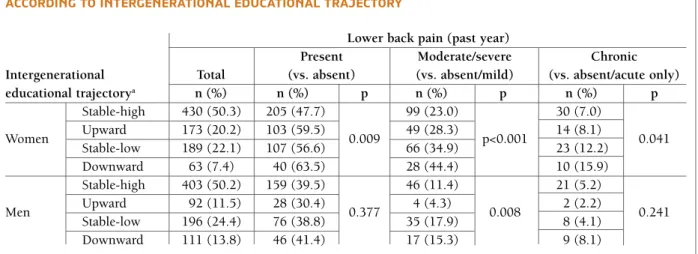
Women with downward educational trajectory were more likely to report LBP in the preceding year when compared to those with stable-high educational
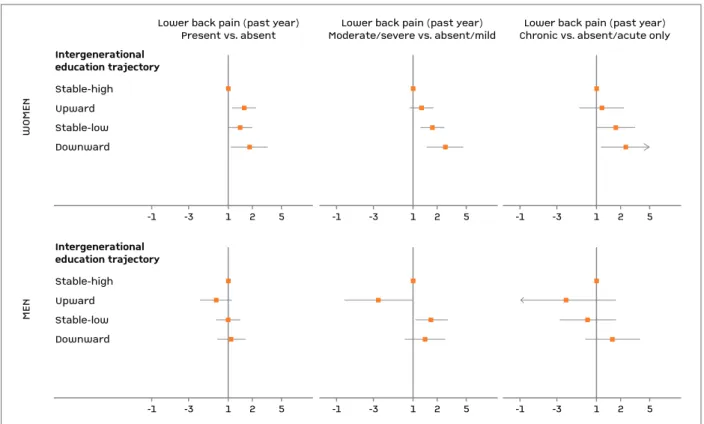
tra-jectory (63.5% vs. 47.7%, p=0.009). Similar associa-tions were found when the severity and chronicity of LBP were the outcomes (respectively, downward vs. stable-high: 44.4% vs. 23.0%, p<0.001; 15.9% vs. 7.0%, p=0.041). No significant associations between educational trajectory and LBP outcomes were ob-served among men, with the exception of males with upward educational trajectory, i.e., this group of indi-viduals was less likely to report moderate/severe LBP when compared to the group with stable-high educa-tional trajectory (4.3% vs. 11.4%, p=0.008) (Table II). Women with upward educational trajectory were significantly more likely to report LBP when compared to those with stable-high educational trajectory (ad-justed OR=1.61, 95% CI: 1.12-2.30). This was not ob-served when the outcomes were moderate/severe or chronic LBP. Stablelow educational trajectory was si -gnificantly associated with severe (adjusted OR=1.76, 95% CI: 1.21-2.57) and chronic (adjusted OR=1.82, 95%CI: 1.023.22) LBP among women using as refe rence group those with stablehigh educational traje -ctory. The magnitude of these associations was even stronger among females moving from higher parental to lower individual educational levels, i.e., with downward educational trajectory (moderate/severe: adjus -ted OR=2.58, 95% CI: 1.49-4.46; chronic: adjus-ted OR=2.42, 95% CI: 1.12-5.27). Overall, intergenera-tional educaintergenera-tional trajectories were not associated to LBP presence, intensity or chronicity among men (Fi -gure 2).
dIscussIon
When both parental and individual educational levels were combined, our findings supported the existence of a gender-specific effect of intergenerational educa-tional trajectories on LBP outcomes: young women with stable-low and downward educational trajecto-ries were more likely to report LBP in the preceding year when compared to those with stable-high educa-tional trajectories. These associations were even stronger when severe or chronic LBP were the outco -mes, particularly among young women with down-ward educational trajectory. Overall, intergenerational educational trajectories were not associated to LBP among young men.
This study added insightful data on the potential ef-fect of intergenerational educational trajectories on LBP presence and severity in early stages of life such as
young adulthood. The use of trajectories has been sugges ted as fundamental to clarify the mechanism whereby socioeconomic indicators such as education affect LBP report13, especially because this approach is
expected to enable the typing of different combinations of social exposures throughout life, i.e., it considers not only individual characteristics but also the potential role of parental social experiences and expectations in relation to their children throughout life27.
The effect of individual educational level and con-comitant social exposures on health outcomes is
ex-pected to be partly a consequence of the educational level and social background provided by parents28. In
agreement, we observed that women with stable-low educational trajectories had higher odds of reporting LBP when compared to those continuously exposed to higher educational levels (stable-high). Prior research is in line with the obtained results among women, even though the role of lower levels of parental and own edu cation on musculoskeletal pain outcomes has been analysed separately and disregarding potential gender specificity29,30,14,15.
tAbLe I. PArentAL And IndIvIduAL socIoeconomIc chArActerIstIcs And Lower bAck PAIn Presence, severIty And chronIcIty In the PAst yeAr AccordIng to gender (ePIteen cohort, 2011-2013)
Overall Gender
n (%) Female n (%) Male n (%)
n=1657 855 (51.6) 802 (48.4) p
Socioeconomic characteristics
Year of birth of parents (2003-2004)a,b
Until 1957 490 (29.6) 233 (27.3) 257 (32.0)
0.033
1958 or more 1167 (70.4) 622 (72.7) 545 (68.0)
Parental educational levelc
≤9 years (lower) 650 (39.2) 362 (42.3) 288 (35.9)
0.007
>9 years (higher) 1007 (60.8) 493 (57.7) 514 (64.1)
Individual educational level
≤12 years (lower) 559 (33.7) 252 (29.5) 307 (38.3) p<0.001 >12 years (higher) 1098 (66.3) 603 (70.5) 495 (61.7) Educational trajectoriesd Stable-high 833 (50.3) 430 (50.3) 403 (50.2) Upward 265 (16.0) 173 (20.2) 92 (11.5) p<0.001 Stable-low 385 (23.2) 189 (22.1) 196 (24.4) Downward 174 (10.5) 63 (7.4) 111 (13.8)
Lower back pain (past year) Presence Absent 893 (53.9) 400 (46.8) 493 (61.5) p<0.001 Present 764 (46.1) 455 (53.2) 309 (38.5) Severity Absent/Mild 1313 (79.2) 613 (71.7) 700 (87.3) p<0.001 Moderate/severe 344 (20.8) 242 (28.3) 102 (12.7) Chronicity Absent/acute only 1540 (92.9) 778 (91.0) 762 (95.0) p<0.001 Chronic 117 (7.1) 77 (9.0) 40 (5.0)
a. Year of birth of the parent with the highest number of schooling years.
b. In Portugal, parents born before 1958 had 4 years of mandatory school; parents born between 1958 and 1979 had 6 years of mandatory school (the youngest parent was born in 1979).
c. Parent with the highest number of schooling years.
d. Stable-high: higher parental educational level-higher individual educational level; upward trajectory: lower parental educational level-higher individual educational level; stable-low: lower parental educational level-lower individual educational level; downward trajectory: higher parental educational level-lower individual educational level.
tAbLe II. Lower bAck PAIn Among young women And men from the ePIteen cohort (2011-2013) AccordIng to IntergenerAtIonAL educAtIonAL trAjectory
Lower back pain (past year)
Present Moderate/severe Chronic
Intergenerational Total (vs. absent) (vs. absent/mild) (vs. absent/acute only)
educational trajectorya n (%) n (%) p n (%) p n (%) p Stable-high 430 (50.3) 205 (47.7) 99 (23.0) 30 (7.0) Women Upward 173 (20.2) 103 (59.5) 0.009 49 (28.3) p<0.001 14 (8.1) 0.041 Stable-low 189 (22.1) 107 (56.6) 66 (34.9) 23 (12.2) Downward 63 (7.4) 40 (63.5) 28 (44.4) 10 (15.9) Stable-high 403 (50.2) 159 (39.5) 46 (11.4) 21 (5.2) Men Upward 92 (11.5) 28 (30.4) 0.377 4 (4.3) 0.008 2 (2.2) 0.241 Stable-low 196 (24.4) 76 (38.8) 35 (17.9) 8 (4.1) Downward 111 (13.8) 46 (41.4) 17 (15.3) 9 (8.1)
a. Stable-high: higher parental educational level-higher individual educational level; upward trajectory: lower parental educational level-higher individual educational level; stable-low: lower parental educational level-lower individual educational level; downward trajectory: higher parental educational level-lower individual educational level
0 W O M EN Lo w er b ac k pa in (p as t ye ar )
Parental educational level
20 58.0% 49.7% 40 60 80 100 Moderate/severe Chronic Present 31.8% 25.8% 10.2% 8.1% 0
Individual educational level
20 58.3% 51.1% 40 60 80 100 37.3% 24.5% 13.1% 7.3% 0 M EN Lo w er b ac k pa in (p as t ye ar ) 20 36.1% 39.9% 40 ≤ 9 years (lower) 60 80 100 Moderate/severe Chronic Present 13.5% 12.3% 3.5% 5.8% 0 20 39.7% 37.8% 40 60 80 100 16.9% 10.1% 5.5% 4.7%
> 9 years (higher) ≤ 12 years (lower)> 12 years (higher)
fIgure 1.Parental and individual educational levels and lower back pain in the past year (presence, severity and chronicity) among young women and men from the EPITeen cohort (2011-2013)
From a life course perspective, this would be an unex-pected result if a cumulative effect of exposure to so-cial disadvantage on LBP throughout life was the main mechanism accounting for the associations found in our investigation. Rather, it argues for an important role for the trajectory itself, posing parental influence as a possible modifier of the effect of individual educatio -nal level on health9,13.
Intergenerational educational trajectories were es-pecially associated to LBP among women. One plausi-ble reason for a gender-specific effect is related to the social and cultural contexts that shaped the access to education in Portugal in the last decades. Our sample comprises adults born in 1990, a generation that grew up after important national socio-political changes that contributed to a notable improvement of educational level and consequent social conditions (e.g. 39% of parents vs. 7% of young adults had nine or less years of schooling). Women, in particular, changed consi -On the other hand, young adults with upward
edu-cational trajectories were less likely to report LBP than those with stable-low trajectories in our study, which may suggest that individual circumstances may par-tially overcome parental disadvantage. However, this finding was not consistent across all the LBP outcomes. In fact, and especially among women, those with lo w -er educational levels still showed increased frequency of LBP than those with higher educational level, what-ever the category of parental education or the LBP out-come in consideration. Moreover, when the educa-tional trajectory was downward, women presented more frequently LBP than those who remained in sta-ble-high or stable-low educational trajectories. This suggests that moving from higher to lower educatio nal contexts between childhood and early adulthood may be more damaging regarding LBP presence and seve rity than being exposed to disadvantageous social envi-ronments (lower educational levels) the whole life.
W
O
M
EN
Lower back pain (past year)
Present vs. absent Moderate/severe vs. absent/mildLower back pain (past year) Chronic vs. absent/acute onlyLower back pain (past year) Intergenerational education trajectory Stable-high Stable-low Upward Downward -1 -3 1 2 5 -1 -3 1 2 5 -1 -3 1 2 5 M EN Intergenerational education trajectory Stable-high Stable-low Upward Downward -1 -3 1 2 5 -1 -3 1 2 5 -1 -3 1 2 5
fIgure 2.Associations between intergenerational educational trajectories and lower back pain in the past year (presence, severity and chronicity) among young women and men from the EPITeen cohort (2011-2013)
Stable-high (reference category): higher parental educational level-higher individual educational level; upward trajectory: lower parental educational level-higher individual educational level; stable-low: lower parental educational level-lower individual educational level; downward trajectory: higher parental educational level-lower individual educational level. Squares and horizontal lines represent, respectively, the adjusted (for year of birth of parents) odds ratios and 95% confidence intervals estimated by logistic regression.
derably their role in the society and are now expected to be more involved and more successful in the labour market and educational system. Therefore, women from the EPITeen cohort who experienced a downward trajectory are probably representing a particularly dis -a dv-ant-aged group since their intergener-ation-al educ-a- educa-tional trajectory is contrary to the naeduca-tional trend.
Notwithstanding, the abovementioned gender-spe-cific effects may additionally be explained by the ex-pected decreased threshold for pain presence and severity among female participants with downward tra-jectory31,32, since the coping strategies to deal with pain
are commonly more negative and passive and less ef-fective (e.g. praying or hoping) among women with lower educational level33. Lastly, these findings may also
be partly explained by the biological predisposition of women to experience pain, i.e., females often exhibit more negative pain responses when focusing on the sensory component of pain (i.e. decreased threshold and tolerance and higher sensory pain) when com-pared to males34.
The interpretation of our findings needs to take into account some methodological issues. Firstly, by defi -ning and analysing specific intergenerational educa-tional trajectories, we aimed to assess whether groups of individuals characterized by different educational trajectories may experience the same health outcome differently. Therefore, we cannot exclude that both in-dividual and parental educational levels may result from unmeasured confounders, such as birth cohort or calendar period effects at the societal level (e.g. the country’s overall welfare), that may be at the same time the true cause of LBP. Nevertheless, this potential limi -tation was partly accounted for by design – all the young adults were born in 1990 – and by analysis – all estimates were adjusted for parental birth cohort.
Secondly, we did not attempt to quantify the relative importance of individual vs. parental effects or to dis-tinguish their direct from indirect effects. The proce-dure of analysing trajectories may obscure the decompo sition of effects due to conditioning on an inter mediate step (individual educational level): for ins -tance, when compared to a stable-low educational tra-jectory, it is more likely that a downward educational trajectory results from an unmeasured background health condition that might also cause LBP. In order to address common biological causes of trajectories and LBP, we adjusted the estimates for the presence of chronic health conditions and we did not observe subs -tantial changes on the main estimates (data not shown).
Despite that, we cannot unequivocally affirm that the effects that we are assigning to trajectories are not shared with other high-level upstream influences.
Thirdly, our focus regarding the role of social exposures on LBP outcomes was analysed using educatio -nal level only. Other indicators of socioeconomic posi-tion could have added important knowledge, but indicators such as occupation or individual monthly income in this sample had little meaning, as most par-ticipants remained students at the time of assessment (near 80%). We believe that future follow-ups of the EPITeen cohort will allow for a more extensive chara -cterization of the social exposures of young adults as well as of how these different social indicators relate with LBP over time.
Fourthly, as adults enrolled in this investigation were particularly young, a fraction of them are likely to achieve more years of formal education hereafter and some of them may even change from lower to higher educational category – yet, only 2% of the young adults remained in secondary school at the moment of evalua -tion. Thus, we believe that this small fraction of young adults that may change their educational level over time would not be large enough to change our main fin -dings.
Finally, the extent to which any cohort represents the source population throughout follow-up is likely to decrease over time because of differential losses to followup. Particular, participants from families with lo -wer educational levels seemed to be selectively lost to follow-up in our sample. Nevertheless, we do not ex-pect that this interferes with our findings significantly, since there are no reasons to believe that the group of participants with social disadvantage lost to follow-up would report different levels of severity of LBP when compared to those attending to the 21 years old fol-low-up with similar background social conditions.
Strengths of this study include our large population--based sampling of women and men, where we could elucidate gender-specific results on the potential effect of educational trajectories on LBP. This was particular-ly relevant because changes in educational level and consequent social exposures throughout the life course are fundamental to clarify the mechanism whereby so-cioeconomic indicators affect LBP report13and a lack of
empirical support existed when this study was setup. Furthermore, adding to the fact that our sample in-cluded a broad spectrum of severity of LBP as expect-ed for the general population, we also evaluatexpect-ed dif-ferent features of the symptom (presence, severity and
chronicity). We believe that this approach argues for the consistency of our findings across a spectrum of outcomes, which supports the validity of our results.
concLusIons
Stable-low and downward educational trajectories con-tributed to a higher odds of LBP report among young women, but not in men. This supports that social di s -advantageous environments up to early adulthood are probably involved in the aetiology of LBP, particularly in women.
AcknowLedgments
This study was supported by FEDER funds through “Programa Ope racional Factores de Competitividade – COMPETE” and by natio -nal funds through “FCT – Fundação para a Ciência e a Tecnologia” within the projects PTDC/SAU-EPI/115254/2009, FCOMP-01--0124-FEDER-015750 and EXPL/DTP-EPI/0280/2012, the Epi-demiology Research Unit – Institute of Public Health, University of Porto (UID/DTP/047507/2013) and the scholarships SFRH/BD/ /77965/2011 and SFRH/BPD/88729/2012.
Additionally, we gratefully acknowledge Dr. Cristina Mesquita for kindly providing the Portuguese version of the Nordic Muscu-loskeletal Questionnaire used in this investigation.
corresPondence to
S Lourenço
Instituto de Saúde Pública da Universidade do Porto Rua das Taipas, 135-139
4050-600, Porto, Portugal E-mail: [email protected]
references
1. Hoy D, March L, Brooks P, et al. The global burden of low back pain: estimates from the Global Burden of Disease 2010 study. Ann Rheum Dis 2014;73: 968-974.
2. Pengel LH, Herbert RD, Maher CG, Refshauge KM. Acute low back pain: systematic review of its prognosis. BMJ 2003;327: 323. 3. Ozguler A, Leclerc A, Landre MF, Pietri-Taleb F, Niedhammer I. Individual and occupational determinants of low back pain ac-cording to various definitions of low back pain. J Epidemiol Community Health 2000;54: 215-220.
4. Manek NJ, MacGregor AJ. Epidemiology of back disorders: prevalence, risk factors, and prognosis. Curr Opin Rheumatol 2005;17: 134-140.
5. Poleshuck EL, Green CR. Socioeconomic disadvantage and pain. Pain 2008;136: 235-238.
6. Krieger N. Theories for social epidemiology in the 21st centu-ry: an ecosocial perspective. Int J Epidemiol 2001;30: 668-677. 7. Dionne CE, Von Korff M, Koepsell TD, Deyo RA, Barlow WE, Checkoway H. Formal education and back pain: a review. J Epi-demiol Community Health 2001;55: 455-468.
8. Riskowski JL. Associations of socioeconomic position and pain prevalence in the United States: findings from the National Health and Nutrition Examination Survey. Pain Med 2014;15: 1508-1521.
9. Huurre T, Aro H, Rahkonen O. Well-being and health behaviour by parental socioeconomic status: a follow-up study of adoles-cents aged 16 until age 32 years. Soc Psychiatry Psychiatr Epi-demiol 2003;38: 249-255.
10. Lipowicz A, Koziel S, Hulanicka B, Kowalisko A. Socioeconomic status during childhood and health status in adulthood: the Wroclaw growth study. J Biosoc Sci 2007;39: 481-491. 11. Macfarlane GJ, Norrie G, Atherton K, Power C, Jones GT. The
influence of socioeconomic status on the reporting of regional and widespread musculoskeletal pain: results from the 1958 British Birth Cohort Study. Ann Rheum Dis 2009;68:1591--1595.
12. Lacey RJ, Belcher J, Croft PR. Does life course socio-economic position influence chronic disabling pain in older adults? A gen-eral population study. Eur J Public Health 2013;23: 534-540. 13. Lallukka T, Viikari-Juntura E, Raitakari OT, et al. Childhood
and adult socio-economic position and social mobility as de-terminants of low back pain outcomes. Eur J Pain 2014;18: 128--138.
14. Mustard CA, Kalcevich C, Frank JW, Boyle M. Childhood and early adult predictors of risk of incident back pain: Ontario Child Health Study 2001 follow-up. Am J Epidemiol 2005;162: 779-786.
15. Hestbaek L, Korsholm L, Leboeuf-Yde C, Kyvik KO. Does so-cioeconomic status in adolescence predict low back pain in adulthood? A repeated cross-sectional study of 4,771 Danish adolescents. Eur Spine J 2008;17: 1727-1734.
16. Schneider S, Randoll D, Buchner M. Why do women have back pain more than men? A representative prevalence study in the federal republic of Germany. Clin J Pain 2006;22: 738-747. 17. Shiri R, Solovieva S, Husgafvel-Pursiainen K, et al. The
associ-ation between obesity and the prevalence of low back pain in young adults: the Cardiovascular Risk in Young Finns Study. Am J Epidemiol 2008;167: 1110-1119.
18. The Social Issues Research Centre. Childhood and family life: socio-demographic changes: Social Issues Research Centre, Ox-ford (United Kingdom), 2008.
19. Ramos E, Barros H. Family and school determinants of over-weight in 13-year-old Portuguese adolescents. Acta Paediatr 2007;96: 281-286.
20. Galobardes B, Shaw M, Lawlor DA, Lynch JW, Davey Smith G. Indicators of socioeconomic position (part 1). J Epidemiol Com-munity Health 2006;60: 7-12.
21. Galobardes B, Shaw M, Lawlor DA, Lynch JW, Davey Smith G. Indicators of socioeconomic position (part 2). J Epidemiol Com-munity Health 2006;60: 95-101.
22. Alves L, Azevedo A, Silva S, Barros H. Socioeconomic inequal-ities in the prevalence of nine established cardiovascular risk factors in a southern European population. PLoS One 2012;7: e37158.
23. Bastos J, Peleteiro B, Barros R, et al. Sociodemographic deter-minants of prevalence and incidence of Helicobacter pylori in-fection in Portuguese adults. Helicobacter 2013;18: 413-422. 24. Instituto Nacional de Estatística. 50 Anos de Estatísticas da Edu
-cação – Volume I. Lisboa: Instituto Nacional de Estatística, 2009.
25. Kuorinka I, Jonsson B, Kilbom A, et al. Standardised Nordic questionnaires for the analysis of musculoskeletal symptoms. Appl Ergon 1987;18: 233-237.
26. Breivik H, Borchgrevink PC, Allen SM, et al. Assessment of pain. Br J Anaesth 2008;101: 17-24.
27. Link BG, Phelan J. Social conditions as fundamental causes of disease. J Health Soc Behav 1995;Spec No: 80-94.
28. Dubow EF, Boxer P, Huesmann LR. Long-term Effects of Parents’ Education on Children’s Educational and Occupational Suc-cess: Mediation by Family Interactions, Child Aggression, and Teenage Aspirations. Merrill Palmer Q (Wayne State Univ Press) 2009;55: 224-249.
29. Power C, Matthews S. Origins of health inequalities in a na-tional population sample. Lancet 1997;350: 1584-1589. 30. Sjolie AN. Persistence and change in nonspecific low back pain
among adolescents: a 3-year prospective study. Spine (Phila Pa 1976) 2004;29: 2452-2457.
31. Cano A, Mayo A, Ventimiglia M. Coping, pain severity, inter-ference, and disability: the potential mediating and moderating roles of race and education. J Pain 2006;7: 459-468.
32. Shavers VL. Measurement of socioeconomic status in health dis-parities research. J Natl Med Assoc 2007;99: 1013-1023. 33. Boothby J, Thorn B, Stroud M, Jensen M. Psychosocial factors
in pain: critical perspectives. In: Gatchel RJ, DC T, editors. Cop-ing with pain. New York: Guilford Press, 1999. p. 343–359. 34. Keogh E, Herdenfeldt M. Gender, coping and the perception of