Perspectives for treating Alzheimer’s disease: a review on
promising pharmacological substances
Perspectivas no tratamento da doença de Alzheimer: uma revisão sobre
substâncias farmacológicas promissoras
Maurílio de Souza Cazarim
I, Julio Cesar Moriguti
II, Abayomi Tolulope Ogunjimi
III, Leonardo Régis Leira Pereira
IVPharmaceutical Services and Clinical Pharmacy Research Center (CPAFF), School of Pharmaceutical Sciences of Ribeirão Preto,
University of São Paulo, Ribeirão Preto, SP, Brazil
ABSTRACT
CONTEXT AND OBJECTIVE: Dementia is a syndrome characterized by functional and cognitive decline. Alzheimer’s disease (AD) is one of the most common causes of dementia and has high prevalence among the elderly. It is known that there is no drug capable of interfering with the course of the disease. Research on treatments for AD has been marked by the appearance of new drugs and their abandonment. This study aimed to describe drugs that have been studied with regard to treating AD and which are capable of inluencing the course of the disease.
DESIGN AND SETTING: Narrative review on original articles published worldwide.
METHODS: A systematized search was conducted in the PubMed/MEDLINE, Cochrane Library/Cochrane and SciELO/Bireme databases. The descriptors “Molecular Mechanisms of Pharmacological Action” and “Drug Therapy” were each combined with the descriptor “Alzheimer disease”. All of these can be found in MeSH and DeCS. These descriptors were used alone or in combination, and a ilter specifying publication between January 2009 and October 2015 in English, Spanish or Portuguese was set.
RESULTS: 6,888 articles were found, of which 37 were included in this review; 70.3% of the articles selected were of good quality with low or unclear risk of bias. 86 drugs were considered promising for AD treatment and these were classiied into 20 pharmacological categories.
CONCLUSION: There are no drugs capable of inluencing the course of AD such that treatments are safe and efective. However, immunomodulators stood out as promising, given their efectiveness and quality in the articles analyzed.
RESUMO
CONTEXTO E OBJETIVO: A demência é uma síndrome caracterizada por declínio funcional e cognitivo, sendo a doença de Alzheimer (DA) uma das causas mais comuns e de alta prevalência em idosos. Sabe-se que não há medicamento capaz de interferir no curso da doença e as pesquisas para o tratamento da DA têm sido marcadas pelo surgimento e abandono de novas drogas. O objetivo deste estudo foi descrever as drogas capazes de inluenciar o curso da DA que têm sido estudadas para o tratamento da doença. TIPO DE ESTUDO E LOCAL: Revisão narrativa de artigos originais publicados mundialmente.
MÉTODOS: Foi realizada uma busca sistematizada nas bases de dados PubMed/MEDLINE, Cochrane Li-brary/Cochrane e SciELO/Bireme. Cada um dos seguintes descritores “Mecanismos Moleculares de Ação Farmacológica” e “Quimioterapia” foram combinados com o descritor “Doença de Alzheimer”, todos encon-trados no MeSH e DeCS. Os descritores foram usados sozinhos ou em combinação, ixando como iltros as publicações de 2009 a 2015, em língua inglesa, espanhola e portuguesa.
RESULTADOS: Foram encontrados 6.888 artigos, dos quais 37 foram incluídos nesta revisão; 70,3% dos artigos selecionados tiveram boa qualidade com baixo ou indeinido risco de viés. Foram elencadas 86 drogas promissoras ao tratamento da AD. Elas foram classiicadas em 20 categorias farmacológicas. CONCLUSÃO: Não há fármacos capazes de interferir no curso da DA com efetividade e segurança no tratamento. Contudo, os imunomoduladores foram considerados promissores devido ao fato de apresen-tarem efetividade e qualidade nos artigos analisados.
IMSc. Doctoral Student in the Department of
Pharmaceutical Sciences, School of Pharmaceutical Sciences of Ribeirão Preto, Universidade de São Paulo (USP), Ribeirão Preto, SP, Brazil.
IIMSc, PhD. Associate professor (MS-5) in the
Department of Internal Medicine, Ribeirão Preto Medical School, Universidade de São Paulo (USP), Ribeirão Preto, SP, Brazil.
IIIMSc, Professor in the Department of
Pharmaceutics, Faculty of Pharmacy, Obafemi Awolowo University, Nigeria. Doctoral Student, School of Pharmaceutical Sciences of Ribeirão Preto Universidade de São Paulo (USP), Ribeirão Preto, SP, Brazil.
IVMSc, PhD. Professor of the Department of
Pharmaceutical Sciences, School of Pharmaceutical Sciences of Ribeirão Preto, Universidade de São Paulo (USP), Ribeirão Preto, SP, Brazil.
KEY WORDS:
Alzheimer disease.
Molecular mechanisms of pharmacological action.
Drug therapy. Amyloid beta-peptides. Tauopathies.
PALAVRAS-CHAVE:
Doença de Alzheimer.
Mecanismos moleculares de ação farmacológica.
INTRODUCTION
Dementia is a syndrome characterized by functional and cogni-tive decline.1-4 Alzheimer’s disease (AD) is one of the several pos-sible causes of dementia, corresponding to 60% to 70% of cases.4,5 he prevalence of dementia due to AD increases with age, such that AD accounts for 5% of dementia cases in the age group of 65-74 years and 50% in the age group over 85 years.6 AD is responsible for reduction of life expectancy by 50% from the time of diagnosis in elderly patients.7
AD is characterized by destruction of the functional activity of neurons in the cerebral cortex, amygdale, frontal base, limbic system and hippocampus, and also by cortical atrophy, thereby causing impairment of cholinergic synapses in the central nervous system (CNS). his is due to formation of inlammatory plaque or neuritic plaque (NP) and neuroibrillary tangles (NFTs), which are associated with the irst onset of disease and secondary develop-ment thereater. he brain regions afected account for memory, learning, emotional reactions and behavior.8-10
he mechanisms for formation of NP and NFTs that have been best elucidated relate to amyloid-beta (Aβ) peptide and tau protein. Some studies have indicated possibilities that repre-sent the “start” of NP and NFT formation, such as inlammation, mitochondrial function, oxidative stress, vascular changes, gene expression and functionality of the endocrine system. hese may be factors relating to the physiopathology of AD.4,10
Aβ peptide is a natural product from the metabolism of the amyloid precursor protein (APP), which is a neuronal trans-membrane protein.8,11 Aggregation of Aβ in the brain and in the walls of cerebral blood vessels gives rise to extracellular lesions that lead to formation of NP, thus causing neurotoxic-ity. Overproduction of APP or diminished clearance are possible explanations for the occurrence of this process. hese situations arise through mutation of both genes that encode APP (chromo-some 21) and in the genes encoding presenilin 1 and output 2 (chromosomes 14 and 1, respectively).10,12,13
NFT formation can be explained in terms of hyperphosphor-ylation of tau protein ilaments. his protein is important for for-mation of the neuronal cytoskeleton and for transport through formation of microtubules. hus, this hyperphosphorylation involves denaturing the protein that takes part in intracellular transport, which culminates in neuronal cell death.10,12
Over almost the entire course of the disease, cholinergic activity is most afected and this is correlated with the sever-ity of AD. he reduction in the number of cholinergic neurons through development of AD implies loss of nicotinic receptors in the hippocampus and cortex. hese are responsible not only for release of acetylcholine (ACh), but also for release of other important neurotransmitters that are involved in memory and mood, including glutamate, serotonin and norepinephrine.10
Noradrenergic and serotonergic systems are also impaired through loss of neurons in the locus coeruleus and raphe nuclei.14 Glutamate receptors, particularly of the type N-methyl-D-aspartate (NMDA), are continuously activated with lower concentrations of glutamate, thereby resulting in stimulation of uncoordinated neurons and hyperarousal mediated by increased calcium inlux.15 his leads to destruction of neurons, with cor-tical atrophy, which then leads to ventricular enlargement and impairment of diferent neurotransmission pathways in key regions responsible for memory, learning, emotional reactions and behavior.14,16
In this context, the guidelines established in pharmacologi-cal therapies for treating AD can be summarized as inhibition of degradation of ACh or blocking of glutamate receptors, thereby reducing glutamatergic activity. his has the aim of enhancing cholinergic activity and decreasing the hyperactivity of the excit-atory neurotransmitter glutamate in the cortex and hippocam-pus regions.10
Accordingly, the drugs commonly used in current clinical practice are acetylcholinesterase inhibitors (IAChEs): donepe-zil, galantamine and rivastigmine, which can be used alone or in combination with memantine, an antagonist of NMDA receptors that can also be used alone, depending on the stage of the disease. However, the pharmacological agents so far available as drug therapy have not been proven to modify the course of the disease, since they are only effective for symp-tomatic treatment.10,17
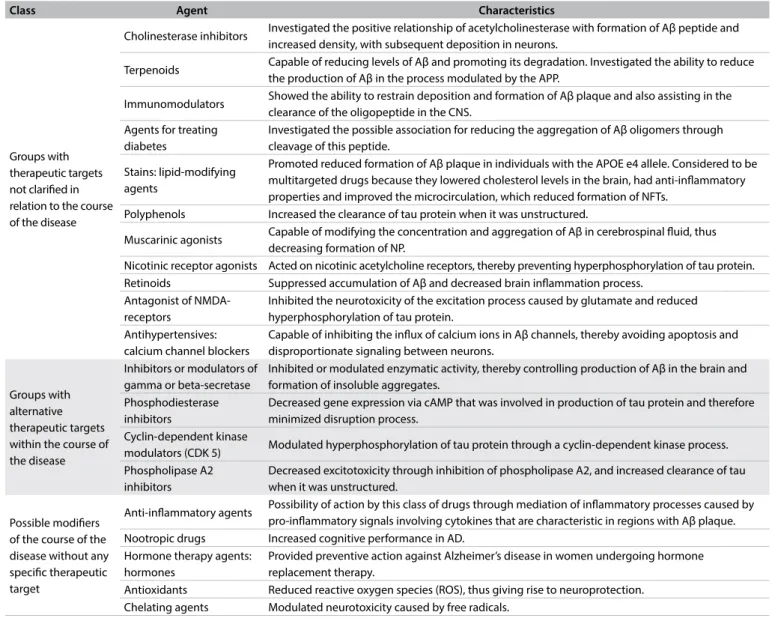
In fact, success in this quest has consistently required clar-iication of the molecular mechanisms relating to the two best pathological pathways elucidated with regard to formation of NP and NFTs in AD cases.18-21 Some studies have put forward new biomolecular mechanisms linked to the physiopathology of AD, which could become possible therapeutic targets within the treatment for this disease. Many of these are called alternative targets and are justiied because they are closely linked to neuro-regeneration, reduction of neurotoxicity and promotion of pos-itive efects on neuronal homeostasis.18,21 However, it has been reported in the literature that only 30% of the compounds stud-ied with a view to treating AD are molecules with mechanisms of action that are directly related to the above pathophysiological pathways, i.e. molecules that are able to modify the course of the disease. Within this percentage, almost 90% do not have a very clear therapeutic target, while about 10% are directed towards alternative targets requiring further elucidation about their asso-ciation with AD.18,21,22
elucidate the ways in which the search for new drugs has always been conducted. In this manner, new proposals for drug ther-apies that have been studied for treating AD can be dissemi-nated, thus strengthening research on new drugs and providing updates for the scientiic community with regard to promis-ing drug treatments.
In addition, the development of new drugs for treating AD has been marked by the appearance of new possibilities and their subsequent abandonment. his diiculty encourages the need to search for new treatments that could inluence the course of AD, through a review of the literature, given that many clinical trials have shown that some drugs are likely to be promising, yet these studies were inconclusive.18,22
OBJECTIVE
he present study had the aim of conducting a review, among publications indexed in scientiic databases, of the studies on drug and chemical groups that have been investigated in rela-tion to treating AD over the last ive years, highlighting those with promising results in terms of their propensity to modify the course of AD.
METHODS
his study consisted of a narrative review conducted through a qualitative assessment on the articles analyzed. he search was conducted in the PubMed database (MEDLINE) (http:// www.ncbi.nlm.nih.gov/pubmed/), Cochrane Library database (Cochrane Collaboration) (http://www.cochranelibrary.com/) and SciELO database (Bireme) (http://www.scielo.br/). MeSH (Medical Subject Headings) and DeCS (Descriptors in Health Sciences) descriptors were used. he descriptors “Alzheimer disease”, “Molecular Mechanisms of Pharmacological Action” and “Drug herapy” were used alone or in combination, as fol-lows: “Alzheimer disease”; “Alzheimer disease” AND “Molecular Mechanisms of Pharmacological Action” AND “Drug herapy”; “Alzheimer disease” AND “Molecular Mechanisms of Pharmacological Action”; “Alzheimer disease” AND “Drug herapy”. Studies in the English, Spanish and Portuguese lan-guages were taken into consideration. We set a ilter to limit the search to articles published from January 2009 to October 2015.
In addition, the review was divided into two stages. In the irst stage, only review articles were selected, including narra-tives, systematic reviews and systematic reviews with meta-anal-yses. At this stage, we sought to answer the following question: “What new drugs that have been studied in relation to treating AD would be capable of inluencing the course of the disease?” he second stage involved a search for articles that discussed lab-oratory studies, human studies, observational studies and clini-cal trials on the drugs or chemiclini-cal groups found in the irst stage.
he second search was conducted using the same speciications as in the irst search, but the descriptors were modiied such that they became “Alzheimer disease” and the name of the drugs or chemical groups.
Articles were identiied and all duplicate records were excluded. Initially, the title and abstract were read in order to include origi-nal articles in which the main objective was to describe the phar-macotherapy of AD. herefore, original articles relating to AD that did not include drugs, molecules or substances for pharmaco-logical treatment were excluded. To ascertain the eligibility crite-ria, we used the manual of the Brazilian Academy of Neurology.23 he Cochrane classiication criteria for risk of bias from the Cochrane Bias Methods Group were used to assess the quality of the articles selected.24 his classiication was made by two research-ers and, when necessary, a third researcher gave his opinion.
RESULTS
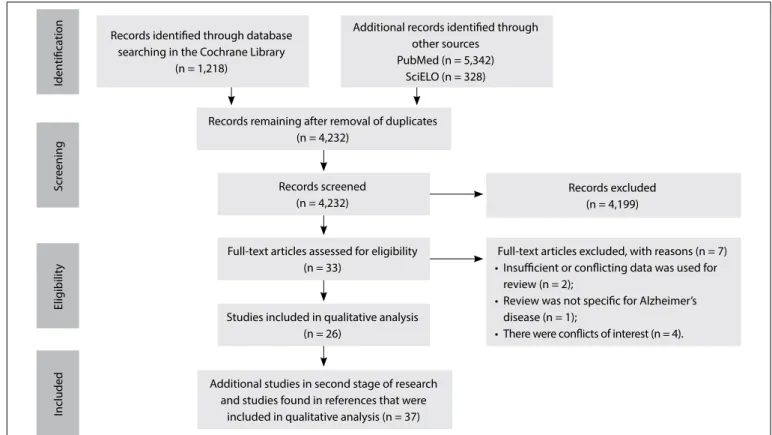
he search identiied 6,888 studies, of which 37 were included in this study (Figure 1). All the articles that were in accordance with our inclusion criteria were available as full texts.
Among the articles selected for this study, the United States were seen to be the most important source country for publica-tions, with 15 articles (40.5%); followed by Germany, with 4 arti-cles (10.8%), and Canada, with 3 artiarti-cles (8.1%). Regarding the quality of the articles accessed in the irst part of this review, 7 (26.5%) were identiied as presenting low risk of bias, 12 (46.1%) were identiied as presenting unclear risk of bias and 7 (26.5%) were identiied as presenting high risk of bias. In all the arti-cles selected for this study, the percentages were 12 (32.5%), 14 (37.8%) and 11 (29.7%), respectively for the three categories of quality (Table 1).
Scr
eening
Included
Elig
ibilit
y
Iden
tiica
tion Records identiied through database searching in the Cochrane Library
(n = 1,218)
Additional records identiied through other sources
PubMed (n = 5,342) SciELO (n = 328)
Full-text articles assessed for eligibility (n = 33)
Records remaining after removal of duplicates (n = 4,232)
Studies included in qualitative analysis (n = 26)
Records screened (n = 4,232)
Additional studies in second stage of research and studies found in references that were
included in qualitative analysis (n = 37)
Records excluded (n = 4,199)
Full-text articles excluded, with reasons (n = 7) • Insuicient or conlicting data was used for
review (n = 2);
• Review was not speciic for Alzheimer’s disease (n = 1);
• There were conlicts of interest (n = 4).
Figure 1. Flowchart of article selection
Reference Authors, year and
country Therapeutic classes Results basis Study design
Cochrane risk of bias classiication*
18 Léon et al., 2013 (England)
Cholinesterase inhibitors; statins: lipid-modifying agents; antioxidants; chelating agents
Clinical
evidence Narrative review Unclear
19 Konrath et al.,
2013 (Brazil) Cholinesterase inhibitors; alkaloids Not speciic Narrative review High
20 McGuinness et al.,
2013 (Ireland) Statins: lipid-modifying agents
Phase III clinical trial
Systematic review (randomized with meta-analysis)
Low
21
Rubio-Perez and Morrilas-Ruiz,
2012 (Spain)
Anti-inlammatory agents; cytokines Not speciic Narrative review High
22 Appleby et al., 2013 (USA)
Agents for treating diabetes mellitus; nicotinic receptor agonists; phosphodiesterase inhibitors
Clinical
evidence Narrative review Unclear
25 Pettenati et al., 2003 (Italy)
Cholinesterase inhibitors; immunomodulators; anti-inlammatory agents; NMDA receptor antagonists; antioxidants; phospholipase A2 inhibitors; nootropic drugs
without elucidated mechanism of action for Alzheimer’s disease; hormone therapy agents; chelating agents
Clinical
evidence Narrative review Unclear
26 Sun et al., 2012 (China)
Cholinesterase inhibitors; muscarinic agonists; immunomodulators; anti-inlammatory agents; statins: lipid modifying agents; antioxidants; chelating agents;
antihypertensive agents
Clinical
evidence Narrative review Unclear
27 Yoo and Park,
2012 (Korea) Terpenoids; antioxidants Not speciic Narrative review High
28 Dodel, 2013
(Germany) Immunomodulators
Clinical
evidence Narrative review Unclear
29 Mikulka et al., 2014 (USA)
Immunomodulators; secretase inhibitors; Inhibitors or modulators of beta and gamma-secretase
Phases I, II and III clinical trial
Systematic review
(with clinical trial) Low
30 Shukla et al., 2012 (USA)
Immunomodulators; cyclin kinase-5 dependent
modulators Not speciic Narrative review High
Reference Authors, year and
country Therapeutic classes Results basis Study design
Cochrane risk of bias classiication*
31 Doody et al., 2014
(Germany) Immunomodulators
Phase III clinical trial
Randomized clinical
trial (double blind) Low
32 Salloway et al.,
2014 (USA) Immunomodulators
Phase III clinical trial
Randomized clinical
trial (double blind) Low
33
Enciu and Popescu, 2013
(Romania)
Anti-inlammatory agents Clinical
evidence Narrative review Unclear
34 Feng and Wang, 2012 (China)
Anti-inlammatory agents; antioxidants;
phospholipase A2 inhibitors Not speciic Systematic review High risk of bias
35 Wolfe, 2012 (USA) Anti-inlammatory agents; Inhibitors or modulators of beta and gamma-secretase; chelating agents
Clinical
evidence Narrative review Unclear
36 Ghosh et al., 2012
(USA) Inhibitors or modulators of beta and gamma-secretase
Phase II
clinical trial Narrative review Low
37 Hopkins, 2011
(USA) Inhibitors or modulators of beta and gamma-secretase
Phase III
Clinical trial Short report Unclear
38 Piccinni et al.,
2013 (Italy) Inhibitors or modulators of beta and gamma-secretase Not speciic Narrative review High
39 Eschecerria et al.,
2012 (USA) Nicotinic receptor agonists
Clinical
evidence Narrative review Unclear
40 Freiherr et al.,
2013 (Germany) Agents for treating diabetes mellitus
Clinical
evidence Narrative review Unclear
41 Morris and Burns,
2012 (USA) Agents for treating diabetes mellitus
Clinical
evidence Narrative review Unclear
42 Xu et al., 2015
(China) Agents for treating diabetes mellitus
In vitro, in
laboratory Experimental study High
43 Papadopoulos et
al., 2013 (Canada) Agents for treating diabetes mellitus
In vivo, in
laboratory Experimental study High
44 Fukasawa et al.,
2012 (Japan) Retinoids
In vivo, in
laboratory Experimental study High
45 Wong et al., 2013
(USA) Statins: lipid-modifying agents Not speciic
Systematic review (randomized with meta-analysis)
Unclear
46 Calcul et al., 2012
(USA) Polyphenols
Clinical
evidence Narrative review Unclear
47 García-Osta et al.,
2012 (Spain) Phosphodiesterase inhibitors
Clinical
evidence Narrative review Unclear
48 Evans et al., 2014
(USA) Antioxidants; NMDA receptor antagonists
Phase III clinical trial
Randomized
controlled clinical trial Low
49 Revett et al., 2013
(Canada) Antioxidants; NMDA receptor antagonists Not speciic Narrative review High
50 Kellermann et al.,
2011 (Germany) Antioxidants
Phase III clinical trial
Systematic review (randomized with meta-analysis)
Low
51 Freund Levi et al.,
2014 (USA) Antioxidants
Phase II clinical trial
Randomized
controlled clinical trial Low
52 Sun et al., 2012
(USA) Phospholipase A2 inhibitors Not speciic Narrative review High
53 Koliaki et al., 2012 (Greece)
Nootropic drugs without elucidated mechanism of action for Alzheimer’s disease
Phase III clinical trial
Randomized
controlled clinical trial Low
54
Maki and Henderson, 2012
(USA)
Hormone therapy agents Randomized
clinical trial Narrative review Low
55
Anekonda and Quinn, 2011
(Canada)
Antihypertensive agents Clinical trials Narrative review Low
56 Valenzuela et al.,
2012 (Australia) Antihypertensive agents
Randomized controlled clinical trial
Narrative review Low
Table 1. Continues...
NP = neuritic plaque; NFT = neuroibrillary tangles; CNS = central nervous system; APP = amyloid precursor protein; Aβ = amyloid-beta; APOE = apolipoprotein E; NMDA = N-methyl-D-aspartate; cAMP = cyclic adenosine monophosphate; CDK5 = cyclin-dependent kinase 5.
Class Agent Characteristics
Groups with therapeutic targets not clariied in relation to the course of the disease
Cholinesterase inhibitors Investigated the positive relationship of acetylcholinesterase with formation of Aβ peptide and increased density, with subsequent deposition in neurons.
Terpenoids Capable of reducing levels of Aβ and promoting its degradation. Investigated the ability to reduce the production of Aβ in the process modulated by the APP.
Immunomodulators Showed the ability to restrain deposition and formation of Aβ plaque and also assisting in the clearance of the oligopeptide in the CNS.
Agents for treating diabetes
Investigated the possible association for reducing the aggregation of Aβ oligomers through cleavage of this peptide.
Stains: lipid-modifying agents
Promoted reduced formation of Aβ plaque in individuals with the APOE e4 allele. Considered to be multitargeted drugs because they lowered cholesterol levels in the brain, had anti-inlammatory properties and improved the microcirculation, which reduced formation of NFTs.
Polyphenols Increased the clearance of tau protein when it was unstructured.
Muscarinic agonists Capable of modifying the concentration and aggregation of Aβ in cerebrospinal luid, thus decreasing formation of NP.
Nicotinic receptor agonists Acted on nicotinic acetylcholine receptors, thereby preventing hyperphosphorylation of tau protein. Retinoids Suppressed accumulation of Aβ and decreased brain inlammation process.
Antagonist of NMDA-receptors
Inhibited the neurotoxicity of the excitation process caused by glutamate and reduced hyperphosphorylation of tau protein.
Antihypertensives: calcium channel blockers
Capable of inhibiting the inlux of calcium ions in Aβ channels, thereby avoiding apoptosis and disproportionate signaling between neurons.
Groups with alternative therapeutic targets within the course of the disease
Inhibitors or modulators of gamma or beta-secretase
Inhibited or modulated enzymatic activity, thereby controlling production of Aβ in the brain and formation of insoluble aggregates.
Phosphodiesterase inhibitors
Decreased gene expression via cAMP that was involved in production of tau protein and therefore minimized disruption process.
Cyclin-dependent kinase
modulators (CDK 5) Modulated hyperphosphorylation of tau protein through a cyclin-dependent kinase process. Phospholipase A2
inhibitors
Decreased excitotoxicity through inhibition of phospholipase A2, and increased clearance of tau when it was unstructured.
Possible modiiers of the course of the disease without any speciic therapeutic target
Anti-inlammatory agents Possibility of action by this class of drugs through mediation of inlammatory processes caused by pro-inlammatory signals involving cytokines that are characteristic in regions with Aβ plaque. Nootropic drugs Increased cognitive performance in AD.
Hormone therapy agents: hormones
Provided preventive action against Alzheimer’s disease in women undergoing hormone replacement therapy.
Antioxidants Reduced reactive oxygen species (ROS), thus giving rise to neuroprotection. Chelating agents Modulated neurotoxicity caused by free radicals.
Table 2. Classiication of pharmacological groups that showed the prospect of changing the course of the disease, with regard to action on therapeutic targets
DISCUSSION
Cholinesterase inhibitors
Alkaloids: huperzine, aporphyrin, lycorine and quaternary beta-carboline
Although this is a chemical group used for symptomatic treatment of AD in the clinical phase of the disease, its possible mechanism of action with regard to changing the course of the disease has been investigated. his source is based on the positive relationship of the enzyme cholinesterase (ChE) with formation of Aβ oligomers and increased density, with subsequent deposition in neurons.25
Cholinesterase inhibitors (ICHE) appear to be promising drugs for treating AD, based on the action of some compounds of
this enzyme. Inhibiting alkaloids such as physostigmine and galan-tamine are used in conventional treatment. hus, some natural alkaloids have been investigated in an attempt to highlight changes to the course of AD. Among these compounds are the steroidal alkaloid triterpene, which promotes non-competitive inhibition; quinolizidine and lycopodium alkaloids such as huperzine, which promotes competitive inhibition; isoquinolines such as aporphy-rin and benzylisoquinoline, which are non-competitive com-pounds, and galantamine and lycorine, which are competitive; and indole alkaloids, which are divided into indole alkaloids, monoter-penes and physostigmine, which are competitive, and quaternary beta-carbolines, which are non-competitive.18,19,25
gravis, organophosphate poisoning and schizophrenia. Clinical tri-als on huperzine have shown that its use improves short-term mem-ory, but there is need for more robust studies in order to prove its efectiveness and minimal toxic efects, which are due to its high selectivity and its ability to cross the blood-brain barrier (BBB).19,26
Muscarinic agonists
Xanomeline and milameline
hese substances are capable of modifying the CSF concentration of Aβ aggregation and decreasing formation of amyloid plaque.25 Xanomeline and milameline have the ability to cross the BBB and have important efects relating to cognitive improvement, but they also have signiicant side efects on the cardiovascular and gastrointestinal tracts.26
Terpenoids
Ginseng
Ginsenosides are natural compounds extracted from the plant Panax ginseng. hey have been the subject of in vitro clinical tri-als aimed at reducing the levels of Aβ and promoting its degra-dation. hey have the ability to suppress production of Aβ, in a process modulated by APP. he results from animal studies have shown that ginsenosides are efective in relation to attenuating some neuroinlammation markers, improving spatial perception and increasing synaptic density.27
Immunomodulators
Gammagard Liquid, bapineuzumab, solanezumab, crenezumab, gantenerumab and Aitope
Passive immunization has been shown to reduce the brain levels of Aβ oligomers, increase their clearance and redistribute them through the circulatory system, to other brain areas and tissues that favor their elimination.25 One immunoglobulin with important efects in relation to AD, which efectively binds to Aβ oligomers and increases their clearance is Gammagard Liquid. he monoclo-nal antibodies bapineuzumab, solanezumab, crenezumab and gan-tenerumab have also been tested for the same purpose.25,28-32
Active immunization with synthetic peptides has been tested with the aim of reducing Aβ aggregation caused by the pro-inlammatory signals involved in AD. However, some vaccines that have been tested in relation to AD have presented certain diiculties relating to side efects such as encephalitis and inlam-mation in the CNS.25,28 One example is Aitope, a patented drug consisting of synthetic peptides with a mechanism of action on AD that so far remains not very well understood.29
Many vaccines and drugs relating to monoclonal antibod-ies have been tested and are protected by patents. hese are very
efective with regard to active immunization for treating AD. However, the big challenge is to ascertain how safe these inter-ventions are, because some promising forms of immunotherapy have shown serious toxic efects.26,29
Anti-inlammatory drugs
Prednisone, prednisolone, ibuprofen, rofecoxib, naproxen, lavo-noids, sulindac sulide and indomethacin
he inlammation caused by proinlammatory signals that are highlighted by cytokines during the process are characteristic of regions of Aβ plaque mediated by astrocytes and microglia cells. his process promotes continual deposition of Aβ, and therefore some anti-inlammatory drugs have been tested.21,25,26,33,34
It is noteworthy that prednisone and its active metabolite prednisolone are efective in reducing formation of Aβ oligomers in vitro, but their efectiveness has not been proven in phase II and III clinical trials. Evidence has emerged from studies on animals that selective inhibitors of cyclooxygenase (ICOX2) are efective, but they are not recommended for chronic treatment.21,25
Ibuprofen, rofecoxib and naproxen have been shown to be able to reduce Aβ levels in animals but not cognitive decline in human trials. However, the possibility that these might help reduce the incidence of the disease rather than its course has recently been investigated.21,25,26,33 It is important to highlight nat-ural compounds with anti-inlammatory activity, such as lavo-noids. here is evidence from experimental studies on animals that lavonoids prevent cognitive impairment. However, this has been contradicted in some observational studies.4
his drug class can be considered to have multiple targets for AD, because some anti-inlammatory drugs have presented activity modulating gamma-secretase, an enzyme involved in formation of NP and NFTs. Ibuprofen, sulindac sulide and indo-methacin were the irst non-steroidal anti-inlammatory drugs (NSAIDs) to be reported to decrease Aβ through this mecha-nism. A Phase III clinical study on r-lurbiprofen in 2009 showed that this agent had good capacity for reducing Aβ, thereby chang-ing the course of AD.35
Inhibitors or modulators of beta and gamma-secretase
Pirezenpine, pseudopeptides based on beta-secretase inhibitor, hydroxyethylene, hydroxyethylamine base, carbinamine base, non-peptidomimetics, macrocyclic inhibitors, acylguanidine base, aminoimidazole base, aminohidantoin, aminoquinozoline base, molecules with diversiication of non-peptide substrates, semagacestat, avagacestat and malonamide
have been studied are able to interfere with the functionality of these enzymes, thereby controlling these pathogenic fac-tors. Although it has been questioned whether enzymes are an important therapeutic target in relation to AD, some molecules that are protected by patents have been studied with regard to such treatments.29,36-38
Pirezenpine, a muscarinic receptor antagonist for acetylcho-line, has shown evidence of capacity for regulating the activity of beta-secretase. In studies conducted in Japan, another mol-ecule called CTS-21166 (which is an analog of pirezenpine) has been shown to decrease formation of Aβ plaque in vivo.39 Pseudopeptides that inhibit beta-secretase enzymatic activity are noteworthy: replacement of a leucine-alanine statin derivative has led to a variety of potent inhibitors. hese include hydroxy-ethylene, hydroxyethylamine base, carbinamine base; non-pep-tidomimetics, macrocyclic inhibitors (molecules modiied for stability of bioactivity), acylguanidine base, aminoimidazole, aminohidantoin base, aminoquinozoline molecule-based diver-siications and non-peptide substrates.36
Some compounds such as gamma-secretase inhibitors are currently being studied. Among these are semagacestat, avagacestat and benzodiazepine (under patent), and malon-amide. he drug-modulating activity of this enzyme comprises several perspectives because it has lower toxicity than that of inhibitors.35
he biggest challenge is to put greater amounts of selec-tive gamma-secretase into the neurons afected by AD.29,35 It is also important to emphasize the challenge of achieving efec-tiveness with regard to inhibiting or reducing cognitive decline coupled with absence of toxicity, in phase II and III studies. It is possible that structural modiications to these molecules will improve their efectiveness.36,37
Agents for treating diabetes mellitus
Intranasal insulin, rosiglitazone and pioglitazone
Some drugs in this class have been emphasized for treating AD because they have shown evidence of efectiveness in decreas-ing the accumulation of Aβ oligomers in in vitro brain studies. here is also evidence that they decrease the neuronal inlamma-tory processes that lead to cell death. Intranasal insulin may be an efective way to prevent or treat this disease, since it has signii-cant action in the hippocampus (a region with a large concentra-tion of insulin receptors), thereby improving memory.40,41
Some glitazones have been studied as important drugs for AD, and rosiglitazone and pioglitazone are among these. However, no precise conclusions regarding the evidence for their efectiveness have been reached, and some researchers have con-demned them as unpromising drugs.22,42,43
Retinoids
Tamibarotene
Retinoids have been attributed with great prospects because of the ability of the oligomers to suppress accumulation of Aβ and to decrease some brain inlammation. One example of these drugs is tamibarotene, which has presented promising results. hese results showed its efectiveness in stimulating emotional function, through regeneration of cholinergic and glutaminergic nodes. In addition, treatment with this drug has shown improved cognition and orientation with regard to timelines. he expecta-tions for this drug have been strengthened through its good tol-erability with prolonged use.44
Statins: lipid-modifying agents
Simvastatin and lovastatin
Action by the apolipoprotein E subtype APOE4, which is expressed by the allele APOE Ɛ4, can lead to greater propen-sity for binding between Aβ oligomers to form NPs. It can also increase the activity of glycogen synthase kinase 3beta (GSK 3beta), thereby causing hyperphosphorylation of tau proteins and formation of NFTs. In some epidemiological studies, statins have shown signiicant reduction of formation of Aβ plaque in individuals with this protein subtype.20,26
Additionally, one form of action that is already well known for this drug class and which makes it a multitarget drug for AD is its lipid-lowering action. his association is based on scien-tiic evidence linking reduction of systemic cholesterol to neuron preservation in some cases of dementia. here is also evidence of a mechanism for reduction of cholesterol levels in the brain that leads to reduction of NFTs and some pleiotropic efects attributed to anti-inlammatory properties.20,45
Use of statins may be an important adjunct in treating AD. Some physicians have advocated their use as a preventive mea-sure for patients who have a dementia risk proile mediated by cerebral vasculature.However, this class of drugs (such as simvas-tatin and lovassimvas-tatin) has great ability to cross the BBB. herefore, the priority in using these drugs is to promote improvement of circulation loci in the CNS. On the other hand, there is insui-cient evidence to recommend their use as a preventive measure or for modifying the course of AD. Furthermore, it needs to be borne in mind that statins have a risky safety proile and there may be hepatic impairment and risk of rhabdomyolysis at doses that would be efective for continuous treatment of AD.18,20
of developing AD and other forms of dementia. However, prog-ress in such studies is still restricted by bias in some of them.45
Nicotinic receptor agonists
Nicotine and cotinine
Cotinine is a metabolite of nicotine and it has pharmacologi-cal efects similar to those of nicotine. It acts on nicotinic ace-tylcholine receptors but with lower side efects. Its pharmaco- dynamic properties have been investigated with regard to treat-ing AD because of its neuroprotective capacity over the course of the disease. Cotinine is able to prevent hyperphosphorylation of tau protein denaturation and thus has been shown to reduce neu-ronal death in vitro. Use of this substance has shown evidence of memory improvement, along with a certain degree of safety pro-ile, in phase II clinical trials.22,46
Polyphenols
Curcumin
Some polyphenols have been tested on the basis of the hypothesis that they increase tau protein clearance when they are destruc-tured, as in AD. hus, their efectiveness has been highlighted in terms of reductions of NFT formation and neuronal death. Curcumin is noteworthy: it is classiied as anti-tau, given that it increases production of the anti-inlammatory cytokine IL-4 and reduces tau Aβ levels in vivo. It can be highlighted that many molecules in this class of natural products are being studied and some synthesis routes have been patented.39
Phosphodiesterase inhibitors
Vinpocetine, rolipram, rolumilast, vardenail, sildenail, tadalail and papaverine
Phosphodiesterase inhibitors have been tested in relation to AD because they act by decreasing gene expression in the cAMP pathway for production of tau and thereby minimize the disin-tegration process. his leads to a possible reduction in formation of NFTs. hese drugs have shown efectiveness in animal testing, in which they have restored cognitive impairment and memory. Among the most efective drugs are vinpocetine, rolipram, rolu-milast, vardenail, sildenail, tadalail, papaverine and other mol-ecules under patent.22,47
NMDA receptor antagonists
D-cycloserine and nitromemantine
In the literature, there are studies that have justiied increases in hyperphosphorylated tau protein levels and increases in
production of βA oligomers through the hypothesis of loss of neuronal homeostasis. his hypothesis is explained by increased glutamatergic activity, i.e. there is an increase in the action of glu-tamate at NMDA receptors, which leads to excitotoxicity and cell death. hus, some drugs have been tested in an attempt to modu-late NMDA receptors so that they can decrease the formation of amyloid-β plaque and NFTs in AD.25,48,49
D-cycloserine is an antibiotic capable of modulating the activity of NMDA receptors. It is capable of improving memory and cognitive processes. However, no evidence for its clinical efectiveness has been shown in randomized trials. his means that in studies on AD, this drug has not presented extensive activ-ity. However, it was argued in a recent study that making changes to its molecule would be instrumental for continuing with new tests towards achieving better results.25 Nitromemantine is another drug that has shown good results in animals, through high speciicity for NMDA receptors, in addition to having fewer side efects.49
Cyclin-dependent kinase modulators: CDK 5
Aminothiazole and roscovitine
he subtype of cyclin-dependent kinase known as CDK 5 is an enzyme that has the function of regulating higher neuron life cycles. However, it is also fundamental to the process of hyper-phosphorylation of tau proteins. Drugs that show the prospect of capacity for modulation of their activity in order to treat AD now exist. While most of the drugs tested have not shown efec-tiveness that would justify their use in AD therapy, aminothia-zole and roscovitine have shown promise in this regard. hese alternatives have shown good eicacy in vitro, but they binds to the CDK 5 site without much speciicity, thereby leading to side efects that would be serious in vivo.30
Antioxidants
Vitamin E, selegiline, Ginkgo biloba, resveratrol, vitamin B12,
carotenoids, ascorbic acid, catalase, glutathione peroxidase, cafeine, selenium, melatonin, omega-3, silibinin, palmatine, berberine and ubiquinone
One example of this pharmacological subgroup that has been a major subject of study is the vitamin E substance known as α-tocopherol. Clinical trials have shown the ability of this com-pound to reduce the chance of developing AD over a four-year follow-up period by about 2.5 to 4.0-fold. Although there is suf-icient evidence to show that this substance can inluence the course of AD, there are few studies that have measured its great potential as an adjunct to treatment.25,26,34,48
Another drug that has shown promise in studies on AD is selegiline. Eight clinical trials on this drug involving twelve eval-uators have shown evidence of improvement in mood and behav-ior. Additionally, signiicant beneit for memory has been shown in a meta-analysis. Although the results relating to this drug have been good, there is not enough evidence to include it in treat-ments for AD.25,26,34
Ginkgo biloba produces a substance belonging to the class of cyclic diterpenes that is a nootropic drug that has signiicant efects as a multitargeted drug for treating AD. It is efective in this treatment because of its ability to increase blood low in the microcirculation and its antioxidant properties, which prevent reduction of synapses and increase the production of neuro-trophic factors relating to neuronal apoptosis in AD. herefore, it is capable of causing behavioral improvements regarding the damage induced by Aβ and positive efects on perception and memory. his substance has signiicant side efects that have been investigated. hese include bleeding when anticoagula-tion therapy or drugs likely to cause bleeding are used concom-itantly. However, no side efects have been seen when it is used alone.25,27,34,50
Other drugs with antioxidant action in relation to AD include resveratrol (a compound from grapes), vitamin B12, carotenoids, ascorbic acid (vitamin C), catalase, glutathione peroxidase, caf-feine, selenium, melatonin, omega 3, silibinin lavonoids, palma-tine alkaloids, berberine and ubiquinone terpenoids.26,34,51
Phospholipase A2 inhibitors
Methyl arachidonoyl luorophosphate, arachidonoyl triluoromethyl
ketone, Ginkgo biloba, curcumin and epigallocatechin gallate
Some studies have shown that abnormal phospholipase A2 (PLPA2) activity implies the existence of some neurodegenera-tive pathogens, including AD. Although this association is cur-rently not well understood, it is believed that prolonged neuron exposure to Aβ may gradually give rise to mitochondrial dys-function and stimulate activation of PLPA2 through increasing ROS and excitotoxicity.25,34
Two compounds that have shown efective results in vitro with regard to this mechanism are methyl arachidonoyl luo-rophosphate and arachidonoyl triluoromethyl ketone. hese
have shown good ability for modulating the properties of neu-ronal membranes and increasing protection against the neuneu-ronal impairment caused by Aβ plaque. Studies have shown a corre-lation between neuroexcitatory PLPA2 glutamate receptors and NMDA capability in relation to stimulating production of ROS through NADPH oxidase. Ginkgo biloba, curcumin and epi-gallocatechin gallate (polyphenols) are substances capable of protecting against the pathological course of AD through this mechanism.34,52
Nootropic drugs without an elucidated mechanism of action for Alzheimer’s disease
Nicergoline, piracetam and aniracetam
his pharmacological class covers drugs that enhance cognitive performance and, as such, are targets for evaluation with a view to treating psychobehavioral symptoms relating to dementia. In addition, they have the signiicance of being drugs that have passed through phase IV clinical studies, have been on the mar-ket for a while and have some degree of safety proile.25,53
Nicergoline, a derivative of ergot, has positive efects on behavior and cognition in AD. Piracetam is a derivative of gamma-aminobutyric acid (GABA) that binds to the neuronal membrane, thus promoting formation of active phospholipid complexes. his increases lamellar restoration, thereby improv-ing perception and memory. In vivo studies have shown evidence that this improves memory retention. However, some reviews on this drug have not shown any evidence for its applicability in treatments for AD.25
Aniracetam is a drug that has shown good tolerability in rela-tion to treating AD. Experimental data have suggested that this medication presents interactions with multiple neurotransmit-ter systems. In monotherapy, it has shown clinical results that are more efective than those from conjugated cognition therapy and ICHE monotherapy for starting the treatment. Over the long term, it has shown improved functional capacity in relation to depression and improvement in the physiopathology of demen-tia only when combined with ICHE. However, it has been found to present some adverse events that counter its supposed efec-tiveness and which do not corroborate its indication for treat-ing AD.53
Agents for hormone therapy: hormones
Estrogen, conjugated estrogens and medroxyprogesterone
combine with an increased chance of developing AD, studies have attempted to evaluate therapy using raloxifene. However, this issue remains controversial. A study on postmenopausal women on estrogen replacement therapy and without this ther-apy revealed that in the irst group, 4% of the women had AD, and that in the second group, 10% had AD. However, reviews and meta-analyses indexed in the Cochrane Library have not found any evidence to show that estrogen replacement therapy is efec-tive for preventing and treating AD.25,54
Some studies have shown that therapy consisting of a com-bination of estrogen and progesterone before the menopause was able to reduce the risk of AD, although, this association may increase the risk of developing AD ater the age of 65 years. It is noteworthy that conjugated estrogen therapy in association with medroxyprogesterone showed a clear clinical response in terms of memory and aphasia among both young women and post-menopausal women.54
Chelating agents
Desferrioxamine and copper and zinc chelating agents
Chelating agents exhibit eicacy through removal of excess fer-ric ions and other ions such as copper, aluminum and zinc, which may be related to neurotoxicity through formation of free radi-cals that bind to Aβ peptides. One drug that has been studied for this purpose in relation to treating AD is desferrioxamine. However, it has shown retinoid toxicity.35 Copper and zinc che-lating agents have also shown the ability to mediate aggregation of Aβ peptides. However, many of these drugs present concerns regarding their safety proile, given that they are responsible for causing optic neuritis.18,25,26
Antihypertensive agents: calcium channel blockers
Isradipine
Antihypertensive drugs that are calcium channel blockers reduce the inlux of Ca2+ ions into Aβ channels, thereby minimizing and reducing the neurotoxicity of Aβ formation in vitro. Isradipine has been tested in clinical trials as monotherapy and has already shown positive efects in relation to treating AD based on this mechanism.55
Six broad experimental studies that were double-blind, ran-domized and placebo-controlled investigated about 50 anti-hypertensive medications for treating dementia and cognitive decline. hese studies suggest that treatment with antihyperten-sive drugs may play an important role in preventing dementia, thereby producing notable cognitive improvement. he impor-tant efect of calcium channel blockers on this line of treatment was emphasized.56
he efectiveness of this alternative drug treatment for AD becomes more pronounced when antihypertensive agents are used in association with other classes of drugs. A combination of calcium channel blocker, angiotensin-converting enzyme (ACE) inhibitor and diuretic was found to have reduced the incidence of dementia in AD cases ater two and four years of follow-up by 50% and 55% respectively.56 A combination consisting only of ACE inhibitor and diuretic reduced the occurrence of dementia by 31%. hus, this suggested that treatment with calcium channel blockers helped in preventing dementia.
Nonetheless, the evidence from studies remains insuicient to be able to state that this class of medication should be used for treating AD. herefore, it is essential to conduct clinical studies with greater robustness regarding use of antihypertensive treat-ment, since the evidence suggests that the efectiveness of this class of drugs with regard to prevention of AD relates to speciic cases such as dementia of microcirculatory origin.26,56
CONCLUSION
From the studies analyzed, it could be seen that there is a current trend among researchers towards separating out the dementia phase from the preclinical phase at which AD usu-ally usuusu-ally starts. his trend has inluenced the search for new drugs. In addition, we can conclude from the results of this study that there are no promising drugs capable of pro-viding efectiveness and safety. In this context, immunomodu-lators are more likely to become drugs capable of inluencing the course of AD, because the studies selected showed better quality and the results were promising. However, the toxic-ity of these drugs for treating AD constitutes a major obsta-cle. his was also observed in relation to new drugs that can interfere with alternative targets, such as inhibitors or modula-tors of gamma or beta-secretase, phosphodiesterase inhibimodula-tors, cyclin-dependent kinase modulators (CDK 5) and phospho-lipase A2 inhibitors. However, the evidence relating to these drugs is weak, as shown by the quality of the articles accessed in this review. No robust studies have yet been conducted, and this is due to the high toxicity of these drugs in relation to treating AD.
REFERENCES
1. Chaves MLF, Godinho CC, Porto CS, et al. Doença de Alzheimer:
avaliação cognitiva, comportamental e funcional. Dement
Neuropsychol. 2011;5(supl 1):21-33.
2. World Health Organization. Neurological disorders: public health
challenges. Switzerland: World Health Organization Library
Cataloguing-in-Publication Data; 2006. Available from: http://www.
who.int/mental_health/neurology/neurological_disorders_report_
web.pdf. Accessed in 2016 (Jan 8).
3. American Psychiatric Association. Delirium, dementia, and amnestic
and other cognitive disorders. In: American Psychiatric Association.
Diagnostic and statistical manual of mental disorders (DSM-IV). 4th
ed. American Psychiatric Association; 1994. p. 123-64. Available from:
https://justines2010blog.iles.wordpress.com/2011/03/dsm-iv.pdf.
Accessed in 2016 (Jan 8).
4. Larson EB, Kukull WA, Katzman RL. Cognitive impairment: dementia
and Alzheimer’s disease. Annu Rev Public Health. 1992;13:431-49.
5. van der Flier WM, Scheltens P. Epidemiology and risk factors of
dementia. J Neurol Neurosurg Psychiatry. 2005;76 Suppl 5:v2-7.
6. Desai AK, Grossberg GT. Diagnosis and treatment of Alzheimer’s
disease. Neurology. 2005;64(12 Suppl 3):S34-9.
7. Larson EB, Shadlen MF, Wang L, et al. Survival after initial diagnosis of
Alzheimer disease. Ann Intern Med. 2004;140(7):501-9.
8. Nelson PT, Alafuzof I, Bigio EH, et al. Correlation of Alzheimer disease
neuropathologic changes with cognitive status: a review of the
literature. J Neuropathol Exp Neurol. 2012;71(5):362-81.
9. Maurer K, Volk S, Gerbaldo H. Auguste D and Alzheimer’s disease.
Lancet. 1997;349(9064):1546-9.
10. Slattum PW, Peron EP, Hill AM. Alzheimer’s disease. In: DiPiro JT, Talbert RL, Yee
GC, Matzke GR, Wells BG, Posey LM. Pharmacotherapy: a pathophysiologic
approach. 7th ed. United States: McGraw-Hill; 2008. p. 1051-68.
11. Lacor PN, Buniel MC, Chang L, et al. Synaptic targeting by
Alzheimer’s-related amyloid beta oligomers. J Neurosci. 2004;24(45):10191-200.
12. Mawuenyega KG, Sigurdson W, Ovod V, et al. Decreased
clearance of CNS beta-amyloid in Alzheimer’s disease. Science.
2010;330(6012):1774.
13. Inestrosa NC, Alvarez A, Pérez CA, et al. Acetylcholinesterase accelerates
assembly of amyloid-beta-peptides into Alzheimer’s ibrils: possible
role of the peripheral site of the enzyme. Neuron. 1996;16(4):881-91.
14. Dekosky ST, Lopez OL. Alzheimer’s disease. In: Growdon JH, Rossor
MN. The Dementias 2. China: Butterworth Heinemann; 2007. p. 33-58.
15. Tanović A, Alfaro V. [Glutamate-related excitotoxicity neuroprotection
with memantine, an uncompetitive antagonist of NMDA-glutamate
receptor, in Alzheimer’s disease and vascular dementia]. Rev Neurol.
2006;42(10):607-16.
16. Cavalcanti JLS, Engelhardt E. Aspectos da isiopatologia da doença
de Alzheimer esporádica [Pathophysiological features of sporadic
Alzheimer’s disease]. Rev Bras Neurol. 2012;48(4):21-9.
17. Lyketsos CG, Colenda CC, Beck C, et al. Position statement of the
American Association for Geriatric Psychiatry regarding principles of
care for patients with dementia resulting from Alzheimer’s disease.
Am J Geriatr Psychiatry. 2006;14(7):561-72.
18. León R, Garcia AG, Marco-Contelles J. Recent advances in the
multitarget-directed ligands approach for the treatment of
Alzheimer’s disease. Med Res Rev. 2013;33(1):139-89.
19. Konrath EL, Passos Cdos S, Klein LC Jr, Henriques AT. Alkaloids as a
source of potential anticholinesterase inhibitors for the treatment of
Alzheimer’s disease. J Pharm Pharmacol. 2013;65(12):1701-25.
20. McGuinness B, O’Hare J, Craig D, et al. Cochrane review on ‘Statins for
the treatment of dementia’. Int J Geriatr Psychiatry. 2013;28(2):119-26.
21. Rubio-Perez JM, Morillas-Ruiz JM. A review: inlammatory process
in Alzheimer’s disease, role of cytokines. ScientiicWorldJournal.
2012;2012:756357.
22. Appleby BS, Nacopoulos D, Milano N, Zhong K, Cummings JL. A
review: treatment of Alzheimer’s disease discovered in repurposed
agents. Dement Geriatr Cogn Disord. 2013;35(1-2):1-22.
23. Vale FAC, Corrêa Neto Y, Bertolucci PHF, et al. Tratamento da doença
de Alzheimer. Dement Neuropsychol. 2011;5(supl 1):34-48.
24. Higgins JP, Deeks JJ, Altman DG. Special topics in statistics. In: Higgins
JP, Green S, eds. Cochrane handbook for systematic reviews of
interventions: Cochrane book series. Chichester: John Wiley & Sons;
2008. p. 481-529.
25. Pettenati C, Annicchiarico R, Caltagirone C. Clinical pharmacology of
anti-Alzheimer drugs. Fundam Clin Pharmacol. 2003;17(6):659-72.
26. Sun X, Jin L, Ling P. Review of drugs for Alzheimer’s disease. Drug
Discov Ther. 2012;6(6):285-90.
27. Yoo KY, Park SY. Terpenoids as potential anti-Alzheimer’s disease
therapeutics. Molecules. 2012;17(3):3524-38.
28. Dodel R. [Towards a vaccine against Alzheimer’s?]. Drug Res (Stuttg).
2013;63 Suppl 1:S18-20.
29. Mikulca JA, Nguyen V, Gajdosik DA, et al. Potential novel targets for
Alzheimer pharmacotherapy: II. Update on secretase inhibitors and
related approaches. J Clin Pharm Ther. 2014;39(1):25-37.
30. Shukla V, Skuntz S, Pant HC. Deregulated Cdk5 activity is involved in
inducing Alzheimer’s disease. Arch Med Res. 2012;43(8):655-62.
31. Doody RS, Thomas RG, Farlow M, et al. Phase 3 trials of solanezumab
for mild-to-moderate Alzheimer’s disease. N Engl J Med.
2014;370(4):311-21.
32. Salloway S, Sperling R, Fox NC, et al. Two phase 3 trials of
bapineuzumab in mild-to-moderate Alzheimer’s disease. N Engl J
Med. 2014;370(4):322-33.
33. Enciu AM, Popescu BO. Is there a causal link between inlammation
and dementia? Biomed Res Int. 2013;2013:316495.
34. Feng Y, Wang X. Antioxidant therapies for Alzheimer’s disease. Oxid
Med Cell Longev. 2012;2012:472932.
35. Wolfe MS. γ-Secretase inhibitors and modulators for Alzheimer’s
disease. J Neurochem. 2012;120 Suppl 1:89-98.
36. Ghosh AK, Brindisi M, Tang J. Developing β-secretase inhibitors for
treatment of Alzheimer’s disease. J Neurochem. 2012;120 Suppl
37. Hopkins CR. ACS chemical neuroscience molecule spotlight on
ELND006: another γ-secretase inhibitor fails in the clinic. ACS Chem
Neurosci. 2011;2(6):279-80.
38. Piccinni A, Origlia N, Veltri A, et al. Neurodegeneration, β-amyloid and
mood disorders: state of the art and future perspectives. Int J Geriatr
Psychiatry. 2013;28(7):661-71.
39. Echeverria V, Zeitlin R. Cotinine: a potential new therapeutic agent
against Alzheimer’s disease. CNS Neurosci Ther. 2012;18(7):517-23.
40. Freiherr J, Hallschmid M, Frey WH 2nd, et al. Intranasal insulin as a
treatment for Alzheimer’s disease: a review of basic research and
clinical evidence. CNS Drugs. 2013;27(7):505-14.
41. Morris JK, Burns JM. Insulin: an emerging treatment for Alzheimer’s
disease dementia? Curr Neurol Neurosci Rep. 2012;12(5):520-7.
42. Xu S, Liu G, Bao X, et al. Rosiglitazone prevents amyloid-β
oligomer-induced impairment of synapse formation and plasticity via
increasing dendrite and spine mitochondrial number. J Alzheimers
Dis. 2014;39(2):239-51.
43. Papadopoulos P, Rosa-Neto P, Rochford J, Hamel E. Pioglitazone
improves reversal learning and exerts mixed cerebrovascular efects
in a mouse model of Alzheimer’s disease with combined amyloid-β
and cerebrovascular pathology. PloS One. 2013;8(7):e68612.
44. Fukasawa H, Nakagomi M, Yamagata N, et al. Tamibarotene: a
candidate retinoid drug for Alzheimer’s disease. Biol Pharm Bull.
2012;35(8):1206-12.
45. Wong WB, Lin VW, Boudreau D, Devine EB. Statins in the prevention of
dementia and Alzheimer’s disease: a meta-analysis of observational
studies and an assessment of confounding. Pharmacoepidemiol
Drug Saf. 2013;22(4):345-58.
46. Calcul L, Zhang B, Jinwal UK, Dickey CA, Baker BJ. Natural products as
a rich source of tau-targeting drugs for Alzheimer’s disease. Future
Med Chem. 2012;4(13):1751-61.
47. García-Osta A, Cuadrado-Tejedor M, García-Barroso C, Oyarzábal J,
Franco R. Phosphodiesterases as therapeutic targets for Alzheimer’s
disease. ACS Chem Neurosci. 2012;3(11):832-44.
48. Evans DA, Morris MC, Rajan KB. Vitamin E, memantine, and Alzheimer
disease. JAMA. 2014;311(1):29-30.
49. Revett TJ, Baker GB, Jhamandas J, Kar S. Glutamate system, amyloid β
peptides and tau protein: functional interrelationships and relevance
to Alzheimer disease pathology. J Psychiatry Neurosci. 2013;38(1):6-23.
50. Kellermann AJ, Kloft C. Is there a risk of bleeding associated with
standardized Ginkgo biloba extract therapy? A systematic review and
meta-analysis. Pharmacotherapy. 2011;31(5):490-502.
51. Freund Levi Y, Vedin I, Cederholm T, et al. Transfer of omega-3 fatty
acids across the blood-brain barrier after dietary supplementation
with a docosahexaenoic acid-rich omega-3 fatty acid preparation in
patients with Alzheimer’s disease: the OmegAD study. J Intern Med.
2014;275(4):428-36.
52. Sun GY, He Y, Chuang DY, et al. Integrating cytosolic phospholipase
A2 with oxidative/nitrosative signaling pathways in neurons: a novel therapeutic strategy for AD. Mol Neurobiol. 2012;46(1):85-95.
53. Koliaki CC, Messini C, Tsolaki M. Clinical eicacy of aniracetam, either
as monotherapy or combined with cholinesterase inhibitors, in
patients with cognitive impairment: a comparative open study. CNS
Neurosci Ther. 2012;18(4):302-12.
54. Maki PM, Henderson VW. Hormone therapy, dementia, and
cognition: the Women’s Health Initiative 10 years on. Climacteric.
2012;15(3):256-62.
55. Anekonda TS, Quinn JF. Calcium channel blocking as a therapeutic
strategy for Alzheimer’s disease: the case for isradipine. Biochim
Biophys Acta. 2011;1812(12):1584-90.
56. Valenzuela M, Esler M, Ritchie K, Brodaty H. Antihypertensives for
combating dementia? A perspective on candidate molecular
mechanisms and population-based prevention. Transl Psychiatry.
2012;2:e107.
Acknowledgements: We thank the funding agencies Conselho Nacional de Desenvolvimento Científico e Tecnológico (CNPq) and
Fundação de Amparo à Pesquisa do Estado de São Paulo (Fapesp)
for supporting this study and for the aid and scholarship for the
development of this study (Maurílio de Souza Cazarim, procedural
numbers: CNPq 130115/2014-2, from February 1, 2014, to July 31,
2014; and Fapesp 2014/02087-9, from August 1, 2014, to October 15,
2016). The funders had no role in the study design, data collection
and analysis, decision to publish or preparation of the manuscript.
In addition, the assumptions, opinions, recommendations and
conclusions expressed in this material are those of the authors and
do not necessarily reflect the views of Fapesp and CNPq. We also
thank the School of Pharmaceutical Sciences of Ribeirão Preto,
Universidade de São Paulo, for their support; and the Pharmaceutical
Services and Clinical Pharmacy Research Center (CPAFF), for
providing enough infrastructure for this study to be developed
Sources of funding: FAPESP and CNPq funding agencies, for scholarship support (protocol numbers 2014/02087-9 and 130115/2014-2, respectively)
Conlict of interests: None
Date of irst submission: October 6, 2015 Last received: November 18, 2015 Accepted: December 14, 2015
Address for correspondence: Maurílio de Souza Cazarim
Centro de Pesquisa em Assistência Farmacêutica e Farmácia Clínica
(CPAFF), sala 23, bloco S, Faculdade de Ciências Farmacêuticas de
Ribeirão Preto, Universidade de São Paulo
Av. Café, s/no
Ribeirão Preto (SP) — Brasil
CEP 14040-903
Tel. (+55 16) 3315-4236