Stress, coping and adherence to immunosuppressive
medications in kidney transplantation: a comparative study
Estresse,
coping
e aderência a medicamentos imunossupressores em transplante renal:
um estudo comparativo
Daniela Cristina Sampaio de Brito
I, Elisa Oliveira Marsicano
II, Fabiane Rossi dos Santos Grincenkov
III,
Fernando Antônio Basile Colugnati
IV, Giancarlo Lucchetti
V, Helady Sanders-Pinheiro
VIThis work was developed at Federal University of Juiz de Fora, Juiz de Fora, Minas Gerais, Brazil
ABSTRACT
CONTEXT AND OBJECTIVE: Adherence to medication is a key issue relating to outcomes from transplan-tation and it is inluenced by several factors, such as stress and coping strategies. However, these factors have been poorly explored. We aimed to compare stress and coping strategies between adherent and nonadherent renal transplant recipients who were receiving immunosuppression.
DESIGN AND SETTING: We conducted a comparative, cross-sectional and observational study at a uni-versity-based transplantation clinic in Juiz de Fora, Brazil.
METHODS:Fifty patients were recruited and classiied as adherent or nonadherent following administra-tion of the Basel Assessment of Adherence to Immunosuppressive Medicaadministra-tions Scale. Stress was evaluated using the Lipp Stress Symptom Inventory for Adults and coping strategies were assessed using the Ways of Coping Scale.
RESULTS: The study included 25 nonadherent patients and 25 controls with a mean age of 44.1 ± 12.8 years and median post-transplantation time of 71.8 months. Stress was present in 50% of the patients. Through simple logistic regression, nonadherence was correlated with palliative coping (OR 3.4; CI: 1.02-11.47; P < 0.05) and had a marginal trend toward signiicance with more advanced phases of stress (OR 4.7; CI: 0.99-22.51; P = 0.053).
CONCLUSION:Stress and coping strategies may have implications for understanding and managing non-adherent behavior among transplantation patients and should be considered among the strategies for reducing nonadherence.
RESUMO
CONTEXTO E OBJETIVO:Aderência à medicação é uma questão chave para o resultado do transplante e é inluenciada por diversos fatores, tais como o estresse e estratégias de enfrentamento ou coping. Entre-tanto, esses aspectos têm sido pouco explorados. Compararmos o estresse e as estratégias de coping em paciente transplantados renais, aderentes e não aderentes, em uso de imunossupressores.
TIPO DE ESTUDOE LOCAL: Realizamos estudo comparativo, transversal e observacional em uma clínica universitária de transplantes em Juiz de Fora, Brasil.
MÉTODO:Cinquenta pacientes foram selecionados e classiicados como aderentes e não aderentes a partir da escala Basel Assessment of Adherence to Immunosuppressive Medications Scale. O estresse foi avaliado pelo Inventário de Sintomas de Estresse para Adulto de Lipp e as estratégias de coping foram avaliadas pela escala Escala de Modos de Enfrentamento de Problemas.
RESULTADOS: O estudo inclui 25 pacientes não aderentes e 25 controles com idade média de 44,1 ± 12,8 anos e mediana de tempo de transplante de 71,8 meses. Estresse esteve presente em 50% dos pacientes. Por regressão linear simples, a não aderência foi associada com o coping paliativo (OR 3,4, CI: 1,02-11,47; P < 0,05) e teve uma tendência marginal a signiicância com as fases mais avançadas do estresse (OR 4,7, CI: 0,99-22,51; P = 0,053).
CONCLUSÃO: Estresse e estratégias de coping podem trazer implicações na compreensão e manejo do comportamento de não aderência dos pacientes transplantados e deveriam ser considerados nas estraté-gias na redução da não aderência.
IMSc. Attending Psychologist, Renal
Transplantation Unit, Division of Nephrology, Federal University of Juiz de Fora, and Research Fellow, Núcleo Interdisciplinar de Estudos e Pesquisas em Nefrologia (NIEPEN), Juiz de Fora, Minas Gerais, Brazil.
IIMSc. Assistant Professor of Nursing, Renal Transplantation Unit, Division of Nephrology, Federal University of Juiz de Fora, and Research Fellow, Núcleo Interdisciplinar de Estudos e Pesquisas em Nefrologia (NIEPEN), Juiz de Fora, Minas Gerais, Brazil.
IIIPhD. Adjunct Professor of Psychology, Renal Transplantation Unit, Division of Nephrology, Federal University of Juiz de Fora, and Research Fellow, Núcleo Interdisciplinar de Estudos e Pesquisas em Nefrologia (NIEPEN), Juiz de Fora, Minas Gerais, Brazil.
IVMD, PhD. Adjunct Professor of Medicine, Renal Transplantation Unit, Division of Nephrology, Federal University of Juiz de Fora, and Research Fellow, Núcleo Interdisciplinar de Estudos e Pesquisas em Nefrologia (NIEPEN), Juiz de Fora, Minas Gerais, Brazil.
VMD, PhD. Adjunct Professor of Medicine, Department of Medicine, Núcleo de Pesquisas em Espiritualidade e Saúde (NUPES), Federal University of Juiz de Fora, Brazil.
VIMD, PhD. Associate Professor of Medicine, Head of Renal Transplantation Unit, Renal Transplantation Unit, Division of Nephrology, Federal University of Juiz de Fora, and Research Fellow, Núcleo Interdisciplinar de Estudos e Pesquisas em Nefrologia (NIEPEN), Juiz de Fora, Minas Gerais, Brazil.
KEY WORDS: Stress, psychological. Adaptation, psychological. Medication adherence. Patient compliance. Kidney transplantation.
INTRODUCTION
Kidney transplantation is associated with higher survival rates, better quality of life and fewer public health costs than those
of dialysis programs.1,2 hese outcomes have been achieved
mainly because of the use of immunosuppressive therapy.3
Nonetheless, long-term survival has not improved to the same degree, and this has therefore become a great challenge for
healthcare providers.4
According to several studies, strict adherence to the drug regimen is one of the main goals of eicient treatment, and this reduces the frequency of complications, such as late acute
rejec-tion episodes and late grat loss.5,6 Adherence is deined as “the
degree to which a person’s behavior corresponds to the
rec-ommendations from a healthcare provider”.7 his concept is
inluenced by several factors.5,7-9 One potential theory that could
lead to attainment of this multilevel interaction is the Ecological Model. his model maintains that behavior that interferes with adherence is a result of interaction between factors at multiple levels. hese diferent levels can be divided into “the patient” and the “micro”, “meso” and “macro” levels. Speciic characteristics of the individual, like psychiatric disorders, stress and coping
strat-egies, are included at the patient level.10,11
On the other hand, nonadherence in the ield of transplanta-tion, deined as any deviation from the drug regimen prescribed
that negatively afects the results,12 represents risky behavior and
is associated with reduced kidney allograt survival, lower
qual-ity of life and increased public spending.5,6,13,14 Unfortunately,
nonadherence to immunosuppressants is common among kid-ney transplantation patients and some reports have shown that kidney recipients are the most nonadherent among all
transplan-tation patients.6,15,16
Within this context, since adherence is multifactorial and is related to socioeconomic, individual, clinical and healthcare
sys-tem variables,7,11 exploration of which individual factors can have
an inluence on nonadherence is needed. Although many psy-chological dimensions contribute towards nonadherence, only a
few of them have been extensively studied.17 Among all of these
factors, particular attention should be given to mental health
(depression and anxiety), stress and coping patterns.17,18
Stress, as was irst described by Seyle,19 can be deined as
an organism’s response to challenging events. It may also be understood as the relationship between the individual and the environment. here is a clear association between high and persis-tent levels of stress and the onset or worsening of several chronic
pathological conditions.20,21 Despite the well-established beneits
of kidney transplantation, it does not eliminate all health-related
stress.22-28 Many challenges are faced ater kidney transplantation,
such as following a complex medication regimen, dealing with its side efects, living constantly under the inluence of feelings of
uncertainty or fear relating to grat survival, and the social
pres-sure to return to the previous routine.22-28
Another important aspect in this complex interaction is how patients cope with their condition. Coping refers to a set of cognitive and behavioral eforts aimed at controlling,
reduc-ing or eliminatreduc-ing stress.29 hese strategies may be classiied
according to function: coping focused on the problem (try-ing to modify the stressor); and coping focused on emotion
(trying to regulate the emotional response to stress).29 Coping
patterns contribute towards management of kidney
transplan-tation-related stressors and maintenance of quality of life.17
However, certain strategies may lead to inefective adaptation to the demands of the illness and the treatment. Emotion-focused strategies have been correlated with more frequent recognition of stressors and less perception of stress control
among kidney transplantation patients.30
herefore, identiication of potentially modiiable vari-ables, like stress and coping patterns, could improve adherence behavior relating to medications, and consequently, the clinical
outcomes from kidney transplantation.8
OBJECTIVE
he present study aimed to compare coping strategies and stress between adherent and nonadherent kidney transplantation patients receiving immunosuppression.
METHODS
Design
We conducted a single-center comparative, cross-sectional and observational study at a university-based transplantation clinic located in the city of Juiz de Fora, Brazil (Núcleo Interdisciplinar de Estudos, Pesquisas e Tratamento em Nefrologia, NIEPEN) between August and December 2010.
Sample and setting
he study sample was recruited from a previous study deal-ing with validation of the Basel Assessment of Adherence to Immunosuppressive Medication Scale (BAASIS) for use in
Portuguese.31 Patients were included based on the following
cri-teria: age of at least 18 years, more than one year ater transplan-tation, and willing to participate in the study; which resulted in a convenience sample of the irst 100 kidney transplantation patients who were being followed up at our outpatient facility.
All the patients answered the BAASIS questionnaire, which is a transculturally adapted self-reporting instrument devel-oped by the Leuven-Basel Adherence Research Group, in
Basel, Switzerland,32,33 and which has been validated by our
regular consultation visits, by transplantation nurses who had been trained as interviewers. However, the patients did not receive any speciic feedback about their adherence status during their responses to the questionnaire.
hen, from August to December 2010, all patients routinely scheduled for medical consultations and included in our
previ-ous validation study31 were consequently invited to participate in
this new study. Patients were included if they had received their transplant more than one year earlier (thus denoting that stable grat function had been achieved) and were at least 18 years old. No patients with retransplantation or who were unable to under-stand the objectives of the study or had diiculties in illing out the questionnaire were included.
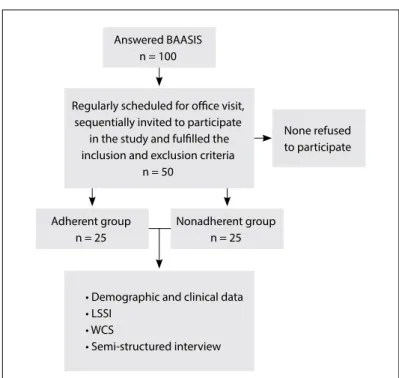
he irst 25 adherent patients (adherent group) and the irst 25 nonadherent patients (nonadherent group) were selected,
totaling 50 patients (Figure 1). None of the irst 50 invited
patients who fulilled the inclusion and exclusion criteria declined to participate.
Variables and measurements
General data
Demographic and clinical data were collected through retriev-ing the followretriev-ing information from the medical records: gender, age, marital status, years of formal education, city of origin, type
of donor, time of kidney transplantation, serum creatinine and comorbidities.
Adherence
he deinition of nonadherence that was used was based on the medication regimen as recommended by the transplantation
com-munity.12 As previously mentioned, to evaluate adherence to
immu-nosuppressive drugs, we applied BAASIS,32-34 as validated for use in
Portuguese.31 BAASIS assesses relevant dimensions of
immuno-suppressive drug use (i.e. adherence to taking the drug, adherence to the times for taking the drug, drug holidays and dose reduction) over a ixed time period consisting of the last four weeks. Responses are given on a six-point scale: never (0), once per month (1), every second week (2), every week (3), more than once per week (4) and every day (5). Any deviation, namely an answer difering from “never,” among any of the items, is considered to be nonadherence. Cronbach’s alpha for the validated translation into Portuguese was
0.70, thus indicating moderate internal consistency.31
Stress
he presence and level of stress were evaluated using the Lipp
Stress Symptoms Inventory (LSSI) for adults.35 he LSSI
com-prises a questionnaire that detects the presence of stress and classiies patients in accordance with Lipp’s four-phase model (alert, resistance, quasi-exhaustion and exhaustion). We opted to use LSSI because it was developed and validated in Portuguese
(Cronbach’s alpha of 0.91).35 We irst evaluated the presence of
stress, then used the original stress phases and inally used a com-posite classiication that included an initial stress phase (patients in the alert and resistance phases) (initial phase) and a more advanced phase (patients in the quasi-exhaustion and exhaustion
phases) (more advanced phase).35
Coping
Coping was assessed using the WCS, a 45-item scale developed by
Vitaliano et al.36 and validated for use in Portuguese.37 he items
on this self-reporting instrument are rated on a ive-point Likert scale: I never do this (1); I do this a little bit (2); I sometimes do this (3); I do this a lot (4); and I always do this (5). Four pat-terns of coping were evaluated: coping focused on the prob-lem (18 items; Cronbach’s alpha: 0.84); coping focused on emo-tion (15 items; Cronbach’s alpha: 0.81); searching for/turning to religion/fantasy thoughts (7 items; Cronbach’s alpha: 0.74); and
seeking social support (5 items; Cronbach’s alpha: 0.70).37 Higher
scores indicate greater use of each coping strategy. A further anal-ysis was also performed, in which these original four categories
were grouped into two others: active coping, focused on the
prob-lem and seeking social support; and palliative coping, focused on
emotion and searching for/ turning to religion/fantasy thoughts.
Figure 1. Study design.
Regularly scheduled for oice visit, sequentially invited to participate
in the study and fulilled the inclusion and exclusion criteria
n = 50
• Demographic and clinical data • LSSI
• WCS
• Semi-structured interview Adherent group
n = 25
Answered BAASIS n = 100
None refused to participate
Nonadherent group n = 25
his categorization was based on the general goal of the coping response, which may be directed towards the situation (active
cop-ing) or towards emotional management (palliative copcop-ing).29
Data collection
First, we invited outpatients who fulilled the study inclusion and exclusion criteria. As mentioned previously, BAASIS had been administered to these patients during their previous regu-lar consultation visit by trained transplantation nurse interview-ers. hen, participants were given written and oral information before signing the informed consent form. Finally, the LSSI and the WCS were applied by a psychologist from outside the kid-ney transplantation team. he time interval between applying BAASIS and applying LSSI and WCS was about a month, and the data were gathered from all of these questionnaires between August and December 2010. Complementary data were gathered from the medical records.
Ethical considerations
his study was approved by the local research ethics committee (approval number 0028/2010). Patients agreed to participate in the study through signing an informed consent form.
Statistical procedures
Descriptive statistical analyses were conducted using frequencies to evaluate categorical variables and means and standard devia-tions to evaluate continuous variables. he t test, Mann-Whitney test and chi-square or Fisher’s test were used to compare variables
between the adherent and nonadherent groups (Tables 1 and 2).
Odds ratios were then estimated by means of simple logistic regres-sion on stress and coping relating to nonadherence. We analyzed stress in three categories: no stress, initial stress phase and more advanced stress phase. For coping, we considered two grouped cat-egories for the analysis: palliative coping and active coping. A mul-tivariate approach was not feasible due to the small sample size and
homogeneity of the adherent and nonadherent groups, as shown in the results section. We presented odds ratio point estimates and
their respective 95% conidence intervals.38,39 he signiicance level
was set at 0.05. he analyses were performed using the SPSS 15.0 statistical package (SPSS Inc., Chicago, IL, USA).
RESULTS
Descriptive data
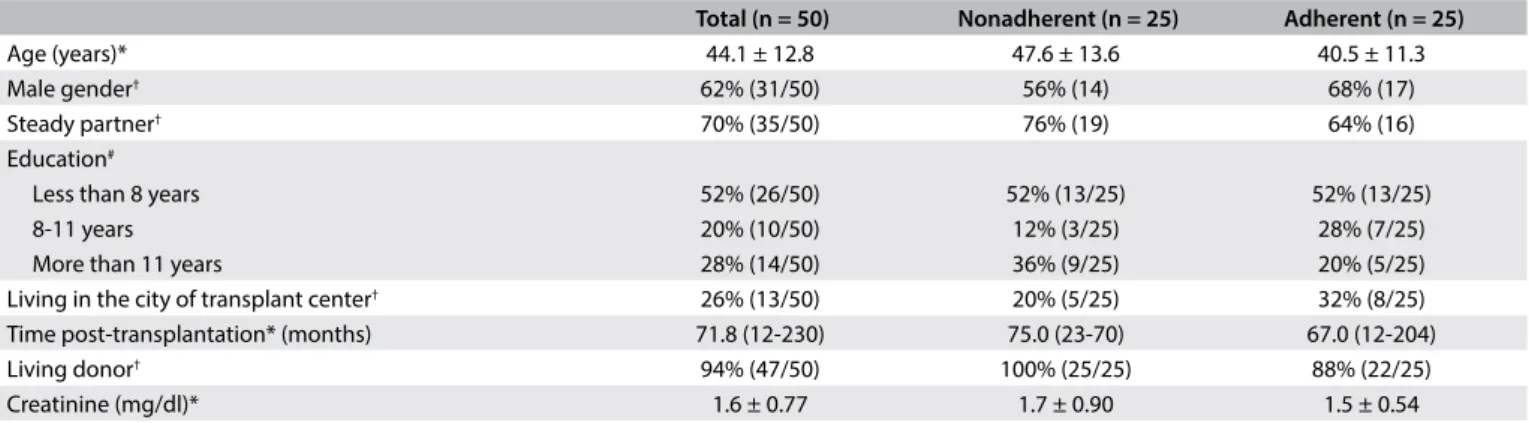
he patients’ mean age was 44.1 ± 12.8 years, and 62% were male. Ninety-four percent received their grat from a living donor. he median post-transplantation time was 71.8 months (range: 12-230), and the creatinine level was 1.6 ± 0.74 mg/dl. Fity-two percent of the patients had inished primary school, 20% second-ary school and 28% higher education. Most of the individuals (70%) reported having a steady partner, and only 26% lived in the city of the transplantation center. No signiicant diferences were found in the descriptive data between the adherent and
nonad-herent groups (Table 1).
Stress and adherence
According to the LSSI, 50% of the patients had a diagnosis of stress. However, we found higher frequency of stress in the nonadherent group (64%) than in the adherent group (36%)
(P = 0.05) (Table 2). On the other hand, neither of the groups
showed any diferences between the stress phases (P = 0.40) and the composite stress phases (P = 0.68).
Likewise, we did not ind any factor independently
associ-ated with nonadherence in bivariate analysis (Tables 1 and 2),
including demographic and clinical data. Because stress and coping variables behaved collinearly, a simple logistic regres-sion model was used to estimate odds ratios and their respective 95% conidence intervals (CI) for stress levels and coping pat-tern, in relation to adherence. he more advanced level of stress showed a nonsigniicant trend towards a positive association
Table 1. Demographic and clinical variables of adherent and nonadherent kidney transplantation patients studied
Continuous variables * were compared using t test or Mann-Whitney test, and frequencies † using chi-square test. No signiicant diferences were found between the groups.
Total (n = 50) Nonadherent (n = 25) Adherent (n = 25)
Age (years)* 44.1 ± 12.8 47.6 ± 13.6 40.5 ± 11.3
Male gender† 62% (31/50) 56% (14) 68% (17)
Steady partner† 70% (35/50) 76% (19) 64% (16)
Education#
Less than 8 years 52% (26/50) 52% (13/25) 52% (13/25)
8-11 years 20% (10/50) 12% (3/25) 28% (7/25)
More than 11 years 28% (14/50) 36% (9/25) 20% (5/25) Living in the city of transplant center† 26% (13/50) 20% (5/25) 32% (8/25)
Time post-transplantation* (months) 71.8 (12-230) 75.0 (23-70) 67.0 (12-204) Living donor† 94% (47/50) 100% (25/25) 88% (22/25)
with nonadherence to immunosuppressive medication in this
analysis (OR 4.7; 95% CI: 0.99-22.51; P = 0.053) (Table 2).
Coping patterns and adherence
here was a diference in the coping patterns relating to search-ing for religious practices and fantasy thoughts between the groups (52 versus 24%), but the results were not statistically
sig-niicant (Table 2). In contrast, ater grouping the coping
pat-terns, adherent patients had more responses associated with active coping directed towards the stressor (76%) than did
non-adherent patients (48%) (P = 0.04) (Table 2). Moreover, the
palliative coping pattern (religion/fantasy thoughts and emo-tion-focused coping) was associated with nonadherence (OR 3.4;
95% CI: 1.02-11.47) (Table 3).
DISCUSSION
In this comparative study, we found that nonadherent patients had high stress (50%) and used more palliative coping strategies than did adherent patients. Although the patients had been pre-viously grouped according to their adherence to immunosup-pressive drugs, the demographic and clinical variables were simi-lar between the adherent and nonadherent groups.
Table 2. Bivariate analysis on the presence of stress, stress factors and coping patterns among adherent and non-adherent kidney
transplantation patients
Bivariate analysis*
Variables Nonadherent
(n = 25)
Adherent
(n = 25) P
Presence of stress* 64% (16/25) 36% (9/25) 0.05
Stress phase†
Alert phase 0 4% (1/25)
Resistance phase 50% (8/16) 20% (5/25)
Quasi-exhaustion phase 37.5% (6/16) 12% (3/25)
Exhaustion phase 12.5% (2/16) 0 0.40
Composite stress phase†
Initial phase (alert and resistance phases) 50% (8/16) 66.7% (6/09)
More advanced phase (quasi-exhaustion phase and exhaustion phase) 50% (8/16) 33.3% (3/09) 0.68 Stress factor*
Fear of graft loss 76% (19/25) 56% (14/25) Medication issues 84% (21/25) 48% (12/25) Excessive need for care 64% (16/25) 60% (15/25) Post-transplant treatment 56% (14/25) 32% (8/25)
Social acceptance/reinsertion 20% (5/25) 28% (7/25) 0.008 Coping pattern†
Focused on problem-solving 40% (10/25) 60% (15/25) Seeking social support 8% (2/25) 16% (4/25)
Emotion-focused 4% (1/25) 0
Religion/fantasy thoughts 48% (12/25) 24% (6/25) 0.20 Coping according to grouping pattern*
Active coping 48% (12) 76% (19)
Palliative coping 52% (13) 24% (6) 0.04
*Variables were analyzed using chi-square * or Fisher test †.
Table 3. Simple logistic regression model for the presence of stress, stress factors and coping patterns among adherent and non-adherent
kidney transplantation patients
*Logistic regression model. We ran two diferent logistic regression models, one for stress and the other for coping pattern.
Simple logistic regression model*
Variables Nonadherent
(n = 25)
Adherent (n = 25)
OR
(95% CI) P
No stress 36% (9) 64.0% (16) 1
-Initial phase 50% (8) 66.7% (6) 2.4 (0.62-9.02) 0.21 More advanced phase 50% (8) 33.3% (3) 4.7 (0.99-22.51) 0.05
Active coping 48% (12) 76.0% (19) 1
These results appear consistent with the conclusions from previous studies, in which kidney transplantation did not eliminate chronic kidney disease-related stressors and those relating to disease treatment, since kidney transplantation is only a form of therapy for chronic kidney disease, and not
its cure.2 Even with a well-functioning graft, these
individu-als continue to be chronic disease patients who are subject to some level of social, physical and emotional limitations, as is
the case with dialysis patients.9,22-25 However, differently from
our study, most other studies failed to directly assess the fre-quency of stress.
In order to assess stress, we used the LSSI, which is a psy-chological test that enables diagnosing of stress based on speciic symptoms and identiication of the stress phase, in accordance
with Seyle’s theory.19 his is the only instrument for evaluating
stress that has been validated for use among Portuguese-speaking patients and that has characteristics in line with the aims of our study. Nevertheless, previous studies evaluating stress and kidney transplantation have used other instruments such as scales based on subjective measurement of stressful factors or speciic life
themes, including those relating to the illness.22-25,28 hose scales
probably have limited evaluation capacity because they rely on patient memory and do not consider the coping strategies used
by patients, which may alter the stress results.35
Additionally, we did not ind any studies that have shown any consistent link between the speciic phases of stress and nonadap-tive behavior of nonadherence in cases of kidney transplantation. Stressed patients, particularly those in the advanced phase, are more likely to develop emotional problems (depression and anx-iety), cognitive problems (attention and memory) and afective
problems (interpersonal conlicts or social withdrawal).35 Each of
these conditions may potentially contribute towards inefective coping with health status, thus afecting adherence to medication among kidney transplantation patients.
Concerning coping patterns, nonadherence to immuno-suppressants was associated with palliative control in our study, mainly focused on “emotion” and “religion/fantasy thoughts”. Coping responses “focused on the problem” or “focused on emo-tion” are fundamental for attenuating the impact of stressors, given that both of these responses play complementary yet
difer-ent roles in stress control.40 However, over a long period of time,
active coping strategies tend to be more adaptive, because they attempt to confront the stressor, thereby reducing stress-related symptoms and helping achieve an adjustment to the stressor
situ-ation.41 We have already identiied the most frequent stressors in
our population.42 Strategies to help this population deal with the
stressors, designed individually or generally, are now the focus of our attention. We have reinforced our educational activities in waiting room and have taken an interdisciplinary approach
towards better social support, with psychotherapy for cognitive restructuring and use of motivational interview techniques.
hus, in the context of adherence to medication among kidney transplantation patients, we expected palliative coping to be related to nonadaptive nonadherence behavior. In fact, Lindqvist et al. observed that patients who used more evasive, fatalistic, palliative and emotional coping strategies were less capable of dealing with
the demands of chronic kidney disease and kidney transplantation.30
Another study on a sample comprising 200 kidney transplantation patients showed that recipients who reported higher stress and more depression, and who coped with stress by using avoidant coping
strategies, were less compliant with medication.41
here are some limitations to our study. he sample size, similarly to other studies involving psychological factors among
kidney transplantation patients,9,17 was less than 100 patients. We
tried to overcome this limitation by applying a sampling design that involved studying the same numbers of adherent and non-adherent subjects, selected from the main study population
(BAASIS validation).31 However, we recognize that this design
was underpowered, compared with case-control matched stud-ies. Use of a single self-reporting instrument may have limited the evaluation of immunosuppressive adherence.
We opted for BAASIS as the method for assessing adherence because it was one of the three measurement tools for self-reporting of nonadherence that the Transplant 360 Task Force identiied as presenting the potential for efective adaptation for
use in transplantation clinical practice.32,33 Moreover, BAASIS
is the only instrument that has been validated for use among
Brazilian Portuguese-speaking transplantation patients.31
In addition, living donor recipients predominated in our sample. Until recently, this donor proile was the most common
type of transplantation performed in Brazil.43 Future
stud-ies should include patients receiving transplants from deceased donors, in order to enable greater understanding of the issues relating to this condition.
he fact that each patient was at a speciic post-transplan-tation time prevented investigation of the potential association between stress and coping over the entire transplantation expe-rience. We also take the view that, because of the design of the present study, it was not possible to evaluated causality and whether stress and coping were the cause or consequence of nonadherence. Moreover, since multivariate analysis was not possible, clinical inferences should be made with caution.
CONCLUSIONS
he present study showed that stress occurs frequently, even in cases of well-functioning kidney transplantation. Palliative pat-terns of coping with transplant-related stressors were indepen-dently associated with immunosuppressive nonadherence. hese indings support the notion that adherence interventions should integrate behavioral, psychosocial and medical approaches in order to appropriately limit the undesirable consequences of nonadherence in kidney transplantation. herefore, more stud-ies are needed in this ield of research. Healthcare professionals should be prepared to provide whole-person care for their trans-plantation patients, taking into consideration their bio-psycho-social-spiritual needs and proposing interventions for improving adherence behavior relating to medication and, consequently, the outcomes from kidney transplantation.
REFERENCES
1. Wolfe RA, Ashby VB, Milford EL, et al. Comparison of mortality in all
patients on dialysis, patients on dialysis awaiting transplantation,
and recipients of a irst cadaveric transplant. N Engl J Med.
1999;341(23):1725-30.
2. Pesavento TE. Kidney transplantation in the context of renal
replacement therapy. Clin J Am Soc Nephrol.2009;4(12):2035-9.
3. Hariharam S, Johnson CP, Bresnahan BA, et al. Improved graft survival
after renal transplantation in the United States, 1988 to 1996. N Engl
J Med. 2000;342(9):605-12.
4. Lamb KE, Lodhi S, Meier-Kriesche HU. Long-term renal allograft
survival in the United States: a critical reappraisal. Am J Transplantat.
2011;11(3):450-62.
5. Denhaerynck K, Dobbels F, Cleemput I, et al. Prevalence, consequences,
and determinants of nonadherence in adult renal transplant patients: a
literature review. Transpl Int. 2005;18(10):1121-33.
6. Dew MA, DiMartini AF, De Vito Dabbs A, et al. Rates and risk factors
for nonadherence to the medical regimen after adult solid organ
transplantation. Transplantation. 2007;83(7):858-73.
7. Sabaté E. Adherence to long-term therapies: evidence for action.
Geneva: World Health Organization; 2003.
8. Dobbels F, Vanhaecke J, Dupont L, et al. Pretransplant predictors
of posttransplant adherence and clinical outcome: an evidence
base for pretransplant psychosocial screening. Transplantation.
2009;87(10):1497-504.
9. Achille MA, Ouellette A, Fournier S, Vachon M, Hébert MJ. Impact
of stress, distress and feelings of indebtedness on adherence
to immunosuppressants following kidney transplantation. Clin
Transplant. 2006;20(3):301-6.
10. Bronfenbrenner U. Toward an experimental ecology of human
development. American Psychologist. 1977;32(7):513-31.
Available from: http://cac.dept.uncg.edu/hdf/facultystaf/Tudge/
Bronfenbrenner%201977.pdf. Accessed in 2015 (Sep 14).
11. Berben L, Dobbels F, Engberg S, Hill MN, De Geest S. An
ecological perspective on medication adherence. West J Nurs Res.
2012;34(5):635-53.
12. Fine RN, Becker Y, De Geest S, et al. Nonadherence consensus
conference summary report. Am J Transplant.2009;9(1):35-41.
13. Takemoto SK, Pinsky BW, Schnitzler MA, et al. A retrospective
analysis of immunosuppression compliance, dose reduction and
discontinuation in kidney transplant recipients. Am J Transplant.
2007;7(12):2704-11.
14. De Geest S, Denhaerynck K, Dobbels F. Clinical and economic
consequences of non-adherence to immunosuppressive drugs
in adult solid organ transplantation. Compliance in solid organ
transplantation. In: Grinyó JM, editor. International Transplantation
Updates. Permanyer Publications; 2011. p. 63-81.
15. Butler JA, Roderick P, Mullee M, Mason JC, Peveler RC. Frequency
and impact of nonadherence to immunosuppressants after
renal transplantation: a systematic review. Transplantation.
2004;77(5):769-76.
16. Denhaerynck K, Burkhalter F, Schäfer-Keller P, et al. Clinical
consequences of non adherence to immunosuppressive medication
in kidney transplant patients. Transpl Int. 2009;22(4):441-6.
17. Gremigni P, Bacchi F, Turrini C, et al. Psychological factors associated
with medication adherence following renal transplantation. Clin
Transplant. 2007;21(6):710-5.
18. Cukor D, Rosenthal DS, Jindal RM, Brown CD, Kimmel PL. Depression
is an important contributor to low medication adherence in
hemodialyzed patients and transplant recipients. Kidney Int.
2009;75(11):1223-9.
19. Seyle H. The general adaptation syndrome and the diseases of
adaptation. J Clin Endocrinol Metab. 1946;6:117-230.
20. Pedersen SS, Denollet J. Type D personality, cardiac events, and
impaired quality of life: a review. Eur J Cardiovasc Prev Rehabil.
2003;10(4):241-8.
21. O’Dell KR, Masters KS, Spielmans GI, Maisto SA. Does type-D personality
predict outcomes among patients with cardiovascular disease? A
meta-analytic review. J Psychosom Res. 2011;71(4):199-206.
22. Hayward MB, Kish JP Jr, Frey GM, et al. An instrument to identify
stressors in renal transplant recipients. ANNA J. 1989;16(2):81-5.
23. Sutton TD, Murphy SP. Stressors and patterns of coping in renal
transplant patients. Nurs Res. 1989;38(1):46-9.
24. White M, Keteian S, Starr AJ, Voepel-Lewis T. Stress, coping, and quality
of life in adult kidney transplant recipients. ANNA J.1990;17(6):421-4,
431; discussion 425.
25. Fallon M, Gould D, Wainwright SP. Stress and quality of life in the
renal transplant patient: a preliminary investigation. J Adv Nurs.
1997;25(3):562-70.
26. Rosenberger J, Geckova AM, Dijk JP, et al. Factors modifying stress
from adverse efects of immunosuppressive medication in kidney
27. Orr A, Willis S, Holmes M, Britton P, Orr D. Living with a kidney
transplant: a qualitative investigation of quality of life. J Health
Psychol. 2007;12(4):653-62.
28. Chen KH, Weng LC, Lee S. Stress and stress-related factors of patients
after renal transplantation in Taiwan: a cross-sectional study. J Clin
Nurs. 2010;19(17-18):2539-47.
29. Folkman S, Lazarus RS, Gruen RJ, DeLongis A. Appraisal, coping,
health status, and psychological symptoms. J Pers Soc Psychol.
1986;50(3):571-9.
30. Lindqvist R, Carlsson M, Sjödén PO. Coping strategies of people with
kidney transplants. J Adv Nurs. 2004;45(1):47-52.
31. Marsicano Ede O, Fernandes Nda S, Colugnati F, et al. Transcultural
adaptation and initial validation of Brazilian-Portuguese version of the
Basel assessment of adherence to immunosuppressive medications
scale (BAASIS) in kidney transplants. BMC Nephrol. 2013;14:108.
32. Dobbels F, Berben L, De Geest S, et al. The psychometric properties
and practicability of self-report instruments to identify medication
nonadherence in adult transplant patients: a systematic review.
Transplantation. 2010;90(2):205-19.
33. Schmid-Mohler G, Thut MP, Wüthrich RP, Denhaerynck K, De Geest
S. Non-adherence to immunosuppressive medication in renal
transplant recipients within the scope of the Integrative Model
of Behavioral Prediction: a cross-sectional study. Clin Transplant.
2010;24(2):213-22.
34. Dobbels F, Van Damme-Lombaert R, Vanhaecke J, De Geest S.
Growing pains: non-adherence with the immunosuppressive
regimen in adolescent transplant recipients. Pediatr Transplant.
2005;9(3):381-90.
35. Lipp MN. Manual do Inventário de Sintomas de Stress para Adultos
de Lipp (ISSL). São Paulo: Casa do Psicólogo; 2000.
36. Vitaliano PP, Russo J, Carr JE, Maiuro RD, Becker J. The ways of
coping checklist: revision and psychometric properties. Multivariate
Behavioral Research. 1985;20(1):3-26. Available from: http://www.
tandfonline.com/doi/abs/10.1207/s15327906mbr2001_1. Accessed
in 2015 (Sep 14).
37. Seidl EMF, Tróccoli BT, Zannon CMLC. Análise fatorial de uma medida
de estratégias de enfrentamento [Factorial analysis of a coping
measure]. Psicologia: Teoria & Pesquisa. 2001;17(3):225-34.
38. Gardner MJ, Altman DG. Conidence intervals rather than P values:
estimation rather than hypothesis testing. Br Med J (Clin Res Ed).
1986;292(6522):746-50.
39. Altman DG, Bland JM. Absence of evidence is not evidence of
absence. BMJ. 1995;311(7003):485.
40. Carver CS, Scheier MF, Weintraub JK. Assessing coping strategies: a
theoretically based approach. J Pers Soc Psychol.1989;56(2):267-83.
41. Frazier PA, Davis-Ali SH, Dahl KE. Correlates of noncompliance among
renal transplant recipients. Clin Transplant.1994;8(6):550-7.
42. Brito DCS, Paula AM, Grincenkov FRS, Lucchetti G, Sanders-Pinheiro
H. Análise das mudanças e diiculdades advindas após o transplante
renal: uma pesquisa qualitativa [Analysis of changes and diiculties
arising from kidney transplantation: a qualitative study]. Rev
Latino-Am Enfermagem. 2015;23(3):419-26.
43. Medina-Pestana JO, Galante NZ, Tedesco-Silva H Jr, et al. O contexto
do transplante renal no Brasil e sua disparidade geográica [Kidney
transplantation in Brazil and its geographic disparity]. J Bras Nefrol.
2011;33(4):472-84.
Presentations: This study was presented at the 12th Brazilian Congress of Organ Transplantation, in Belém, Brazil, on October 1 to 4, 2011. It also
formed the dissertation of Daniela Cristina Sampaio Brito for obtaining a
master’s degree in Health from the Federal University of Juiz de Fora, in
August 2012.
Acknowledgements: Daniela Cristina Sampaio Brito received grants from Coordenação de Aperfeiçoamento de Pessoal de Nível Superior
(CAPES) and from Fundação Instituto Mineiro de Estudos e Pesquisas em
Nefrologia (IMEPEN). These institutions had no involvement in any parts
of the study.
Sources of funding: Coordenação de Aperfeiçoamento de Pessoal de Nível Superior (CAPES) and Fundação Instituto Mineiro de Estudos e
Pesquisas em Nefrologia (IMEPEN)
Conlict of interests: None
Date of irst submission: June 2, 2015
Last received: August 5, 2015
Accepted: August 10, 2015
Address for correspondence:
Helady Sanders-Pinheiro
Rua Benjamin Constant, 1044/1001
Juiz de Fora (MG) — Brazil
CEP 36015-400
Tel. (+55 32) 9982-8439
Fax. (+55 32) 3215-1067