Undergraduate Study of Thermal Condutivity of Metals
Estudodaondutividadetermiademetaisanveldegradua~ao
T. B. Ferrari,S. H. Hara, J. L. Aziani, L.Roha,
E. de Paula and M. Mulato
Departamento deFsiaeMatematia,Fauldadede FilosoaCi^eniase Letrasde Ribeir~aoPreto,
Universidadede S~aoPaulo,Av. Bandeirantes3900, Ribeir~aoPreto, 14040-901,Brazil
Reebidoem7demaio,2002. Aeitoem7dejunho,2002.
Inthisworkweanalyzeanundergraduateexperimentusedtodeterminethethermalondutivity
of metals(K). Weintroduefewmodiations inordertooer thestudentthe hanetoexplore
dierent models,learning thebasisienti methodofdevelopingappropriateand improved
ex-planationsforeahexperimentinordertobetterlinktheoryandempirialresults. Semi-empirial
orretions are introdued inthe system in orderto hek the experimental results aording to
previouslyreportedKvalues.Asspeiasesweuseopper[K=0.92al/(Csm)℄,aluminum
[K=0.49al/(Csm)℄andbrass[K=0.26 al/(Csm)℄ylinders.
Nesse trabalho analisamos um experimento de gradua~ao que e utilizado para se determinar a
ondutividade termia de metais (K). Introduzimos algumas modia~oes a m de ofereer ao
estudanteaoportunidadedeexplorardiferentesmodelos,deformaaaprenderobasiodometodo
ientodedesenvolvimentodeexplia~oesapropriadas,emelhoradasparaadaexperimentoom
oobjetivodeobterumamelhoranidadeentreteoriaeresultadosexperimentais. Corre~oes
semi-emprias s~aointroduzidasnosistemaa mdeompararos resultadosexperimentais omoutros
previamentetabelados. Como asosespeos utilizamosilindrosdeobre[K= 0.92 al/(Cs
m)℄,alumnio[K=0.49al/(Csm)℄elat~aobrass[K=0.26al/(Csm)℄.
I Introdution
Duringthehigh-shoollassesaroundtheworld, most
of theativities arestill based onthe lassi
seminar-like presentation by the teaher. Most of the ourses
arebasedontheoretiallasses,where onlyaverylow
perentage ofthe studentshavethe hane to explore
any kind of pratial demonstration or
experimenta-tion. Eveninthebestases,theapproahisvery
super-ial. Theamountofexperimentalstudiesinreasesat
the undergraduate level, speially onsidering Physis
and Chemistry lasses. It an thus be said that the
rstontatofthestudentswith thesientimethod
ofinvestigationoursduring thebasilaboratory
un-dergraduatephysisourses.
Thelassesofexperimentalphysisarenormally
de-veloped in parallel with the theoretial lasses during
thesame termorsemester. Inthis sense,most ofthe
timesitisassumedthatthestudentsperformtheir
ex-periments after the omprehension of all the physial
oneptsbehindthetheory,aswellasthedevelopment
ofall theequations, et. Unfortunately,historyshows
thatthisisnotalwaystheasebeausethestudentsdo
lasses. Theyseem to have the behaviorof olleting
thedatarst,andtryingtounderstandthemlatterasa
homework. Thisphilosophymustbehanged,although
this is notan easytask. Even in the best ases, after
olletingalltheneessarydataandsubstitutingthem
into therespetiveequations in orderto hek the
va-lidityofthelast(orthevalidityofthedesriptionofthe
physial phenomena), in many oasions the students
ndadisagreementbetweenthepreditionof the
the-ory and their ndings in the laboratory. Most of the
time this fat happens not beause the physial laws
are wrong, and not also beause the experiment was
wrongly performed. This happensindeed beause the
physial model is inomplete ortoosimple to explain
the whole experimental work. As two typial
exam-plesitanbesaidthat duringthelassesofmehanis
veryoften themodel does nottake into aount
non-onservativefores,andduringthelassesof
thermody-namisveryoftenthemodeldoesnottakeintoaount
the lossof energyby heat ondution at somesurfae
orinterfae,andso on.
Theimportantfat about thesituation is that the
disrep-ing onepts. The students adopt either one of two
proeduresduringtheirreports: a)theystatethat the
experiment is verybad, theavailable toolsand
equip-ments are inappropriate, the results are onsequently
very poor and they annot verify what they wanted,
thus blaming the experimental errors more than they
should orould;b)theytrytoadopttheoppositeway
of thinking, i.e., onsidering the many possible errors
in theexperiment,theytrytoreatealargererrorbar
in ordertojustify anymismathaordingto this
ma-neuver.
Regardlessofanyoftheabove,mostofthetimethe
students tryto blame theexperiment and the
experi-mental data in awayto protet theset of theoretial
equationsasahollystatement. Onlyaverysmall
per-entageofthestudentshaveinfattheouragetofae
the problem and try to look for the real explanation,
even though this seems to be a hard work for them.
Some times they an even elaborate a list of possible
ausesfortheobservedmismath,butdonothavethe
feeling ofhoweah oneofthem would ontributeto a
nalexperimentalvaluehigherorlowerthanexpeted.
Ingeneral,theyhavetroubletryingtoquantifythe
pos-sible auses of disagreement between expeted values
andobserveddata.
Inorderto trytohelp to solvetheaboveproblem,
the present paper disusses a simple experiment and
proedureofanalysisthat aresuggestedforlaboratory
lasseswherethestudentsareintrodued tothe
sien-timethodbasedonthedeterminationofthethermal
ondutivityofmetals.
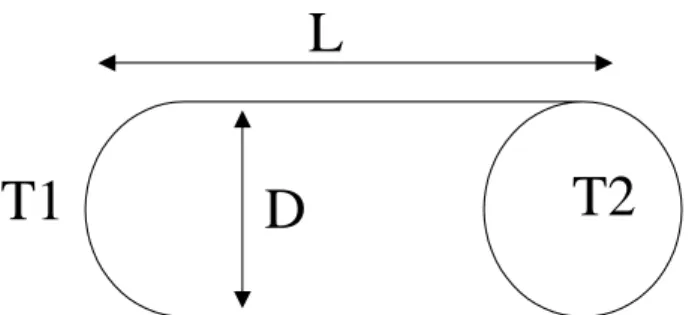
The experimentdeals with theanientproblem of
thermal ondution throughametalli ylinderwhose
ends sit at temperaturesT1 and T2 where T1>T2 as
shownin Fig. 1(whereL istheylinderlengthandD
its diameter). Assumingan isolated system, the heat
exhangeanbewrittenas [1,2℄:
Q
t
= K
A
L
T (1)
where Q/t is theheat transferperunit time, Kis
thethermalondutivityof thematerial,Ais the
sur-faearea,Listhetotallengthoftheylinder,andT
isthetemperaturedierenebetweenthetwofaes,i.e.
T =T1-T2.
Inthisworkwereviewasimpleexperimentthatan
be used to determine K for dierent metalli
materi-alswhere thetheoretial model expressedby equation
1 represents only a rst approximation to the reality.
Themaindierenesbetweentheoryandexperimental
T1
T2
L
D
Figure1. IllustrationofametalliylinderoflengthLand
diameter D, whose faes sit at temperatures T1 and T2.
Heat ondution ours from fae 1 to fae 2 given that
T1>T2.
II Experimental
Theexperimental setuponsists of ametalli ylinder
(diameterD, and lengthLasshown in Fig. 1) that is
usedto onnettwoups asillustratedin Fig. 2. For
alltheexperimentspresentedinthisworkitwasalways
adoptedD=15.850.01mmandL=61.000.01mm.
Cup1is madeofaluminumandit islledwith water
(M1 = 300 1 ml) at room temperature. The
wa-tertemperatureinsideCup 1isgoingtobereferredas
T1,and it is monitoredby the useof a thermometer.
Cup 2is madeof Teon [3-5℄ and it weights M
C2 . It
hasalsoaTeonoverwithaholefortheintrodution
of a thermometer ( 0.5C) that is used to monitor
thetemperature(T2)ofaxedamountofwater(M2)
insideCup2.
Cup1isheatedbyaameuntilthewaterinside it
startsto boil. Atthismomentanstirrer isintrodued
insideCup2. Thisstirreronsistsofasmall
ferromag-netiylinderoveredwithathinlayerofepoxy. Under
Cup2sitsarotatingmagnetthatisusedtoinduethe
movementofthestirrerinside Cup2. Inthesequene,
small ubes of ie are introdued inside Cup 2, and a
hronometerisstarted. Afteralltheiehasmeltedan
inrease in temperature T2 is observed, and thus the
systemisunder analmost stationaryondition. A
ta-ble is onstruted ontaining eah degree of variation
ofT2,therespetiveT1andtheelapsedtimesinethe
beginningof theexperiment. Thetable of thepresent
paper(not shown)wasonstrutedfromT2equalto0
upto36C.NotethathigherT2nalvaluesouldalso
beused.
Attheend of theexperiment theamountof water
inside Cup 2(M
2
)wasmeasured. Weused M
2 values
of145.0 0.5 ml,135.0 0.5 mland 112.00.5 ml
for the experiments performed with brass, aluminum
and opper ylinders, respetively. Note that in
or-derto avoidburningaidentstheexternalpartofthe
ylinderwasprotetedby athin Teonlayerbetween
imental data, dierent models were applied for their
understandingaspresentedin thenextsetions.
Cup 1
Aluminum
at T1
Cup 2
Teflon
at T2
Thermometer Thermometer
Metallic
cylinder
Motor
Flame
Magnet
Figure2. Shematidrawing orrespondingto the
experi-mentalset-up. Cup1madeofaluminumislledwithwater
and heatedbya ame while itstemperature is monitored
by a thermometerT1. Cup 2is made of Teon, whih is
also lled with ie and water. It has a Teon over and
itstemperatureT2 is also monitored. Heatis transferred
fromCup1toCup2throughthemetalliylinder. A
stir-rerisusedfor abetter temperaturehomogenization inside
Cup2.
III Results and Disussion
III.1 The simplestmodel
We observed that for the ase of a opper
(alu-minum/brass) ylinder the system takes about 800
(1350/1840)seondsfortheheatingofT2from0Cup
to 36C. These are importantnumbers that help the
professorduringthepreparationofthelasses.Inorder
to determine Kusing the theoretial model predited
byequation1,Qanbealulatedusingthe
approx-imationsthat alltheheatthatistransferredfromCup
1 throughthe metalli ylinderis stored in the water
insideCup2. Aordingtothatsimplemodel,foreah
variation of T2 by onedegree, Q an be written as
[6,7℄:
Q=M
2 C
W T
W
(2)
where C
W
is the spei heat of water (equal to
1al/gC) and T is the inrease in temperature
equalto 1C.Foreahmaterial Kanbedetermined
by substituting equation 2into equation 1. We name
thismodelasmodel1,andthusKisdenotedasK
1 and
written as:
K
1 =(M
2 C
W T
W
L)=(T At) (3)
Note that in equation (3) most of the parameters
are onstants, besidesT and t(assuming T
W as
1C).
Figure 3 shows the results of K
1
as a funtion of
T2 foropper(squares),aluminum(irles)and brass
(triangles) respetively. Three dierentregionsnamed
A, B and C are illustrated in Fig. 3, and they are
separated by the vertial dashed lines. Eah of them
will beonsidered separatelynext. ThedataforT2 <
5Cwerenotshown in regionA. Theywere exluded
from the graphbeauseregion A representsa regions
where thesystemin notinequilibrium yet (amixture
ofwaterandieexistsinsideup2,thatalsopresentsa
temperaturegradient),thusK1valuesstartfromlose
to zero and reah the equilibrium value at about T2
equal to 5C. Inthis sense,region A is totally
disre-garded. Regions B and C are separated aordingto
roomtemperature,that wasabout27C.
0
10
20
30
40
0.10
0.15
0.20
0.25
0.30
0.35
0.40
C
B
A
Copper
Aluminum
Brass
Calculat
ed
K1 (
cal
/
o
C s
cm
)
Temperature T2 (
o
C )
Figure 3. Experimentally obtained thermal ondutivity
values(K1)aordingtothesimplesttheoretialmodel
de-sribed by equations 1 and 2 (see text) for three metalli
ylindersmadeofopper(squares),aluminum(irles)and
brass(triangles) asa funtionof thetemperature(T2)
in-sideCup2. Vertialdashedlinesseparatethreeregions: a)
non-equilibriumregion; b)quasi-equilibriumregion for T2
smallerthanroomtemperature;)quasi-equilibriumregion
for T2higher thanroomtemperature. Note that the
ob-tained K1are neither onstant nor linear as afuntion of
T2,indisagreementwiththetheory.
It an be observed from Fig. 3 that the
experi-mental K
1
is neitheronstantnorlinear asafuntion
of T2. This nding is in total disagreementwith the
preditedtheoretialmodel. Ontopofthatthe
thanthosereportedforopper[0.92al/(Csem)℄,
aluminum[0.49 al /(C se m)℄ and brass [0.26al
/(Csem)℄[8℄. Thedierenebetweenreportedand
experimentallydeterminedvaluesarebigger,thehigher
the reported Kvalue. At this moment the studentis
leadtothinkabouttheexperimentalresults,andisalso
lead to tryto understand them andto formulate new
modelsthatwould betterexplainthedata.
III.2 The inuene of the TeonCup
The model needs aorretion in region Bbeause
the totalinreasein T2 is due to theheat ondution
throughthemetalliylinder(Q
CYLINDER
),plusthe
heatondutionfromtheTeonCup(Q
CUP
)beause
theinternalpartoftheTeonCupsitsatT2whilethe
outmostpartsitsatroomtemperature(whihishigher
than T2). In this sense, the total heat transferred to
thewaterinside Cup2anbewritten as:
Q
WATER
=Q
CYLINDER
+Q
CUP (4)
Q
CYLINDER
alulated from equation 4 an be
substitutedintoequation1.Q
WATER
isalulatedas
inequation2,andQ
CUP
isalulatedas:
Q
CUP =
K
TE A
TE
d
TE T
TE
t (5)
where t is the same time interval as before, T
TE
isthetemperaturedierenebetweentheinternal and
externalwalls ofthe TeonCup, d
TE
is the thikness
ofthewallsofthe Cup (7.5mm),K
TE
is thethermal
ondutivityofTeon(4.53x10 4
al/(Csm)),and
A
TE
istheeetiveareaoftheup inontatwiththe
waterinsideit. Thisareaanbewrittenasthesumof
thelateralandthebottom areas,andanbe
approxi-matedbythefollowingequationusing anaverageup
radiusR
TE
(37.2mm):
A
TE
=2 R
TE
H+R 2
TE
(6)
whereHistheheightofthewaterolumninsideCup2
(76.1mm). Notethattheupis nottotallylledwith
water, and the top of the up is not in ontat with
thewater inside it. Aording to the above, the right
Q
CYLINDER
tobeusedinequation1wouldbegiven
by:
Q
CYLINDER =M
2 C
W T
W
K
TE
d
TE (2 R
TE
H+R 2
TE )T
TE t
(7)
d
what suggests an even worse result than the one
ob-servedin Fig. 3, given that a smaller Q
CYLINDER
wouldbeobtained. Wewillome bakto thatfurther
below.
Themodel needstobeorretedforregionCalso,
but in thisase thetotalheattransferred throughthe
metalli ylinderisbasially dividedinthree parts: a)
part of it is used to inrease the water temperature
inside Cup2(Q
WATER
);b)partofitisused to
in-rease the temperature of the up itself (Q
CUP A ),
and ) partof it is lost dueto themehanism ofheat
transferthroughCup2totheatmospherienvironment
(Q
CUP B
). Thus,Q
CYLINDER
anbewritten as:
Q
CYLINDER
=Q
WATER +Q
CUP A
+Q
CUP B
(8)
where Q
WATER
is alulated as in equation 2, and
Q
CUP B
isalulatedasinequation5.
Inorderto alulateQ
CUP A
weassumealinear
temperature distribution though the thikness of the
Teonup asillustratedbythesolid linein Fig. 4(a).
Wealsoassumethatforeahtthetemperature
distri-butionvariesqualitativelyaordingtothedashedline
inFig. 4(a),onethatthetemperatureof theinternal
wallinreasesby1C,and thetemperatureofthe
ex-ternalwallstaysat roomtemperature. Of ourse this
is just a rst simple approximation, sine the higher
thevalueofthetemperatureoftheinternalwallofthe
up,thebiggerthedierenebetweenthetemperature
oftheexternal walland theexternalambient. This is
goingtobelatteraddressedinmoredetail. Aording
tothisrstapproximation,thetotalheatstoredinside
theup materialitselfwouldbegivenby:
Q
CUPA =
Z
dTE
0
TE A
TE C
TE
T(x)dx=
TE A
TE C
TE Z
dT
E
0
where
TE
isthemassdensityofTeon(2200kg/m 3
),
A
TE
isgivenbyequation6,C
TE
isthespeiheatof
Teon(0.28al/(gC)),andT(x)isthetemperature
variationinsidethethiknessoftheupasafuntionof
thelengthfor0xd
TE
. Inordertosolvetheabove
integral,T(x)mustbeknown. Thisinformation an
be extrated from Fig. 4(a) using the dierene
be-tweenthetwoequationsthatdesribeeahofthelinear
dependeneofTwithxbeforeandaftert. Aording
tothat,theinitialdistributionoftemperaturewouldbe
givenby:
T1(x)=T
INT 1
a1x with a1= T
INT 1 T
EXT
d
TE
(10)
and thenaldistribution of temperatureafter t was
elapsedwouldbegivenby:
T2(x)=T
INT 2
a2x with a2= T
INT 2 T
EXT
d
TE
(11)
Usingequation10and11,T(x)anbewrittenas:
T(x)=T2(x) T1(x)=T
INT 2 T
INT 1 +
T
INT 1 T
INT 2
d
TE
x (12)
TakingintoaountthatthevariationfromT
INT 1 toT
INT 2
isequalto1C,equation12anbereduedto:
T(x)=1 x
d
TE
(13)
Thesubstitutionofequation13into equation9leadsto:
Q
CUP A =
TE A
TE C
TE Z
d
TE
0 1
x
d
TE
dx=
TE A
TE C
TE d
TE
2
(14)
Then, theexpressionforQ
CYLINDER
anbeobtainedbysubstitutingequations2,5and 14into equation8:
Q
CYLINDER =M
2 C
W T
W +
K
TE
d
TE (2R
TE
H+ R 2
TE )T
TE t
+
TE A
TE C
TE d
TE
2
(15)
d
0
d
TE
T
EXT
T
INT_1
T
INT_2
1
2
a)
0
L
T2_f
T2_i
T1
1
2
b)
Figure 4. Shemati illustration of temperature
distribu-tion: a) from the inner surfae of the Teon wall of Cup
2 to the outersurfae; and b) along the extension of the
metalliylinderfromCup1toCup2. Thesolidline
(num-bered1)representstheinitialtemperaturedistributionand
thedashedline (numbered2)representsthenal
tempera-turedistributionafterthetimeintervalt,forbothurves.
Ina) thehorizontal axis orrespondsto thewall thikness
(from0tod
TE );T
EXT
istheexternaltemperature,T
INT 1
and TINT
2
arethe internal initial andnal temperatures
respetively. In b) the horizontal axis orresponds to the
ylinderlength(from0to L);T1is theonstant
tempera-tureofCup1; T
2i andT
2 f
arethe initialand nal
tem-peraturesofCup2respetively.
At thismomentthestudentshould beableto
per-form new alulations taking into aountthe
ontri-bution of eah dierent mehanism desribed so far.
We donot presentthese datahere. Instead, we move
one stepfurther and disuss in thenext setion extra
mehanismsthat must also be taken into aountfor
III.3 Losses throughthe ylinder
Two other dierent mehanisms exist, besides the
heat ondution from up 1 to up 2 by the metalli
ylinder. Therstofthemregardstheheatthatislost
through the surfaeof the ylinder (Q
SURF
)(in its
radialdiretion,i.e. alongthevertialarrowinFig. 1)
beause,inpriniple,eahsetionoftheylindersitsat
a temperature T higherthan roomtemperature. The
seond mehanism regards the storage of heat inside
themetalli ylinderitself(Q
STORED
)aspreviously
desribedfor Cup 2. Inthis sense,the totalheat lost
(Q
LOST
)anbewrittenas:
Q
L
O ST
=Q
SURF
+Q
STORED
(16)
TheheatlostthroughthesurfaeQ
SURF
isoneof
themostdiÆulttobequantied,mainlybeauseofits
three-dimensionalharater. Asaveryrough
approxi-mation, itould be saidthat theheat transferrateat
eahsetionoftheylinder(i.e. in itsradialdiretion)
wouldbegiven,asintheaseofequation1,by[1,2℄:
Q
SURF
t
= K
A
SEC
L
SEC
T(x) (17)
wheret is theelapsedtime asbefore, Kis the
ther-malondutivityofthemetalli ylinder,T(x)isthe
temperature dierene between the highest
tempera-tureinside eahsetionoftheylinder androom
tem-perature, A
SEC
is an eetive area and L
SEC is an
eetivelengthfortheheattransfer,respetively. Just
as a simple approximation it ould be assumed that:
a)A
SEC
anbeapproximatedbytheperimeterofthe
setion at position x, i.e., A
SEC
= D; and b) the
highest temperature inside the setion is loalized at
theylinder axis,i.e., alineargradientof temperature
willbeassumedforeahsetionwiththehighest
tem-peraturevaluesittingattheylinderaxisandthelowest
temperature valuesitting at the externalsurfae thus
leadingto L
SEC
=D/2. It is obvious that thisis not
the exatase, and thus extradisussion about these
approximations is needed. Anyway, aording to the
aboveQ
SURF
ouldbewritten as:
Q
SURF =
Z
L
0
K2D
D
tT(x)dx=2Kt Z
L
0
T(x)dx (18)
NotethatL inequation18refersto theylinderlengthbetweenthetwoups.
InordertosolvetheaboveequationT(x)mustbeknown. Applyingthesameapproximationasintheprevious
setion,T(x)=T
INT -T
EXT
,andT
INT
anbeapproximatedbyalinearfuntion ofxas:
T
INT
=T1 ax; with a=
T1 T2
L
(19)
ThenQ
SURF
anbenallywritten as:
Q
SURF
=2 Kt Z
L
0
(T1 T
EXT )
T1 T2
L
xdx=2KLt
T1 T
EXT
T1 T2
2
(20)
On the other hand, the heat stored inside the ylinder itself Q
STORED
an be alulated using the same
proedure asbefore for thease of Cup 2. The onlydierene nowis thefat that thetemperaturedistribution
inside the ylinder and itsvariation after t would be illustratedby Fig. 4(b). Aording to Fig. 4(b), T(x)
ouldbewrittenas:
T(x)=T1
T1 T2f
L
x
T1
T1 T2i
L
x
= x
L
(T2f T2i)= x
L
(21)
beausethedierenebetweenT2 fandT2 iisalwayskeptequalto1C.
Theheatstoredineahsetionofthemetalli ylinderanbewrittenas:
Q(x)=
M
D
2
2
C
M
T(x) (22)
where
M andC
M
arethemassdensityandspeiheat ofthemetalli ylinder,respetively.
M (C
M
)isequal
to 8400(0.090), 2700 (0.215) and 8920 (0.092)kg/m 3
(al/(gC)) for thease of brass, aluminum and opper,
Q STORED = Z L o M D 2 2 C M x L dx = M D 2 2 C M L 2 (23)
Thesubstitutionofequations20and23into equation16leadstothenalQ
LOST :
Q
LOST
=2KLt
T1 T
EXT
T1 T2
2 + M D 2 2 C M L 2 (24)
ForregionB,allontributions(equations7and24)disussedinthelasttwosetionsaddupas:
Q
CYLINDER =M 2 C W T W n K TE dT E (2R
TE
H+R 2 TE )T TE t o +
2KLt T1 T
EXT
T1 T2
2 + M D 2 2 C M L 2 (25)
Thesubstitutionofequation25into equation1would leadtoanalKvalueforregionBof:
K B = Z (26) where =M 2 C W T W K TE d TE (2R
TE
H+ R 2 TE )T TE t + M D 2 2 C M L 2 (27) and Z= A L tT W
2 Lt
T1 T
EXT
T1 T2
2
(28)
ForregionC, ontheother hand,allontributions(equation 15and 24)disussedin the lasttwosetionsadd
upas: Q CYLINDER =M 2 C W T W + n KTE d TE (2R
TE
H+R 2 TE )T TE t o + TE A TE C TE dT E 2 +
2 KLt T1 T
EXT T1 T2 2 + M D 2 2 C M L 2 (29)
Thesubstitutionofequation29into equation1would leadtoanalKvalueforregionCof:
K C = Z (30) where =M 2 C W T W + K TE d TE (2 R
TE
H+R 2 TE )T TE t + M D 2 2 C M L 2 + TE A TE C TE d TE 2 (31) d
andZisgivenbyequation28.
It is obvious that the models desribed above
ei-ther for region B or C are not exat. In fat lots of
approximationshavebeenmadejustbeauseitwas
as-sumed that the students do not have enough
mathe-matial toolsyet,giventhat this experimentould be
performedduringtherstyear(seondsemester)ofthe
undergraduateourse. Infat,thepresentauthorshave
alreadyadoptedthisexperimentaspartofalaboratory
ourse alled Laboratorio de Fsia II, at the
DFM-Notethateventhoughthemathematialmodelsare
not orret, the most important physial mehanisms
forheatondutionandheatstoragehavebeen
identi-ed. Thusthealulationspresentedsofarrepresenta
wayofinduingthestudentstotheontinuous
interro-gationoftheexperimentalresultsandtotheontinuous
developmentof betterandmorespei models. As a
simpleexample,startingwiththeanalysisofregionB,
the students aneasily observeby simplesubstitution
ofthevariables'valuesintotheequationsthat the
Aordingtothat,Zwouldhaveanalnegativevalue,
lakinganyrealphysialsigniane. Thisshowsthat
Q
SURF
,asobtainedbyequation20isoverestimated
mainly due to the inorret temperature distribution
insideeahsetionoftheylinderaspresentedby
equa-tions18and19.
Inordertobetterunderstandthesystem,adierent
approahanbeadoptedbyahugeturninthe
experi-ment. Thestudentsan:a)adoptthereportedKvalues
asknownonstants;b)introdueafuntionF(T2)that
wouldrepresentthe orretionthat must multiplythe
seond termof Z in equation 28 for the right answer,
thusleadingtoanewfuntion alledZ2;and)
deter-mine F(T2)usingexpressions26,27andtheorreted
equation28. Notethatanewsemi-empirialmodelfor
theseondtermofequation28wouldbeobtainedthis
way.
Curiously, after the proper substitution, the
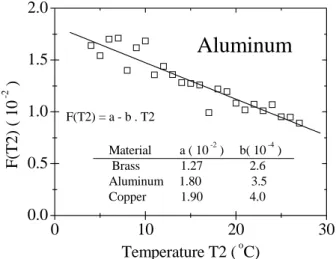
ob-tainedF(T2)isalinearlydereasingfuntionof T2in
theregion5T227Cforthethree ylinders,i.e.,
F(T2) = a - b.T2. Fig. 5 presents the experimental
data for the aseof the aluminum ylinder only. The
orrespondingoeÆientsofthelineartsforthease
of thethree metalli ylindersarepresentedin the
in-set of Fig. 5. Note that eah metalli ylinderhas its
ownsetofttedparameters,indiatingthatthe
orre-tionfuntionF(T2)isinfatafuntionoftheylinder
materialalso.
0
10
20
30
0.0
0.5
1.0
1.5
2.0
Aluminum
F(T2) = a - b . T2
Material a ( 10
-2
) b( 10
-4
)
Brass 1.27 2.6
Aluminum 1.80 3.5
Copper 1.90 4.0
F(T2) ( 10
-2
)
Temperature T2 (
o
C)
Figure 5. Empirial funtion F(T2) as a funtion of the
temperatureinsideCup 2 for the orretionof the seond
terminequation28(fortheanalysisofregionBinFigure
3) for thease of analuminumylinder. Notethat F(T2)
is alinearfuntion ofT2,thesamebeing truefor thease
of the othermetalliylinders. The orresponding tting
parametersaregivenattheinset.
The tted parameters a and b are plotted in Fig.
6 as a funtion of eah reported K value, where the
ylindermaterialisalsoidentied. Parameterais
plot-ted as solid squares at the left axis, while parameter
b is plotted as open triangles at the right axis. It is
bothparametersasafuntionofthereportedKvalue,
indiatingthat one again the ylinder material itself
plays averyimportant hole. Note that both aand b
parametersinreasewithK,andthatwhiletheratioof
thehighesttolowestreportedKvalueisabout3.5,the
ratioof highestand lowest a(or b) parametersis less
than2. The dashed line in Fig. 6 is only aguide for
theeyes,andnottingwastriedbeauseofthelimited
amount of experimental data. Finally, thenal
semi-empirialorretiontotheseondtermof equation28
woulddependontwovariables(K andT2)as:
F(T2;K)=a(K) b(K):T2 (32)
regardlessof other parameters intrinsially related to
thegeometry ofthesystem.
0.0
0.2
0.4
0.6
0.8
1.0
1.0
1.2
1.4
1.6
1.8
2.0
2.2
0.0
0.2
0.4
0.6
0.8
1.0
2.0
2.5
3.0
3.5
4.0
4.5
a
a ( 10
-2
)
Reported K value (cal /
o
C s cm )
b
F(T2) = a - b . T2
Copper
Aluminum
Brass
b ( 10
-4
)
Figure 6. Fitted parameters of F(T2) for the ase of the
three metalliylinders (as presented inthe inset of Fig.
5)plottedas afuntionof theorrespondingthermal
on-dutivityofeahmaterial,thelast onesobtainedfrom the
literature(seetext).
Note that although an experimental funtion is
found,thestudentsannottotallyunderstandits
phys-ialmeaning and origin, what an ontribute to their
own stimulation for the following ourses of physis,
mathematisandnumerialalulus.
Moving to the analysis of region C, the orreted
Z2 term should be used in plae of Z in equation 30
asdisussedabove. Nevertheless,evenin thisase,the
Kvaluealulatedaordingto equation 30 is
overes-timated. Therst three terms in equation 31 are
ba-sially thesameasin equation 27(the only dierene
beingthefatthattheseondtermisnowaddedrather
thansubtratedinthewholeexpression). Aordingto
thepreviousdisussionaboutregionB,thesetermsan
beonsideredmathematiallyorret,andinthisase,
theonlypossibilityofdisagreementmustomefromthe
fourthterminequation 31. Thatisindeed theaseas
anbenumeriallyonrmed: thefourthtermin
equa-tion31ismorethantwieasbigasthesumoftheother
one. Themain reasonforthat istheverysimple(and
inorret) distributionof temperatureinside thewalls
ofCup2itself.
Following thesame proedure as for region B,the
student an try to determine a funtion G(T2) that
would multiply the fourth term in equation 31, thus
leadingto aorretedY2valueinsubstitutionto Yin
equation31. Oneagain,asemi-empirialmodelwould
beobtained. Inpratie,oneagaintheobtained
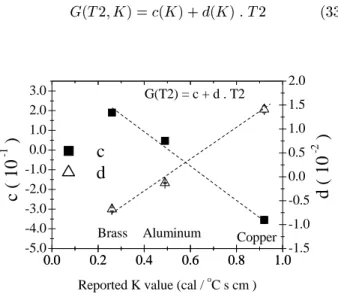
fun-tionislinearlydependentonT2,andanbewrittenas
G(T2) = +d . T2. The tted parameters and d
areplotted in Fig. 7fortheaseof thethree metalli
ylinders. As in theprevious ase, thetted
parame-ters depend onthe materialalso, and the nal G(T2)
ouldthenbewritten as:
G(T2;K)=(K)+d(K):T2 (33)
0.0
0.2
0.4
0.6
0.8
1.0
-5.0
-4.0
-3.0
-2.0
-1.0
0.0
1.0
2.0
3.0
0.0
0.2
0.4
0.6
0.8
1.0
-1.5
-1.0
-0.5
0.0
0.5
1.0
1.5
2.0
c
c ( 10
-1
)
Reported K value (cal /
o
C s cm )
d
G(T2) = c + d . T2
Copper
Aluminum
Brass
d ( 10
-2
)
Figure 7. Fitted parameters of G(T2) for the ase of the
three metalli ylinders plotted as a funtion of the
or-respondingthermalondutivity ofeahmaterial,the last
ones obtainedfrom theliterature (seetext). G(T2) is the
empirialfuntionthatorretsthefourthterminequation
31.
Fig. 8showsthenalresultsfortheaseofthethree
metalliylindersforalearomparisonofthemodels
disussed. The K1alulated aordingto equation 1
areshownasopensquares. Thenal Kfalulated
a-ordingtotheorretionsintroduedforregionsBand
Care shownas solid squares, andthe reported values
for K for eah material is shown as asolid line. The
improvementof thesemi-empirial model is
outstand-ing.
The main reason behind the need for funtions F
andGintheorretedmodelsisthefatthatthe
tem-peraturedistributioninsideeahsetionoftheylinder
and inside the walls of Cup 2were oversimplied. In
order to better presenta physial model the students
needmoremathematialandomputationaltools,not
availableforthemyetduringtheirrstyearofthe
un-0.0
0.2
0.4
0.6
0.0
0.5
1.0
0
10
20
30
40
0.0
0.1
0.2
0.3
Aluminum
K ( cal /
o
C s cm
)
Copper
K1
Kf
K
T
Brass
Temperature T2 (
o
C )
Figure8. Comparisonoftheresultsthatwouldbeobtained
with the simples model (K1, open squares) and with the
modelthattakesintoaountseveralorretions,inluding
the empirial funtions F and G (Kf, solidsquares). The
thermalondutivityvaluesobtainedfromtheliteratureare
shownashorizontalsolidlines(KT). Resultsareshownfor
thease of thethreemetalliylinders(opper, aluminum
andbrass).
IV Conlusion
In fat, the ndings of this experiment are important
not beause of the nal results, but beausethey an
showthe students howomplex a physis experiment
anbeeven thoughitmight look too simplefrom the
beginning, and how simplied the theoretial models
an be sometimes. This is an experiment that leaves
student thinking about it even after the end of the
lass,andsureontributestotheirselfmotivation
dur-ingotherlassesofphysis,mathandnumerial
alu-lus. Finally,morethanthesimpleveriationofertain
equations, the students are foredto think about the
nature of manyphysial mehanismsduring heat
on-dution.
Aknowledgements
This work wassupported by the Brazilian ageny
CNPq.
Referenes
[1℄ J. Carslaw, in Condution of heat in solids, Seond
Edition,OxfordUniversityPress,Oxford,p.2(1989).
[2℄ J. Phillips, inExamples in AppliedThermodinamis,
[3℄ see
http://www.dupont.om/teon/hemial/properties.html
#thermal
[4℄ seehttp://www.jenseninert.om/properties-teon.htm
[5℄ seehttp://boedeker.om/ptfe p.htm
[6℄ M.Plank,inTreatiseonThermodinamis,Dover
Pub-liationsIn.,NewYork,p.35(1945).
[7℄ E.Fermi,inThermodinamis,DoverPubliationsIn,
NewYork,p.21(1936).