Ricardo Machado(a)
Ulisses Xavier da Silva Neto(a) Sérgio Aparecido Ignácio(a) Rodrigo Sanches Cunha(b)
(a) Postgraduate Program, School of Dentistry, Pontifícia Univ Católica do Paraná - PUCPR, Curitiba, PR, Brazil.
(b) School of Dentistry, Univ of Manitoba, Winnipeg, MB, Canada.
Corresponding Author:
Ricardo Machado
E-mail: [email protected]
Lack of correlation between obturation
limits and apical leakage
Abstract: The aim of this paper was to evaluate a possible correlation between obturation limits and leakage. Thirty-six extracted human mandibular incisors were used, characterized by straight and single ca-nals, non-anatomical complexities, absence of previous endodontic treat-ment, complete root formation and patent foramen. For standardization of the specimens for the leakage analysis, foraminal instrumentation was performed up to a Flexoile #25 (Dentsply-Maillefer, Ballaigues, Swit-zerland). All specimens were instrumented and illed following the same protocol, and the obturation limits were measured using Axiovision 4.5 Software (Carl Zeiss Vision, Hallbergmoos, Germany). The specimens were then separated into three groups (n = 12) according to the following variables: Group I – obturation limits ranging from 0 mm to 0.76 mm of the main apical foramen. Group II – obturation limits ranging from 0.77 mm to 0.98 mm of the main apical foramen. Group III – obturation limits ranging from 0.99 mm to 1.68 mm of the main apical foramen. Apical leakage was quantiied by luid iltration. The analyses were con-fronted using Pearson’s test (p > 0.05). Groups I, II and III showed Pear-son correlation values (r2) of −0.152, −0.186 and 0.058, respectively. No
correlation was found between the obturation limits and apical leakage.
Descriptors: Endodontics; Root Canal Obturation; Dental Leakage.
Introduction
Over the years, several studies have shown the importance of correct illings for achieving higher success rates in endodontics. Most of these studies classify these illings as appropriate when considering obturation limits ranging from 0 to 3 mm, among other factors.1-4
Insofar as apical seals are the main barriers against tissue luid leak-age and bacterial recontamination, the long-term success of endodontic therapy is directly dependent on the effectiveness of these seals.3,4 Several
techniques have been developed over the years to improve their proper-ties, including improved sealing of the apical illing. Although thermo-plastic techniques show a certain superiority in achieving gutta-percha density, compared to cold techniques,5 neither technique can effectively
prevent the leakage, which has been analyzed by several different meth-ods.2-19 Considering that different illing techniques and sealers have
re-sulted in similar apical seals,20-22 it seems wise to investigate other
rea-sons associated with greater or lesser leakage rates.
To date, no research has evaluated the correlation between obturation
Declaration of Interests: The authors certify that they have no commercial or associative interest that represents a conflict of interest in connection with the manuscript.
Submitted: Dec 05, 2012
limits and apical leakage. Therefore, this was the ob-jective of this paper. The null hypothesis tested is that there is no correlation between these two variables.
Methodology
Sample size: statistical considerations
Based on a simple random sampling, consider-ing a pilot sample of 36 human mandibular incisors with similar anatomical characteristics, the average (0.95) and the standard deviation (0.29) were cal-culated for the three groups of variable apical lim-its. Next, the margin of error for a level of signii-cance = 0.05 was calculated, based on the formula for calculating the sample size when the standard deviation is unknown, using the Student’s t distri-bution, and obtaining an error of 10.4% for n = 36. The sample size was then divided into three groups of n = 12 to stratify the apical limits.
Specimen selection
After approval by the Research Ethics Commit-tee of the University (protocol #5314), 36 extracted human mandibular incisors were selected for this research. They were characterized by straight and single canals, non-anatomical complexities, com-plete root formation, absence of previous endodon-tic treatment and patent foramen provided by the tooth bank of the University. Crowns were removed with a diamond-cutting disc (∅ 127 mm × 0.4 mm × 12.7 mm; Buehler Ltd., Lake Bluff, USA) to obtain specimens with a standard length of 12 mm. The specimens were kept in distilled water until use.
Specimen preparation
Access to the canal was performed using a ta-pered-tip bur 3082 (KG Sorensen, Barueri, Brazil). Working length was established by subtracting 1 mm from the point where the ile was just visi-ble at the apical foramen. The coronal and middle thirds of each canal were prepared using Gates Glid-den drills (Dentsply-Maillefer, Ballaigues, Switzer-land), sizes 4, 3 and 2, by placing each instrument 2 mm deeper than the previous one. The apical fo-ramens were standardized using real length instru-mentation of the teeth up to instrument 25 K-Flexo-ile (Dentsply-Maillefer, Ballaigues, Switzerland)
and the apical thirds were prepared with the Proile 04 System (Dentsply-Maillefer, Ballaigues, Switzer-land) up to size 35 at the working length. The canals were irrigated between each instrument with 2 mL of freshly prepared 2.5% NaOCl (Fórmula & Ação, São Paulo, Brazil) plus a lush of 3 mL of 17% EDTA (pH 7.7) (Fórmula & Ação, São Paulo, Brazil) for 3 minutes. Five milliliters of sterile water were used as a inal rinse.
Canal filling
The prepared canals were illed using the lateral compaction technique to control the methodological variables associated with the illing technique. The root canals were dried with paper points. A pre-it-ted size 35, 0.04-taper gutta-percha cone (Dentsply-Maillefer, Ballaigues, Switzerland) was used as the master cone. A size 20 ile was used to place 20 µL of AH Plus sealer (Dentsply De Trey, Konstanz, Germany) into the canal, using a counter-clockwise rotation. The illed roots were stored at 37°C and 100% humidity for 7 days to allow the sealer to set.
Radiographic analysis of the obturation limits
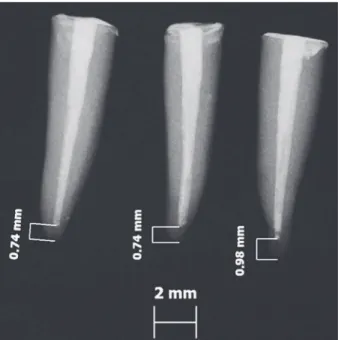
After obturation and storage, all specimens were radiographed in the buccolingual and mesiodistal views to analyze the quality of the treatments. The buccolingual views were digitized and the obtura-tion limits were analyzed using Axiovision 4.5 Soft-ware (Carl Zeiss Vision, Hallbergmoos, Germany), as can be seen in Figure 1.
The specimens were separated into three groups according to the obturation limits:
• Group I (n = 12) – obturation limits ranging from 0 mm to 0.76 mm of the main apical foramen.
• Group II (n = 12) – obturation limits ranging from 0.77 mm to 0.98 mm of the main apical foramen.
• Group III (n = 12) – obturation limits ranging from 0.99 mm to 1.68 mm of the main apical foramen.
Apical leakage analysis by fluid filtration method
deter-Discussion
In recent decades, different researchers have used several leakage models. These models have been criticized for many factors mainly related to preclu-sion of direct clinical applicability of results.23-25
Several authors also observed divergent results when comparing different types of leakage tests. Barthel et al.26 applied the dye leakage test after
mine leakage.9,17 The root apex was connected to a
Luer type metal needle by a plastic tube.4 The
leak-age allowed by the tested groups was quantiied ac-cording to the movement of a small air bubble inside a 25 µL micropipette (Fisher Scientiic, Philadelphia, USA). The inside of the pipette and the entire sys-tem was illed with distilled water and a pressure of 10 psi was applied. After ensuring that there was no leakage at the connections, the system was activated and balanced for 4 minutes. The volume of luid was calculated by observing the air bubble displace-ments, and was expressed in µL/min.10 psi. Mea-surements were made at 2-minute intervals over an 8-minute period.17
Results
Tables 1 through 3 show the relevant statistical data of the study.
Groups I, II and III showed Pearson correlation values (r2) of −0.152 (Table 1), −0.186 (Table 2) and
0.058 (Table 3), respectively. Furthermore, our re-sults showed that the leakage rates for a given obtu-ration limit, such as about 0.85, ranged from 0.10 to 0.89, indicating lack of correlation between obtura-tion limits and apical leakage.
Figure 1 - Obturation limits analysis by AxioVision 4.5 soft-ware (Carl Zeiss Vision, Hallbergmoos, Germany).
Table 3 - Correlation analysis of Group III. Group III
Obturation
limits leakageApical
Obturation limits
Pearson correlation 1 0.058
Sig. (2 - Tailed) 0.858
n 12 12
Apical leakage
Pearson correlation 0.058 1 Sig. (2 - Tailed) 0.858
n 12 12
Table 1 - Correlation analysis of Group I. Group I
Obturation
limits leakageApical
Obturation limits
Pearson correlation 1 −0.152
Sig. (2 - Tailed) 0.637
n 12 12
Apical leakage
Pearson correlation −0.152 1 Sig. (2 - Tailed) 0.637
n 12 12
Table 2 - Correlation analysis of Group II. Group II
Obturation
limits leakageApical
Obturation limits
Pearson correlation 1 −0.186
Sig. (2 - Tailed) 0.564
n 12 12
Apical leakage
Pearson correlation −0.186 1 Sig. (2 - Tailed) 0.564
the bacterial test on the same teeth and found no correlation between the tests. Pommel et al.27 also
compared luid iltration, electro-chemical and dye leakage tests in evaluating the sealing ability of sin-gle-cone and vertical condensation obturation tech-niques, using the same teeth, and found no correla-tion among the tests.
However, Wu et al.28 compared luid iltration
and dye penetration methods and found luid trans-port was a more sensitive method for detecting voids along the root canal illing than dye penetration.
Moreover, Wu et al.29 showed a signiicant
cor-relation between the quality of the illings and leak-age rates. Of a total of 80 mesial roots of mandibu-lar momandibu-lars observed in the buccolingual direction, 76% had well performed illings, but this igure fell to 36% when the specimens were also analyzed in the mesiodistal direction. Because these specimens iniltrated less, although effectively, according to the analytic methodology used, we believe it is relevant to investigate others factors associated with leakage rates not just associated with radiographically evi-dent illing voids.
According to Karagenç et al.,14 the difference in
results obtained when using various methods to as-sess leakage may be attributed to the differences in the working principles of various tests methods and the different nature of obturation materials.
A factor still not well studied in relation to apical leakage regards the obturation limits. Theoretically, when main cone obturation does not reach instru-mentation limits, it can predispose incorrect
adapta-tions in the apical, middle and cervical thirds, lead-ing to voids unilled by lateral condensation.
Therefore, the purpose of this study was to eval-uate this possible predisposition according to luid iltration tests. The results showed that there was no correlation between obturation limits and apical leakage. We believe these results are related to the effectiveness of the methodology. The luid iltration test shows leakage only when there is at least one void extending from the apical to the coronal thirds. A root canal illing which looks badly condensed on the radiograph may contain many “cul de sac” type voids and no leakage. On the other hand, very small “through and through” type voids are invisible on radiographs but may be detected by the luid iltra-tion test as having considerable leakage rates.16,28-30
Our results showed that there were no statisti-cal differences associated with apistatisti-cal leakage in the three groups analyzed. However, our obturation limits ranged from 0 to 1.68 mm of the main api-cal foramen, and these limits are in conformity with what are considered to be adequate limits in litera-ture.3 We believe that more research similar to that
conducted in this study, using different obturation limits, is important to compare our results.
Conclusions
According to the methodology of this in vitro
study, we conirmed the null hypothesis that there is no correlation between the obturation limits and the apical leakage in roots illed with gutta percha and AH Plus sealer, in the three groups analyzed.
References
1. Wu MK, Wesselink PR, Walton RE. Apical terminus location of root canal treatment procedures. Oral Surg Oral Med Oral Pathol Oral Radiol Endod. 2000 Jan;89(1):99-103.
2. Chueh LH, Chen SC, Lee CM, Hsu YY, Pai SF, Kuo ML, et al. Technical quality of root canal treatment inTaiwan. Int Endod J. 2003 Jun;36(6):416-22.
3. Schaeffer MA, White RR, Walton RE. Determining the op-timal obturation length: a meta-analysis of literature. J En-dod. 2005 Apr;31(4):271-4.
4. Moura MS, Guedes OA, Alencar AHG, Azevedo BC, Estrela C. Influence of length of root canal obturation on apical
peri-odontitis detected by periapical radiography and cone beam computed tomography. J Endod. 2009 Jun;35(6):805-9. 5. Collins J, Walker MP, Kulild J, Lee C. A comparison of three
gutta-percha obturation techniques to replicate canal irregu-larities. J Endod. 2006 Aug;32(8):762-5.
6. Shakespeare RC, Donnelly JC. An in vitro comparison of api-cal microleakage after obturation with JS Quick-fill or lateral condensation. J Endod. 1997 May;23(5):312-4.
8. Carratù P, Amato M, Riccitiello F, Rengo S. Evaluation of leak-age of bacteria and endotoxins in teeth treated endodontically by two different techniques. J Endod. 2002 Apr;28(4):272-5. 9. Çobankara FK, Adanir N, Belli S, Pashley DH. A quantitative
evaluation of apical leakage of four root-canal sealers. Int Endod J. 2002 Dec;35(12):979-84.
10. De Moor RJG, Hommez GMG. The long-term sealing ability of an epoxy resin root canal sealer used with five gutta percha obturation techniques. Int Endod J. 2002 Mar;35(3):275-82. 11. Robinson MJ, McDonald NJ, Mullally PJ. Apical extrusion of
thermoplasticized obturating material in canals instrumented with Profile 0.06 or Profile GT. J Endod. 2004 Jun;30(6):418-21.
12. Venturi M, Breschi L. Evaluation of apical filling after warm vertical gutta-percha compaction using different procedures. J Endod. 2004 Jun;30(6):436-40.
13. Diemer F, Sinan A, Calas P. Penetration depth of warm ver-tical gutta-percha pluggers: impact of apical preparation. J Endod. 2006 Feb;32(2):123-6.
14. Karagenç B, Gençoğlu N, Ersoy M, Cansever G, Külekçi G. A comparison of four different microleakage tests for assessment of leakage of root canal fillings. Oral Surg Oral Med Oral Pathol Oral Radiol Endod. 2006 Jul;102(1):110-3.
15. Shemesh H, Wu M-K, Wesselink PR. Leakage along apical root fillings with and without smear layer using two different leakage models: a two-month longitudinal ex-vivo study. Int Endod J. 2006 Dec;39(12):968-76.
16. Paqué F, Sirtes G. Apical sealing ability of Resilon/Epiphany versus gutta-percha/AH Plus: immediate and 16-months leak-age. Int Endod J. 2007 Sep;40(9):722-9.
17. Silva Neto UX, Moraes IG, Westphalen VPD, Menezes R, Carneiro E, Fariniuk LF. Leakage of 4 resin-based root canal sealers used with a single-cone technique. Oral Surg Oral Med Oral Pathol Oral Radiol Endod. 2007 Aug;104(2):e53-7. 18. Veríssimo DM, Vale MS, Monteiro AJ. Comparison of apical
leakage between canals filled with gutta-percha/AH Plus and the Resilon/Epiphany System, when submitted to two filling techniques. J Endod. 2007 Mar;33(3):291-4.
19. Wedding JR, Brown CE, Legan JJ, Moore BK, Vail MM. An in vitro comparison of microleakage between Resilon and
gutta-percha with a fluid filtration model. J Endod. 2007 Dec;33(12):1447-9.
20. Miletic I, Anic I, Pezelj-Ribaric S, Jukic S. Leakage of five root canal sealers. Int Endod J. 1999 Sep;32(5):415-8.
21. Depraet FJHW, De Bruyne MAA, De Moor RJG. The seal-ing ability of an epoxy resin root canal sealer after Nd:YAG laser irradiation of the root canal. Int Endod J. 2005 May;38(5):302-9.
22. Qiong X, Ling J, Cheung GSP, Hu Y. A quantitative evalua-tion of sealing ability of 4 obturaevalua-tion techniques by using a glucose leakage test. Oral Surg Oral Med Oral Pathol Oral Radiol Endod. 2007 Oct;104(4):e109-13.
23. Oliver CM, Abbott PV. Correlation between clinical success and apical dye penetration. Int Endod J. 2001 Dec;34(8):637-44.
24. Susini G, Pommel L, About I, Camps J. Lack of correlation between ex vivo apical dye penetration and presence of apical radiolucencies. Oral Surg Oral Med Oral Pathol Oral Radiol Endod. 2006 Sep;102(3):e19-23.
25. De Bruyne MAA, De Moor RJG. Inluence of cracks on leak-age and obturation eficiency of root-end illing materials after ultrasonic preparation: an in vitro evaluation. Quintessence Int. 2008 Sep;39(8):685-92.
26. Barthel CR, Moshonov J, Shuping G, Orstavik D. Bacterial leakage versus dye leakage in oburated root canals. Int Endod J. 1999 Sep;32(5):370-5.
27. Pommel L, Jacquot B, Camps J. Lack of correlation among three methods for evaluation of apical leakage. J Endod. 2001 May;27(5):347-50.
28. Wu MK, De Gee AJ, Wesselink PR. Fluid transport and dye penetration along root canal illing. Int Endod J. 1994 Sep;27(5):233-8.
29. Wu MK, Bud MG, Wesselink PR. The quality of single cone and laterally compacted gutta-percha fillings in small and curved root canals as evidenced by bidirectional radiographs and fluid transport measurements. Oral Surg Oral Med Oral Pathol Oral Radiol Endod. 2009 Dec;108(6):946-51. 30. Wu MK, De Gee AJ, Wesselink PR, Moorer WR. Fluid