ABSTRACT
Quality of cellular attachment to various root-end
1, Oula R. AL-SA’EED23
1- BDS, MScD, PhD, Department of Conservative Dentistry, Faculty of Dentistry, Jordan University of Science and Technology, Irbid, Jordan. 2- BDS, MSc, Department of Conservative Dentistry, Faculty of Dentistry, Jordan University of Science and Technology, Irbid, Jordan.
3- BSc, FIMLS, PhD, Department of Biotechnology and Genetic Engineering, Faculty of Science, Jordan University of Science and Technology, Irbid, Jordan.
Professor Ahmad S. Al-Hiyasat - Department of Conservative Dentistry - Faculty of Dentistry, Jordan University of Science & Technology - P.O. Box 3030 - Irbid 22110 - Jordan - Phone: +962-795-843677 - Fax: +962-2-7095115 - e-mail: [email protected]
!!"#$#%%&'(##$%$%()*%#%$%
O
as a measure of the biocompatibility of the materials. Material and Methods: Class I !"" #$%&' left empty served as the controls. The root slices were then processed for scanning electron microscopy, and were viewed to assess the quality of cellular attachment by observing the shape of cells, spread, and membrane outline. Results: The best cellular attachment was () *# + # # # / &0 surfaces of IRM, Super EBA, KetacFil and Retroplast. Furthermore, the cells did not attach well to the tooth structure next to IRM and Super EBA. Conclusions: The present study ## # #() *&1'( 23) Ketac Fil and Retroplast rendered poor attachment.
Key words: Biocompatibility testing. Cell adhesion. Electron microscopy. Endodontics.
Dental materials. Fibroblasts.
INTRODUCTION
The aim of endodontic surgery is to preserve the tooth and to remove the periradicular pathosis and to restore health and function of tooth periodontium11,14. This includes curettage of the
periapical pathosis, resection of the root end and # root-end cavity.
Many materials have been used for root-end 6+ eugenol cements (Intermediate Restorative Material - IRM®, Ethoxybenzoic acid cement Super EBATM),
glass ionomer cement, gold foil pellets, Cavit, composite resin, and mineral trioxide aggregate (MTA)10,17. Although MTA has been thoroughly
examined nowadays with promising results12,19,
# yet to be found.
' > with the periradicular tissues, thus requiring biocompatibility as the main property of such & should be biocompatible, adherent to tooth structure, dimensionally stable, resistant to dissolution, antibacterial, radiopaque, and easy to use10,17. Indeed, the biocompatibility of the root
of endodontic treatment. A toxic, tissue necrotizing sealer may impair tissue healing or create a favorable local environment for microbial invasion and long-term failure.
In-vitro +
evaluation criterion24.
1 orientation are necessary steps for attachment regeneration, which is a prerequisite of the healing process following endodontic surgery22. As cellular
attachment is the initial phase of cellular function, it has been considered a more sensitive indicator of cytotoxicity6,9. Thus, the aim of this study was
# # assessment of these materials.
MATERIAL AND METHODS
5RRWHQG¿OOLQJPDWHULDOV
Figure 1 shows details of the composition of the + present study, namely: RetroplastTM (Retroplast
GH G >JL * N Endo kit (DEN-MAT Corporation, Santa Maria, CA, USA) shade A3.5; Ketac FilTM Plus (3M ESPE,
2#* J )"L1'(® (Caulk-Dentsply,
Milford, DE, USA); Super EBA (Bosworth Company, Skokie, IL, USA); PROROOT® MTA (Dentsply-Tulsa
Dental, Johnson City, TN, USA) tooth-colored.
Cell culture
Fibroblasts derived from Balb/C mouse ]^ ! "" ! A31 (European Collection of Cell Culture, Salisburg, Wilts, UK)] were routinely maintained in DMEM supplemented with 5% fetal bovine serum, 5% new born calf serum, 100 unit/mL penicillin, 100 { |&$}~# ^N)){ *{6) J "! in an atmosphere of 5% CO2. They were routinely passaged by trypsinization.
Preparation of root slices for Scanning Electron Microscopy (SEM)
Extracted human teeth were collected and stored in 0.12% thymol. Roots selected were either from single-rooted teeth, distal roots of lower molars, or palatal roots of upper molars. Upon examination, roots with apical resorption or severe dilacerations, as well as roots that contained more than one canal foramen were all excluded. Prior to use, teeth were washed with tap water and tissue tags removed.
In order to be able to hold the teeth in the milling machine, each tooth was then mounted with its apex up, inside a plastic ring using self cure acrylic ^( 6*! 2 * J& to the tripod attachment of the milling machine ^N >(3** J& " mm of the root tips were cut using a 0.2-mm-thick ^ *3' ')223{3' * !{* J }|||&) was then prepared using the milling machine to a depth of 2 mm using a low-speed tungsten carbide ^&$""J^(3G1&((!6 Republic). All cavities had a diameter of 1 mm. Burs and discs used to prepare root slices were discarded after each group in order to ensure similar surface characteristics and standardization of all specimens. The root was then cut 4 mm coronal to the apical prepared surface using the diamond disc. Water cooling was used during root slice preparation and a total of 20 root slices were prepared, as described. Root slices were then sterilized by placing them in glass vials containing distilled water and autoclaved &! & The surface of the material was smoothed using plastic instruments and carvers. For each material, three specimens were prepared. Two root slices with the cavities described above were left empty and served as the controls.
3
+0( ) +(( Lot no. Notes
RetroplastTM Resin composite Two pastes in syringes 12 ________
Geristore Two pastes in jars G327010038 Perio-Endo kit, shade A3.5
Ketac FilTM Plus Glass ionomer cement Powder and liquid Powder: 215153 Liquid: 185972
Shade A3
IRM® Reinforced zinc oxide-eugenol cement
Powder and liquid 60215 _________
Super EBA Reinforced zinc oxide-eugenol cement
Powder and liquid 0602-055-X Fast set
PROROOT® MTA Portland cement derivative Powder and sterile water ampoules
5002015 Tooth colored
placed in a well of a 24-well tissue culture plate and 1 mL of cell suspension (5x10⁵ cells/mL) was added
over the specimen. Cells were incubated for 24 h at 37°C and 5% CO2. At the end of the incubation period, the culture medium was aspirated, and the + {#$&} |& M Sorensen’s sodium phosphate buffer (pH 7.2) for 30 min, followed by a brief wash with phosphate buffered saline. Specimens were dehydrated in a series of 30, 50, 70, 90 and 95% ethyl alcohol and twice in absolute ethyl alcohol for 30 min before they were critical point dried with CO2 (CPD 030, 6 * J&
mounted on aluminum stubs and coated with gold in a vacuum coater (Polaron Division E6100, Bio-Rad, Birmingham, UK) at 1200 volts and 20 mA. They were viewed carefully under a scanning electron microscope (Quanta 2000-FEI, Eindhoven, Netherlands) at an accelerating voltage of 30 kV. Several photomicrographs were taken to ensure that representative data were collected.
Criteria for image analysis
The image analysis was performed by one operator who was not blind to the study. Cell attachment was assessed by the presence of filopodia (cylindrical/conical processes, often |$| ~ JL ^# |& |&$~JL ^/ +> |& |&} ~JL ^ + $~J&
RESULTS
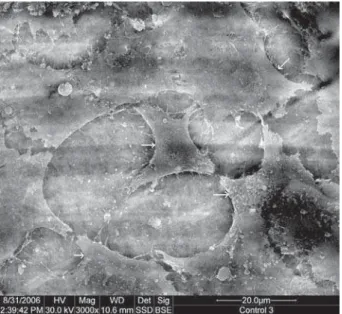
Control
Cells attached well to root slices, observed in / > (Figure 2). All 4 types of cellular projections could be seen, as described previously.
MTA
# # () / &! blebs, and microvilli from their surfaces. The root surfaces demonstrated a similar view, with more cellular process, and a higher cellular density (Figure 3).
Figure 2- Scanning electron microscope (SEM) Arrows indicate cells
Figure 3 !" "#$% '*/
$ ;
Geristore
# # * were spindle shaped and well attached, with / attachment to the material. Root surfaces did not show differences from the material surfaces, same cellular density, when viewed at the same ^0%J&
IRM
The IRM material surface showed round cells with rough surfaces and numerous vacuoles and surface depressions. The root surfaces
demonstrated a similar view to that of the material surface, however, with more irregularity of the cell & ( seen on root surfaces (Figure 5).
Super EBA
A similar view to that of IRM was seen on the Super EBA material. Root surfaces also showed round cells with vacuoles, however, with less cellular processes compared to IRM root surfaces (Figure 6).
Ketac Fil
The surface of Ketac Fil showed very sparse cellular growth, with cells of round shape, and a
Figure 4 !" < %
*/ =$ ;
a
b
a
b
Figure 5 !" >"% '*/
rough surface due to the extending processes, namely microvilli. While on the root surface, cells demonstrated excellent attachment features and microvilli (Figure 7).
Retroplast
SEM micrographs of Retroplast specimens the material. They had a round structure with vacuoles and depression on their surfaces (Figure 8). However, the root surface of the Retroplast specimens showed that cells had attached well. Cells were spindle shaped, with blebs and lamellipodia
extending from them (Figure 8).
DISCUSSION
Fibroblast attachment is an essential requirement for the formation of a new attachment apparatus to root surfaces following endodontic surgery22 and
thus may be an important predictor of the success of surgical endodontic treatment. In the present study, attachment of cells was assessed qualitatively by SEM, which allows a close observation of cellular and this method has been used by several investigators2,4,5,15,16,24.
a
b
Figure 6 !" !?$%
'*/ '$ ;
a
b
Figure 7 !" NQ% '*
Root slice specimens were used with the materials embedded within them to compare the cellular attachment to the materials as well as to the tooth structure itself. Cavity preparations were # $ & ' condensed into these cavities. This specimen design was adopted from a previous study5. It is easy to
handle without disturbing the cell layer and allows a comparison between the cellular attachment to the material surface and to the root surface.
In the present study, root slices were autoclaved prior to incubation with cells. This is mandatory because the concentration of antibiotics present # contamination when human tooth root slices are used1.
We found that the best cellular attachment # #() * on these materials were spindle shaped and well # ## / good attachment to the materials.
() study of Balto4 (2004) who reported good spread
and a high density of attached human periodontal # # of MTA. Furthermore, Pérez, et al.16 (2003) also
reported that osteoblasts and osteosarcoma cells attached well to both white and gray MTA in the short-term part of their study, although osteoblasts could not sustain their attachment to white MTA in the long-term part of their study (after 13 days). Raldi, et al.18 (2010) also found
() # its surface. We have recently reported that one of
the leached components of MTA was calcium3, and
since calcium plays a major role in the process of 6, the effect of calcium is obvious
regarding the attachment of cells to the surface of this material. The formation of hydroxyapatite when MTA is exposed to physiologic solutions has been strongly suggested to enhance its biological performance13.
1 # study, Al-Sabek, et al.2 (2005) reported that
# * # the controls, in comparison to the other & 0 ! &7
(2003) evaluated the quantitative attachment of ## * than MTA, with an increase in cell count probably # ###* cells2,3.
attach very well to the surface of the zinc oxide-eugenol cements (IRM and Super EBA). These #)2 > et al.2 (2005), who found that human gingival
1'( # &24 (2000), who reported a similar
outcome with osteoblasts, with cells having round structures with little or no processes extending from their surfaces. However, other studies found moderately well attached cells to Super EBA5,7.
Furthermore, the results of the present study also showed poor attachment of the cells to the root surface of specimens of IRM and Super EBA. This could be linked to the presence of some component
Figure 8 !" %
'*/ $ ;
like eugenol that leached from the materials into the dentinal tubules of the root structure.
The surfaces of KetacFil and Retroplast showed the least cellular attachment. In agreement with our results, human gingival fibroblasts have been reported to show poor attachment to Ketac Fil2. On the other hand, Sasanaluckit, et al.20
^ "J morphology of cells in contact with Ketac Fil, when compared to the control. It has been reported that washing glass ionomer cements with distilled water and tissue culture media is a prerequisite to cellular attachment; without it cells do not attach23. In our
experiment, cells were directly seeded over the material specimens without washing. Our results are also supported by those of Al-Sabek, et al.2
^$||}J# poorly to Ketac Fil.
In the current study, Retroplast displayed poor attachment characteristics, with cells exhibiting features of toxicity. It is possible that the higher concentrations of monomers leached to the immediate surroundings of the material were # +##20,21.
Noting that cells on the root surface exhibited features of good attachment further validates this conclusion. Currently, and to the best of our knowledge, there are no other reports on the use of Retroplast for in vitro attachment assays.
CONCLUSION
Overall, under the conditions of the current () * cellular attachment to their surfaces among the materials investigated. IRM, Super EBA, Ketac Fil and Retroplast showed poor cellular attachment to their surfaces. IRM and Super EBA affected negatively the attachment of the cells to the root structure close to them.
REFERENCES
1- Al-Nazhan S. SEM observations of the attachment of human 6 surface in vitro. Oral Surg Oral Med Oral Pathol Oral Radiol Endod. 2004;97:393-7.
2- Al-Sabek F, Shostad S, Kirkwood KL. Preferential attachment # *& Endod. 2005;31:205-8.
3- Al-Sa’eed OR, Al-Hiyasat AS, Darmani H. The effects of six viability. J Endod. 2008;34:1410-4.
4- Balto HA. Attachment and morphological behavior of human + a scanning electron microscope study. J Endod. 2004;30:25-9.
5- Balto HA, Al-Nazhan S. Attachment of human periodontal " ## scanning electron microscope observation. Oral Surg Oral Med Oral Pathol Oral Radiol Endod. 2003;95:222-7.
+ {! 0 + ( * 1 ' '*& Fibroblast and osteoblast adhesion and morphology on calcium. Eur Cell Mater. 2002;4:1-17.
! () * { & ) # &3&$||"L$|$& 8- Craig R, Hanks C. Restorative dental materials. St. Louis: Mosby-Year Book; 1997.
9- Hensten-Pettersen A. Comparison of methods available for assessing cytotoxicity. Int Endod J. 1988;21:89-99.
10- Kim S. Endodontic microsurgery. In: Cohen S, Burns R, editors. Pathways of the pulp. St. Louis: Mosby; 2002.
11- Lin CP, Chen YJ, Lee YL, Wang JS, Chang MC, Lan WH, et al. 3### dehydrogenase activity and cytotoxicity of human periodontal ligament fibroblasts. J Biomed Mater Res B Appl Biomater. 2004;71:429-40.
12- Miranda RB, Fidel SR, Boller MA. L929 cell response to root perforation repair cements: an in vitro cytotoxicity assay. Braz Dent J. 2009;20:22-6.
13- Modena KC, Casas-Apayco LC, Atta MT, Costa CA, Hebling J, Sipert CR, et al. Cytotoxicity and biocompatibility of direct and indirect pulp capping materials. J Appl Oral Sci. 2009;17:544-54. %(2*'')&3&111 Bakland LK, editors. Endodontics. London: BC Decker Inc; 2002. } ) G ' 0 2 ) ' * Cozzolino A, et al. Biocompatibility studies on glass ionomer cements by primary cultures of human osteoblasts. Biomaterials. 1996;17:1351-6.
N6){2 '* { {)& (*" ## with ProRootTM MTA and White MTA. Int Endod J. 2003;36:564-70.
17- Pitt Ford TR. Surgical treatment of apical periodontitis. In: Ørstavik D, Pitt Ford T, editors. Essential endodontology. Oxford: Blackwell Science; 2004. p. 288-90.
18- Raldi DP, Mello I, Neves AC, Habitante SM, Miyagi SS, Lage-( {&) # analysis of simulated cervical resorptions treated with high-power lasers and MTA. Oral Surg Oral Med Oral Pathol Oral Radiol Endod. 2010;109:154-61.
19- Ribeiro DA, Matsumoto MA, Duarte MA, Marques ME, Salvadori DM. In vitro biocompatibility tests of two commercial types of mineral trioxide aggregate. Braz Oral Res. 2005;19:183-7. 20- Sasanaluckit P, Albustany KR, Doherty PJ, Williams DF. Biocompatibility of glass ionomer cements. Biomaterials. 1993;14:906-16.
$ 2( )&*() are they safe? J Am Dent Assoc. 1999;130:201-9.
$$ *G ( ) N(& ) in vitro
# & 1 3 & 1999;32:444-9.
23- Yan F, Xiao Y, Li H, Haase H, Bartold PM. A comparison of the effects of two kinds of glass-ionomer cement on human gingival
# in vitro. J Int
Acad Periodontol. 2000;2:14-8.