496
IMAGES IN NEUROLOGY
DOI:
10.1590/0004-282X20130071
Unilateral abdominal bulging
caused by L1-L2 herniation
Abaulamento abdominal unilateral causado por hérnia L1-L2
Marco A. Lima
1,2, Pericles Maranhão-Filho
11MD PhD; Department of Neurosurgery, Instituto Nacional do Câncer (INCA), Rio de Janeiro RJ, Brazil;
2MD PhD; Instituto de Pesquisa Clínica Evandro Chagas - Fundação Oswaldo Cruz (Ipec/FIOCRUZ), Rio de Janeiro RJ, Brazil.
Correspondence: Marco A. Lima; Avenida Alexandre Ferreira 420 / apto. 403; 22470-220 Rio de Janeiro RJ - Brasil; E-mail: [email protected] Conflict of interest: There is no conlict of interest to declare.
Received 02 April 2012; Received in inal form 22 February 2013; Accepted 01 March 2013.
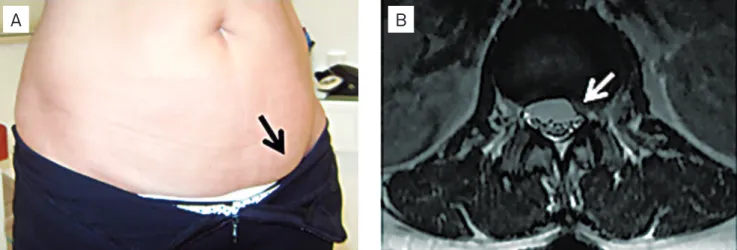
A 62-year-old woman noticed, after a sharp lumbar pain,
a non-painful bulging mass in the left inguinal fossa upon
standing upright, which disappeared in the supine position
(Fig 1A). Neurological examination revealed hypoesthesia
above the left inguinal ligament. Abdominal computerized
tomography (CT) scan showed no evidence of tumor or
in-guinal hernia. Lumbar spine magnetic resonance imaging
(MRI) indicated L1-2 disk herniation compressing the left L1
nerve root (Fig 1B).
A cutaneous sensory recurrent branch from the anterior
branches of L1 of the iliohypogastric and ilioinguinal nerves
innervates a small narrow band-shaped area on the
abdomi-nal wall above the pubis. he clinical picture and the imaging
results were indicative of a lesion at L1 root
1,2.
1. Billet FP, Ponssen H, Veenhuizen D. Unilateral paresis of the abdominal wall: a radicular syndrome caused by herniation of the Ll-2 disc? J Neurol Neurosurg Psychiatry 1989;52:678-692.
References
2. Mumenthaler M, Schliack H. Patologia de los nervios periféricos. Diagnóstico y tratamiento. Barcelona: Ediciones Toray; 1976.