Arq Neuropsiquiatr 2004;62(3-B):895-898
Unit of Graphic Registers, Area of Clinical Neurophysiology, Márcio Cunha Hospital, Ipatinga MG, Brazil: 1MD, Márcio Cunha Hos-pital, 2MD Arapiara Hospital.
Received 29 September 2003, received in final form 1 April 2004. Accepted 25 May 2004.
Dr. Rafael José Soares Dias - Rua Francisco Sales 96 - 35010-110 Governador Valadares MG - Brasil. E-mail: [email protected]
SEP DIAGNOSING NEUROPATHY OF THE
LATERAL CUTANEOUS BRANCH OF THE
ILIOHYPOGASTRIC NERVE
Case report
Rafael José Soares Dias
1, Lancaster de Souza
1,
Wanderley Freitas de Morais
1, Armando Pereira Carneiro
2ABSTRACT - The article pertains to the uncommon clinical case of a patient with a proximal neuropathy of the lower extremity. It outlines the electrophysiological evaluation and reviews the medical literature. The electrophysiologic test that most accurately revealed the neuropathy was the segmental somatosenso-ry evoked potential (SEP) of the lateral cutaneous branch of the iliohypogastric nerve. It showed well-defined and replicable cortical waveforms following the excitation of the lateral cutaneous branch of the iliohypogas-tric nerve in the asymptomatic lower extremity, but failed to present somatosensory evoked potentials aris-ing from the excitation of the contralateral nerve in the symptomatic lower extremity. We did not find any previous reports diagnosing that particular pathology by the use of segmental SEP. In conclusion, it is impor-tant to remember that the accurate diagnosis of patients complaining of pain and dysesthesia in the prox-imal part of the lower extremities can possibly be achieved through the use of electrophysiologic tests such as the segmental SEP.
KEY WORDS: neuropathy, nerve injury, nerve entrapment, iliohypogastric nerve, somatosensory evoked potential.
Neuropatia do ramo cutâneo lateral do nervo ílio-hipogástrico diagnosticada por PES: relato de caso
RESUMO - O presente artigo relata caso clínico incomum de neuropatia proximal de membro inferior, demons-tra eletrofisiologicamente o comprometimento neural e revisa a literatura médica sobre o assunto. O teste neurofisiológico que demonstrou a patologia foi o potencial evocado somato-sensitivo (PES) segmentar do ramo cutâneo lateral do nervo ílio-hipogástrico. Ele revelou potenciais corticais bem definidos e repli-cáveis à estimulação do membro inferior assintomático, mas falhou em produzir respostas corticais do mem-bro inferior sintomático. Na revisão da literatura não foi encontrado nenhum relato anterior de diagnós-tico dessa patologia por PES segmentar. Conclui-se que é importante ter em mente ao avaliar pacientes com queixas de dor e disestesia na base dos membros inferiores que o acometimento de pequenos ramos cutâneos, como o cutâneo lateral do ílio-hipogástrico, pode ter confirmação eletrofisiológica da patolo-gia por testes neurofisiológicos como o potencial evocado somato-sensitivo segmentar.
PALAVRAS-CHAVE: neuropatia, nervo ílio-hipogástrico, potencial evocado somato-sensitivo.
Proximal neuropathies of the lower extremities, with the exception of the lateral femoral cutane-ous neuropathy, are uncommon causes of pain and paresthesia1. As such, these pathologies can often
present a diagnostic challenge for the physician. There are several proximal neural branches of the lower extremities that can suffer nerve entrap-ment: the cluneal, the lateral cutaneous branch of the iliohypogastric and the subcostal2,3.
This paper references one specific neuropathy that affects the lateral cutaneous branch of the ilio-hypogastric nerve, as revealed by the segmental somatosensory evoked potential (SEP).
quadra-tus lumborum. From there, it continues through the transverses abdominis, extending between the transverses and the internal oblique and continu-ing medially deep into the aponeurosis of the in-ternal oblique at the level of the anterosuperior iliac crest. Then the nerve divides into its anterior and lateral cutaneous branches. The anterior branch extends horizontally below the aponeurosis of the external oblique and becomes cutaneous in the anterior abdominal wall. The lateral cutaneous branch becomes superficial close to the iliac crest, where it creates a bony groove located 7 to 11 cm from the anterosuperior iliac spine. This groove is transformed into an osseo-membranous tunnel by the aponeurosis of the oblique muscle4-9.
CASE
A 20-year-old woman was examined in the Unit of Graphic Registers (area of clinical neurophysiology) of Márcio Cunha Hospital. She has described pain and hy-poesthesia in the proximal lateral face of the right thigh for 4 years, but the symptoms have increased as of late.
896 Arq Neuropsiquiatr 2004;62(3-B)
The patient’s past medical history did not reveal any trau-ma, sickness, and use of drugs or contact with toxic sub-stances that could have cause neuropathies. Hansen’s dis-ease, a common illness in this country, was investigat-ed by physical examination and skin biopsy at the pub-lic department of infect-contagious diseases, and the out-come was negative. Physical examination - Weight: 47 kg, Height: 156 cm. Positive findings: hypoesthesia (de-creased sensation to light touch and pinprick) in the lat-eral aspect of the proximal segment of the right thigh, and a painful point over the iliac crest approximately 8 cm off the anterior-superior iliac spine. Negative find-ings: absence of local alterations on the skin, normal sen-sitivity in the groin, normal muscle stretch reflex and nor-mal muscle strength.
Many test were performed, including: thigh, abdo-men and wall abdominal ultrasound; plain X-ray of the right hip and lumbosacral spine, and computed tomog-raphy of the lower thoracic and upper lumbar spine. The-se exams did not show any abnormality.
An orthopedist and a pain-clinic specialist evaluat-ed the case and were left to decide the best treatment for the patient. They chose 6 neural blockades with a
local anaesthetic (lidocaine 2%) in addition to the remo-val of physical pressure on the iliac crest (via underclo-thes) as a treatment. After 45 days, the patient was reli-eved of symptoms and the hypoesthesia area was de-creased.
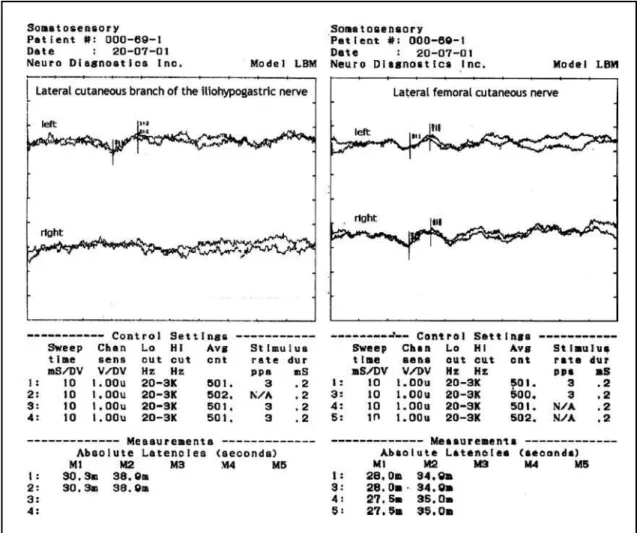
Neurophysiological evaluation- The neurophysiolog-ical assessment of this case included nerve conduction studies, needle electromyography and segmental SEP. An LBM electromyography machine (Neurodiagnostics Inc., USA) was used for all tests. The instrument parameters of the segmental SEP are in Figure 1.
These neural conduction studies analyzed sensory ner-ves (right sural and both superficial peroneal) as well as motor nerves (tibial and peroneal). Needle electromyo-graphy was performed in the proximal muscles of the lower extremity (iliopsoas, vastus medialis, gluteus me-dius), the paraspinal muscles (T12/L1), and the abdomi-nal wall muscles (obliquus int abdominis) using a dispos-able monopolar needle. These tests resulted in no defined diagnosis.
Segmental SEP was then performed by electrical stimulation via bar electrode of the skin regions associ-ated with the lateral cutaneous branch of the iliohypo-gastric nerve. It was positioned 8.5 cm distal to the ili-ac crest, at a distance of 9.5 cm from the superior-ante-rior iliac spine (Fig 2). The stimulus intensity used was 3.5 times the sensory threshold of the asymptomatic side. Segmental SEP of the lateral femoral cutaneous was performed too. The recording scalp needle electrodes were placed 2 cm posterior to the International 10-20 Cz and Fpz electrode locations. The exam revealed well-defined cortical waveforms following excitation of all sensory nerves, except the one arising from the lateral cutaneous branch of the right iliohypogastric nerve (symptomatic side). It did not show any cortical response (Fig 1).
Arq Neuropsiquiatr 2004;62(3-B) 897
The corresponding neurophysiologic evaluation revealed an injury to the iliohypogastric nerve, located distally to the motor branches of the abdominal wall mus-cles. The possibility of central sensory conduction disor-der was ruled out because the segmental SEP of the lat-eral femoral cutaneous nerve showed normal wave-forms at the same side of the affected nerve.
DISCUSSION
In modern medical literature, it is common to ex-perience cases of iliohypogastric neuropathy (IHN) after performing specific surgical procedures like abdominoplasty, and herniorraphy10-12. These
diag-noses were commonly found by the use of neuro-chemical blocks or by performing surgery to relieve the symptoms13, 14. In one report, however, IHN was
diagnosed using neurophysiologic assessment15. It
employed needle electromyography of the abdom-inal muscles to identify the injured nerves. This me-thod, however, revealed an important limitation of such testing, since only motor fibers were ana-lyzed, thereby reducing the test’s sensitivity. As a result, a complete neurophysiological evaluation wi-th conduction tests (specifically segmental SEP) and needle electromyography has been determined to provide a much better chance of diagnosing IHN. In fact, in the aforementioned case, segmental SEP was utilized to analyze the iliohypogastric senso-ry nerve fibers and it provided the crucial monitor-ing needed to accurately diagnose the neuropathy. Segmental SEP testing was able to evaluate senso-ry nerve fibers as opposed to electromyography, which could only analyze motor nerve fibers.
Results of anatomic dissection show morpholo-gical changes of the lateral cutaneous branch of the iliohypogastric nerve at the point where it crosses the iliac crest inside the osseo-membra-nous tunnel7. This neuropathy was labeled in
oth-ers articles as “perforates syndrome”3and
“pseu-dotrochanteric bursitis”16. This neuropathy was
apparently caused by the wearing of tight underclo-thes that compressed the osseomembranous tun-nel over the iliac crest, thereby damaging the lat-eral cutaneous branch of the iliohypogastric nerve.
Proximal neuropathies are difficult to assess through the use of electroneurological tests due to the inherent difficulty of the electroneurogra-phy to study proximal nerves. This is due primari-ly to the anatomy of the nerve becoming superfi-cial at its very thin-ending neural branches and con-sequent inability of most electroneurological tests to accurately analyze them.
In conclusion, it is important to consider using alternative electrophysiological testing for patients with pain and dysesthesia in the proximal region of the lower extremities. As showed-in this study, the segmental SEP test, in addition to a conventio-nal electrophysiological assessment, may be espe-cially helpful in the neurological assessment of the small sensory cutaneous branches like the ilio-hypogastric nerve, as many other electophysiolo-gical tests have proven inadequate in such cases.
Acknowledgement - The authors wish to thank Mr. Charles W. Smith III for the manuscript revision.
REFERENCES
1. Reid V, Cros D. Proximal sensory neuropathies of the leg. Neurol Clin1999;17:655-667.
2. Maigne JY, Doursounian L. Entrapment neuropathy of the medial supe-rior cluneal nerve. Spine 1997;22:1156-1159.
3. Touzard RC, Maigne JY, Maigne R, Doursounian L. Douleur de la région trochanterienne par striction canalaire de la brenche perforante latérale cutaneé du nerf iliohypogastrique. Chirurgie 1989;115:287-291. 4. Papadopoulos NJ, Katritsis ED. Some observations on the course and
898 Arq Neuropsiquiatr 2004;62(3-B)
relations of the iliohypogastric and ilioinguinal nerves (based on 348 specimens). Anat Anz 1981;149:357-364.
5. Mandelkow H, Loeweneck H. The iliohypogastric and ilioinguinal nerves: distribution in the abdominal wall, danger areas in surgical inci-sions in the inguinal and pubic regions and reflected visceral pain in their dermatomes. Surg Radiol Anat 1988;10:145-149.
6. Maigne JY, Lazareth JP, Maigne R. Étude anatomique de l’innervation cutaneé lombo-sacrée. Rev Rhumat 1988;55:107-111.
7. Maigne JY, Maigne R, Guérin-Surville H. Anatomic study of the later-al cutaneous rami of the subcostlater-al and iliohypogastric nerves. Surg Radiol Anat 1986;8:251-256.
8. Maigne JY, Lazareth JP, Maigne R, Guérin-Surville H. The lateral cuta-neous branches of the dorsal rami of the thoraco-lumbar junction. Surg Radiol Anat 1989;11:289-293.
9. Netter FH. Atlas de anatomia humana. Trad. Jaques Vissoky. Porto Alegre:Artes Médicas,1996.
10. Melville K, Schultz EA, Dougherty JM. Ilioinguinal-iliohypogastric nerve entrapment. Ann Emerg Med 1990;19:925-929.
11. Liszka TG, Dellon AL, Manson PN. Iliohypogastric nerve entrapment following abdominoplasty. Plast Reconstr Surg 1994;93:181-184. 12. Cunningham J, Temple WJ, Mitchell P, et al. Cooperative hernia study:
pain in the postrepair patient. An Surg 1996;224:598-602.
13. Carter BL, Racz GB. Iliohypogastric nerve entrapment in pregnancy: diagnosis and treatment. Anesth Analg 1994;79:1193-1194.
14. Ziprin P, Williams P, Foster ME. External oblique aponeurosis nerve en-trapment as a cause of groin pain in the athlete. Br J Surg 1999;86:566-568. 15. Knockaert DC, Boonen AL, Bruyninckx FL, Bobbaers HJ. Electromyo-graphic findings in ilioinguinal-ilohypogastric nerve entrapment syn-drome. Acta Cl Bel 1996;51:156-160.