Brazilian Journal of Physics, vol. 38, no. 3B, September, 2008 515
First Atempt to Apply Techniques from
LEP Experiments to Help Selecting Diffractive Events
M. Begalli and R. A. B. Oneto Universidade do Estado do Rio de Janeiro
Rua S˜ao Francisco Xavier, 524 20550-013 Rio de Janeiro - RJ
Brazil
(Received on 12 May, 2008)
Hard Diffraction has been subject of studies for more than 10 years and its event selection has been heavyly based on rapidity gaps because of the colorless nature of the pomeron but soft gluon emission tends to destroy the gaps lowering the efficiency to identify those events. We present here a first attempt to use techniques developed at DELPHI, one of the 4 experiments at LEP, to select diffractive events in Dzero experiment, at Tevatron. All results presented here are very preliminary.
Keywords: Hard diffraction; Dzero experiment; Fit techniques
I. INTRODUCTION
Diffraction in high energy hadron physics encompasses those phenomena in which no quantum numbers are ex-changed between interacting particles, i.e. surviving particles have same quantum numbers as incident particles. Diffractive events can occur in hadron-hadron and lepton-hadron colli-sions. Together with the elastic events they account for≈40% [1] of the total cross section at 2 TeV. Signatures of diffraction include rapidity gaps (regions of the detector with no particles above threshold) and tagging the intact final particle(s) with a forward detector close to the beam (normally roman pots).
In a proton-antiproton (pp¯) collision, a quark or gluon(s) can be exchanged giving rise to a typical QCD event where, due to the color flow in the event, particles are produced throughout phase space and concentrated in regions around the struck partons, which further hadronise into jets, as shown schematically in figure 1. There can also be a virtual photon orZ0exchange resulting in elastic events (pp¯→pp¯).
FIG. 1: schematic view of a typical QCD event.
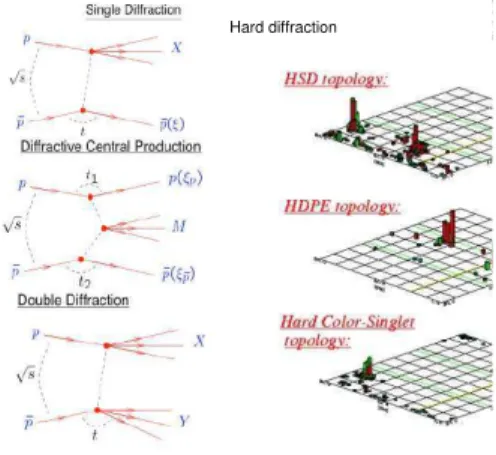
Diffractivepp¯collisions will increase the ammount of pro-duced elastic events because there can be also a pomeron exchange between the proton and the antiproton. Hadronic diffractive events with hard scattering (”hard diffraction”) oc-cur in three possible event topologies, as shown in figure 2: single diffraction, where one of the incident particles remains intact and the other diffracts producing jets giving a rapidity gap between the scattered proton (antiproton) and the nearest jet; double diffraction, where both incident particles diffract and the jets are produced more forward resulting in a gap in the central region of the detector; and the double pomeron ex-change or diffractive central production, where both proton
and antiproton remain intact producing two rapidity gaps in the event, around the outgoing proton and antiproton.
FIG. 2: Diffractive Topologies: hard diffraction
Pseudorapidity is defined asη=−ln¡ tan(1
2θ
¢
and rapidity is defined asy= 1
2ln
³E+p
L
E−pL
´
, whereθis the polar angle of the particle,Eis its energy andpLits longitudinal momentum. At a√s=2TeV, the center of mass energy in Dzero, rapidity and pseudorapidity are commonly exchanged, since they are numerically equivalent.
If the scattered (anti)proton is detected, its four-momentum pµf can be measured and two other important variables can be obtained: xp=pf/pbeam, the fractional longitudinal mo-mentum of the scattered proton, and|t|= (pµ
f−pµbeam)2, the four-momentum transfer to the (anti)proton. The momentum fraction (ξ) taken by the pomeron is related to the momentum fraction of the proton byξ=1−xp=1−(pf/pbeam). The diffractive mass is given byMx=
p
516 M. Begalli and R. A. B. Oneto
II. THE DZERO EXPERIMENT
Dzero is a multi-purpouse experiment because it give us the possibility to study many different topics in particle physics. The detector consists of 3 main components.
The Tracking System, composed by the Silicon Microstrip Tracker (SMT), used to precisely determine the location of the interaction point (or event vertex), the Central Fiber Tracker (CFT), used to track particles to the interaction point. They are inside a magnetic field of 2 Tesla generated by a Solenoid, providing magnetic field to bend particle tracks in order to allow the momentum measurement of charged particles. After the solenoid a Central and a Forward Preshower are used to detect electrons and photons.
The Calorimeter System measures the energy of electrons, photons and hadronic jets with high precision. It is divided in 3 regions, 1 central and 2 forward, with fine segmentation in theηregions. Combined with the tracking system, it allows electron-photon separation and to calculate the missing energy due to neutrinos, which hardly interact with matter. The fine segmentation allows to determine the location of particles in an event, even inside jets, as well as the position of the center of the shower(s) of hadronic or electromagnetic nature.
The Muon System surrounds all the detector, giving a high efficiency to detect the muons that escape the calorimeter.
In the forward region there is also a Luminosity Monitor, used to measure the delivered luminosity, and the Forward Proton Detector, a series of momentum spectrometers to mea-sure protons that escape down beampipe[1].
A detailed description of Dzero detector can be found in [2].
III. EVENT SELECTION
At Dzero, the standard criteria to select diffractive events is to demand jets plus a rapidity gap in the event. Rapidity gap technique is suitable to the Dzero detector, given its good cov-erage and good calorimetry, combined with the informations from other detector components, as discussed in the previous section. However, the rapidity gap method does not give ac-cess to the scattered proton momentum, losing important in-formation about the diffractive process.
Moreover, factorization breaking due to additional soft in-teractions between protons (antiprotons) might destroy the ra-pidity gap. Eikonal model predicts gap survival probability ≈0.3 for Tevatron energies and≈0.1 for LHC ones, some models predicts 0.1 for both of them [3]. This drops down the selection efficiency for diffractive event using rapidity gaps≈ 25% or less, depending on the topology analyzed.
Therefore we propose a new selection criteria for tive events, starting by the simplest topology, single diffrac-tion. At least two jets are required to be well reconstructed in the event,|η|<4 for all particles. The event is then divided in two hemispheres: η>0 andη<0. All visible energy is added in the hemisphere definingE+andE−, where the sig-nal + (-) stands for the biggest (smallest) sum of both hemi-spheres. We requireE−/E+<0.1. We assume there is a
pro-ton(antiproton) near the beam withp≈900 GeV/c at the same hemisphere where we defineE−. The event is forced to have two or three jets (both possibilities are tried separately). The energy and momemtum of the jets and of the proton (antipro-ton) as well as the detector resolution are used in PUCFIT, a program writen by Niels Kjer and widely used by the DEL-PHI Collaboration[4]. This program takes into account the center of mass energy of the experiment (2 TeV) and uses the given detector resolution to vary the three components of the momentum of the jets. The momentum of the proton near the beam is allowed to vary as much as needed. A photon in the direction of the beam pipe can be added to the event if it helps to achieve the energy-momentum conservation. Electrons and muons have a proper treatment in the program, unless they were considered to be part of a jet. The same happens to tau leptons if they were previously identified as such in order to take care of the missing neutrino in the tau decay. All possible results are listed and compared, one by one, to the real event using theχ2method. This procedure is called the fit of the event.
Once the event is fitted, the energy and momentum for all the jets, the proton and the photon are given by the program as well as the rapidity for all of them. A fit result is discarded if: the proton has p>pbeam or p<800 GeV/c, the proton has|η|<4 or the photon has |η|<4 because, in this case, they should have been measured by the calorimeter. If there is still more than one fit result for the same event, the best fit result can be chosen based on theχ2/NDF of the fit. Normally, when it happens, there is a result without the photon and one with the photon with similarχ2/NDF values. In this case, the solution without the photon is chosen.
Single diffractive events are selected asking for pproton> 800 GeV/c. The method was tested on Monte Carlo gen-erated events. PHOJET was used for single diffraction and non-diffractive events and PYTHIA for QCD (pp¯→qq¯) ones. Samples of 10000 events were done for each channel. The cri-teria selects 60% of the single diffractive events and 3.5% of the non-diffractive plus 13% of the QCD ones which repre-sent the background for this method. In 2% of the QCD and non-diffractive events the program gave no fit result, probably due to the existence of energetic neutrinos. It is possible to try special fits for those events, considering neutrinos or any other missing particle but this is not our scope in this analysis. Those events were discarded. define the cut on the quality of the order to work with the real events collected by Dzero.
This work is the first attempt to show that the PUCFIT pro-gram, developed for the DELPHI Collaboration, can be used as an auxiliary tool in selecting diffractive events at Dzero. The method can be used as a complement to the Forward Pro-ton Detector (FPD) information, and can be of special value in runs where the FPD information is not available. Since this fit procedure gives the energy and momentum of all jets and particles in the event, important informations for diffractive events, such as the diffractive mass and other variables, can be obtained.
Brazilian Journal of Physics, vol. 38, no. 3B, September, 2008 517
[1] G. Alves et al., A Forward Proton Detector at D0, http://www.cbpf.br/ gilvan/Proposal/fpd pub.html
[2] V. M. Abazov et al.,The Upgraded D0 Detector, NIM A565, 463 (2006).
[3] see for example, Khoze et al., EPJ C21, 521 (2001).
[4] see for example: J. Abdallah et al. (DELPHI Collaboration),Zγ∗
production in e+e− interactions at√s = 183 - 209 GeV, EPJ C51, 503 (2007); J. Abdallah et al. (DELPHI Collaboration),