*e-mail: [email protected] Recebido: 14/05/2012 / Aceito: 23/07/2012
Quasi-static and cyclic compressive loading studies of the intervertebral
disc with combined lexion and torsion
Helio Schechtman*, Peter Alexander Robertson, Neil David Broom
Abstract Bovine caudal motion segments were used to investigate the loss of load-bearing ability of the intervertebral disc (IVD) under both quasi-static and cyclic compressive loading combined with torsion and lexion. While the response of the disc to both compressive hyper-lexion and hyper-torsion has been previously investigated much less is known about their individual and combined inluence on compressive failure. Eighty motion segments dissected from 41 bovine tails were subjected to quasi-static and cyclic compression with added components of lexion and torsion. The four different combinations of lexion and torsion were 0º torsion/0º lexion, 10º torsion/15º lexion, 10º torsion/0º lexion and 0º torsion/15º lexion. Quasi-static compression failed to show any signiicant difference among the different combinations of torsion and lexion for failure stress, failure strain and compressive tangent modulus. Cyclic compression indicated a signiicant inluence of torsion in reducing the disc’s load-bearing ability. Cyclic loading provides a more sensitive tool for the assessment of potentially damaging mechanical parameters for the IVD.
Keywords Intervertebral disc, Quasi-static compression, Cyclic compression, Torsion, Flexion.
Estudo da compressão monotônica e cíclica associada à lexão e torção do
disco intervertebral
Resumo Segmentos de cauda bovina foram utilizados para investigar a perda de capacidade de suporte de carga do
disco intervertebral (IVD) sob compressão monotônica e cíclica combinada com torção e lexão. Embora a resposta do disco a hiper-lexão e hiper-torção compressiva já fora previamente investigada, pouco se conhece sobre suas inluências individuais e combinada para a falha compressiva. Oitenta segmentos dissecados
a partir de 41 caudas bovina foram submetidos a compressão monotônica e cíclica com componentes
adicionais de lexão e de torção. As quatro combinações diferentes de lexão e torção foram 0º torção/0º lexão, 10º torção/15º lexão, 10º torção/0º lexão e 0º torção/15º lexão. A compressão monotônica não evidenciou qualquer diferença signiicativa entre as diferentes combinações de torção e lexão para tensão de ruptura, deformação em ruptura e módulo tangente. A compressão cíclica indicou inluência signiicativa da torção na redução da capacidade de carga do disco intervertebral. A carga cíclica proporciona uma ferramenta sensível para a avaliação de parâmetros mecânicos potencialmente deletérios ao IVD.
Introduction
The intervertebral disc (IVD) is a complex structure that allows load bearing, limits intervertebral motion, and maintains anatomic relationships of surrounding bony vertebral bodies and ligamentous structure (Skaggs et al., 1994). Mechanical failure of the
disc might be the result of traumatic overloading. Alternatively, it could be the result of a slow degenerative process that alters the mechanical properties of the disc, increasing its vulnerability to disruption when subjected to loads substantially lower than that required to induce a traumatic injury.
Adams and Hutton (1982) have shown that hyper-lexion combined with axial compressive loads could produce prolapse of the disc in vitro. Farfan et al. (1970) damaged the disc annulus by
applying axial hyper-rotation. Gordon et al. (1991)
investigated cyclic loading and rotation of fully lexed lumbar motion segments. These investigators were able to induce annular protusions and nuclear extrusion through annular tears.
Failure of motion segments in cyclic loading has been achieved by a combination of cyclic loading and lexion (Adams and Hutton, 1983, 1985; Callaghan and McGill, 2001; Hansson et al., 1987). Others have
investigated the inluence of torsion (Gordon et al.,
1991; Liu et al., 1985).
However, the individual influence of hyper-lexion, i.e. lexion beyond the physiological range (Gordon et al., 1991) of 9º, or hyper-rotation,
i.e. rotation beyond 3º, either in single or cyclic compressive loads, was not properly assessed in any of the above mentioned studies.
Loss of a disc’s load-bearing ability can be assessed in a variety of ways. Complete closure of the endplate separation could be used for such a purpose under quasi-static compression. Under cyclic loading involving displacements less than the endplate separation an appropriate failure parameter is considerably more dificult to deine.
One possible approach is to use the internal pressure generated in the disc by the subject as a fundamental reference value against which cyclically generated stresses can be compared. In the human lumbar disc 2 MPa is an average value of the internal pressure generated by the subject’s normal in vivo
activities (Nachemson and Elfström, 1970). Under displacement-controlled cyclic loading, if the externally imposed stress drops below this 2 MPa value, then endplate closure in vivo would be deemed to occur as a result of this physiological loading. Under displacement-controlled loading the number of cycles required to reduce the initial level of externally induced
stress to this 2 MPa value can be conveniently deined as the threshold value for the loss of load-bearing ability of the IVD.
The present paper reports on an investigation into the effects of hyper-lexion and hyper-rotation on the load-bearing ability of the IVD when it is subjected to single or cyclic axial compressive loading. We have used the endplate closure criterion as a means of deining the point of ultimate compressive stress above which quasi-static failure would have occurred. Secondly, we have employed the criterion of stress decay to the value of 2 MPa to deine the threshold life (in number of cycles) of the disc under displacement controlled cyclic loading.
Materials and Methods
Prime ox tails were obtained at the local abattoir. The tails were immediately wrapped in plastic ilm and kept at –20 °C until the day prior to mechanical testing. The tail was then removed from the freezer into a refrigerator and stored overnight at a temperature of +4 °C for slow thawing. Motion segments comprising an intervertebral disc and its adjoining two vertebrae were obtained from the tails and cleaned of all subjacent tissue. The bone processes of both vertebrae were then trimmed off. Each vertebral body was set in cylindrical stainless steel pots (Ø50 × 50 mm) using dental plaster, with the disc and pot axes coaxial. Prior to any mechanical testing the potted motion segment was hydrated in physiological saline for 12 hours at +4 °C. The endplate gap separation was measured radiographically. The external diameter of the IVD was measured with a vernier caliper and its value employed in the calculation of its cross-sectional area.
Quasi-static tests: The testing machine was
operated in displacement control with the actuator moving at a rate of 0.5 mm/s. The specimens were mounted in the rig and compressed well beyond the point of endplate gap closure to ensure complete failure of the motion segment. It was assumed that all the compressive strain up to endplate gap closure occurred only in the IVD. Beyond endplate gap closure the compressive strain was assumed to be derived from the bony structures of the vertebrae.
These quasi-static compressive tests were conducted in combination with each of the following loading regimes: 0º lexion, 0º torsion (F0T0); 15º lexion, 0º torsion (F15T0); 0º lexion, 10º torsion (F0T10); and 15º lexion, 10º torsion (F15T10). Test specimens were randomly allocated into each one of these four loading regimes.
Load and displacement were continuously recorded. The maximum compressive stress was calculated as the load at failure divided by the cross-sectional area of the IVD. Strain at failure was based on the initial endplate gap distance. The compressive modulus was calculated as the tangent to the linear portion of the stress-strain curve relating to the displacement achieved prior to end-plate closure. A total of 40 motion segments obtained from 21 tails were employed in these quasi-static compressive tests.
Cyclic loading: For these tests the specimens were kept moist throughout the experiment by wrapping them in paper towel soaked with 0.15 M saline solution. The testing machine imposed a compression-compression displacement sinus at 2 Hz. The minimum displacement was 0.5 mm and the maximum value was set at 2/3 of the endplate gap separation. The cyclic tests were carried out using each one of the four loading regimes as described above for the quasi-static tests. Specimens were randomly allocated to each one of the four loading regimes.
However, in order to allow a paired t-test statistical analysis, each one of the two specimens from a given tail was allocated to one of the loading regimes of the pair F0T0/F15T10 or F15T0/F0T10. The cyclic load was recorded continuously. The test was terminated when the recorded maximum load imposed on the specimen decayed to a value equivalent to a stress of 2 MPa based on the measured external diameter of the disc. A total of 40 motion segments from 20 tails were tested cyclically.
Results
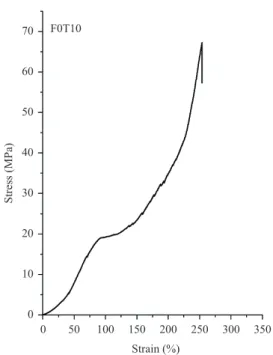
Quasi-static tests: Figure 2 shows a typical stress
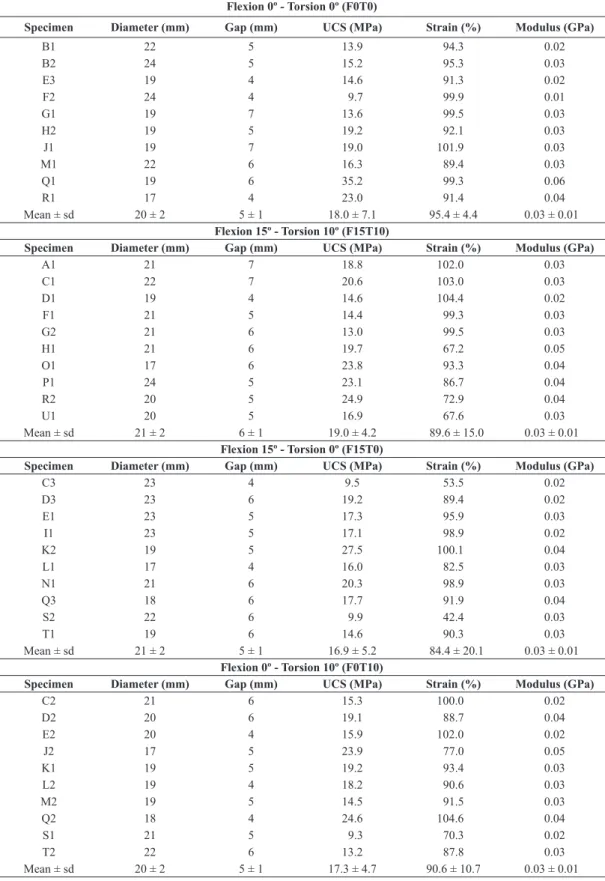
versus strain response for quasi-static compression of a motion segment. The curve has an initial non-linear region of low modulus leading into a relatively linear, stiffer region. The inlexion point following this linear region corresponds with the closure of the endplate gap. These irst three regions therefore deine the compressive response of the IVD itself. Further compressive displacement beyond endplate closure, i.e. beyond the inlexion point, would require compression of the vertebrae. The relatively lat region beyond the inlexion point would represent compaction through crushing of the trabecular architecture, and the steep region following would correspond to the increased stiffness arising from this increasingly compacted bone structure. Table 1 shows for each disc the diameter, endplate gap, ultimate compressive stress, strain at failure and compressive modulus for the four different loading regimes employed.
Figure 1. Detail of the compression loading rig designed to incorporate added components of lexion and/or torsion, with motion segment
Table 1. Quasi-static compression data showing disc diameter, endplate gap, ultimate compressive stress (UCS), strain at compressive failure and compressive tangent modulus for the 40 IVD specimens tested in the four loading regimes involving lexion and torsion. In the specimen column the letter identiies the tail and the numeral deines the individual motion segment in that tail.
Flexion 0º - Torsion 0º (F0T0)
Specimen Diameter (mm) Gap (mm) UCS (MPa) Strain (%) Modulus (GPa)
B1 22 5 13.9 94.3 0.02
B2 24 5 15.2 95.3 0.03
E3 19 4 14.6 91.3 0.02
F2 24 4 9.7 99.9 0.01
G1 19 7 13.6 99.5 0.03
H2 19 5 19.2 92.1 0.03
J1 19 7 19.0 101.9 0.03
M1 22 6 16.3 89.4 0.03
Q1 19 6 35.2 99.3 0.06
R1 17 4 23.0 91.4 0.04
Mean ± sd 20 ± 2 5 ± 1 18.0 ± 7.1 95.4 ± 4.4 0.03 ± 0.01
Flexion 15º - Torsion 10º (F15T10)
Specimen Diameter (mm) Gap (mm) UCS (MPa) Strain (%) Modulus (GPa)
A1 21 7 18.8 102.0 0.03
C1 22 7 20.6 103.0 0.03
D1 19 4 14.6 104.4 0.02
F1 21 5 14.4 99.3 0.03
G2 21 6 13.0 99.5 0.03
H1 21 6 19.7 67.2 0.05
O1 17 6 23.8 93.3 0.04
P1 24 5 23.1 86.7 0.04
R2 20 5 24.9 72.9 0.04
U1 20 5 16.9 67.6 0.03
Mean ± sd 21 ± 2 6 ± 1 19.0 ± 4.2 89.6 ± 15.0 0.03 ± 0.01
Flexion 15º - Torsion 0º (F15T0)
Specimen Diameter (mm) Gap (mm) UCS (MPa) Strain (%) Modulus (GPa)
C3 23 4 9.5 53.5 0.02
D3 23 6 19.2 89.4 0.02
E1 23 5 17.3 95.9 0.03
I1 23 5 17.1 98.9 0.02
K2 19 5 27.5 100.1 0.04
L1 17 4 16.0 82.5 0.03
N1 21 6 20.3 98.9 0.03
Q3 18 6 17.7 91.9 0.04
S2 22 6 9.9 42.4 0.03
T1 19 6 14.6 90.3 0.03
Mean ± sd 21 ± 2 5 ± 1 16.9 ± 5.2 84.4 ± 20.1 0.03 ± 0.01
Flexion 0º - Torsion 10º (F0T10)
Specimen Diameter (mm) Gap (mm) UCS (MPa) Strain (%) Modulus (GPa)
C2 21 6 15.3 100.0 0.02
D2 20 6 19.1 88.7 0.04
E2 20 4 15.9 102.0 0.02
J2 17 5 23.9 77.0 0.05
K1 19 5 19.2 93.4 0.03
L2 19 4 18.2 90.6 0.03
M2 19 5 14.5 91.5 0.03
Q2 18 4 24.6 104.6 0.04
S1 21 5 9.3 70.3 0.02
T2 22 6 13.2 87.8 0.03
For 0º lexion and torsion (F0T0) the ultimate compressive stress ranged from 9.7 to 35.2 MPa with a mean value of 18.0 ± 7.1 MPa (mean ± sd; n = 10). The strain at failure ranged from 89.4 to 101.9% with a mean value of 95.4 ± 4.4% (mean ± sd; n = 10). The tangent modulus ranged from 0.01 to 0.06 GPa with a mean value of 0.03 ± 0.01 GPa (mean ± sd; n = 10).
For the regime of 15º lexion and 10º torsion (F15T10) the ultimate compressive stress ranged from 13.0 to 24.9 MPa with a mean value of 19.0 ± 4.2 MPa (mean ± sd; n = 10). The strain at failure ranged from 67.2 to 104.4% with a mean value of 89.6 ± 15.0% (mean ± sd; n = 10). The tangent modulus ranged from 0.02 to 0.05 GPa with a mean value of 0.03 ± 0.01 GPa (mean ± sd; n = 10).
A similar pattern was found for the loading regime of 15º lexion and 0º torsion (F15T0) the ultimate compressive stress ranged from 9.5 to 27.5 MPa with a mean value of 16.9 ± 5.2 MPa (mean ± sd; n = 10). The strain at failure ranged from 42.4 to 100.1% with a mean value of 84.4 ± 20.1% (mean ± sd; n = 10). The tangent modulus ranged from 0.02 to 0.04 GPa with a mean value of 0.03 ± 0.01 GPa (mean ± sd; n = 10).
For the regime of 0º lexion and 10º torsion (F0T10) the ultimate compressive stress ranged from 9.3 to 24.6 MPa with a mean value of 17.3 ± 4.7 MPa (mean ± sd; n = 10). The strain at failure ranged from 70.3 to 104.6% with a mean value of 90.6 ± 10.7% (mean ± sd; n = 10). The tangent modulus ranged from 0.02 to 0.05 GPa with a mean value of 0.03 ± 0.01 GPa (mean ± sd; n = 10).
Statistical analysis by means of ANOVA among all the loading regimes and t-tests between the 6 possible combinations of loading regimes failed to indicate any signiicant difference for all three parameters, i.e. ultimate compressive stress, strain at failure and compressive tangent modulus.
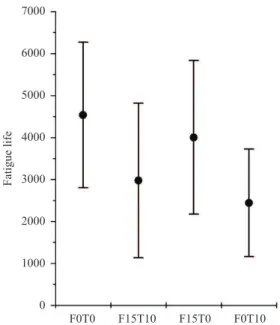
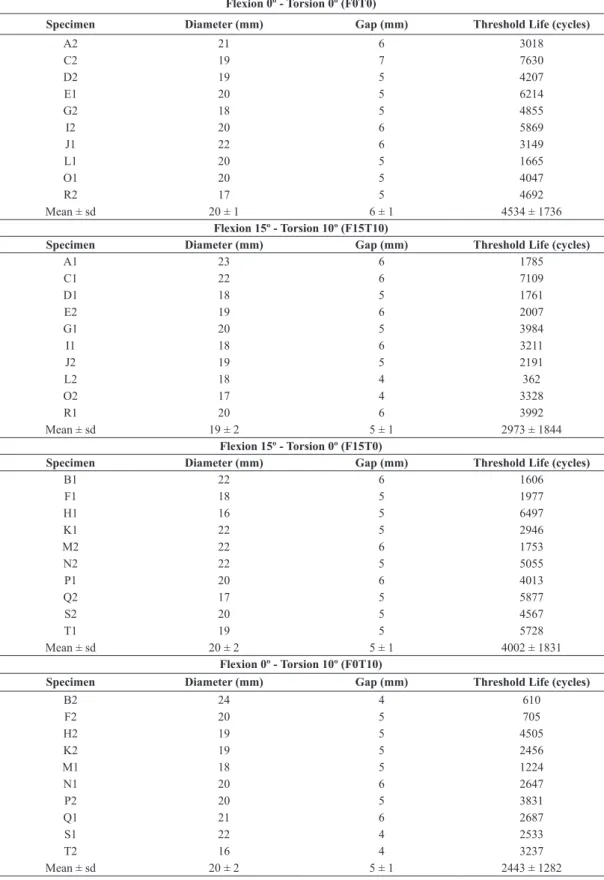
Cyclic tests: The values for the threshold life (in number of cycles) for each of the 40 motion segments in the four loading regimes of lexion and torsion are presented in Table 2. For the regime of 0º lexion and 0º torsion (F0T0) the threshold life ranged from 1665 to 7630 with a mean value of 4534 ± 1736 (mean ± sd, n = 10). For the loading regime of 15º lexion and 10º torsion (F15T10), the threshold life ranged from 362 to 7109, with a mean value of 2973 ± 1844 (mean ± sd, n = 10). The third regime, 15º lexion and 0º torsion (F15T0), produced a threshold life in the range of 1606 to 6497, with a mean value of 4002 ± 1831 (mean ± sd, n = 10). The loading regime of 0º lexion and 10º torsion (F0T10), produced a threshold life in the range of 610 to 4505, with a mean value of 2443 ± 1282 (mean ± sd, n = 10). The mean values are also presented in graphical form in Figure 3.
The ANOVA analysis for the four different loading regimes indicated signiicant differences (p = 3.6%) at the level of 5%. Furthermore, the t-test analysis indicated that the paired regimes F0T0/F15T10 and F15T0/F0T10 were signiicantly different at the 1% level, with p values of 0.2% and 0.1% respectively. Also, the t-test analysis indicated a signiicant difference between the F0T0 and the F0T10 regimes at a level of 1% with a p value of 0.1%. However, the t-test analysis failed to indicate any signiicant difference between the F0T0 and F15T0 regimes at a level of 5%, p = 51%. The t-test analysis also failed to indicate any signiicant difference at the level of 5% for comparison between the pairs of loading regimes F15T10/F15T0 and F15T10/F0T10, with p values of 23% and 47%, respectively.
Discussion
The methodology developed in this study has provided a means of assessing the relative inluence of different mechanical constraints in reducing the load-bearing ability of the disc under both quasi-static and cyclic displacement.
An experimental dificulty experienced with the present methodology was the accurate positioning of the specimen in the testing machine while avoiding the introduction of any pre-test compression or tension. In the quasi-static tests the wide range of strain values obtained at failure can be explained by the very small loads generated in the low modulus ‘toe-in’ region combined with the use of a load cell of suficient
Table 2. Cyclic compression data showing disc diameter, endplate gap and threshold life for the 40 IVD specimens tested in the four loading regimes involving lexion and torsion. In the specimen column, the letter identiies the tail and the numeral deines the individual motion segment in that tail.
Flexion 0º - Torsion 0º (F0T0)
Specimen Diameter (mm) Gap (mm) Threshold Life (cycles)
A2 21 6 3018
C2 19 7 7630
D2 19 5 4207
E1 20 5 6214
G2 18 5 4855
I2 20 6 5869
J1 22 6 3149
L1 20 5 1665
O1 20 5 4047
R2 17 5 4692
Mean ± sd 20 ± 1 6 ± 1 4534 ± 1736
Flexion 15º - Torsion 10º (F15T10)
Specimen Diameter (mm) Gap (mm) Threshold Life (cycles)
A1 23 6 1785
C1 22 6 7109
D1 18 5 1761
E2 19 6 2007
G1 20 5 3984
I1 18 6 3211
J2 19 5 2191
L2 18 4 362
O2 17 4 3328
R1 20 6 3992
Mean ± sd 19 ± 2 5 ± 1 2973 ± 1844
Flexion 15º - Torsion 0º (F15T0)
Specimen Diameter (mm) Gap (mm) Threshold Life (cycles)
B1 22 6 1606
F1 18 5 1977
H1 16 5 6497
K1 22 5 2946
M2 22 6 1753
N2 22 5 5055
P1 20 6 4013
Q2 17 5 5877
S2 20 5 4567
T1 19 5 5728
Mean ± sd 20 ± 2 5 ± 1 4002 ± 1831
Flexion 0º - Torsion 10º (F0T10)
Specimen Diameter (mm) Gap (mm) Threshold Life (cycles)
B2 24 4 610
F2 20 5 705
H2 19 5 4505
K2 19 5 2456
M1 18 5 1224
N1 20 6 2647
P2 20 5 3831
Q1 21 6 2687
S1 22 4 2533
T2 16 4 3237
capacity to operate in the high load range. In this ‘toe-in’ region the actuator could be moved distances of the order of a millimetre with only minor changes in the measured load. This uncertainty in displacement measurement clearly limits the accuracy of the strain values derived from the endplate separation.
For satisfactory biomechanical function the disc must maintain a minimum level of hydration. Cyclic compression, without the opportunity for luid resorption to take place, will result in progressive dehydration. Keeping the disc moist (as was done in the present study) will help reduce the rate of dehydration. However, ultimately the mechanical forces producing outlow will overcome the physicochemical forces driving the rehydration process, at least until an equilibrium is reached between the externally applied load and the internal swelling pressure corresponding to the state of consolidation reached under that particular mechanical history. Any further decay in stress could then be attributed to some form of structure damage which has reduced the intrinsic load-bearing ability of the disc. This interpretation is further supported by the observation that prior to cyclic loading only a limited degree of easy lexion of the IVD was possible. However, following cyclic testing and rehydration for a period of 12 hours the disc retained a high degree of laxity which could not be accounted for solely by luid exudation.
Although we have employed a regime of cyclic loading, this was not aimed at establishing a fatigue life in the strict sense of the word. Rather, the objective of the present study was to assess the inluence of different combinations of mechanical constraint upon the cyclic load-bearing ability of the disc. Any direct comparison of the cyclic threshold values presented in the present work with ‘fatigue’ data published in the literature (Gordon et al., 1991; Green et al., 1993;
Hansson et al., 1987) would not be possible as the
limiting criteria employed were signiicantly different. Direct comparison with other studies is also hindered by differences in the in vitro setup employed
to conduct the cyclic loading experiments. For example, Callaghan and McGill (2001) used load control whilst the present experiments were conducted under displacement control. Load control experiments are better viewed as cyclic creep procedures whereas displacement control would be equivalent to cyclic stress relaxation. Both experiments yield viscoelastic responses which are transposable. Both load control and displacement control will have relevance to the disc’s mechanical environment in vivo since periods of sustained, constant and variable loading will be mixed with movements involving displacements between ixed limits. For the purpose of comparing the
relative inluence of lexion and torsion under cyclic compression the choice of load or displacement control is probably less important than having a consistently reproducible testing procedure. We accordingly chose the easier displacement controlled experiment.
The present methodology of imposing pure compression in combination with anterior hyper-lexion and hyper-torsion, whilst obviously non physiological, was expected to induce readily observed changes in the functional properties of the disc as quantiied in single quasi-static or cyclic compressive loading. Pure compression of the disc is translated into tensile loading of the collagenous ibres in the annulus. Torsion will impose additional tensile loading on half of the obliquely arranged ibres in the lamellar structure of the annulus. Anterior lexion would impose additional tensile loading on the posterior ibres of the annulus whilst the anterior ibres would undergo increased compression and outwards bulging.
Statistical analysis failed to indicate any difference between the four loading regimes in single monotonic quasi-static compression. This inding could imply that the extra tensile loading on the collagenous ibres of the annular wall resulting from the added effects of torsion and lexion was still relatively small compared to the tensile forces arising from radial bulging in the single quasi-static compression test. An alternative explanation could be that loading half of the ibres in the whole of the IVD wall as occurs in torsion is similar to loading the posterior half of the annular wall as in anterior lexion, and this would be relected in the quantiied mechanical parameters. However, the fact that the quasi-static loading regimes F0T0 and F15T10 showed similar results indicate that the irst explanation is more reasonable.
By contrast, cyclic compressive loading resulted in signiicant differences among the four loading regimes. Our analysis (Figure 3) indicates that the loading regime of cyclic compression plus torsion only (F0T10) is more severe in reducing the load-bearing ability of the disc than the regime of cyclic compression plus lexion only (F15T0). The fact that the statistical analysis failed to indicate any signiicant difference between the pairs of loading regimes F15T10/F15T0 and F15T10/F0T10, is probably explained by normal biological variations. Indeed the paired t-test analysis, which eliminated interspecimen variability, i.e. in the paired regimes F0T0/F15T10 and F15T0/F0T10, were signiicantly different (see Figure 3). In summary, the cyclic data indicates that torsion has potential to inlict greater damage than lexion, a fact that is consistent with the relatively larger in vivo anatomical limitations
on this speciic type of movement.
either quasi-static or cyclic compression will not allow us to predict the behaviour of the human lumbar disc in vivo. Whereas the lumbar disc is
highly asymmetrical the bovine caudal disc is almost circular in cross-section. There is a difference too in the collagen angle in the alternating lamellae. In the human lumbar disc it is about 65º to the sagittal plane whereas in the caudal disc we found it to be around 52º. The loading conditions in the caudal disc will also differ substantially from those in the lumbar disc. However the overall similarity of structural plan of the bovine and human discs, their cell phenotype, their composition, aspect ratio and loaded pressure proiles (Yu et al., 2003) all clearly imply a reliance
on common biomechanical mechanisms for function, namely the coninement of a pressurized nucleus by the surrounding annular wall. Thus, insights gained from testing caudal units should at the very least have some principled application to the behaviour of human discs.
Conclusions
We have shown that cyclic loading provides a more sensitive measure of the inluence of potentially damaging mechanical parameters for the IVD than is provided by a single quasi-static test. We offer an experimental technique that provides evidence of the effects of different loading regimes on the deterioration in functional properties of the IVD, and thus has the potential to further enhance our understanding of the initiating mechanisms of disc failure. This model, or variations of it, in conjunction with detailed structural analysis, should help deine more precisely the role of the biomechanical environment in contributing to disc malfunction and thus to the prevention of injury with its ensuing degenerative cascade in this complex biomechanical organ.
Acknowledgements
The authors gratefully acknowledge the support of the Auckland Medical Research Foundation and the Brazilian Government (CAPES/MEC).
References
Adams MA, Hutton WC. Prolapsed intervertebral disc. A hyperlexion injury 1981 Volvo Award in Basic Science. Spine. 1982; 7:184-91. PMid: 7112236
Adams MA, Hutton WC. The effect of fatigue on the lumbar intervertebral disc. Journal of Bone & Joint Surgery. 1983; 65:199-203. PMid: 6826631
Adams MA, Hutton WC. Gradual disc prolapse. Spine. 1985; 10:524-31. PMid: 4081867
Callaghan JP, McGill SM. Intervertebral disc herniation: studies on a porcine model exposed to highly repetitive lexion/extension motion with compressive force. Clinical Biomechanics. 2001; 16:28-37. PMid: 11114441 Farfan HF, Cossette JW, Robertson GH, Wells RV, Kraus H. The effects of torsion on the lumbar intervertebral joints: the role of torsion in the production of disc degeneration. The Journal of Bone & Joint Surgery. 1970; 52:468-97. PMid: 5425641
Gordon SJ, Yang KH, Mayer PJ, Mace Junior AH, Kish VL, Radin EL. Mechanism of disc rupture. A preliminary report. Spine. 1991; 16:450-6. PMid: 2047918
Green TP, Adams MA, Dolan P. Tensile properties of the annulus ibrosus II. Ultimate tensile strength and fatigue life. European Spine Journal. 1993; 2:209-14. PMid: 20058407 Hansson TH, Keller TS, Spengler DM. Mechanical behavior of the human lumbar spine. II. Fatigue strength during dynamic compressive loading.Journal of Orthopaedic Research. 1987; 5:479-87. PMid: 3681522
Liu YK, Goel VK, Dejong A, Njus G, Nishiyama K, Buckwalter J. Torsional fatigue of the lumbar intervertebral joints. Spine. 1985; 10:894-900. PMid: 3832457 Nachemson A, Elfström G. Intravital dynamic pressure measurements in lumbar discs. A study of common movements, maneuvers and exercises. Scandinavian Journal of Rehabilitation Medicine – Supplement. 1970; 1:1-40. Skaggs DL, Weidenbaum M, Iatridis JC, Ratcliffe A, Mow VC. Regional variation in tensile properties and biochemical composition of the human lumbar anulus ibrosus. Spine. 1994; 19:1310-9. PMid: 8066509 Yu C-Y, Tsai K-H, Hu W-P, Lin R-M, Song H-W, Chang G-L. Geometric and morphological changes of the intervertebral disc under fatigue testing. Clinical Biomechanics. 2003; 18:S3-9. PMid: 12828908
Authors
Helio Schechtman*
Programa de Computação Cientíica, Fundação Oswaldo Cruz – FIOCRUZ, Av. Brasil, 4365, Manguinhos, CEP 21040-360, Rio de Janeiro, RJ, Brazil.
Peter Alexander Robertson
Department of Orthopaedic Surgery, Auckland Hospital, Auckland, New Zealand.
Neil David Broom