Fiabilitate si Durabilitate - Fiability & Durability No 1/ 2015 Editura “Academica Brâncuşi” , Târgu Jiu, ISSN 1844 – 640X
3
ANALYTICAL PARAMETERS DETERMINATION
OF CUTTING POWER TENSION
Prof. PhD. Eng.Feodor NOVIKOV
Kharkov National University of Economics
Abstract: analytically identified components of the cutting force, cutting and conventional stress conditions reduction for blade and grinding. Substantiated conditions for transition from the cutting process to the process of plastic deformation of the material being processed without the formation of chips.
Keywords: cutting process, grinding, cutting force, processing productivity
1. INTRODUCTION
Of the various materials processing technologies based on the use of various forms of energy, it is necessary to highlight the mechanical machining materials processing technologies [1, 2], which are characterized by the lowest power consumption and highest processing capacity and ensure high quality and accuracy of machined surfaces. Cutting processes materials are widely used in manufacturing and in the coming years won't lose its significance. Their further development is of great practical importance to improve the accuracy, quality and machining performance. Accordingly in the work considered questions analytical determination of parameters of the power intensity of the cutting process and the conditions of reduction applied to the blade and grinding.
2.ANALYTICAL RESEARCH
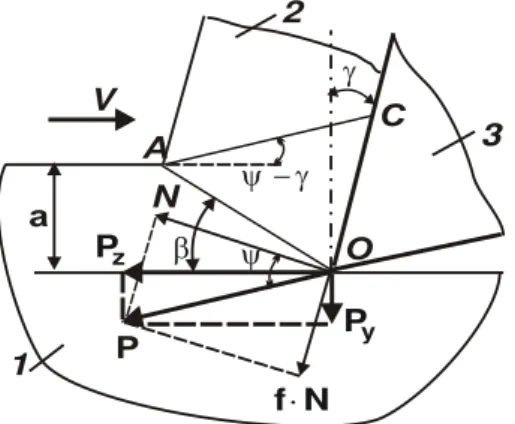
The cutting process is directed destruction of the surface layer of the treated material under the action of the load arising from contact with the cutting tool. This load is called the theory of cutting the cutting force. Usually it is resolved into two components - the tangential
z
P and radial Py (fig. 1):
О
V
А С
1
2
3
N
а
y P
Р z P
N f
Fiabilitate si Durabilitate - Fiability & Durability No 1/ 2015 Editura “Academica Brâncuşi” , Târgu Jiu, ISSN 1844 – 640X
4
cut z
V Q S
P ; (1)
cut cut cut
z y
V Q K
K P
P , (2)
where ı- conventional voltage cutting; S- the cross sectional area of cut; Q=SVcut-
processing performance ; Vcut- cutting speed; Кcut=Pz /Py- coefficient of cutting.
The most important condition of efficiency of the cutting process is to increase
processing performance Q. On the basis of the converted according (1):
ı V P =
Q z cut , this is
achieved by increasing parameters Pz, Vcut and reduction ı. Obviously, the increase of the
tangential component cutting force Pz limited durability of the cutting tool, and increase the cutting speed Vcut - his resistance due to the temperature factor. The possibility of reduction
of nominal voltage cutting ı connected with the contact management processes, taking place on the front and back surfaces of the instrument. Therefore, parameters ı and Pz due mechanics, the cutting speed Vcut- the thermophysics of the cutting process. However, this separation is very relative, because the parameters ı and Pz also temperature depends on cutting and they must learn how to position mechanics, and from a position of Thermophysics of the cutting process.
About the effectiveness of processes for mechanical and physical-technical materials processing judged by the value of energy consumption Е, equal to the work expended on a unit volume of material removal V . Presenting the work А, necessary for removing bulk material V , at machining and volume V as A=Pzl; V=lS (where l- length of cutting path , м; S- the cross sectional area of cut , м2), energy consumption Е=A/V determined
ı = S P =
Е z . (3)
As can be seen, when machining (cutting, cutting and abrasive tools) energy intensity Е numerically equal to the conventional stress cutting ı.
To determine ı should consider a simplified analytical model of the cutting process (fig. 1), according to which the material removal occurs by shifting elements formed along the conditional chip shear plane, located at the angle ȕ to the direction of movement of the tool. Under the influence of forces Pz and Py in the shear plane shear stress occurs IJ. To
determine the position of the shear plane of the material conditional (contingent shift angle material ȕ) it is necessary to project the components of the cutting force Pz, Py and set the
shear stress IJ:
0,5 К sin2ȕ sin ȕ
в a
P = ȕ sin P ȕ cos P в a
ȕ sin =
IJ 2
cut y
y
z
Fiabilitate si Durabilitate - Fiability & Durability No 1/ 2015 Editura “Academica Brâncuşi” , Târgu Jiu, ISSN 1844 – 640X
5
where а, в- accordingly, thickness and width of cut , м.
Shear stress IJ, based on dependencies (4), has the most from conditional shift material ȕ. On the fig. 2 graphically the character of change
of the function IJ0=0,5Кcutsin2ȕsin2ȕ, a member of the dependence (4).
The extreme value ȕ is determined from
the necessary conditions of extremum IJ'ȕ=0:
cut K = 2ȕ
tg . (5) As you can see, the relative shift of the material clearly depends on the coefficient of cutting Кcut: with increasing angle ȕ increases. Radial component cutting force Py is determined from the dependence (4) with
relation (5) on condition IJ=IJsh:
2 cut 2 cut st
y 1+ 1+К
К в a =
P σ , (6)
where IJsh0,5ıst- tensile strength the shift of the processed material, Н/м2; ıst– tensile strength at compression of processed material , Н/м2.
Tangential component cutting force Pz=КcutPy and conditional voltage cutting
в
a / P =
ı z are defined:
2 cut cut st
z К 1+ 1+К
ı в a =
P ; (7)
2 cut cut
st 1+ 1+К К
ı
=
ı . (8)
Specific components of the cutting forces describes dependencies:
2 cut cut st z sp
z 1+ 1+К
К 1 = ı в а P =
P ; (9)
2 cut 2 cut st y sp
y 1+ 1+К
К 1 = ı в а P =
P . (10)
From dependences (9) and (10) it follows that the parameters
sp z
P and ı identical,
asdescribes the same addiction. The analysis calculated based on the dependencies (9) and (10) values
sp z
P and
sp y
P , which is shown in fig. 3, shows that, subject to the Кcut=
1parameters
sp z
P and
sp y
P equal, as provided Кcut<1 и Кcut>1 fair accordingly conditions
sp z P < sp y P и sp z P > sp y
P . As is known, the condition Кcut< 1 implemented for abrasive
0 10 20 30 0,05 0,10 0,15 0,20 0 . а , 1 2
Fig. 2: Dependency IJ0 on the angle ȕ:
Fiabilitate si Durabilitate - Fiability & Durability No 1/ 2015 Editura “Academica Brâncuşi” , Târgu Jiu, ISSN 1844 – 640X
6
processing, but the condition Кcut>1 – at the blade processing. Therefore, when sanding the greatest influence on the process parameters has a radial Py component cutting force, but
when the blade processing - tangential Pz component cutting force. Thus the components of the forces at the edge processing (Кcut>1) less than for abrasive processing (Кcut<1), that indicates the possibilities of improving the accuracy and quality of cutting edge tools. This pattern is due to the smaller values of the conditional voltage cutting ı=
sp z
P , which
provided Кcut seeks to adopt the values ıst (fig. 3). In this case the conditions of chip formation comply with the terms of straightforward destruction of the sample at its compression.
Express the ratio of cut Кcut through the components of the cutting force N и f N, appearing on the front surface of the tool (fig. 1) [3]:
, cos N f sin N P
, sin N f cos N P
y z
(11)
where f - the coefficient of friction on the front surface of the tool; Ȗ- cutting angle of the tool.
Whence
ȥ Ȗ
ctg =Kcut
tgȖ f
tgȖ f + 1 =
, (12)
where f =tgȥ; ȥ- conditional friction angle on the front surface of the tool.
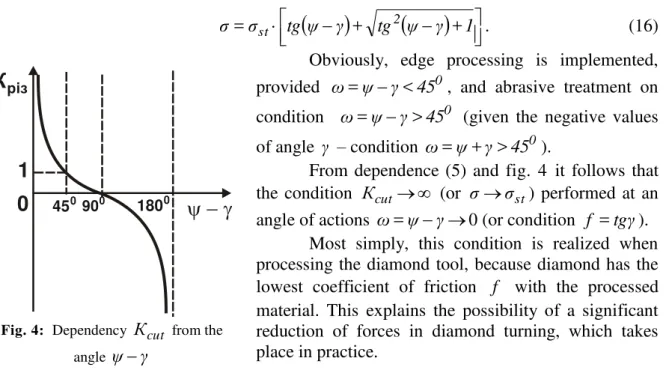
Graphically, the dependence (12) shows on the fig. 4. The coefficient cutting
cut
К - plus, changes in limits from 0 up to 0. Comparing dependence (5) and (12), the obtained dependence for calculation of the conditional shift material ȕ:
2 ȥ Ȗ + 45° =
ȕ . (13)
Angel Ȧ=ȥȖ is called the angle of the. So the options Pz , Py and ı can be
expressed also through the angle of the Ȧ=ȥȖ:
в ı tg ȥ Ȗ + tg ȥ Ȗ +1 a
=
Pz st 2 ; (14)
в ı tg ȥ Ȗ tg ȥ Ȗ + tg ȥ Ȗ +1 a
=
Py st 2 ; (15)
0 1 2 3 4
1 2 4 6
, Pz т
т
y
P
і
К
Fig. 3: Dependency sp z
P (the solid line) и sp y P
Fiabilitate si Durabilitate - Fiability & Durability No 1/ 2015 Editura “Academica Brâncuşi” , Târgu Jiu, ISSN 1844 – 640X
7
tg ȥ Ȗ + tg ȥ Ȗ +1 ı
=
ı 2
st . (16)
Obviously, edge processing is implemented,
provided Ȧ=ȥȖ<450, and abrasive treatment on
condition Ȧ=ȥȖ>450 (given the negative values
of angle Ȗ – condition Ȧ=ȥ+Ȗ>450).
From dependence (5) and fig. 4 it follows that the condition Кcut (or ııst) performed at an angle of actions Ȧ=ȥȖ0 (or condition f =tgȖ).
Most simply, this condition is realized when processing the diamond tool, because diamond has the lowest coefficient of friction f with the processed material. This explains the possibility of a significant reduction of forces in diamond turning, which takes place in practice.
In dependencies (14) – (16) the angle of the Ȧ=ȥȖ you must look at the positive. Obviously, with the increase in the angle-action Ȧ=ȥȖ parameters Py, Pz and ı
increase. For them reduce it is necessary the positive angle of the tool Ȗ increase, and the friction angle ȥ (coefficient of friction f ) reduce.
At values tg
ȥȖ
>1 radial component cutting force Py more tangential componentcutting force Pz. This is possible when the angle of action
ȥȖ
>45°, sowith a relatively large contingent angle of friction ȥ>45° and small value Ȗ0, or negative values of the front angle Ȗ, then the angle actions Ȧ=ȥȖ will be obviously more 45°.The last case is implemented, for example, when cutting with abrasive and diamond grains grinding wheel [4]. The more the degree of dulling of grains, the more negative the front angle Ȗ and the higher the ratio Pz/Py. This is consistent with the practice of cutting. It
is established experimentally that when the blade processing is executed, as a rule, condition
z
P >Py, so tg
ȥ+Ȗ
>1.At the initial moment of treatment (at the moment of cutting blade tool in the processed material), when almost no friction generated chip with the front surface of the tool(ȥ 0), tangential component cutting force Pz more, than at the steady state cutting process, when there is friction chip with the front surface of the tool and ȥ>0. This is because in the first case, when 10°<Ȗ<40° values tg
ȥȖ
more, than in the second case, at 10°<ȥ<40° – tg
ȥȖ
0.The lowest value Pz is reached at ȥ=Ȗ.Increase Pz at the moment of cutting tool in the material can be one of the factors determining the low efficiency of the instrument for discontinuous cutting. The presence of
0
45 900 1800 і
К
1
0
Fiabilitate si Durabilitate - Fiability & Durability No 1/ 2015 Editura “Academica Brâncuşi” , Târgu Jiu, ISSN 1844 – 640X
8
forces Py at the steady state cutting process allows essentially to reduce Pz and improve the efficiency of the instrument.
Negative values of the front corner of the instrument Ȗ (and zero) tangential component cutting force Pz at the moment of cutting is less, than at a steady process of cutting. Consequently, the use of instruments with a negative front corners of the fundamentally changes regularities tensions process, excludes increase Pz at the moment of cutting. According to (14) - (16) with relation (5) and trigonometric transforms simplified and take the form:
tgȕ 2ȕ tg
ı в a =
Py st
;
tgȕ ı в a =
Pz st ;
tgȕ ı =
ı st . (17)
As you can see, the options Py, Pz, ı quite clearly depend on conditional shift
material ȕ. The more ȕ, the less Py, Pz, ı and effectively cutting process.
At grinding (Кcut< 1), looking forward corner cutting grain circle Ȗ negative [5], dependency (14) – (16) can be simplified
cut st z
К ı в a 2 =
P ; 2
cut st y
К ı в a 2 =
P ; =2 ı tg
ȥ+Ȗ
К ı
2 =
ı st
cut
st
. (18)
on condition
ȥ+Ȗ
900 rightly ı. In this case the cutting process (chip disposal) is not implemented, only the elastic-plastic deformation of the material without the chip formation. Therefore, the process of cutting edge cutting and abrasive tools may be made,provided Ȧ=ȥ+Ȗ<900. Using this condition, you can scientifically grounded approach to the selection of optimum processing conditions, including processing methods, mode settings cutting tool characteristics, etc. Thus, in the solution of important topical the problem of determination of parameters of power tension cutting process, and the conditions of decrease in relation to edge cutting machining and grinding.
REFERENCES
[1] Bobrov, V. F. Fundamentals of the theory of metal cutting. – Moscow: Mashinostroenie, 1975. – 343 p. – In Russian.
[2] Granovsky, G. I. Cutting of metals. – Moscow: Higher school, 1985. – 304 p. – In Russian.
[3] Rosenberg, A. M., Eryomin, A. N. Elements of the theory of the process of metal cutting. – Moscow-Sverdlovsk, 1956. – 318 p. – In Russian.
[4] Maslov, E. N. Theory of grinding of metals. – Moscow: Mechanical Engineering, 1974. – 319 p. – In Russian.