P . b . b . 0 2 Z 0 3 1 1 0 5 M , V e r l a g s p o s t a m t : 3 0 0 2 P u r k e r s d o r f , E r s c h e i n u n g s o r t : 3 0 0 3 G a b l i t z
Indexed in EMBASE/Excerpta Medica/Scopus
www.kup.at/kardiologie
Member of the ESC-Editors’ Club
Member of the
Offizielles Organ des
Österreichischen Herzfonds
Homepage:
www.kup.at/kardiologie
Online-Datenbank mit
Autoren- und Stichwortsuche
Gasteditorial: Newsflash
Thrombosis 2010
Verheugt FWA
Journal für Kardiologie - Austrian
Journal of Cardiology 2010; 17
Jetzt in 1 Minute
Früh-erkennung der PAVK: boso
ABI-system 100
PAVK – Die unterschätzte Krankheit Die periphere arterielle Verschlusskrank-heit (PAVK) ist weitaus gefährlicher und verbreiteter als vielfach angenommen. Die getABI-Studie [1] zeigt, dass 20 % der > 60-Jährigen eine PAVK-Prävalenz aufweisen. Die PAVK wird oft zu spät diagnostiziert. Das liegt vor allem da-ran, dass die Betroffenen lange Zeit be-schwerdefrei sind und eine entsprechen-de Untersuchung daher meist erst in akuten Verdachtsfällen erfolgt. Mit dem Knöchel-Arm-Index („ankle- brachial in dex“ [ABI]) ist die Diagnose einer PAVK durchführbar. Der Knöchel-Arm-Index (ABI) ist ein wesentlicher Marker zur Vorhersage von Herzinfarkt, Schlag-anfall und Mortalität.
PAVK-Früherkennung mit dem boso ABI-system 100: Ein Gewinn für alle. Eine präzise und schnelle, vaskulär orientierte Erst untersuchung. Der entscheidende Wert für die Dia-gnose der PAVK ist der Knöchel-Arm-Index („ankle-brachial index“ [ABI]). Das boso ABI-system 100 ermittelt die-sen Wert zeitgleich und oszillometrisch an allen 4 Extremitäten. Die eigentliche Messung dauert dabei nur ca. 1 Minu-te. Ein ABI-Wert < 0,9 weist im
Ver-gleich mit dem Angiogramm als Gold-standard mit einer Sensitivität von bis zu 95 % auf eine PAVK hin und schließt umgekehrt die Erkrankung mit nahezu 100 % Spezifität bei gesunden Perso-nen aus.
Das boso ABI-system 100 wurde wei-terentwickelt und ist jetzt optional mit der Messung der Pulswellenge-schwindigkeit ausgestattet.
Optional ist das boso ABI-system 100 ab sofort auch mit der Möglichkeit zur Messung der
Pulswellengeschwindig-keit (ba) verfügbar. Mit der Messung der Pulswellengeschwindigkeit („pulse wave velocity“ [PWV]) kann eine arteri-elle Gefäßsteifigkeit diagnostiziert wer-den. Die Steifigkeit der arteriellen Ge-fäße nimmt mit einer fortschreitenden Arteriosklerose zu, was sich durch eine Erhöhung der Pulswellengeschwindig-keit darstellt. PWV und ABI-Wert er-möglichen eine noch fundiertere Risi-kostratifizierung von kardiovaskulären Ereignissen.
Literatur:
1. http://www.getabi.de
Weitere Informationen:
Boso GmbH und Co. KG Dr. Rudolf Mad
A-1200 Wien
400 J KARDIOL 2010; 17 (11–12)
Gasteditorial
Since the last newsflash from ACC 2010 some interesting studies on antiplatelet and anticoagulant therapy have been presented and/or published.
INNOVATE-PCI (Sunil Rao, Chapel Hill) presented at ESC
2010, was a randomized, double-blind, phase II study on elinogrel (an oral and intravenous reversible P2Y12 receptor antagonist with a half-life of 12 hours) versus clopidogrel in 652 patients undergoing non-urgent PCI. Like ticagrelor, elinogrel is not a prodrug neither requires metabolic activa-tion. It has no CYP metabolism resulting in low potential drug-drug interactions. Patients were randomized to clopido-grel (300/600 mg, followed 75 mg qd) or elinoclopido-grel (80 mg i.v., followed by oral 50, 100 or 150 mg bid) pre-PCI. Initially, follow-up was 60 days, but the protocol was amended with an extended follow-up of 120 days. Enrolment in the 50 mg oral dose arm was discontinued after 117 patients were enrolled. The intravenous dose was increased to 120 mg after 170 pa-tients were enrolled (recommendations of the DSMC) (Fig. 1).
This level of inhibition was sustained during the transition to an oral dose and persisted at day 30. In the different elinogrel arms there was no excess of TIMI major or minor bleeding after 24 h and 120 d (Fig. 2, 3).
Asymptomatic elevation (5 times ULN) of transaminases oc-curred within the first 60 days of treatment (clopidogrel 0.5%, elinogrel 100 mg 2.0% and elinogrel 150 mg 3.4%). This re-solved in all patients, even when treatment was continued. Results look promising and phase III trials in PCI and second-ary prevention will follow.
ATOLL presented at ESC 2010 by Gilles Montalescot from
Paris compared head-to-head i. v. enoxaparin and UFH in 910 patients undergoing primary PCI for STEMI. Patients were randomized prior to coronary angiography to enoxaparin 0.5 mg/kg intravenously (STEEPLE dose) with or without a glycoprotein inhibitor (GPI) versus UFH 50–70 U/kg intrave-nous with GPI or UFH 70–100 U/kg without. Subcutaneous enoxaparin was recommended to be given until discharge. PCI was performed via radial access in 69%, stents were implanted in 96% and a GPI was used in 71% of patients. Median time from symptom onset until randomization was 2.5 hrs. The primary outcome (composite of all-cause mortal-ity, complications of myocardial infarction, procedural fail-ure, and non-CABG major bleeding during hospitalization and up to 30d) occurred in 28% with enoxaparin versus 34% with UFH group (p = 0.07). All-cause mortality at 30 d was seen 3.8% with enoxaparin versus 6.3% for UFH (p = 0.08).
Newsflash Thrombosis 2010
F. W. A. Verheugt
Figure 1: Inhibition of platelet ADP aggregation first 24 h. Reprinted from the e-Library, ESC Congress 2010, with permission of the ESC, Communications Department.
Figure 2: Bleeding first 24h or discharge. Reprinted from the e-Library, ESC Congress 2010, with permission of the ESC, Communications Department.
Figure 3: Bleeding 24h to 120 days. Reprinted from the e-Library, ESC Congress 2010, with permission of the ESC, Communications Department.
Figure 4: Bleeding Endpoints. Reprinted from the e-Library, ESC Congress 2010, with permission of the ESC, Communications Department.
J KARDIOL 2010; 17 (11–12) 401
Only the secondary endpoint of death, recurrent ischemia/ reinfarction or urgent revascularisation was significantly bet-ter with enoxaparin than with UFH: 6.7% and 11.3% respec-tively, p = 0.01 (Fig. 4)
Unexpectedly, the main safety endpoint (non-CABG related major bleeding) was quite similar (4.5% for enoxaparin and 4.9% for UFH). This may due to the high rates of radial access and use of GPI. Thus, ATOLL did not show major improve-ments in primary clinical outcomes for enoxaparin over UFH
in patients undergoing primary PCI for STEMI. On the other hand, intravenous enoxaparin in STEMI is an acceptable and safe alternative to UFH for primary PCI.
Stuart Connolly from Hamilton, Canada, presented at ESC 2010 AVERROES (Apixaban VERsus Acetylsalicylic acid
to pRevent strOkES) study. This double blind trial random-ized 5,600 patients with AF and a mean CHADS2 score of 2.1 (± 1.1), who were deemed intolerant (40%) or unsuited for vitamin K antagonist (VKA) therapy (60%), to the novel oral direct factor Xa blocker apixaban 5 mg bid or aspirin (81– 324 mg/d, mean 162/d). Unsuitability was determined at the discretion of the treating physician. Patients had a mean age of 70 y and 30% had a high risk for stroke (CHADS2≥3). The study was prematurely stopped at 1-year follow-up by the DSMB because of a significant benefit with apixaban (Fig. 5).
As expected, apixaban led to a decrease in the number of strokes or systemic embolic events (SEE) annually from 3.6%/y to 1.6%/y (p < 0.001). This result was mainly driven by a reduction in ischemic strokes (2.9%/y versus 1.1%/y). There was no difference in vascular or all cause mortality, or in the occurrence of myocardial infarctions (MI). Surpris-ingly, these results occurred without the expected increase in the risk of bleeding. A slight increase in minor bleeding was observed (5.2%/y versus 4.1%/y, p = 0.04), but intracranial
Figure 5: Stroke or systemic embolism. Reprinted from the e-Library, ESC Congress 2010, with permission of the ESC, Communications Department.
402 J KARDIOL 2010; 17 (11–12)
Gasteditorial
haemorrhage was similar: 13 for apixaban and 12 for aspirin (p = 0.83). Apixaban was well tolerated without significant effects on transaminases. Thus, apixaban significantly reduces strokes and SEE compared to aspirin in patients with AF un-suitable or intolerant for VKA with a favourable risk-benefit profile. Results in comparison to warfarin (ARISTOTLE study) are eagerly awaited and will be available in the summer of 2011.
Another study on novel oral anticoagulation in atrial fibrilla-tion was presented at ACC 2010 and recently published: the
RE-LY substudy on the INR quality for warfarin relative to
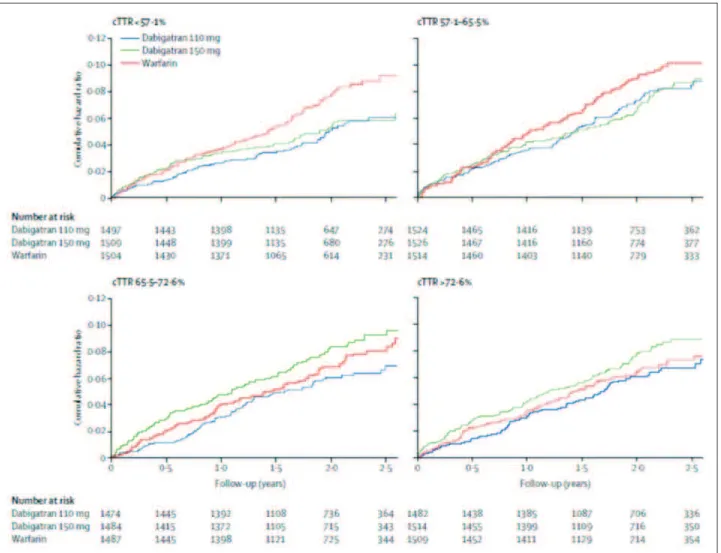
the efficacy of the oral direct thrombin blocker dabigatran [1]. Time in therapeutic range (TTR) was available in 18,024 (99%) patients and ranged from 44% (Taiwan) to 77% (Sweden). TTR was split into quartiles (Fig. 6, 7).
Thus, relative to warfarin dabigatran was most efficacious when TTR was lowest, and the least when TTR was maximal. Safety with warfarin was lowest when TTR was lowest and comparable with dabigatran when TTR was maximal. This prespecified subgroup analysis suggests that the net clinical benefit of dabigatran is the largest in regions where TTR is suboptimal. This is especially true for the high dose of dabigatran (150 mg bid).
Figure 7: Time in therapeutic range (TTR) and major bleeding with warfarin and dabigatran. Reprinted from The Lancet [1], © 2010, with permission from Elsevier.
At ESC 2010 EINSTEIN-DVT (Harry Büller, Amsterdam)
was presented. This randomized open label trial was designed to show non-inferiority of the oral direct factor Xa blocker rivaroxaban compared to conventional treatment (enoxaparin (1 mg/kg bid, ≥5days) followed by warfarin with target INR 2–3) in 3449 patients with a confirmed deep venous thrombo-sis without signs of pulmonary embolism. Rivaroxaban was dosed 15 mg bid for the first three weeks and 20 mg daily thereafter. Treatment duration (3, 6 or 12 months) was at the discretion of the physician. Among patients using rivaroxaban, 2.1% experienced recurrent DVT vs 3.0% of the controls (p < 0.0001 for non-inferiority) and almost reached statistical superiority (p = 0.076). A combination of major and minor clinically-relevant non-major bleeding was similar (8.1%, p = 0.77). Rivaroxaban was not associated with liver toxicity. Thus, rivaroxaban seems to be an attractive and simple alter-native for the initial and long-term treatment of deep vein thrombosis.
Two important studies on genotype analysis (CYP2C19 loss-of-function carrier status) of the clinical antiplatelet activity of clopidogrel have been published on line.
J KARDIOL 2010; 17 (11–12) 403
(stroke prevention in atrial fibrillation) trials [2]. No differ-ences could be observed between the clinical efficacy of clopidogrel over placebo in carriers of the loss of function al-lele and those with the gain of function alal-lele of CYP2C19. Also major bleeding was not influenced by the carrier status.
The second study addressed the genotype analysis of several CYP2C19 loss-of-function alleles and of the ABCB1 single nucleotide polymorphism 3435C → T (all heavily involved in clopidogrel metabolism) relative to the clinical antiplatelet activity of both clopidogrel and ticagrelor in the well known PLATO trial in patients with acute coronary syndromes [3]. Except for the first 30 days when thrombotic risk is highest, neither the CYP2C19 loss-of-function allele polymorphisms nor the ABCB1 single nucleotide polymorphism 3435C → T were associated with differences in long-term clinical out-comes or bleeding with clopidogrel. For ticagrelor similar re-sults were found.
Although the above polymorphisms heavily interfere with
ex vivo platelet reactivity, the observations from the 2 clinical analyses suggest that they are of little, if any, clinical rel-evance. Thus genotyping for clopidogrel metabolism as rec-ommended by the FDA appears hardly important for clopido-grel and unnecessary for the novel ADP receptor blockers, since the clinical efficacy of Prasugrel [4] and ticagrelor has shown to be independent of the above polymorphisms.
One year after the presentation at ESC 2009, the final results of the CURRENT OASIS-7 comparing 2 dose regimens of
clopidogrel and 2 doses of aspirin in 25,086 patients with non-ST elevation acute coronary syndromes eligible for an early invasive treatment were published. The outcome was split into 2 papers: one of the outcome in all patients [5] and one on the results of the subset of patients (69%) that underwent PCI [6]. Overall, the primary study outcome (CV death, MI and stoke) was neutral: clopidogrel 600 mg loading followed by
References:
1. Wallentin L, Yusuf S, Ezekowitz MD, et al. Efficacy and safety of dabigatran compared with warfarin at different levels of interna-tional normalised ratio control for stroke pre-vention in atrial fibrillation: an analysis of the RE-LY trial. Lancet 2010; 276: 975–83. 2. Paré G, Mehta SR, Yusuf S, et al. Effect of CYP2C19 genotype on outcome of clopidogrel treatment. N Engl J Med 2010; Epub ahead of print.
3. Wallentin L, James S, Storey R, et al. Ef-fect of CYP2C19 and ABCB1 single nucleotide polymorphisms on outcomes of treatment with ticagrelor versus clopidogrel for acute coro-nary syndromes: a genetic substudy of the PLATO trial. Lancet 2010; Epub ahead of print.
4. Mega JL, Close SL, Wiviott SD, et al. Ge-netic variants in ABCB1 and CYP2C19 and cardiovascular outcomes after treatment with clopidogrel and prasugrel in the TRITON-TIMI 38 trial: a pharmacogenetic analysis. Lancet 2010; Epub ahead of print.
5. CURRENT OASIS-7 investigators. Dose comparisons of clopidogrel and aspirin in acute coronary syndromes. N Engl J Med 2010; 360: 930–40.
6. Mehta SR, Tanguay JF, Eikelboom JW, Jolly SS, Joyner CD, Granger GB. Double-dose versus standard-Double-dose clopidogrel and high-dose versus low-dose aspirin in indi-viduals undergoing percutaneous coronary in-tervention for acute coronary syndromes (CURRENT-OASIS 7): a randomised factorial trial. Lancet 2010; Epub ahead of print.
150 mg daily for a month was not better than 300 mg loading with 75 mg daily, but led to significant 24% increase in major bleeding. For the higher dose of aspirin (300–325 mg daily) for a month there was no benefit or excess bleeding risk over 75–100 mg daily (after 300 mg loading). In the PCI substudy in 17,263 patients the high dose clopidogrel regimen resulted in a 14% reduction of the primary endpoint (p = 0.04) and 46% reduction in stent thrombosis (p < 0.001), but also a sig-nificant 41% increase in major bleeding. For high dose aspirin there was no benefit or excess harm in this subgroup.
Given the neutral outcome of the main CURRENT OASIS-7 trial, it is likely that future guidelines on non-ST elevation acute coronary syndromes will not change with regard to the maintenance dose clopidogrel and aspirin. The 600 mg load-ing dose has been accepted for a long time, especially for patients undergoing PCI in that setting.
Die neue Rubrik im Journal für Kardiologie:
Clinical Shortcuts
In dieser Rubrik werden Flow-Charts der Kardiologie kurz und bündig vorgestellt
Zuletzt erschienen:
Interventionelle kathetergestützte
Diagnostik der Synkope
Aortenklappenimplantation (TAVI)
J Kardiol 2015; 22 (5–6): 132–4.
J Kardiol 2014; 21 (11–12): 334–7.
Einsatz einer perioperativen Blockertherapie
Kardiologische Rehabilitation nach
zur Reduktion von Morbidität und Mortalität
akutem Koronarsyndrom (ACS)
J Kardiol 2015; 22 (1–2): 38–40.
J Kardiol 2015; 22 (9–10): 232–5.
Besuchen Sie unsere Rubrik
P
聺
Medizintechnik-Produkte
boso ABI-system 100 Boso GmbH & Co KG IntelliSpace Cardiovascular
Philips Austria GmbH, Healthcare
BioMonitor 2
BIOTRONIK Vertriebs-GmbH CT TAVI Planning mit
syngo.CT Cardiac Function-Valve Pilot Siemens AG Österreich
STA R Max
Stago Österreich GmbH

![Figure 6: Time in therapeutic range and efficacy with warfarin and dabigatran. Reprinted from The Lancet [1], © 2010, with permission from Elsevier.](https://thumb-eu.123doks.com/thumbv2/123dok_br/18247730.341932/4.892.77.798.587.1139/figure-therapeutic-efficacy-warfarin-dabigatran-reprinted-permission-elsevier.webp)