review article
Licence Creative Commom
CC
RBCDH
1 University of São Paulo. Depart-ment of Biodynamics Applied to Motor Activity. Laboratory of Nutrition and Metabolism Applied to Motor Activity. São Paulo, SP. Brazil.
2 University of São Paulo. Faculty of Pharmaceutical Sciences. De-partment of Food and Experimen-tal Nutrition. São Paulo, SP. Brazil.
Received: 17 December 2014 Accepted: 08 April 2015
Can leucine supplementation attenuate
muscle atrophy? A literature review
A suplementação de leucina pode atenuar a atroia
muscular? Uma revisão da literatura
Rafael Bruno Do Amaral1
Carlos Eduardo Carvalho Martins2
Antonio Herbert Lancha Junior1
Vitor de Salles Painelli1
Abstract– Currently, there has been new expectations in studying strategies with the potential to mitigate the skeletal muscle atrophy that characterizes conditions such as aging, disuse, cancer, and the use of certain medications. Among them, amino acid leucine has received special attention due to its potential to stimulate speciic pathways of protein synthesis in skeletal muscle. Due to the wide spread use of this amino acid by the media, several studies have been aimed at investigating the possible efectiveness of leucine against skeletal muscle atrophy. As a result, this literature review was aimed to analyze recent studies that investigated the efects of leucine supplementation on skeletal muscle atrophy in both humans and animals. Overall, the wide variations in the experi-mental designs developed, models studied, leucine dose, treatment duration and sample healthiness make it diicult for professionals and researchers to establish guidelines about possible therapeutic efectiveness of this nutritional strategy.
Key words: Dietary supplements; Leucine; Muscular atrophy.
INTRODUCTION
Skeletal muscle is constantly balancing its anabolism and catabolism state. he balance between these two phenomena is known as protein turnover, i.e. the relationship between degradation level and protein synthesis during a given
period1. When protein synthesis and degradation level are equivalent, the
volume of protein turnover is considered neutral. In contrast, when protein synthesis is higher than the degradation level, the protein turnover can be considered as positive. Finally, the turnover is considered negative when there is a reduction in protein synthesis with or without change in the degradation
rate and / or when protein degradation is greater than protein synthesis2.
Protein turnover in muscle tissue is well characterized in some situa-tions. For example, it is well known that nutrition, speciically, adminis-tration of amino acids, induces a sharp and positive protein turnover due
to an increased protein synthesis rate3. Likewise, it is known that under
certain conditions, such as sepsis and acute use of glucocorticoids induce
a negative protein turnover4,5. Due to the obvious diiculty in performing
long-term investigations evaluating changes that occur in protein turnover, it is believed that such changes result in acute chronic adaptations in muscle tissue. herefore, researchers have speculated that muscle atrophy, which characterizes chronic conditions such as immobilization, cancer, various autoimmune diseases and aging, is the result of acute successive decreases
of the protein synthesis rate and / or increased degradation6,7. hus, some
strategies aimed to mitigate or even prevent this acute negative protein turnover in such conditions have received special attention in recent years.
One of the strategies that have gained prominence is leucine administration8.
Leucine is an essential amino acid that comprises BCAA (branched-chain amino acids). It is known that it is an important nutrient involved in increasing insulin secretion in the pancreatic beta cells. Furthermore, this amino acid has the capacity to increase activation and expression of the mammalian target of rapamycin (mTOR) in various tissues, especially muscle; mTOR activation, in turn, is a key step in the process of protein
synthesis9 (see Figure 1). Based on the above, it has been consistently
dem-onstrated in literature that leucine is efective to increase protein synthesis and decrease the degradation rate 1) in culture model of animal muscle
cells10; 2) in muscle tissue samples incubated with this amino acid11; 3)
via intravenous administration in humans12-14; and inally, 4) by means of
oral supplementation both in animal models and humans9,15-17. Katsanos
et al.18, reported a signiicant increase in the protein synthesis rate of the
an attractive therapeutic tool in the attenuation of muscle atrophy during catabolic situations. Although results acutely observed have aroused interest from health researchers, it is noteworthy that long-term studies investi-gating the therapeutic eicacy of this nutritional strategy on maintaining muscle mass are scarce, and their results are controversial.
hus, due to recent scientiic advances investigating possible anti-catabolic efects of leucine, this is an opportune time to review and sum-marize the main indings in literature about the possible therapeutic efects of chronic leucine supplementation on muscle atrophy. Due to the natural overlap of experimental designs oten observed in studies investigating the therapeutic potential of leucine supplementation, it was decided to include in this review only studies that have examined the chronic efect of leucine supplementation on muscle mass and studies that used this amino acid alone instead of the combination with other nutritional strategies. To this end, a search for articles in the following databases: Web of Science, PubMed and Google Scholar, was carried out in 2014. A wide variety of keywords were used to search for information, which included “muscle atrophy”, “therapeutic nutrition”, “nutritional supplementation”, “nutrition and atrophy”, “leucine intake” and “ leucine supplementation”.
EFFECTS OF ISOLATED LEUCINE SUPPLEMENTATION ON MUSCLE ATROPHY
As previously mentioned, recent in vivo results from acute studies in
hu-mans16,18 suggest that leucine supplementation is an efective nutritional
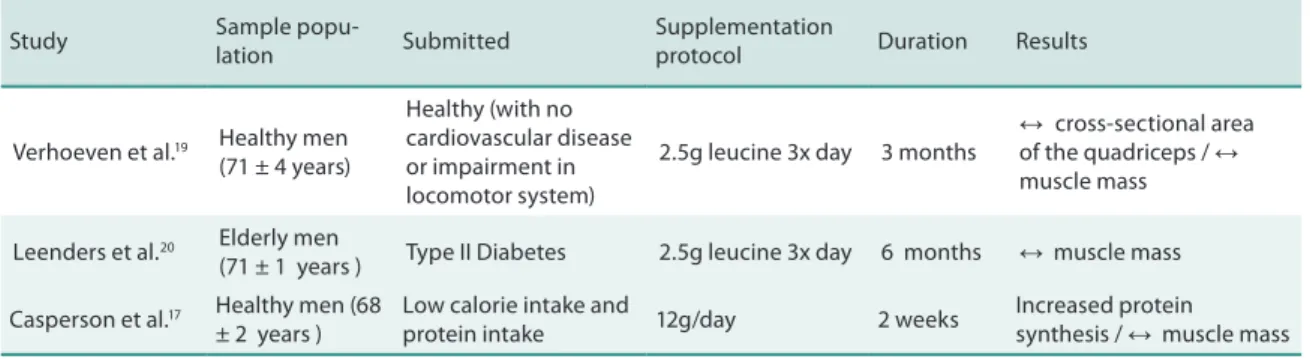
strategy to increase muscle mass in the elderly, especially when added at each main meal. However, interventions investigating the possible clinical beneits of prolonged leucine supplementation are scarce both in humans (see Table 1) as in animals (see Table 2).
Table 1. Efect of leucine supplementation alone on muscle atrophy in humans.
Study Sample
popu-lation Submitted
Supplementation
protocol Duration Results
Verhoeven et al.19 Healthy men
(71 ± 4 years)
Healthy (with no cardiovascular disease or impairment in locomotor system)
2.5g leucine 3x day 3 months
↔ cross-sectional area of the quadriceps / ↔ muscle mass
Leenders et al.20 Elderly men
(71 ± 1 years ) Type II Diabetes 2.5g leucine 3x day 6 months ↔ muscle mass Casperson et al.17 Healthy men (68
± 2 years )
Low calorie intake and
protein intake 12g/day 2 weeks
Increased protein synthesis / ↔ muscle mass
In a double-blind randomized study, Verhoeven et al.19 submitted
healthy elderly men (71 ± 4 years) with no cardiovascular disease or impair-ment of the locomotor system to 3 months of leucine suppleimpair-mentation or placebo. Leucine dose used by the authors was 7.5g / day divided into 2.5 g during each main meal (breakfast, lunch and dinner). However, no efects of leucine supplementation on the cross-sectional area of quadriceps or
Table 2. Efect of leucine supplementation alone on muscle atrophy in rodents.
Study Sample
Popu-lation Submitted Supplementation Protocol Duration Results
Baptista et al.30
Male rats (2 months old)
Unilateral hindlimb immobilization for 7 days
2.7g/kg (gavage)
3 days before immobilization, followed by another 8 days
↑ muscle mass
Peters et al.32
CD2F1 Mice (6 to 7 weeks old)
inoculated with C26 adenocarcinoma cells
Standard diet with 8.7g leucine per gram of protein vs. standard diet with 9.6 g leucine per gram protein vs. standard diet with 14.8g leucine per gram of protein
21 days ↑ muscle mass
Zeanandin at al.22
Old rats (18
months old ) Healthy Diet rich in leucine (4.5 %) 6 months
↔ muscle mass Magne et
al.26
Old rats (22-24 months old )
Immobilization of unilateral lower limb for 8 days
Control diet + 4.5% leucine 40 days ↔ muscle mass Faure et
al.24
Old rats (23
months old ) Dietary restriction 11.2g/kg/day leucine 3 months ↑ muscle mass
Baptista at al.29
Male rats (2 months old )
Unilateral hindlimb immobilization for 7 days
2.7g/kg (gavage)
3 days before immobilization, followed by another 8 days
↑ muscle mass
Pedroso et al.25
Male rats (2 months old )
Dietary restriction
(30% of diet) 71.43g/kg/ day leucine 6 weeks ↑ muscle mass
Figure 1. A brief illustration of the degradation processes and muscle protein synthesis and the efects of leucine on such processes. Legend: IGF-1 - Insulin-like Growth Factor 1; AKT - protein kinase B; AMPK - adenosine monophosphate protein kinase; mTOR - mammalian target of rapamycin; p70s6k - ribosomal protein 70 S6 kinase; 4E-BP1 - eukaryotic initiation factor of 4E binding protein; eIF4G - eukaryotic initiation factor 4G); FoxO - forkhead box protein; MURF-1 - Muscle RING-inger protein-1
positive efects of leucine on muscle mass is related to the relatively short period of intervention or even the speciic inclusion of healthy elderly
men19. In this context, in a subsequent study20 , the same research group
investigated the efects of 6 months of leucine supplementation on muscle mass of older men (71 ± 1 years) with type II diabetes, which is a popula-tion known to have a pronounced decrease in muscle mass compared to
normoglycemic controls matched for age21. Again, in a double-blind,
ran-domized, placebo-controlled study, leucine doses of 7.5g / day subdivided during the three daily main meals were administered. However, as the main outcome, the authors showed that lean body mass did not increase or difer between groups supplemented with leucine and placebo ater six months of supplementation.
In a study evaluating the therapeutic eicacy of leucine on muscle mass
of human, Casperson et al.17 submitted healthy elderly individuals with
daily protein intake of 0.8 g / kg to 2 weeks of leucine supplementation (12 g / morning). Although the authors observed a signiicant increase in muscle protein synthesis rate in the post-absorptive and postprandial state ater 2 week of leucine supplementation as well as mTOR phosphorylation, there were no signiicant changes in fat free mass of participants. his study, however, has clear limitations, among them the absence of randomization. Another important limitation, which includes studies previously mentioned with humans, is the inclusion of a limited and healthy cohort (as Verhoeven
et al.19). Although Leenders et al.20 have examined the efect of leucine
supplementation on muscle mass of elderly type II diabetics, none of the participants was under sarcopenic or “really aggressive” conditions to the skeletal muscle such as chronic use of glucocorticoids, disuse (for example, immobilization) or degenerative or autoimmune diseases (such as cancer).
Some authors have used animal models in an attempt to explain the mechanisms behind the absence of positive results observed in studies
with humans. As an example, Zeanandin et al.22 investigated the efects
of 6 months of ad libitum administration of a diet rich in leucine (4.5%)
on the muscle mass of older mice (18 months old) and on the mTOR signaling pathway in the skeletal muscle of these animals. Similar to the results observed in studies with humans, the authors did not observe any changes in the muscle of animals treated with leucine-rich diet compared to animals treated with control diet. Unlike results previously observed, chronic supplementation with leucine induced a low efect on the activation of the mTOR pathway in skeletal muscle of animals. hus, it is possible to speculate that the absence of increase in muscle mass with chronic leucine supplementation in studies discussed so far can be explained by a loss of leucine eiciency to stimulate postprandial protein synthesis in the skeletal muscle ater a long period compared to acute supplementation. Another possible explanation for the absence of positive results with leucine sup-plementation is the fact that the efect of leucine is time-dependent, since this amino acid stimulates muscle protein synthesis during a short period
spe-cial attention when considering that studies so far discussed in this review ofered leucine in meals spaced throughout the day. hus, in addition to using a high dose, an interesting strategy to observe the chronic efects of leucine on muscle mass would be ofering it fractionally throughout the day. However, this hypothesis still needs to be tested in future studies.
Another possible factor explaining the absence of positive results of the efect of leucine supplementation on muscle mass, at least in studies with humans mentioned so far, would be the appropriate protein intake of participants, i.e., within daily recommendations (0.8 - 1.0 g / kg / day). Consequently, moderate or high daily protein intake may provide leucine enough to stimulate an appropriate protein synthesis rate in skeletal muscle by decreasing the “window action” of this amino acid. From this theoretical justiication, some authors investigated the efect of leucine supplementa-tion on muscle mass in speciic condisupplementa-tions, such as during malnutrisupplementa-tion or
low daily protein intake. In this sense, Faure et al.24 evaluated the efects of
leucine supplementation on the muscle mass of old Sprague-Dawley rats (23 months old) submitted to three months of dietary restriction. Animals were acclimatized for 2 weeks, with dietary intake (grams of diet) being daily recorded. Ater acclimatization, a group of animals was submitted to dietary restriction, being deprived of 50% of their daily dietary intake for 3 months; another group was submitted to dietary restriction during the same period, being supplemented with leucine (11.2 g / kg / day) for
additional 1 week; and a group kept their ad libitum diet during the
experi-mental period. As expected, both groups of animals submitted to dietary restriction had a signiicant decrease in body weight compared to the group
with ad libitum diet. However, the mass of the anterior tibialis muscle was
signiicantly higher in the group of animals submitted to dietary restriction and leucine supplementation compared to the group submitted to dietary restriction only. Although without statistically signiicant diference, the contents of muscle proteins in this group of animals was 71% greater than the group submitted to dietary restriction and only 15% higher than the
group with ad libitum diet, showing that leucine supplementation proved
to be an efective strategy to increase muscle mass and muscle protein content in older rats submitted to dietary restriction. hese results are
consistent with a recent study published by Pedroso et al.25, who found a
decline of 16.5% in lean mass of young rats deprived of 50% of their daily dietary intake for 6 weeks. However, when rats were submitted to the same procedure but added of leucine supplementation (71.43 g / kg / day), lean
mass loss of only 8.3% in relation to the initial weight was observed25.
In order to examine whether an “aggressive condition” to skeletal mus-cle could inluence the response of musmus-cle mass to leucine supplementation,
Magne et al.26 assessed the efects of supplementation with this amino acid
soleus muscles27,28. For muscle recovery ater immobilization, a period
of 40 days was allowed, where half of the rats was fed with a control diet + alanine and the other half was fed with control diet + 4.5% of leucine supplementation. In order to increase the possibility of interventions, the authors also performed a pilot study in which another group of animals was submitted to the same immobilization procedure, but half of this new group of animals was supplemented with whey protein, while the other half received a high-protein diet ater 8 days of immobilization. In short, the authors demonstrated that 8 days of immobilization induced a signiicant muscular atrophy of 20% in the gastrocnemius muscle. However, leucine supplementation for 40 days was not an efective strategy to improve the recovery of the gastrocnemius muscle mass compared to control diet + alanine. On the other hand, both high-protein diet and supplementation with whey protein proved to be efective in the recovery of the gastrocne-mius muscle mass ater immobilization, inducing a gain of approximately 60% of the total lost muscle mass, demonstrating that the administration of such strategies was more efective than leucine supplementation alone
on muscle mass recovery ater a short immobilization period26.
Despite the lack of efectiveness of leucine supplementation in this initial study with immobilization, other studies have succeeded in observing posi-tive results with the administration of this nutritional strategy for similar
intervention period29,30. In fact, in two subsequent studies, male rats aged 8
weeks were submitted to unilateral leg immobilization for 729 and 8 days30 in
a very similar way to the study mentioned above26. In both studies, leucine
was administered via gavage (2.7 g / kg / day) and started three days before immobilization in a group of animals, while the other second group was immobilized but received no nutritional intervention, and a third group was used as control. At the end of interventions, rats were euthanized and the soleus muscle and its mass were evaluated. Similarly to the study by Magne
et al.26, the immobilization protocol adopted in these studies induced a loss
of soleus muscle mass of 29 30 and 40%29 compared to the respective control
groups. However, in both studies, the authors found that leucine supplemen-tation was able to mitigate loss of the soleus muscle mass. Given the similarity
between the immobilization protocols of the above studies29,30 and the study
by Magne et al.26, it is possible that the discrepancy between results is related
to the form leucine was administered (gavage vs. diet), that is, ingestion of low fractionated doses vs. bolus. Studies with animal models have shown that acute leucine administration in a single bolus results in a greater acute increase in muscle protein synthesis rate compared to the administration
of this nutrient in fractionated doses31. Further studies should be conducted
to examine whether this signiicant diference observed between leucine administration protocols could result in long-term diferences.
Another example of study aimed at evaluating the therapeutic eicacy of leucine supplementation on the muscle mass loss under conditions
consider-ably “more aggressive” was the study by Peters et al.32. he authors evaluated
attenuation of muscle atrophy in CD2F1 male mice aged 6-7 weeks subcutane-ously inoculated with C26 adenocarcinoma cells. his animal model is well characterized as a method for the induction of colon cancer, cancer-related
anorexia and consequent reduction of muscle and body mass33,34. Ater 1
week of acclimatization, the animals were immediately randomized based on body weight and divided into four groups: 1) control group (animals that were not inoculated with tumor and standard diet containing 8.7% leucine per gram of protein); 2) T group (inoculated with tumor and control diet); 3) T + BL group (control diet containing 9.6% leucine per gram of protein; low dose); and 4) T + AL group (control diet containing 14.8% leucine per gram of protein; high dose). Immediately ater randomization, speciic groups were inoculated with tumor and 21 days ater inoculation, animals were euthanized. As main results, the authors found that the tumor inoculation signiicantly reduced the size and mass of gastrocnemius, tibialis anterior, extensor digitorum longus and soleus muscles in T, T + BL and T + AL groups compared to the control group. However, a tendency to attenuation of muscle atrophy of the gastrocnemius muscle was observed in T + BL group compared to the T group, while a statistical diference in this parameter was observed in T + AL group compared to the T group. A similar response was observed for the tibialis anterior muscle, with the low dose exhibiting a trend, and the high dose providing a signiicant attenuation of muscle atrophy. No efects of the low leucine dose were observed on muscular atrophy in the other two muscle groups (extensor digitorum longus and soleus muscles), while the high dose exhibited a tendency to attenuate muscle atrophy in these groups compared to the T group (p = 0.07 and 0.09, respectively). he data of this study suggest that under speciic conditions and extremely detrimental to skeletal muscle, for example cancer, leucine supplementation appears to be efective in the attenuation of the muscular atrophy, and that this efectiveness can be increased if high doses of this amino acid are used. However, despite a statistically signiicant efect of this amino acid found in this study, the magnitude of this efect could be considered as low; for example, if we take into account only the mass of the gastrocnemius muscle, low and high doses of leucine induced attenuation of muscle atrophy compared to the inoculated group of approximately 7 and 9%, respectively. In addition, when studies are compared, it was observed that young rats were used for the experimental intervention, and the young age of animals may have been a factor that aided in the muscle mass recovery, since aging is known to be inluenced by the
anabolic resistance phenomenon35. In addition, the lack of muscle function
tests in this study makes it doubtful whether the magnitude of the efect observed with leucine supplementation can be considered clinically relevant in terms of muscle mass preservation in cancer.
FINAL COMMENTS
positive conclusion regarding the clinical eicacy of this amino acid. his is probably due to the great diference among experimental designs, leucine dose, supplementation duration and study models used.
Studies that have examined the efectiveness of this nutritional strategy in healthy sample populations or stable animal models, i.e. in situations where there is no great “stress” or imbalances in the homeostasis of the skeletal muscle did not reveal any beneicial efects of leucine supplementa-tion. On the other hand, the few studies that have investigated the efects of this amino acid on muscle atrophy in situations “more aggressive to the skeletal muscle” such as energy restriction, immobilization and cancer, positive efects of leucine supplementation on the mitigation of muscle mass loss have been reported. Such studies, however, have been conducted in animal models; therefore, caution should be taken when extrapolating these results for the same conditions in humans. In addition, the low sup-plementation period used in these studies impairs verifying its efectiveness in the long term. Further studies with better internal control and prolonged duration should be carried out to investigate the efectiveness of leucine supplementation in other models also aggressive to the skeletal muscle, and if these results can be applied to humans.
REFERENCES
1. Rose AJ, Richter EA. Regulatory mechanisms of skeletal muscle protein turnover during exercise. J Appl Physiol 2009;106(5):1702-11.
2. Burd NA, Tang JE, Moore DR, Phillips SM. Exercise training and protein metabo-lism: inluences of contraction, protein intake, and sex-based diferences. J Appl Physiol 2009;106(5):1692-170.
3. Phillips SM. Protein requirements and supplementation in strength sports. Nutri-tion 2004;20(7-8):689-95.
4. Lang CH, Frost RA, Vary TC. Regulation of muscle protein synthesis during sepsis and inlammation. Am J Physiol Endocrinol Metab 2007;293(2):453-9.
5. Menconi M, Fareed M, O’Neal P, Poylin V, Wei W, Hasselgren PO. Role of glucocorticoids in the molecular regulation of muscle wasting. Crit Care Med 2007;35(9):602-8.
6. Lemoine JK, Haus JM, Trappe SW, Trappe TA. Muscle proteins during 60-day bedrest in women: impact of exercise or nutrition. Muscle Nerve 2009;39(4):463-47.
7. Tesch PA, Von Walden F, Gustafsson T, Linnehan RM, Trappe TA. Skeletal mus-cle proteolysis in response to short-term unloading in humans. J Appl Physiol 2008;105(3):902-6.
8. Nicastro H, Artioli GG, Dos Santos Costa A, Solis MY, Da Luz CR, Blachier F, et. al. An overview of therapeutic efects of leucine supplementation on skeletal muscle under atrophic conditions. Amino Acids 2011;40(2):287-300.
9. Anthony JC, Anthony TG, Kimball SR, Vary TC, Jeferson LS. Orally administered leucine stimulates protein synthesis in skeletal muscle of postabsorptive rats in association with increased eIF4F formation. J Nutr 2000;130(2):139-45.
10. Nakashima K, Ishida A, Yamazaki M, Abe H. Leucine suppresses myoibrillar proteolysis by down-regulating ubiquitin-proteasome pathway in chick skeletal muscles. Biochem Biophys Res Commun 2005;336(2):660-6
11. Buse MG, Reid SS. Leucine. A possible regulator of protein turnover in muscle. J Clin Invest 1975;56(5):1250-126.
13. Nair KS, Schwartz RG, Welle S. Leucine as a regulator of whole body and skeletal muscle protein metabolism in humans. Am J Physiol 1992;263(5):928-34.
14. Tessari P, Inchiostro S, Biolo G, Trevisan R, Fantin G, Marescotti MC, et al. Dif-ferential efects of hyperinsulinemia and hyperaminoacidemia on leucine-carbon metabolism in vivo. Evidence for distinct mechanisms in regulation of net amino acid deposition. J Clin Invest 1987;79(4):1062-9.
15. Combaret L, Dardevet D, Rieu I, Pouch MN, Bechet D, Taillandier D, et. al. A leucine-supplemented diet restores the defective postprandial inhibition of protea-some dependent proteolysis in aged rat skeletal muscle. J Physiol 2005;569(2):489-99.
16. Rieu T, Balage M, Sornet C, Guraudet C, Pujos E, Grizard J, et al. Leucine sup-plementation improves muscle protein synthesis in elderly men independently of hyperaminoacidaemia. J Physiol 2006;575(1):305-15.
17. Casperson SL, Sheield-Moore M, Hewlings SJ, Paddon-Jones D. Leucine supple-mentation chronically improves muscle protein synthesis in older adults consuming the RDA for protein. Clin Nutr 2012;31(4):512-4.
18. Katsanos CS, Kobayasgi H, Sheield-Moore H, Aarsland A, Wolfe RR. A high proportion of leucine is required for optimal stimulation of the rate of muscle protein synthesis by essential amino acids in the elderly. Am J Physiol Endocrinol Metab 2006;291(2):381-7.
19. Verhoeven S, Vanschoonbeek K, Verdijk LB, Koopman R, Wodzig WK, Dendale P, et. al. Long-term leucine supplementation does not increase muscle mass or strength in healthy elderly men. Am J Clin Nutr 2009;89(5):1469-75.
20. Leenders M, Verdijk LB, Van Der Hoeven L, Van Kranenburg J, Hartgens F, Wodzig WK, et al. Prolonged leucine supplementation does not augment muscle mass or afect glycemic control in elderly type 2 diabetic men. J Nutr 2011;141(6):1070-6.
21. Park SW, Goodpaster BH, Strotmeyer ES, De Rekeneire N, Harris TB, Scawartz AV, et. al. Decreased muscle strength and quality in older adults with type 2 diabetes: the health, aging, and body composition study. Diabetes 2006;55(6):1813-18.
22. Zeanandin G, Balage M, Schneider SM, Dupont J, Hérbuterne X, Mothe-Satney L, et al. Diferential efect of long-tem leucine supplementation on skeletal mus-cle and adipose tissue in old rats: an insulin signaling pathway approach. Age 2012;34(2):371-87.
23. Bohé J, Low JF, Wolfe RR, Rennie MJ. Latency and duration of stimulation of hu-man muscle protein synthesis during continuous infusion of amino acids. J Physiol 2001;532(2):575-9.
24. Faure C, Ranaud-Simom A, Ferry A, Daugé V, Cnober V, Aussel C, et al. Leucine and citrulline modulate muscle function in malnourished aged rats. Amino Acids 2012;42(4):1425-33.
25. Pedroso JA, Nishimura LS, De Matos-Neto EM, Donato J Jr, Tirapegui J. Leucine improves protein nutritional status and regulates hepatic lipid metabolism in calorie-restricted rats. Cell Biochem Funct 2012;32(4):326-32.
26. Magne H, Savary-Auzeloux T, Migné C, Peyron M, Combaret L, Rémond D, et al. Contrarily to whey and high protein diets, dietary free leucine supplementation cannot reverse the lack of recovery of muscle mass ater prolonged immobilization during ageing. J Physiol 2012;590(8):2035-49.
27. Magne H, Savary-Auzeloux T, Vazeille E, Claustre A, Attaiz D, Anne L, et. al. Lack of muscle recovery ater immobilization in old rats does not result from a defect in normalization of the ubiquitin-proteasome and the caspase-dependent apoptotic pathways. J Physiol 2011;589(3):511-24.
28. Vazeille E, Codran A, Claustre A, Averous J, Listrat A, Bechet D, et. al. he ubiquitin-proteasome and the mitochondriaassociate dapoptotic pathways are sequentially downregulated during recovery ater immobilization-induced muscle atrophy. Am J Physiol Endocrinol Metab 2008;295(5):1181-90.
29. Baptista IL, Silva WJ, Artioli GG, Guilherme JP, Leal ML, Aoki MS, et. al. Leucine and HMB diferentially modulate proteasome system in skeletal muscle under dif-ferent sarcopenic conditions. PLoS One 2013;8(10):e76752.
Corresponding author
Vitor de Salles Painelli
Avenida Professor Melo de Moraes, 65.
Cidade Universitária – Butantã. CEP 05508-030 - São Paulo, SP - Brasil E-mail: [email protected]
31. Donato J Jr, Pedrosa RG, Cruzat VF, Pires IS, Tirapegui J. Efects of leucine sup-plementation on the body composition and protein status of rats submitted to food restriction. Nutrition 2006;22(5):520-7.
32. Peters SJ, Van Helvoort A, Kegler D, Argilès JM, Luiking YC, Laviano A, et al. Dose-dependent efects of leucine supplementation on preservation of muscle mass in cancer cachectic mice. Oncol Rep 2011;26(1):247-54.
33. Tanaka Y, Eda T, Tanaka T, Udagawa T, Ishikawa T, Horii L, et. al. Experimental cancer cachexia induced by transplantable colon 26 adenocarcinoma in mice. Cancer Res 1990;50(8):2290-5.
34. Soda K, Kawakami M, Kashii A, Miyata M. Manifestations of cancer cachexia induced by colon 26 adenocarcinoma are not fully ascribable to interleukin-6. Int J Cancer 1995;62(3):332-6.