INTRODUCTION
Ischemia-reperfusion (I/R) injury occurs because of temporary dis-ruption and subsequent improvement of the blood low. This type of injury may become serious because signiicant amounts of reactive oxygen species (ROS), which are very toxic to cells, are produced as a result of tissue reoxygenation. Both direct and indirect mechanisms may be involved in ROS-induced cellular toxicity. In the direct
me-RESUMO
Objetivo: O objetivo deste estudo é investigar o efeito da quercetina, contra a morte celular por apoptose induzida por lesão consequente à isquemia-reperfusão (I/R) na retina de ratos.
Método: Vinte e quatro ratos foram divididos em quatro grupos iguais: controle, is-quêmico, solvente e quercetina. O modelo lesão por I/R foi realizado por meio da elevação da pressão intraocular acima da pressão de perfusão, em todos os grupos. Injecções intraperitoneais de 20 mg/kg de quercetina ou sulfóxido de dimetilo (DMSO) foram realizadas nos grupos quercetina e solvente, respectivamente, imediatamente antes da lesão por I/R, permitindo que as retinas fossem reperfundidas. Quarenta e oito horas após a lesão, as espessuras de camada de células ganglionares da retina (RGCL), camada nuclear interna (INL), camada plexiforme interna (IPL), camada ple-xiforme externa (OPL), e a camada nuclear externa (ONL) foram medidas em todos os grupos. Além disso, o número de células TUNEL (+) e caspase-3 (+) tanto na camada nuclear interna quanto na camada nuclear externa foi avaliada em todos os grupos. Resultados: A administração de quercetina diminuiu o afinamento de todas as camadas da retina em comparação com o grupo isquêmico. A espessura média da camada nuclear interna nos grupos quercetina e isquêmico foi de 21 ± 5,6 µm e 16 ± 6,4 µm, respectivamente (p<0,05). A espessura média da camada nuclear externa no grupo quercetina e isquêmico foi 50 ± 12,8 µm e 40 ± 8,7 µm, respectivamente (p<0,05). O efeito anti-apoptótico de quercetina em termos de redução do número de células TUNEL (+) e caspase-3 (+) foi significativa na INL. O número médio de células TUNEL (+) da camada nuclear interna no grupo isquêmico e quercetina foi 476,8 ± 45,6/mm2
e 238,72 ± 251/mm², respectivamente (p<0,005). O médio número de células de cas-pase-3 (+) na INL do grupo isquêmico e quercetina foi 633,6 ± 38,7/mm² e 342,4 ± 36,1/mm², respectivamente (p<0,001).
Conclusão: A utilização de quercetina pode ser benéfica no tratamento de lesão da re tina por I/R devido ao seu efeito anti-apoptótico nas camadas da retina, particu-larmente na camada nuclear interna.
Descritores: Quercetina; Retina/efeitos de drogas; Traumatismo por reperfusão; Apop to se; Isquemia; Modelos animais de doenças; Ratos
chanism, because both mitocondria and DNA are surrounded by membranes, ROS may lead to disruption of mitocondrial function and alterations in the structure of DNA, as a result of peroxidation of polyunsaturated fatty acids present in these membranes(1). In the indirect mechanism, ROS induce hypersecrection of excitatory amino acids such as glutamate and aspartate(2). Hypersecrection of excitatory amino acids leads to an inlux of excessive free calcium by
Quercetin protects the retina by reducing apoptosis due to ischemia-reperfusion
injury in a rat model
Quercetina protege a retina reduzindo a apoptose consequente à lesão por isquemia e
reperfusão em um modelo de rato
Sedat arikan1, iSmail erSan1, turan karaca2, Selcuk kara1, Baran Gencer1, ihSan karaBoGa2, haSan ali tufan1
Submitted for publicattion: October 28, 2014 Accepted for publicattion: February 9, 2015
1 Department of Ophthalmology, Canakkale Onsekiz Mart University School of Medicine, Canakkale, Turkey.
2 Department of Histology and Embriyology, Trakya University School of Medicine, Edirne, Turkey.
Funding: No specific financial support was available for this study.
Disclosure of potential conflicts of interest: None of the authors have any potential conflict of interest to disclose.
Corresponding author: Sedat Arikan. Canakkale Onsekiz Mart University, School of Medicine -
De-partment of Ophthalmology - Canakkale Onsekiz Mart Universitesi Tip Fakultesi - Goz Hastalıkları
AD - Canakkale - Turkey - E- mail: [email protected]
Approved by the following research ethics committee: Canakkale Onsekiz Mart University Ethics Committee of Experimental Animals (2011/09-11).
ABSTRACT
Purpose: This study aimed to investigate the effect of quercetin on apoptotic cell death induced by ischemia-reperfusion (I/R) injury in the rat retina.
Methods: Twenty-four rats were divided into four equal groups: control, ischemic, solvent, and quercetin. I/R injury was achieved by elevating the intraocular pressure above the perfusion pressure. Intraperitoneal injections of 20 mg/kg of quercetin and dimethyl sulfoxide (DMSO) were performed in the quercetin and solvent groups, respectively, immediately prior to I/R injury, and the researchers allowed for the retinas to be reperfused. Forty-eight hours after injury, the thicknesses of the retinal ganglion cell layer (RGCL), inner nuclear layer (INL), inner plexiform layer (IPL), outer plexiform layer (OPL), and outer nuclear layer (ONL) were measured in all groups. Moreover, the numbers of terminal deoxynucleotidyl transferase dUTP nick-end-labeled [TUNEL (+)] cells and caspase-3 (+) cells in both INL and ONL were evaluated in all groups.
Results: The administration of quercetin was found to reduce the thinning of all retinal layers. The mean thickness of INL in the quercetin and ischemic groups was 21 ± 5.6 µm and 16 ± 6.4 µm, respectively (P<0.05). Similarly, the mean thickness of ONL in the quercetin and ischemic groups was 50 ± 12.8 µm and 40 ± 8.7 µm, respectively (P<0.05). The antiapoptotic effect of quercetin in terms of reducing the numbers of both TUNEL (+) cells and caspase-3 (+) cells was significant in INL. The mean number of TUNEL (+) cells in INL in the ischemic and quercetin groups was 476.8 ± 45.6/mm2 and 238.72 ± 251/mm², respectively (P<0.005). The mean
number of caspase-3 (+) cells in INL of ischemic and quercetin groups was 633.6 ± 38.7/mm2 and 342.4 ± 36.1/mm2, respectively (P<0.001).
Conclusion: The use of quercetin may be beneficial in the treatment of retinal I/R injury because of its antiapoptotic effect on the retinal layers, particularly in INL.
stimulation of the N-methyl-D-aspartate (NMDA) receptor-operated channels, and increased levels of intracellular free calcium may subsequently trigger apoptosis of neuronal cells by a process called excitotoxicity(2,3). Neurotrophin, deprivation, glial activation, ischemia, glutamate excitotoxicity, and oxidative stress lead to induction of apoptotic cell death of retinal ganglion cells(3).
Retinal cell death is mostly due to apoptosis rather than necro-sis, and this provides an important advantage to the retina because apop tosis does not result in an extreme inlammatory response; thus, limiting cell loss(4). However, in the event of excessive or deicient apop tosis, such as in I/R injury, increased loss of retinal neurons may lead to visual impairment if the macula is afected(5,6). I/R injury is the main pathogenetic mechanism underlying several clinically impor-tant di seases such as myocardial infarction, stroke, spinal injury, and shock, as well as some sight-threatening disorders such as diabetic retinopathy, retinal vascular occlusion, and glaucoma(7). Thus, there may be a potential beneit from the use of medications, vitamins, and subs tances possessing both antioxidative and antiapoptotic efect as adjuvants in the treatment of eye diseases associated with I/R injury. Flavonoids are plant-derived substances possessing several an-tioxidative properties. Among the lavonoids, quercetin is known as a powerful antioxidant and free radical-scavenging substance(8). Fur-thermore, quercetin also posseses antiapoptotic efects(9). Some stu-dies have evaluated the antiapoptotic efect of quercetin; however, little data is available regarding the antiapoptotic efect of quercetin on retinal I/R injury(10,11).
In the present study, we aimed to evaluate whether quercetin decreases apoptotic cell loss in a rat retinal I/R injury model. Because the intensity of apoptosis occuring in the diferent layers of the retina may difer because of diferences in the susceptibility of the retinal layers to I/R injury, we separately evaluated the antiapoptotic efect of quercetin on both the inner and outer nuclear layers of the retina.
METHODS
Twenty-four male Winstar Albino rats weighing 250-300 g, which were obtained from Saki Yenilli Research Animal Laboratory, were in-cluded in the study. After obtaining approval from Canakkale Onsekiz Mart University Ethics Committee of Experimental Animals, the rats were housed in cages with free access to standard food and drinking water, and they were maintained under controlled conditions, inclu-ding a 12-h light/dark cycle (08:00-20:00, light; 20:00-08:00, dark), an ambient temperature of 23-25°C, and a humidity in the range of 55%-60% in the Canakkale Onsekiz Mart University Laboratory of Animal Research Center.
All operations were performed under aseptic conditions. For anes-thetizing the rats, a single dose of 80 mg/kg ketamine (Ketasol, Richter Pharma Ag, Wels, Austria) and 5 mg/kg xylazine (Rompun, Bayer, İs-tan bul) was intraperitonally injected. To maintain body temperature within the physiological range, the rats were moved to special con-tainers to ensure suicient covering of their bodies. After instilling one or two drops of 0.5% proparakain HCl (Alcaine; Alcon, USA) for corneal analgesia, 10% povidone iodine was administered into the conjonctival sac to ensure desinfection of the ocular surface.
Twenty-four rats were divided into four groups of six according to weight and were used as control, ischemic, solvent, and quercetin treatment groups, respectively. In the control group, the right an te-rior chamber of each animal was penetrated without drug adminis-tration.
In the ischemic group, the I/R injury model was developed using the method previously described by Buchi et al.(12). According to this method, to establish retinal ischemia, the right anterior chamber was cannulated with a 30-gauge needle attached to an infusion set, and its reservoir was placed approximately 200 cm above the animal. After opening the reservoir of the infusion set containing physiological saline, the intraocular pressure (IOP) was raised above 50 mmHg, until
whitening of the iris and loss of the red relex of the fundus were ob-served, which are signs of retinal ischemia. All procedures and clinical examinations in the present study were performed using a portable biomicroscope (Shin Nippon, Japan). After 60 min of retinal ischemia, IOP was reverted to normal pressure by removing the infusion needle from the anterior chamber to allow the retinas to be reperfused. In the solvent group, after inducing retinal ischemia in the right eyes, di-methyl sulfoxide (DMSO) was intraperitoneally injected immediately before allowing the retinas to be reperfused. In the quercetin group, after inducing retinal ischemia in the right eyes, a dose of 20 mg/kg quercetin (Sigma-Aldrich Chemical Co., United Kingdom) dissolved in DMSO was intraperitoneally injected immediately before allowing the retinas to be reperfused. After 48 h, the right eye of each animal was enucleated to perform histopathological and immunohistoche-mical evaluations of the retina, and the experimental animals were sacriied.
H
ISTOPATHOLOGICALANDIMMUNOHISTOCHEMICALEVALUATIONSEye tissue samples, ixed in 10% bufered formaldehyde ixative so lution and embedded in parain 48 h after acute retinal ischemia, were examined with hematoxylin and eosin (H&E) to evaluate his-topathology. Sections that were 5 µm thick were obtained using a microtome (Leica, RM2245) and stained with H&E. Retinal thickness was calculated in three separate regions: peripheral (100-150 µm from the ora serrata), central (100-150 µm from the optic nerve), and midperipheral (halfway between the central and peripheral). Two representative sections were randomly selected from the same three positions for each eye, and their mean values were calculated(13). The sections were also incubated with polyclonal anti-Caspase-3 antibody (Abcam, ab4051; dilution 1:100) at room temperature for 90 min. Sections were washed three times with PBS and incubated with biotinylated secondary antibody (Ultra Vision Detection System-HRP kit, Thermo, Fremont, USA), and subsequently streptavidin peroxidase (Ultra Vision Detection System-HRP kit, Lab Vision, Fremont, USA) was added and sections were maintained at room temperature for 20 min.
T
ERMINALDEOXYNUCLEOTIDYLTRANSFERASEDUTP
NICK-
ENDLABELING(TUNEL)
ASSAYEnucleated eyes were immersed in 10% formaldehyde ixative solution for 48 h at room temperature and embedded in parain; 5-µm sections were obtained, and the slides were air dried. Apopto-tic cells were identiied using terminal deoxynucleotidyl transferase dUTP nick-end labeling(TUNEL; Calbiochem, San Diego, CA, USA), as previously reported(14). Nuclear counterstaining was performed using 3,3’-diaminobenzidine (DAB), and sections were counterstained with hematoxylin.
S
TATISTICALANALYSISData were expressed as mean ± standard deviation (SE). The Bartlett test was used to determine whether the data were heterogeneous or homogeneous. Bonferroni multiple comparison test was applied to identify diferences between means. Diferences were considered statistically signiicant at probability (P) levels of <0.05.
RESULTS
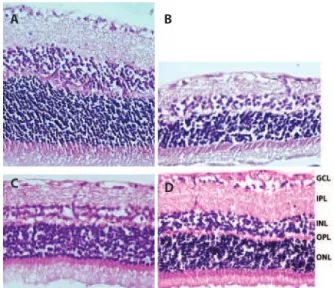
The mean thicknesses of RGCL, IPL, OPL, INL, and ONL were 19 ± 2.7 µm, 60 ± 12.1 µm, 11 ± 3.0 µm, 27 ± 9.9 µm, and 55 ± 13.3 µm, respectively, in the control group; 8 ± 1.4 µm; 22 ± 6.5 µm, 7 ± 1.9 µm, 16 ± 6.4 µm, and 40 ± 8.7 µm in the ischemic group; 9 ± 0.9 µm, 22 ± 7.4 µm, 7.4 ± 1.6 µm, 17 ± 5.2, and 41 ± 10.2 µm in the solvent group; and 10 ± 3.8 µm, 25 ± 8.2 µm, 9 ± 2.4 µm, 21 ± 5.6 µm, and 50 ± 12.8 µm, respectively, in the quercetin group (Figures 1 and 2).
the reduction in the thicknesses of both ONL and INL was statistically signiicant, particularly in the quercetin group; ONL mean thickness in the quercetin and ischemic groups were 50 ± 12.8 µm and 40 ± 8.7 µm, respectively (P<0.05), and INL mean thickness in the quercetin and is-chemic groups were 21 ± 5.6 µm and 16 ± 6.4 µm, respectively (P<0.05).
T
HEEFFECTOFQUERCETINONTHENUMBEROFTUNEL (+)
CELLSININL
ANDONL
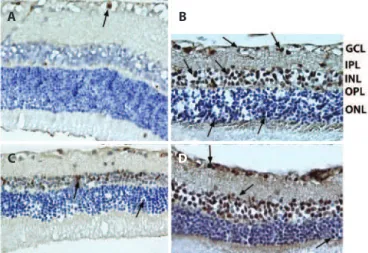
The mean number of TUNEL (+) cells counted in INL was 10.88 ± 3.5/mm², 476.8 ± 45.6/mm², 336 ± 34.9/mm², and 238.72 ± 251/mm² in the control, ischemic, solvent, and quercetin groups, respectively. The mean number of TUNEL (+) cells in INL was signiicantly lower in the quercetin group than in the ischemic group (P<0.005). Moreover, the mean number of TUNEL (+) cells counted in ONL was 197.76 ± 18.4/mm², 176 ± 16.8/mm², and 71.68 ± 11.8/mm2 in the ischemic, solvent, and quercetin groups, respectively. The mean number of TUNEL (+) cells in ONL was also signiicantly lower in the quercetin group than in the ischemic group (P<0.05; Figures 3 and 4).
C
HANGESINTHENUMBEROFCASPASE-3 (+)
CELLSININL
ANDONL
The mean number of caspase-3 (+) cells detected in INL was 62.56 ± 0.2/mm², 633.6 ± 38.7/mm², 550 ± 34.2/mm², and 342.4 ± 36.1/mm² in the control, ischemic, solvent, and quercetin groups, respectively. Treatment with quercetin was found to signiicantly decrease the number of caspase-3 (+) cells in INL by a ratio of nearly 46% when compared with the ischemic group (P<0.05). Moreover, the mean number of caspase-3 (+) cells detected in ONL was 43.6 ± 9.4/mm², 41.2 ± 6.7/mm², and 29,7 ± 8.4/mm² in the ischemic, solvent, and quercetin groups, respectively. Quercetin treatment was found to signiicantly decrease the number of caspase-3 (+) cells in ONL by a ratio of nearly 32% when compared with the ischemic group (P<0.05; Figures 5 and 6).
DISCUSSION
The antioxidant, free radical-scavenging, and neuroprotective efects of quercetin is well known(15-17). Besides these important bene-its of quercetin, it also has a protective efect against apoptotic cell damage. Some experimental studies have revealed the antiapoptotic efect of quercetin on I/R injury in various organs(18,19); however, we have not been able to ind any experimental studies evaluating the beneit of quercetin in treatment of I/R injury of the retina.
Because apoptosis is the mechanism predominantly involved in retinal cell death, antiapoptotic drugs or substances are considered
*P<0.05 compared with the control group.
¥ P<0.05compared with the control, ischemic, and solvent groups.
Figure 1. The thicknesses of the retinal layers (µm) as measured in each group.
A
C
B
D
Figure 2. Representative photographs showing retinal thickness detected in the rat retina. A) Normal appearance of the retina (control group). B and C) Retinal thickness in the ischemic group and solvent group, respectively; in both of B and C, the thicknesses of the retina was found to be signiicantly reduced after ischemia. D) Retinal thickness in the quercetin group. Total retinal thickness in the quercetin group was signiicantly less reduced compared with the ischemic group at end of the experiment. H&E staining (×400).
Figure 4. Representative photographs of TUNEL staining of rat retinas in control (A), ischemic (B), solvent (C), and quercetin (D) groups. The number of cells positive by TUNEL staining was increased in ischemic rats. However, treatment with quercetin markedly reduced retinal cell apoptosis. Arrows: TUNEL (+) cells. (×400).
A
C
B
D
a= P<0.001 compared with the control group.
b= P<0.005 compared with the control and ischemic groups. c= P<0.05 compared with the control, ischemic, and solvent groups. d= P<0.05 compared with the control group.
particularly beneicial in the treatment and prevention of retinal di-seases that are associated with the formation of excessive apoptosis, such as I/R injury.
The exact mechanism of cell death due to retinal ischemia is incompletely known; however, it was previously demonstrated that in conditions of oxidative stress, retinal ganglion cells are damaged as a result of increased intracellular ROS and calcium inlux(20). During I/R, overproduction of ROS leads to excessive apoptosis by inducing the secretion of glutamate and calcium inlux(21-23). Apart from indu-cing apoptosis, increased intracellular calcium levels may also cause cellular damage by hindering mitocondrial functions, decreasing the level of intracellular adenosine triphosphate (ATP), inducing ROS production, and stimulating cellular proteases and nitric oxide synthase(24). Therefore, it is conceivable that the maintainance of intracellular free calcium levels at an optimal concentration may be critical for treating I/R injury.
Flavonoids, such as quercetin, contain a lavonol nucleus that is surrounded by functional groups that have the ability to maintain the intracellular free calcium concentration at low levels by inluencing glutathione metabolism, particularly in conditions of excessive ROS
production(25,26). Therefore, it may be reasonable to use quercetin in the treatment of I/R injury because of its beneicial biochemical properties.
A supressor efect of quercetin against the activities of caspase-3 and calpain, which are the representitive proteases in apoptotic and necrotic pathways, was demonstrated in puriied primary rat retinal ganglion cell cultures and in human retinal pigment epithelium cell cultures(27,28). Moreover, an antiapoptotic efect of quercetin in terms of reducing caspase-3 activity has also been demonstrated in a myocardial I/R model(29). Because quercetin was found to induce cardioprotection in the myocardial I/R model, we thought that it may also be beneicial for retinal protection in the ocular I/R model; hence, we aimed to investigate this relationship in the present study. To develop the ocular I/R model, we applied a widely used me-thod, which involves increasing the intraocular pressure above the ocular perfusion pressure for nearly 60 min(5). In the histological exa-mination of the retina, this procedure was found to cause retinal da mage through diferent types of cell death mechanisms such as apoptosis, necrosis, and nonlysosomal vesiculate(5). Hughes demons-trated increased apoptosis and INL thinning in a tissue model of acute ischemic injury(30). In addition, a number of investigations have shown that a peak in apoptosis occurs 6 to 18 h after I/R, returning to control levels after 48 h(31,32). Therefore, in the present study, we administered quercetin immediately after the induction of ischemia but before the begining of reperfusion, i.e., before the peak of apoptosis. Forty-eight hours later, we found that the thickness of the retinal layers in the quercetin group was signiicantly less decreased than that in the is-chemic and solvent groups.
Moreover, a signiicant decrease in the number of TUNEL (+) and caspase-3 (+) cells was detected in both INL and ONL in the quercetin group in comparison with the ischemic group. Because TUNEL (+) and caspase-3 (+) cells are important markers in the determination of apoptosis, obtaining a reduction in the number of such markers and a decrease in the thinning of retinal layers clearly demonstrates the antiapoptotic efect of quercetin on I/R-induced retinal injury. Although the decrease in the thinning of INL and ONL was found to be almost similar, the antiapoptotic efect of quercetin appeared much more evident in INL than in ONL. We believe that this disparity may arise from a diference in susceptibility of INL and ONL to ische-mic damage. In a previous study, the intensity of apoptotic cell loss was found to be more signiicant in INL than in ONL in the earlier phases of I/R injury(33). Consistent with this inding, we also observed that the number of both TUNEL (+) and caspase-3 (+) cells was much higher in INL than in ONL.
In the present study, the reason for the signiicantly increased degree of apoptosis in INL may result from excitotoxicity, which is coupled to hypersecretion of excitatory amino acids such as gluta-mate. This idea is supported by the indings of both Massey et al. and Brandstätter et al. who showed that expression of glutamate recep-tors is conined to neurons of the ganglion cell layer and INL(34,35). This supports the hypothesis that quercetin may achieve its antiapoptotic efect depending on the intensity of the apoptosis, and it may be beneicial, particulary in the presense of increased apoptosis. On the other hand, because the number of both TUNEL (+)and caspase-3 cells was much lower in ONL in all the groups, it is speculated that the antiapoptotic efect of quercetin may not be prominent in ONL because of decereased induction of apoptosis. However, in an animal model of I/R injury, an increased rate of apoptosis in ONL was repor-ted to be associarepor-ted with extended postischemic survival time(36). In our study, upon evaluation of the early phases of I/R injury, we speculate that a signiicant decrease in the thickness of ONL in the ischemic group may also be due to a diferent cell death mechanism such as necrosis in addition to apoptosis. Therefore, the assessment of the intensity of apoptosis in ONL should be also elucidated in the later phases of the I/R injury model, to gain additional insight into the antiapoptotic efects of quercetin in all the layers of the retina.
a= P<0.0001 compared with the control group
b= P<0.001 compared with the control and ischemic groups c= P<0.005 compared with the control and quercetin groups d= P<0.05 compared with the control, ischemic, and solvent groups
Figure 5. The number of caspase-3 (+) cells in the inner nuclear layer (INL) and outer nucler layer (ONL) in each group.
A
C
B
D
Caspase-3 is an important marker of apoptosis, and it is capable of decreasing the thickness of retinal layers as a result of activating the proteolytic cascade(37). Hence in the current study, the possible mechanism of the efect of quercetin on change in retinal thickness over a relatively short time may arise from its inhibitory efect on cas-pase-3 cells. In a previous study, a dose of 20 mg/kg i.p. quercetin was found to be suicient for achieving cerebral protection in a cerebral I/R injury model; we also used quercetin at a dose of 20 mg/kg i.p. in our retinal I/R injury model(38). Although, we could not assess the penetrance of quercetin into the retinal layers, we believe that when systemically used, quercetin may accumulate in the retinal layers at adequate concentrations during ischemic injury because of the possibly broken blood-retinal barrier. On the other hand, an antia-poptotic efect of quercetin was also previously demonstrated in the retinal layers of the streptozotocin-induced diabetic rats even after oral administration(39). This result may indicate that quercetin has a good oral bioavailability; therefore, if the therapeutic dose is adjusted for humans in future studies, oral use of quercetin may be beneicial in the treatment of various retinal diseases associated with I/R injury.
Toxicity studies of quercetin and electrophysiological tests of the retina could not be performed in the present study because of inadequate laboratory equipment; we view this as a major limitation of this study. Because we histologically examined the retinal tissues 48 h after I/R injury, the antiapoptotic efect of quercetin in the later periods of the injury could not be properly evaluated, and this is ano-ther major limitation of this study. However, we used an additional number of rats to create a control group. However, we believe that if we had used the left eyes of either the ischemic group or the solvent group as a control group, we would not have been able to perform accurate comparisons between the control group and the other experimental groups because of the inluence of possibly increased inlammatory cytokines produced in the eye with I/R injury, as in the case of sympathetic ophthalmia.
CONCLUSION
To the best of our knowledge, this study is the irst to demonstrate the neuroprotective efect of quercetin on apoptotic cell injury in a retinal I/R model. Because a signiicant antiapoptotic efect of quer-cetin was obtained when it was used even after the begining of is-chemia, the present study could be valuable with respect to revealing the therapeutic efects of quercetin on retinal diseases, for which the pathophysiological mechanism involves I/R injury.
REFERENCES
1. Zimmerman BJ, Granger DN. Oxygen free radicals and the gastrointestinal tract: role in ischemia-reperfusion injury. Hepatogastroenterology 1994;41(1):337-42. 2. Bresnick GH. Excitotoxins: a possible new mechanism for the pathogenesis of
ische-mic retinal damage. Arch Ophthalmol.1989;107(3):339-41.
3. Qu J, Wang D, Grosskreutz CL. Mechanisms of retinal ganglion cell injury and defense in glaucoma. Exp Eye Res. 2010;91(1):48-53.
4. Ryan SJ (ed). Retina. 5th ed. Philadelphia (PA): Elsevier/Mosby; 2013. Vol. 1, p.537 5. Büchi ER. Cell death in the rat retina after a pressure-induced ischaemia-reperfusion
insult: an electron microscopic study. I. Ganglion cell layer and inner nuclear layer. Exp Eye Res. 1992;55(4):605-13.
6. Levin LA, Louhab A. Apoptosis of retinal ganglion cells in anterior ischemic optic neur opathy. Arch Ophthalmol. 1996;114(4):488-91.
7. Osborne NN, Casson RJ, Wood JP, Chidlow G, Graham M, Melena J. Retinal ischemia: mechanisms of damage and potential therapeutic strategies. Prog Retin Eye Res. 2004;23(1):91-147.
8. Chen WJ, Sun SF, Cao W, Liang Y, Song JR. Antioxidant property of quercetin-Cr(III) com-plex: The role of Cr(III) ion. J Mol Struct. 2009;918:194-7.
9. Chao CL, Hou YC, Chao PD, Weng CS, Ho FM. The antioxidant efects of quercetin metabolites on the prevention of high glucose-induced apoptosis of human umbilical vein endothelial cells. Br J Nutr. 2009;101(8):1165-70.
10. Chang HC, Yang YR, Wang PS, Wang RY. Quercetin enhances exercise-mediated neu-roprotective efects in brain ischemic rats. Med Sci Sports Exerc. 2014;46(10):1908-16.
11. Sekaran S, Kandaswamy S, Gunasekaran K, Perumal E, Afsar Basha FY, Madhan Mohan BJ, et al. Protective role of quercetin on polychlorinated biphenyls (Aroclor-1254) in-duced oxidative stress and apoptosis in liver of adult male rats. J Biochem Mol Toxicol. 2012;26(12):522-32.
12. Büchi ER, Suivaizdis I, Fu J. Pressure-induced retinal ischemia in rats: an experimental model for quantitative study. Ophthalmologica. 1991;203(3):138-47.
13. Woo TT, Li SY, Lai WW, Wong D, Lo AC. Neuroprotective efects of lutein in a rat model of retinal detachment. Graefes Arch Clin Exp Ophthalmol. 2013;251(1):41-51. 14. Sayhan MB, Kanter M, Oguz S, Erboga M. Protective efect of Urtica dioica L. on renal
ischemia/reperfusion injury in rat. J Mol Hist. 2012;43(6):691-8.
15. Rodriguez RJ, Miranda CL, Stevens JF, Deinzer ML, Buhler DR. Inluence of phenylated and non-phenylated lavonoids on liver microsomal lipid peroxidation and oxidative injury in rat hepatocytes. Food Chem Toxicol. 2001;39(5):437-45.
16. Boots AW, Haenen GR, Bast A. Health efects of quercetin: from antioxidant to nutra-ceutical. Eur J Pharmacol. 2008;13;585(2-3):325-37.
17. Rogerio AP, Dora CL, Andrade EL, Chaves JS, Silva LF, Lemos-Senna E, et al. Anti-inlamma-tory efect of quercetin-loaded microemulsion in the airways allergic inlammaAnti-inlamma-tory model in mice. Pharmacol Res. 2010;61(4):288-97.
18. Ghosh A, Sarkar S, Mandal AK, Das N. Neuroprotective role of nanoencapsulated quer cetin in combating ischemia-reperfusion induced neuronal damage in young and aged rats. PLoS One 2013;19;8(4):e57735.
19. Chen YW, Chou HC, Lin ST, Chen YH, Chang YJ, Chen L, et al. Cardioprotective efects of quercetin in cardiomyocyte under ischemia/reperfusion injury. Evid Based Com-plement Alternat Med. 2013;2013:364519.
20. Maher P, Hanneken A. Flavonoids protect retinal ganglion cells from oxidative stress-induced death. Invest Ophthalmol Vis Sci. 2005;46(12):4796-803.
21. Xu H, Chen M, Forrester JV. Para-inlammation in the aging retina. Prog Retin Eye Res. 2009;28(5):348-68.
22. Jarrett SG, Lin H, Godley BF, Boulton ME. Mitochondrial DNA damage and its potential role in retinal degeneration. Prog Retin Eye Res. 2008;27(6):596-607.
23. Meldrum B, Garthwaite J. Excitatory amino acids in neurotoxicity and neurodegene-rative disease. Trends Pharmacol Sci. 1990;11(9):379-87.
24. Osborne NN, Ugarte M, Chao M, Childlow G, Wood JP, et al. Neuroprotection in rela-tion to retinal ischemia and relevance to glaucoma. Surv Ophthalmol. 1999;43 Suppl 1:S102-28.
25. Heim KE, Tagliaferro AR, Bobilya DJ. Flavonoid antioxidants: chemistry, metabolism and structure-activity relationships. J Nutr Biochem. 2002;13(10):572-84.
26. Ishige K, Schubert D, Sagara Y. Flavonoids protect neuronal cells from oxidative stress by three distinct mechanisms. Free Radic Biol Med. 2001;30(4):433-46.
27. Nakayama M, Aihara M, Chen YN, Araie M, Tomita-Yokotani K, Iwashina T. Neuropro-tective efects of lavonoids on hypoxia-, glutamate-, and oxidative stress-induced re ti nal ganglion cell death. Mol Vis. 2011;17:1784-93.
28. Kook D, Wolf AH, Yu AL, Neubauer AS, Priglinger SG, Kampik A, et al. The protective efect of quercetin against oxidative stress in the human RPE in vitro. Invest Ophthalmol Vis Sci. 2008;49(4):1712-20.
29. Wang Y, Zhang ZZ, Wu Y, Ke JJ, He XH, Wang YL. Quercetin postconditioning attenua-tes myocardial ischemia/reperfusion injury in rats through the PI3K/Akt pathway. Braz J Med Biol Res. 2013;46(10):861-7.
30. Hughes WF. Quantation of ischemic damage in the rat retina. Exp Eye Res. 1991;53(5): 573-82.
31. Zhao Y, Niu YJ, Zhou ZY, Gao YX, Wang HY. Expression of Fas/Fas L and the apoptosis in rat ischemia/reperfusion-induced retinal injury and efects of bFGF. Int J Opthalmol. 2008;1:226-9.
32. Zheng GY, Zhang C, Li ZG. Early activation of caspase-1 after retinal ischemia and reper-fusion injury in mice. Chin Med J (Engl). 2004;117(5):717-21.
33. Ju WK, Kim KY, Hofmann HD, Kim IB, Lee MY, Oh SJ, et al. Selective neuronal survival and upregulation of PCNA in the rat inner retina following transient ischemia. J Neu-ropathol Exp Neurol. 2000;59(3):241-50.
34. Massey SC. Cell types using glutamate as a neurotransmitter in the vertebrate retina. In: Osborne NN, Chader GJ, editors. Progress in retinal research, Oxford: Pergamon Press; 1994. p.399-426.
35. Brandstätter JH, Koulen P, Wässle H. Diversity of glutamate receptors in the mamma-lian retina. Vision Res. 1998;38(10):1385-97.
36. Kim IB, Kim KY, Joo CK, Lee MY, Oh SJ, Chung JW, et al. Reaction of Müller cells after increased intraocular pressure in the rat retina. Exp Brain Res. 1998;121(4):419-24. 37. Abu-El-Asrar AM, Dralands L, Missotten L, Al-Jadaan IA, Geboes K. Expression of
apop-tosis markers in the retinas of human subjects with diabetes. Invest Ophthalmol Vis Sci. 2004;45(8):2760-6.
38. Mansoorali KP, Prakash T, Kotresha D, Prabhu K, Rama Rao N. Cerebroprotective efect of Eclipta alba against global model of cerebral ischemia induced oxidative stress in rats. Phytomedicine 2012;15;19(12):1108-16.