INTELLECTUAL PRODUCTION OF THE PROFESSORS FROM THE
FACULTY OF EDUCATION/UFRGS: ANALYSIS OF DOCUMENTS
TYPOLOGY
Ana Gabriela Clipes Ferreira
Universidade Federal do Rio Grande do Sul (UFRGS) Brazil
ABSTRACT
This article aims to approach the intellectual production of the Professors from the Faculty of Education at the Universidade Federal do Rio Grande do Sul (FACED/UFRGS). This study is about a quantitative traits with qualitative analyzes using mixed methods. Through the Common Command Language (CCL) command at the software Aleph, it was collected the productions deposited from 2007 to 2010 and it was confronted with the data of the 2010 Census of Conselho Nacional de Desenvolvimento Científico e Tecnológico (CNPq). The type of document on which the FACED departments publish more were the papers presented in annals of international events, followed by chapters of books and articles in national journals indexed. Concluded that although constrained, the method used enables the analysis of productivity of diversified documents, which would not be possible in a database collection.
Keywords: Scientific Communication; Scientific Production. Intellectual Production;
Bibliometrics.
1 INTRODUCTION
The end product of a research is usually considered as the publication of the results, either total or partial. However, to enable the Science to expand the Information cycle, it is desirable that this work be cited. To the scientific journals, having articles cited is fundamental to the achieving of impact and, in certain areas of knowledge, having no impact is a synonym of invisibility in front of peers.
However, with the advancement of technology and the change of several paradigms, one can observe the increasing number of journals in all areas and the Human Sciences are inserted in this phenomenon. Another relevant aspect to highlight the differences between the areas is the assessment of the development agencies: in the humanities area, for example, if observed the documents of the area for the obtaining of the Qualis of the Coordenação de Aperfeiçoamento de Pessoal de Nível Superior (CAPES), the impact factor is not considered as significantly as in other areas of the hard sciences. Finally, Meadows (1999), despite of presenting the preferred channels of each area, stresses that measuring the productivity of researchers from different areas is a delicate issue, given that it is not possible to compare the content of a book with the one of an article, for example.
In this work we investigated the intellectual production by typology of documents produced by the professors of the Faculty of Education at the
Universidade Federal do Rio Grande do Sul (FACED/UFRGS). In the analysis the three departments of the Faculty were analyzed, besides the production of retired professors or special guests connected to the Post Graduate Program in Education and Computer in the Education. Conducted the survey of the typology of these documents and the data analysis, it is asked whether there is a possibility of the authors to receive citations.
2 INTELLECTUAL PRODUCTION AT THE UFRGS AND AT THE FACED
intellectual production at the academic and administrative units of the University, dissemination of the intellectual production of the Institution, among others.
The documents produced by the professors are inserted in the database Sistema de Automação de Bibliotecas (SABI), which uses the software Aleph version 20. A the bibliographic record they are inserted fields of the format Machine Readable Cataloging (MARC) differentials of the other documents, which are: 090, that identifies the areas of knowledge according to the Conselho Nacional de Desenvolvimento Científico e Tecnológico (CNPq), and the field 909 that includes the subfields 'a' (department/unit/organ), 'b' (production type), 'c' ( postgraduate program), 'd' (specialization course) 'and' (graduation), 'f' (funding body), and 'g' (professional teaching course).
In the field 909, subfield 'b', the production is defined by codes, depending on the type of document: 'pa' indicates book; 'pb' book chapter; 'pfi' article published in indexed foreign journal; 'pgi' article published in national indexed journal; 'pfn' article published in a not indexed foreign journal; 'pgn' article published in a not indexed national journal; 'pj' work published in the annals of event held outside the country; 'ph' work published in annals of event held in the country (OLIVEIRA et al., 2004). It is still possible to identify several other types of documents, such as the theses and dissertations, work of completion of graduation or specialization course, among others, however the documents which will be analyzed in this study are the ones identified above by the code.
The Repositório Digital da Universidade Federal do Rio Grande (LUME) provides the documents which are in electronic format. The LUME collects the data inserted into the SABI, in other words, the records are included by the librarians of the University, unlike other types of repositories, on which the author inserts the data. Currently, the LUME is the second repository with more accesses in Brazil and the 41st in the world1. The documents can be viewed and downloaded for free by any user.
substitutes, and 2 (two) Postgraduate Programs (Education and Computer in the Education). There is a large flow of bibliographic material produced by these professors, as well as by the retired teachers invited by the Postgraduate Programs (EDU0). For this reason, it was opted at the Sectorial Library of Education (BSE) for the creation of an exclusive area for the cataloging of this material, aiming that the insertion be done in a quickly and centralized way. The responsibility for the delivery of books, magazines, among others, is from the professors; however in this sector it is made the sorting in printed journals that the unit has the subscription, finding articles that have authorship or co-authorship from the professors, as well as the search in annals of important events in the area.
3 THE SCIENTIFIC COMMUNICATION AND ITS CHANNELS
The unpublished survey does not exist in the eyes of the scientific communication. Therefore, it is necessary that the research results are disseminated, in other words, that there is the exchange of information among researchers. This exchange system is called scientific communication, which can be anything from a casual conversation to the publication in books or journals (GARVEY, 1979).
The communication channels can be formal and informal. They are considered the link between the researchers and the public (MEADOWS, 1999; TARGINO, 1999). The formal channels are constructed by books, journals, probably the most known and used, besides the reference work, technical reports, literature reviews, bibliographies of bibliographies, among others.
The advantages of the formal channels are related to the reach of a wide public; safer storage and retrieval; moderate volume of redundant information; and higher rigidity and control via previous assessment (TARGINO, 2000; MEADOWS, 1999). The main disadvantage of the formal channels is the level of downgrading of information.
documenting the Science), videoconferencing, messages exchanged by e-mail, chats, discussion lists, are also considered informal communications.
The advantages of the informal channels are the speed and the currency in the dissemination of information and the interactivity between author and reader and peers. Among the disadvantages, it can be cited the lack of previous assessment, the public is restricted, and the redundancy, recovery and the storage of such information (MEADOWS, 1999; TARGINO, 2000).
The informal channels have gained ground in the recent decades thanks to the facilities provided by the web, which provides higher alternatives of dissemination and discussion of results. The scientific community can, though informally, discuss, criticize, add new ideas through comments and thus contribute to the final result. The practice of the electronic communication has positive and negative aspects. Meadows (1999), states that, with the reduction of the boundaries between the traditional communication, formal and informal, between the different properties of the electronic and printed media, it becomes more difficult the assessment of the information quality.
For each area of knowledge, the means of communication may be different. In the humanities area there is the preference for publication in book, on the other hand, in the Medical area the journal is the preferred among the scientists (MEADOWS, 1999). In each situation, the use of formal or informal communication will be justified as the ideal. The two types of communication complement each other and can coexist without any friction between them, in other words, one does not exclude the other, as it happens to the printed and electronic formats. The decision of the most appropriate information channel to publish is of the scientist, choice that can occur either by his area of knowledge, of the goals when publishing, which can be to contribute to the advancement of Science, as well as being recognized by his peers.
4 METHODS
setting up, therefore, as a research of mixed methods (CRESWELL, 2007). To deepen the analysis of bibliometric studies, regardless of whether it is a study of productivity, citation analysis, among others, it is critical that the quantitative data be analyzed in a qualitative way. Thus, the mixed method assists the execution of the qualiquantitative analysis of the research.
For the data collection, we used the Common Command Language (CCL) [Common Command Language] from the Aleph software version 20. We searched the departments of FACED by the respective codes (EDU0, EDU01, EDU02 and EDU03). Next, the search was refined by year (2007 to 2010) and, finally, by the type
of document (‘pa’, ‘pb’, ‘pfi’, ‘pgi’ and the others used in this research). The search strategy can be exemplified like this: WUN=EDU0 + WYR=2007 + WPI=pa. The data were compiled in an electronic spreadsheet.
The selected population refers to documents produced in books, book chapters, national and international articles, and events for teachers between the years 2007 to 2010. The period and the typology of documents were selected in order to confront with the data from the 2010 Census from the Directory of Research Groups of CNPq, and to have a parameter of the national production of the wide area of Humanities with the one of Education defined in this study, once that the professors of FACED publish in several subareas of this wide area such as: Philosophy, Anthropology, Psychology, among others.
5 RESULTS
Table 1: Intellectual Production of the professors from FACED / UFRGS by department, type of production and year.
EDU0 – RETIRED PROFESSORS, GUESTS PPG
Type of Document 2007 2008 2009 2010
Total per Type of Production
Book 3 5 11 7 26
Chapter 14 5 13 14 46
Article published in foreign indexed journal 1 3 0 0 4 Article published in national indexed journal 12 9 6 11 38 Article published in foreign not indexed journal 7 2 2 1 12 Article published in national not indexed journal 3 2 13 2 20 Paper published in annals of event held in the country 2 3 2 3 10 Paper published in annals of event held outside the
country 15 17 15 10 57
Total per year 57 46 62 48
EDU01 – DEPARTAMENT OF BASIC STUDIES
Type of Document 2007 2008 2009 2010
Total per Type of Production
Book 7 11 9 27 54
Chapter 40 28 24 40 132
Article published in foreign indexed journal 1 1 1 1 4 Article published in national indexed journal 17 14 8 4 43 Article published in foreign not indexed journal 0 1 0 1 2 Article published in national not indexed journal 7 11 4 3 25 Paper published in annals of event held in the country 2 6 5 8 21 Paper published in annals of event held outside the
country 20 39 33 15 107
Total per year 94 11 84 99
EDU02 – DEPARTAMENT OF TEACHING AND CURRICULUM
Type of Document 2007 2008 2009 2010
Total per Type of Production
Book 9 10 10 22 51
Chapter 37 48 10 56 151
Article published in national not indexed journal 5 9 11 8 33 Paper published in annals of event held in the country 3 4 3 3 13 Paper published in annals of event held outside the
country 51 100 53 38 242
Total per year 125 185 102 137
EDU03 – DEPARTAMENTO DE ESTUDOS ESPECIALIZADOS
Type of Document 2007 2008 2009 2010
Total per Type of Production
Book 10 8 10 10 38
Chapter 28 19 27 40 114
Article published in foreign indexed journal 1 3 0 0 4 Article published in national indexed journal 10 16 23 32 81 Article published in foreign not indexed journal 0 0 1 1 2 Article published in national not indexed journal 5 8 3 6 22 Paper published in annals of event held in the country 14 5 5 10 34 Paper published in annals of event held outside the
country 54 73 71 48 246
Total per year 122 132 140 147
Graphic 1: Intellectual production of the professors from all the FACED/UFRGS departments (2007-2010).
The Graphic 1 provides the typology of documents which is determined in the MARC 90, subfield 'b' used at the UFRGS for the registration of the intellectual
0 100 200 300 400 500 600 700 169 443 21 210 18
100 78
652
Book
Chapter
Article published in foreign indexed journal
Article published in national indexed journal
Article published in foreign not indexed journal
Article published in national not indexed journal
Paper published in annals of event held in the country
production. As it can be observed, the number of documents published in international events is predominant in the population and periods analyzed. Because they were surveyed only the document types, it is not possible in this study to verify the reason of a high number of work in international events which may have been accomplished out of the country or not. It was not what happened in just one year of the four analyzed or in a particular department, therefore, it is not an isolated situation of a determined event in which several professors presented papers, but a tendency of professors in this quadrennial. In the analysis of Mueller (2005) about the preferred channels of scientific areas, the result highlights the national events as a preferred channel of researchers from the Humanities area nevertheless the annals of international events have the marginalized presence of these researchers.
If compared with the 2010 Census from the Diretório de Grupos de Pesquisa of the CNPq, the result is similar: there is higher productivity in annals of events, however it does not identify whether they are national or international ones. Odlyzko (2002) pointed out that the papers in the area of Computer Science available free on the Web were often cited. Still in the wide area of the Exacts, in Engineering it is possible to observe the preference of the researchers to publish the results in annals of events (MUELLER, 2005). Possibly with the technologies of education in great prominence, particularly the distance education and computer in education, the need to publish initial or partial results in events is a way to quickly provide the knowledge among the peers and at the same time, to validate among the peers and improve the publication, aiming other communication media, such as books and journals.
The book chapters are the second type of document on which the professors most publish. With this data, it is possible to infer results of future research of authorship: if they publish in chapters of books, it is likely that the work has other authors at the work as a whole, and even in the same chapter. On the other hand, the production of books is considered in the cataloging module of Aleph both authors and publishers or organizers of the work.
in his research, when identified the productivity of the area in national and international journals. In the 2010 Census, the national journals are the second type of support, on which the researchers of the Humanities area publish more, presenting a higher number than in book chapters.
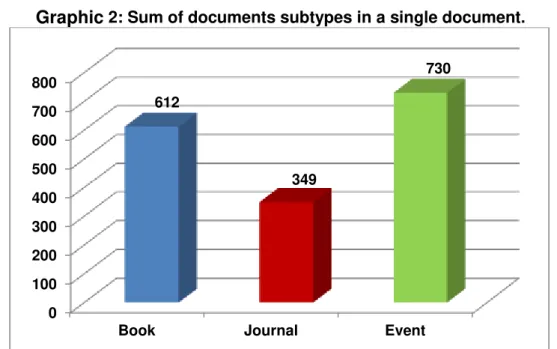
The journals are mentioned in the literature as the preferred means of some areas, unlike the Humanities, which publish traditionally in books (MEADOWS, 1999). However, Packer (2011) points out that the distribution of citations of the articles indexed in the Scientific Electronic Library Online (SciELO), in 2009, by document type and field of knowledge, whose table in the scope of the Humanities presents the following results: 49 % in journals; 46% in books; 2% in annals of events; and 4% in thesis. The numbers of publications in journals and books is very close, being the first slightly higher. In this case, the data of the journals in the scope of the SciELO contradict the scientific literature, already demonstrating changes in the way of publishing in the Humanities area.
Graphic 2: Sum of documents subtypes in a single document.
With these results, it is possible to verify how the researches of certain areas in databases which provide bibliometric indices may be impaired, given that the productivity in indexed journals at these sources is still modest both in the Humanities area and in the country, even Brazil having a considerable increase of the production viewed internationally in the latest years. Both the collection and the data analysis would be necessary tools different from those used for the areas that traditionally have impact.
6 FINAL CONSIDERATIONS
This is about an initial study on which it was carried out first the survey of the intellectual production of a determined group, and at a certain space of time. They were primarily analyzed the types of documents on which the professors of a particular Faculty publish more and from these data, the results were presented and analyzed in a qualitative way. Among the study's limitations, it is emphasized that the mistaken insertion of the data about the intellectual production in field 909, subfield 'b' may bring an unreliable result. Even if inserted by trained professionals, the mistakes may occur as in any other type of database on which the data is collected.
0 100 200 300 400 500 600 700 800
Book Journal Event
612
349
The second limitation quite important to point out refers to the productivity in books: in the system used they are not differentiated the authorship of a work of the edition or its organization. It is understood that the authorship and the organization of a work are different, however in the method used to collect the data there is not such separation, which is another factor that influences in the results of the study.
However, in the cataloging it is clear in the field 700, subfield 4 (which determines the authority) the kind of responsibility for the work. The authorship of chapters does not present such limitation. It is also possible to identify in the introductory textbook, the presenting of the work and even 'ear', having a smaller weight in the evaluation and being properly identified the type of production in the field 909, subfield 'b'. Finally, if the professor has not deposited the whole production in the unit, is possible occurs noise in the analysis. For this reason, it is not convenient to collect data for the current year or the previous one, considering also that there may be a delay in the publications.
Every method presents some limitations, however, the productivity analysis through the collecting of the intellectual production of the professors from UFRGS enables the accomplishment of studies that would be limited if it was searched in databases, for example, which may not possess the journals in which the professors publish, nor other types of documents. Another advantage is that the information was handled by information professionals from the professors units, different from a collection in the Currículo Lattes, resource on which the authors themselves provide the data: the Currículo Lattes also cannot be updated or contain misinformation or in wrong fields from the resource. Even so, the database of the Lattes Platform is, according to Lane (2010), an example of a successful experience and of high quality, once that it provides adequate incentives for the use of the database by the researchers and institutions encourage the academic research and possess dynamic infrastructure.
Banco Pessoa also makes it possible the consultation about the bonds of the author with the UFRGS, either as a student, professor or administrative technician.
The comparison with the 2010 Census from the Diretório de Grupos de Pesquisa of the CNPq was used to get an initial idea of how the publication is currently among the researchers of Education, although the wide area is the one of knowledge and the Education is a subarea. However, the group of professors from FACED/UFRGS is formed with diverse background in the Humanities area, and also from others, in other words, it is multidisciplinary. For this reason, the results of this work are a support for further studies, so that it is possible to analyze qualitatively the numbers presented here.
The factor of impact is not a tradition in the Humanities area. If having impact is to be seen in the Science, it is possible to state at a first moment that the media on which the professors from FACED/UFRGS publish more do not provide great probabilities of citation, once that the publication in indexed national or foreign journal is small in relation to other documents. However, in no way it invalidates the other productions, mainly the great productivity in annals of international events. Considering also the large number of production in books and book chapters, some current initiatives, such as SciELO Books and Book Citation Index, from Thomson Reuters, will in the coming years make the paradigm of impact be different from what is currently for certain areas of knowledge.
The goal of this study was achieved, once that they were identified the types of documents on which the professors from FACED publish. For future studies, it is possible the analysis of other aspects, such as the departments or the most productive authors, the relations of co-authoring and of themes or even to focus on a determined department or subject present in the productivity. A bibliometric study involving the Humanities area is a challenge, due to the deficiency of adequate tools for the collection and analysis of large amounts of data.
REFERERENCES
CRESPO, I. M. Um estudo sobre o comportamento de busca e uso de informação de pesquisadores das áreas de Biologia Molecular e
2005. 119f. Dissertação (Mestrado) - Programa de Pós-Graduação em
Comunicação e Informação - Faculdade de Biblioteconomia e Comunicação - Universidade Federal do Rio Grande do Sul, Porto Alegre, 2005. Available:
<http://www.bibliotecadigital.ufrgs.br/da.php?nrb=000500810&loc=2005&l=b23c2b8 87cba2e41>. Access: Set. 20, 2012.
DIRETÓRIO de Grupos de Pesquisa no Brasil. Súmula Estatística. Censo 2010.
Available:
<http://dgp.cnpq.br/censos/sumula_estatistica/2010/producao/producao.htm>. Access: Apr. 2, 2012.
GARVEY, W. D. Communication: The essence of science; facilitating information
among librarians, scientists, engineers, and students. Oxford: Pergamon, 1979.
LANE, J. Let's make science metrics more scientific. Nature,v.464, p.488-489, Mar.
2010. Available:
<http://www.nature.com.ez45.periodicos.capes.gov.br/nature/journal/v464/n7288/pdf/ 464488a.pdf>. Access: Set. 7, 2012.
MEADOWS, A. J. A comunicação científica.Brasília: Briquet de Lemos, 1999.
268p.
ODLYZKO, A. The rapid evolution of scholarly communication. Learned Publishing, v.15, n.1, p.7-19, Jan. 2002.Available:
<http://www.dtc.umn.edu/~odlyzko/doc/rapid.evolution.pdf>. Access: Apr. 19, 2012.
OLIVEIRA, Z. P. et al. O uso do campo MARC 9XX para controle bibliográfico institucional. Ciência da Informação, Brasília, v.33, n.2, dez. 2004. Available:
<http://revista.ibict.br/ciinf/index.php/ciinf/article/view/105>. Access: Aug. 21, 2012.
MUELLER, S. P. M. A publicação da ciência: áreas científicas e seus canais
preferenciais. DataGramaZero: Revista de Ciência da Informação, Rio de Janeiro,
v.6, n.1, fev. 2005. Available: <http://www.dgz.org.br/fev05/Art_02.htm>. Access: Aug. 30, 2012.
PACKER, A. L. Os periódicos brasileiros e a comunicação da pesquisa nacional. Revista USP, São Paulo, n. 89, maio 2011. Available:
<http://www.revistasusp.sibi.usp.br/scielo.php?script=sci_arttext&pid=S0103-99892011000200004&lng=pt&nrm=iso>. Access: Apr. 20, 2012.
TARGINO, M. das G. Comunicação científica: uma revisão de seus elementos básicos. Informação & Sociedade: Estudos, João Pessoa, v.10, n.2, p.37-85,
2000. Available: <http://www.ies.ufpb.br/ojs2/index.php/ies/article/view/326/248>. Access: Set. 27, 2012.
Available: <http://www.ufrgs.br/cepe/legislacao/Res38-06.htm>. Access: Apr. 7, 2012.
UNIVERSIDADE FEDERAL DO RIO GRANDE DO SUL. Conselho Universitário. 2001. Decisão 118/2001, de 17 de agosto de 2001. Available:
<http://www.ufrgs.br/consun/leis/dec118-01.htm>. Access: Apr. 7, 2012.
NOTES
1 Fonte: <http://www.ufrgs.br/faced>.
Ana Gabriela Clipes Ferreira Chief Librarian
Library of Faculty of Education
Universidade Federal do Rio Grande do Sul (UFRGS) E-Mail: [email protected]