Abstract— Using the Lagrange interpolation the number of conditions determines the interpolation space, however, the k-algebraic Lagrange interpolation only determines their dimension, therefore exist the possibility of choosing different interpolation spaces, this allows to determine a polynomial such that besides be able to interpolate is a good approximation with respect to the uniform norm. In this paper a heuristic technique is developed in order to find this polynomial in the case of an asymptotic function with two nodes and a condition that allows to obtain the polynomial degree.
.
Index Terms— Lagrange K-algebraic interpolation, heuristic procedure, degrade system.
I. INTRODUCTION
he K-algebraic interpolation is an interpolation with a space type
(1) Where the integer set is called the degrade system, non-negative, different and could be non consecutive. The interpolation polynomials have the form
. (2) A Birkhoff interpolation problem consists of an interpolation matrix which elements only are zeros and ones, but lacks null rows, order (m x n) and denoted by
(3) corresponding to a system with m nodes , an interpolation space with dimension and data . The problem is to determine a polynomial from interpolation space that agreed with the following n conditions:
(4)
G. Martínez-Guzmán, M. Bustillo-Díaz, A. Rangel-Huerta, G. Juárez-Díaz, A. Ata-Pérez and N. Quiroz-Hernández. Benemérita Universidad Autónoma de Puebla, Facultad de Ciencias de la Computación,Av. San Claudio y 14 Sur, Ciudad Universitaria, C.P. 72570, Puebla, Puebla [email protected], [email protected], [email protected] [email protected], [email protected], [email protected]
We say that interpolation is algebraic if the space is a set with all polynomials with degree less than n [5] and the interpolation is K-algebraic if the interpolation space is type that results in an extension of the algebraic interpolation
An interpolation matrix is regular ordered if the conditions (1) determine an unique polynomial for each set
of nodes , or equivalently, if the
homogeneous problem (1) with has only trivial solution. So is regular ordered if and only if determinant of the linear system (1), denoted by is nonzero for all
with (5)
Given an interpolation matrix the number of ones in the j-th column is denoted by and equal to
(6) So, the Polya constants of are defined as the numbers:
(7) Theorem. If is an interpolation regular ordered matrix
then the Polya condition is
satisfied.
For the problem with two nodes the Polya condition is a sufficient condition for the ordered regularity. The proof of these results can be found in [1], [2], [3].
The solution of the algebraic interpolation problem is not affected by translations and homothecies from node system, this means that solution to algebraic interpolation problem not depends on the interval [a, b], therefore, it is assumed that the end nodes and take the values 0 and 1, respectively. However, in the K-algebraic interpolation the solution and uniqueness depends on the interval , therefore, does not allow the transfer of nodes but supports homothecies from nodes for this reason the K-algebraic interpolation problems on intervals and , are
Approximation with Interpolation Conditions of
an Asymptotic Function Using K-algebraic
Lagrange Interpolation
G. Martínez-Guzmán, M. Bustillo-Díaz, A. Rangel-Huerta, G. Juárez-Díaz, A. Ata-Pérez and N.
Quiroz-Hernández
.transformed to K-algebraic interpolation problems in the interval .
In algebraic interpolation, the number of conditions determines completely the interpolation space, however, in the K-algebraic interpolation the number of conditions only determines its dimension. For this reason there are an infinite number of degree systems in order to perform the interpolation. This situation establishes the problem of choosing the most suitable system for interpolation such that also we obtain a good approximation with respect to the uniform norm. This work is restricted to the particular case of the Lagrange K-algebric interpolation with two nodes and presents a heuristic procedure in order to determine the degree of the interpolating polynomial that besides is a good approximant in the uniform norm.
II. DEVELOPMENT
A Lagrange interpolation matrix is formed by n rows and unique column that is fully occupied. In this case, interpolation conditions are:
(8) The following statement sets a restrictive necessary and sufficient condition for K-regularity of Lagrange K-algebraic interpolation problem in intervals with the form and
.
Theorem. is a matrix for Lagrange interpolation and a degrees system. Then is regular ordered, regarding degree system , on intervals of the form and if and only if . Demonstration of this statement is on [4].
For the case of Lagrange K-algebraic interpolation, a problem that could be presented is the appropriate choice of degrees system. On the problem with two nodes, the degrees system can be founded considering some additional restrictions, such as the conditions in the first and second derivative at some interpolation points [4]. In this paper a restriction that considers the interpolating polynomial should be very close to the function to be interpolated.
A.Nodes and Interpolation Space .
If , the interpolation interval
is . We want to find an interpolator with the form
(9)
where .
For this case, we perform a transformation, so that the problem becomes an interpolation problem in the range .
If we carried out the transformation ,
the polynomial with the form are required to
fulfill the new conditions, , and
. These conditions imply that and
. Hence the polynomial is
transformed into expression:
(10) from we obtain:
(11)
S value is indeterminate because is unknown. To overcome this trouble we can replace by for some , this t will be consider as the point where the distance between the line that interpolates the points and and the function on the interval such that be maximum, then we require that for any , is very close to . Therefore, s could be taken as the nearest integer number
(12) This substitution may assist in problems where the function is not exactly known, as in some applications where only some values of are known. For the case where the form of is exactly know, this can be used a condition from derivative of in b as shown in [4]. But note that our s can be applied in both cases.
Taking the value of s, the polynomial with the variable x assumes the form
(13)
that is the polynomial approximated to and interpolates the points .
B.Interpolation of in .
We consider the nodes . In order to determine the value of we must obtain the tangent line that interpolates the points
whose equation is
(14)
The value is where the function
(15) So, the interpolating polynomial is
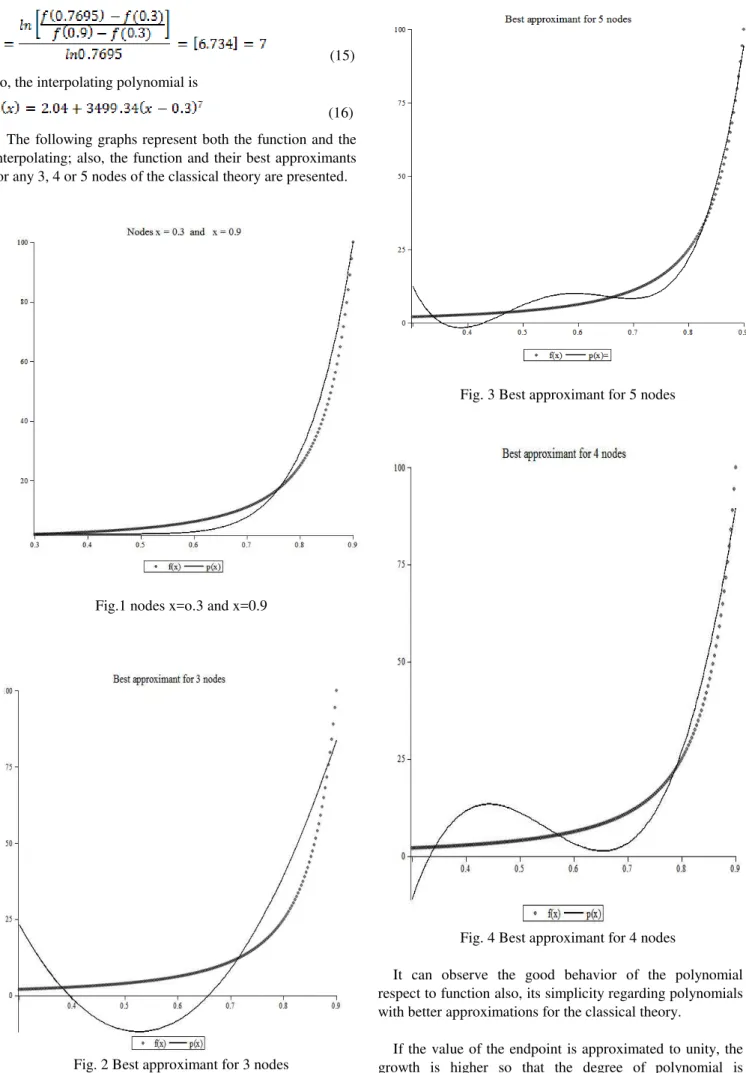
(16) The following graphs represent both the function and the interpolating; also, the function and their best approximants for any 3, 4 or 5 nodes of the classical theory are presented.
Fig.1 nodes x=o.3 and x=0.9
Fig. 2 Best approximant for 3 nodes
Fig. 3 Best approximant for 5 nodes
Fig. 4 Best approximant for 4 nodes
It can observe the good behavior of the polynomial respect to function also, its simplicity regarding polynomials with better approximations for the classical theory.
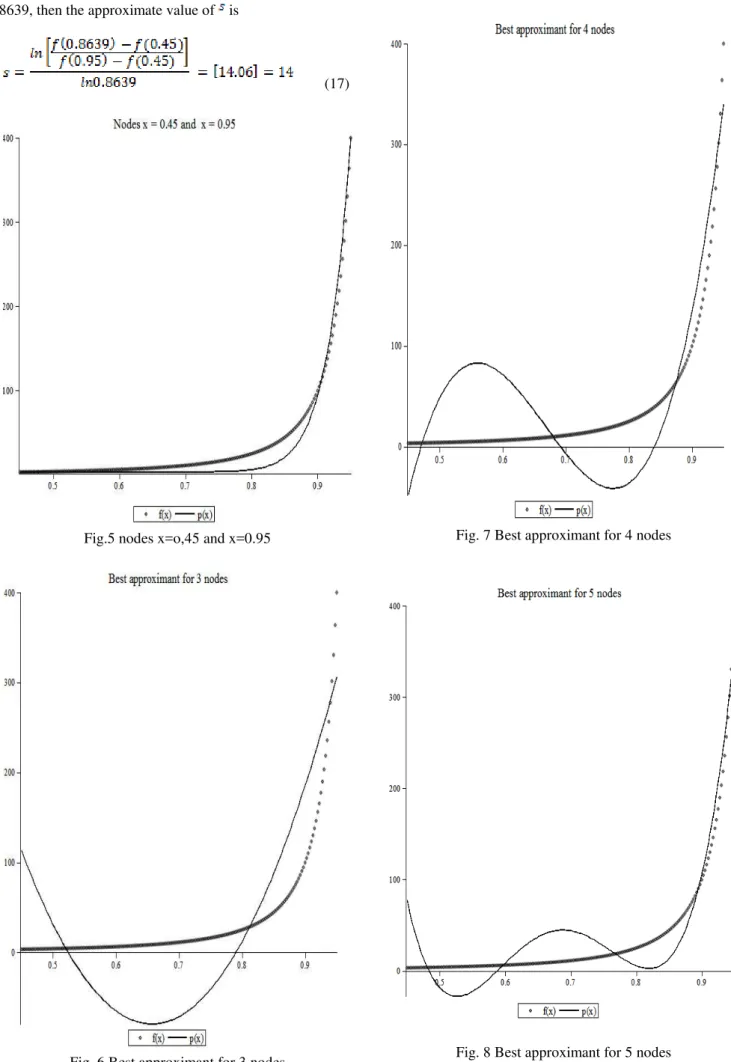
0.8639, then the approximate value of is
(17)
Fig.5 nodes x=o,45 and x=0.95
Fig. 6 Best approximant for 3 nodes
Fig. 7 Best approximant for 4 nodes
Fig. 8 Best approximant for 5 nodes
interpolating polynomial respect to the function besides the simplicity regarding to polynomials with better approximation to the function in classical theory.
III. CONCLUSION
Algebraic interpolation imposes a restriction in the degree of interpolants, that makes difficult the function approximation with high growth, however, using the K-algebraic interpolation can be constructed interpolants with arbitrary degree, obtaining a better approximant.
Using the Remes algorithm can be obtained an approximation to the optimal approximant and realize comparisons to the interpolant obtained in this work that is the better approximant than any interpolator with three, four and five nodes in the classical interpolation.
Other advantage of these interpolants is the small oscillation along the function despite the degree is high, this does not occurs using the optimal approximation since the increment of polynomial degree causes am increment of oscillation.
This technique can be performed in order to find interpolants for functions with high growth, for example, exponential functions.
REFERENCES
[1] K. Atkinson, A Sharma, “A partial characterization of poised hermite-Birkhoff interpolation problems”. SIAM J. Numer. Anal. 6 (1969) pp 230-235.
[2] E. Kimchi and N. Richter, “Best Uniform Approximation with Hermite-Birkhoff interpolatory side conditions”. J. of approximation Theory 15, (1975) pp85-100.
[3] G. G Lorentz, “Birkhoff interpolation and the problem of free matrices”, J. Approximation Theory 6 (1972) pp283-290.
[4] F. Palacios, P. Rubio, “Contribución al Problema de Interpolación de Birkhoff”, Barcelona, diciembre 2004.