www.biogeosciences.net/7/2327/2010/ doi:10.5194/bg-7-2327-2010
© Author(s) 2010. CC Attribution 3.0 License.
Biogeosciences
Heterotrophic denitrification vs. autotrophic anammox –
quantifying collateral effects on the oceanic carbon cycle
W. Koeve and P. K¨ahler
IFM-GEOMAR, Leibniz-Institut f¨ur Meereskunde, D¨usternbrooker Weg 20, 24105 Kiel, Germany Received: 8 February 2010 – Published in Biogeosciences Discuss.: 16 March 2010
Revised: 14 July 2010 – Accepted: 24 July 2010 – Published: 6 August 2010
Abstract. The conversion of fixed nitrogen to N2 in sub-oxic waters is estimated to contribute roughly a third to to-tal oceanic losses of fixed nitrogen and is hence understood to be of major importance to global oceanic production and, therefore, to the role of the ocean as a sink of atmospheric CO2. At present heterotrophic denitrification and autotrophic anammox are considered the dominant sinks of fixed nitro-gen. Recently, it has been suggested that the trophic na-ture of pelagic N2-production may have additional, “collat-eral” effects on the carbon cycle, where heterotrophic deni-trification provides a shallow source of CO2and autotrophic anammox a shallow sink. Here, we analyse the stoichiome-tries of nitrogen and associated carbon conversions in marine oxygen minimum zones (OMZ) focusing on heterotrophic denitrification, autotrophic anammox, and dissimilatory ni-trate reduction to nitrite and ammonium in order to test this hypothesis quantitatively. For open ocean OMZs the com-bined effects of these processes turn out to be clearly het-erotrophic, even with high shares of the autotrophic anam-mox reaction in total N2-production and including various combinations of dissimilatory processes which provide the substrates to anammox. In such systems, the degree of het-erotrophy (1CO2:1N2), varying between 1.7 and 6.5, is a function of the efficiency of nitrogen conversion. On the contrary, in systems like the Black Sea, where suboxic N-conversions are supported by diffusive fluxes of NH+4 orig-inating from neighbouring waters with sulphate reduction, much lower values of1CO2:1N2can be found. However, accounting for concomitant diffusive fluxes of CO2, the ratio approaches higher values similar to those computed for open ocean OMZs. Based on this analysis, we question the signif-icance of collateral effects concerning the trophic nature of suboxic N-conversions on the marine carbon cycle.
Correspondence to:W. Koeve ([email protected])
1 Introduction
The importance and relative proportion of processes remov-ing combined nitrogen from the marine environment is cur-rently under discussion. There is evidence supporting the long standing view that heterotrophic denitrification domi-nates oceanic N loss, but also autotrophic anaerobic ammo-nium oxidation (anammox) has been reported to make up for large shares, or even the bulk, in certain waters (e.g. Thamdrup et al., 2006; Ward et al., 2009). Both processes convert fixed nitrogen into N2 (Ward et al., 2007; Devol, 2008) and reduce the oceanic nutrient inventory in this way. Temporal changes of the nitrogen removal flux in the past (on glacial/interglacial timescales), or from present to fu-ture, are thought to influence the level of oceanic production and associated CO2fluxes (Altabet et al., 1995; Ganeshram et al., 1995; Codispoti, 1995) by tightening or relaxing N-limitation of oceanic primary production and export. There are other aspects in which both processes differ (collateral ef-fects, Voss and Montoya, 2009). One example is the forma-tion of climate reactive gases, namely N2O (Jin and Gruber, 2003), which is an intermediate of denitrification (Yoshinari and Knowles, 1976) but not known as one of anammox. Here we focus on collateral effects of the trophic status of nitrogen loss processes on the carbon cycle, as recently proposed by Voss and Montoya (2009).
Table 1.Stoichiometric equations for (1) dissimilatory nitrate reduction to nitrite (DNRN), (2) denitrification, (3) anammox, and (4) dissim-ilatory nitrate reduction to ammonium (DNRA) for bulk organic matter with an average composition of CaHbOcNdPeSf. For simplicity and following Paulmier et al. (2009) we give the stoichiometric equations in non-ionic forms. We assume reaction of NH3and CO2with water and subsequent dissociation as well as dissociation of HNO3, HNO2, H3PO4, and H2SO4according to seawater pH. For a more detailed discussion of the derivation of Eqs. (1), (2), and (3) see Paulmier et al. (2009).
Bulk reaction stoichiometry
(1) CaHbOcNdPeSf+xHNO3⇋aCO2+dNH3+eH3PO4+fH2SO4+yHNO2+zH2O DNRN withx=2a+0.5b−c−1.5d+2.5e+3f,y=x,z=0.5b−1.5d−1.5e−f.
(2) CaHbOcNdPeSf+xHNO2⇋aCO2+dNH3+eH3PO4+fH2SO4+yN2+zH2O denitrification withx=4/3a+1/3b−2/3c−d+5/3e+2f,
y=2/3a+1/6b−1/3c−0.5d+5/6e+f, z=2/3a+2/3b−1/3c−2d−2/3e.
(3a) xNH3+xHNO2⇋xN2+2xH2O anammoxa
(3b) yHNO2+zCO2⇋zCH2O0.5N0.15+wH2O
(4) CaHbOcNdPeSf+xHNO3⇋aCO2+yNH3+eH3PO4+fH2SO4+zH2O DNRA withx=0.5a+0.125b−0.25c−0.375d+0.625e+0.75f,
y=0.5a+0.125b−0.25c+0.625d+0.625e+0.75f=x+d, z= −0.5a+0.375b+0.25c−1.125d−2.125e−1.75f.
aThe energy gain from the anammox reaction (3a) is used to drive the fixation of CO
2into organic matter (biomass of anammox bacteria). Here we follow the suggestion of Strous et al. (1998) and Kuenen (2008) that nitrite is used in this reaction as the electron donor of CO2fixation (Eq. 3b). Since the combined system of equations (3a, 3b) is underdetermined we are unable to provide a generic solution forx,y,z, andw. In our computations we use instead empirical values taken from the experimental work of Strous et al. (1998), i.e. z/x=0.066 mol CO2:mol NH+4 andz/y=0.066/0.26 mol CO2:mol NO2−. In the1CO2:1N2ratios of Figs. 2a, 4b, and 6, these effects of autotrophic CO2-fixation are included.
is a heterotrophic process or an autotrophic one which dom-inates nitrogen loss processes in the ocean’s water column. In view of projected increases in the extent of oxygen min-imum zones (Matear and Hirst, 2003; Oschlies et al., 2008; Hofmann and Schellnhuber, 2009), heterotrophy or autotro-phy in relation to nitrogen losses taking place there would be of increasing importance, potentially providing a positive or negative feedback on the carbon cycle, respectively. In this short note we analyse the stoichiometries of suboxic nitrogen conversions and their effect on the carbon balance.
2 Heterotrophy vs. autotrophy of N2production in
OMZs
2.1 Background and definitions
Nitrogen in the ocean occurs in seven oxidation states and there are transformations between all, oxidations and reduc-tions. Nitrogen serves both as a constituent of organic mat-ter and nitrogen compounds are used as oxidants and re-ductants in dissimilatory reactions. Historically, a number of terms, and varieties of definitions of some, have been in use for many of these reactions. We will in the following use only four reactions, all relevant to nitrogen loss in sub-oxic environments: (1) dissimilatory nitrate reduction to ni-trite (DNRN); (2) denitrification, the production of N2from nitrite (denitrification sensu strictu; Zumft, 1997), this is a heterotrophic process consuming organic carbon; (3) anam-mox, the combination of nitrite and ammonia to produce N2,
which is an autotrophic process consuming CO2; (4) dissim-ilatory nitrate reduction to ammonia (DNRA). Both DNRN and DNRA are heterotrophic. Formulas describing the bulk stoichiometries of these processes are given in Table 1. We use only these four definitions of suboxic nitrogen transfor-mations to develop our points. There are numerous variations to these (incomplete reactions, shortcuts, combinations, by-reactions) which can be of interest in special environments. We confine the treatment to oxygen minimum zones (OMZ) which are the only pelagic realms in which nitrogen loss occurs (at [O2]<5 mmol m−3; Devol, 2008). In the cores of OMZs, N transformations are based on the N inventory present plus anything which reaches them by sedimentation. It is these that we start with (Sects. 2.1 and 2.2). Later we shall consider the allochthonous supply of additional sub-strates by diffusion from the fringes of the OMZ, and other special situations encountered in the sea (Sects. 2.3 and 3).
Already during early work on denitrification, it had been observed that this process cannot account for all observed ni-trogen loss. Ammonia liberated from organic matter during its heterotrophic consumption by denitrification and DNRN should accumulate in an oxygen-free environment, but it does not (Thomas, 1966; Cline and Richards, 1972; Codipoti and Christensen, 1985). Therefore a reaction involving the combination of NO−3 and NH+4 to produce N2 has been invoked (Richards, 1965; Sen Gupta and Koroloff, 1973; Stumm and Morgan, 1996) and deduced from evolutionary and thermodynamical knowledge (Broda, 1977). Finally, a similar reaction has been observed in nature (Mulder et al., 1995; Thamdrup and Dalsgaard, 2002; Kuypers et al., 2003), the combination of NO−2 and NH+4 to form N2, which was called anaerobic ammonium oxidation (anammox).
During anammox NH+4 and NO−2 react in an approxi-mately equimolar ratio (Table 1). Since oceanic OMZs are extensive lenses of oxygen free water surrounded by oxy-gen rich waters above, below and at least towards the open sea, and since NH+4 and NO−2 are usually scarce in these surrounding oxic waters (Zafiriou et al., 1992; Brzezinski, 1988), the major sources of the reactants of anammox must be autochthonous, i.e. NH+4 and NO−2 must be produced in the suboxic water body itself. Anammox therefore depends on nutrient regeneration for the supply of both its substrates (NH+4 and NO−2) (Ward et al., 2009). In principle, NO−2 can be supplied by DNRN (Table 1) and NH+4 may be liberated from organic matter broken down during DNRN or denitri-fication. The low production ratios of NH+4:NO−2 of these reactions (compare Fig. 1b), however, allow only for a lim-ited quantitative importance of anammox for N2production (see Sect. 2.2 for details). An alternative and additional au-tochthonous source of NH+4 may be dissimilatory nitrate re-duction to ammonium (DNRA; Kartal et al., 2007; Lam et al., 2009) which is associated with heterotrophy as well.
In this paper, we will refer to the conversion of fixed ni-trogen (i.e. the sum of NO−3, NO−2, NH+4, and organic ni-trogen) to nitrogen gas (N2) in suboxic waters as “suboxic N2-production”, irrespective of the pathways or agents (or-ganisms) involved. Different stoichiometries of suboxic ni-trogen conversions have been discussed in the literature, dif-fering by the composition of the organic matter utilized and the fate of remineralised nitrogen (e.g. Richards, 1965; Can-field, 2006; Paulmier et al., 2009). In the following section we will present the bulk stoichiometries of two possible sys-tems, one consisting of combinations of DNRN, denitrifica-tion and anammox (i.e. a system where heterotrophic denitri-fication necessarily dominates N2 production) and an alter-native system where DNRN, DNRA and anammox co-exist (i.e. a system where autotrophic anammox is the exclusive process forming gaseous nitrogen). We will also briefly dis-cuss to what extent and under which specific conditions al-lochthonous sources of substrates can be relevant and evalu-ate their maximum effect on the trophic stevalu-ate of the suboxic
0 0.2 0.4 0.6 0.8 1
0 0.05 0.1 0.15 0.2 0.25 0.3 0.35 0.4
6
NH
4
+ :
6
NO
2
ï (mol : mol)
1 ï NO 2 ï
acc : NO3 ï
cons
(b)
0 0.2 0.4 0.6 0.8 1
0 20 40 60 80 100
fraction N
2
from anammox (%)
(a)
layer. Our general subject will be to quantify the net ratio of CO2 produced to molecular nitrogen formed (1CO2:1N2) given various combinations of the processes involved in sub-oxic N-conversions.
2.2 Stoichiometric constraints
First, let us consider the simple case that organic matter of standard oceanic composition (C106H175O42N16P; Ander-son, 1995) is completely oxidized with nitrate to form CO2, N2and water according to Reaction (R1) (Canfield, 2006). C106H175O42N16P+104NO−3 ⇋102HCO−
3+4CO2+60N2 +HPO2−
4 +36H2O (R1) Complete oxidation here refers to the boundary condition that neither NH+4 nor NO−2 accumulate. This yields a ra-tio of organic carbon oxidized to nitrate consumed of close to 1 (106 C:104 NO−3) and a gross ratio of CO2produced to molecular nitrogen formed (1CO2:1N2) of +1.77 (106 C:60 N2). In suboxic waters no NH+4 accumulates (Richards, 1965) and here we assume that the oxidation of NH+4 is due to anammox. In this reaction 1 mol of NH+4 combines with 1 mol of NO−2 to form 1 mol of N2and water (Eq. 3a in Table 1). Each mol of NH+4 consumed supports the au-totrophic fixation of about 0.07 mol of CO2 (Strous et al., 1998; Tijhuis et al., 1993) yielding a molar1CO2:1N2 ra-tio of anammox of 0.07. The electron donor required for the reduction of CO2 is not well known. In aerobic am-monium oxidation, NH+4 is the only reductant. In anam-mox, NO−2 has been proposed as the electron donor result-ing in NO−3 as a product of CO2 fixation (van de Graaf et al., 1996; Strous et al., 1998; Eq. 3b in Table 1). During experiments in a sequencing batch reactor of these authors the ratio NO−2 consumed : NH+4 consumed differed significantly from the 1:1 ratio, which is usually assumed for marine anaerobic ammonium oxidation (e.g. Kuypers et al., 2003). About 20% of the nitrite was converted to nitrate and the
1NO−2:1NH+4 ratio of the combined reaction (3a, 3b) was about 1.3:1. Under marine conditions, with substrate concen-trations several orders of magnitude smaller than in the batch reactor experiments, a smaller1CO2:1NH+4 is expected be-cause of the energy requirements for maintainance. This re-sults in a lower1NO−2:1NH+4 ratio of the combined reaction (3a+3b). Even when assuming the published1NO−2:1NH+4 ratio from batch reactor experiments to be valid for ma-rine anammox, the effect on the nitrogen budget of the N-conversions is small. Consider the oxidation of a one mole P-equivalent of organic matter according to Reaction (R1) by DNRN+denitrification+anammox which consumes 104 mol of nitrate and implies the oxidation of 16 mol of NH+4 with 16 mol NO−2 due to anammox. The associated CO2 fixa-tion should consume another 4 mol of nitrite and yield 4 mol nitrate, thus replenishing only about 4% of the nitrate con-sumed during DNRN+denitrification.
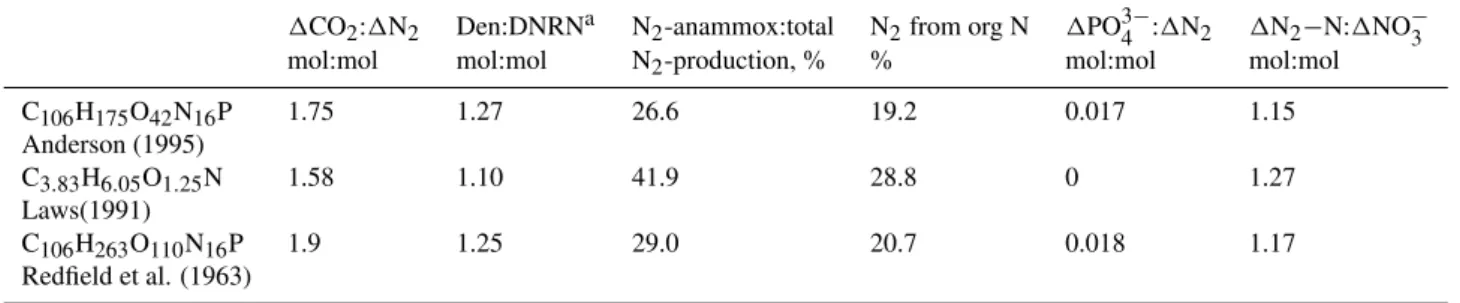
Using generic stoichiometric equations to describe the possible reactions which contribute to suboxic N2-production (Table 1) we can quantify the proportions in which the individual reactions involved (DNRN, denitrifica-tion, anammox) are required for a variety of bulk organic matter compositions (Table 2) and for a range of bound-ary conditions (fraction of accumulating intermediate NO−2). For the mean organic matter composition given above, the condition of complete conversion of fixed nitrogen to N2, is met if 1 mol P-equivalent of organic matter is remineralised through DNRN, 1.27 mol P equivalents of organic matter through denitrification and if the 2.27·16 mol NH+
4 produced in these heterotrophic reactions are oxidized with NO−2 to form N2 via anammox. In this scenario about 73% of the N2 produced is by denitrification and 27% by anammox (Table 2). The respective autotrophic CO2 fixation is 2.54 (0.07·2.27·16) mol and the bulk 1CO2:1N2 ratio for the combined heterotrophic and autotrophic processes changes to +1.75. This is, for all practical purposes, indistinguish-able from the gross ratio (+1.77) which does not account for the autotrophic carbon fixation. The net 1CO2:1N2 ratio for the complete conversion of fixed nitrogen to N2may vary between 1.58 and 1.90, depending on the composition of or-ganic matter (Table 2).
Significantly higher contributions of anammox to N2 pro-duction of up to 100% have been suggested from tracer ex-periments (Kuypers et al., 2005; Thamdrup et al., 2006; Hamersley et al., 2007). With a combination of DNRN, denitrification and anammox (scenario I, Figs. 1–3) this can be achieved if nitrite accumulates (Fig. 1a). Nitrite accu-mulation is a characteristic of the upper margin of oxygen minimum zones (Cline and Richards, 1972; Sen Gupta and Naqvi, 1984; Codispoti and Christensen, 1985). The ra-tio of nitrite accumulating to nitrate consumed denotes the inefficiency of suboxic N2-production. We use the term “1 – NO−2 accumulated: NO−3 consumed”, i.e. the efficiency of suboxic N2-production, as the independent variable (x-axes) in Figs. 1–5. Contrary to expectations, a higher contribution of anammox to total N2 production goes along with an in-crease (and not a dein-crease or even turn in sign) of the ratio of CO2produced to N2 formed (1CO2:1N2, Fig. 2a). In the most extreme case (no denitrification, 100% anammox; high NO−2 accumulation) the ratio is about +6.5, i.e. almost four times as high as for 100 percent efficient N2-production (Fig. 2a). This effect is due to the increased contribution of organic nitrogen to produced N2 (Fig. 2b). The higher the contribution from anammox the more inefficient the suboxic N-removal becomes.
Table 2.Bulk ratios for complete conversion of fixed nitrogen to N2(i.e. no accumulation of NO−2 or NH+4) for different compositions of organic matter. Bulk1CO2:1N2ratios include the effect of autotrophic CO2fixation (data for scenario I, with DNRN, denitrification and anammox, only).
1CO2:1N2 Den:DNRNa N2-anammox:total N2from org N 1PO34−:1N2 1N2−N:1NO−3 mol:mol mol:mol N2-production, % % mol:mol mol:mol
C106H175O42N16P 1.75 1.27 26.6 19.2 0.017 1.15
Anderson (1995)
C3.83H6.05O1.25N 1.58 1.10 41.9 28.8 0 1.27
Laws(1991)
C106H263O110N16P 1.9 1.25 29.0 20.7 0.018 1.17
Redfield et al. (1963)
aRatio of denitrification to DNRN, in mol:mol of organic matter oxidized, respectively.
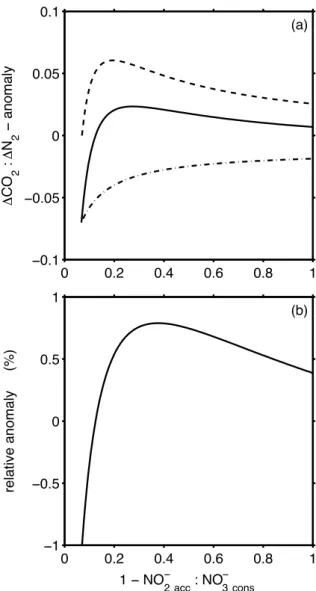
together, the combined effect is within±1% of the uncor-rected1CO2:1N2(Fig. 3b).
Alternatively, OMZs may function as systems in which dissimilatory nitrate reduction to ammonium (DNRA) sup-plements the respiratory pathways of DNRN and denitrifi-cation in the production of ammonium to supply substrates to anammox (Lam et al., 2009; Eq. 4 in Table 1). In this case high shares of anammox in total N2-production may be achieved even with no or little nitrite accumulation, i.e. with highly efficient nitrogen removal. Here (scenario II, Fig. 4) we assume combinations of DNRA (major NH+4 source), DNRN (prime source of NO−2 and minor NH+4 source), and anammox as the only process producing N2. Combining DNRA and DNRN in variable ratios yields a range of effi-ciencies of N2-production (x-axes) accompanied by varying NO−2-accumulation (again using the boundary condition that no NH+4 should accumulate).
Both DNRA and DNRN are heterotrophic. Figure 4a shows their relative contribution along the efficiency gradi-ent expressed as the fraction of NH+4 provided via DNRA, to the total flux of NH+4 to anammox. High contributions of DNRA allow for highly efficient N-conversion while low ef-ficiencies are found where NH+4 provision from DNRA falls below 50%. Although in this scenario 100 percent of N2 production is from the autotrophic anammox reaction for all possible efficiencies, the overall process (i.e. the combined net effects of DNRA, DNRN, and anammox) is clearly het-erotrophic (Fig. 4b), with1CO2:1N2ratios almost indistin-guishable from those given in Fig. 2a where DNRN, denitri-fication, and anammox co-exist.
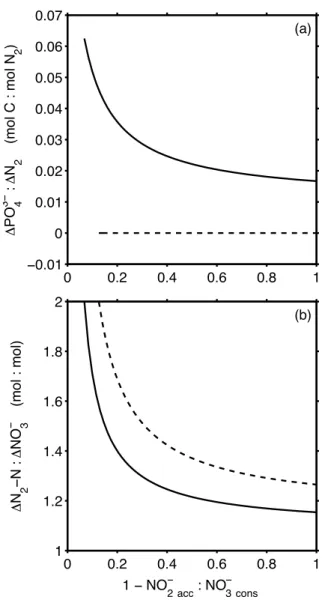
Differences occur related to the quality of organic matter consumed during the N-conversions. Using protein instead of mean bulk organic matter, the1CO2:1N2ratio is some-what lower (Figs. 2a, 4b) and the yield of N2-N produced per nitrate molecule consumed is larger (Fig. 5b) with maxi-mum values of 2 in the case of very inefficient N-conversion. The major difference, however, is in the molar1PO34−:1N2 yield (Fig. 5a). For mean bulk organic matter of a
composi-tion commonly used in global biogeochemical models (Paul-mier et al., 2009), the 1PO34−:1N2 yield increases from about 0.02 mol P:mol N2 (efficient N-conversion) to about 0.06 (highly inefficient N-conversion). If, however, mainly proteins were preferentially respired in OMZs as indicated by recent particle-flux and decay studies (van Mooy et al., 2002), the 1PO34−:1N2 yield should be much smaller and even approach zero (Fig. 5a).
Assuming that autochthonous substrates to the anammox reaction dominate in typical open ocean OMZs, we find that although anammox itself is autotrophic, the sum of processes providing substrates for anammox and/or denitrification in all possible combinations of DNRN, denitrification, DNRA and anammox is heterotrophic. The degree of this heterotro-phy depends on the efficiency of N2-production. In a combi-nation of DNRN, denitrification, and anammox it is actually positively correlated with the importance of anammox for N2 production (Fig. 6).
2.3 Allochthonous substrate sources
So far we addressed a typical open-ocean OMZ bounded by oxic waters where substrates to anammox are autochthonous, i.e. produced within the OMZ. This is in particular relevant for NH+4, which appears to be limiting to anammox in a sys-tem characterized by DNRN, denitrification and anammox. Potential external sources of NH+4 are anoxic waters or sedi-ments located below suboxic zones and the primary ammonia maximum at the base of the euphotic zone. In this section we discuss the potential effects of allochthonous substrate sources for1CO2:1N2ratios.
0 0.2 0.4 0.6 0.8 1 0
20 40 60 80 100
fraction N
2
from orgN (%)
1 ï NO
2 ï
acc : NO3
ï cons
(b)
0 0.2 0.4 0.6 0.8 1
0 1 2 3 4 5 6 7
6
CO
2
:
6
N 2
(mol C : mol N
2
)
(a)
Fig. 2. Same N-conversion scenario as Fig. 1 (DNRN+denitrification+anammox; solid lines for OM com-position of C106H175O42N16P; dashed lines for proteins).(a)The net ratio of CO2to N2release (1CO2:1N2, mol:mol) as a function of N-conversion efficiency. The ratios include a correction for autotrophic CO2fixation during anammox. (b)Percent fraction of N2-production supported by nitrogen from respired organic matter.
with nitrate diffusing downwards from overlying oxic waters may provide additional nitrite or ammonium (Konovalov et al., 2008) to support anammox and/or denitrification. In a system like the Black Sea such allochtonous sources of sub-strates may dominate (Fuchsman et al., 2008). Assuming DNRN as the sole NO−2 source and diffusive NH+4 fluxes as the major NH+4 supply of anammox in the suboxic layers of the Black Sea, the net1CO2:1N2 ratio may be as low as 0.38 inside the suboxic layer. This is still heterotrophic, but to a much lesser degree than under the conditions discussed above. Heterotrophy may become even smaller when
assum-0 0.2 0.4 0.6 0.8 1
ï1
ï0.5
0 0.5 1
relative anomaly (%)
1 ï NO 2
ï
acc : NO3
ï
cons
(b)
Fig. 3
0 0.2 0.4 0.6 0.8 1
ï0.1
ï0.05
0 0.05 0.1
6
CO
2
:
6
N 2
ï
anomaly
(a)
Fig. 3. Effects of autotrophic CO2fixation on1CO2:1N2ratio (for scenario I).(a)Absolute anomalies (mol:mol). Dash-dotted line shows the direct effect of CO2 fixation on 1CO2:1N2 as difference between1CO2:1N2 (corrected for CO2-fixation) and 1CO2:1N2(without this correction). Dashed line shows the indi-rect effect from NO−3 production during anammox on1CO2:1N2 as difference between1CO2:1N2(corrected for NO−3-production) and1CO2:1N2(without this correction). This indirect effect acts on values of the x-axes, not the 1CO2:1N2 itself. The solid line gives the combination of both effects. (b) Plot shows the relative anomaly (%), i.e. the combined anomaly due to CO2 -fixation and NO−3-production from (a) devided by the fully cor-rected1CO2:1N2ratio times 100.
0 0.2 0.4 0.6 0.8 1 0
1 2 3 4 5 6 7
6
CO
2
:
6
N 2
(mol C : mol N
2
)
1 ï NO
2
ï
acc : NO3
ï
cons
(b)
0 0.2 0.4 0.6 0.8 1
0 20 40 60 80 100
NH
4
+ ï
flux from DNRA (%)
(a)
Fig. 4.Scenario II, assuming that suboxic N-conversions are due to a combination of DNRN, DNRA, and anammox. We assume that no NH+4, but variable fractions of NO−2 accumulate (see description of x-axes in legend of Fig. 1). Solid lines are for bulk standard organic matter, dashed lines for proteins. (a)Percent fraction of NH+4 supply to the anammox reaction from DNRA.(b)1CO2:1 N2ratio for scenario II.
1991). Hence suboxic N2 production, supplied with sub-strates from outside, may locally become fully autotrophic. However, diffusion of reduced substrates is accompanied by diffusive CO2-fluxes from the remote heterotrophic decom-position of organic matter by sulphate reduction, which drive the overall1CO2:1N2back into the positive range.
While sulphate reduction can supply NH+4 to the suboxic layer from below, there is also the possibility of NH+4 enter-ing from above. The primary NH+4 maximum at the base of the euphotic zone is a characteristic feature of open-ocean NH+4 distribution (Brzezinski, 1988). Where surface
pro-0 0.2 0.4 0.6 0.8 1
1 1.2 1.4 1.6 1.8 2
6
N 2
ï
N :
6
NO
3
ï (mol : mol)
1 ï NO
2 ï
acc : NO3
ï cons
(b)
0 0.2 0.4 0.6 0.8 1
ï0.01
0 0.01 0.02 0.03 0.04 0.05 0.06 0.07
6
PO
4
3
ï :
6
N 2
(mol C : mol N
2
)
(a)
Fig. 5. Scenario I and II. Solid lines are for bulk organic matter composition, dashed lines for proteins. (a)The ratio of phosphate released per N2formed. (b)The molar ratio of N2−N released to nitrate used during N-conversion.
0 20 40 60 80 100 0
1 2 3 4 5 6 7
6
CO
2
:
6
N 2
(mol C : mol N
2
)
fraction N
2 from anammox (%)
Fig. 6. 1CO2:1N2 vs. percent fraction of N2 produced by the anammox reaction for scenario I (DNRN+denitrification+anammox). Solid line is for bulk or-ganic matter compositions, dashed line for proteins.
constants of aerobic ammonia oxidation and surge-uptake of substrate pulses have recently been observed in nitrify-ing archaea (Martens-Habbena et al., 2009). Unfortunately, 15N-isotope experiments of anammox studies have usually applied micro-molar tracer additions, often larger than the ambient substrate concentration, and therefore provide po-tential rather than in situ substrate uptake rates (Hamersley et al., 2007). It is therefore difficult to compare in situ kinet-ics of aearobic and anaerobic ammonium oxidation. From the thermodynamic argument given above we conclude that it appears more likely that low-oxygen nitrification stops at the NO−2 level, providing NO−2 rather than NH+4 to anam-mox (e.g. Schmidt et al., 2002) via diffusion of substrates into suboxic layers. Anyway, the NH+4 invading suboxic waters from above is of heterotrophic origin from the oxic remineralisation of organic matter and hence should be ac-companied by diffusive fluxes of respiratory CO2, similar as in an anoxic system underlying suboxic zones discussed above. This should drive the1CO2:1N2ratio of the upper margin of the OMZ back towards values computed for au-tochthonous substrate sources of anammox.
3 Discussion
Considering autochthonous sources of NH+4 and NO−2 to anammox and a coupled system with DNRN, denitrification and anammox, we find the somewhat counterintuitive rela-tionship that the higher the contribution of autotrophic anam-mox to pelagic N2-production, the more heterotrophic the system is (Fig. 6). Hence the feedback switch proposed by
Voss and Montoya (2009) to the effect that expending OMZs (Stramma et al., 2008; Oschlies et al., 2008) will either act as positive or negative feedbacks in the carbon cycle depend-ing on whether anammox or denitrification dominate N2-production in OMZs does not exist. Including additional au-tochthonous NH+4 sources from DNRA does not change the picture significantly. Even when combining DNRA, DNRN, and anammox in scenarios with anammox always contribut-ing 100 percent to N2production, the coupled system is al-ways heterotrophic. What appears to be variable in both sys-tems is the degree of heterotrophy, however, depending on the efficiency of N2-production.
Allochthonous supply of NH+4 (or NH+4 and NO−2)may contribute to the substrate needs of anammox, as has been observed in the Black Sea (Murray et al., 2005; Fuchs-man et al., 2008; Konovalov et al., 2008). In such a situa-tion,1CO2:1N2ratios in the suboxic layer are much lower than with autochthonous substrate supply, and hence the de-gree of heterotrophy is lower. However, the NH+4 diffusing from anoxic waters underlying a suboxic system is from or-ganic matter remineralised via heterotrophic sulphate reduc-tion, which has a concomitant CO2production. Hence NH+4 fluxes go along with CO2 fluxes. NH+4 and total dissolved sulfide (ST=H2S+HS−+S2−) as well as ST and total dis-solved inorganic carbon (CT)co-vary linearly over much of the anoxic water body of the Black Sea (Volkov and Rozanov, 2006). Averaging over anoxic waters from the upper 2000 m Volkov and Rozanov (2006) find ST-NH+4 slopes of 4.29 and CT-STslopes of 2.01, indicating an average C:N ratio of rem-ineralisation of 8.6 which is close to that of bulk standard or-ganic matter. Just below the suboxic layer, however, the HS− to NH+4 slope is less (about 2) which if combined with the av-erage CT-STplot yields a C:N ratio of only 4.2. There is the possibility that this reduction in the apparent C:N reminerali-sation ratio can be explained as due to nitrogen-rich material (proteins) preferentially remineralised in the upper part of the anoxic layer. This has been suggested for other low oxygen waters by van Mooy et al. (2002). Alternatively, this differ-ence in the apparent C:N ratio can be taken as another indica-tion of the quantitative importance of anammox in close-by suboxic waters, providing a significant sink for NH+4 but not for CO2, as evident from the observed low CO2:NH+4 effi-ciency of the anammox reaction (Strous et al., 1998; Tijhuis et al., 1993). Though details will depend on the respective NH+4 supplies by diffusion or autochthonous sources, respec-tively, the overall1CO2:1N2ratio should be larger than in the most extreme case computed above (1CO2:1N2=+0.38) and approach the autochthonous ratio (1CO2:1N2=+1.75).
Biogeochemically the system is clearly heterotrophic al-though autotrophic reactions are a vital element shaping the observed tracer distribution. Low, even negative, values of the1CO2:1N2ratio can be computed where substrates are imported from anoxic domains and if associated diffusive CO2fluxes are ignored.
In Figs. 1–5 we use the property “1 – NO−2 accumulated: NO−3 consumed” as master variable in our discussion of suboxic nitrogen conversions. This property can vary between 0 and 1, reflecting a fully inefficient sys-tem where a large fraction of NO−2 accumulates and a fully efficient system with no NO−2 accumulation, respectively. In our model computations both numerator (NO−2 accumulated) and denominator (NO−3 consumed) are well constrained. When applying the results to the real ocean the denominator has to be estimated from observed data and a number of assumptions. One approach to quantify NO−3 consumedis the NO−3 deficit-approach (Cline and Richards, 1972). In this approach the nitrate deficit is computed as the difference between expected and observed nitrate concentration, where the expected nitrate concentration can for example be computed from observed phosphate concentrations and a N:P ratio assumed or derived for the source waters of the OMZ. Including a correction for phosphate release during nitrate based oxidation of organic matter, a general form may be written
NO−3def=(NO−3exp−NO−
3obs)/(1+rNO3:PO4/rNO3:orgP), (1) with rNO3:orgP as the ratio of nitrate consumed per P-equivalent of organic matter remineralised andrNO3:PO4 as the nitrate to phosphate ratio in the source water. The ex-pected nitrate concentration can for example be computed from
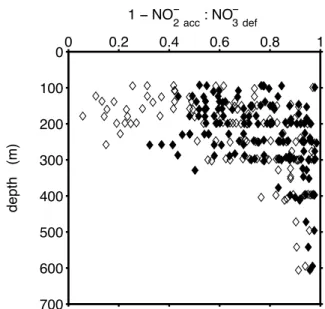
NO−3exp=PO34obs− ·rNO3:PO4. (2) We use the Pacific subset of the GLODAP dataset (Key et al., 2004) to describe examplarily the vertical distribution of the N-conversion efficiency in low oxygen waters (Fig. 7). Val-ues of “1 – NO−2 accumulated: NO−3 consumed” observed in the Pacific OMZs ([O2]<5 mmol m−3) range between 0.4 and 1, and 0.1 and 1, depending on the choosen form of Eq. (2) (see legend of Fig. 7 for details). In principle, the full range of N-conversion efficiencies theoretically possible is expressed in these real ocean data and we conclude that the full range of1CO2:1N2may be found in the ocean as well.
Would the absence or presence of anoxic zones, or their extent, in the ocean have any collateral effects on the marine carbon balance at all? So far we emphazised that autotrophic anammox in OMZs depends on substrates (NH+4) provided by heterotrophic processes either locally, or from neighbouring water layers. Heterotrophic and au-totrophic processes are similarly coupled also everywhere else in the aphotic oxic watersphere. Oxic remineralisa-tion of organic matter there releases CO2, PO34− and NH+4
0 0.2 0.4 0.6 0.8 1
700 600 500 400 300 200 100 0
depth (m)
1 ï NO 2 ï
acc : NO3 ï
def
Fig. 7. Vertical distribution of the N-conversion efficiency (1 – NO−2 acc: NO−3 exp) in data from Pazific low oxygen waters (sub-set of GLODAP database, Key et al. (2004); [O2]<5 mmol m−3, Z>80 m). Results for two estimates of NO−3 exp are shown. Solid symbols: NO−3 exp is computed according to Eq. (2) with rNO3:PO4=16. Open symbols: NO−3 expis computed as in Devol et al. (2006), i.e. NO−3 exp=14.89·(PO34 obs− –0.28). The term “1/(1+ rNO3:PO4/rNO3:orgP)” of Eq. (1), which in principle is a function of the N-conversion efficiency and the organic matter composition, is approximated with a constant value (0.87=1/(1+16/104)), which is based on the stoichiometry of Reaction (R1).
to ambient waters. NH+4 does not accumulate (Brezezin-ski, 1988) under oxic conditions but is subsequently oxi-dized autotrophically to nitrite and nitrate by nitrifying bac-teria and archaea (Ward, 2008). The carbon fixation ef-ficiency of nitrifyers is low (1CO2:1NH+4=0.03 mol:mol,
oxic conditions. Hence there is no significant difference be-tween suboxic and oxic systems of the aphotic zone of the ocean concerning their trophic state.
Acknowledgements. This work was funded by the CAU Excellence Cluster “The Future Ocean” and the BMBF-International Buero German-Turkish bilateral project “IntenC”. This study profited from discussions within the Seeburg Team and with Andreas Os-chlies and from suggestions made by three anonymous reviewers.
Edited by: C. P. Slomp
References
Altabet, M. A., Francois, R., Murray, D. W., and Prell, W. L.: Climate-related variations in denitrification in the Arabian Sea from sediment15N/14N ratios, Nature, 373, 506–509, 1995. Anderson, L. A.: On the hydrogen and oxygen content of marine
phytoplankton, Deep-Sea Res. I, 42, 1675–1680, 1995. Brettar, I. and Rheinheimer, G.: Denitrification in the Central
Baltic: evidence for H2S-oxidation as motor of denitrification at the oxic-anoxic interface, Mar. Ecol. Prog. Ser., 77, 157–169, 1991.
Brewer, P. G. and Peltzer, E. T.: Limits to marine life, Science, 324, 347–348, 2009.
Broda, E.: Two kinds of lithotrophs missing in nature, Z. Allg. Mikrobiol., 17, 491–493, 1977.
Brzezinski, M. A.: Vertical distribution of ammonium in stratified oligotrophic waters, Limnol. Oceanogr., 33, 1176–1182, 1988. Canfield, D. E.: Models of oxic respiration, denitrification and
sulfate reduction in zones of coastal upwelling, Geochim. Cos-mochim. Acta, 70, 5753–5765, 2006.
Cline, J. D. and Richards, F. A.: Oxygen deficient conditions and ni-trate reduction in the eastern tropical North Pacific Ocean, Lim-nol. Oceanogr., 17, 885–900, 1972.
Codispoti, L. A.: Is the ocean losing nitrate?, Nature, 376, 724, 1995.
Codispoti, L. A. and Christensen, J. P.: Nitrification, denitrification and nitrous oxide cycling in the eastern tropical South Pacific ocean, Mar. Chem., 16, 277–300, 1985.
Codispoti, L. A., Friederich, G. E., Murray, J. W., and Sakamoto, C. M.: Chemical variability in the Black Sea: implications of con-tinuous vertical profiles that penetrated the oxic/anoxic interface, Deep-Sea Res., 38(S2), S691–S710, 1991.
Devol, A. H.: Denitrification including anammox, in: Nitrogen in the Marine Environment, 2nd Edition, edited by: Capone, D., Bronk, D., Mulholland, M., and Carpenter, E., Elsevier, Amster-dam, 263–301, 2008.
Devol, A. H., Uhlenhopp, A. G., Naqvi, S. W. A., et al.: Denitrifica-tion rates and excess nitrogen gas concentraDenitrifica-tions in the Arabian Sea oxygen deficient zone, Deep-Sea Res., 53, 1533–1547, 2006. Fuchsman, C. A., Murray, J. W., and Konovalov, S. K.: Concentra-tion and natural stable isotope profiles of nitrogen species in the Black Sea, Mar. Chem., 111, 90–105, 2008.
Ganeshram, R. S., Pedersen, T. F., Calvert, S. E., and Murray, J. W.: Large changes in oceanic nutrient inventories from glacial to interglacial periods, Nature, 376, 755–757, 1995.
Gibb, S. W., Mantoura, R. F. C., Liss, P. S., and Barlow, R. G.: Distributions and biogeochemistries of methylamines and
am-monium in the Arabian Sea, Deep-Sea Res. II, 46, 593–615, 1999.
Hamersley, M. R., Lavik, G., Woebken, D., et al.: Anaerobic ammo-nium oxidation in the Peruvian oxygen minimum zone, Limnol. Oceanogr., 52, 923–933, 2007.
Hanning, M., Lavik, G., Kuypers, M. M. M., et al.: Shift from den-itrification to anammox after inflow events in the central Baltic Sea, Limnol. Oceanogr., 52, 1336–1345, 2007.
Hofmann, M. and Schellnhuber, H.-J.: Oceanic acidifica-tion affects marine carbon pump and triggers extended ma-rine oxygen holes, P. Natl. Acad. Sci., 106, 3017–3022, doi:10.1073/pnas.0813384106, 2009.
Hulth, S., Aller, R. C., Canfield, D. E., et al.: Nitrogen removal in marine environments: recent findings and future research chal-lenges, Mar. Chem., 94, 125–145, 2005.
Jin, X. and Gruber, N.: Offsetting the radiative benefit of ocean iron fertilization by enhancing N2O emissions, Geophys. Res. Lett., 30, 2249, doi:10.1029/2003GL018458, 2003.
Kartal, B., Kuypers, M. M. M., Lavik, G., et al.: Anammox bacteria disguised as denitrifiers: nitrate reduction to dinitrogen gas via nitrite and ammonium, Environ. Microbiol., 9, 635–642, 2007. Key, R. M., Kozyr, A., Sabine, C. L., Lee, K., Wanninkhof, R.,
Bullister, J. L., Feely, R. A., Millero, F. J., Mordy, C., and Peng, T.-H.: A global ocean carbon climatology: results from Global Data Analysis Project (GLODAP), Global Biogeochem. Cycles, 18, GB4031, doi:10:1029/2004GB002247, 2004.
Konovalov, S. K., Fuchsman, C. A., Belokopitov, V., and Murray, J. W.: Modelling the distribution of nitrogen species and isotopes in the water column of the Black Sea, Mar. Chem., 111, 106–124, 2008.
Kuenen, J. G.: Anammox bacteria: from discovery to application, Nature Reviews Microbiol., 6, 320–326, 2008.
Kuypers, M. M. M., Sllekers, A. O., Lavik, G., et al.: Anaerobic ammonium oxidation by anammox bacteria in the Black Sea, Na-ture, 422, 608–611, 2003.
Kuypers, M. M. M., Lavik, G., Woebken, D., et al.: Massive nitro-gen loss from the Benguela upwelling system through anaerobic ammonium oxidation, P. Natl. Acad. Sci. USA, 102, 6478–6483, 2005.
Lam, P., Lavik, G., Jensen, M. M., et al.: Revising the nitrogen cycle of the Peruvian oxygen minimum zone, P. Natl. Acad. Sci. USA, 106, 4752–4757, 2009.
Laws, E. A.: Photosynthetic quotients in the open ocean, Deep-Sea Res., 38, 143–167, 1991.
Matear, R. J. and Hirst, A. C.: Long term changes in the dis-solved oxygen concentrations in the ocean caused by pro-tracted global warming, Global Biogeochem. Cycles, 17, 1125, doi:10.1029/2002GB001997, 2003.
Martens-Habbena, W., Berube, P. M., Urakawa, H., et al.: Ammonia oxidation kinetics determine niche separation of nitrifying archaea and bacteria, Nature, 461, 976–979, doi:10.1038/nature08465, 2009.
Molina, V. and Far´ıas, L.: Aerobic ammonium oxidation in the oxy-cline and oxygen minimum zone of the eastern tropical South Pacific off northern Chile (∼20◦S), Deep-Sea Res. II, 56, 1032– 1041, 2009.
43, 2005.
Mulder, A., van de Graaf, A. A., Robertson, L. A., and Kuenen, J. G.: Anaerobic ammonium oxidation discovered in a denitrify-ing fluidized bed reactor, FEMS Microbiol. Ecol., 16, 177–183, 1995.
Murray, J. W., Fuchsman, C., Kirkpatrick, J., Paul, B., and Kono-valov, S. K.: Species andδ15N signatures of nitrogen transfor-mations in the suboxic zone of the Black Sea, Oceanography, 18, 36–47, 2005.
Oschlies, A., Schulz, K. G., Riebesell, U., and Schmittner, A.: Simulated 21st century’s increase in oceanic suboxia by CO2 -enhanced biotic carbon export, Global Biogeochem. Cycles, 22, GB4008, doi:10.1029/2007GB003147, 2008.
Paulmier, A., Kriest, I., and Oschlies, A.: Stoichiometries of remineralisation and denitrification in global biogeochemical ocean models, Biogeosciences, 6, 923–935, doi:10.5194/bg-6-923-2009, 2009.
Redfield, A. C., Ketchum, B. H., and Richards, F. A.: The influence of organisms on the composition of seawater, in: The sea, Vol 2, edited by: Hill, M. N., John Wiley and Sons, New York, 26–77, 1963.
Richards, F. A.: Anoxic basins and fjords, in: Chemical Oceanog-raphy, edited by: Riley, J. P. and Skirrow, G., Academic Press, London, 611–643, 1965.
Schmidt, I., Sliekers, O., Schmid, M., et al.: Aerobic and anaerobic ammonia oxidizing bacteria – competitors or natural partners?, FEMS Microbiol. Ecol., 39, 175–181, 2002.
Sen Gupta, R. and Koroleff, F.: A quantitative study of nutrient fractions and a stoichiometric model of the Baltic, Estuar. Coast. Mar. Sci., 1, 335–360, 1973.
Sen Gupta, R. and Naqvi, S. W. A.: Chemical oceanography of the Indian Ocean, north of the aquator, Deep-Sea Res., 31, 671–706, 1984.
Stramma, L., Johnson, G. C., Sprintall, J., and Mohrholz, V.: Ex-panding oxygen-minimum zones in the tropical oceans, Science, 320, 655–658, 2008.
Strous, M., Heijnen, J. J., Kuenen, J. G., and Jetten, M. S. M.: The sequencing batch reactor as a powerful tool to study very slowly growing micro-organisms, Appl. Microbiol. Biotechnol., 50, 589–596, 1998.
Stumm, W. and Morgan, J. J.: Aquatic chemistry – chemical equi-libria and rates in natural waters, John Wiley & Sons, Inc., New York, 1022 pp., 1996.
Thamdrup, B. and Dalsgaard, T.: Production of N2through anaer-obic ammonium oxidation coupled to nitrate reduction in marine sediments, Appl. Environ. Microbiol., 68, 1312–1318, 2002. Thamdrup, B., Dalsgaard, T., Jensen, M. M., et al.: Anaerobic
am-monium oxidation in the oxygen-deficient waters off northern Chile, Limnol. Oceanogr., 51, 2145–2156, 2006.
Thomas, W. H.: On denitrification in the northeastern tropical Pa-cific Ocean, Deep-Sea Res., 13, 1109–1114, 1966.
Tijhuis, L., Van Loosdrecht, M. C. M., and Heijnen, J. J.: A ther-modynamically based correlation for maintenance Gibbs energy requirements in aerobic and anaerobic chemotrophic growth, Biotechnol. Bioeng., 42, 509–519, 1993.
van de Graaf, A. A., de Bruijn, P., Robertson, L., Jetten, M. S. M., and Kuenen, J. G.: Autotrophic growth of anaerobic ammonium-oxidizing micro-organisms in a fluidized bed reactor, Microbiol., 142, 2187–2196, 1996.
Van Mooy, B. A. S., Keil, R. G., and Devol, A. H.: Impact of sub-oxia on sinking particulate organic carbon: enhanced carbon flux and preferential degradation of amino acids via denitrification, Geochim. Cosmochim. Acta, 66, 457–465, 2002.
Volkov, I. I. and Rozanov, A. G.: Fundamentals of biohydrochem-istry of anoxic basins, Oceanology, 46, 803–816, 2006. Voss, M. and Montoya, J. P.: Oceans apart, Nature, 461, 49–50,
2009.
Ward, B. B.: Nitrification in marine systems, in: Nitrogen in the Marine Environment, 2nd Edition, edited by: Capone, D., Bronk, D., Mulholland, M., and Carpenter, E., Elsevier, Amsterdam, 2008.
Ward, B. B., Capone, D. G., and Zehr, J. P.: What’s new in the nitrogen cycle?, Oceanography, 20, 101–109, 2007.
Ward, B. B., Devol, A. H., Rich, J. J., Chang, B. X., Bulow, S. E., Naik, H., Pratihary, A., and Jayakumar, A.: Denitrification as the dominant nitrogen loss process in the Arabian Sea, Nature, 461, 78–81, 2009.
Yoshinari, T. and Knowles, R.: Acetylene inhibition of nitrous ox-ide reduction by denitrifying bacteria, Biochem. Biophys. Res. Comm., 69, 705–710, 1976.
Zafiriou, O. C., Ball, L. A., and Hanley, Q.: Trace nitrite in oxic waters, Deep-Sea Res., 39, 1329–1347, 1992.