HESSD
11, 3083–3109, 2014Tritium simulation by MODPATH particle
tracking
M. A. Gusyev et al.
Title Page
Abstract Introduction
Conclusions References
Tables Figures
◭ ◮
◭ ◮
Back Close
Full Screen / Esc
Printer-friendly Version Interactive Discussion
Discussion
P
a
per
|
D
iscussion
P
a
per
|
Discussion
P
a
per
|
Discuss
ion
P
a
per
|
Hydrol. Earth Syst. Sci. Discuss., 11, 3083–3109, 2014 www.hydrol-earth-syst-sci-discuss.net/11/3083/2014/ doi:10.5194/hessd-11-3083-2014
© Author(s) 2014. CC Attribution 3.0 License.
Hydrology and Earth System
Sciences
Open Access
Discussions
This discussion paper is/has been under review for the journal Hydrology and Earth System Sciences (HESS). Please refer to the corresponding final paper in HESS if available.
Simulated tritium concentrations in river
waters of the western Lake Taupo
catchment, New Zealand with MODPATH
particle tracking
M. A. Gusyev1, D. Abrams2, M. W. Toews1, U. Morgenstern1, and M. K. Stewart1,3 1
GNS Science, Avalon, Lower Hutt, 5011, New Zealand
2
Illinois State Water Survey, Champaign, IL, 61820, USA
3
Aquifer Dynamics & GNS Science, P.O. Box 30368, Lower Hutt, New Zealand
Received: 24 January 2014 – Accepted: 28 February 2014 – Published: 17 March 2014
Correspondence to: M. A. Gusyev ([email protected])
HESSD
11, 3083–3109, 2014Tritium simulation by MODPATH particle
tracking
M. A. Gusyev et al.
Title Page
Abstract Introduction
Conclusions References
Tables Figures
◭ ◮
◭ ◮
Back Close
Full Screen / Esc
Printer-friendly Version Interactive Discussion
Discussion
P
a
per
|
D
iscussion
P
a
per
|
Discussion
P
a
per
|
Discuss
ion
P
a
per
|
Abstract
We simulated in a previous study tritium concentrations in the river waters of the west-ern Lake Taupo catchment (WLTC) using MODFLOW/MT3DMS model (Gusyev et al., 2013). The model was calibrated to match simulated tritium to measured tritium in river waters at baseflows of the Waihaha, Whanganui, Whareroa, Kuratau and Omori river 5
catchments of the WLTC. Following from this work we now utilized the same MOD-FLOW model for the WLTC to calculate the pathways of groundwater particles (and their corresponding tritium concentrations) using steady-state particle tracking with MODPATH. In order to simulate baseflow tritium concentrations with MODPATH, transit time distributions (TTDs) such as cumulative frequency distribution (CFD) and proba-10
bility density function (PDF) are generated with particle tracking for the river networks of the five WLTC catchment outflows. Then, PDFs are used in the convolution inte-gral with tritium concentration time series obtained in the precipitation. The resulting MODPATH tritium concentrations yield a very good match to measured tritium con-centrations and are similar to the MT3DMS simulated tritium concon-centrations, with the 15
greatest variation occurring around the bomb peak. MODPATH and MT3DMS also yield similar Mean Transit Times (MTT) of groundwater contribution to river baseflows, but the actual shape of the TTDs is strikingly different. While both distributions provide valuable information, the methodologies used to derive the TTDs are fundamentally different and hence must be interpreted differently. With the current models setting, 20
only the methodology used with MODPATH provides the true TTD for use with the convolution integral.
1 Introduction
Particle tracking is a widely applied tool to calibrate aquifer porosity values in ground-water flow models and to characterize ground-water availability and quality at groundground-water 25
HESSD
11, 3083–3109, 2014Tritium simulation by MODPATH particle
tracking
M. A. Gusyev et al.
Title Page
Abstract Introduction
Conclusions References
Tables Figures
◭ ◮
◭ ◮
Back Close
Full Screen / Esc
Printer-friendly Version Interactive Discussion
Discussion
P
a
per
|
D
iscussion
P
a
per
|
Discussion
P
a
per
|
Discuss
ion
P
a
per
|
et al., 2001; McGuire and McDonnell, 2006; Stichler et al., 2008). For example, par-ticle tracking results are commonly used for mapping recharge contributing area to the pumping wells (US EPA, 1994) and obtaining transit times of groundwater at the discharge point (Haitjema, 1995; McGuire and McDonnell, 2006). The MODPATH gen-erated transit time represents the time taken by a groundwater molecule to travel in 5
a groundwater volume from the starting cell, i.e., groundwater recharge at the aquifer top, to an outlet cell, such as a pumping well or a spring (Pollock, 1994; Boronina et al., 2005; McGuire and McDonnell, 2006; Sanford, 2010). Integrating over all flow paths in an area, a transit time distribution (TTD) can be constructed from MODPATH transit times at a discharge point. The TTD provides the fraction of water that had a cer-10
tain transit time through the aquifer and can vary both in shape and in scale, usually defined as a central tendency such as mean transit time (MTT) or mean residence times (MRT) (McDonnell et al., 2010; Stewart et al., 2012). The TTDs can then be an input to the convolution integral to obtain tracer concentrations at discharge points. While many lumped parameter models (LPMs) exist to derive these TTDs, using MOD-15
PATH/MODFLOW allows one to simulate age groundwater tracer directly relying on the actual groundwater flow dynamics and hence eliminates the need to compare between different alternative LPMs, i.e., exponential, piston-exponential, gamma, dispersion, etc. (McGuire and McDonnell, 2006; Sanford, 2010). For example, Eberts et al. (2012) evaluated tracer concentrations obtained with particle tracking model and several LPMs 20
in wells of four aquifers using an Excel workbook, which uses TTDs both from LPMs and MODPATH as an input to the convolution integral to obtain tracer concentrations at wells (Jurgens et al., 2012).
Groundwater flow and particle tracking models have also been used to simulated isotope tracers at wells, springs and lakes as groundwater discharge points. McMahon 25
HESSD
11, 3083–3109, 2014Tritium simulation by MODPATH particle
tracking
M. A. Gusyev et al.
Title Page
Abstract Introduction
Conclusions References
Tables Figures
◭ ◮
◭ ◮
Back Close
Full Screen / Esc
Printer-friendly Version Interactive Discussion
Discussion
P
a
per
|
D
iscussion
P
a
per
|
Discussion
P
a
per
|
Discuss
ion
P
a
per
|
simulations. Troldbord et al. (2007) constructed probability density curves using par-ticle tracking and obtained isotope concentrations using the convolution integral. Starn et al. (2010) distributed particles with assigned isotope concentrations and estimated groundwater recharge by backwards particle tracking from the well to the model sur-face. Szabo et al. (1996) presented tritium measurements and other tracers in wells 5
and conducted one dimensional cross-sectional modelling of travel times. Boronina et al. (2005) discussed modelling tritium in an aquifer and a groundwater driven spring with groundwater flow MODFLOW and particle tracking PMPATH model, which is an al-ternative to USGS particle tracking model MODPATH. Several studies compared MTTs from tritium and CFCs to MTTs obtained with MODPATH particle tracking in the Trout 10
Lake, Wisconsin (Pint et al., 2003; Hunt et al., 2006; Walker et al., 2007). In the Trout Lake watershed, Fienen et al. (2009) used measured stable oxygen isotopes and tri-tium concentrations in wells to refine groundwater pathways between the Big Muskel-lunge and Crystal Lakes in a cross-sectional model.
In the particle tracking technique, groundwater velocities obtained with a groundwa-15
ter flow models are used to produce particle pathlines with associated particle travel times. These pathlines and travel times account only for advective transport and do not include chemical parameters that are available in transport models such as MT3DMS (i.e. dispersion, diffusion, decay, sorption, dual porosity). Therefore, a direct compari-son of measured and simulated environmental tritium tracer concentrations with par-20
ticle tracking (MODPATH/MODFLOW) and transport (MT3DMS/MODFLOW) models is needed to provide important insights about the applicability of the particle tracking to simulation of groundwater contaminant movement in the aquifer systems and river waters at baseflows.
This study is a continuation of the western Lake Taupo catchment (WLTC) work, 25
HESSD
11, 3083–3109, 2014Tritium simulation by MODPATH particle
tracking
M. A. Gusyev et al.
Title Page
Abstract Introduction
Conclusions References
Tables Figures
◭ ◮
◭ ◮
Back Close
Full Screen / Esc
Printer-friendly Version Interactive Discussion
Discussion
P
a
per
|
D
iscussion
P
a
per
|
Discussion
P
a
per
|
Discuss
ion
P
a
per
|
observed groundwater elevations and baseflows. This model was the basis for a tran-sient MT3DMS model that had annual inputs of tritium in precipitation and was cali-brated to observed tritium values in base flow. To expand on this work, a steady-state particle tracking MODFLOW/MODPATH model has been developed, utilizing the cali-brated values from the MODFLOW/MT3DMS model. Next, TTDs are generated for the 5
river waters of the Waihaha, Whanganui, Whareroa, Kuratau and Omori catchments of the WLTC. Then the tritium concentrations in the outlets of the five river catchments are simulated by convoluting the tritium input time series with the MODPATH generated TTD obtained for the river network. These results are compared with measured and MT3DMS simulated tritium concentrations for the Waihaha, Whanganui, Whareroa, 10
Kuratau and Omori river catchments (Gusyev et al., 2013). In addition, we compare the MODPATH and MT3DMS TTDs and discuss the discrepancies between the methodolo-gies and proper interpretation of each distribution. Finally, the current limitations of the MODPATH approach in view of spatially varying groundwater contaminant simulations, such as nitrate, are discussed.
15
2 Approach
2.1 MODFLOW model
The groundwater flow model MODFLOW of the WLTC was developed by Gusyev et al. (2013) using the Visual MODFLOW (VMOD) graphical user interface (Harbaugh et al., 2000; SWS, 2012). A brief summary of the WLTC model settings and calibration 20
to groundwater levels and river baseflows is presented in this paper. For the detailed description refer to Gusyev et al. (2013). In the MODFLOW model, the WLTC area of 1072 km2 was represented by the finite-difference grid with a uniform grid cell size of 80 m resulting in 500 rows and 335 columns. The WLTC aquifer system was assumed to be 320 m thick based on the WLTC hydrogeology and was represented with a uni-25
HESSD
11, 3083–3109, 2014Tritium simulation by MODPATH particle
tracking
M. A. Gusyev et al.
Title Page
Abstract Introduction
Conclusions References
Tables Figures
◭ ◮
◭ ◮
Back Close
Full Screen / Esc
Printer-friendly Version Interactive Discussion
Discussion
P
a
per
|
D
iscussion
P
a
per
|
Discussion
P
a
per
|
Discuss
ion
P
a
per
|
were assigned to layer 1 as drain cells with drain bottom elevation 1 m below the top elevation of layer 1. The water level in Lake Taupo was simulated using a constant head boundary of 357 m, which was assigned to relevant model layers using bathymetry data (Gusyev et al., 2013). In the calibrated model, Gusyev et al. (2013) used groundwater recharge values in 10 recharge zones, see Fig. 1a. From the MT3DMS model, the 5
calibrated effective porosity values of the transient MT3DMS model were used as the starting point for the MODPATH particle tracking with the calibrated heads and flows of the steady-state MODFLOW model (Gusyev et al., 2013).
2.2 MODPATH model
MODPATH version 4 (Pollock, 1994) was used to conduct forward particle tracking in 10
the WLTC (Gusyev et al., 2013). In forward particle tracking option, the particles are released at the water source (e.g., point of groundwater recharge) and collected at sink cells such as drains. These sink cells could be either weak, meaning they can only discharge a portion of water entering the cell, or strong, meaning they discharge all groundwater reaching them (Pollock, 1994; Abrams et al., 2013). For the weak sink 15
option, the VMOD value was used to stop particles where discharge to sink cells is greater than a specified total inflow to the cell; we elected to use the 5 % default setting (SWS, 2013). However, this setting is not expected to be important in our case due to relatively thin layers of 20 m and location of all sink cells in layer 1. In cases where the sink cells comprise a larger percentage of the aquifer thickness, other MODPATH 20
settings should be considered (Abrams et al., 2013).
In each grid, one MODPATH particle was assigned at the water table and cell centre using a custom Python script, resulting in 120 585 particles. The location of these grid cells and the vertical position of a particle were identified by interrogating MODFLOW groundwater heads (*.hds) and VMOD grid file (*.vmg). All assigned particles were 25
HESSD
11, 3083–3109, 2014Tritium simulation by MODPATH particle
tracking
M. A. Gusyev et al.
Title Page
Abstract Introduction
Conclusions References
Tables Figures
◭ ◮
◭ ◮
Back Close
Full Screen / Esc
Printer-friendly Version Interactive Discussion
Discussion
P
a
per
|
D
iscussion
P
a
per
|
Discussion
P
a
per
|
Discuss
ion
P
a
per
|
out the transit times from the endpoint file for each of the five river catchments and sorted by their transit times. These selected particles were scaled by their associated groundwater recharge value obtained from a starting cell location to construct cumu-lative frequency distributions (CFDs) of transit times for river waters at baseflow of the five WLTC river catchments.
5
It is noted that the sink cells exaggerate the width of the actual streams. This leads to an error in the MODPATH transit time distribution if the width of the stream cell in MODFLOW is large compared to watershed width (Abrams, 2013). This can be (ap-proximately) corrected by first removing particles with zero transit times from the data set as these particles represent particles assigned on sink cells. Then the remaining 10
transit times are multiplied by the ratio of the particles with non-zero transit times to the total number of particles released. For the five watersheds considered in this study, the ratios of drain cells to total number of cells in the watershed were 0.87 (Waihaha), 0.88 (Whanganui), 0.92 (Whareroa), 0.87 (Kuratau), and 0.88 (Omori).
2.3 Tritium measurements in rain and river waters
15
Following Gusyev et al. (2013), the same tritium rain and river water measurements were used in this study for the tritium input and calibration targets, respectively. The tri-tium input to an aquifer was a time series from 1952 to 2011 of annual measured tritri-tium in precipitation. The tritium concentrations measured in river waters at baseflows of the Waihaha, Whanganui, Whareroa, Kuratau and Omori River sub-catchments were used 20
HESSD
11, 3083–3109, 2014Tritium simulation by MODPATH particle
tracking
M. A. Gusyev et al.
Title Page
Abstract Introduction
Conclusions References
Tables Figures
◭ ◮
◭ ◮
Back Close
Full Screen / Esc
Printer-friendly Version Interactive Discussion
Discussion
P
a
per
|
D
iscussion
P
a
per
|
Discussion
P
a
per
|
Discuss
ion
P
a
per
|
2.4 Convolution integral for tritium response
The time-dependent tritium concentration at discharge points, C(T) [TU], can be ob-tained using the convolution integral (Małoszewski and Zuber, 1982):
C(t)=
∞ Z
0
Cin(t−T)f(T)e−λTdT (1)
5
whereCin(t−T) [TU] is the input tritium concentration at time t,f(T) is the probability density function (PDF) of transit times, ande−λT[
−] is the subsurface first-order decay;
for tritium λ=0.056262 1 year−1. The input tritium concentration, C
in(t−T), varies in time and is a function of the lag time, (t−T), between the current timetand a specific transit time T. In this study, PDFs are obtained for all watersheds using the central 10
finite-difference method on their respective CFDs obtained with MODPATH. Forward and reverse finite-difference methods did not yield appreciably different PDFs; hence numerical error is expected to be small. The convolution integral was evaluated with MATLAB’s convolution integral function and an Excel work book using non-parametric version of the convolution integral (Eberts et al., 2012) leading to identical results. 15
3 Results
3.1 MODPATH transit times
In this study, the tritium calibration with MODPATH for river waters started with porosity values calibrated with MT3DMS. The resulting transit time map obtained with MOD-PATH particles is shown in Fig. 1b. In Fig. 1b, the colour code represents the starting 20
HESSD
11, 3083–3109, 2014Tritium simulation by MODPATH particle
tracking
M. A. Gusyev et al.
Title Page
Abstract Introduction
Conclusions References
Tables Figures
◭ ◮
◭ ◮
Back Close
Full Screen / Esc
Printer-friendly Version Interactive Discussion
Discussion
P
a
per
|
D
iscussion
P
a
per
|
Discussion
P
a
per
|
Discuss
ion
P
a
per
|
the placement of the surface water features in the model and indicate the importance of implementing a detailed river network. In the absence of these detailed surface water features, surface waters would be smeared and discharge zones would be exagger-ated, resulting in many particles discharging too soon to the stream (perhaps even with a transit time of zero if they fell directly on the smeared stream network).
5
As shown in Fig. 1b, the groundwater divides rarely coincide with the surface wa-ter divides of the river catchments in the WLTC. Contaminants recharged in one river surface water catchment may be discharged in another river surface water catchment, an important point in view of groundwater quality and pollution management. In other words, ground watersheds do not always coincide with surface watersheds. Therefore, 10
the TTDs in this study are developed from grouped particles based on their respective ground watershed shown in Fig. 1b.
The particle transit times are used to develop CFD curves for the river network in each of five selected catchments, using the adjustment outlined in Abrams (2013) (see Fig. 2a). The CFDs for each catchment differ in both shape and scale, the latter of which 15
is MTT (summarized in Table 1). In order to make a meaningful comparison of shape irrespective of scale, the transit times for the CFD of a catchment were divided by their respective MTT, hence resulting in normalized CFD distribution for each catchment (see Fig. 2b).
In Fig. 2, the normalized CFD curves for all five catchments are roughly similar in 20
shape to the exponential shape CFD. This is consistent with observations made by Haitjema (1995) and Abrams and Haitjema (2013), which state CFDs are generally exponential in shape for larger watersheds. In the WLTC, the entire modelled area re-ceives groundwater recharge and hence is conceptually similar to the exponential flow system described by Małoszewski and Zuber (1982). However, it is also noted that the 25
HESSD
11, 3083–3109, 2014Tritium simulation by MODPATH particle
tracking
M. A. Gusyev et al.
Title Page
Abstract Introduction
Conclusions References
Tables Figures
◭ ◮
◭ ◮
Back Close
Full Screen / Esc
Printer-friendly Version Interactive Discussion
Discussion
P
a
per
|
D
iscussion
P
a
per
|
Discussion
P
a
per
|
Discuss
ion
P
a
per
|
times with a smaller frequency of intermediate transit times. This implies that the Ku-ratau, Waihaha, and Whanganui watersheds have a greater incidence of weak sinks as was also observed by Gusyev et al. (2013).
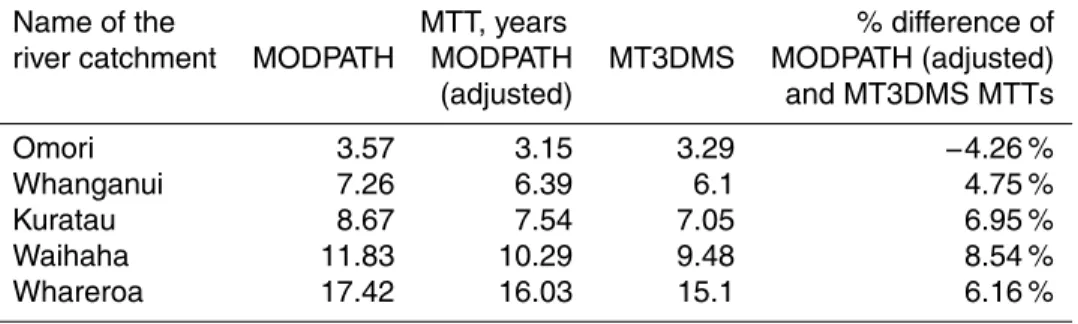
The original and adjusted (per Abrams, 2013) MTTs for the Waihaha, Whanganui, Whareroa, Kuratau and Omori catchments are presented in Table 1 along with the 5
MTTs obtained with MT3DMS by Gusyev et al. (2013). The adjusted MTT is closest to the MTT obtained with MT3DMS for four of the five river catchments. However, there are confounding factors (i.e. dispersion, dual porosity) that make it difficult to determine whether the adjustment applied to the purely advective MTTs from MODPATH truly bring the MT3DMS and MODPATH MTTs together.
10
3.2 MODPATH tritium concentrations in river waters
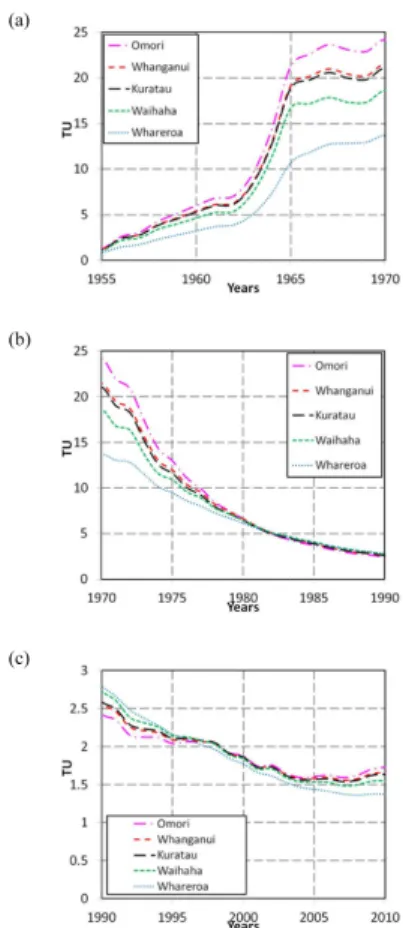
The MODPATH tritium concentrations in river waters of five WLTC catchment outflows are shown in Fig. 3 in tritium units (TU) and are obtained by convoluting PDFs derived from the numerical derivative of the MODPATH CFDs (Fig. 2a) with the tritium input time series (Fig. 4a). The simulated MODPATH tritium concentrations are demonstrated for 15
the sharp tritium rise from 1955 to 1970 due to the bomb-peak in Fig. 3a, for the sharp decline from 1970 to 1990 in Fig. 3b, and for the natural background tritium concentrations from 1990 to 2010 in Fig. 3c. Note that in Fig. 3, the watersheds in the legend are not only listed in order of increasing MTT but also in order of highest tritium peak; hence it appears that the smaller the MTT, the higher the tritium peak will be. 20
For example, the Omori has the smallest MTT (3 year), and as a result tritium will on average remain in the aquifer less time than in the other four watersheds. This reduced transit time of groundwater results in less decay of tritium in the subsurface, see Eq. (1). The resulting tritium maximum output is greater than at the other watersheds (compare the pink curve in Fig. 3a to the other curves).
25
HESSD
11, 3083–3109, 2014Tritium simulation by MODPATH particle
tracking
M. A. Gusyev et al.
Title Page
Abstract Introduction
Conclusions References
Tables Figures
◭ ◮
◭ ◮
Back Close
Full Screen / Esc
Printer-friendly Version Interactive Discussion
Discussion
P
a
per
|
D
iscussion
P
a
per
|
Discussion
P
a
per
|
Discuss
ion
P
a
per
|
the Whareroa, which has a MTT of 16.03 year, removes much more tritium in the sub-surface but concurrently is slower to flush out the high concentrations of tritium. As a result, in the early 1980s, the tritium response for the Omori actually dipped below that of the Whareroa during the model simulation (Fig. 3b). As the bomb tritium is de-cayed and flushed out of the aquifer in the Whareroa, the Omori again returns to the 5
highest tritium concentration due to the shortest transit time (Fig. 3c).
The significance of the above discussion is that sharp changes in an input, be it tritium, nitrate, or some other dissolved constituent in groundwater, can lead to some unexpected responses. In particular, the assumption that the relative magnitude of tritium between two watersheds is a function of the MTT and a constant tritium decay, 10
while true for the peak and present days (at least in this study), was not true in the 1980s. In addition, MTT was an important factor in determining the amplitude of the tritium response curves during the bomb peak in the five river catchments.
3.3 MODPATH and MT3DMS results comparison
MODPATH and MT3DMS simulated tritium concentrations in TU resulting from the tri-15
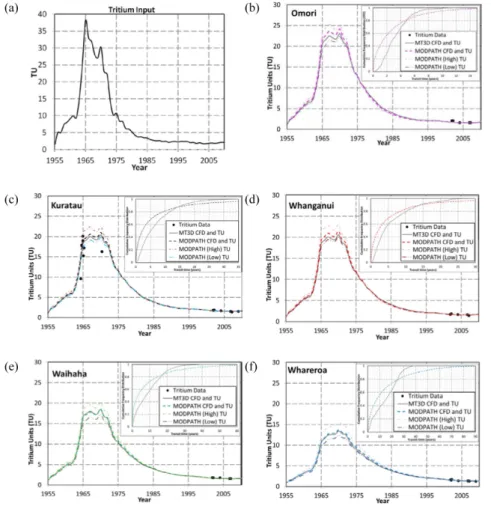
tium input time series (Fig. 4a) are compared in Fig. 4b–f and CFDs in Fig. 4b–f insets for each of the five catchments. The measured tritium concentrations in river waters of each catchment are shown by solid circles. For the tritium calibrated porosity values, the tritium concentrations and CFDs calculated with MT3DMS by Gusyev et al. (2013) are shown by solid lines and calculated with MODPATH are shown by dashed lines. In 20
addition, the MODPATH tritium concentrations were simulated with 25 % lower (MOD-PATH Low) and 25 % higher (MOD(MOD-PATH High) porosity values than the MT3DMS cal-ibrated porosity (Fig. 4b–f). In these two porosity cases, the MODPATH CFDs have the same shape but are scaled by percentage values and are not shown in the in-sets of Fig. 4b–f. It is noted that the MODPATH and MT3DMS models yield virtually 25
HESSD
11, 3083–3109, 2014Tritium simulation by MODPATH particle
tracking
M. A. Gusyev et al.
Title Page
Abstract Introduction
Conclusions References
Tables Figures
◭ ◮
◭ ◮
Back Close
Full Screen / Esc
Printer-friendly Version Interactive Discussion
Discussion
P
a
per
|
D
iscussion
P
a
per
|
Discussion
P
a
per
|
Discuss
ion
P
a
per
|
decay process (Gusyev et al., 2013), which reduce influence of the dual porosity mass transfer coefficient and dispersion-diffusion terms in the advection-dispersion equation solved by the MT3DMS (Zheng and Wang, 1999; Zheng, 2006).
While the MODPATH and MT3DMS CFDs are very similar in scale of MTTs, as indi-cated by Table 1, they are surprisingly different in shape (see Fig. 4b–f insets for a com-5
parison of MODPATH and MT3DMS CFDs). In all five cases, the MT3DMS CFDs have less short transit times compared to MODPATH CFDs. Using the MT3DMS PDFs with the convolution integral in Eq. (1) also produces much smaller tritium concentrations for each of the five river catchments, especially around the peak (these results are not shown). While dispersion could potentially result in similar discrepancies, the tritium 10
response curves were insensitive to dispersion values in the WLTC model. Note that MT3DMS CFDs are not required for generating tritium concentrations with MT3DMS. Gusyev et al. (2013) implemented a method to develop MT3DMS CFDs only after the tritium outputs were developed; hence a calibrated value for porosity could be utilized in developing the MT3DMS CFDs. They were developed to provide a very informative 15
step of how transit times help to shape the tritium output. The shape differences of MT3DMS and MODPATH CFDs are attributed to the limitation of the MT3DMS CFD generation methodology (Zheng, 2009).
3.4 MODPATH and MT3DMS methodology comparison
To generate CFDs for the river networks, uniformly spaced particles were tracked from 20
their release at the top of the aquifers until they reached discharge points such as constant head, river, drain and stream cells in the MODPATH methodology. All particles discharging to a river cell belonging to a particular watershed were sorted from smallest to largest transit time. Particles released directly on a river cell had a transit time of zero; hence never entered the aquifer and were removed before constructing the TTD. 25
HESSD
11, 3083–3109, 2014Tritium simulation by MODPATH particle
tracking
M. A. Gusyev et al.
Title Page
Abstract Introduction
Conclusions References
Tables Figures
◭ ◮
◭ ◮
Back Close
Full Screen / Esc
Printer-friendly Version Interactive Discussion
Discussion
P
a
per
|
D
iscussion
P
a
per
|
Discussion
P
a
per
|
Discuss
ion
P
a
per
|
assigned to its cell of origin to the total recharge that was assigned to the watershed. Note that recharge was constant for the entire simulation, so the weight assigned to each particle was constant with time. As a result of the above procedure, the transit time for every particle was accounted for, hence this is a TTD that can be applied in Eq. (1).
5
For the MT3DMS methodology, the CFD for the river network is generated by simulat-ing groundwater age concentrations. An initial concentration of zero age was assigned ubiquitously at the top of the aquifer and a zero-order decay rate of negative 1 was assigned to MT3DMS to represent ageing of one year per simulation step of one year. All dispersion, diffusion, and sorption parameters were left unchanged from the tritium 10
simulations. The model was then run for 200 year to reach steady-state concentrations in river cells. The simulated concentration found in each river cell is representative of the groundwater age of all particles mixed together in that cell. This methodology was defined by Cornaton (2004) to simulate a spatial map of groundwaterage, and indeed
yields informative cross-sectional images (as shown in Gusyev et al., 2013). The finer 15
the resolution of the model, the better represented is the distribution of groundwater ages throughout the aquifer. To develop the transit time distributions in Fig. 4 insets, the output concentration of each river cell was inferred to represent the mean ground-water transit time of all particles reaching that cell (a result of the assigned zero order degradation rate). The MTT (i.e. output concentration) for each cell was recorded, and 20
these mean transit times were sorted from smallest to largest. A weight was assigned to each time based on the ratio of the influx of groundwater to that cell over the total influx of groundwater to the groundwater watershed.
3.5 Hypothetical examples of MODPATH and MT3DMS CFD methodology
To further illustrate the difference between the two methodologies, we introduce 1-D, 25
HESSD
11, 3083–3109, 2014Tritium simulation by MODPATH particle
tracking
M. A. Gusyev et al.
Title Page
Abstract Introduction
Conclusions References
Tables Figures
◭ ◮
◭ ◮
Back Close
Full Screen / Esc
Printer-friendly Version Interactive Discussion
Discussion
P
a
per
|
D
iscussion
P
a
per
|
Discussion
P
a
per
|
Discuss
ion
P
a
per
|
generating CFDs can be replicated in MODPATH and that the MODPATH methodol-ogy of generating transit time CFDs can be replicated in MT3DMS. In all three cases, the MODFLOW model was created to have an MTT of 20.5 year by assigning a con-stant porosity of 0.3, recharge of 0.445 m year−1 implemented in layer 1, and
satu-rated thickness of 30.48 m. The model was assigned horizontal hydraulic conductivity 5
of 10 m day−1. For the 1-D model (Fig. 5a), a single layer was utilized, hence the model
was a Dupuit–Forchheimer flow model due to the absence of resistance to flow in the vertical direction. The model grid was 30 rows by 5 columns with 10 m cell size. The 1-D case conceptualizes a one dimensional flow aquifer bounded by a no-flow bound-ary on the left side (dark no-flow cells) representing groundwater divide, a constant 10
head boundary of 30.48 m representing the river network on the right side (blue cells). The MODPATH particles were assigned at each cell centre on the top of the aquifer, see plan view in Fig. 5a, and produced pathlines to the discharge cells, see the cross-sectional view in Fig. 5a. In the 2-D and 3-D models, the model grid had 1000 rows and 1000 columns with cell size of 10 m and five layers of equal thickness and a hypo-15
thetical river network implemented in layer 1 (Fig. 5b). As in the 1-D case, the model was surrounded by no-flow cells and the hypothetical river network was represented by the constant head cells of 30.48 m without river bed conductance. Both 2-D and 3-D cases are different in vertical hydraulic conductivity setting in the MODFLOW model. For the 2-D model, a vertical hydraulic conductivity of 1000 m/day was assigned to ap-20
proximate Dupuit–Forchheimer flow. The simulated groundwater contours range from 30.48 m at the head cells to 31.48 m with contour interval of 0.125 m. In the 3-D model, vertical hydraulic conductivity was set equal to the horizontal hydraulic conductivity and resulted in the same groundwater contour range.
The resulting CFDs of all three cases are demonstrated in Fig. 5c. For the 1-D case 25
HESSD
11, 3083–3109, 2014Tritium simulation by MODPATH particle
tracking
M. A. Gusyev et al.
Title Page
Abstract Introduction
Conclusions References
Tables Figures
◭ ◮
◭ ◮
Back Close
Full Screen / Esc
Printer-friendly Version Interactive Discussion
Discussion
P
a
per
|
D
iscussion
P
a
per
|
Discussion
P
a
per
|
Discuss
ion
P
a
per
|
a proxy for MTT of all particles reaching a discharge cell. As a result, the MT3DMS CFD has a pulse shape shown by the orange curve in Fig. 5c with the jump from 0 to 1 oc-curs at a transit time of 20.5 year, which is indeed the MTT for this aquifer setting. This is indeed significant as it indicates how the MODPATH and MT3DMS methodologies employed for the WLTC model could generate very similar MTTs but very differently 5
shaped CFDs.
In the 2-D case, the result yields exactly the same transit time CFD as the 1-D case, which is expected for this idealized (constant recharge, porosity, and saturated thick-ness) aquifer (Haitjema, 1995) and a very similar MT3DMS CFD (see Fig. 5c). The 2-D MT3DMS CFD is similar to the 1-D case, but it does not have a discrete jump. Rather, 10
there are a few river cells that have a slightly smaller and slightly larger mean transit time (Fig. 5c). This is likely a result of numerical dispersion; a more refined grid would have yielded an even smaller range of mean transit times in each cell. Interestingly, the 3-D case with the isotropic aquifer yields a much different MT3DMS CFD with MTT of 21.86 year than the 1-D and 2-D cases with MTT of 20.5 year (Fig. 5c). This result 15
is due to the resistance to vertical flow, which was absent in the 1-D and 2-D Dupuit– Forchheimer models. This apparent deviation from the other two MT3DMS CFDs does not manifest in the transit time CFD – it is identical on the scale of Fig. 5c.
To further stress aquifer complexities, we investigated two cases of aquifer hetero-geneity and sloping river network with the 3-D model. For the aquifer heterohetero-geneity 20
case, we randomly added zones of horizontal hydraulic conductivity with values of 5– 30 m day−1 throughout the model domain following analysis introduced by Haitjema
(1995). Though we repeated this with multiple random hydraulic conductivity zona-tions, all yielded a similar response in the transit time CFDs of the heterogeneous aquifer, which was consistent with findings by Haitjema (1995). However, the hetero-25
HESSD
11, 3083–3109, 2014Tritium simulation by MODPATH particle
tracking
M. A. Gusyev et al.
Title Page
Abstract Introduction
Conclusions References
Tables Figures
◭ ◮
◭ ◮
Back Close
Full Screen / Esc
Printer-friendly Version Interactive Discussion
Discussion
P
a
per
|
D
iscussion
P
a
per
|
Discussion
P
a
per
|
Discuss
ion
P
a
per
|
case there is still quite a difference between the transit time and MT3DMS CFDs). For the sloping river network case, some headwater stream cells will skim water from only the upper portion of the aquifer (physical weak sinks) and hence will have a concen-tration (i.e. MTT) in MT3DMS that is younger than the MTT for the entire aquifer (the results of 3-D simulation are not shown). Other stream cells will take up water that has 5
bypassed those headwater streams and hence will have a concentration (i.e. MTT) in MT3DMS that is older than the MTT for the entire aquifer (Abrams and Haitjema, 2013). To further introduce real world complexities of a 3-D aquifer system, such as the WLTC, saturated thickness, aquifer porosity and groundwater recharge values may have spatial variations resulting in different local groundwater age distributions that will 10
be represented in each of the individual sink cells. Hence, the MT3DMS CFD simulation can, in theory, approach the MODPATH CFD simulation, and this indeed has happened for each of the five WLTC watersheds (compare the CFDs shown in Fig. 4 insets) due to complex WLTC model setting of saturated thickness, recharge and porosity values.
4 Concluding remarks
15
In this work, we presented an approach to calibrate the steady-state MOD-FLOW/MODPATH model to measured tritium concentrations in river waters at base-flows of the five river catchments of the WLTC. In the previous study, Gusyev et al. (2013) developed the steady-state groundwater flow MODFLOW model for the WLTC and calibrated the transient MT3DMS model to tritium measurements in river 20
waters. The model had several important features: the uniform 80 m model grid to in-clude small surface water features, 10 zones of groundwater recharge and 5 zones of aquifer porosity. The results of the groundwater flow model indicated variable saturated thickness and groundwater elevations ranging from 357 m above mean sea level at the Lake Taupo lakeshore to over 1000 m in the northern part of the model domain. In 25
HESSD
11, 3083–3109, 2014Tritium simulation by MODPATH particle
tracking
M. A. Gusyev et al.
Title Page
Abstract Introduction
Conclusions References
Tables Figures
◭ ◮
◭ ◮
Back Close
Full Screen / Esc
Printer-friendly Version Interactive Discussion
Discussion
P
a
per
|
D
iscussion
P
a
per
|
Discussion
P
a
per
|
Discuss
ion
P
a
per
|
MODPATH TTDs were convoluted to obtain tritium concentration in river waters for the five river catchments of the WLTC. The tritium concentrations obtained with MODPATH show a good match to measured tritium time series despite accounting only for the advective transport.
When generating tritium concentrations with MODPATH TTDs, it is important to un-5
derstand many implicit assumptions of the convolution integral. First, there is no spatial component in the convolution integral, time is the only variable. As a result, input tritium concentrations at each timetare assumed to be spatially uniform over each individual watershed. This is a valid assumption for tritium in precipitation, but it may not be true for other chemicals such as nitrate. Second, λ is assumed to be constant over time 10
and the entire aquifer thickness. Again, this assumption is valid for non-reactive tritium tracer, but may not be for describing zonal reaction processes such as denitrification, which is dependent on organic matter concentrations in the aquifer. Third, the CFDs (and therefore PDFs) are based on steady state model runs with constant recharge and saturated thicknesses. The MODPATH model has the capability of taking into ac-15
count spatial variations in the vertical and horizontal directions, as well as conducting transient simulations, but the constructing CFDs for this case is non-trivial. Finally, any travel times and resulting reactions of tritium in the unsaturated zone and river beds are not considered. It should be noted that for this particular watershed, these as-sumptions are reasonable; this is especially true since the tracer is tritium. It is noted 20
that the assumptions underlying the convolution integral may lead to conceptual errors when studying other dissolved constituents in groundwater such as nitrates.
Consequently the MODPATH and MT3DMS CFDs were compared to understand better the model results and assumptions for generating CFDs in river networks. Even though the MT3DMS CFDs for the river network are only yielding approximations of the 25
HESSD
11, 3083–3109, 2014Tritium simulation by MODPATH particle
tracking
M. A. Gusyev et al.
Title Page
Abstract Introduction
Conclusions References
Tables Figures
◭ ◮
◭ ◮
Back Close
Full Screen / Esc
Printer-friendly Version Interactive Discussion
Discussion
P
a
per
|
D
iscussion
P
a
per
|
Discussion
P
a
per
|
Discuss
ion
P
a
per
|
in saturated thickness, variations in recharge, etc. It is important to note that the MOD-PATH and MT3DMS CFDs must be interpreted differently, and that only MODPATH is providing the true CFD that should be used in the convolution integral. This is evident by the match of MODPATH tritium responses using the CFD in conjunction with the convolution integral to the MT3DMS tritium outputs (Fig. 4). Using the MT3DMS CFDs 5
with the convolution integral yields a much different (and inaccurate) tritium response because, even though they have a similar mean transit time, the shape of the MT3DMS CFDs generally have both more short and long transit times than MODPATH. Hence, we promote both CFDs when using MODPATH and/or MT3DMS, as the transit time CFD generated by MODPATH is necessary to generate tritium and nitrate output func-10
tions with Eq. (1), but the MT3DMS CFD allows us to understand the variation from idealized conditions. This would be particularly useful in assessing when a lumped pa-rameter model could have been used in place of a distributed papa-rameter model, which would be valuable information for future studies.
References
15
Abrams, D.: Correcting transit time distributions in coarse MODFLOW-MODPATH models, Groundwater, 51, 474–478, doi:10.1111/j.1745-6584.2012.00985.x, 2013.
Abrams, D. B. and Haitjema, H. M.: A lumped parameter transit time model in watersheds with weak sinks, Groundwater, under review, 2014.
Abrams, D., Haitjema, H., and Kauffman, L.: On modeling weak sinks in MODPATH, Ground-20
water, 51, 597–602, doi:10.1111/j.1745-6584.2012.00995.x, 2013.
Boronina, A., Renard, P., Balderer, W., and Stichler, W.: Application of tritium in precipitation and in groundwater of the Kouris catchment (Cyprus) for description of the regional groundwater flow, Appl. Geochem., 20, 1292–1308, doi:10.1016/j.apgeochem.2005.03.007, 2005. Cornaton, M. F.: Deterministic Models of Groundwater Age, Life Expectancy and Transit Time 25
HESSD
11, 3083–3109, 2014Tritium simulation by MODPATH particle
tracking
M. A. Gusyev et al.
Title Page
Abstract Introduction
Conclusions References
Tables Figures
◭ ◮
◭ ◮
Back Close
Full Screen / Esc
Printer-friendly Version Interactive Discussion
Discussion
P
a
per
|
D
iscussion
P
a
per
|
Discussion
P
a
per
|
Discuss
ion
P
a
per
|
Eberts, S. M., Bohkle, J. K., Kauffman, L. J., and Jurgens, B. C.: Comparison of particle-tracking and lumped-parameter age-distribution models for evaluating vulnerability of production wells to contamination, Hydrogeol. J., 20, 263–282, doi:10.1007/s10040-011-0810-6, 2012. Fienen, M., Hunt, R. J., Krabbenhoft, D. P., and Clemo, T.: Obtaining parsimonious hydraulic
conductivity fields using head and transport observations: a Bayesian geostatistical param-5
eter estimation approach, Water Resour. Res., 45, W08405, doi:10.1029/2008WR007431, 2009.
Gusyev, M. A., Toews, M., Morgenstern, U., Stewart, M., White, P., Daughney, C., and Had-field, J.: Calibration of a transient transport model to tritium data in streams and simulation of groundwater ages in the western Lake Taupo catchment, New Zealand, Hydrol. Earth Syst. 10
Sci., 17, 1217–1227, doi:10.5194/hess-17-1217-2013, 2013.
Harbaugh, A. W., Banta, E. R., Hill, M. C., and McDonald, M. G.: MODFLOW-2000, the US Ge-ological Survey modular ground-water model – User guide to modularization concepts and the Ground-Water Flow Process, Open-File Report 00-92, US Geological Survey, Reston, Virginia, USA, 2000.
15
Hunt, R. J., Feinstein, D. T., Pint, C. D., and Anderson, M. P.: The importance of diverse data types to calibrate a watershed model of the Trout Lake Basin, northern Wisconsin, USA, J. Hydrol., 321, 286–296, doi:10.1016/j.jhydrol.2005.08.005, 2005.
Jurgens, B. C., Böhlke, J. K., and Eberts, S. M.: TracerLPM (Version 1): An Excel®workbook for interpreting groundwater age distributions from environmental tracer data, US Geological 20
Survey Techniques and Methods Report 4-F3, USGS, Reston, Virginia, USA, 60 pp., 2012. Kaufman, L. J., Baehr, A. L., Ayers, M. A., and Stackelberg, P. E.: Effects of Land Use and Travel
Time on the Distribution of Nitrate in the Kirkwood-Cohansey Aquifer System in Southern New Jersey, US Geological Survey Water-Resources Investigations Report 01-4117, USGS, West Trenton, New Jersey, USA, 49 pp., 2001.
25
Małoszewski, P. and Zuber, A.: Determining the turnover time of groundwater systems with the aid of environmental tracers, 1. Models and their applicability, J. Hydrol., 57, 207–231, doi:10.1016/0022-1694(82)90147-0, 1982.
McDonnell, J. J., McGuire, K., Aggarwal, P., Beven, K., Biondi, D., Destouni, G., Dunn, S., James, A., Kirchner, J., Kraft, P., Lyon, S., Małoszewski, P., Newman, B., Pfister, L., Ri-30
HESSD
11, 3083–3109, 2014Tritium simulation by MODPATH particle
tracking
M. A. Gusyev et al.
Title Page
Abstract Introduction
Conclusions References
Tables Figures
◭ ◮
◭ ◮
Back Close
Full Screen / Esc
Printer-friendly Version Interactive Discussion
Discussion
P
a
per
|
D
iscussion
P
a
per
|
Discussion
P
a
per
|
Discuss
ion
P
a
per
|
streamwater?, Open questions in catchment transit time conceptualization, modelling and analysis, Hydrol. Process., 24, 1745–1754, doi:10.1002/hyp.7796, 2010.
McGuire, K. J. and McDonnell, J. J.: A review and evaluation of catchment transit time mod-elling, J. Hydrol., 330, 543–563, doi:10.1016/j.jhydrol.2006.04.020, 2006.
McMahon, P. B., Carney, C. P., Poeter, E. P., Peterson, S. M.: Use of geochemical, iso-5
topic, and age tracer data to develop models of groundwater flow for the purpose of water management, northern High Plains aquifer, USA, Appl. Geochem., 25, 910–922, doi:10.1016/j.apgeochem.2010.04.001, 2010.
Morgenstern, U. and Taylor, C. B.: Ultra Low-level tritium measurement using electrolytic en-richment and LSC, Isot. Environ. Healt. S., 45, 96–117, doi:10.1080/10256010902931194, 10
2009.
Pint, C. D., Hunt, R. J., and Anderson, M. P.: Flowpath delineation and ground wa-ter age, Allequash Basin, Wisconsin, Groundwawa-ter, 41, 895–902, doi:10.1111/j.1745-6584.2003.tb02432.x, 2003.
Pollock, D. W.: User’s Guide for MODPATH/MODPATH-PLOT, Version 3: A Particle Track-15
ing Post-Processing Package for MODFLOW, the US Geological Survey Finite-Difference Ground-Water Flow Model, US Geological Survey Open-File Report 94-464, 249 pp., USGS, Reston, Virginia, USA, 1994.
Sanford, W.: Calibration of models using groundwater age, Hydrogeol. J., 19, 13–16, doi:10.1007/s10040-010-0637-6, 2010.
20
Schlumberger Water Services (SWS): Visual MODFLOW User’s Manual, Version 2010.1, SWS, Waterloo, Ontario, Canada, 676 pp., 2010.
Starn, J. J., Bagtzoglou, A. C., and Robbins, G. A.: Using atmospheric tracers to reduce un-certainty in groundwater recharge areas, Groundwater, 48, 858–868, doi:10.1111/j.1745-6584.2010.00674.x, 2010.
25
Stewart, M. K., Morgenstern, U., McDonnell, J. J., and Pfister, L.: The “hidden streamflow” challenge in catchment hydrology: a call to action for stream water transit time analysis, invited Commentary, Hydrol. Process., 26, 2061–2066, doi:10.1002/hyp.9262, 2012.
Stichler, W., Małoszewski, P., Bertleff, B., and Watzel, R.: Use of environmental isotopes to define the capture zone of a drinking water supply situated near a dredge lake, J. Hydrol., 30
362, 220–223, doi:10.1016/j.jhydrol.2008.08.024, 2008.
HESSD
11, 3083–3109, 2014Tritium simulation by MODPATH particle
tracking
M. A. Gusyev et al.
Title Page
Abstract Introduction
Conclusions References
Tables Figures
◭ ◮
◭ ◮
Back Close
Full Screen / Esc
Printer-friendly Version Interactive Discussion
Discussion
P
a
per
|
D
iscussion
P
a
per
|
Discussion
P
a
per
|
Discuss
ion
P
a
per
|
path analysis, southern New Jersey coastal plain, Water Resour. Res., 32, 1023–1038, doi:10.1029/96WR00068, 1996.
US EPA: Handbook of Ground Water and Wellhead Protection, US Environmental Protection Agency (US EPA), Report EPA/625/R-94001, US EPA, Washington DC, USA , 288 pp., 1994. Walker, J. F., Saad, D. A., and Hunt, R. J.: Dynamics of CFCs in northern temperate lakes 5
and adjacent groundwater, Water Resour. Res., 43, W04423, doi:10.1029/2005WR004647, 2007.
Weissman, G. S., Zhang, Y., LaBolle, E. M., and Fogg, G. E.: Dispersion of groundwater age in an alluvial aquifer system, Water Resour. Res., 38, 1098, doi:10.1029/2001WR000907, 2002.
10
Vant, B. and Smith, P.: Nutrient concentrations and groundwater ages in 11 streams flowing into Lake Taupo, Environment Waikato Technical Report 2002/18R, Doc. #767068, Environment Waikato, Hamilton East, New Zealand, 18 pp., 2002.
Zheng, C.: MT3DMS v. 5.2 Supplementary User’s Guide, Technical Report, University of Al-abama, 41 pp., 2006.
15
Zheng, C.: Recent developments and future directions for MT3DMS and related transport codes, Groundwater, 47, 620–625, doi:10.1111/j.1745-6584.2009.00602.x, 2009.
Zheng, C. and Wang, P. P.: MT3DMS: A Modular Three-Dimensional Multispecies Transport Model for Simulation of Advection, Dispersion, and Chemical Reactions of Contaminants in Groundwater Systems: Documentation and User’s Guide, Report SERDP-99-1, US Army 20
HESSD
11, 3083–3109, 2014Tritium simulation by MODPATH particle
tracking
M. A. Gusyev et al.
Title Page
Abstract Introduction
Conclusions References
Tables Figures
◭ ◮
◭ ◮
Back Close
Full Screen / Esc
Printer-friendly Version Interactive Discussion
Discussion
P
a
per
|
D
iscussion
P
a
per
|
Discussion
P
a
per
|
Discuss
ion
P
a
per
|
Table 1.MODPATH, adjusted MODPATH, and MT3DMS simulated MTT values, and the percent
difference of adjusted MODPATH and MT3DMS MTTs.
Name of the MTT, years % difference of
river catchment MODPATH MODPATH MT3DMS MODPATH (adjusted)
(adjusted) and MT3DMS MTTs
Omori 3.57 3.15 3.29 −4.26 %
Whanganui 7.26 6.39 6.1 4.75 %
Kuratau 8.67 7.54 7.05 6.95 %
Waihaha 11.83 10.29 9.48 8.54 %
HESSD
11, 3083–3109, 2014Tritium simulation by MODPATH particle
tracking
M. A. Gusyev et al.
Title Page
Abstract Introduction
Conclusions References
Tables Figures
◭ ◮
◭ ◮
Back Close
Full Screen / Esc
Printer-friendly Version Interactive Discussion
Discussion
P
a
per
|
D
iscussion
P
a
per
|
Discussion
P
a
per
|
Discuss
ion
P
a
per
|
(a) (b)
of
3.57 7.26 8.67 11.83
Fig. 1. (a)MODFLOW model setup of the WLTC from Gusyev et al. (2013), and(b)the ground-water transit time map for river ground-waters of the WLTC produced with MODPATH/MODFLOW model. The colour coding indicates groundwater age from 0 year (blue) up to 200 year old (red).
HESSD
11, 3083–3109, 2014Tritium simulation by MODPATH particle
tracking
M. A. Gusyev et al.
Title Page
Abstract Introduction
Conclusions References
Tables Figures
◭ ◮
◭ ◮
Back Close
Full Screen / Esc
Printer-friendly Version Interactive Discussion
Discussion
P
a
per
|
D
iscussion
P
a
per
|
Discussion
P
a
per
|
Discuss
ion
P
a
per
|
(a) (b)
HESSD
11, 3083–3109, 2014Tritium simulation by MODPATH particle
tracking
M. A. Gusyev et al.
Title Page
Abstract Introduction
Conclusions References
Tables Figures
◭ ◮
◭ ◮
Back Close
Full Screen / Esc
Printer-friendly Version Interactive Discussion
Discussion
P
a
per
|
D
iscussion
P
a
per
|
Discussion
P
a
per
|
Discuss
ion
P
a
per
|
HESSD
11, 3083–3109, 2014Tritium simulation by MODPATH particle
tracking
M. A. Gusyev et al.
Title Page
Abstract Introduction
Conclusions References
Tables Figures
◭ ◮
◭ ◮
Back Close
Full Screen / Esc
Printer-friendly Version Interactive Discussion
Discussion
P
a
per
|
D
iscussion
P
a
per
|
Discussion
P
a
per
|
Discuss
ion
P
a
per
|
HESSD
11, 3083–3109, 2014Tritium simulation by MODPATH particle
tracking
M. A. Gusyev et al.
Title Page
Abstract Introduction
Conclusions References
Tables Figures
◭ ◮
◭ ◮
Back Close
Full Screen / Esc
Printer-friendly Version Interactive Discussion
Discussion
P
a
per
|
D
iscussion
P
a
per
|
Discussion
P
a
per
|
Discuss
ion
P
a
per
|
(a)
(b)
(c)
Top view of 1D model
Side view of 1D model
Top view of 2D and 3D model