ISSN 1517-7076 artigo e-11942, 2017
Autor Responsável: Wilson Acchar Data de envio: 29/06/2017 Data de aceite: 02/08/2017
10.1590/S1517-707620170005.0278
Study of NiO-GDC material produced
by aqueous tape casting
Wilson Acchar1, Luana Barbosa Cruz1, Herval Ramos Paes Junior 2
1
Post-Graduation Program of Science and Materials Engineering, Federal University of Rio Grande do Norte (UFRN), Natal, Brazil
2
Universidade Estadual Norte-Fluminense-UENF, Rio de Janeiro,Brazil e-mail: [email protected], [email protected], [email protected]
____________________________________________________________________________________________________
ABSTRACT
Studies have been developed in last decades in order to produce NiO-based material to be used as anode in solid oxide fuel cell (SOFC). Aqueous-based tape casting was used to produce NiO-GDC substrates with smooth and homogeneous surfaces and good flexibility. Physical and mechanical properties were obtained in green tapes sintered at temperatures ranging from 1200 to 1400 ͦ C. The tapes sintered in 1400 ͦ C showed the best density and porosity values and mechanical strength between 7 and 25 MPa. SEM micrographs show a dense material with cracks and pores. The sintered material shows the presence of nickel oxide and gadolinium cerium oxide.
Keywords: NiO-GDC; sintering; tape casting
___________________________________________________________________________
1. INTRODUCTION
Solid oxide fuel cells (SOFC) are a green and clean energy and have been intensively studied in the last decades. Many studies are developed in order to reduction the operating temperature, fabrication costs and improve the energy efficiency [1-3]. Two basically points were investigated. The first point is to developed new electrolyte material with higher ionic conductivity and the second is to decrease the electrolyte thickness, developing the electrode-supported SOFC [4,5]. GDC electrolyte has an ionic conductivity higher than of yittria stabilized zirconia (YSZ) and a thermal expansion coefficient much closer to that of the Ni-cermet and commercial ferrite stainless interconnects compared to YSZ, making the GDC a very good candidate to electrolyte material [6]. Recently, some works about tape casting and solid-state reaction of NiO-GDC anode substrate have been reported in the literature [6-9]. The mainly result obtained in these studies indicated that is possible to produce a homogeneous anode substrate by tape casting process.
Tape casting has showed to be an excellent good method to obtain thin films and is particularly indicated to produce multilayer ceramic composite and nanostructured material [10-14]. The objective of this work was to obtain a Ni-GDC homogeneous sheet.
In this study, Ni-GDC sheet was produced by an aqueous-based tape casting process and sintered at different temperatures. The physical and mechanical values behavior of sintered material was evaluated.
2. MATERIALS AND METHODS
3. RESULTS AND DISCUSSION
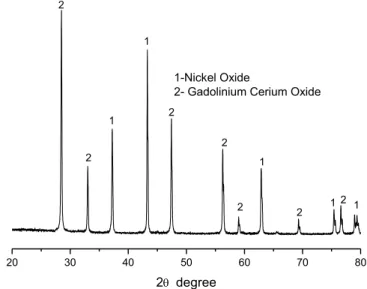
Figure 1 shows the X-ray diffraction pattern of the green tape sintered at 1400 ͦ C during 1 hour. The sintered material showed the presence of Nickel oxide and gadolinium cerium oxide, as expected. No others phases or new reaction products were identified. Similar crystalline phases were founded at 1200 ͦ C. The GDC phases founded in this work are totally in agreement with the reported in the literature [10].
20 30 40 50 60 70 80
1 2 1 2 1
2 2 2
1 1
2 2
1-Nickel Oxide
2- Gadolinium Cerium Oxide
2 degree
Figure 1: X-ray diffraction of green tape sintered at 1400C.
Figure 2 shows the NiO-GDC sheet obtained after the tape casting process. The tape shows a smooth and homogeneous surface, showing no visible superficial defects.
Figure 2: Green tapes.
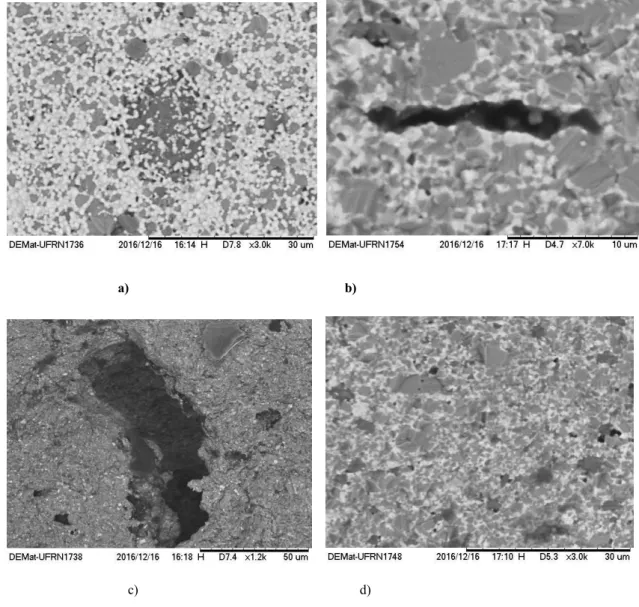
SEM micrographs of the green and sintered tapes. It is possible to see the presence of nickel oxide (gray area) and the gadolinium oxide (white regions), according to the x-ray diffraction (fig. 1).
The sintered material showed a dense structure, but the presence of cracks and pores, which can explain the low strength values of the sheets. Studies are under way in order to improve having a crack free sintered material with better mechanical properties.
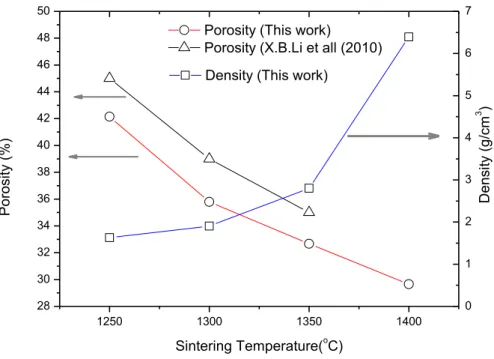
Figure 3: Porosity and density values of the sintered sheets.
1 2 3
0 5 10 15 20 25 30 35
S
tre
n
g
th
(
M
P
a)
Samples
Normal Tape
Laminates
Figure 4: Strength values of normal tapes and laminates.
1250 1300 1350 1400
28 30 32 34 36 38 40 42 44 46 48 50 D e n si ty (g /cm 3 ) Po ro si ty (% )
Sintering Temperature(oC)
Porosity (This work)
Porosity (X.B.Li et all (2010)
0 1 2 3 4 5 6 7
a) b)
c) d)
Figure 5: MEV of the sheets (a) green and (b,c,d) sintered.
4. CONCLUSIONS
NiO-GDC anode substrates were successfully obtained by aqueous-based tape casting process and sintering. X-ray diffraction at the sintered tape showed the presence of nickel oxide and gadolinium cerium oxide. No other crystalline phase was detected. The best sintering temperature was 1400 ͦ C for 1 h, in which sufficient open porosity of around 30 % was obtained. Mechanical bending strength between 7 (normal tape) and 25 MPa (laminates) were obtained, which can be associated to the presence of cracks and pores. The sintered material showed a dense structure, but the presence of cracks and pores.
5. ACKNOWLEDGMENTS
The authors gratefully acknowledge the financial support of CNPq and CAPES.
6. BIBLIOGRAPHY
[1] SHAO Z., ZHOU W., ZHU Z., ”Advanced synthesis of materials for intermediate temperature SOFC”, Progress in Materials Science, v.57, pp. 804-874, 2012.
[2] CHOUDHURY A., CHANDRAHA H., AROSA A., “Application of SOFC technology for power
generation-A review”, Renewable and Sustainable Energy reviews, v.20, pp. 430-442, 2013.
[3] COLOGNA M., SGLAVO V.M. “Sintering and deformation of solid oxide fuel cells produced by sequential
tape casting”, International Journal Applied Ceramic Technology, v.7, pp. 803-813,2010.
[5] SINGHAI S.C. “Advances in solid oxide fuel cell technology”, Solid State Ionics, v.135 pp. 305-313,2000. [6] FU C., CHAN S.H., LIU Q., et al., “Fabrication and evaluation of Ni-GDC composite anode prepared by aqueous-based tape casting method for low-temperature solid oxide fuel cell”, Int. J.Hydrogen Energy, v.35,pp. 301-307, 2010.
[7] LI X.B., WANG H.Y., GU H.X., et al., “Preparation of gradient Ni-SDC anode by tape casting and co-sintering”, Science of Sintering, v. 42, pp.153-159, 2010.
[8] LENG Y.J, CHAN S.H., JIANG S.P., et al.,” Low-temperature SOFC with thin film GDC electrolyte prepared in situ by solid-state reaction”, Solid State Ionics, v.170, pp. 9-15, 2004.
[9] ACCHAR W, SILVA A.C., CRUZ L.B., et al., “Ni-GDC nano-composite material prepared by aqueous based tape casting”, accepted to Materials Science Forum, 2017.
[10] MINATTO F.D., MILAK P., NONI A. Jr, et al., “Multilayered ceramic composites – a review”, Advances in Applied Ceramics, v.114, pp.127-138, 2015.
[11] GUGLIELMI, P.O., BLASÉ, D., HABLITZEL, M.P., et al.,“Microstructure and flexural properties of multilayered fiber-reinforced oxide composites fabricated by a novel lamination route”, Ceramics International, v.41, pp.7836-7846, 2015.
[12] THOMAS, M., JURGEN, H., GOMES, C.M., et al., “Slurry-based additive manufacturing of ceramics”, International Journal of Applied Ceramic Technology, v.12, pp.18-25, 2015.
[13] COLOGNA, M., SGLAVO, V.M., “Sintering and deformation of solid oxide fuel cells produced by sequencial tape casting”, International Journal Applied Ceramic Technology, v.7, pp.803-813, 2010.