Objective: To evaluate the prevalence of scoliosis and the risk factors in elementary school students.
Methods: A cross-sectional study was carried out in 954 students in 2015. The instrument involved was a questionnaire on postural habits, socioeconomic conditions, and demographic factors. The anthropometric measurements, including height and weight, a visual inspection of the deformity of the vertebral column, the leveling of shoulders, and the Adam’s test were obtained. The sample was calculated in the expected frequency of 12.3%, acceptable error rate of 2.0% and conidence level of 95.0%. To compare the proportions, the chi-square test or Fisher’s exact test was applied. The association between scoliosis and risk factors was evaluated by logistic regression, being signiicant p<0.05.
Results: The prevalence of scoliosis was 24.3%, higher in obese patients and students who adopted a sitting position for a long period of time. Obese students showed a 1.8 times higher chance of testing positive Adam’s Forward Bend Test when compared to normal-weight/lean and 2.1 times higher chance compared to overweight students. The sitting position for watching television increases the chance of testing positive Adam’s test in 38.0%, when compared to the lying position. Obesity increases the risk of testing positive Adam’s test in 74.0 and 98.0%, when compared, respectively, to the underweight/normal weight and overweight.
Conclusions: There was a high prevalence of scoliosis in students from public elementary schools in Santos. The most inluential factors for this deviation of the spine were obesity and the position adopted by students to watch television.
Keywords: scoliosis; epidemiology; prevalence; education; obesity.
Objetivo: Avaliar a prevalência de escoliose e os fatores de risco em alunos do ensino fundamental.
Métodos: Estudo transversal realizado em 954 alunos em 2015. O instrumento envolvido foi um questionário sobre hábitos posturais, condições socioeconômicas e fatores demográicos. As medidas antropométricas, incluindo altura e peso, a inspeção visual da deformidade da coluna vertebral, o nivelamento dos ombros e o Teste de Adams foram obtidos. A amostra foi calculada na frequência esperada de 12,3%, erro aceitável de 2,0% e nível de coniança de 95,0%. Para comparar as proporções, o teste do qui-quadrado ou o teste exato de Fisher foram aplicados. A associação entre escoliose e fatores de risco foi avaliada por regressão logística, sendo signiicante p<0,05.
Resultados: A prevalência de escoliose foi de 24,3%, superior em obesos e estudantes que adotavam posição sentada durante um longo período de tempo. Estudantes obesos mostraram risco 1,8 vez superior no Teste de Adams positivo quando comparados aos eutróicos/magros e risco 2,1 vezes superior comparados aos alunos com sobrepeso. A posição sentada para assistir à televisão aumenta a chance de Teste de Adams positivo em 38,0% quando comparada à posição deitada. A obesidade aumenta o risco de Teste de Adams positivo em 74,0 e 98,0% quando comparada, respectivamente, à magreza/eutroia e ao sobrepeso. Conclusões: Houve elevada prevalência de escoliose em estudantes de escolas públicas do ensino fundamental em Santos. Os fatores que mais inluenciaram esse desvio de coluna foram a obesidade e a posição adotada pelos alunos para assistir à televisão. Palavras-chave: escoliose; epidemiologia; prevalência; escolar; obesidade.
ABSTRACT
RESUMO
*Corresponding author. E-mail: [email protected] (M.C. Ciaccia). aCentro Universitário Lusíada de Santos, São Paulo, SP, Brazil.
Received on 31 May 2016; approved on 28 October 2016; available online on June 08, 2017.
PREVALENCE OF SCOLIOSIS IN
PUBLIC ELEMENTARY SCHOOL STUDENTS
Prevalência de escoliose em escolares do ensino fundamental público
Maria Célia Cunha Ciaccia
a,*, Julia Silvestre de Castro
a, Mariana Abduch Rahal
a,
Barbarah Silveira Penatti
a, Iara Borin Selegatto
a, João Lucas Morette Giampietro
a,
INTRODUCTION
he postural problems of the spinal column, mainly scoliosis, have been considered a serious issue of public health, because they have a high incidence in the workforce, disabling it tem-porarily or permanently for professional activities.1
Scoliosis is a severe postural alteration, characterized as a lateral deviation accompanied by the distortion of individual parts of the spinal column, which makes it a morphological deformation,2 thus causing emotional problems related to
visu-ally impaired esthetics, pain, as well as pulmonary mechan-ic-related problems.3
hese changes, in general, are developed in childhood and adolescence and, when ignored, may progress and become irreversible. Knoplich,4 in 1985, observed that incorrect
pos-tural habits adopted since elementary education are alarm-ing, as skeletons of children are in growth phase and muscle and skeletal structures present greater tolerability to loads and are more susceptible to deformations. he prevalence of scoliosis varies in diferent regions of Brazil and throughout the world, oscillating between 1.0 and 15.8% in children and adolescents.5-10
According to Stokes and Moreland,11 in 1987, Adam’s
Forward Bend Test was recommended for detection of scolio-sis as it accentuates the deformity on the surface of the torso, being widely used throughout the world as the basis for this problem’s evaluation in schools.7,8,10,11 According to Santos
et al.,12 students have minimal knowledge about the
conse-quences of spinal deviations and about the possible causes that generate them, because they do not receive information or guidance about postural habits and disorders related to pos-ture. A large part of school-age children remain seated for hours in an improper manner and make use of improper securities, both in schools and at home.
In this context, the objective of this study was to estimate the prevalence of scoliosis in children from 1st to 4th grades of elementary school, enrolled in the municipal schools of the city of Santos, and verify its association with postural habits adopted in their daily activities and with demographic, socio-economic, and anthropometric variables.
METHOD
A cross-sectional study was carried out in the year 2015, when 954 questionnaires were applied to families and chil-dren. Simultaneously, Adam’s test was applied to detect the presence of scoliosis, and the height and weight of the stu-dents were also measured to calculate the body mass index (BMI), in addition to the inspection of spinal deviations and
the leveling of shoulders in children from 1st to 4th grades of elementary school, who were enrolled in municipal schools of Santos.
We used the Epi Info program version 6 (November 1996). he sample was calculated with an expected frequency of 12.3% (based on the study of Saints et al.,12 in Cuiabá,
Mato Grosso, because it is a representative sample and it uses the Adam’s Test), an acceptable error of 2.0% and coni-dence level of 95.0%. he calculation was made, taking into account 12,129 students enrolled in the municipal schools of Santos. he total sample was composed of 954 students, or 10 students from each of the 7 grades of 15 randomly selected schools. he randomly selected students were invited to join the study, and the presence of their caregivers was required. After the approval by the Committee for Ethics in Research on Human Beings of the University Center Lusíada de Santos, with the authorization of the Municipal Secretariat of Health and Education of Santos, the project was presented to the directors, coordinators, and teachers of the randomly selected schools. he informed consent form about the research, was presented to the caregivers, and, after approval, the questionnaire administration and the physical examination were started.
In the irst stage, we administrated the questionnaire with demographic and socioeconomic data and postural habits. In the second stage, the physical examination was done in a closed room on each student (accompanied by the caregivers) by two observers and, in case of doubt, by a third observer. he students were asked to remain without shirts and bare-foot. he physical examination consisted in: measurement of height and weight in order to calculate the BMI; inspection of visible spine deviations; leveling of the shoulders, putting the student against the wall (with a line), front and back; and application of the Adam’s test. For its implementation, the students were requested to remain in orthostatic position, barefoot, with feet together, knees straight, and bent forward until their backs were in a horizontal position, keeping the arms hanging, the palms of the hands together, with ingers in opposition. he test was considered positive if there was a vertebral rotation.
193
RESULTS
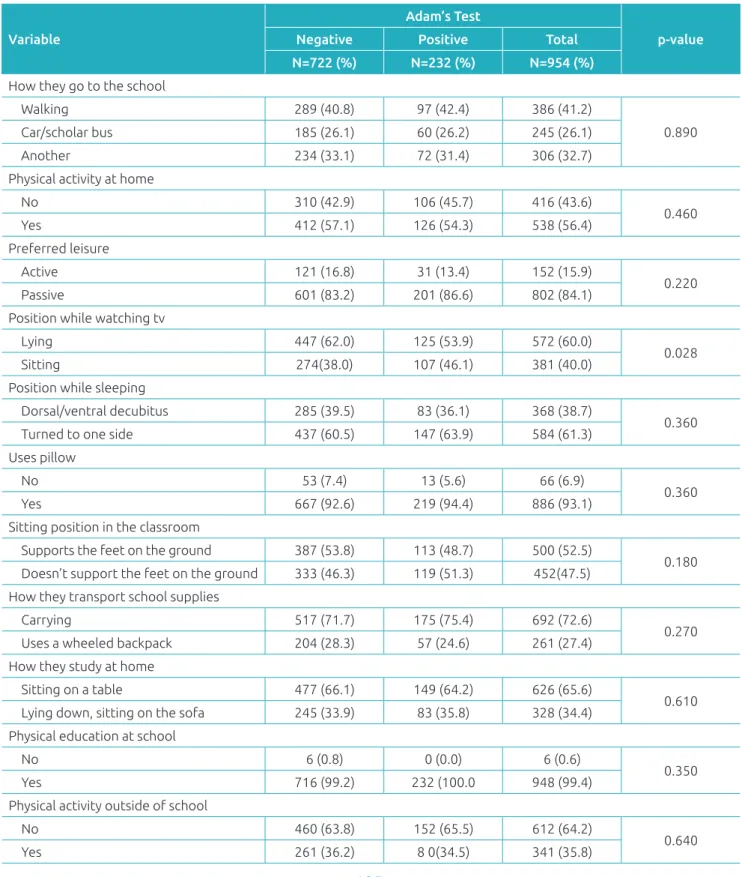
he overall prevalence of scoliosis was 24.3%. In the analyses performed, signiicant associations were found between posture while watching TV, nutritional evaluation, and inspection of the vertebral column. Students who have the habit of watch-ing television in the sittwatch-ing position had higher percentages of positive Adam’s test, compared to those who watch TV in the lying position. Students who had their spines inspected and were found without deviations, had higher percentages of neg-ative Adam’s test, as shown in Tables 1 and 2.
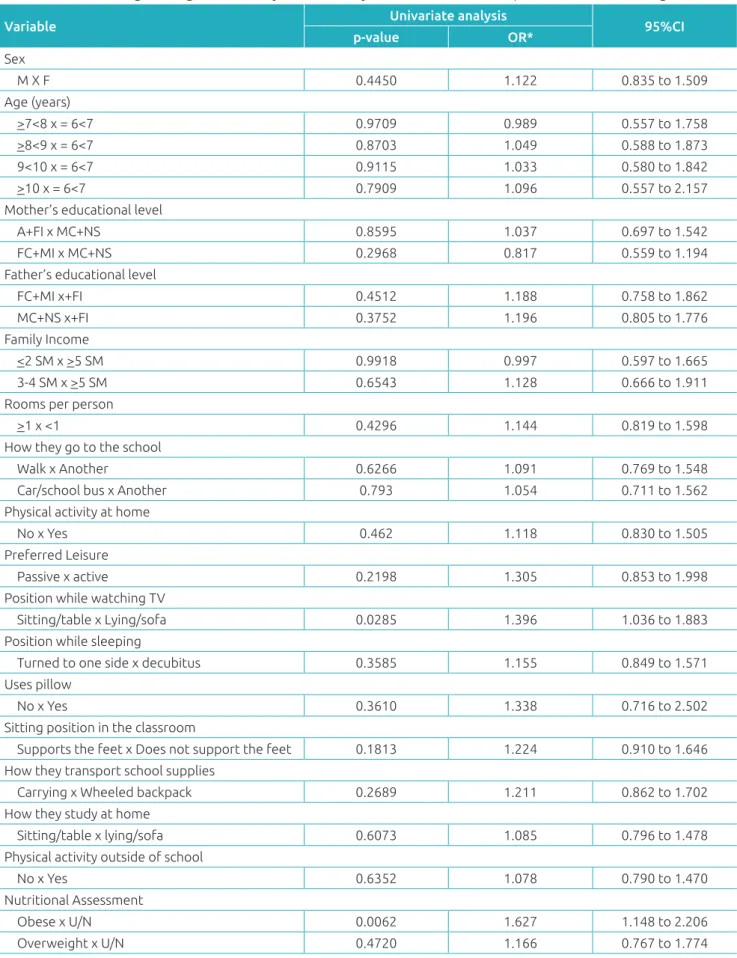
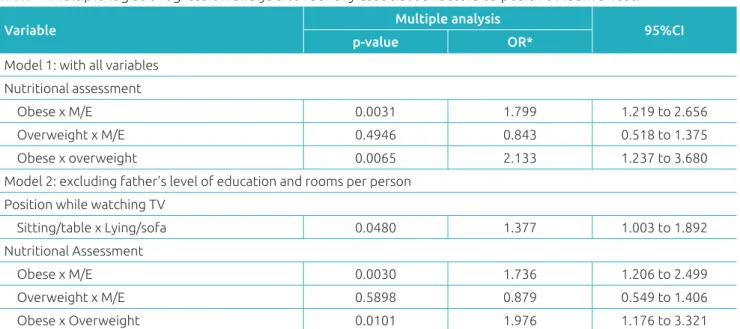
he results of the analysis of univariate and multiple logistic regressions to identify associated factors to positive Adam’s test, in the model with a small number of observations due to miss-ing data on some variables, obese patients presented 1.8 times higher chances of having a positive Adam’s test, when compared to normal-weight or underweight, and 2.1 times higher chances when compared to overweight patients. Excluding the variables with greater frequency of missing data, the sitting position while watching TV increased the chance of positive Adam’s test in 38.0% when compared to the lying position, while obesity increased the risk of positive Adam’s Test in 74.0%, compared to underweight/normal weight, and in 98.0%, when compared to overweight, as shown in Tables 3 and 4.
DISCUSSION
he prevalence of scoliosis in 24.3% of the sample was supe-rior to the results found in most of the literature. It was far superior to that found by Nery et al.,8 in 2010, of 1.4% in
adolescent students between 10 and 14 years in the munic-ipality of Carlos Barbosa, Rio Grande do Sul; and also to the study of Holy et al.7, in 2002, of 12.3% in municipal
schools of Cuiabá, Mato Grosso, and the observations made by Souza et al.,13 in 2013, of 4.3% in adolescent students
from public schools in Goiânia, Goiás. However, the preva-lence of scoliosis was lower than the one reported by Vieira et al.,14 in 2011, of 26.3% in the age group of
preschool-ers in Londrina, Paraná, thereby stressing the importance of an early diagnosis for the implementation of preventive measures. here is also a variation of the prevalence in other countries. In 2014, Ortega et al.15,16 found a prevalence
of 14.2% of scoliosis in Mexican school children with an average age of 10 years, and of 36.3% in Spanish students with an average age of 8.5 years, while Minghelli et al.,17
also in 2014, found 4.2% of adolescents between 10 and 16 years with scoliosis in southern Portugal. he variation found in the prevalence of the various studies may be due to the diferent methods employed to detect scoliosis, i.e., it is more diicult to compare results because there is no
standardization in the methodology of the surveys. Another possible explanation to be given to this variation is the num-ber of diferences found in the age groups studied. Second Braccialli and Vilarta,1 the period of pubertal growth spurt
is associated with the development and acceleration of pos-tural deviations. However, what has occurred in the present study was a higher prevalence in the age groups from 6 to 10 years, than in assessments of adolescents,8,13,17
suggest-ing that other factors may be involved. In this context, this study has limitations because it does not include several fac-tors that may be associated with postural deviations, such as the adequacy of the sofa or chair used for study or for lei-sure, the weight of the backpack with school supplies, and the period in which it is charged.8
here was no statistical diference in the prevalence of scoliosis between genders. However, a variation in the results is found in literature. Tavares et al.18 did not ind also such
association; however, in the study of Fields et al.,19 there was
a predominance of scoliosis in females, while Ferriani et al.20
showed a higher frequency in males. It is possible that the explanation for this variation is that, in the age groups studied, the majority of girls has not yet reached the peak of growth rate, which occurs in a period prior to the boys, and higher prevalence of postural deviations in the periods of growth spurts is expected.1
No association was found between the scoliosis and the majority of demographic and socioeconomic variables stud-ied, as there was also none between the posture adopted in daily activities, with the exception of the sitting position while watching TV. here is a large variation of these variables in the analyses found in literature, and the importance of posture in its execution is mentioned by the majority of studies.8,15,21
he students in growth phase and with sitting postures unsuit-able for the performance of their tasks in the classroom or at home can acquire postural deviations. Ortega et al.16 report
that adopting an improper sitting posture increases the like-lihood of spinal deviation. Braccialli and Vilarta1 reported
that staying in the sitting position for long periods of time, maintaining a static posture, without movement and, some-times inadequate movement, results in overload of the verte-bral column, which supports the body. he dorsal decubitus position would reduce the load over lumbar region compared to sitting. he habit of watching television, which is a part of everyday life of children is added to the likelihood of postural deviations. Penha et al.6 mention that adopting a improper
Adam’s Test
p-value
Negative Positive Total
N=722 (%) N=232 (%) N=954 (%)
Sex
Female 388 (53.7) 118 (50.9) 506 (53.0)
0.440
Male 334 (46.3) 114 (49.1) 448 (47.0)
Age (years)
>6<7 64 (8.8) 20 (8.6) 84 (8.8)
1.000
>7<8 207 (28.7) 64 (27.6) 271 (28.4)
>8<9 186 (25.8) 61 (26.3) 247 (25.9)
>9<10 192 (26.6) 62 (26.7) 254 (26.6)
>10 73 (10.1) 25 (10.8) 98 (10.3)
Mother’s educational level
Illiterate 6 (0.9) 2 (0.9) 8 (0.8)
0.910
Incomplete elementary school 120 (17.0) 41 (18.4) 161 (17.4)
Completed elementary school 75 (10.7) 22 (9.9) 97 (10.5)
Incomplete middle school 96 (13.6) 24 (10.8) 120 (12.9)
Complete middle school 314 (44.6) 104 (46.6) 418 (45.1)
College education 93 (13.2) 30 (13.4) 123 (13.3)
Father’s educational level
Illiterate 11 (1.7) 4 (1.8) 15 (1.7)
0.950
Incomplete elementary school 141 (22.1) 41 (19.0) 182 (21.4)
Completed elementary school 76 (11.9) 28 (13.0) 104 (12.2)
Incomplete middle school 86 (13.5) 29 (13.4) 115 (13.5)
Complete middle school 254 (39.9) 89 (41.2) 343 (40.3)
College education 68 (10.7) 25 (11.6) 93 (10.9)
Family Income (minimum wages)
<2 371 (53.3) 111 (50.0) 486 (52.7)
0.690
3-4 251 (36.1) 88 (39.6) 339 (36.8)
5-10 66 (9.5) 22 (9.9) 88 (9.5)
>10 8 (1.1) 1 (0.5) 9 (1.0)
Number of rooms per person
<1 215 (30.6) 62 (27.8) 277 (29.9)
0.430
>1 488 (69.4) 161 (72.2) 649 (70.1)
Nutritional Assessment
Underweight/normal weight 460 (63.7) 128 (55.2) 588 (61.7)
0.023
Obesity 148 (20.5) 67 (28.9) 215 (22.5)
Overweight 114 (15.8) 37 (15.9) 151 (15.8)
Leveling of shoulders
R highest 95 (25.4) 35 (22.0) 130 (24.4)
0.250
R highest and L lowest 1 (0.3) 3 (1.9) 4 (0.7)
R lower 72 (19.2) 32 (20.1) 104 (19.5)
R lower and and L higher 1 (0.3) 2 (1.3) 3 (0.6)
L higher 95 (25.4) 43 (27.0) 138 (25.9)
L lower 110 (29.4) 44 (27.7) 154 (28.9)
Inspection of the vertebral column
Deviation from R 64 (8.9) 53 (22.9) 117 (12.3)
<0.001
Deviation from L 44 (6.1) 52 (22.4) 96 (10.1)
Regular 610 (85.0) 127 (54.7) 737 (77.6)
R: right; L: left.
195
the appropriateness of the chair or sofa to the height of the child who is sitting watching television, the slope of the chair and, also, the wrong postures of sitting by tilting the shoulders forward. he adoption of a improper sitting posture during
the growth phase due to the use of a inadequate piece of fur-niture can facilitate spinal deviations.1,6
he association between positive Adam’s test and the obesity as found in this study, is not observed in several
Variable
Adam’s Test
p-value
Negative Positive Total
N=722 (%) N=232 (%) N=954 (%)
How they go to the school
Walking 289 (40.8) 97 (42.4) 386 (41.2)
0.890
Car/scholar bus 185 (26.1) 60 (26.2) 245 (26.1)
Another 234 (33.1) 72 (31.4) 306 (32.7)
Physical activity at home
No 310 (42.9) 106 (45.7) 416 (43.6)
0.460
Yes 412 (57.1) 126 (54.3) 538 (56.4)
Preferred leisure
Active 121 (16.8) 31 (13.4) 152 (15.9)
0.220
Passive 601 (83.2) 201 (86.6) 802 (84.1)
Position while watching tv
Lying 447 (62.0) 125 (53.9) 572 (60.0)
0.028
Sitting 274(38.0) 107 (46.1) 381 (40.0)
Position while sleeping
Dorsal/ventral decubitus 285 (39.5) 83 (36.1) 368 (38.7)
0.360
Turned to one side 437 (60.5) 147 (63.9) 584 (61.3)
Uses pillow
No 53 (7.4) 13 (5.6) 66 (6.9)
0.360
Yes 667 (92.6) 219 (94.4) 886 (93.1)
Sitting position in the classroom
Supports the feet on the ground 387 (53.8) 113 (48.7) 500 (52.5)
0.180 Doesn’t support the feet on the ground 333 (46.3) 119 (51.3) 452(47.5)
How they transport school supplies
Carrying 517 (71.7) 175 (75.4) 692 (72.6)
0.270
Uses a wheeled backpack 204 (28.3) 57 (24.6) 261 (27.4)
How they study at home
Sitting on a table 477 (66.1) 149 (64.2) 626 (65.6)
0.610
Lying down, sitting on the sofa 245 (33.9) 83 (35.8) 328 (34.4)
Physical education at school
No 6 (0.8) 0 (0.0) 6 (0.6)
0.350
Yes 716 (99.2) 232 (100.0 948 (99.4)
Physical activity outside of school
No 460 (63.8) 152 (65.5) 612 (64.2)
0.640
Yes 261 (36.2) 8 0(34.5) 341 (35.8)
Variable Univariate analysis 95%CI
p-value OR*
Sex
M X F 0.4450 1.122 0.835 to 1.509
Age (years)
>7<8 x = 6<7 0.9709 0.989 0.557 to 1.758
>8<9 x = 6<7 0.8703 1.049 0.588 to 1.873
9<10 x = 6<7 0.9115 1.033 0.580 to 1.842
>10 x = 6<7 0.7909 1.096 0.557 to 2.157
Mother’s educational level
A+FI x MC+NS 0.8595 1.037 0.697 to 1.542
FC+MI x MC+NS 0.2968 0.817 0.559 to 1.194
Father’s educational level
FC+MI x+FI 0.4512 1.188 0.758 to 1.862
MC+NS x+FI 0.3752 1.196 0.805 to 1.776
Family Income
<2 SM x >5 SM 0.9918 0.997 0.597 to 1.665
3-4 SM x >5 SM 0.6543 1.128 0.666 to 1.911
Rooms per person
>1 x <1 0.4296 1.144 0.819 to 1.598
How they go to the school
Walk x Another 0.6266 1.091 0.769 to 1.548
Car/school bus x Another 0.793 1.054 0.711 to 1.562
Physical activity at home
No x Yes 0.462 1.118 0.830 to 1.505
Preferred Leisure
Passive x active 0.2198 1.305 0.853 to 1.998
Position while watching TV
Sitting/table x Lying/sofa 0.0285 1.396 1.036 to 1.883
Position while sleeping
Turned to one side x decubitus 0.3585 1.155 0.849 to 1.571
Uses pillow
No x Yes 0.3610 1.338 0.716 to 2.502
Sitting position in the classroom
Supports the feet x Does not support the feet 0.1813 1.224 0.910 to 1.646
How they transport school supplies
Carrying x Wheeled backpack 0.2689 1.211 0.862 to 1.702
How they study at home
Sitting/table x lying/sofa 0.6073 1.085 0.796 to 1.478
Physical activity outside of school
No x Yes 0.6352 1.078 0.790 to 1.470
Nutritional Assessment
Obese x U/N 0.0062 1.627 1.148 to 2.206
Overweight x U/N 0.4720 1.166 0.767 to 1.774
Table 3 Univariate logistic regression analysis to identify associated factors to positive Adam’s testing.
197
studies in the literature, such as Nery et al.,8 Jannini et al.,22
Pinto et al.,23 and Souza Junior et al.24 However, in 2011
Silva et al.25 found a higher prevalence of postural
devia-tions in obese children and adolescents. Postural deviadevia-tions, in an attempt to adjust the posture, occur in overweight children, in order to avoid localized muscular fatigue.23,25
hese diverging data continue to suggest that other factors not addressed in this study may also inluence the presence of scoliosis, as the excess weight of school supplies8 and the
ergonomics in school and at home.1,6
Several studies show that the increase of knowledge and learning of healthy postural habits has a positive efect.26-29
In this study, however, the knowledge of teachers, par-ents, and students about postural habits was not discussed. Even in pediatric consultations it is known that it is unusual to evaluate the posture of the child or adolescent, making it
diicult to ascertain the efect of knowledge of postural hab-its of the patient. With this, the importance of the school in a preventive proposal toward the orientation of proper postural habits, especially in this growth phase, is consid-ered critical for the acquisition of postural deviations, and is emphasized on.
here was a high prevalence of scoliosis in students from elementary public schools in Santos. he factors that most inluenced this spinal deviation were obesity, and the position adopted by the students to watch television.
Funding
he study did not receive funding.
Conflict of interests
he authors declare no conlict of interests.
REFERENCES
1. Braccialli LM, Vilarta R. Aspectos a serem considerados na elaboração de programas de prevenção e orientação de problemas posturais. Rev Paul Educ Fis. 2000;14:159-71. 2. Souchard PE, Ollier M. As escolioses:seu tratamento
isioterapêutico e ortopédico. São Paulo: É realizações; 2001. 3. Weinstein SL, Dolan LA, Cheng JC, Danielsson A, Morcuende
JA. Adolescent idiopathic scoliosis. Lancet. 2008;371:1527-37.
4. Knoplich J. Enfermidades da coluna vertebral. São Paulo: Panamed; 1986.
5. Figueiredo JD, Figueiredo UM. Incidência de escoliose no Maranhão. Rev Bras Ortop. 1981;16:121-7.
6. Penha PJ, João SM, Casarotto RA, Amino CJ, Penteado DC. Postural assessment of girls between 7 and 10 years of age. Clinics (São Paulo). 2005;60:9-16.
Variable Multiple analysis 95%CI
p-value OR*
Model 1: with all variables
Nutritional assessment
Obese x M/E 0.0031 1.799 1.219 to 2.656
Overweight x M/E 0.4946 0.843 0.518 to 1.375
Obese x overweight 0.0065 2.133 1.237 to 3.680
Model 2: excluding father’s level of education and rooms per person
Position while watching TV
Sitting/table x Lying/sofa 0.0480 1.377 1.003 to 1.892 Nutritional Assessment
Obese x M/E 0.0030 1.736 1.206 to 2.499
Overweight x M/E 0.5898 0.879 0.549 to 1.406
Obese x Overweight 0.0101 1.976 1.176 to 3.321
Table 4 Multiple logistic regression analysis to identify associated factors to positive Adam’s Test.
7. Santo AE, Guimarães LV, Galera MF. Prevalência de escoliose idiopática e variáveis associadas em escolares do ensino fundamental de escolas municipais de Cuiabá, MT, 2002. Rev Bras Epidemiol. 2011;14:347-56.
8. Nery LS, Halpern R, Nery PC, Nehme KP, Stein AT. Prevalence of scoliosis among school students in a town in southern Brazil. São Paulo Med J. 2010;128:69-73.
9. Nuñez AR, Vásquez OP. Factores escolares predisponentes en la escoliosis idiopática. Rev Cuba Pediatr. 1988;60:708-19. 10. Lezica AV. Detección precoz de deformidades de columna en
escolares de 10 a 15 años. Rev Asoc Arg Ortop y Traumatol. 1994;59:386-91.
11. Stokes IA, Moreland MS. Measurement of the shape of the surface of the back in patients with scoliosis. The standing and forward-bending positions. J Bone Joint Surg Am. 1987;69:203-11.
12. Santos SG. Educação postural mediante um trabalho teórico. RBAFS. 1998;3:32-42.
13. Souza FI, Ferreira RB, Labres D, Elias R, Sousa AP, Pereira RE. Epidemiology of adolescent idiopathic scoliosis in students of the public schools in Goiânia- GO. Acta Ortop Bras. 2013;21:223-5.
14. Vieira DB, Beresoski CM, Camargo MZ, Fernandes KB, Siqueira CP, Fujisawa DS. Sinais precoces de escoliose em crianças pré-escolares. Fisioter Pesq. 2015;22:69-75. 15. Ortega FZ, Rodrigues LR, Morales LZ, Sánchez MF, Garcia
RF, Manrique ML. Análisis de la prevalencia de escoliosis y factores asociados en una población escolar mexicana mediante técnicas de cribado. GacMed Mex. 2014;150:432-9. 16. Ortega FZ, Sánchez MF, García RF, Schyke CE, Morales LZ. Predictors of scoliosis in school-aged children. Gac Med Mex. 2014;150:533-9.
17. Minghelli B, Nunes C, Oliveira R. Prevalence of scoliosis in southern Portugal adolescents. Pediatr Endocrinol Rev. 2014;11:374-82.
18. Tavares AR, Feitosa EL, Bezerra LM. Proposta de implantação do isioterapeuta na escola face a alterações posturais. Rev Coluna Fisioterápica. 2001;1:18-21.
19. Campos FS, Silva AS, Fisberg M. Descrição Fisioterapêutica das alterações posturais de adolescentes obesos. [homepage on the Internet]. [cited 2010 Sep 14]. Available from: https:// www.researchgate.net/publication/237666219_
20. Ferriani MG, Cano AA, Candido GT, Kanchina AS. Levantamento epidemiológico dos escolares portadores de escoliose da rede pública de ensino de 1º grau no município de Ribeirão Preto. Revista Eletrônica de Enfermagem [serial on the Internet]. 2000;2 [cited 2016 Feb 04 ]. Available from: https://www.fen.ufg.br/fen_revista/revista2_1/ Levanta.html
21. Sedrez JA, Rosa MI, Noll M, Medeiros FS, Candotti CT. Fatores de risco associados a alterações posturais estruturais da coluna vertebral em crianças e adolescentes. Rev Paul Pediatr. 2015;33:72-81.
22. Jannini SN, Dória-Filho U, Damiani D, Silva CA. Dor músculo-esquelética em adolescentes obesos. J Pediatr (Rio J). 2011;87:329-35.
23. Pinto AL, Holanda PM, Radu AS, Villares SM, Lima FR. Musculoskeletal indings in obese children. J Paediatr Child Health. 2006;42:341-4.
24. Souza Junior JV, Sampaio RM, Aguiar JB, Pinto FJ. Peril dos desvios posturais da coluna vertebral em adolescentes de escolas públicas do município de Juazeiro do Norte – CE. Fisioter Pesqui. 2011;18:311-6.
25. Silva LR, Rodacki AL, Brandalize M, Lopes MF, Bento PC, Leite N. Alterações posturais em crianças e adolescentes obesos e não-obesos. Rev Bras Cineantropom Desempenho Hum. 2011,13:448-54.
26. Kisner C, Colby LA. Exercícios terapêuticos: fundamentos e técnicas. 3rd ed. São Paulo: Manole; 1998.
27. Knoplich J. Endireite as costas. Desvios da coluna, exercícios e prevenção. 5th ed. São Paulo: Ibrasa, 1998.
28. Hungria Filho JS. Postura: a primazia da pélvis no seu condicionamento e na correção de seus desvios. Rev Bras Ortop. 1986;21:144-8.
29. Camargo OP, Molina AI. O tratamento da criança com escoliose por alongamento muscular. Rev Fisioter Brasil. 2003;4:369-72.